Unless, Provided That, As Long As: Conditional Alternatives

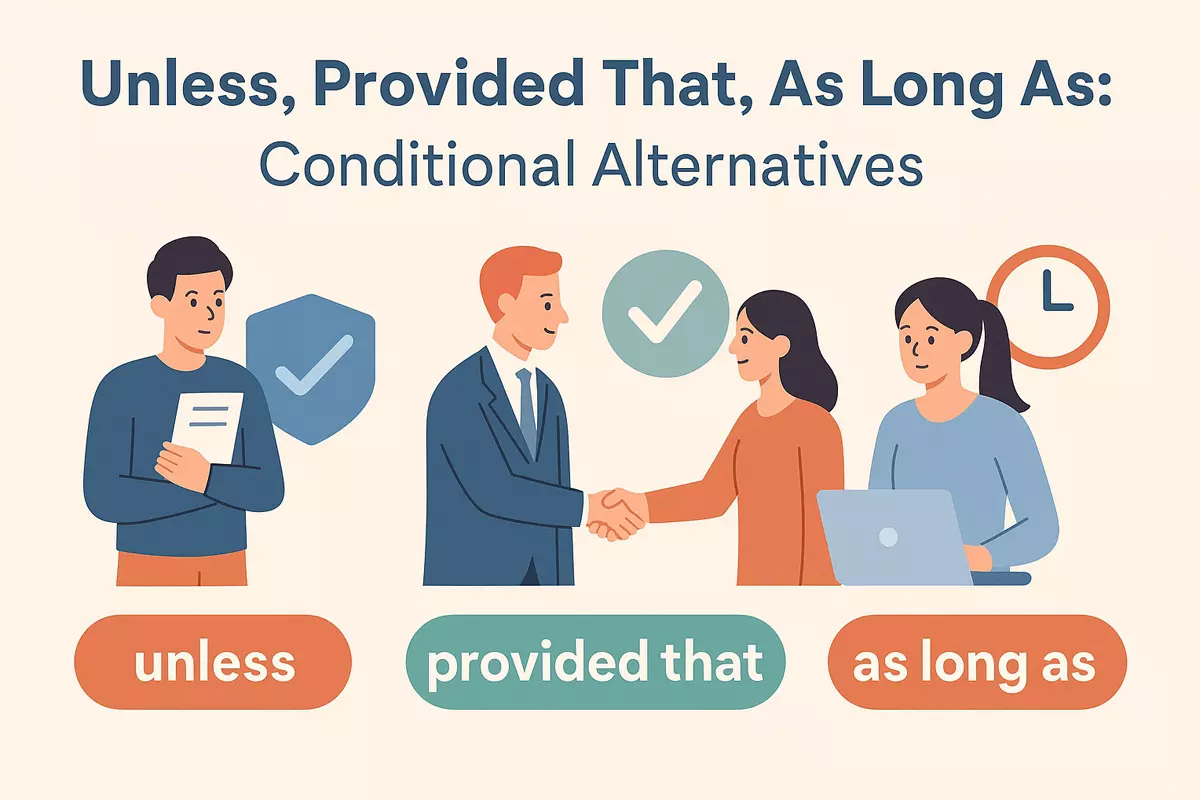 Here we how to use unless, provided that, and as long as for different types of conditions, highlights formal and informal usage, explains correct word order and punctuation, and offers practice in selecting the right conditional phrase for sentences.
Mastering English conditionals can be challenging, particularly when alternative expressions such as unless, as long as, and provided that are involved. These phrases each add subtle shifts in meaning, making sentences more precise or conditional in different ways. For example, unless introduces a negative condition, as long as sets a requirement, and provided that specifies a stipulation. Gaining familiarity with these forms helps speakers and writers convey their intended message more accurately, resulting in clearer and more effective communication in both spoken and written English.
Meaning of unless as the opposite of if not
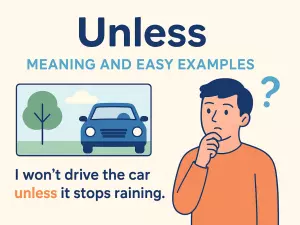
"Unless" is a conjunction that introduces a condition which must not be true for something else to happen. In many cases, it can be thought of as the opposite of "if not." Where "if not" explicitly states a negative condition, "unless" does so more compactly and smoothly in English sentences. For example, "You can't go out unless you finish your homework" means the same as "You can't go out if you do not finish your homework."
How "unless" flips the condition
Using "unless" allows speakers and writers to set a boundary: the stated result will occur in all situations except the one described by the condition. This is why "unless" is often described as the inverse of "if not." Instead of saying "if not X, then Y," you can say "Y unless X." This construction is common in both spoken and written English, and is especially useful for concise communication.
Examples: "unless" vs. "if not"
- "I won’t call you unless it’s important." → "I won’t call you if it’s not important."
- "She won't go unless you invite her." → "She won't go if you don't invite her."
- "They won’t succeed unless they try harder." → "They won’t succeed if they don’t try harder."
- "Unless you hurry, you'll miss the train." → "If you don't hurry, you'll miss the train."
- "We can't start unless everyone is here." → "We can't start if everyone is not here."
- "He doesn't eat dessert unless it's chocolate." → "He doesn't eat dessert if it's not chocolate."
- "You can't enter unless you show your ID." → "You can't enter if you don't show your ID."
- "The picnic is on unless it rains." → "The picnic is on if it doesn't rain."
- "Don't touch it unless you wash your hands." → "Don't touch it if you don't wash your hands."
- "We won’t leave unless you’re ready." → "We won’t leave if you’re not ready."
- "She won't answer unless you apologize." → "She won't answer if you don't apologize."
- "Unless told otherwise, continue as planned." → "If you are not told otherwise, continue as planned."
Summary table: "unless" and "if not" comparison
| Sentence with unless | Equivalent with if not |
|---|---|
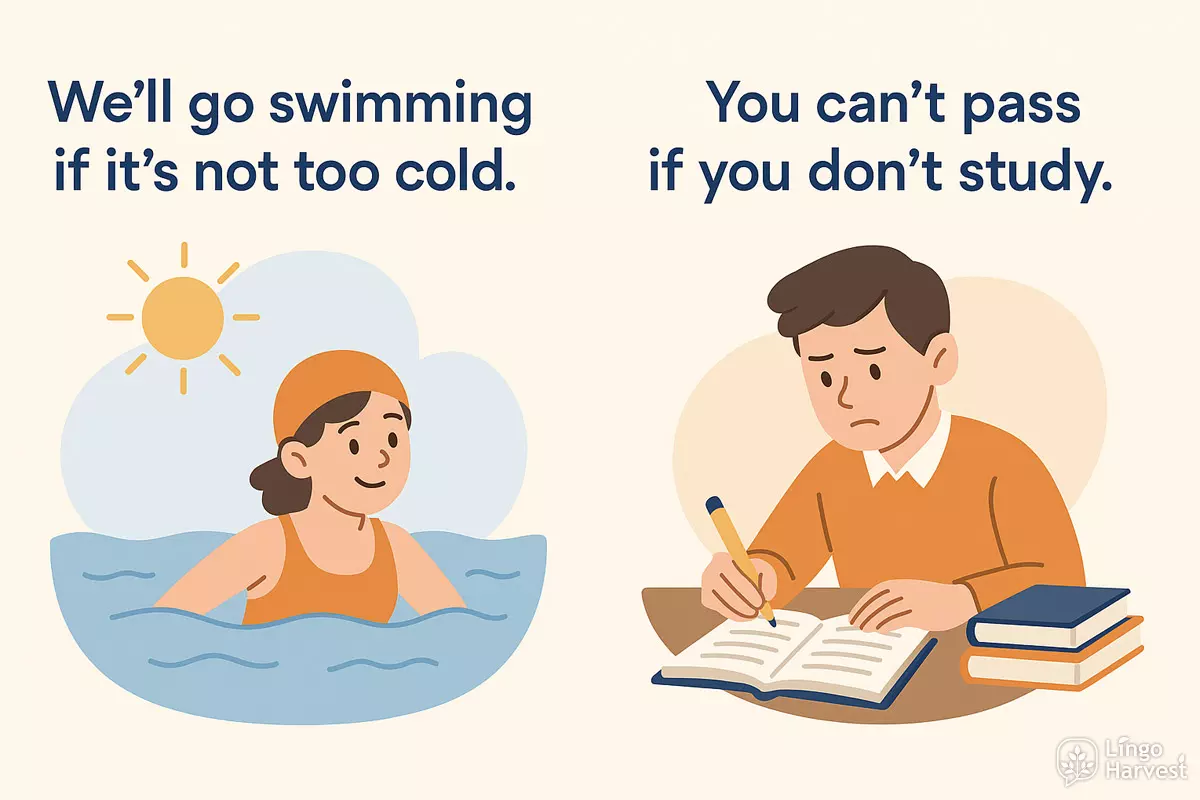
| We’ll go swimming unless it’s too cold. | We’ll go swimming if it’s not too cold. |
| You can’t pass unless you study. | You can’t pass if you don’t study. |
| Don't call me unless it's urgent. | Don't call me if it's not urgent. |
| The machine won’t work unless plugged in. | The machine won’t work if it’s not plugged in. |
| He won’t play unless his friend joins. | He won’t play if his friend doesn’t join. |
Notice how "unless" provides a natural way to set negative conditions without needing to use "not" or double negatives. It often makes sentences shorter and easier to understand. When choosing between "unless" and "if not," consider which sounds more natural and clear for your context.
Using provided that for strict conditions
When you want to express a requirement that must be met with no room for flexibility, “provided that” is a useful phrase. It sets a clear boundary or rule, making it suitable for situations where the condition is non-negotiable. In legal language, contracts, and formal agreements, this structure is especially common, as it leaves little doubt about what is required for the main statement to apply.
How “provided that” functions in sentences
The phrase often appears after a primary clause, introducing a secondary clause that states the condition. Unlike “unless” or “as long as,” which can suggest some flexibility or ongoing circumstances, “provided that” signals a single, specific requirement. For example:
- You may enter the contest, provided that you are over 18.
- The warranty is valid, provided that the product was purchased from an authorized dealer.
- Employees may work from home, provided that all deadlines are met.
Common contexts for strict conditions
Writers and speakers use this phrase in rules, policies, and instructions where exceptions are not allowed. It’s also prevalent in official documents and technical manuals.
- Access is permitted, provided that identification is shown at the entrance.
- Refunds are issued, provided that the item is returned within 30 days.
- Travel is allowed, provided that all required vaccinations are documented.
- Support is given, provided that the request is submitted before the deadline.
- Admission is granted, provided that the application is complete.
- Bonuses are paid, provided that targets are achieved.
- Participation is open, provided that registration is confirmed.
- Discounts apply, provided that the coupon is presented at purchase.
- Permission is granted, provided that prior approval is obtained.
- Use of equipment is allowed, provided that safety guidelines are followed.
Comparing strictness: “provided that” vs. alternatives
| Phrase | Typical Use & Strictness |
|---|---|
| provided that | Sets a firm, explicit requirement; no exceptions implied ✅ |
| unless | Indicates an exception, often less rigid; implies the rule applies except in stated cases |
| as long as | Suggests a condition that may be ongoing or negotiable; less formal and strict |
Choosing “provided that” is ideal when you want to highlight a condition’s importance and enforceability. In contrast, less formal alternatives might not convey the same level of obligation.
Using as long as for requirements that must be met
When you need to express that something is allowed or possible only if a certain condition is fulfilled, “as long as” is a natural and flexible choice. This phrase introduces a clear prerequisite, letting your listener or reader know that a rule or permission depends on a specific action, state, or circumstance. It’s especially useful for policies, agreements, or instructions, where clarity about conditions is crucial.
How “as long as” sets boundaries
“As long as” typically signals that an outcome will occur only if the stated requirement is satisfied. This makes it distinct from “unless” (which introduces exceptions) and “provided that” (which can sound more formal). The phrase is common in both spoken and written English, and it helps avoid ambiguity about what’s needed for something to happen.
- You can borrow my car as long as you return it by 8 PM.
- Employees may leave early as long as their work is finished.
- Children are allowed in the pool as long as an adult is present.
- We can go hiking as long as the weather stays clear.
- Access is granted as long as you have the correct badge.
- Students may retake the test as long as they sign up in advance.
- Pet owners can bring dogs as long as they are on a leash.
- You may eat snacks as long as you clean up afterward.
- The warranty is valid as long as you keep the original receipt.
- Discounts apply as long as you show your membership card.
- Visitors can use the lounge as long as they follow the posted rules.
- Guests are welcome as long as the host is notified in advance.
- Orders are accepted as long as supplies last.
- Refunds are given as long as the item is unused.
- Parking is free as long as you display a permit.
- Meetings may run late as long as participants agree.
- You can join the call as long as you have the link.
- Loans are extended as long as payments are made on time.
- Members may vote as long as dues are paid.
- Work-from-home is permitted as long as projects stay on track.
Comparing “as long as” with other conditionals
To highlight the nuances, here’s how “as long as” contrasts with “unless” and “provided that” in typical usage:
| Phrase | Example | Usage Note |
|---|---|---|
| as long as | You can stay out as long as you call if you’ll be late. | Specifies a positive requirement that must be met. |
| unless | You can stay out unless you don’t call if you’ll be late. | Introduces an exception; focuses on what would prevent permission. |
| provided that | You can stay out provided that you call if you’ll be late. | More formal; interchangeable with “as long as” in many contexts. |
Choosing “as long as” helps clarify expectations without sounding overly formal or negative. It’s an effective way to ensure everyone understands the requirements for participation, permission, or benefit.
Register differences: formal vs neutral vs spoken
How you express conditional ideas in English often depends on the context—academic writing, everyday conversation, or somewhere in between. Words and phrases like unless, provided that, and as long as all signal conditions, but their tone and usage vary. Choosing the right form helps you sound natural and clear, whether you're writing an email, chatting with friends, or drafting a report.
Conditional alternatives and their typical registers
Some conditional markers are primarily used in formal speech or writing, while others are more common in neutral or spoken English. The table below summarizes their typical usage and register.
| Expression | Typical Register & Example |
|---|---|
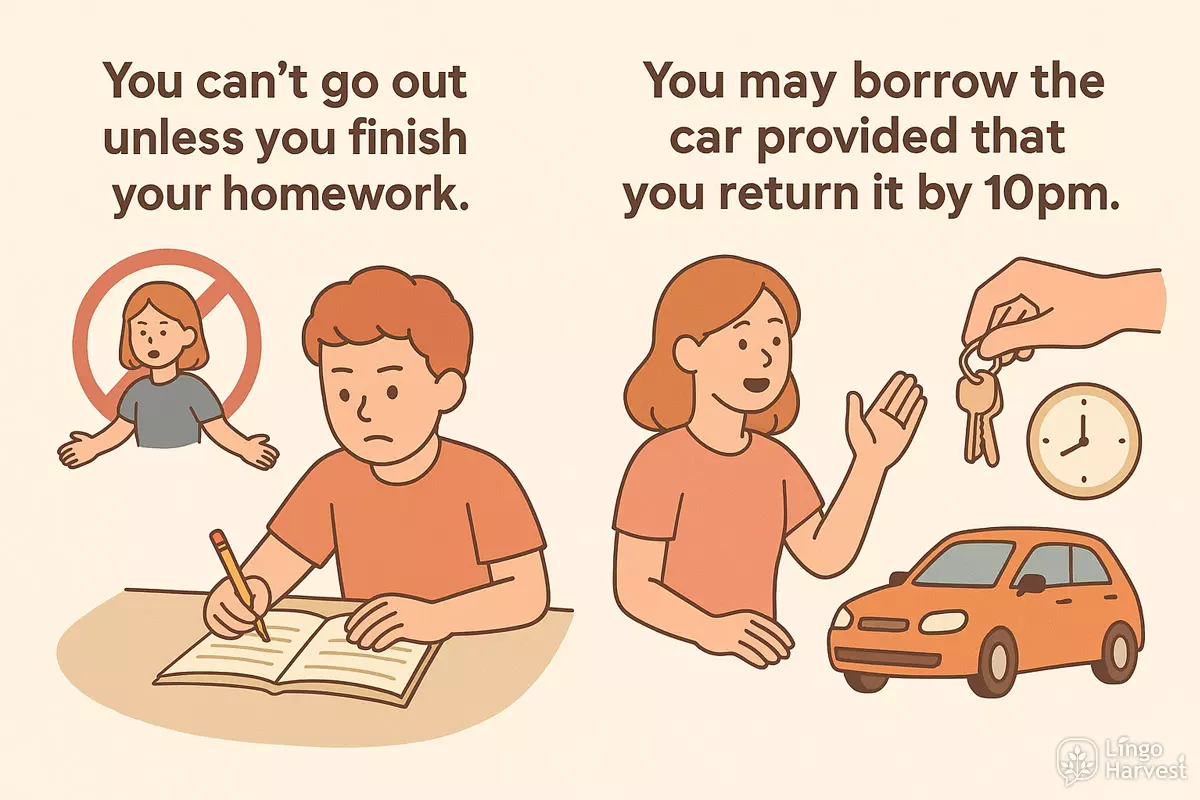
| Unless | Neutral/spoken: You can’t go out unless you finish your homework. |
| Provided (that) | Formal/official: You may borrow the car provided that you return it by 10pm. |
| As long as | Neutral/spoken: As long as you call, I’ll be happy. |
| On condition that | Formal/legal: The contract is valid on condition that both parties agree. |
| Only if | Neutral/formal: Only if it rains will we cancel the picnic. |
| In case | Neutral/spoken: Take an umbrella in case it rains. |
| Supposing (that) | Spoken/informal: Supposing you lost your keys, what would you do? |
| Assuming (that) | Neutral/formal: Assuming that we finish early, we can leave together. |
| Unless otherwise stated | Formal/official: Unless otherwise stated, the rules apply to all students. |
| So long as | Formal/neutral: So long as you agree, we can proceed. |
| If | All registers: If you’re ready, we can start. |
Notes on choosing the right expression
- Formal: Use provided that, on condition that, or unless otherwise stated in legal, academic, or official contexts.
- Neutral: Unless, as long as, only if, and in case work well in both writing and speech.
- Spoken/informal: Supposing (that) and sometimes as long as or just if fit everyday conversations.
Notice that overly formal phrases can sound stiff or unnatural in casual speech, while informal options might be inappropriate in business or academic writing. Adjust your choice according to the context and audience for natural, effective communication.
Word order and punctuation patterns
When using conditional alternatives like "unless," "provided that," and "as long as," English writers need to pay close attention to how sentences are structured and where punctuation marks are placed. Each connector brings its own typical sequence and comma usage, especially when placed at the beginning or middle of a sentence.
Typical placement and structure
- Unless usually introduces a condition that must not happen for the main clause to occur. It can start a sentence or appear in the middle.
- Provided that and as long as often introduce positive conditions and tend to come at the start or after the main clause.
- When these phrases start a sentence, a comma is generally used before the main clause.
- If they appear after the main clause, a comma is often omitted.
Common sentence patterns
Here are some ways these alternatives are typically arranged in sentences:
- Unless you hurry, you’ll miss the train.
- You’ll miss the train unless you hurry.
- Provided that you finish your work, you can leave early.
- You can leave early provided that you finish your work.
- As long as it doesn’t rain, the event will go ahead.
- The event will go ahead as long as it doesn’t rain.
Punctuation guidance
- When the conditional phrase comes first: Comma is required.
✅ Unless you call ahead, we can't reserve a table. - If the main clause comes first: No comma needed.
✅ We can't reserve a table unless you call ahead. - The same rules apply for provided that and as long as.
Comparison of connectors in context
| Connector | Example Sentence | Implication |
|---|---|---|
| Unless | Unless you study, you won't pass. | Negative condition; exception |
| Provided that | You can borrow my car provided that you return it by 6. | Positive condition; requirement |
| As long as | You can stay out as long as you call me. | Ongoing/continuing condition |
Quick tips
- Never use a comma before "unless," "provided that," or "as long as" when they follow the main clause.
- Do not split the conditional phrase from its clause with unnecessary punctuation.
- Switching the order (main clause first or condition first) is allowed, but adjust punctuation accordingly.
Understanding these patterns will help your writing stay clear and grammatically correct when expressing conditions with alternative connectors.
Practice: choose the correct conditional alternative for each sentence
Understanding how to use conditional alternatives like "unless," "provided that," and "as long as" is essential for expressing conditions and exceptions accurately in English. Below, you'll find scenario-based sentences where you need to select the most appropriate expression. These exercises will help you distinguish the subtle differences among these alternatives and use them correctly in context.
Pick the best conditional phrase
For each sentence, choose the most suitable option to complete the idea logically. Consider the meaning and nuance of each conditional phrase.
- You can borrow my car ______ you return it by 8 PM.
- The meeting will be canceled ______ everyone arrives on time.
- The offer remains valid ______ stocks last.
- I won’t go to the party ______ you come with me.
- ______ you follow the instructions, the recipe should turn out well.
- You won’t pass the exam ______ you study harder.
- We’ll go hiking ______ it doesn’t rain.
- ______ you have a ticket, you will be allowed entry.
- The dog won’t bark ______ someone approaches the house.
- ______ you don’t mind waiting, I’ll be ready soon.
Quick reference: Conditional alternatives at a glance
Here’s a summary of when to use each alternative. This overview helps reinforce the rules and patterns behind these expressions.
| Conditional Phrase | Typical Usage | Example |
|---|---|---|
| Unless | Except if (negative condition) | You won’t understand unless you read carefully. |
| Provided (that) | Only if (stronger, formal condition) | You may leave early provided that you finish your work. |
| As long as | On the condition that (neutral, informal) | You can stay as long as you like. |
Apply your knowledge: More scenarios
- The train will depart on time ______ there are no delays.
- ______ you keep your receipt, you can return the item.
- We won’t start dinner ______ everyone is here.
- You can join the club ______ you pay the membership fee.
- ______ you don’t touch anything, you can look around.
Show answers
- as long as / provided that
- unless
- as long as
- unless
- Provided that / As long as
- unless
- provided that / as long as
- Provided that / As long as
- unless
- As long as / Provided that
- as long as / provided that
- as long as / provided that
- unless
- provided that / as long as
- as long as / provided that