Conjunctions of Condition: if, unless, provided that

 The article explains conditional meaning in grammar, details zero and first conditionals with if, shows how unless and provided that are used, compares if and unless, and highlights differences between spoken and written English. Practice exercises are included.
- What conditional meaning is in grammar
- Zero and first conditional with if for real situations
- Using unless to express negative conditions
- Using provided that and providing that for formal conditions
- Subtle meaning changes when switching between if and unless
- Typical patterns in spoken vs written English
- Practice: complete conditional sentences with the correct conjunction
Understanding how to use connecting words is crucial when expressing possibilities or setting requirements in English because they link ideas and shape the intended meaning. Mastery of terms such as if, unless, provided that, and in case not only clarifies intentions but also improves the flow of communication. By choosing the right connectors, speakers and writers can convey conditions, alternatives, and requirements more precisely, making their language both more accurate and engaging for the audience.
What conditional meaning is in grammar
Conditional meaning in grammar refers to statements that express a situation and its possible result, depending on whether a specific condition is met. These constructions typically link two clauses: one setting the condition (often with words like if, unless, or provided that), and the other stating what will happen if that condition is true or false. The relationship can be about real or hypothetical events, future plans, or even general truths.
How conditional structures work
Conditional sentences usually have two main parts:
- Condition clause (also called the "if-clause"): States the requirement or situation. Example: If it rains
- Main clause: Describes what happens if the condition is fulfilled. Example: we’ll stay indoors
The order of these clauses can be switched, but the meaning remains clear.
Common types of conditional meanings
- Real conditionals: Describe likely or possible situations (e.g., If you study, you will pass.)
- Unreal conditionals: Refer to hypothetical, unlikely, or impossible situations (e.g., If I were rich, I would travel the world.)
- General truths: State facts that are always true (e.g., If water freezes, it turns to ice.)
- Negative conditions: Use words like unless to mean "if not" (e.g., Unless you hurry, you’ll miss the bus.)
- Specific requirements: Expressed with provided that, as long as, or on condition that (e.g., You can go out, provided that you finish your homework.)
Examples of conditional meaning in sentences
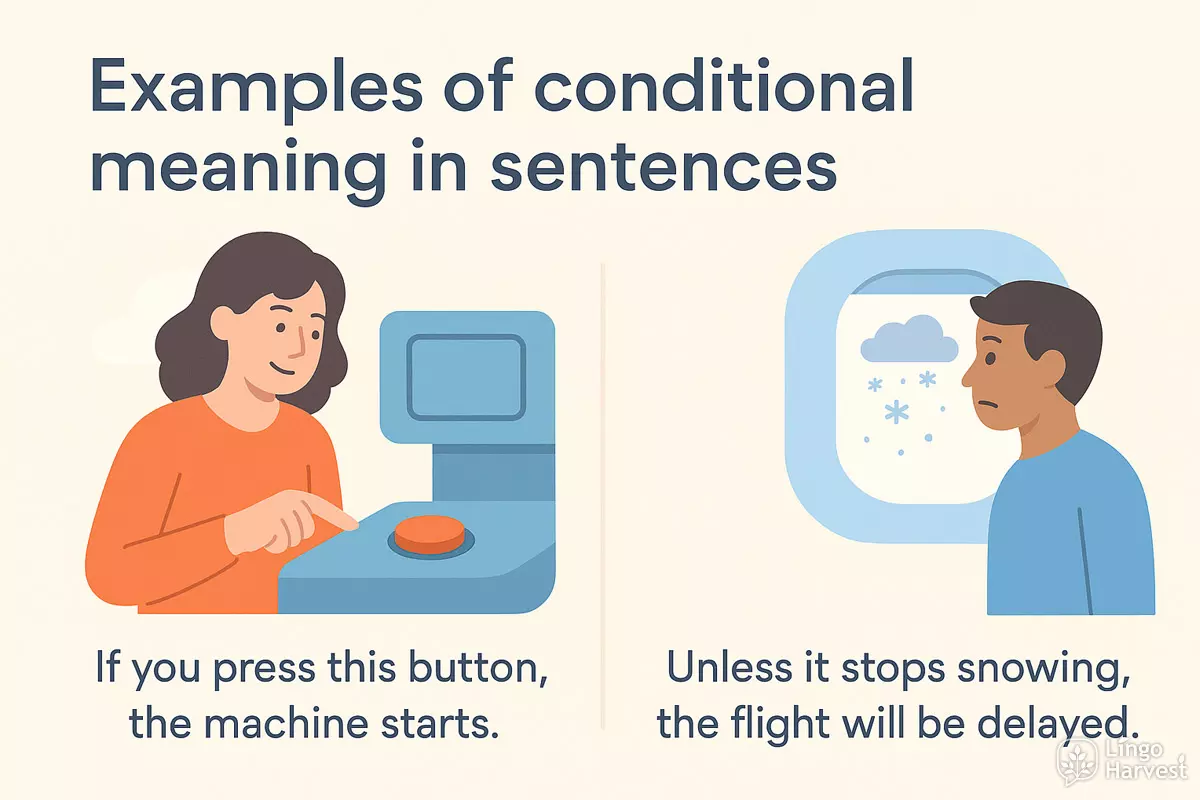
- If you press this button, the machine starts.
- Unless it stops snowing, the flight will be delayed.
- Provided that you call ahead, we can reserve a seat for you.
- If I were you, I would take the job offer.
- If she had known, she would have acted differently.
- Unless you water the plants, they will die.
- If the weather is nice, we'll go hiking.
- Provided that everyone agrees, we’ll start at 10 a.m.
- If you mix red and blue, you get purple.
- Unless you try, you’ll never know.
Key conjunctions for expressing conditional meaning
- if → If it rains, we’ll stay inside.
- unless → Unless you hurry, we’ll be late.
- provided that → Provided that you finish on time, you can leave early.
- as long as → You can borrow my car as long as you drive carefully.
- on condition that → You may enter on condition that you show your ID.
- in case → Take an umbrella in case it rains.
- even if → Even if it’s cold, they will go swimming.
Conditional conjunctions compared
| Conjunction | Typical Use | Example |
|---|---|---|
| if | Standard condition, real or unreal situations | If you need help, call me. |
| unless | Negative condition ("if not") | Unless you hurry, you’ll be late. |
| provided that | Specific requirement, formal contexts | You may leave early, provided that you finish your tasks. |
| as long as | Emphasizes a continuing condition | You can stay here as long as you keep quiet. |
| even if | Describes a result happening despite a condition | Even if it rains, we’ll play football. |
In summary, conditional meaning allows speakers and writers to explore possibilities, set requirements, and describe what could, might, or would happen under certain circumstances. Understanding these structures is key to expressing cause and effect, making predictions, giving advice, and negotiating terms in English.
Zero and first conditional with if for real situations
Understanding how to use "if" in conditional sentences helps you talk about situations that are real, likely, or always true. In English, the zero and first conditional forms are common tools for describing real-world events, facts, routines, and likely outcomes. Each pattern has a specific structure and use.
Zero Conditional: Facts and General Truths
The zero conditional is used when the result of the condition is always true. This structure is often chosen for scientific facts, routines, or instructions. The form is simple: if + present simple, present simple.
- If you heat water to 100°C, it boils.
- If people eat too much sugar, they gain weight.
- If it rains, the ground gets wet.
- If you mix red and blue, you get purple.
- If a plant doesn’t get sunlight, it dies.
- If you touch fire, it burns.
- If students are late, the teacher gets annoyed.
- If dogs see a stranger, they often bark.
- If the sun sets, it gets dark.
- If you press this button, the machine starts.
First Conditional: Real and Possible Futures
The first conditional is used to talk about possible future events that are likely to happen if a certain condition is met. The structure is: if + present simple, will + base verb.
- If it rains tomorrow, we will cancel the picnic.
- If you study hard, you will pass the test.
- If she calls, I will answer.
- If they arrive late, we will start without them.
- If you don’t eat now, you will be hungry later.
- If I finish early, I will go for a walk.
- If he is free tonight, he will join us.
- If the weather improves, we will go to the park.
- If you ask politely, they will help you.
- If the train is delayed, we will take a taxi.
Quick Comparison: Zero vs First Conditional
The following table summarizes the main differences and typical uses of these two patterns:
| Conditional Type | Form | Use | Example |
|---|---|---|---|
| Zero Conditional | if + present simple, present simple | General truths, scientific facts, routines | If water freezes, it turns to ice. |
| First Conditional | if + present simple, will + base verb | Real, possible future situations | If you hurry, you will catch the bus. |
Tips for Real-Life Communication
- Use the zero conditional for habits, scientific rules, and general truths.
- Use the first conditional for likely future outcomes and real possibilities.
- Both patterns use "if" to link the condition and the result, but the verb tense in the result clause is what changes the meaning.
- Do not use "will" after "if" in zero or first conditional; the "if-clause" stays in the present tense.
- Practising both forms helps you talk about real situations clearly and naturally.
Using unless to express negative conditions
When you want to talk about exceptions or conditions that would prevent something from happening, "unless" is a useful conjunction. It sets up a scenario where something happens only if another thing does not. In other words, "unless" introduces a negative condition—often replacing "if not" for smoother, more natural sentences.
"Unless" is typically followed by a present tense verb, even when referring to future events. This makes it different from some other conditional words. Consider how "unless" helps specify what must not occur for the main action to take place.
Common patterns with "unless"
- You can’t enter unless you have a ticket. (You need a ticket; otherwise, you can’t enter.)
- I won’t go unless you come with me. (I’ll go only if you come.)
- Don’t call me unless it’s urgent. (Call only if it’s urgent.)
- We’ll miss the bus unless we hurry. (If we don’t hurry, we’ll miss it.)
- The plant will die unless you water it. (It needs water or it will die.)
- You won’t pass unless you study. (Studying is necessary to pass.)
- I’ll be surprised unless he arrives late. (I expect him to be late.)
- We can’t start unless everyone is here. (Everyone must be present to start.)
- She won’t know unless you tell her. (She needs to be told.)
- Unless it rains, we’ll have a picnic. (We’ll have a picnic if it doesn’t rain.)
- Don’t open the door unless you know who it is. (Open only if you know the person.)
- He can’t go out unless he finishes his homework. (Homework must be complete first.)
- I never eat dessert unless it’s chocolate. (The only exception is chocolate.)
- We won’t succeed unless we work together. (Teamwork is required.)
- Unless you try, you’ll never know. (Trying is necessary for knowledge.)
Comparing "unless" and "if not"
In many situations, "unless" can replace "if not" for brevity. Here's a comparison:
| With "unless" | With "if not" |
|---|---|
| We’ll be late unless we leave now. | We’ll be late if we do not leave now. |
| You can’t go out unless you finish your chores. | You can’t go out if you do not finish your chores. |
| I won’t buy it unless it’s on sale. | I won’t buy it if it is not on sale. |
| She won’t join us unless she gets an invitation. | She won’t join us if she does not get an invitation. |
Key points to remember
- "Unless" always introduces a negative requirement.
- It is not generally used with negative verbs (avoid "unless you don’t").
- For future meanings, present simple is used after "unless" (e.g., "Unless it rains, we will go").
- In spoken and written English, "unless" often adds clarity and conciseness compared to "if not".
Using provided that and providing that for formal conditions
In formal English, "provided that" and "providing that" serve as alternatives to "if" when expressing conditions, especially in official documents, contracts, or polite requests. These phrases introduce requirements or stipulations, adding a sense of formality and precision to the statement. While both are widely accepted, "provided that" is more common in very formal writing.
When to use these conjunctions
Use "provided that" or "providing that" to:
- Specify a requirement that must be met for something else to occur
- Add legal or contractual conditions
- Make policies or instructions clear and unambiguous
- Show that an exception or allowance depends on a particular situation
Examples in context
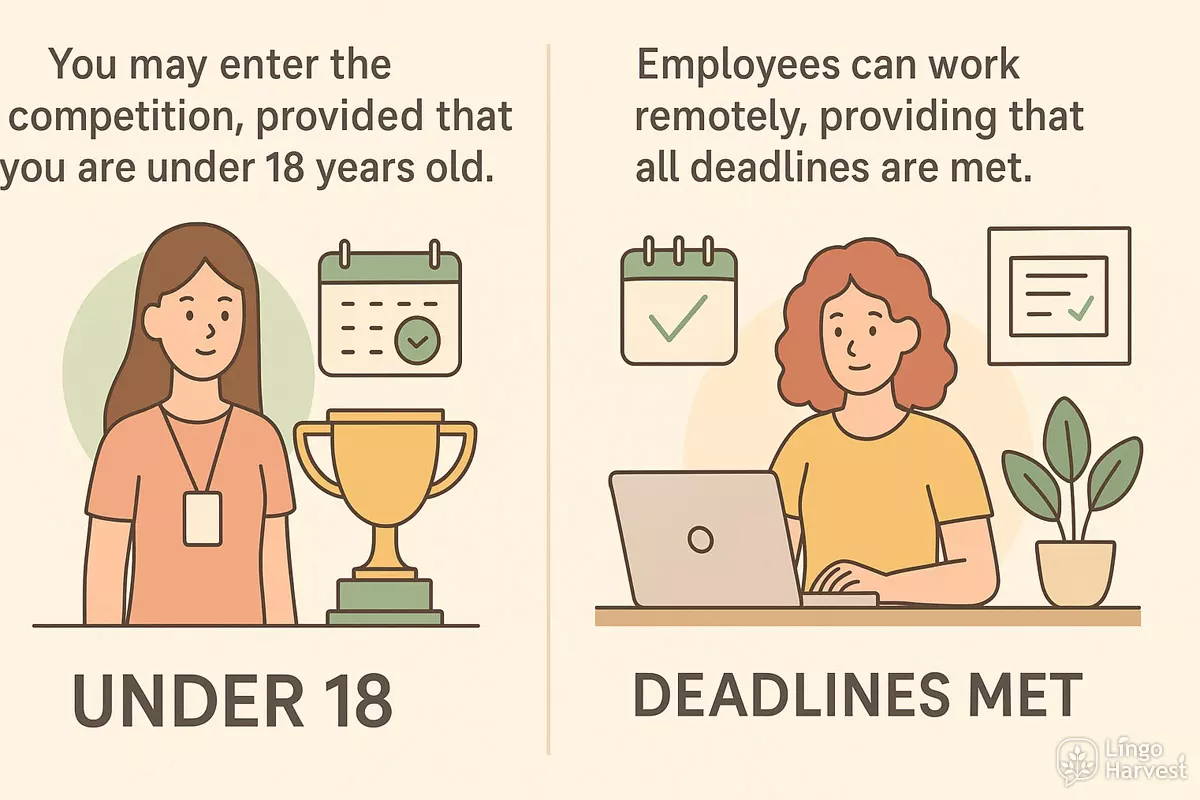
- You may enter the competition, provided that you are under 18 years old.
- Employees can work remotely, providing that all deadlines are met.
- The agreement will be valid, provided that both parties sign before Friday.
- Visitors are welcome, providing that they follow the safety regulations.
- The bank will approve the loan, provided that all documents are submitted.
- Refunds are possible, providing that the item is returned within 30 days.
- Members can renew their subscription, provided that they have no outstanding fees.
- The package will be delivered, providing that the address is correct.
- He can join the meeting, provided that he registers in advance.
- Assistance is available, providing that you request it before noon.
Comparing usage in formal and informal contexts
In everyday conversation, "if" is more natural, while "provided that" and "providing that" add a layer of formality or specificity. For instance, contracts or regulations often favor the more formal alternatives to avoid ambiguity.
| Informal (If) | Formal (Provided/Providing that) |
|---|---|
| If you finish your work, you can leave early. | You may leave early, provided that you finish your work. |
| If you pay the fee, you can participate. | You can participate, providing that you pay the fee. |
| If it doesn’t rain, the event will be outside. | The event will be outside, provided that it doesn’t rain. |
| If there are no objections, we’ll proceed. | We’ll proceed, providing that there are no objections. |
Summary of usage tips
- Use "provided that" or "providing that" for formal or official statements.
- Both phrases can often be used interchangeably, but "provided that" is slightly more formal.
- They work best when emphasizing requirements, exceptions, or stipulations.
- In legal or policy documents, these conjunctions help avoid vague conditions.
For clear, precise conditions in writing, these alternatives to "if" are invaluable tools.
Subtle meaning changes when switching between if and unless
Choosing between "if" and "unless" can have a significant impact on how a condition is understood in English. These words both introduce conditional clauses, but each frames the situation differently. "If" sets a condition that must be met, while "unless" presents an exception to a general rule. Understanding the nuance helps avoid confusion and ensures your intended meaning is clear.
How "if" and "unless" shift emphasis
Using "if" focuses on the possibility of something happening. In contrast, "unless" draws attention to the exception or what happens when something does not occur. For example, compare:
- If it rains, we will cancel the picnic.
- Unless it rains, we will have the picnic.
Though both sentences seem similar, the first highlights the condition (rain), while the second stresses that only one thing (rain) will stop the event. This subtlety can change how listeners interpret your intentions.
Common patterns and meaning shifts
Here are several ways the choice between these conjunctions can change the sense of a sentence:
- If you hurry, you'll catch the bus. → Focuses on hurrying as a positive action.
- Unless you hurry, you'll miss the bus. → Emphasizes the negative outcome if you do not hurry.
- If you call me, I'll explain everything. → The explanation depends on you calling.
- Unless you call me, I won't explain anything. → Implies silence is the default unless you act.
- If you have any questions, ask. → Encourages questions as a possibility.
- Unless you have questions, we can finish. → Suggests finishing is expected unless interrupted.
- If you finish early, let me know. → Notification depends on early completion.
- Unless you finish early, keep working. → Working continues by default.
- If he agrees, we’ll start tomorrow. → The plan depends on his agreement.
- Unless he agrees, we can’t start. → Starting is blocked by his disagreement.
- If you pay now, you get a discount. → Rewards immediate payment.
- Unless you pay now, you don’t get a discount. → No discount is the standard outcome.
- If you study, you’ll pass. → Passing is conditional on studying.
- Unless you study, you’ll fail. → Failing is probable if you don’t study.
Comparing "if" and "unless" in context
Switching between these conjunctions is not always straightforward. Sometimes, the negative form of "if" is equivalent to "unless," but not in every case. The table below highlights some typical transformations and their implications.
| With if | With unless |
|---|---|
| If you do not call, I'll worry. | Unless you call, I'll worry. |
| If it isn't sunny, we won't go out. | Unless it's sunny, we won't go out. |
| If you don't finish, you can't leave. | Unless you finish, you can't leave. |
| If they aren't ready, we will wait. | Unless they are ready, we will wait. |
| If I don't see you, I'll call. | Unless I see you, I'll call. |
| If we don't hurry, we'll be late. | Unless we hurry, we'll be late. |
| If you don't understand, ask me. | Unless you understand, ask me. |
| If he doesn't apologize, I won't forgive him. | Unless he apologizes, I won't forgive him. |
Things to watch out for
- Switching between these conjunctions can change the speaker’s attitude or the default expectation.
- Negatives can become double negatives if not careful (e.g., "unless you don’t mind" = "if you mind").
- Not all sentences with "if not" have a perfect equivalent with "unless," especially in idiomatic expressions.
Grasping these subtle distinctions helps you express conditions and exceptions precisely, making your English both accurate and natural.
Typical patterns in spoken vs written English
When using conjunctions of condition like if, unless, and provided that, patterns often shift depending on whether the context is conversational or formal writing. Spoken English typically favors brevity and directness, while written English—especially academic or legal texts—tends to use more complex and varied structures.
Spoken English: Simplicity and Clarity
- If is the dominant choice: “If it rains, we’ll stay in.”
- Unless is used for simple negatives: “I won’t go unless you come.”
- Provided (that) is rare and can sound overly formal in casual speech.
- Contractions and ellipsis are common: “If you’re late, call me.”
- Conditional sentences are often shortened: “If not, let me know.”
- Intonation and stress help clarify meaning more than complex grammar.
- People sometimes omit the subject: “If finished, let me know.”
- First conditionals (“If you do this, I’ll do that”) are especially frequent in everyday talk.
- Alternative forms like “unless” can sometimes be replaced by “if…not”: “Unless you hurry, you’ll miss the bus” vs “If you don’t hurry, you’ll miss the bus.”
- Slang or informal phrases may appear: “If you ask me, that’s not fair.”
Written English: Range and Precision
- Provided (that) is more common, especially in legal, business, or academic writing: “You may enter the contest provided that you meet the requirements.”
- Longer, more precise conditional clauses: “If the report is not submitted by Friday, the application will be rejected.”
- Use of unless for formal exceptions: “Unless otherwise stated, all fees are non-refundable.”
- Complex or nested conditionals: “If you have any questions, or if you require assistance, contact the office.”
- Reduced use of contractions: “If you are interested, please respond.”
- Passive structures appear more often: “Access will be granted if the criteria are met.”
- Greater variety of conjunctions, including “as long as,” “so long as,” and “in case.”
- Clarity and unambiguity are prioritized, especially in instructions and regulations.
| Conjunction | Typical in Speech | Typical in Writing |
|---|---|---|
| If | Very common, straightforward (“If it’s late, call me.”) | Common, but with longer clauses (“If payment is not received,…”) |
| Unless | Used for simple negatives (“I won’t go unless you do.”) | Used for formal exceptions (“Unless otherwise indicated…”) |
| Provided (that) | Rare, may sound formal or stilted | Frequent in formal/legal writing (“Provided that all terms are met…”) |
| As long as / So long as | Occasionally used for informal conditions | Appears in both, but more often in written instructions |
Overall, spoken English relies on natural, concise conditionals, while written English uses more structured and varied forms to convey precise meaning. Understanding these tendencies helps learners adapt their style to fit the context.
Practice: complete conditional sentences with the correct conjunction
Understanding when to use "if," "unless," and "provided that" is essential for forming correct conditional statements in English. These conjunctions set the conditions for the action in the main clause. Below, you'll find exercises and tips to help you choose the most suitable connector in different contexts.
Fill in the Blanks
Complete each sentence by inserting "if," "unless," or "provided that" where appropriate:
- You can borrow my car ______ you return it by 6 p.m.
- I won’t go to the party ______ you come with me.
- We will start the meeting ______ everyone arrives on time.
- He won’t get better ______ he takes his medicine.
- ______ it rains, we’ll stay indoors.
- The plan will work ______ all team members cooperate.
- They won’t let you in ______ you have a ticket.
- ______ you don’t tell anyone, I’ll share my secret.
- She’ll pass the exam ______ she studies hard.
- We’ll go hiking tomorrow ______ the weather is good.
Show answers
- provided that
- unless
- if
- unless
- If
- provided that
- unless
- If
- if
- if
Choosing the Right Conditional Connector
Each conjunction has a specific use. Review these tips to decide which one fits best:
- If introduces a condition that may or may not happen.
- Unless means "if not" or sets a negative condition.
- Provided that introduces a strong requirement, similar to "only if."
Identify the Conjunction
Read the sentences below. Choose which conjunction ("if," "unless," "provided that") best completes each sentence:
- We’ll go for ice cream ______ we finish our homework early.
- You can join the club ______ you pay the membership fee.
- I won’t call you ______ there’s an emergency.
- The picnic will be cancelled ______ it rains tomorrow.
- Plants die ______ they don’t get enough water.
- If you heat ice, it ______ (turn) into water.
- You’ll feel better ______ you take this medicine.
- He won’t pass the test ______ he studies harder.
- The alarm rings ______ you open the door.
- We’ll start the meeting ______ everyone arrives on time.
Show answers
- if
- provided that
- unless
- if
- if
- turns
- if
- unless
- when
- as soon as
Common Patterns and Examples
Observe how these conjunctions appear in typical conditional statements:
- If you need help, just ask.
- I won’t go unless you come with me.
- You can have dessert provided that you finish your dinner.
- The show will be cancelled if not enough tickets are sold.
- Unless it’s urgent, please don’t disturb me while I’m working.
- Provided that you agree, we can start now.
- If it snows tomorrow, schools might close.
- Unless you hurry, we’ll miss the train.
- We’ll have the meeting outside if the weather is nice.
- She’ll go to university provided that she passes all her exams.
- If you don’t understand, let me know.
- You can’t leave unless you sign the attendance sheet.
- Provided that you follow the instructions, the recipe should work.
Practice using these connectors in your own sentences to solidify your understanding. Try swapping "if," "unless," and "provided that" in different contexts to see how the meaning changes.