Wish and If Only for Unreal Present Situations

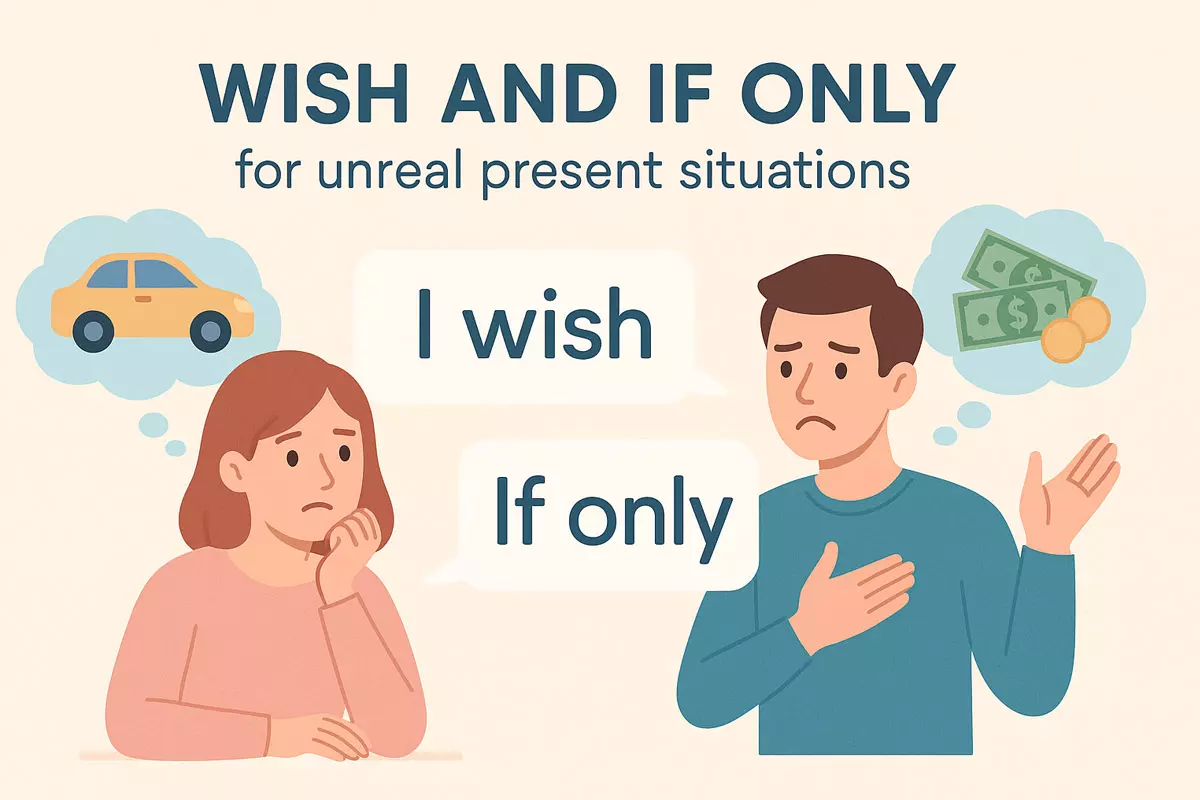 Here we the unreal present meaning in English, showing how wish and if only with past simple express dissatisfaction or a desire for change. It compares their emotional strength, gives real examples, and includes sentence rewriting practice.
- What unreal present meaning is and how it is expressed
- Form: wish + past simple / if only + past simple
- Using wish to show dissatisfaction or desire for change
- Emotional strength differences between wish and if only
- Examples from conversations, opinions, and complaints
- Practice: rewrite sentences using wish or if only
Have you ever wondered how to discuss situations that are not true at the moment but that you wish were different? In English, there are specific structures to express these unreal or imagined circumstances in the present, allowing you to convey regrets, wishes, or hypothetical changes. Using phrases like “If I were taller, I would play basketball” or “I wish I knew the answer” helps you communicate things that are not real right now but reflect your hopes or thoughts about how things could be.
What unreal present meaning is and how it is expressed
When we talk about unreal present situations, we’re describing scenarios that are not true at the current moment but are imagined, wished for, or regretted. In English, this concept is most often conveyed using certain verb forms and sentence structures, especially with verbs like wish and the phrase if only. These constructions help express desires for things to be different from how they actually are right now.
How to recognize unreal present situations
Unreal present statements refer to situations that are contrary to fact in the present. For example, saying “I wish I were taller” means the speaker is not tall, but would like to be. Similarly, “If only I had more time” expresses regret or longing for a different present reality.
Common structures for expressing unreal present
The most typical way to show an unreal present meaning is to use past tense verbs, even though the time being talked about is actually now. This use of the past tense signals that the speaker is not describing a real situation. Here are some key patterns:
- wish + past simple: “I wish I knew the answer.” (I don’t know the answer.)
- wish + could: “She wishes she could drive.” (She can’t drive.)
- if only + past simple: “If only it were sunny.” (It isn’t sunny.)
- if only + could: “If only I could speak French.” (I can’t speak French.)
- Use of were instead of was after “I/he/she/it” for more formal or emphatic style: “I wish I were at home.”
Typical verbs and phrases used
Some verbs and expressions are especially common in this context. Here are examples of how they are used to talk about imagined present situations:
- wish → I wish I knew the answer.
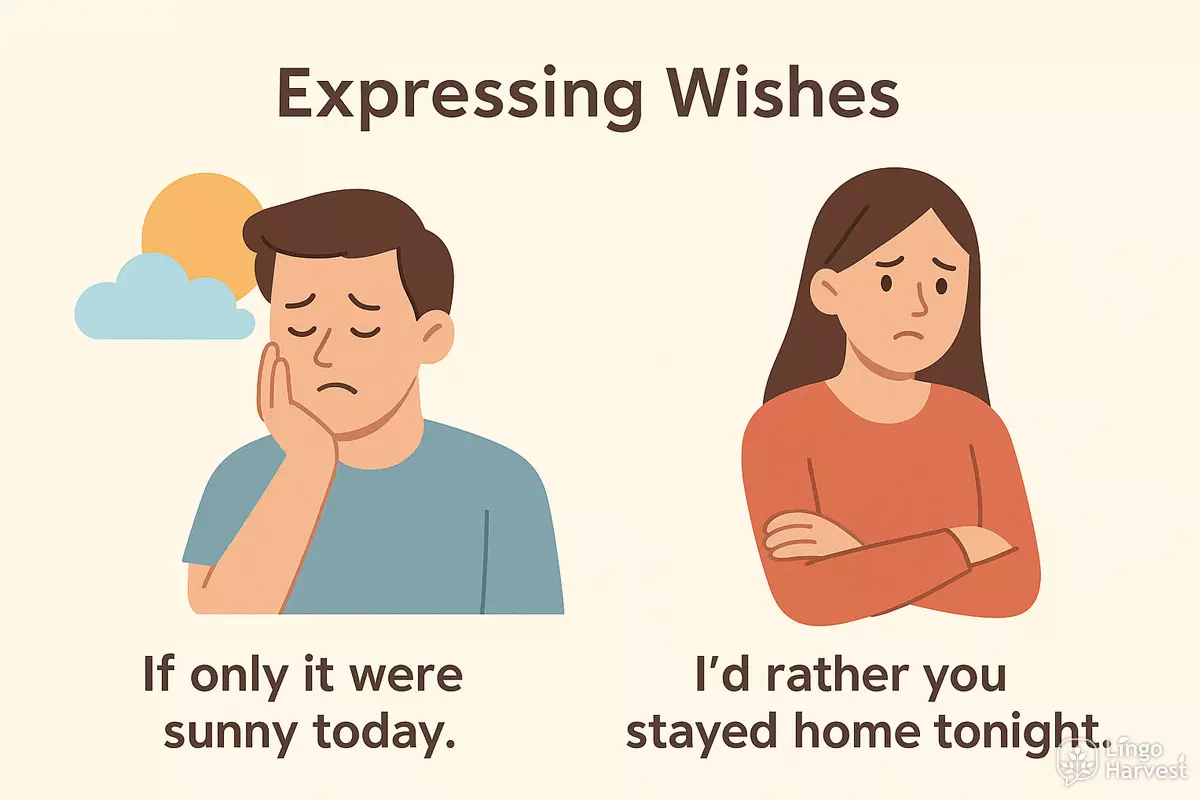
- if only → If only it were sunny today.
- would rather → I’d rather you stayed home tonight.
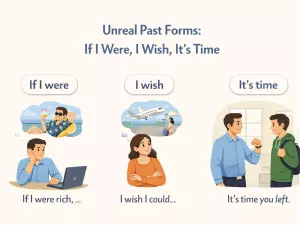
- it’s time → It’s time we left.
- suppose (in hypothetical questions) → Suppose you won the lottery—what would you do?
- imagine (in present hypotheticals) → Imagine you lived on Mars.
- as if / as though (with past simple) → He talks as if he knew everything.
- would sooner → I’d sooner walk than take the bus.
- what if (imagined scenarios) → What if we failed the test?
- would prefer (hypothetical) → I’d prefer it if you didn’t smoke here.
- pretend (with unreal present) → She pretended she knew the rules.
Example sentences
- I wish I had a better memory. (I don’t have one.)
- If only my phone worked. (It doesn’t work.)
- She wishes she were here. (She isn’t here.)
- Suppose you won the lottery – what would you do?
- He acts as if he knew everything. (He doesn’t know everything.)
- It’s time you went home. (You are not at home yet.)
- I’d rather you stayed. (You are not staying.)
Summary: Key forms for expressing unreal present
| Pattern | Example |
|---|---|
| wish + past simple | I wish I knew the answer. |
| wish + could | She wishes she could drive. |
| if only + past simple | If only it were sunny. |
| if only + could | If only I could speak French. |
| as if / as though + past simple | He talks as if he knew everything. |
| it’s time + past simple | It’s time you went home. |
These patterns are essential for expressing present situations that are not real, allowing speakers to convey wishes, regrets, or imagined alternatives to reality.
Form: wish + past simple / if only + past simple
When talking about present situations we would like to be different, English uses "wish" or "if only" followed by the past simple tense. This structure allows us to express regret, dissatisfaction, or a desire for change in the present. It's important to note that although we use the past simple, we are not referring to the actual past; rather, we are showing that something is unreal or unlikely at this moment.
How the Structure Works
The pattern is straightforward: use "wish" or "if only" and then a subject plus the past simple form of the verb. For the verb "be," we commonly use "were" for all subjects in more formal or careful English, though "was" is also often heard in informal contexts.
- I wish I knew the answer. (But I don’t know.)
- If only it were warmer today. (But it isn’t.)
- She wishes she had more free time. (She doesn’t.)
- If only I lived closer to work. (I don’t.)
- We wish we didn’t have so much homework. (But we do.)
- If only he spoke Spanish. (He doesn’t.)
- I wish you were here. (You’re not.)
- If only they understood me. (They don’t.)
- She wishes it wasn’t raining. (It is.)
- If only my phone worked. (It doesn’t.)
- I wish I could drive. (I can’t.)
- If only we had a bigger house. (We don’t.)
- He wishes he didn’t have to work today. (He does.)
- If only I felt better. (I don’t.)
- I wish it weren’t so late. (It is.)
Common Uses and Meanings
This construction is especially useful when expressing frustration or disappointment with current reality, or when imagining how life might be improved. It does not indicate any expectation that things will actually change.
Quick Reference: Pattern Comparison
| Expression | Example (Unreal Present) |
|---|---|
| wish + past simple | I wish I had a car. (I don’t have one now.) |
| if only + past simple | If only it were sunny. (It isn’t sunny now.) |
| wish + could | I wish I could swim. (I can’t swim now.) |
| if only + subject + past simple | If only she knew the truth. (She doesn’t know.) |
Summary
Using "wish" or "if only" with the past simple is a practical way to express imagined or impossible changes to the present. This form is a staple in both spoken and written English for conveying regret, hypothetical thinking, or desires about what isn’t real right now.
Using wish to show dissatisfaction or desire for change
When we talk about things in the present that we are unhappy with or would like to be different, the verb "wish" is commonly used. This structure expresses a sense of regret, frustration, or longing for change regarding a current situation. Typically, "wish" is followed by a past simple verb, even though the meaning refers to the present. This use signals that what we want is not real or possible at the moment.
For example, if you are not satisfied with the weather today, you might say, "I wish it were sunny." Here, "were" is used instead of "am" to indicate that the situation is unreal or contrary to fact. This pattern helps English speakers convey their discontent or hopes for something different right now.
Common patterns and examples
- I wish I had more free time. (I don’t have enough free time.)
- I wish I knew the answer. (I don’t know the answer.)
- I wish it weren’t raining. (It is raining now.)
- I wish you lived closer. (You don’t live close.)
- I wish I could speak Spanish. (I can’t speak Spanish.)
- I wish my phone worked. (My phone doesn’t work.)
- I wish he were here. (He isn’t here.)
- I wish I didn’t have to work today. (I have to work today.)
- I wish my room was bigger. (My room is small.)
- I wish they understood me. (They don’t understand me.)
- I wish we weren’t so busy. (We are very busy.)
- I wish I wasn’t so tired. (I am tired.)
- I wish there were more options. (There aren’t many options.)
- I wish I didn’t feel nervous. (I feel nervous.)
- I wish you weren’t angry. (You are angry.)
Forming sentences with "wish" for present regrets
The structure is simple: subject + wish + subject + past simple. In formal English, "were" is often used instead of "was" after "I/he/she/it," though "was" is common in spoken language.
| Present Reality | Wish Statement |
|---|---|
| I am not tall. | I wish I were taller. |
| She doesn’t have a car. | She wishes she had a car. |
| It is raining. | I wish it weren’t raining. |
| They live far away. | I wish they lived nearby. |
This construction is a useful way to express current dissatisfaction or a strong desire for things to be different. Remember, "wish" for unreal present situations always uses a past verb form, even when the speaker is thinking about now.
Emotional strength differences between wish and if only
When expressing unreal present situations in English, both wish and if only are frequently used, but they differ in how strongly they communicate emotion, frustration, or regret. If only tends to be more intense, often conveying a deeper sense of longing or dissatisfaction compared to wish, which can sound milder or more neutral in tone.
Comparing emotional intensity
- If only is typically chosen when the speaker feels a strong emotional reaction, such as disappointment, frustration, or even desperation about the unreal situation.
Example: If only I knew the answer! → This shows strong regret or frustration. - Wish is more common in polite, thoughtful, or less emotionally charged statements.
Example: I wish I knew the answer. → This shows a desire, but less emotional force.
Common uses and nuances
Choosing between these structures can subtly change the impact of your message. Here are some typical situations and feelings each structure might express:
- If only highlights how badly the speaker wants a change.
- Wish suggests a hope or desire, but not always a powerful one.
- If only often appears alone for dramatic effect: If only things were different...
- Wish is more likely to be followed by a reason: I wish I could help, but I'm busy.
Examples: Emotional range in unreal present situations
- If only I were taller! (strong frustration)
- I wish I were taller. (gentle desire)
- If only she didn't live so far away! (intense longing)
- I wish she lived closer. (moderate wish)
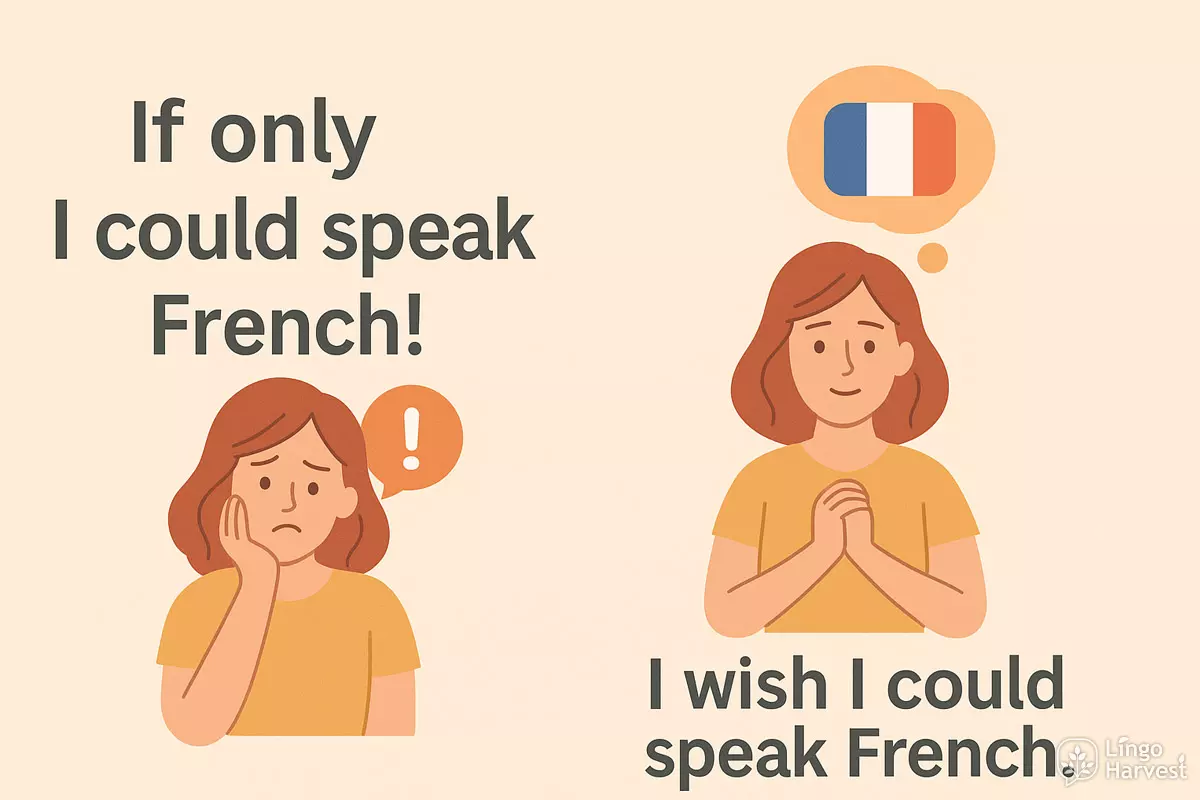
- If only I could speak French! (strong regret or ambition)
- I wish I could speak French. (mild regret or hope)
- If only it wasn't raining! (annoyance or disappointment)
- I wish it wasn't raining. (neutral wish)
- If only my boss understood me! (emotional frustration)
- I wish my boss understood me. (softer regret)
Summary: Key emotional contrasts
- If only = stronger emotion, more dramatic, often used alone or to express regret or impossible hopes.
- Wish = softer, more general hope, used in both formal and informal contexts.
Examples from conversations, opinions, and complaints
Everyday speech is full of expressions where people talk about imaginary situations in the present. Both “wish” and “if only” are common for expressing regrets, dissatisfaction, or desires that are impossible or unlikely right now. These forms let speakers show how they feel about the reality they’re experiencing, often highlighting what they’d like to change.
Typical conversation snippets using "wish" and "if only"
- I wish I knew the answer. (But I don’t know.)
- If only it weren’t raining! (But it is raining.)
- I wish you were here. (But you’re not.)
- If only I spoke Spanish. (But I don’t speak Spanish.)
- I wish I wasn’t so tired. (But I am tired.)
- If only my phone worked. (But it doesn’t.)
- I wish we had more time. (But we don’t.)
- If only she listened to me. (But she doesn’t.)
- I wish this coffee tasted better. (But it doesn’t.)
- If only my boss understood me. (But he doesn’t.)
- I wish I could help. (But I can’t.)
- If only I felt better today. (But I don’t.)
- I wish the train wasn’t late. (But it is.)
- If only I lived closer to work. (But I don’t.)
- I wish my internet was faster. (But it isn’t.)
- If only people were more polite. (But they aren’t.)
- I wish I didn’t have allergies. (But I do.)
- If only the weather was warmer. (But it isn’t.)
Opinions and complaints in real-life contexts
When expressing opinions or voicing complaints, speakers use these patterns to show frustration or longing for a different present. The choice between “wish” and “if only” often depends on how strong the feeling is; “if only” usually sounds more emotional or dramatic.
- I wish meetings didn’t take so long. (Complaint)
- If only customer service answered faster. (Complaint)
- I wish my neighbors were quieter at night. (Opinion/complaint)
- If only my job paid more. (Desire/frustration)
- I wish public transport was more reliable. (Opinion)
- If only my friends understood how I feel. (Longing)
Comparing "wish" and "if only" in structure and intensity
| Form | Example Sentence | Implied Meaning |
|---|---|---|
| Wish + past simple | I wish I had a car. | I don’t have a car now. |
| If only + past simple | If only I had a car! | Strong regret about not having a car. |
| Wish + could | I wish I could swim. | I can’t swim. |
| If only + could | If only I could swim! | Intense longing to be able to swim. |
| Wish + was/were | I wish I were taller. | I’m not tall. |
These patterns help speakers clearly communicate disappointment, wishes for change, or dissatisfaction with the current situation. Whether in quick chats, detailed opinions, or everyday complaints, these structures make it easy to express feelings about unreal present circumstances.
Practice: rewrite sentences using wish or if only
This section provides hands-on exercises to help you transform ordinary statements into sentences expressing unreal present situations using wish or if only. These structures allow us to talk about regrets, desires, or situations we would like to be different in the present. Review the sentences below and try to rewrite each one using the correct form of wish or if only. Remember, these expressions are usually followed by a past simple verb to show that the situation is unreal now.
Rewrite the following sentences:
- I don’t have enough money to buy this jacket.
- She doesn’t live closer to her office.
- It isn’t sunny today.
- We can’t speak French fluently.
- They aren’t here with us right now.
- My phone’s battery doesn’t last long.
- I am not tall enough to reach the shelf.
- He isn’t more confident in meetings.
- My parents don’t let me stay out late.
- Our teacher doesn’t give us less homework.
- I don’t have a pet.
- My job isn’t more interesting.
- I can’t play the piano.
- We don’t live by the sea.
- The bus isn’t on time today.
- I don’t remember his name.
Common patterns with wish and if only
- Wish/If only + past simple: for present situations you would like to be different (e.g., "I wish I knew the answer.").
- Wish/If only + could: to express ability or possibility (e.g., "She wishes she could drive.").
- Wish/If only + was/were: both are possible, but "were" is more formal, especially with "I" (e.g., "If only I were taller.").
Extra Challenge: Spot the Error
Some of these sentences use wish and if only incorrectly. Identify and correct the mistakes.
- I wish I can fly.
- If only she knows the answer.
- I wish I am rich.
- If only we are at the beach now.
Show answers
- I wish I had enough money to buy this jacket.
- She wishes she lived closer to her office.
- If only it were sunny today.
- We wish we could speak French fluently.
- If only they were here with us right now.
- I wish my phone’s battery lasted longer.
- I wish I were tall enough to reach the shelf.
- He wishes he were more confident in meetings.
- I wish my parents let me stay out late.
- If only our teacher gave us less homework.
- I wish I had a pet.
- I wish my job were more interesting.
- I wish I could play the piano.
- We wish we lived by the sea.
- If only the bus were on time today.
- I wish I remembered his name.
Extra Challenge corrections:
- I wish I could fly. ✅
- If only she knew the answer. ✅
- I wish I were rich. ✅
- If only we were at the beach now. ✅