If vs Unless vs Only If: Clear Functional Differences

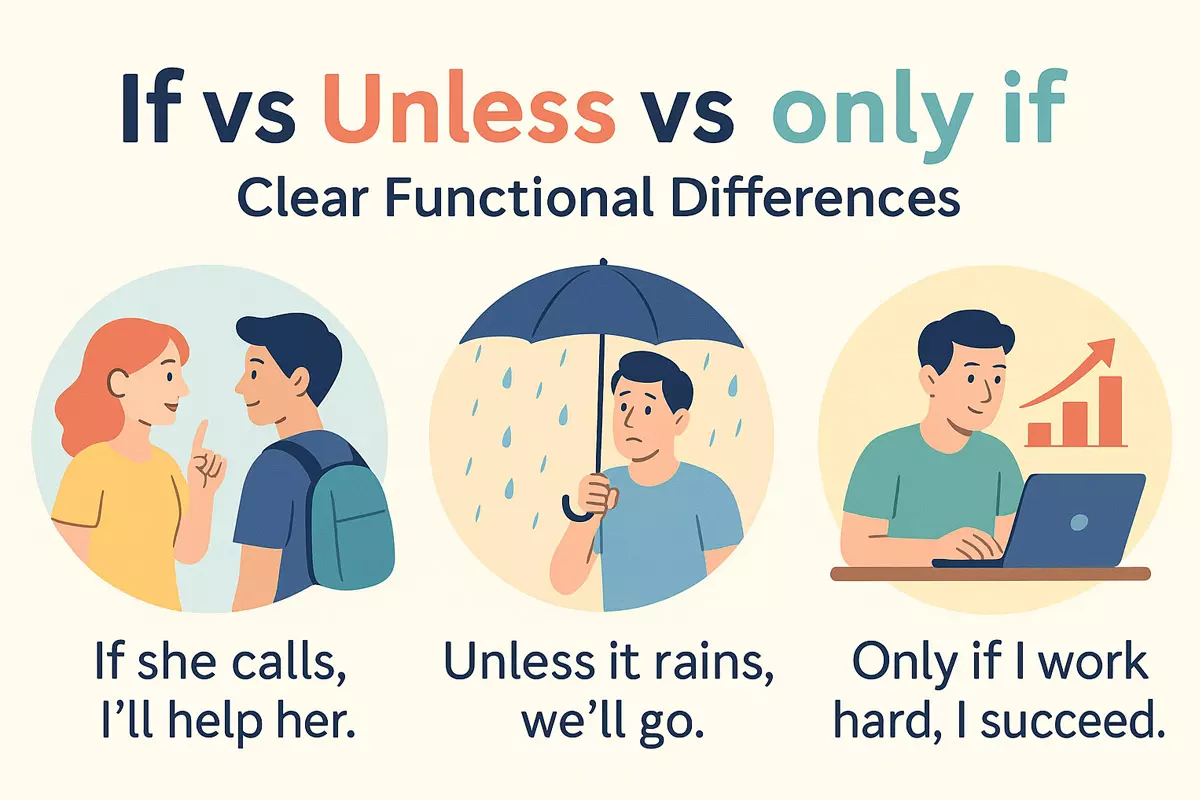 This article explains the differences between if, unless, and only if, their logical roles, and how each affects sentence meaning. It covers clause placement, tone, and formality, and includes examples and practice choosing the right conjunction.
- Meaning and usage differences among if, unless, and only if
- Logical relationships: positive condition vs negative condition vs strict condition
- Where to place the condition clause in a sentence
- Tone and formality considerations
- Examples showing how meaning changes with each conjunction
- Practice: choose the correct conjunction for each conditional idea
Mastering the subtle differences between conditional words in English, such as if, unless, and only if, can be challenging but is essential for clear and accurate communication. These terms may appear similar, but each has a distinct function that affects the meaning of your sentences. By learning how to use them correctly, you can express your ideas more precisely and avoid misunderstandings in both spoken and written English. Developing this skill will greatly enhance your ability to convey complex thoughts and respond effectively in a variety of situations.
Meaning and usage differences among if, unless, and only if
Understanding how "if," "unless," and "only if" function in English helps clarify the logic of statements and conditions. Each word introduces a different type of condition, and choosing the right one affects the meaning of a sentence.
How "if" works in conditional sentences
"If" introduces a condition that must be fulfilled for something else to happen. It is the most common conditional word, used for both real and hypothetical situations. For example, "If it rains, we will stay inside" shows a possible situation leading to a result.
- If you study, you will pass the exam.
- If she calls, let me know.
- If he arrives early, we can start dinner.
- If they agree, the project moves forward.
Understanding "unless" as a negative condition
"Unless" introduces a negative condition, meaning "except if." It sets a requirement that must not be true for the main clause to occur. For instance, "Unless it rains, we’ll go hiking" means "We’ll go hiking if it does not rain." This word is useful for expressing exceptions or default outcomes.
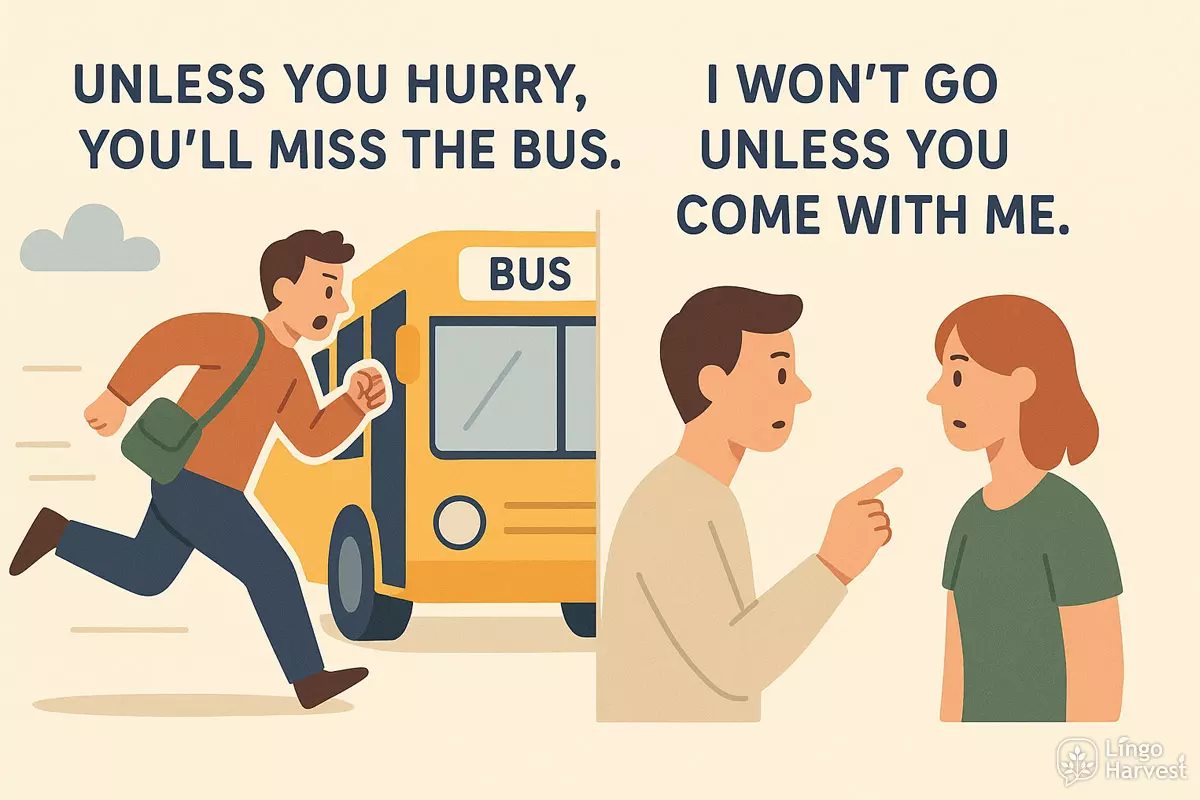
- Unless you hurry, you’ll miss the bus.
- I won’t go unless you come with me.
- She won’t pass unless she studies.
- Unless told otherwise, follow the instructions.
"Only if" for strict, exclusive conditions
"Only if" makes the condition exclusive. The main clause is true in one specific case, and not otherwise. For example, "She will agree only if you apologize" means apologizing is a necessary and exclusive condition for her agreement.
- You can enter only if you have a ticket.
- He’ll sign the contract only if the terms change.
- The machine works only if plugged in.
- Only if you ask politely will they help you.
Direct comparison of meaning and logic
The three words differ in how they relate the condition to the result. "If" is open and flexible, "unless" introduces a negative, and "only if" sets a strict requirement. This makes them not interchangeable.
| Connector | Type of Condition | Example Sentence |
|---|---|---|
| If | General/positive; possible situation | If you call, I’ll answer. |
| Unless | Negative; exception to the main action | I’ll go unless it rains. |
| Only if | Exclusive; the result happens in one specific case | She’ll help only if you ask. |
Summary of usage
Selecting between these connectors depends on the nuance you want to express. "If" suits most neutral or open conditions, "unless" is for exceptions, and "only if" is for strict, necessary requirements. Being attentive to these differences helps ensure your meaning is clear and accurate.
Logical relationships: positive condition vs negative condition vs strict condition
Understanding the difference between “if,” “unless,” and “only if” hinges on how each expresses a specific type of logical dependency. Each connector shapes the meaning of a sentence by indicating whether an outcome depends on a positive, negative, or strictly limited condition.
Positive Condition: “If”
“If” introduces a general, open condition—something may happen when another thing is true. This is the most flexible of the three, indicating a possible relationship without imposing extra restrictions.
- If you study, you will pass the test. (Passing depends on studying.)
- If it rains, we’ll stay indoors.
- If you call me, I’ll answer.
Negative Condition: “Unless”
“Unless” introduces an exception—a negative or exclusionary condition. It implies that the result will happen except in the stated case.
- You will fail unless you study. (You fail if you don’t study.)
- I won’t go unless you invite me.
- The train leaves unless there’s a delay.
Strict Condition: “Only if”
“Only if” signals a strict, limiting requirement. The result happens in no other circumstance except the one stated. This is less flexible and creates a one-way dependency.
- You will pass only if you study. (Studying is the sole way to pass.)
- We’ll go outside only if it’s sunny.
- I will help you only if you ask.
Comparison Table: Condition Types and Their Logical Relationships
| Connector | Logic Type | Effect on Outcome |
|---|---|---|
| If | Positive Condition | Outcome occurs when the condition is true; open possibility. |
| Unless | Negative Condition | Outcome occurs except when the condition is true; sets an exception. |
| Only if | Strict Condition | Outcome occurs exclusively when the condition is true; no alternatives. |
Summary of Usage Patterns
- “If” is for general possibilities: If you leave now, you’ll be on time.
- “Unless” sets a limit by exception: You won’t win unless you try.
- “Only if” is exclusive: He’ll attend only if he finishes work.
Recognizing these distinctions helps you select the connector that precisely matches your intended meaning, making your statements clearer and more logically accurate in both formal and everyday communication.
Where to place the condition clause in a sentence
Understanding the position of conditional clauses helps you write clearer and more natural sentences. In English, the part of the sentence that expresses the condition (the "if," "unless," or "only if" clause) is quite flexible. It can usually come at the start or the end of a sentence, depending on emphasis and flow. However, the placement can subtly affect meaning and tone.
Beginning vs. End Placement
Starting with the condition often puts focus on the possibility, while ending with it highlights the result. For example:
- If you study hard, you will pass the exam.
- You will pass the exam if you study hard.
Both are correct, but the nuance shifts slightly.
Comma Usage
A comma is usually needed when the conditional clause comes first:
- If it rains, we’ll stay inside. ✅
- We’ll stay inside if it rains. ✅ (no comma)
The same applies to "unless" and "only if."
Examples with 'If', 'Unless', and 'Only If'
Here’s how these condition words can be positioned in real sentences:
- If you hurry, you’ll catch the bus.
- You’ll catch the bus if you hurry.
- Unless you call ahead, there won’t be a table.
- There won’t be a table unless you call ahead.
- Only if you apologize will she forgive you. (note inversion!)
- She will forgive you only if you apologize.
- If it snows, schools may close.
- Schools may close if it snows.
- Unless you study, you won’t succeed.
- You won’t succeed unless you study.
- Only if you have a ticket can you enter. (inversion)
- You can enter only if you have a ticket.
Special Note: Inversion with "Only If"
When "only if" starts a sentence, English often uses inversion (switching subject and auxiliary verb):
- Only if you finish the work will you get paid. ✅
- ~Only if you finish the work, you will get paid. ❌
This pattern is unique to "only if" among these three.
Summary Table: Condition Clause Placement
| Condition Word | Start of Sentence | End of Sentence | Comma Needed? | Special Grammar |
|---|---|---|---|---|
| If | If you arrive early, we’ll begin. | We’ll begin if you arrive early. | Yes, at start | Normal word order |
| Unless | Unless you hurry, you’ll be late. | You’ll be late unless you hurry. | Yes, at start | Normal word order |
| Only if | Only if you ask will I help. | I will help only if you ask. | Yes, at start | Inversion at start |
In summary, conditional clauses are flexible in their position, but small changes—especially with "only if"—can affect both punctuation and grammar. For most cases, choose the position that best fits your emphasis and make sure to use the correct punctuation.
Tone and formality considerations
Understanding how “if,” “unless,” and “only if” affect the style and register of your sentences is essential. Each connector brings its own nuance, which can subtly shift how formal or casual your message sounds. For example, “if” is broadly neutral and fits most situations, from academic writing to everyday speech. “Unless” is also common in both spoken and written contexts, but it can introduce a slightly more conversational or conditional feel. “Only if,” on the other hand, tends to sound more precise and can come across as stricter or more official, making it well-suited for rules, policies, or technical instructions.
Choosing the right connector for your audience
Selecting between these terms often depends on your relationship with the reader or listener. In professional or legal documents, “only if” is favored for its clarity and lack of ambiguity. In informal emails or casual conversation, “if” and “unless” are more approachable and natural. Overusing “only if” in everyday exchanges may make your statements seem rigid or overly formal.
- “If” is appropriate for both formal and informal communication.
- “Unless” is friendly and straightforward, commonly used in speech.
- “Only if” signals strict conditions and is often used in official documents.
- Switching between these can soften or strengthen your tone.
- Context matters: technical writing prefers “only if” for accuracy.
- Instructions often use “unless” to highlight exceptions.
- “If” is flexible and rarely sounds out of place.
- “Only if” may imply non-negotiable terms.
- “Unless” can sometimes sound less formal than “if not.”
- In academic writing, all three are acceptable but should be chosen for clarity.
- Politeness can be impacted by the connector you choose.
- “Only if” can make requests sound more like requirements.
- “If” is often used to propose ideas or possibilities.
- “Unless” highlights special conditions or exceptions.
- Be mindful: “only if” is rarely used in casual speech.
Comparative overview of tone and register
| Connector | Common Tone/Register | Typical Usage Example |
|---|---|---|
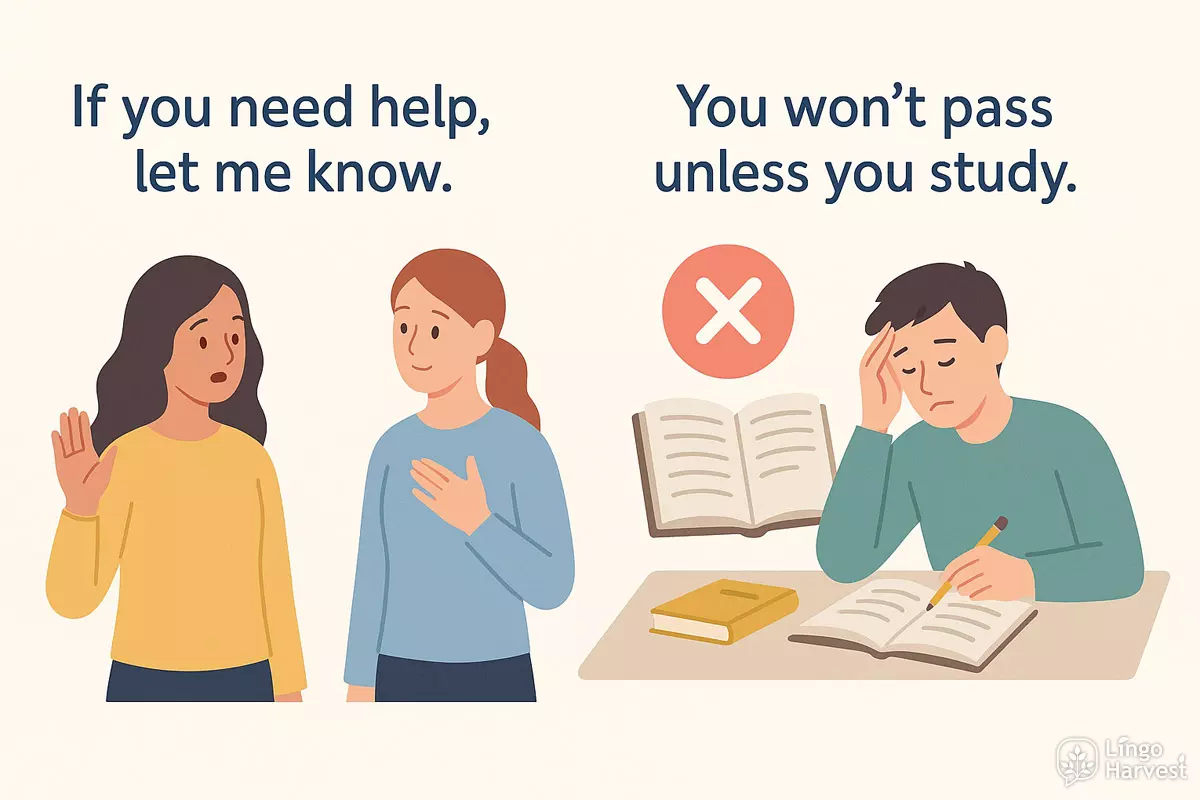
| If | Neutral, versatile | If you need help, let me know. |
| Unless | Conversational, clear | You won’t pass unless you study. |
| Only if | Formal, precise | Access is granted only if you have a badge. |
Being aware of these distinctions helps you tailor your language for the situation, whether you’re drafting an email, giving instructions, or writing academic content. Adjusting your choice of connector can help ensure your intent and level of formality are both clear and appropriate.
Examples showing how meaning changes with each conjunction
Understanding the impact of "if," "unless," and "only if" on a sentence's logic is crucial for clear, accurate communication. Each conjunction sets a different condition, which can completely alter the meaning of a statement. Below, you'll see how swapping these connectors changes intent and outcome.
Comparing Real-Life Sentences
- If: If it rains, we will cancel the picnic.
(A picnic is canceled in the event of rain.) - Unless: Unless it rains, we will have the picnic.
(A picnic happens except in the event of rain.) - Only if: We will cancel the picnic only if it rains.
(Rain is the sole reason for cancellation.)
How Shifting the Conjunction Alters Logic
| Conjunction | Resulting Meaning |
|---|---|
| If | If you study, you will pass the exam. (Studying gives a chance to pass, but not the only way.) |
| Unless | You will pass the exam unless you fail to study. (Passing is expected except if you don't study.) |
| Only if | You will pass the exam only if you study. (Studying is the single condition for passing.) |
| If | If you call me, I will help you. (Calling is one possible way to get help.) |
| Unless | I will help you unless you don't call me. (Help is expected unless you fail to call.) |
| Only if | I will help you only if you call me. (Calling is required for help; no call means no help.) |
| If | If the shop is open, I’ll buy bread. (Buying bread depends on the shop being open.) |
| Unless | I’ll buy bread unless the shop is closed. (I’ll buy bread except if the shop is closed.) |
| Only if | I’ll buy bread only if the shop is open. (Bread will be bought exclusively when the shop is open.) |
Key Takeaways
- If introduces a general condition; other outcomes remain possible.
- Unless sets an exception; the action happens except in one case.
- Only if defines a single, exclusive condition for the result.
- Substituting one for another can reverse, restrict, or broaden meaning.
- Precision in choosing the right connector prevents misunderstandings.
Practice: choose the correct conjunction for each conditional idea
Understanding when to use "if", "unless", or "only if" is essential for expressing different types of conditions accurately. The following exercises will help you distinguish between these conjunctions in practical contexts. Below, you'll find a mix of fill-in-the-blank sentences and a short quiz to test your ability to select the most appropriate conditional word.
Fill in the Blank: Which Conjunction Fits?
Read each sentence and decide whether "if", "unless", or "only if" completes the meaning best. Think about whether the condition is general, negative, or exclusive.
- ________ you study, you will not pass the exam.
- We will go for a walk ________ it doesn't rain.
- You can enter the contest ________ you are over 18.
- ________ you hurry, you'll miss the train.
- I'll forgive you ________ you tell me the truth.
- Don't call me ________ it's urgent.
- The machine will stop ________ you press the red button.
- She won't come to the meeting ________ she is invited.
- We won't start the movie ________ everyone arrives.
- You won't understand this topic ________ you ask questions.
Show answers
- Unless you study, you will not pass the exam.
- If it doesn't rain, we will go for a walk.
- Only if you are over 18 can you enter the contest.
- If you hurry, you'll miss the train.
- Only if you tell me the truth will I forgive you.
- Unless it's urgent, don't call me.
- If you press the red button, the machine will stop.
- Unless she is invited, she won't come to the meeting.
- Only if everyone arrives will we start the movie.
- Unless you ask questions, you won't understand this topic.
Quick Check: When to Use Each Conjunction
Here’s a summary of when each word is typically used. Review these points before moving to the next task:
- If: For general conditions and possibilities.
- Unless: For negative conditions (meaning "if not").
- Only if: For strict, exclusive conditions (something is true in just one case).
Identify the Conditional Type
Decide which conjunction is most logical in each scenario:
- You can borrow my car (only if / unless / if) you fill up the tank after using it.
- (If / Unless / Only if) you have an appointment, you don't need to wait.
- The alarm sounds (unless / only if / if) someone opens the door without a key.
- She gets nervous (if / unless / only if) she has to speak in public.
- You can enter the building (only if / unless / if) you show your ID.
- (If / Unless / Only if) you pay in advance, your booking is not confirmed.
- The machine stops (if / only if / unless) you press this button.
- He never gets angry (unless / if / only if) someone lies to him.
- You can join us (if / unless / only if) you finish your work on time.
- The lights turn on (only if / unless / if) you flip this switch.
Show answers
- Only if you fill up the tank after using it.
- Unless you have an appointment, you don't need to wait.
- If someone opens the door without a key, the alarm sounds.
- If she has to speak in public, she gets nervous.
- Only if you show your ID.
- Unless you pay in advance, your booking is not confirmed.
- If you press this button, the machine stops.
- Only if someone lies to him.
- If you finish your work on time.
- Only if you flip this switch.
Common Traps: Spot the Mistake
Some sentences below have the wrong conjunction. Identify which ones are incorrect and suggest corrections.
- I’ll be there unless you need me. (Correct/Incorrect?)
- Only if you don’t hurry, you’ll be late. (Correct/Incorrect?)
- If you don’t call me, I’ll assume you’re fine. (Correct/Incorrect?)
- Unless you study, you’ll fail the test. (Correct/Incorrect?)
- Unless you invite him, he won’t come. (Correct/Incorrect?)
- If you don’t lock the door, someone might come in. (Correct/Incorrect?)
- Only if you leave now, you catch the bus. (Correct/Incorrect?)
- Unless it rains, the event is canceled. (Correct/Incorrect?)
- If you don’t try, you won’t succeed. (Correct/Incorrect?)
- Only if you study, you will pass the exam. (Correct/Incorrect?)
Show answers
- Incorrect. Correction: I’ll be there if you need me.
- Incorrect. Correction: If you don’t hurry, you’ll be late.
- Correct.
- Correct.
- Correct.
- Correct.
- Incorrect. Correction: If you leave now, you’ll catch the bus.
- Incorrect. Correction: The event is canceled if it rains.
- Correct.
- Incorrect. Correction: If you study, you will pass the exam.
By practicing with these examples, you’ll develop a clearer sense of how to choose between these conditional connectors in real communication. Remember that "unless" often replaces "if not", and "only if" sets a strict requirement that must be met.