How to Use In Case and In the Event That Correctly

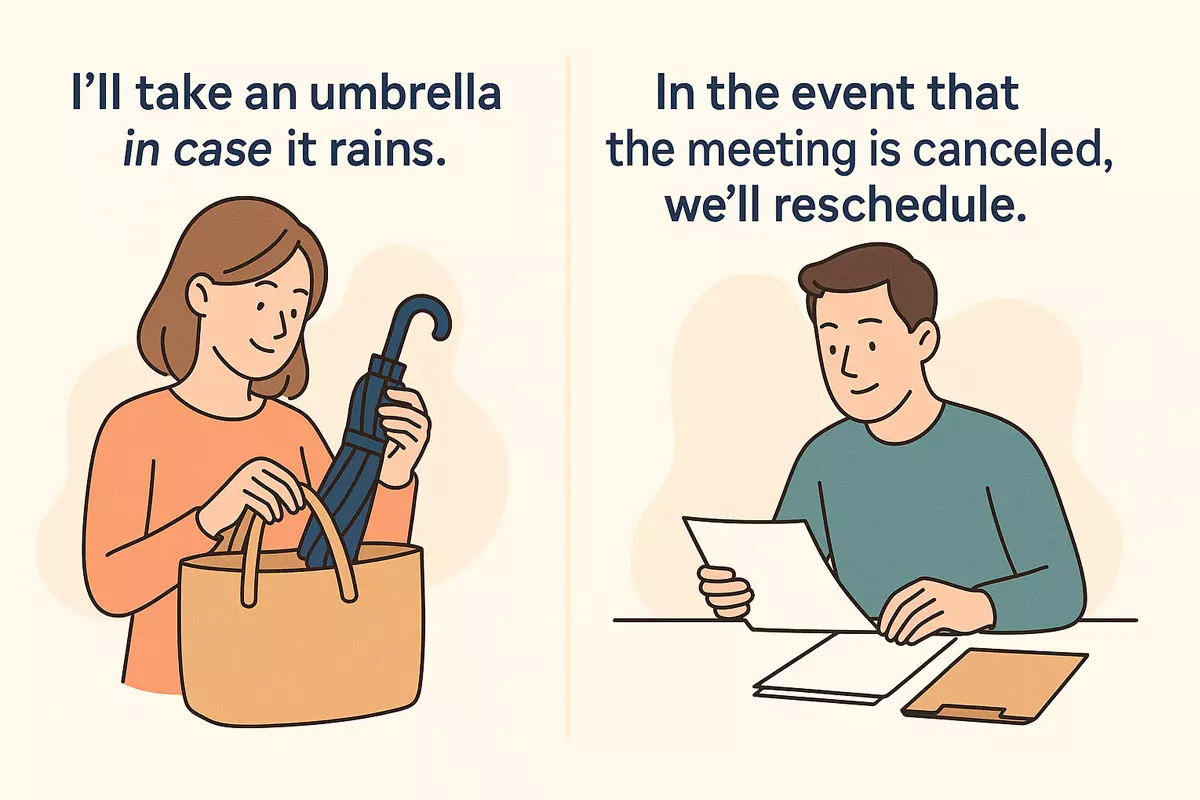 The article explains how precaution works in English conditionals, when to use in case for daily situations and in the event that for formal or rare ones, differences in tone and likelihood, common mistakes, and gives practice with both phrases.
Navigating the subtle differences between similar English expressions can be challenging, particularly when discussing possible situations. Knowing when to use alternatives such as "if necessary" or "should something happen" can make your language sound more natural and precise in both writing and conversation. By paying attention to context and meaning, you can select the most appropriate phrase, which not only improves clarity but also helps you communicate more effectively and confidently in various situations.
Meaning of precaution in English conditionals
When English speakers use expressions like "in case" or "in the event that" in conditional sentences, the focus is often on taking steps to prevent problems or to be ready for unexpected situations. These phrases signal that the action is not certain to happen, but preparation or caution is considered wise. The idea is to avoid negative consequences or to be ready just in case something occurs.
How precaution works in conditional phrases
Precaution in conditionals usually means doing something before a problem arises, not after. For example, "Take an umbrella in case it rains" means you bring the umbrella now, even though rain is only a possibility. The precaution is proactive: you prepare for a potential issue, not a definite one.
Common ways to express precaution
English offers several structures to show this sense of prevention or readiness. Some of the most frequent include:
- In case: "Take your keys in case you get locked out."
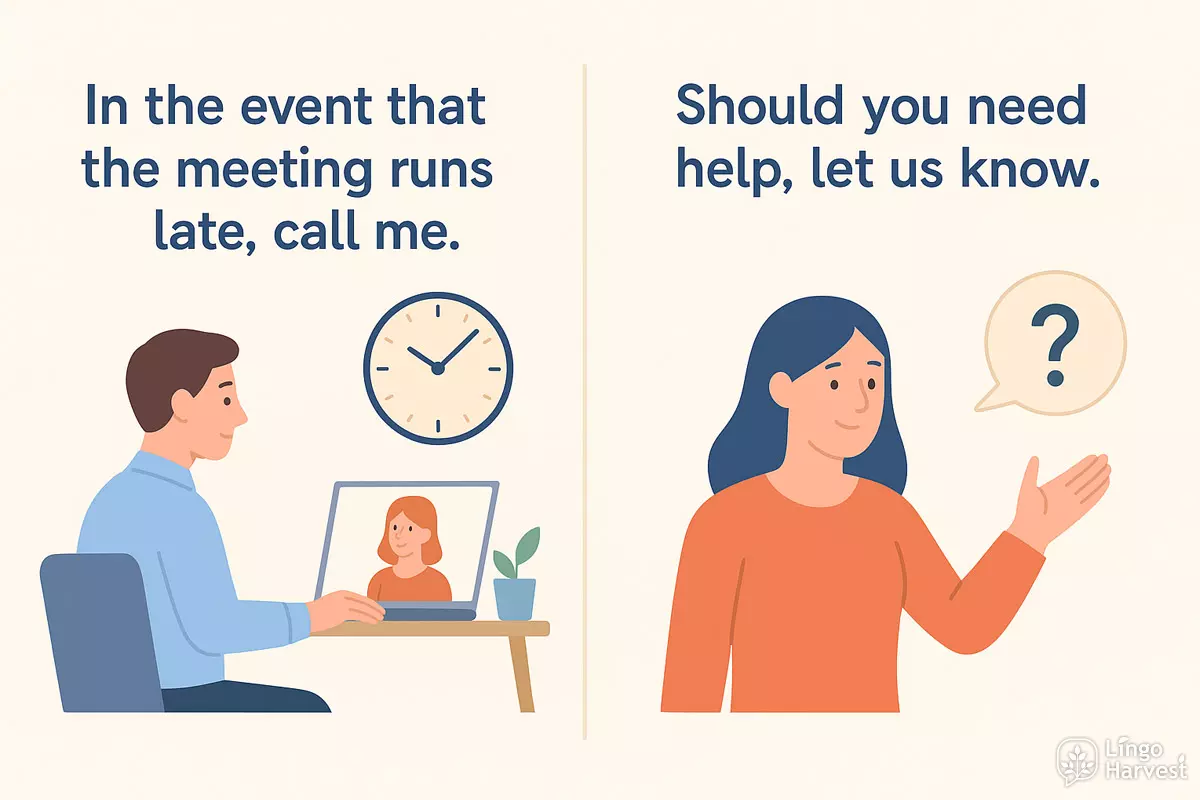
- In the event that: "In the event that the meeting runs late, call me."
- Should + subject + verb: "Should you need help, let us know."
- Just in case: "Pack some snacks just in case you're hungry later."
- If (with a precautionary tone): "If you feel sick, stay home."
- For fear that: "He whispered for fear that someone might hear."
- Lest: "Take notes lest you forget the details."
- So that (purpose): "Leave early so that you won’t be late."
- Against (the possibility that): "Stock up against the possibility that supplies run out."
- To avoid: "Double-check your work to avoid mistakes."
- Should anything happen: "Call this number should anything happen."
- As a precaution: "As a precaution, back up your files."
- In anticipation of: "They prepared extra food in anticipation of more guests."
- Protecting against: "Wearing sunscreen protects against sunburn."
- On the off chance that: "Bring a charger on the off chance that your phone dies."
- To be on the safe side: "Take your passport, to be on the safe side."
- Preparing for the possibility: "She saved money, preparing for the possibility of an emergency."
Comparing different precautionary structures
| Structure | Usage Example |
|---|---|
| In case | Take a flashlight in case the power goes out. |
| In the event that | In the event that you are delayed, send a message. |
| Should + subject + verb | Should you have any questions, contact support. |
| Just in case | Bring extra cash just in case. |
| Lest | He hurried lest he be late. |
| For fear that | She left early for fear that traffic would be bad. |
Key points to remember
Precautionary conditionals do not guarantee the event will happen; they reflect a mindset of preparation. The action taken is meant to reduce risk or handle possible trouble before it arises. Choosing the right expression depends on formality, context, and how strong the sense of caution needs to be.
Using in case for everyday preparations or prevention
When talking about being ready for possible situations in daily life, "in case" is the natural choice. It helps us express precaution, readiness, or an action taken to avoid potential problems before they happen. This phrase is commonly used when we prepare for something that might occur, even if we don’t expect it to.
Common situations for "in case"
People use "in case" when they want to explain why they are doing something to handle a possible event. Here are some typical scenarios:
- Taking an umbrella in case it rains
- Bringing a snack in case you get hungry
- Charging your phone in case you need to call someone
- Leaving early in case there’s traffic
- Locking the door in case someone tries to enter
- Bringing extra cash in case cards don’t work
- Saving documents in case the computer crashes
- Wearing layers in case it gets cold
- Writing notes in case you forget details
- Taking medicine in case symptoms come back
- Setting an alarm in case you oversleep
- Bringing a charger in case your battery dies
- Checking the weather in case plans change
- Putting water in the car in case it overheats
- Buying insurance in case of accidents
How "in case" differs from similar phrases
"In case" is often confused with similar expressions like "if" or "in the event that." However, "in case" is specifically about taking action now to prepare for something that might occur. For example, you might pack a jacket in case it gets cold, but you would not use "if" in the same way for a precautionary action.
Patterns and structure
This expression is usually followed by a subject and verb, or a noun if the situation is clear. For example:
- “I’ll write down the address in case you lose it.”
- “Take some money in case of emergencies.”
Quick reference: Typical uses of "in case"
- Preparing for possible events (rain, delays, emergencies)
- Explaining the reason for a precaution
- Making recommendations for readiness
Remember, "in case" is about forethought and prevention, not about reacting to events as they happen. Use it when you want to show that an action is taken now to handle a possible, but uncertain, future situation.
Using in the event that for formal or unlikely scenarios
The phrase in the event that is typically reserved for formal writing or situations that are considered improbable. It often appears in legal documents, contracts, and official statements where clarity and caution are important. While it can sometimes be swapped with in case, in the event that tends to sound more official and is used when discussing possibilities that are not expected to happen, but still deserve mention for completeness or precaution.
When to use “in the event that”
- Drafting formal agreements or contracts
- Writing policy statements or regulations
- Outlining procedures for rare emergencies
- Clarifying unlikely but possible scenarios
- Adding a sense of seriousness or gravity to a statement
- When you want to avoid ambiguity in official communications
- Specifying backup plans in technical documentation
- Describing actions to take if something unexpected occurs
- Providing instructions for exceptional circumstances
- Legal disclaimers or terms and conditions
Example sentences with “in the event that”
- In the event that the meeting is cancelled, all participants will be notified by email.
- In the event that you lose your key, please contact building security.
- All warranties are void in the event that the product is modified by the user.
- Employees must evacuate the building in the event that the fire alarm sounds.
- In the event that payment is not received, your account will be suspended.
- The agreement will terminate in the event that either party breaches the terms.
- In the event that your application is unsuccessful, you may reapply after six months.
- Use the backup generator in the event that there is a power outage.
- The insurance policy is only active in the event that the premiums are paid on time.
- We will reschedule in the event that weather conditions are unsafe.
Comparing “in case” and “in the event that”
| Expression | Typical Use | Formality | Example |
|---|---|---|---|
| in case | Everyday conversation, likely scenarios | Informal to neutral | Take an umbrella in case it rains. |
| in the event that | Contracts, regulations, unlikely or serious scenarios | Formal | In the event that the system fails, follow the emergency protocol. |
Choosing between these expressions depends on both the likelihood of the event and the tone you want to convey. For most casual contexts, in case is sufficient. However, when you need to address rare or significant circumstances, or when writing formally, in the event that is the preferred choice.
Differences in tone and probability
When deciding between "in case" and "in the event that," the way each phrase sounds and the likelihood it expresses are key factors. "In case" tends to be more informal and direct, often used in spoken English and everyday writing. On the other hand, "in the event that" is more formal and is commonly found in legal documents, contracts, or official correspondence.
Tone: Formality and Context
- "In case" usually feels casual and conversational. You might use it when chatting with friends or writing emails at work.
- "In the event that" sounds more official. It's appropriate for policies, instructions, or when you want to sound precise and careful.
Probability: Likelihood and Intention
- "In case" suggests you are preparing for something that might happen, but probably won't. The focus is on being ready just in case the situation arises.
- "In the event that" does not directly indicate probability, but is used to cover a possible scenario—often one that is less expected or more serious. It’s about outlining procedures or consequences if something occurs.
Comparing Usage in Sentences
| Phrase | Typical Example & Context |
|---|---|
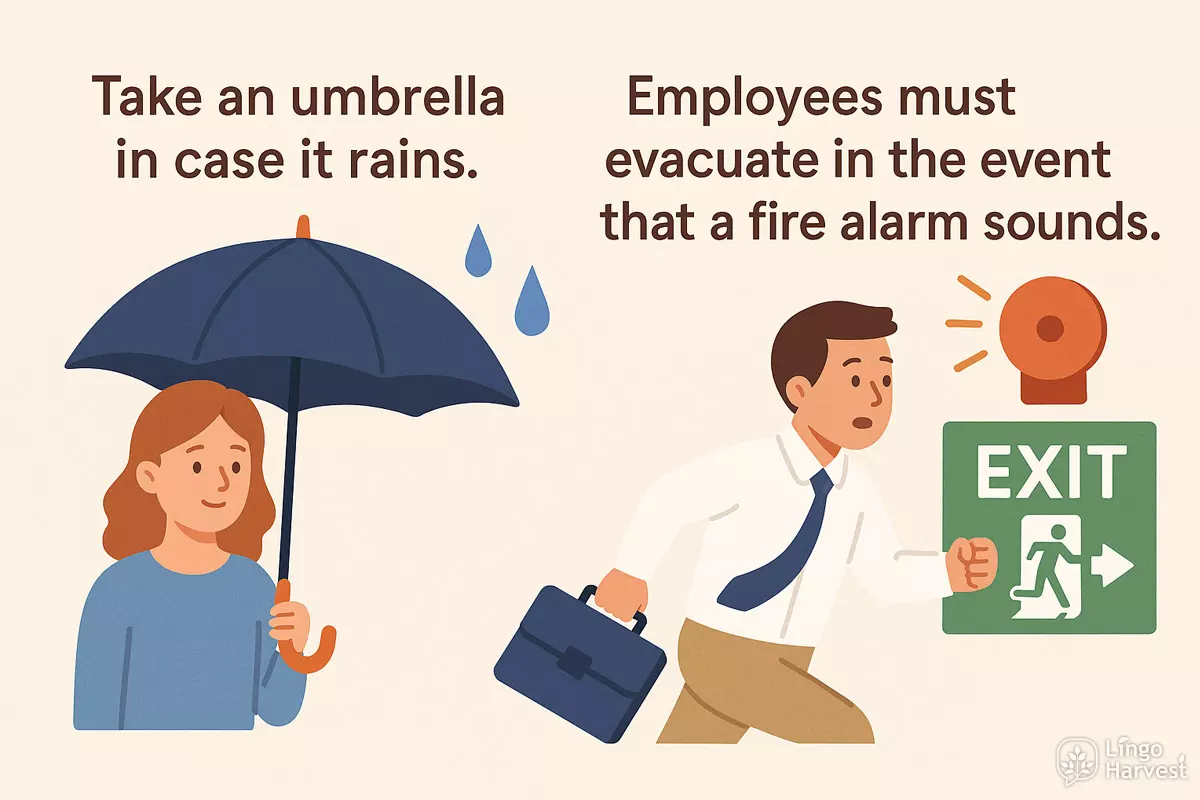
| in case | Take an umbrella in case it rains. → Everyday advice, suggests rain is possible but not certain. |
| in the event that | Employees must evacuate in the event that a fire alarm sounds. → Formal instruction, emphasizes procedure if something happens. |
| in case | Please call me in case you need help. → Friendly offer, assumes needing help is unlikely but possible. |
| in the event that | Payments will be refunded in the event that the event is canceled. → Official policy, outlines what happens if cancellation occurs. |
Quick Reference: When to Use Each
- Choose "in case" for informal suggestions, everyday planning, or when the situation is possible but not expected.
- Opt for "in the event that" in written rules, legal statements, or when formality and clarity about conditions are needed.
Understanding these subtle differences can help you sound more natural in conversation and precise in formal writing. The choice depends on both the tone you want and how likely you think the situation is.
Common errors with tense and word order
Many learners mix up verb tenses and structure when using "in case" and "in the event that." These phrases are often confused because they introduce possible situations, but the grammar rules differ subtly. Misunderstandings can lead to awkward sentences or unintended meanings. Below, we’ll clarify the most frequent mistakes, offer clear examples, and provide guidance to help you avoid them.
Tense confusion with "in case"
"In case" usually calls for the present simple tense when talking about future possibilities, not the future tense. Learners often add "will," which is incorrect. For example:
- ❌ I’ll bring an umbrella in case it will rain.
- ✅ I’ll bring an umbrella in case it rains.
This mistake happens because "in case" means "because something might happen," so the present tense is used for the possible event.
Incorrect word order
Both "in case" and "in the event that" can go at the start or end of a sentence, but the clause order must be logical. Errors happen when clauses are jumbled, making the sentence hard to follow. For example:
- ❌ In case you are late, call me you should.
- ✅ Call me in case you are late.
Mixing up "in case" and "in the event that"
Although similar, "in the event that" is more formal and often pairs with the present simple for future events, too. Don’t swap them without considering the context and register.
| Incorrect Example | Corrected Version |
|---|---|
| Take your phone in case you will need it. | Take your phone in case you need it. |
| In the event that it will rain, the match is cancelled. | In the event that it rains, the match is cancelled. |
| She’ll call you in case if she misses the bus. | She’ll call you in case she misses the bus. |
| In case of you are late, send a message. | If you are late, send a message. Or: Send a message in case you are late. |
| I took notes in case I will forget. | I took notes in case I forgot. |
Common pitfalls to watch for
- Using "will" after "in case" or "in the event that" for future possibilities
- Placing both phrases at the wrong place in the sentence
- Adding unnecessary words: "in case if..." is incorrect
- Confusing "in case" (precaution) with "if" (condition)
- Forgetting to match the tense of the main clause with the subordinate clause
- Using "in case of" for clauses (it should be followed by a noun, not a verb)
- Being too formal or informal for the context
- Creating run-on sentences by joining too many clauses
- Switching tenses within the same sentence unnecessarily
- Omitting the subject in the subordinate clause
Being aware of these patterns will help you construct natural, accurate sentences with both "in case" and "in the event that." Practice by checking your sentences for tense and word order before finalizing them.
Practice: complete sentences using in case or in the event that
Understanding the subtle differences between in case and in the event that helps improve clarity and formality in English writing. Below, you’ll find exercises and practical examples to help you select the right phrase for different situations. Read each sentence and decide which expression best fits the context.
Fill in the Blank
Complete each sentence by choosing either in case or in the event that.
- Take an umbrella ______ it rains later this afternoon.
- We have extra snacks ______ some guests arrive hungry.
- The evacuation plan will be used ______ there is a fire.
- Call me ______ you need any help with your homework.
- We should leave early ______ we run into heavy traffic.
- ______ I forget, please remind me to send the email.
- ______ the printer breaks down, you can use the one in the next room.
- Bring your charger ______ your phone battery dies during the trip.
- ______ you cannot attend the meeting, let us know in advance.
- She wrote down the directions ______ she got lost on the way.
Show answers
- in case
- in case
- in the event that
- in case
- in case
- In case
- In the event that
- in case
- In the event that
- in case
Usage Patterns and Examples
The following list provides more sentences where you can observe the typical usage of both expressions. Try to identify which phrase fits naturally in each context:
- Keep a flashlight nearby ______ the power goes out.
- ______ of emergency, dial this number immediately.
- He brought his ID ______ he needed to show it at the entrance.
- ______ the weather gets worse, the event will be postponed.
- Store important files online ______ your computer crashes.
- ______ you are unable to finish the test, inform your teacher.
- She always checks the fuel level ______ she forgets to refuel before a long drive.
- ______ you miss your flight, contact the airline for rebooking options.
- Take notes ______ you forget the main points of the lecture.
- ______ of any changes to the schedule, we will notify you by email.
Show answers
- in case
- In the event that
- in case
- In the event that
- in case
- In the event that
- in case
- In the event that
- in case
- In the event that
Quick Reference: Choosing the Right Expression
Use the guide below to help you remember when to use each phrase:
- in case: For preparing for something that might happen, often with a sense of precaution.
- in the event that: For formal contexts, or when talking about what will happen if a specific event occurs.
Practicing with these sentences will help you gain confidence in selecting the appropriate phrase for both everyday and formal communication.