Using Modal Verbs in Conditional Sentences: Can, Could, Might, Would

 This article explains modal verbs in conditional sentences, highlighting the differences between ability, possibility, permission, and likelihood. It covers how would, might, and could work and provides B1–B2 level structures with practice exercises.
- Overview of modal meaning in conditional sentences
- Difference between ability, possibility, permission, and likelihood
- How would expresses imagined or hypothetical results
- How might and could show different degrees of possibility
- Typical structures at B1–B2 level
- Practice: complete conditional sentences with the best modal verb
Understanding conditional statements in English involves selecting the appropriate auxiliary verbs to convey different shades of meaning, such as possibility, permission, or hypothetical results. Words like can, could, might, and would each serve specific roles in expressing what is possible, what is permitted, or what could happen under certain circumstances. By learning to use these auxiliaries correctly, you can clarify your intentions and describe various scenarios more effectively, making your communication both precise and natural in everyday conversations or writing.
Overview of modal meaning in conditional sentences
Modal verbs like can, could, might, and would play a crucial role in expressing different shades of possibility, probability, permission, and hypothetical situations within conditional sentences. The choice of modal helps specify the speaker's attitude toward the condition and its likely result, ranging from real possibilities to pure speculation.
How modals shape meaning in conditionals
In English, modals in conditional sentences allow speakers to convey more than just "if X, then Y." They add nuance, such as indicating uncertainty, politeness, or imagining alternative realities. For example, can suggests general ability or possibility, while could and might often express less certainty or more remote possibilities. Would typically marks hypothetical or unreal situations.
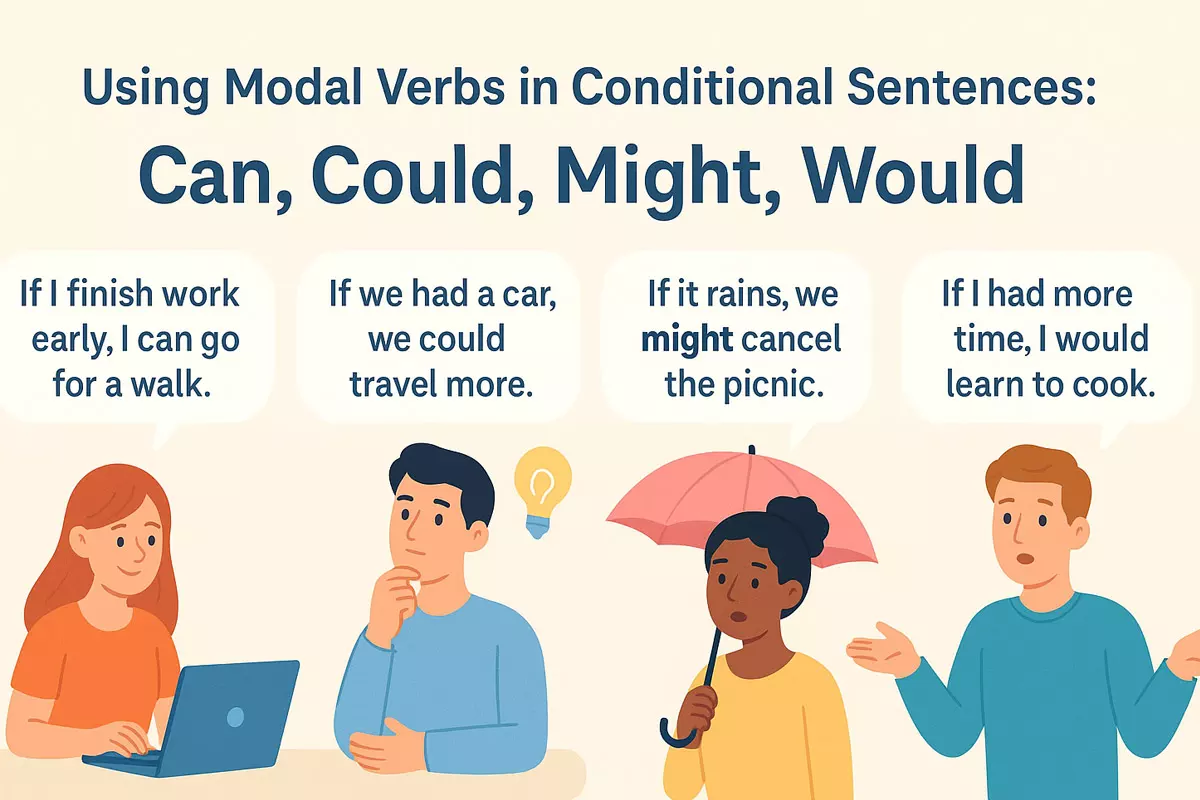
- Can – ability or factual possibility: “If you can finish early, we’ll go to the park.”
- Could – polite suggestion or hypothetical ability: “If you could help me, I’d appreciate it.”
- Might – uncertain or tentative possibility: “If it rains, we might stay home.”
- Would – imagined outcome or preference: “If I had more time, I would travel more.”
The placement and selection of these verbs depend on both the type of conditional sentence (zero, first, second, or third) and the intended meaning. Modals can appear in the main clause, the conditional clause, or sometimes both, each time subtly shifting the sense of the sentence.
Common patterns and meanings with modals in conditionals
Let's look at some typical uses of modals in "if" sentences and what they convey:
- If you can speak French, you can work here. ✅ (real ability/possibility)
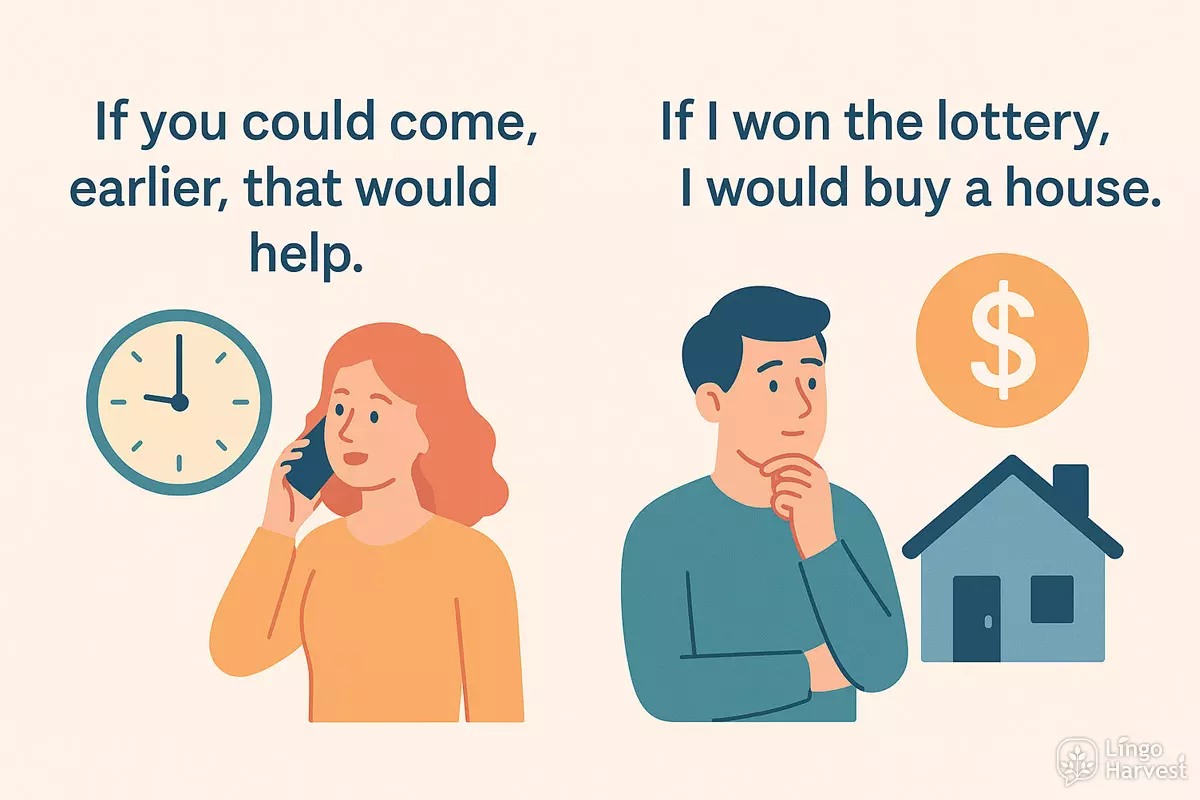
- If you could come earlier, that would help. (polite/hypothetical suggestion)
- If I won the lottery, I would buy a house. (imagined result)
- If it snows tomorrow, we might cancel the trip. (uncertain future)
- If you had left earlier, you would have arrived on time. (unreal past)
- If you should need help, call me. (formal/less likely condition)
- If I were you, I would apologize. (advice/unreal present)
- If you will wait a moment, I’ll check. (polite request)
- If we can solve this, everyone will benefit. (real possibility and result)
- If she could join us, it would be great. (hypothetical ability and result)
Modal verbs and conditional types
The following table summarizes how different modals typically function in conditional sentences, depending on the type of conditional and the meaning expressed:
| Conditional Type | Common Modals & Meaning | Example |
|---|---|---|
| Zero Conditional (general truths) |
can – ability, general possibility | If water is heated, it can boil. |
| First Conditional (real future) |
will, can, may, might – likely or possible future results | If it rains, we might stay in. |
| Second Conditional (unreal/present or future) |
would, could, might – hypothetical result or ability | If I went abroad, I would learn a lot. |
| Third Conditional (unreal/past) |
would have, could have, might have – imagined past result | If she had studied, she could have passed. |
Understanding the use of modals in "if" sentences helps speakers and writers convey precise attitudes—whether expressing certainty, making polite suggestions, or exploring hypothetical situations. This flexibility makes modals an essential part of nuanced English communication.
Difference between ability, possibility, permission, and likelihood
Understanding modal verbs in conditional sentences means recognizing the unique shades of meaning each modal brings. Words like "can," "could," "might," and "would" each signal something different depending on context. Let’s break down these core ideas to help you use them correctly.
Ability
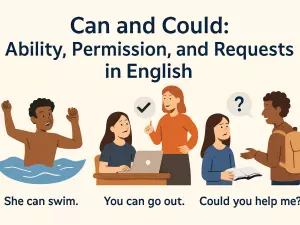
"Can" and "could" often express a person’s skill or means to do something. In conditionals, this refers to whether someone is capable of performing an action if a certain requirement is met.
- If you can swim, you can join the team. (present ability)
- If she could drive, she would visit more often. (past or hypothetical ability)
Possibility
"Could" and "might" are commonly used to suggest that something is possible, but not certain. In conditionals, they introduce outcomes that depend on another event.
- If it rains, we might cancel the picnic.
- If you study, you could pass the exam.
Permission
"Can" and "could" also handle requests or permission, especially in polite or formal contexts. Conditionals show what is allowed under certain circumstances.
- If you finish your homework, you can watch TV.
- If I finished early, could I leave?
Likelihood
"Might," "could," and "would" all signal how probable an event is, but with varying strengths. "Would" often describes a likely result in the second conditional, while "might" and "could" suggest less certainty.
- If I won the lottery, I would travel the world. (high likelihood, hypothetical)
- If you called her, she might answer. (less certain)
| Function | Typical Modals & Examples |
|---|---|
| Ability | If you can solve this, you can join. If she could speak French, she would move to Paris. |
| Possibility | If you hurry, you might catch the bus. If we ask, they could help us. |
| Permission | If you finish, you can leave early. If I could go, I would join you. |
| Likelihood | If I had more time, I would learn Spanish. If you try, you might succeed. |
Quick Reference: Common Patterns
- If + present simple, can/will/might + base verb
- If + past simple, could/would/might + base verb
- Use can/could for ability and permission
- Use might/could for possibility
- Use would for likely results in hypothetical situations
Getting comfortable with these distinctions helps you express yourself clearly and accurately in English, especially when talking about conditions and outcomes.
How would expresses imagined or hypothetical results
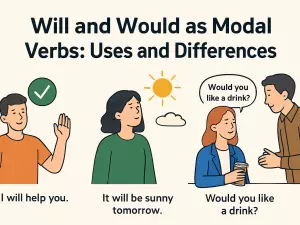
The modal verb would is essential for talking about imagined or hypothetical outcomes, especially in conditional sentences. When discussing situations that are not real or are only possible under certain circumstances, "would" helps to express what could happen if the condition were true. This usage is especially common in the second and third conditional forms.
Second Conditional: Present or Future Hypotheticals
In the second conditional, "would" is paired with the simple past tense to talk about unreal or unlikely situations in the present or future. This pattern allows speakers to speculate or imagine results that are not currently happening.
- If I won the lottery, I would travel the world.
- If she were taller, she would play basketball.
- If you studied more, you would get better grades.
- If they had a car, they would visit us more often.
- If it rained tomorrow, we would stay inside.
Third Conditional: Imagined Past Results
The third conditional is used for unreal situations in the past. Here, "would have" combines with the past participle to show what might have happened if things had been different.
- If you had called me, I would have come to help.
- If they had left earlier, they would have caught the train.
- If she had known about the meeting, she would have attended.
- If we had saved more money, we would have bought a bigger house.
- If I had studied harder, I would have passed the test.
Common Patterns and Examples
Below is a comparison of how "would" works in different types of conditional sentences to show hypothetical results:
| Conditional Type | Example Sentence |
|---|---|
| Second Conditional (Present/Future) | If I had more time, I would read more books. |
| Third Conditional (Past) | If they had invited me, I would have joined the party. |
| Mixed Conditional (Past Condition, Present Result) | If I had moved to Paris, I would be speaking French now. |
| Polite Requests (Less Common) | Would you help me if I asked? |
Summary of Uses
- Talking about unreal or imagined outcomes in the present or future.
- Speculating about what could have happened in the past.
- Describing hypothetical consequences based on impossible or unlikely conditions.
- Making polite requests or offers in certain contexts.
By using "would" in these ways, speakers can communicate possibilities and imagined scenarios clearly and effectively. This makes it a fundamental modal verb in expressing conditional ideas in English.
How might and could show different degrees of possibility
When talking about what is possible in conditional sentences, “might” and “could” help us express different levels of likelihood. Both are modal verbs, but they’re not always interchangeable. The choice between them can subtly shift the meaning of your sentence, signaling either a more remote or a more realistic outcome.
Understanding the nuance
“Could” often suggests a real, but not definite, possibility. It implies that something is within the realm of what can happen—perhaps depending on a choice or circumstance. In contrast, “might” usually introduces a more tentative or uncertain possibility, indicating that the result is less likely or more hypothetical. For example:
- If you hurry, you could catch the bus. (It’s genuinely possible.)
- If you hurry, you might catch the bus. (It’s possible, but there’s doubt.)
Comparing usage in conditional sentences
These modals are commonly used in second conditional sentences (if + past simple, modal + base verb) to talk about present or future possibilities that are not guaranteed. Here’s how the meaning shifts:
- If he studied harder, he could pass the exam. (He has the ability or opportunity.)
- If he studied harder, he might pass the exam. (It’s not certain, but there’s a chance.)
- If it rained tomorrow, we could stay inside. (Staying inside is a viable option.)
- If it rained tomorrow, we might stay inside. (We are considering it, but not sure.)
Common patterns and sentence examples
Here are more ways these modals appear in conditionals, showing subtle shades of meaning:
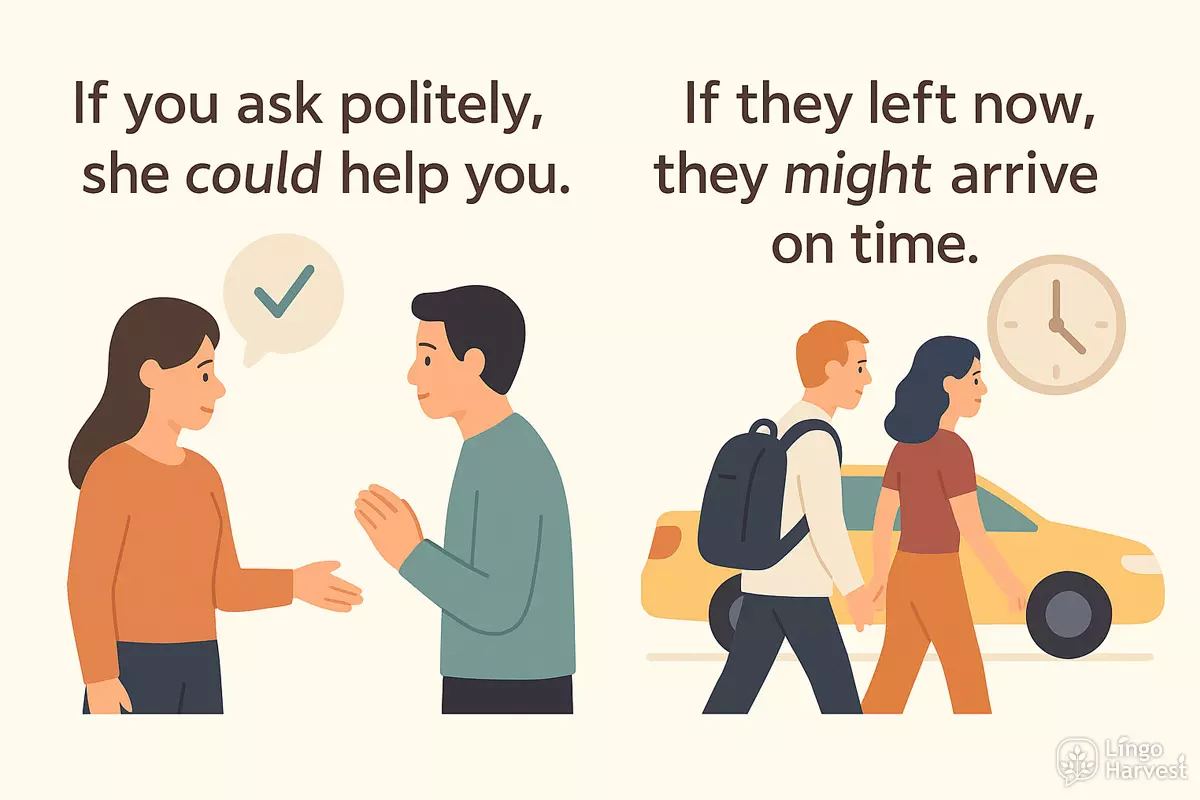
- If you ask politely, she could help you.
- If you ask politely, she might help you.
- If they left now, they could arrive on time.
- If they left now, they might arrive on time.
- If I had more time, I could visit you.
- If I had more time, I might visit you.
- If you tried, you could solve it.
- If you tried, you might solve it.
- If we invited them, they could come.
- If we invited them, they might come.
- If the weather improves, we could go hiking.
- If the weather improves, we might go hiking.
Summary: Degrees of Possibility
The difference between these two modal verbs becomes clearer when you compare their use side by side. “Could” tends to express a realistic or available option, while “might” leans toward uncertainty or speculation. Choosing between them helps you show exactly how likely you think something is.
| Modal Verb | Typical Degree of Possibility |
|---|---|
| Could | Realistic, reasonable, within reach |
| Might | More doubtful, tentative, speculative |
In summary, selecting “could” or “might” in conditionals allows you to control how probable or remote a possible result sounds, giving your sentences clarity and precision.
Typical structures at B1–B2 level
Learners at intermediate stages often use modal verbs in conditional sentences to express possibility, ability, permission, and hypothetical situations. Understanding how to combine modals like can, could, might, and would with different conditional forms helps communicate a range of meanings in English.
Common Modal Verb Patterns in Conditionals
At these levels, students typically work with first and second conditional sentences, occasionally experimenting with third conditionals. Here are some frequent structures:
- If + present simple, can + base verb (ability or possibility):
If you finish early, you can go home. - If + present simple, might + base verb (possibility):
If it rains, we might stay inside. - If + past simple, could + base verb (hypothetical ability or possibility):
If I had more time, I could learn another language. - If + past simple, would + base verb (unreal/hypothetical result):
If he knew the answer, he would tell us. - If + present simple, would + base verb (polite requests, informal):
If you would help me, I’d be grateful. - If + past simple, might + base verb (less certain hypothetical):
If she tried, she might succeed. - Modal in the if-clause (less common, polite offers/suggestions):
If you could call me later, that would be great. - If + present simple, could + base verb (suggesting possible options):
If you need help, you could ask your teacher. - If + past simple, might/could + base verb (mixed conditionals):
If I were taller, I might play basketball. - Negative forms:
If he doesn't hurry, he might miss the bus.
If I didn't have a car, I couldn't visit you.
Comparing Modals in Conditional Sentences
Below is a summary of how these modal verbs are typically used in different types of conditionals at this level:
| Modal Verb | Example in a Conditional | Meaning/Usage |
|---|---|---|
| can | If you study, you can pass the test. | Expressing ability or real possibility |
| could | If I had time, I could help you. | Hypothetical ability or possibility |
| might | If it gets cold, we might stay home. | Suggesting a possible but uncertain result |
| would | If you called, I would answer. | Hypothetical or imagined result |
Tips for Practice
To master these patterns, try creating your own examples using different modals and conditionals. Focus on expressing real and unreal situations, and pay attention to how the meaning changes with each modal. Practice both positive and negative forms for a more complete understanding.
Practice: complete conditional sentences with the best modal verb
Understanding how modal verbs like can, could, might, and would fit into conditional sentences is essential for expressing possibility, ability, and hypothetical situations. In this section, you'll find a mix of fill-in-the-blank exercises and a variety of sentence starters. These activities will help you develop a clear sense of which modal verb fits best in each context.
Fill in the Blanks
Choose the most appropriate modal verb (can, could, might, would) to complete each sentence.
- If you studied harder, you ______ get better grades.
- If it rains tomorrow, we ______ need to cancel the picnic.
- If I had more free time, I ______ learn to play the guitar.
- If you finish your work early, you ______ leave the office.
- If she were here, she ______ help us solve this problem.
- If you call him now, he ______ be able to answer your question.
- If I saw a shooting star, I ______ make a wish.
- If we hurry, we ______ catch the last bus.
- If you had asked me, I ______ have told you the truth.
- If John eats too much cake, he ______ feel sick later.
Show answers
- could
- might
- would
- can
- could
- might
- would
- can
- would
- might
Sentence Starters: Choose and Complete
Use your knowledge of modal verbs in conditional sentences to finish these prompts naturally.
- If I won the lottery, I ________.
- If it snows tonight, we ________.
- If you see Anna, you ________.
- If I were you, I ________.
- If they arrive early, they ________.
- If the weather improves, we ________.
- If I had known about the meeting, I ________.
- If you practice every day, you ________.
- If the shop is open, we ________.
- If I had more information, I ________.
Show answers
- would travel the world
- might build a snowman
- can give her this letter
- would apologize
- can help set up
- could go for a walk
- would have attended
- can improve quickly
- might buy some snacks
- could answer your question
Quick Reference: Modal Verbs in Conditional Patterns
The table below summarizes typical uses of modal verbs in different types of conditional sentences:
| Type of Conditional | Common Modal Verbs | Example |
|---|---|---|
| If + present simple | can, might | If you hurry, you can catch the train. |
| If + past simple | would, could, might | If I knew his number, I would call him. |
| If + past perfect | would have, could have, might have | If she had seen him, she could have spoken to him. |
| If + modal verb | can, could, might, would | If you can help, please let us know. |
Practicing with a variety of examples helps you become comfortable choosing the right modal verb for each conditional sentence. Notice how meaning changes with different modals—sometimes showing possibility, other times ability or hypothetical results.