Conditional Clauses Without If: Should, Were, Had Inversion

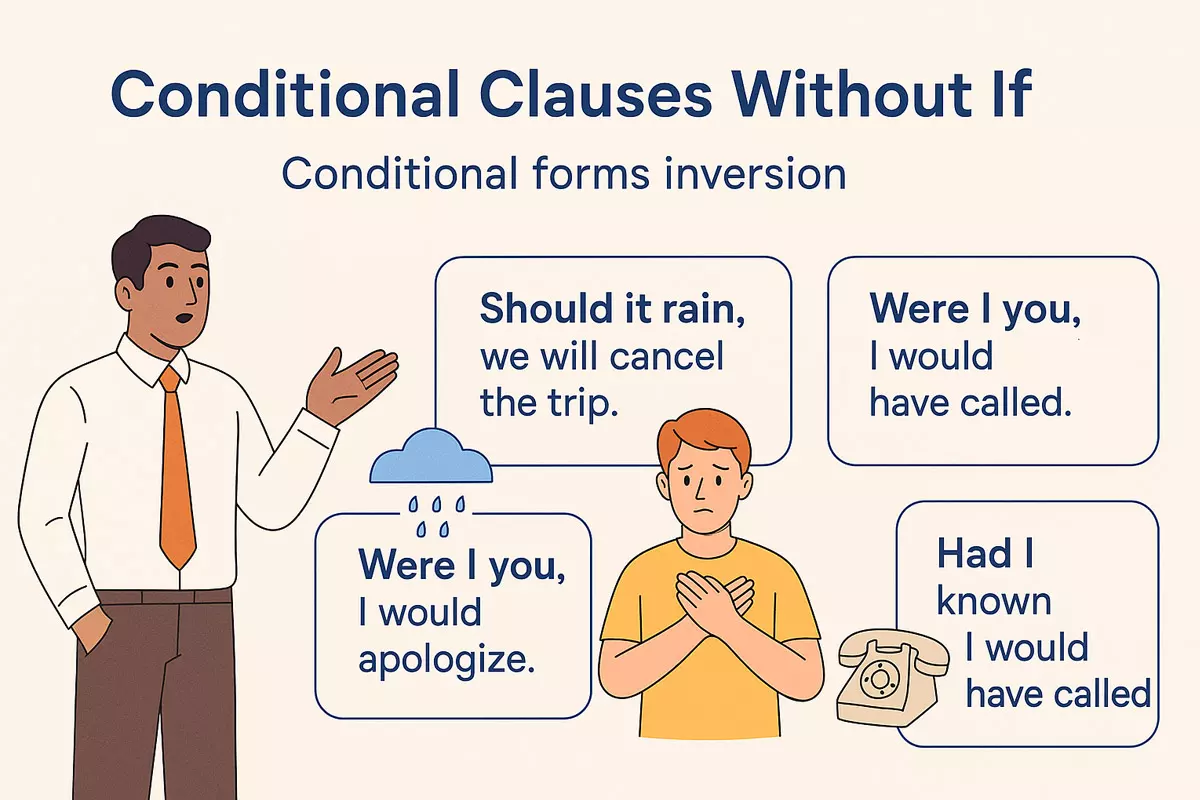 Here we what inversion is and why it appears in formal English, details patterns like should, were, and had plus subject, and explains how these differ from standard if-clauses.
- What inversion is and why English uses it in formal writing
- Inversion patterns: should + subject, were + subject, had + subject
- Meaning differences compared to standard if-clauses
- Register notes: academic, professional, and literary usage
- Examples showing subtle tone differences
- Practice: rewrite if-clauses using inversion
Expressing hypothetical situations in English doesn't always require starting your sentence with "if." Instead, you can use inversion with words like should, were, and had to convey conditions in a more advanced and sophisticated way. For example, saying "Should you need assistance, let me know" or "Had I known, I would have acted differently" provides variety and elegance to your language. Mastering these structures not only improves your fluency but also makes your speech and writing more engaging and nuanced.
What inversion is and why English uses it in formal writing
Inversion in English refers to changing the usual order of words in a sentence, most often by placing the auxiliary verb before the subject. This is common in questions (“Are you coming?”), but in formal writing and certain conditional clauses, inversion is used for stylistic and structural reasons. Instead of starting with “if,” writers and speakers can invert the subject and auxiliary to make the sentence sound more elegant or emphasize a hypothetical situation.
How inversion works in conditionals
Normally, conditional sentences begin with “if,” followed by the subject and verb (“If he should call, let me know”). In more formal contexts, “if” is dropped and the auxiliary comes first: “Should he call, let me know.” This technique is especially common with “should,” “were,” and “had.” Using inversion in this way signals a hypothetical or unlikely scenario, and it often appears in written or formal spoken English.
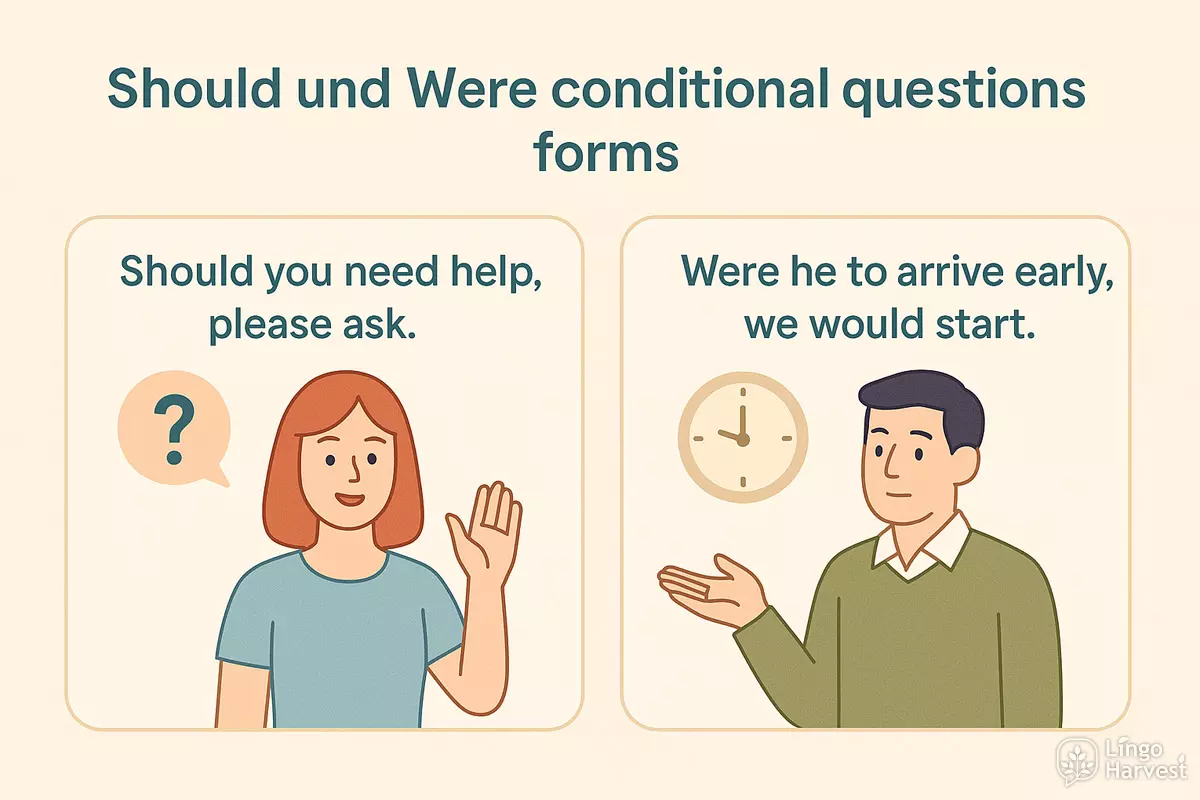
- Should you need help, please ask. (instead of “If you should need help…”)
- Were he to arrive early, we would start. (for “If he were to arrive…”)
- Had I known, I would have acted differently. (for “If I had known…”)
Why English prefers inversion in formal writing
Using inversion gives sentences a polished, concise feel. It eliminates the need for “if” and often shortens the clause, which can make writing more direct. In addition, this structure allows writers to foreground the conditional idea, drawing the reader’s attention to the hypothetical nature of the statement. In official documents, literature, or academic writing, inversion can add a sense of sophistication and clarity.
Common patterns and their effects
Writers use inversion not only for style but also to create variety and avoid repetition. This can be especially useful in longer texts where many conditional statements are needed. Here are some typical patterns:
- Should + subject + base verb (future or less certain conditions)
- Were + subject + infinitive (hypothetical present/future situations)
- Had + subject + past participle (hypothetical past events)
- Never, rarely, seldom + auxiliary + subject (for emphasis in negative or restrictive statements)
- Only then, only after, not until + auxiliary + subject (for time-related emphasis)
- No sooner + auxiliary + subject + than (to express immediate sequence)
- So + adjective + auxiliary + subject (for emphasis: “So difficult was the test…”)
- Little + auxiliary + subject (to highlight lack of knowledge: “Little did she know…”)
- Under no circumstances + auxiliary + subject (strong negative rules)
- At no point + auxiliary + subject (absolute negatives)
Summary
In sum, inversion in conditional clauses is a hallmark of formal English. It helps writers convey complex or hypothetical ideas with precision and style, while also giving their language a more formal tone. By mastering these inversion patterns, advanced learners and professionals can make their writing more varied and effective.
Inversion patterns: should + subject, were + subject, had + subject
When forming conditional sentences in English, it’s possible to invert the subject and auxiliary verb rather than using "if" at the start. This technique is most common in more formal or literary contexts, and it helps to add variety to sentence structure. The main inversion patterns involve "should," "were," and "had," each corresponding to a different type of conditional meaning.
How inversion works in conditional sentences
Instead of starting a conditional clause with "if," you can invert the auxiliary verb and the subject. This creates a more elegant or formal tone. For example, "If you need any help, let me know" becomes "Should you need any help, let me know." The meaning remains the same, but the style shifts.
Summary of inversion structures
- Should + subject + base verb: Used for first conditionals, expressing possible or likely future events. ("Should you see him, tell him I called.")
- Were + subject + infinitive (or adjective/prepositional phrase): Used for second conditionals, talking about hypothetical or unlikely present/future situations. ("Were I taller, I would play basketball.")
- Had + subject + past participle: Used for third conditionals, referring to hypothetical past situations. ("Had she known, she would have acted differently.")
Examples of inversion without "if"
Here are some practical examples to illustrate each pattern:
- Should you arrive early, the office will be open.
- Should it rain, the event will be canceled.
- Were they to ask, I would help them.
- Were he here, he would explain everything.
- Had I seen the sign, I would have stopped.
- Had we known about the traffic, we would have left earlier.
- Should anything happen, call me immediately.
- Were you in my position, what would you do?
- Had they listened, this problem could have been avoided.
- Were it not for the rain, we would go hiking.
- Should there be any changes, I will let you know.
- Had the alarm gone off, we would have woken up on time.
Comparing inversion forms
| Inversion Form | Typical "If" Conditional |
|---|---|
| Should you need help, call me. | If you need help, call me. |
| Were I you, I’d apologize. | If I were you, I’d apologize. |
| Had she studied, she would have passed. | If she had studied, she would have passed. |
| Were it not for your advice, I’d be lost. | If it were not for your advice, I’d be lost. |
These inversion patterns help create concise, formal-sounding conditional statements, and are particularly useful in writing or when you want to add stylistic variety to your English. Practice with these examples to become comfortable using them in both spoken and written contexts.
Meaning differences compared to standard if-clauses
When comparing inversion conditionals (using should, were, or had at the start of a clause) to typical "if"-clauses, the intended nuance often shifts in subtle but important ways. These alternative forms can sound more formal, hypothetical, or emphatic, and sometimes add a sense of immediacy or probability that isn't always present with regular "if" constructions. Using inversion instead of "if" doesn’t usually change the basic meaning of the condition itself, but it can affect style, register, and the speaker’s attitude. For example, “Should you need help, call me” feels more formal or polite than “If you need help, call me.” Similarly, “Had I known” sounds more literary or reflective than “If I had known.”
Formality and emphasis
Inverted conditionals are often found in written English, speeches, or formal conversation. They can make statements sound more official, thoughtful, or even dramatic. In everyday spoken English, people generally prefer standard "if" clauses for ease and clarity.
Subtle shifts in meaning
Sometimes, inversion brings a nuance of open possibility or polite suggestion, especially with "should." With "were," the inversion highlights unreality or hypothetical situations. "Had" inversion emphasizes regret or missed opportunities.
- Should you see him, please tell him I called. (Polite, slightly formal, open possibility)
- If you see him, please tell him I called. (Neutral, straightforward)
- Were I the manager, I would change the policy. (Hypothetical, formal)
- If I were the manager, I would change the policy. (Standard hypothetical)
- Had I realized the time, I wouldn’t have been late. (Expresses regret, formal)
- If I had realized the time, I wouldn’t have been late. (Neutral regret)
- Should you wish to discuss further, my office is open. (Invitation, formal)
- Had she asked for help, we would have supported her. (Reflective, formal)
- Were it not for your advice, I might have failed. (Hypothetical, formal)
- If it were not for your advice, I might have failed. (Standard, less formal)
Summary: Inversion vs. standard "if"-clauses
| Standard "If"-Clause | Inversion Conditional | Register/Effect |
|---|---|---|
| If you need help, call me. | Should you need help, call me. | Polite, formal, open possibility |
| If I were you, I'd apologize. | Were I you, I'd apologize. | Formal, hypothetical, literary |
| If I had known, I would have left earlier. | Had I known, I would have left earlier. | Reflective, formal, emphasis on regret |
| If it rains, the event will be canceled. | Should it rain, the event will be canceled. | Slightly formal, polite, possible future |
In summary, while inversion and "if"-clauses often express the same core idea, inversion adds a layer of formality, politeness, or emphasis. It’s a useful stylistic option, but naturalness and clarity should guide your choice in everyday communication.
Register notes: academic, professional, and literary usage
Inverted conditional clauses using should, were, or had instead of if tend to appear more in formal English. This stylistic choice is often found in academic writing, business correspondence, legal documents, and literary texts. While perfectly correct, these forms can sound stilted or overly formal in everyday conversation. Understanding when and where to use such structures will help you match your language to the context.
Usage across different registers
- Academic writing: Inverted conditionals offer conciseness and can lend an air of precision or objectivity. For example, "Were this assumption to fail, results would differ."
- Professional/business: Such constructions are common in emails, contracts, and reports to express hypothetical scenarios or polite offers: "Should you require further assistance, please contact us."
- Literary style: Authors use inversion to achieve a more elegant, dramatic, or archaic tone: "Had he known the truth, he might have acted differently."
- Everyday speech: These forms are rare in casual conversation, where standard if-clauses are preferred for clarity and naturalness.
Comparing register and frequency
| Register | Typical Usage & Example |
|---|---|
| Academic | Expressing formal hypotheses or conditions Were this method valid, results would be significant. |
| Professional | Polite offers or instructions Should you have questions, let us know. |
| Literary | Stylistic flourish or period tone Had she but known, she would have fled. |
| Informal/Spoken | Rare; usually replaced by if-clauses If you need help, call me. |
Expanded examples: inversion in context
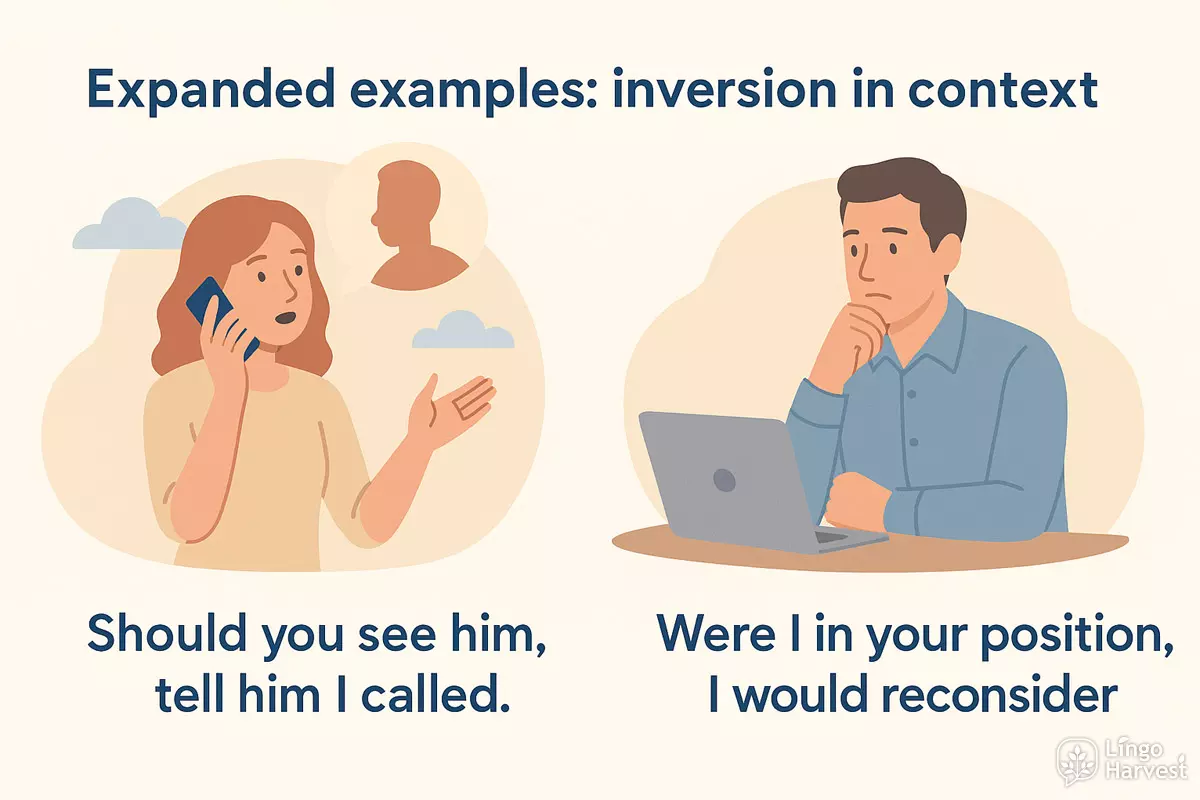
- Should you see him, tell him I called.
- Were I in your position, I would reconsider.
- Had it rained, the event would have been canceled.
- Should any problems arise, notify the supervisor.
- Were this to continue, changes would be necessary.
- Had she applied earlier, she might have been accepted.
- Should the opportunity present itself, seize it.
- Were they aware of the risks, they would hesitate.
- Had you told me, I could have helped.
- Should the weather improve, we will go hiking.
- Were the data accurate, our conclusions would differ.
- Had the alarm sounded, evacuation would have begun.
- Should you require further clarification, do not hesitate to ask.
- Were it not for your support, I could not have succeeded.
In summary, inverted conditional clauses without if are a hallmark of formal or creative English. Choosing these forms adds sophistication, but in most everyday scenarios, sticking to standard if-clauses is clearer and more natural.
Examples showing subtle tone differences
Using inversion in conditional sentences (with "should," "were," or "had") can subtly shift the mood, formality, or nuance of your message. While the meaning often remains close to that of regular "if" clauses, the tone can become more formal, hypothetical, or even cautious. Let’s look at how these alternatives can color your statements.
Comparing regular and inverted conditionals
- If you need any help, let me know.
(Direct, neutral) - Should you need any help, let me know.
(More formal, slightly distant) - If he were here, he would know what to do.
(Standard, straightforward) - Were he here, he would know what to do.
(Formal, literary) - If I had known, I would have acted differently.
(Neutral, regretful) - Had I known, I would have acted differently.
(Elegant, thoughtful)
Subtle shifts in meaning or emphasis
- If you see her, tell her I called. → Should you see her, tell her I called.
(The first is an everyday request; the second feels more remote, as if the encounter is less likely.) - If the weather improves, we will go hiking. → Should the weather improve, we will go hiking.
(The inversion adds a note of uncertainty and formality.) - If they arrive early, we’ll start dinner. → Should they arrive early, we’ll start dinner.
(Makes the early arrival sound less expected.) - If you be in doubt, ask for help. (rare, archaic) → Be you in doubt, ask for help.
(Extremely formal or poetic; almost never used in modern English.)
Table: Comparing Tone in Conditional Structures
| Standard Conditional | Inversion Form (Tone/Effect) |
|---|---|
| If you need anything, let me know. | Should you need anything, let me know. (Polite, formal, less direct) |
| If he were taller, he could reach the shelf. | Were he taller, he could reach the shelf. (Literary, elegant) |
| If I had seen the sign, I would have stopped. | Had I seen the sign, I would have stopped. (Reflective, slightly old-fashioned) |
| If you decide to join us, call ahead. | Should you decide to join us, call ahead. (Adds a touch of formality or distance) |
| If they have questions, let them ask. | Should they have questions, let them ask. (Polished, less conversational) |
Situational nuance
Choosing inversion can make your English sound more polished or suitable for written communication, especially in business, academic, or official contexts. In casual speech, these forms might seem distant or overly formal, but in the right setting, they convey confidence and subtlety. Notice how the underlying message stays the same, but the delivery adjusts to suit the audience or purpose.
Practice: rewrite if-clauses using inversion
Understanding how to transform conditional sentences by omitting "if" and using inversion is a useful skill in formal English. This exercise will help you rewrite standard conditional clauses using structures with "should," "were," and "had" at the beginning of the sentence. These forms are common in formal writing and speeches, and mastering them will make your English sound more advanced.
How to transform standard conditionals
To form these inversions, remove "if" and invert the subject and auxiliary verb. The structures look like this:
- Should + subject + base verb (for first conditional/future situations)
- Were + subject + to + base verb (for present/future unreal situations)
- Had + subject + past participle (for third conditional/past unreal situations)
Rewrite the following sentences using inversion
Below are typical if-clauses. Change each one by removing "if" and using the correct inverted form.
- If you need any help, let me know.
- If I were you, I would apologize.
- If he had known about the meeting, he would have come.
- If we arrive early, we can get good seats.
- If they had studied harder, they might have passed the exam.
- If it were not raining, we could go for a walk.
- If you should see Anna, tell her to call me.
- If I had seen the sign, I would have stopped.
- If she were to win the lottery, she would travel the world.
- If you should change your mind, let me know.
- If Tom were here, he would know what to do.
- If I had realized the time, I wouldn’t have been late.
Show answers
- Should you need any help, let me know.
- Were I you, I would apologize.
- Had he known about the meeting, he would have come.
- Should we arrive early, we can get good seats.
- Had they studied harder, they might have passed the exam.
- Were it not raining, we could go for a walk.
- Should you see Anna, tell her to call me.
- Had I seen the sign, I would have stopped.
- Were she to win the lottery, she would travel the world.
- Should you change your mind, let me know.
- Were Tom here, he would know what to do.
- Had I realized the time, I wouldn’t have been late.
Common patterns for inversion
Here are some typical forms you'll encounter:
- Should + subject + verb (for real or possible future conditions)
- Were + subject + to + verb (for hypothetical or unlikely situations)
- Had + subject + past participle (for past unreal situations)
- Were + subject + adjective/preposition (for present unreal conditions: "Were I taller, I would play basketball.")
Practice these transformations to build fluency and make your formal writing more dynamic.