Should and Ought To: Giving Advice and Expressing Expectation

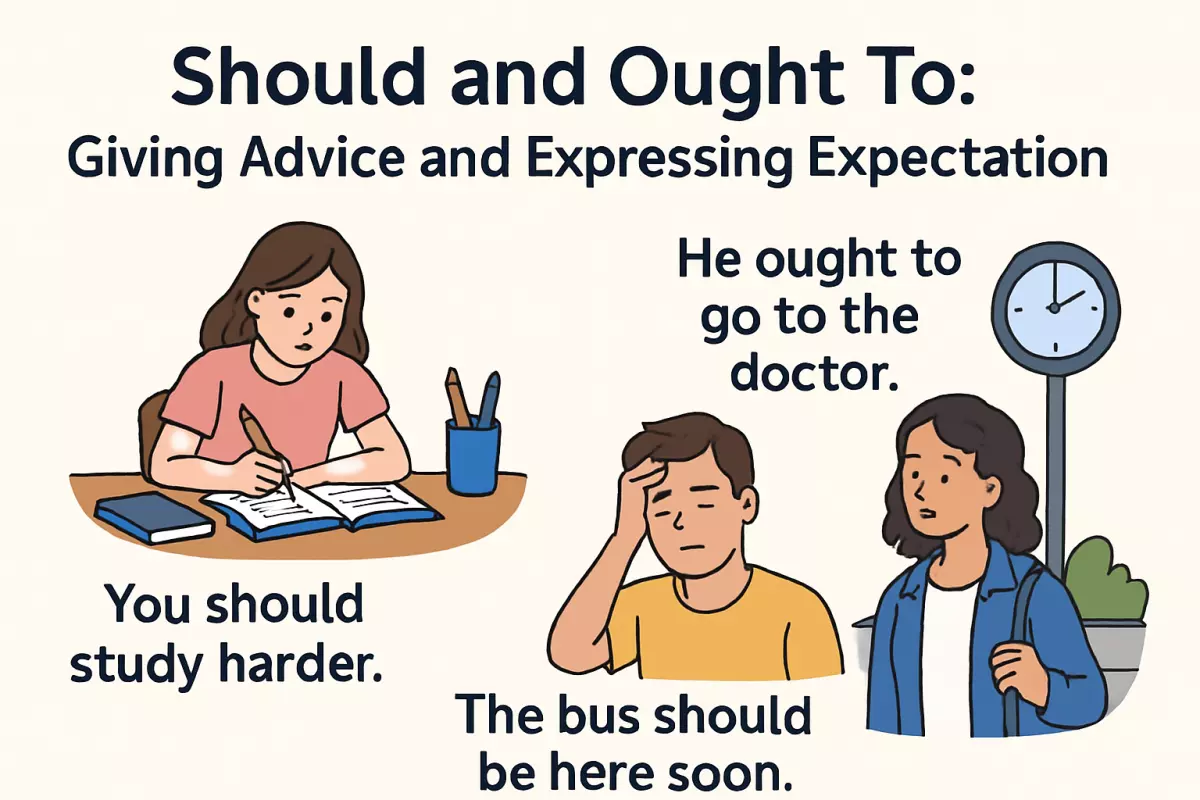 Explains the basic meaning of should and ought to, how to use them for advice, recommendations, expectations, and probability, plus negatives and questions. Covers should have for past advice, modern ought to vs should, common errors, and practice homework tasks.
In English, should and ought to are common ways to give advice or describe what is expected. They let you sound helpful, polite, or gently firm, depending on the situation. You might use them when guiding a friend, suggesting a better choice, or explaining a workplace standard. Both express a recommendation rather than a strict rule, though the tone can feel stronger in formal contexts.
Basic meaning of should and ought to
Should and ought to are modal (or semi-modal) forms used to talk about what is advisable, expected, or the “right” thing to do. They are less forceful than must, so they often sound like guidance rather than an order. In many everyday contexts, the two are very close in meaning, with should being more common in modern speech.
Core uses: advice, expectation, and mild obligation
These forms commonly express three related ideas. The speaker is not describing a fact; they are giving an evaluation about what is best, likely, or appropriate.
- Advice / recommendation: suggesting a good action.
- Expectation: saying what is probable or what normally happens.
- Mild obligation / duty: pointing to responsibility or what is correct, without the strength of must.
- Criticism (often about the past): implying something was a mistake or not done properly.
Meaning in context: what the speaker is really doing
The same sentence shape can do different jobs depending on context and tone. Compare these typical intentions:
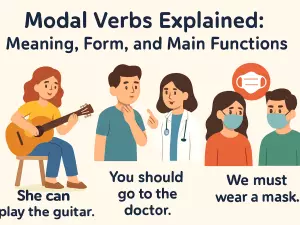
- Giving advice: “You should back up your files.” (This is a good idea.)
- Stating an expectation: “The package should arrive tomorrow.” (This is likely.)
- Expressing duty: “Employees ought to follow the safety rules.” (This is expected behavior.)
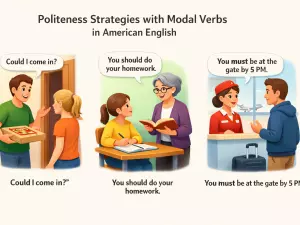
- Softening a directive: “You should send the report today.” (Still a request, but less direct than “Send it.”)
Common patterns and forms
Both forms are followed by the base verb (the infinitive without to for should, and with to for ought). They do not change for person or number.
- Affirmative: should + base verb → “You should call.”
- Affirmative: ought to + base verb → “You ought to call.”
- Negative: should not / shouldn’t + base verb → “You shouldn’t wait.”
- Negative: ought not to (less common; oughtn’t to is rare in many varieties) → “You ought not to rush.”
- Questions: Should + subject + base verb? → “Should I apologize?”
- Questions: Ought + subject + to + base verb? (more formal/less frequent) → “Ought we to leave now?”
- Past reference (criticism/regret): should have + past participle → “I should have studied.”
- Past reference (criticism/regret): ought to have + past participle → “They ought to have told you.”
Example sentences you can reuse
- Advice: “You should drink more water during the day.”
- Advice: “You ought to ask for clarification before you agree.”
- Advice: “We should leave a little earlier to avoid traffic.”
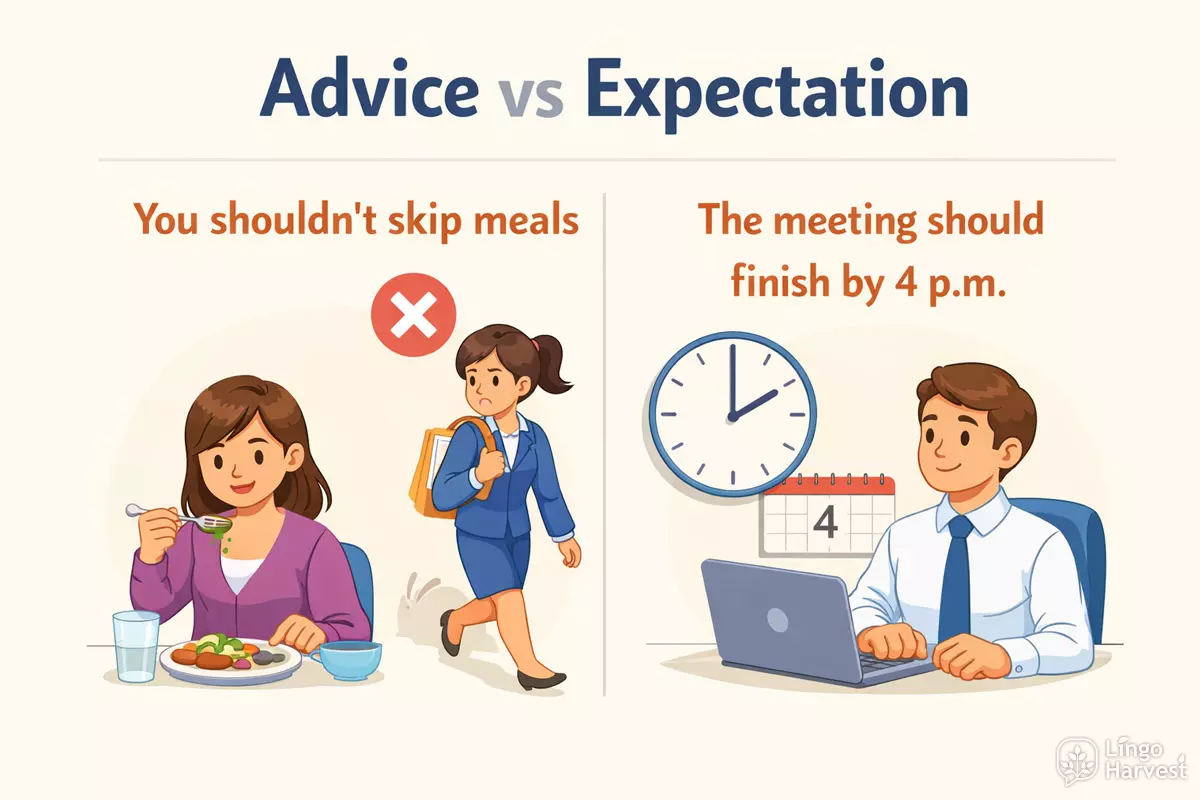
- Advice: “You shouldn’t skip meals when you’re busy.”
- Expectation: “The meeting should finish by 4 p.m.”
- Expectation: “Prices ought to drop after the holiday season.”
- Expectation: “This key should fit the back door.”
- Mild obligation: “You should reply to clients within one business day.”
- Mild obligation: “Drivers ought to slow down near schools.”
- Polite suggestion: “You should probably restart the router.”
- Seeking guidance: “Should I mention it now or wait?”
- Seeking guidance (more formal): “Ought I to inform the manager?”
- Past criticism: “You shouldn’t have said that in public.”
- Past regret: “I should have checked the address.”
- Past expectation not met: “They ought to have arrived by now.”
Giving advice and recommendations
Use should and ought to to suggest a sensible action, give guidance, or express what you think is the best choice. Both forms are common when the speaker is not giving an order, but offering a recommendation based on experience, rules, or likely results.
Core patterns
These modals are followed by the base verb. Ought is usually followed by to.
- should + base verb: You should call them today.
- ought to + base verb: You ought to call them today.
- negative: You shouldn’t skip breakfast. / You ought not to skip breakfast.
- question: Should I email or call? / Ought I to email or call?
Choosing between “should” and “ought to”
- Should is the most frequent choice in everyday English and sounds neutral: You should back up your files.
- Ought to can sound slightly more formal or moral in tone, especially about duty: You ought to apologize.
- In negatives, shouldn’t is much more common than ought not to in modern speech.
- In questions, Should I…? is far more natural than Ought I to…? in casual conversation.
Practical uses with example sentences
- General suggestion: You should try restarting the router.
- Health advice: You should drink more water during flights.
- Study guidance: You ought to review your notes after each class.
- Workplace tip: You should confirm the meeting time in writing.
- Polite recommendation: You should consider a smaller size.
- Warning about consequences: You shouldn’t leave candles unattended.
- Social behavior: You ought to thank them for the help.
- Travel planning: You should book early if you want a window seat.
- Money management: You ought to set aside some savings each month.
- Time management: You should prioritize the urgent tasks first.
- Relationship advice: You shouldn’t assume they know what you want.
- Professional conduct: You ought not to share confidential details.
- Asking for guidance: Should I bring anything to the dinner?
- Seeking confirmation: Should we wait here or go inside?
- Gentle criticism: You really should read the instructions first.
- Expectation-based suggestion: You should be able to finish in an hour.
Making advice softer or stronger
- Softer (less direct): You might want to check the settings first.
- Neutral: You should check the settings first.
- Stronger (more urgent): You really should check the settings first.
- Very strong (close to obligation): You should definitely report it.
- Hedged (more cautious): I think you should talk to them directly.
Common learner notes
- Use the base verb after should: ✅ You should go. ❌ You should to go.
- Include to after ought: ✅ You ought to go. ❌ You ought go.
- Ought to is possible in questions, but sounds formal: Ought I to tell them now?
- For past advice not followed, use should have / ought to have: You should have called earlier.
Expressing expectation and probability
Use should and ought to to describe what you reasonably expect to happen, based on evidence, routine, or normal conditions. In this meaning, they are close to “probably” or “it’s likely that,” and they are less certain than will but more confident than might.
Common patterns
- should/ought to + base verb → a likely result: “The package should arrive tomorrow.”
- should/ought to be + adjective/noun → expected state: “The road should be quiet at this time.”
- should/ought to have + past participle → expected completion by now (often with mild surprise if it hasn’t happened): “They should have finished by noon.”
- should/ought to + be + -ing → expected activity around now: “She should be landing about now.”
- There should/ought to be + noun → expected existence/availability: “There should be a spare key in the drawer.”
- should/ought to + not → expectation that something is unlikely: “It shouldn’t take long.”
- Do you think … should/ought to … ? → checking a prediction: “Do you think the train should arrive on time?”
Typical uses in context
- Based on schedules: “The meeting should start at 9.”
- Based on normal conditions: “Traffic should be lighter after 7.”
- Based on evidence: “With those clouds, it should rain later.”
- Based on a plan: “We should have enough time to stop for coffee.”
- Based on calculations: “The total should be around $50.”
- Based on past experience: “This app should run fine on your phone.”
- Polite reassurance: “Everything should be okay.”
- Soft warning: “It shouldn’t be too hard, but bring a jacket.”
- Checking progress: “They should be working on it now.”
- Expectation not met: “He should have called by now.”
- Unexpected delay: “The results ought to have arrived already.”
- Low probability: “It shouldn’t happen again.”
- Availability: “There should be seats near the front.”
- Location: “Your file should be in the shared folder.”
- Timing: “She ought to be here in ten minutes.”
Choosing between should and ought to
In probability statements, should is more common in everyday speech and writing. Ought to often sounds slightly more formal or deliberate. Both can express a confident expectation, but ought to is used less in questions and negatives in many varieties of English.
- ✅ Natural: “It should be easy to find.”
- ✅ Also possible (more formal): “It ought to be easy to find.”
- ✅ Common question: “Should we expect delays?”
- ❌ Less common: “Ought we to expect delays?”
Past expectation: should have / ought to have
Use should have or ought to have when you expected something to be true or completed before now. This often implies “by now” even when it is not stated, and it can carry a hint of surprise or concern if reality is different.
- “The email should have arrived by now.”
- “They ought to have updated the schedule yesterday.”
- “She shouldn’t have taken this long.”
- “There should have been a confirmation message.”
Negative forms and questions
To make advice or expectations negative, place not after should, or use the contracted form shouldn’t. With ought to, the negative is usually formed as ought not to (often contracted to oughtn’t to in British English). In questions, invert the modal and the subject, and keep the base verb after the modal.
Negative patterns
- should not + base verb: “You should not skip breakfast.”
- shouldn’t + base verb: “You shouldn’t drive when you’re tired.”
- ought not to + base verb: “You ought not to share that password.”
- oughtn’t to + base verb (more BrE): “We oughtn’t to ignore the warning signs.”
- should not have + past participle (past regret/criticism): “I should not have said that.”
- shouldn’t have + past participle: “They shouldn’t have left so early.”
- ought not to have + past participle (past regret/criticism): “You ought not to have spoken to her like that.”
- should not be + -ing (rare; ongoing situation): “You shouldn’t be working this late.”
- should not need to (expectation): “You shouldn’t need to reset it every time.”
- should not be allowed to (rule/expectation): “Visitors shouldn’t be allowed to enter without ID.”
- ought not to be (expectation): “This ought not to be so complicated.”
- shouldn’t + base verb for gentle warnings: “You shouldn’t touch that; it’s hot.”
Question patterns
- Should + subject + base verb?: “Should I call her now?”
- Should we + base verb?: “Should we leave a bit earlier?”
- What/Where/When/Why/How + should + subject + base verb?: “When should I submit the form?”
- Shouldn’t + subject + base verb? (suggestion or expectation): “Shouldn’t you get some rest?”
- Ought + subject + to + base verb? (more formal/less common): “Ought we to tell them?”
- Oughtn’t + subject + to + base verb? (BrE; expectation): “Oughtn’t he to be here by now?”
- What + ought + subject + to + base verb?: “What ought I to do next?”
- Do you think + subject + should + base verb? (softer): “Do you think I should apologize?”
- Should + subject + have + past participle? (past decision): “Should I have waited?”
- Ought + subject + to have + past participle? (past judgment): “Ought he to have told you?”
Common usage notes
In everyday English, shouldn’t is far more frequent than oughtn’t to, and many speakers avoid ought questions entirely. Negative questions like “Shouldn’t we…?” often function as a prompt for agreement or a polite push toward an action, while “Should we…?” sounds more open and neutral. With ought to, keeping to is standard in both statements and questions.
Should have and past advice
To talk about a mistake, a missed opportunity, or a better choice in the past, English commonly uses should have + past participle. This form looks back from the present and judges a past action as advisable, expected, or preferable. It often implies “it didn’t happen” (or “it happened, but it was a bad idea”).
Core pattern and meaning
Use should have + past participle (V3) to express a past recommendation, criticism, or regret: the better action was in the past, and the speaker evaluates it now.
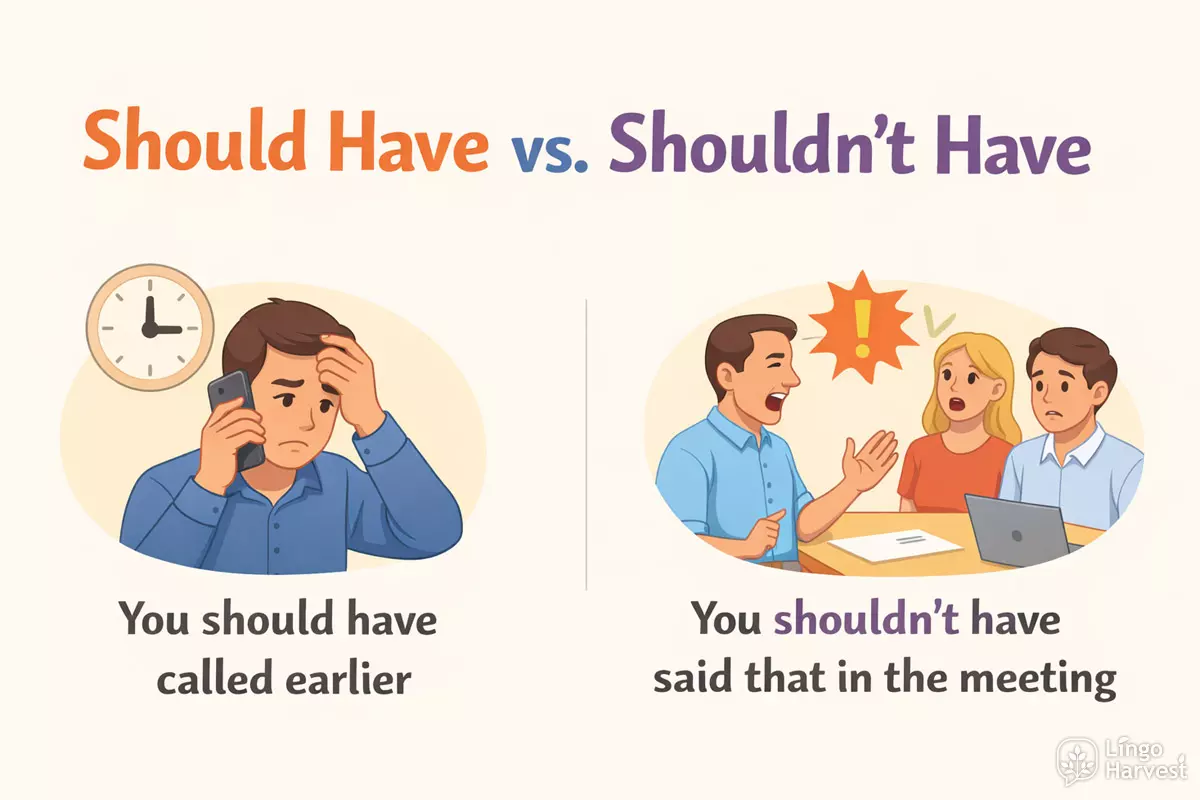
- You should have called earlier. → Calling earlier was the better choice (but you didn’t).
- I should have studied more. → The speaker regrets not studying enough.
- They should have told us about the change. → It was expected or appropriate, but it didn’t happen.
- We should have left before rush hour. → Leaving earlier was advisable.
Negative forms: “shouldn’t have”
Use shouldn’t have + past participle to say a past action was a bad idea or should not have happened. This often implies the action did happen.
- You shouldn’t have said that in the meeting. → You said it, and it caused problems.
- I shouldn’t have bought it without checking the size. → The purchase happened; it was a mistake.
- They shouldn’t have ignored the warning signs. → Ignoring them led to consequences.
- We shouldn’t have driven in that storm. → The decision was risky and unwise.
Questions and short answers
Questions with this structure are common when someone is trying to understand what the best past choice was, or when checking responsibility.
- Should I have told her sooner?
- Should we have booked the tickets in advance?
- Who should have informed the team?
- Shouldn’t they have checked your ID?
Common uses and example set
These examples show typical contexts: apologies, feedback, and hindsight after a result is known.
- I should have apologized right away.
- You should have read the instructions first.
- She should have taken a break instead of working all night.
- We should have backed up the files before updating.
- They should have locked the door when they left.
- He should have asked for clarification.
- You shouldn’t have shared that photo publicly.
- I shouldn’t have interrupted you.
- We shouldn’t have trusted that estimate without data.
- They shouldn’t have parked there; it’s a tow zone.
- Should we have waited for confirmation?
- Shouldn’t you have reported it sooner?
How it differs from “should + base verb”
Should + base verb points to the present or future: advice or expectation about what is still possible. Should have + past participle looks backward and evaluates what was (or wasn’t) done.
- You should call your doctor. → Advice now (you can still do it).
- You should have called your doctor. → Past evaluation (it would have been better earlier).
- We should leave at 6. → Plan/advice for later.
- We should have left at 6. → Regret after leaving late.
Notes on tone: advice vs. criticism
This past form can sound neutral in self-reflection, but it can sound like blame when directed at someone else. In careful feedback, speakers often soften it with context (reason, apology, or shared responsibility).
- Direct: You should have told me. → Can sound accusatory.
- Softer: It would have helped if you’d told me earlier. → Focuses on impact.
- Shared: We should have double-checked the schedule. → Spreads responsibility.
Ought to vs should in modern English
Should is the everyday choice for advice, recommendations, and expectations. Ought to is still correct, but it sounds more formal, more old-fashioned, or more morally weighted in many contexts. In most modern speech and writing, people use should where earlier English might have preferred ought to.
How they differ in tone and typical use
Both forms express that something is advisable or expected, but they often carry different “feelings”:
| Use case | More natural choice | Typical effect | Example |
|---|---|---|---|
| General advice (neutral) | should | Common, straightforward recommendation | You should back up your files regularly. |
| Expectation / probability | should | Reasonable prediction based on evidence | The train should arrive by 6. |
| Duty, ethics, “the right thing” | ought to | Stronger sense of obligation or principle | You ought to apologize. |
| Formal or traditional style | ought to | More serious or old-fashioned register | We ought to consider the long-term costs. |
| Negative advice | shouldn’t | Very natural in modern English | You shouldn’t skip meals. |
| Negative with “moral” tone | ought not to | More formal; can sound stern | You ought not to speak to her that way. |
| Questions asking for advice | Should…? | Standard, idiomatic question form | Should I call them now? |
| Past criticism / regret | should have | Common way to judge a past action | I should have left earlier. |
| Past duty not done (heavier) | ought to have | More weighty; implies responsibility | They ought to have told you. |
Modern patterns to notice
Usage patterns in current English tend to follow these habits:
- “Should” dominates in everyday conversation. It fits quick advice, casual recommendations, and planning talk. “Ought to” can sound marked or deliberate, so speakers often reserve it for emphasis.
- Questions strongly favor “should”. While “Ought I to…?” is grammatical, it is uncommon and can sound old-fashioned in most settings. “Should I…?” is the default.
- Negatives are simpler with “should”. “Shouldn’t” is frequent and natural. “Ought not to” is correct but more formal, and “oughtn’t to” exists but is relatively rare in many varieties of modern English.
- Both work for expectations, but “should” is more neutral. When you mean “this is likely,” “should” usually sounds more natural than “ought to,” which can hint at a value judgment or a stronger sense of what is proper.
Common learner pitfalls
These points help avoid unnatural phrasing:
- Use the full form “ought to”. In standard usage, ought is normally followed by to: ✅ You ought to rest. ❌ You ought rest.
- Prefer “should” for quick advice and questions. If your goal is simple guidance, “should” will usually sound more idiomatic.
- Choose “ought to” when you want moral weight or formality. It can signal duty, fairness, or responsibility rather than just a practical suggestion.
Common learner errors and corrections
Many mistakes with should and ought to come from mixing patterns (infinitive vs. gerund), using the wrong auxiliary in questions/negatives, or choosing a form that sounds too strong for the situation. The corrections below focus on the most common structure and meaning problems.
Form and grammar patterns that cause errors
- Using “to” after should: ❌ You should to call her. → ✅ You should call her.
- Forgetting “to” after ought: ❌ You ought call her. → ✅ You ought to call her.
- Using -ing after should/ought: ❌ You should going now. → ✅ You should go now.
- Adding “do” for negatives with should: ❌ You don’t should do that. → ✅ You shouldn’t do that.
- Adding “do” for questions with should: ❌ Do I should tell him? → ✅ Should I tell him?
- Wrong negative with ought to: ❌ You oughtn’t to not say that. → ✅ You ought not to say that. (or more natural: You shouldn’t say that.)
- Double modals: ❌ You should must see a doctor. → ✅ You should see a doctor. / You must see a doctor.
- Using “should” as a main verb: ❌ I should a new phone. → ✅ I need a new phone. / I should get a new phone.
- Confusing “should” with “be supposed to”: ❌ You should wear a uniform (rule). → ✅ You’re supposed to wear a uniform. (for rules/requirements)
Meaning and tone: advice vs. expectation
- Overstating advice as obligation: ❌ You must try this cake. (too strong in many contexts) → ✅ You should try this cake.
- Using “ought to” in very casual situations: ❌ You ought to text me. (can sound formal/serious) → ✅ You should text me.
- Using “should” when you mean “probably/expected” without context: ❌ She should be at work. (sounds like an inference) → ✅ She’s probably at work. (if you mean guess, not advice)
- Confusing advice with prediction: ❌ It should rain tomorrow, so take an umbrella. (unclear) → ✅ It’s supposed to rain tomorrow, so you should take an umbrella.
- Using “should” for permission: ❌ Should I go out? (meaning: Is it allowed?) → ✅ Can I go out? (permission) / Should I go out? (asking for advice)
- Using “should” to criticize too directly: ❌ You should know that! (can sound harsh) → ✅ You might already know this, but… / Just so you know…
Past forms: missed advice and expectations
- Wrong form for past advice: ❌ You should went to the doctor. → ✅ You should have gone to the doctor.
- Mixing “should have” with a base verb: ❌ You should have go earlier. → ✅ You should have gone earlier.
- Using “ought to” without “have” for past meaning: ❌ He ought to finish yesterday. → ✅ He ought to have finished yesterday.
- Confusing regret with simple past: ❌ I should call you yesterday. → ✅ I should have called you yesterday.
- Using “should have” when you mean “was supposed to”: ❌ I should have been at work at 9. (schedule) → ✅ I was supposed to be at work at 9. (expectation/arrangement)
Quick self-check patterns
- Advice now/future: should + base verb → You should rest.
- Advice not to do something: shouldn’t + base verb → You shouldn’t drive tired.
- More formal advice: ought to + base verb → You ought to apologize.
- Past criticism/regret: should have / ought to have + past participle → You should have told me.
- Inference (guess): should + be → They should be home by now. (not advice)
Homework: advice verb practice tasks
Use these exercises to build automatic control of should and ought to for advice, mild obligation, and expectation. Focus on the core pattern modal + base verb (no to after should, but to is required after ought).
1. Choose the best option (should / ought to)
Select the option that sounds most natural in neutral, everyday English. In some items, both are possible; choose the one that best matches the tone.
- You look exhausted. You ______ go home and rest.
- We ______ be there by 6, if traffic is normal.
- People ______ recycle more to reduce waste.
- I think you ______ apologize for what you said.
- The package ______ arrive tomorrow, according to the tracking page.
- Students ______ submit the form before Friday.
- He ______ call his parents more often.
- This medicine ______ help with the pain within an hour.
- You ______ to double-check the email address before sending it.
- They ______ not speak during the presentation.
Show answers
- should
- ought to
- should
- should
- ought to
- should
- ought to
- should
- ought to
- should
2. Fix the form (pattern accuracy)
Each sentence has a form problem (wrong verb form, missing to, incorrect negative, or an extra word). Rewrite each sentence correctly.
- You should to see a doctor.
- He ought call you later.
- We should going now.
- They ought to not be so rude.
- I don’t should tell her.
- It should arrives by noon.
- You ought to can finish this today.
- Should you to bring your passport?
- We oughtn’t to worry so much.
- She should not to drive when she’s tired.
Show answers
- You should see a doctor.
- He ought to call you later.
- We should go now.
- They ought not to be so rude.
- I shouldn’t tell her.
- It should arrive by noon.
- You ought to finish this today.
- Should you bring your passport?
- We oughtn’t worry so much.
- She should not drive when she’s tired.
3. Advice vs. expectation (meaning choice)
Decide whether each sentence expresses advice or expectation. Write one word: “advice” or “expectation.”
- You should drink more water during the day.
- The train should arrive on platform 3.
- He ought to save a copy of the file before editing.
- The results ought to be ready by Monday.
- You shouldn’t skip breakfast if you get headaches.
- She ought to be home by now.
- We should review the contract before signing.
- The new update should fix the bug.
- You ought not to share your password.
- They should be able to hear you from the back row.
Show answers
- advice
- expectation
- advice
- expectation
- advice
- expectation
- advice
- expectation
- advice
- expectation
4. Rewrite with the other modal (keep the meaning)
Rewrite each sentence using the other form (should → ought to, or ought to → should). Keep the meaning as close as possible, and keep negatives and questions correct.
- You should back up your photos regularly.
- We ought to leave a little earlier.
- He shouldn’t talk over people in meetings.
- Ought I to send a follow-up email?
- The delivery should be here before noon.
- They ought not to park here.
- She should be finished by 5.
- You ought to read the instructions first.
- Should we mention the delay?
- It ought to work after you restart it.
Show answers
- You ought to back up your photos regularly.
- We should leave a little earlier.
- He ought not to talk over people in meetings.
- Should I send a follow-up email?
- The delivery ought to be here before noon.
- They shouldn’t park here.
- She ought to be finished by 5.
- You should read the instructions first.
- Ought we to mention the delay?
- It should work after you restart it.
5. Production task (short responses)
Write one sentence of advice or expectation for each situation. Use should in five answers and ought to in five answers. Keep each response to one sentence.
- A friend has a bad cold and keeps going to work.
- You sent an important message but got no reply.
- A classmate is nervous about a speaking test.
- Your team is often late to meetings.
- You are waiting for a refund that was promised within 7 days.
- A sibling spends money too quickly.
- You are unsure whether to accept an invitation.
- A coworker shares confidential information.
- You expect heavy traffic during a holiday weekend.
- You want to improve pronunciation.