Time Clauses vs Conditional Clauses: Avoiding Confusion

 The article explains how time and conditional clauses differ, lists key conjunctions for both, and clarifies why will is not used in future time clauses. It also gives examples and exercises for classifying sentences as time or conditional clauses.
- Meaning differences between time reference and condition
- Key conjunctions for time clauses: when, after, before, until
- Key conjunctions for conditional clauses: if, unless, provided that
- Why time clauses cannot use will for future meanings
- Examples contrasting time vs conditional logic
- Practice: classify sentences as time clauses or conditional clauses
Understanding the subtle differences between statements about future events and those expressing possibilities can be challenging, even for advanced English learners. Being able to distinguish between expressions that refer to specific times and those that indicate conditions is crucial for effective and accurate communication. Mastering this skill not only helps avoid misunderstandings but also allows speakers to convey their intentions more clearly and confidently in both written and spoken English.
Meaning differences between time reference and condition
Understanding the distinction between time clauses and conditional clauses is essential for clear communication. Time clauses focus on when something happens, while conditionals deal with what must be true for something else to occur. Although their structures may look similar, their purposes and meanings are quite different.
Time Clauses: Expressing When
Time clauses tell us about the timing of an action. They answer questions like "when?" and are introduced by words such as when, after, before, as soon as, until, and while. These clauses set the temporal context for the main action but do not express uncertainty or dependency.
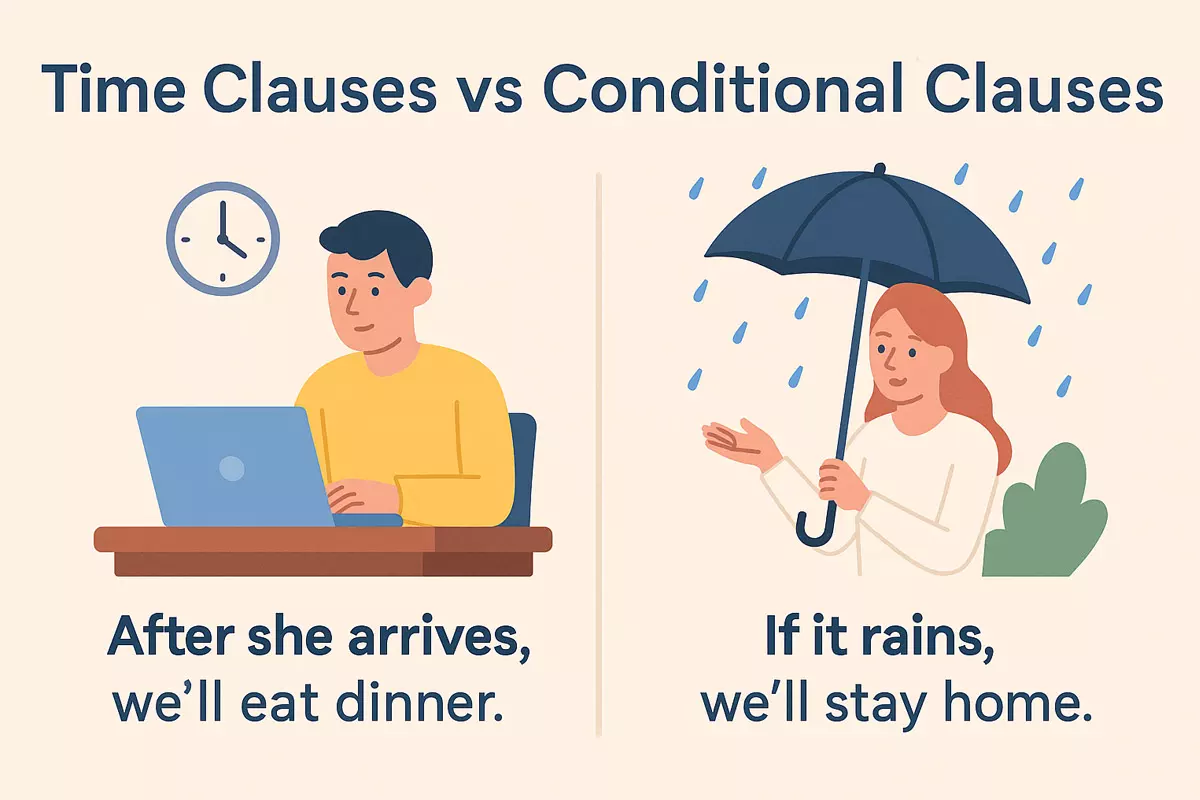
- When she arrives, we will start dinner.
- He’ll call you after he finishes work.
- Please wait until I come back.
- You can leave as soon as the bell rings.
- Before you go out, lock the door.
Conditional Clauses: Expressing "If"
Conditional clauses describe situations where one action depends on another. They are introduced by if, unless, provided (that), or in case. The main clause only happens if the condition in the subordinate clause is fulfilled.
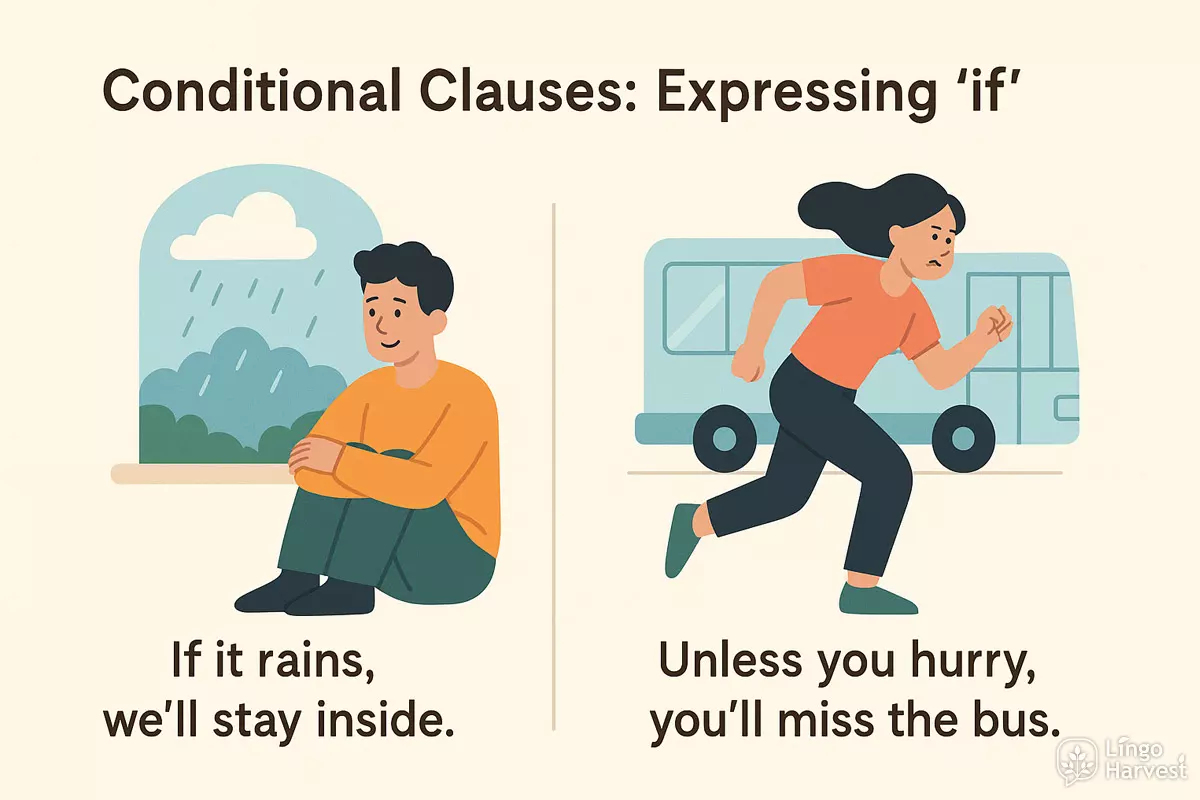
- If it rains, we’ll stay inside.
- Unless you hurry, you’ll miss the bus.
- Provided (that) you have a ticket, you can enter.
- Take an umbrella in case it rains.
Comparing Function and Focus
Below is a comparison to help clarify the key differences between time and conditional clauses:
| Type | Main Purpose | Typical Connectors | Example |
|---|---|---|---|
| Time Clause | Specifies when an action happens | when, after, before, until, as soon as, while | We’ll eat when he arrives. |
| Conditional Clause | States a condition for an action | if, unless, provided (that), in case | We’ll eat if he arrives. |
Common Mistakes and Subtle Contrasts
Learners often confuse these clauses because both may use present tense forms to refer to future events. However, a time clause simply tells when something will happen, while a conditional clause adds a requirement or possibility. For example, "Call me when you arrive" assumes arrival will happen; "Call me if you arrive" suggests arrival is uncertain. To summarize:
- Use time clauses for definite events or sequences in time.
- Use conditional clauses for hypothetical or uncertain situations.
- Present tenses are used in both, but meanings are not the same.
- Choosing the wrong type can lead to misunderstanding about certainty and timing.
Key conjunctions for time clauses: when, after, before, until
Understanding how to link actions and events in time is crucial for clarity in English. Words like when, after, before, and until serve as the backbone for expressing sequences, durations, and conditions related to time. These conjunctions introduce subordinate clauses that specify precisely when something happens relative to another action.
Usage and Meaning of Each Conjunction
- When: Refers to the moment or period an event occurs. Example: Call me when you arrive.
- After: Indicates that one action happens following another. Example: I'll text you after I finish work.
- Before: Shows that one event happens earlier than another. Example: Wash your hands before you eat.
- Until: Expresses that an action continues up to a certain point. Example: Wait here until I return.
Common Patterns and Pitfalls
Time clauses often use the present simple tense, even when referring to the future. For example: I'll call you when I get home (not when I will get home). This rule can be confusing for learners, especially when contrasting with conditional clauses, which sometimes use would or could.
Examples of Time Clause Conjunctions in Action
- She’ll start cooking when he arrives.
- Don’t leave until the movie ends.
- We always have coffee after lunch.
- Finish your homework before you play games.
- He usually calls when he’s free.
- They didn’t speak until the teacher entered.
- You can go out after you clean your room.
- Let’s meet before the concert starts.
- I’ll stay here until you’re ready.
- She left when it started raining.
- We always warm up before a match.
- I’ll check my email after lunch.
Quick Reference: Choosing the Right Time Conjunction
| Conjunction | Function / Example |
|---|---|
| When | Indicates the time something happens. We’ll leave when you’re ready. |
| After | Describes what follows another event. He called after he finished his work. |
| Before | Shows what precedes another event. Lock the doors before you go out. |
| Until | Marks a point up to which something continues. They waited until the rain stopped. |
By mastering the use of these connectors, you’ll communicate time relationships more naturally and avoid confusion with conditional clauses that focus on possibility rather than sequence.
Key conjunctions for conditional clauses: if, unless, provided that
Understanding which words introduce conditional ideas is essential for clear communication. In English, certain conjunctions signal that one action depends on another. The most common are “if,” “unless,” and “provided that.” Each one shapes the meaning of the sentence and the relationship between ideas.
The main conditional conjunctions and their uses
- If — Used for general conditions or possibilities.
Example: If it rains, we’ll stay inside. - Unless — Means “except if”; it sets a negative condition.
Example: I won’t go unless you come with me. - Provided that — Adds a formal or specific condition, similar to “if and only if.”
Example: You can borrow my car provided that you return it by 8 PM.
Expanded list of conjunctions for conditional meaning
In addition to the main three, English uses several other words and phrases to introduce conditional statements:
- As long as
- Only if
- Even if
- In case
- Supposing (that)
- On condition that
- Assuming (that)
- Whether or not
- So long as
- In the event that
- Unless
- Given (that)
- Providing (that)
These alternatives allow for greater nuance in expressing conditions.
Comparing the main conditional conjunctions
| Conjunction | Usage & Example |
|---|---|
| If | General condition: If you study, you will pass. |
| Unless | Negative condition: Unless you hurry, you’ll miss the train. |
| Provided that | Specific/formal condition: You can attend the meeting provided that you register in advance. |
Quick tips for using conditional conjunctions
- Use if for most regular conditional sentences.
- Choose unless to express exceptions or negative conditions.
- Apply provided that (or similar phrases) for formal or strict requirements.
- Pay attention to verb tense after these conjunctions; the structure often follows simple present for real conditions and past for unreal situations.
- Mixing up these connectors can change the meaning. For example, “if” and “unless” are not interchangeable.
Knowing which connector best fits your intention helps avoid confusion between time and conditional clauses. Each one highlights a different aspect of possibility or requirement, making your meaning clear.
Why time clauses cannot use will for future meanings
When talking about future events, English speakers often expect to use will to indicate the future. However, after time words like when, after, before, as soon as, and until, the present tense is used—even if the meaning is clearly about the future. This rule helps keep sentences clear and avoids confusion between what is certain and what is just possible or conditional.
Time Clause Structure: Key Points
- After time words (e.g., when, before, after, until, as soon as), use the present simple for future events.
- This pattern signals that the action in the time clause is expected or scheduled, not just a possibility.
- Will is reserved for the main clause, not the time clause.
Why the Present Simple is Used
The present simple in time clauses expresses a sense of certainty or scheduled events. English uses this form to highlight a sequence: one action must happen before the other. Using will in the time clause could make it sound like a conditional or uncertain event, which is not the intended meaning. This distinction keeps time clauses different from conditional clauses, which often use will to show possible results.
Common Time Clause Words
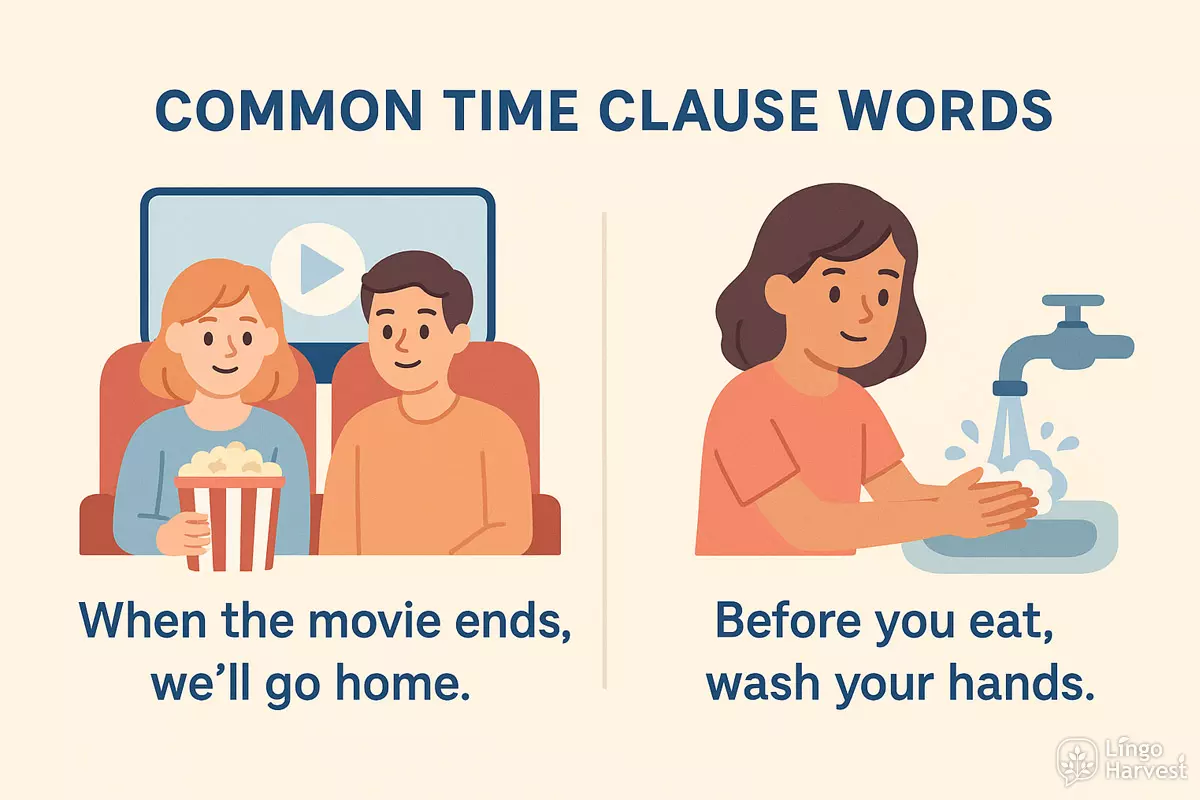
- when → When the movie ends, we’ll go home.
- before → Before you eat, wash your hands.
- after → After I finish work, I’ll call you.
- as soon as → As soon as she arrives, let me know.
- until → Stay here until I get back.
- while → While he cooks, I set the table.
- by the time → By the time you wake up, I’ll be gone.
- once → Once you understand it, it becomes easy.
- the moment → The moment he saw her, he smiled.
- whenever → Whenever I see him, he’s smiling.
Examples of Correct and Incorrect Usage
- ✅ Correct: I’ll call you when I arrive.
- ❌ Incorrect: I’ll call you when I will arrive.
- ✅ She’ll start cooking after she finishes work.
- ❌ She’ll start cooking after she will finish work.
- ✅ Wait here until I come back.
- ❌ Wait here until I will come back.
Comparison: Time Clauses vs. Conditional Clauses
| Clause Type | Typical Structure | Example | Notes |
|---|---|---|---|
| Time Clause | Time word + present simple | I'll call when I arrive. | No will after time word |
| Conditional Clause | If + present simple | If it rains, we’ll stay in. | Will in main clause only |
| Incorrect Time Clause | Time word + will | I'll call when I will arrive. | Not standard English |
| Mixed Conditional | If + past simple, would + base verb | If I knew, I would tell you. | Shows hypothetical situation |
Summary
Using will after time words creates confusion and is not accepted in standard English grammar. The present simple in time clauses signals a definite future event, while will remains in the main clause to indicate the result or action that follows. This pattern keeps communication clear and distinguishes time clauses from conditionals.
Examples contrasting time vs conditional logic
Understanding the difference between time clauses and conditional clauses can be tricky, as both often use similar connecting words and verb forms. However, the logic behind each is distinct: time clauses anchor actions to a specific moment, while conditional clauses hinge on hypothetical outcomes. Let's look at a variety of examples that highlight these differences in real sentences.
Key Patterns in Time Clauses
- After she finishes her work, she goes home. (Action follows another in time)
- When it rains, the streets get wet. (Describes what happens every time a certain event occurs)
- Before you leave, lock the door. (One action must be completed before another)
- As soon as they arrive, we will start dinner. (Event triggers another action immediately)
- While I was reading, the phone rang. (Ongoing action interrupted by another)
Typical Forms in Conditional Clauses
- If you study, you will pass the test. (Hypothetical: passing depends on studying)
- Unless he calls, we won’t leave. (Negative condition: action depends on not calling)
- If it rains, we will stay inside. (Outcome depends on possible event)
- If I had known, I would have helped. (Unreal past: condition wasn’t met)
- Should you need help, let me know. (Inverted conditional: more formal, same logic)
Side-by-Side Comparison
| Time Clause Example | Conditional Clause Example |
|---|---|
| After you finish dinner, call me. | If you finish dinner, call me. |
| When the bell rings, class begins. | If the bell rings, class will begin. |
| Before I go to bed, I read. | If I go to bed early, I feel rested. |
| As soon as you arrive, let me know. | If you arrive early, you can help set up. |
| While she was studying, he cooked dinner. | If she studies, he cooks dinner. |
How to Distinguish: Practical Tips
- Time clauses never use “will” or “would” after their conjunction (after, when, before, as soon as), even for future events.
- Conditional clauses (with if, unless, provided that) often describe what could, would, or might happen, not what always happens.
- Look at the logic: Is it about sequence or about possibility?
- Pay attention to verb tense patterns—these often signal the type of clause.
By carefully studying these structures, you’ll be able to avoid common mistakes and clearly distinguish between events anchored in time and those based on hypothetical situations.
Practice: classify sentences as time clauses or conditional clauses
Understanding the subtle differences between time clauses and conditional clauses can help you avoid common mistakes in both writing and speaking. Below, you’ll find a set of sentences designed to test your ability to distinguish between these two types of subordinate clauses. Consider the function of the clause—does it indicate a specific time or does it set a condition?
Exercise: Identify the Clause Type
Read each sentence carefully. Decide whether the highlighted part is a time clause or a conditional clause.
- We’ll start dinner when Dad arrives home.
- If it rains tomorrow, the picnic will be cancelled.
- The lights turn off as soon as you leave the room.
- Unless you hurry, you will miss the bus.
- I’ll call you after I finish the meeting.
- Provided you have your ticket, you can enter the concert.
- She always feels happy when she hears that song.
- In case you need help, call this number.
- You can’t go out until you finish your homework.
- If I see him, I’ll give him your message.
- The train will leave before the sun rises.
- Even if you apologize, he may not forgive you.
- Let’s eat once everyone is here.
- Unless they call soon, we’ll have to leave without them.
- We’ll go for a walk after the rain stops.
- If you study hard, you’ll pass the exam.
- I’ll text you when I get home.
- Provided that the weather is good, we’ll go hiking.
- Don’t turn off the oven until the cake is ready.
- If he doesn’t answer, leave a message.
Show answers
- 1. Time clause
- 2. Conditional clause
- 3. Time clause
- 4. Conditional clause
- 5. Time clause
- 6. Conditional clause
- 7. Time clause
- 8. Conditional clause
- 9. Time clause
- 10. Conditional clause
- 11. Time clause
- 12. Conditional clause
- 13. Time clause
- 14. Conditional clause
- 15. Time clause
- 16. Conditional clause
- 17. Time clause
- 18. Conditional clause
- 19. Time clause
- 20. Conditional clause
Tips for Telling Them Apart
- Time clauses often start with: when, after, before, as soon as, until, once, while.
- Conditional clauses use: if, unless, provided (that), in case, even if, as long as.
- Ask yourself: does the clause state a time or a condition?
- Time clauses relate to when something happens; conditionals relate to whether something happens.
With practice, distinguishing these clauses becomes much more intuitive. Use the patterns and practice above to strengthen your skills.