How to Contract Conditionals Naturally in Spoken English

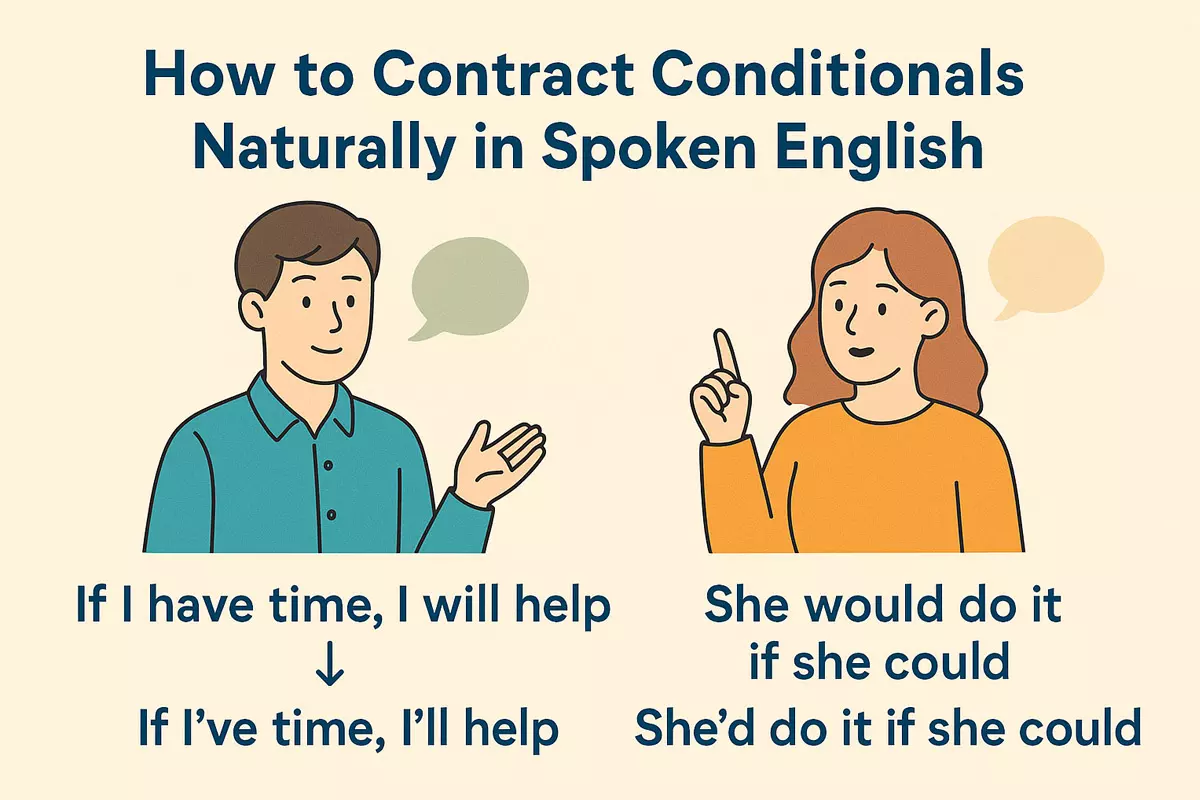 The article lists the most common contractions in conditional speech like it’ll, I’d, and wouldn’t, explains why they make conversation sound natural, points out common mistakes, shows real dialogue examples, and gives practice rewriting sentences with contractions.
Mastering the art of shortening conditional sentences helps your English sound more fluent and natural in everyday conversation. Native speakers often blend words and use contractions to express possibilities and hypothetical situations quickly and clearly. By learning these techniques, you can make your speech smoother and more relaxed, allowing you to communicate ideas efficiently without sounding overly formal. Practice using shortened forms in your own sentences to build confidence and sound more like a native speaker.
Most common contractions in conditional speech patterns
When speaking English, people naturally shorten conditional forms to sound more fluent and casual. These contractions help conversation flow and make speech less formal. You'll often hear these shortened forms in questions, responses, and hypothetical situations.
Key contracted forms in conditionals
In both real and unreal conditional sentences, certain auxiliary verbs and pronouns are almost always contracted in spoken English. This not only makes your speech sound more natural, but also helps with understanding native speakers.
- I'd (I would or I had) – Example: "I'd go if I could."
- He'd (He would or He had) – "He'd tell you if he knew."
- She'd (She would or She had) – "She'd have helped if she were here."
- We'd (We would or We had) – "We'd leave if it rained."
- They'd (They would or They had) – "They'd have come if invited."
- You'd (You would or You had) – "You'd understand if you tried."
- I'll (I will) – "I'll help if you need me."
- He'll (He will) – "He'll call if he's late."
- She'll (She will) – "She'll join if she can."
- We'll (We will) – "We'll go if it doesn't rain."
- They'll (They will) – "They'll be here if possible."
- You'll (You will) – "You'll pass if you study."
- Wouldn't (would not) – "I wouldn't go if I were you."
- Won't (will not) – "She won't come unless you ask."
- Should've (should have) – "You should've told me if it mattered."
- Could've (could have) – "He could've helped if he'd known."
- Might've (might have) – "We might've won if we'd tried."
Common negative contractions in conditionals
Negatives are also frequently contracted, especially in spoken hypotheticals. Here are some standard examples:
- Wouldn't – "She wouldn't leave unless she had to."
- Couldn't – "I couldn't do it if I tried."
- Shouldn't – "He shouldn't go if he's sick."
- Won't – "They won't come if it's raining."
Contraction patterns overview
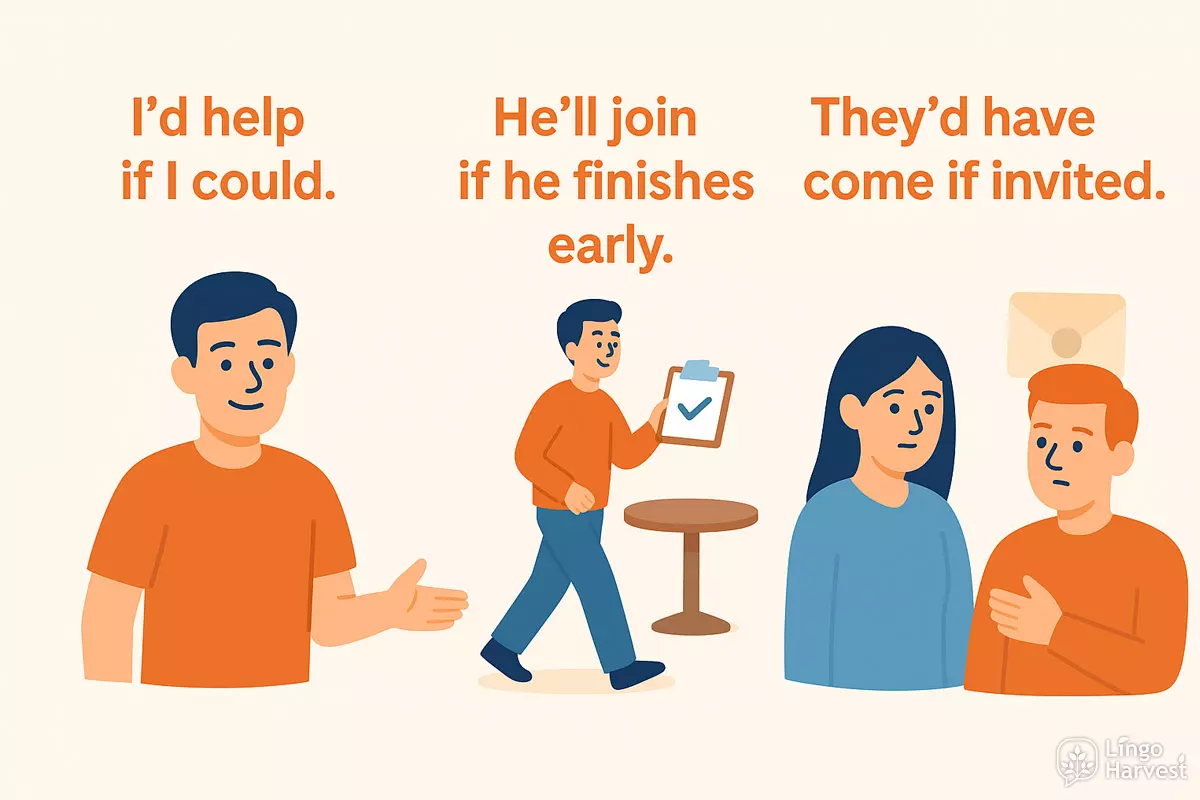
To compare how contractions work across different subjects and auxiliaries, see the table below. Note that these forms are used in both first and second conditionals, as well as in mixed conditional sentences.
| Full Form | Contracted Form | Example in Conditionals |
|---|---|---|
| I would | I'd | I'd help if I could. |
| He will | He'll | He'll join if he finishes early. |
| They had | They'd | They'd have come if invited. |
| Would not | Wouldn't | I wouldn't do that if I were you. |
| Could have | Could've | We could've won if we'd tried. |
| Will not | Won't | She won't go unless you call her. |
| Should have | Should've | He should've left if he was tired. |
| Might have | Might've | You might've missed it if you blinked. |
Mastering these contracted forms will help you sound more like a native speaker, especially when discussing possibilities, hypothetical outcomes, or giving advice. Listen closely to native conversations and practice these contractions to make your spoken English smoother and more natural.
It’ll, I’d, he’d, wouldn’t, couldn’t, etc.
Contracted forms are a core feature of natural spoken English, especially in conditional sentences. Native speakers rarely use the full forms in everyday conversation; instead, they shorten words like "will," "would," "had," "not," and "could" for efficiency and fluency. Mastering these contractions helps you sound more authentic and understand fast, casual speech.
Common Conditional Contractions
When discussing hypothetical situations or possibilities, speakers blend auxiliary verbs and pronouns. Here are some of the most frequent contractions you’ll hear:
- it’ll (it will) → It’ll rain later.
- I’d (I would / I had) → I’d help you if I could.
- he’d (he would / he had) → He’d call you if he were free.
- she’d (she would / she had) → She’d go with us if she had time.
- we’d (we would / we had) → We’d travel more if we had money.
- they’d (they would / they had) → They’d be happy to join.
- wouldn’t (would not) → He wouldn’t do that.
- couldn’t (could not) → I couldn’t find my keys.
- shouldn’t (should not) → You shouldn’t worry too much.
- won’t (will not) → She won’t come tonight.
- can’t (cannot) → I can’t hear you.
- you’ll (you will) → You’ll love this movie.
- we’ll (we will) → We’ll meet you at six.
- they’ll (they will) → They’ll arrive soon.
- I’ll (I will) → I’ll send it later.
- he’ll (he will) → He’ll fix it tomorrow.
- she’ll (she will) → She’ll explain everything.
- there’d (there would / there had) → There’d be more people if it were free.
- that’d (that would / that had) → That’d make things easier.
Contracted Forms in Conditional Sentences
Contractions make conditional sentences more fluid. For example, instead of saying “If he would help, it would be easier,” most people say, “If he’d help, it’d be easier.” Notice how both “he would” and “it would” are contracted to “he’d” and “it’d.” This streamlining is especially common with the auxiliary verbs "will" and "would."
Negative Contractions
Negatives are also routinely shortened. “Would not” becomes “wouldn’t,” and “could not” becomes “couldn’t.” These forms are almost always preferred in informal speech.
| Full Form | Contracted Form |
|---|---|
| It will | It’ll |
| I would / I had | I’d |
| He would / He had | He’d |
| She will | She’ll |
| We will | We’ll |
| They would / They had | They’d |
| You will | You’ll |
| There would / There had | There’d |
| That would / That had | That’d |
| Is not | Isn’t |
| Are not | Aren’t |
| Do not | Don’t |
| Does not | Doesn’t |
| Could not | Couldn’t |
| Would not | Wouldn’t |
| Should not | Shouldn’t |
| Will not | Won’t |
Practical Tips
When listening or speaking, pay attention to context. For example, “he’d” could mean “he would” or “he had.” The verb that follows will tell you which meaning is intended. Practice using these shortened forms in your own conditional sentences to build fluency and confidence in natural conversation.
Why contractions sound more natural in conversation
Spoken English often relies on speed and flow, making full forms of words feel overly formal or stiff. Native speakers usually contract words to create smoother, more relaxed sentences. This habit helps speech sound less robotic and more connected, mirroring the natural rhythm of casual dialogue.
How contractions help conversational flow
Using contractions reduces the number of syllables and blends words together, which supports the quick back-and-forth of everyday talk. When you say “I’d go” instead of “I would go,” the phrase is shorter and easier to say, matching the pace of real conversation. Additionally, contractions help speakers sound more approachable and less formal, which is often preferred in friendly interactions.
Why uncontracted forms feel awkward
- Full forms often sound overly formal or even hesitant.
- They can make sentences longer, slowing down interaction.
- Listeners may perceive uncontracted speech as less natural or even distant.
- In fast-paced conversation, uncontracted forms can interrupt the flow.
Common contracted forms in conditionals
Conditionals in English are especially likely to be contracted in speech. Here are some typical examples you’ll hear:
- I’d go (I would go)
- You’d better (You had better)
- She’d have helped (She would have helped)
- He’d left (He had left)
- We’ll see (We will see)
- They’ll come (They will come)
- If I’d known (If I had known)
- We’d have finished (We would have finished)
- You’ll get it if you try (You will get it if you try)
- If he’d called, I’d have answered (If he had called, I would have answered)
- They’d be upset if it rained (They would be upset if it rained)
- I’ll help if I can (I will help if I can)
- If she’d studied, she’d have passed (If she had studied, she would have passed)
- I’d see her if I could (I would see her if I could)
- If you’d told me, I’d have come (If you had told me, I would have come)
Sound and rhythm: the key to naturalness
Contractions contribute to the melody and rhythm of English speech. The reduced forms allow sentences to flow, with natural rises and falls in intonation. This not only makes the speaker sound more fluent, but also makes it easier for listeners to follow and engage in the conversation.
Common mistakes with ambiguous contractions
When speaking naturally, English speakers often shorten words in conditional sentences, but not every contraction is clear in context. Some contracted forms can confuse listeners, especially in fast or informal speech. Recognizing these pitfalls helps avoid misunderstandings and makes your spoken English smoother.
When contractions cause confusion
Many contractions look or sound identical, but have different meanings depending on the context. For instance, he’d could mean he had or he would, and she’d can stand for she had or she would. These ambiguities are especially common in conditionals, where both forms are possible.
- He’d call if he had time. (he would call)
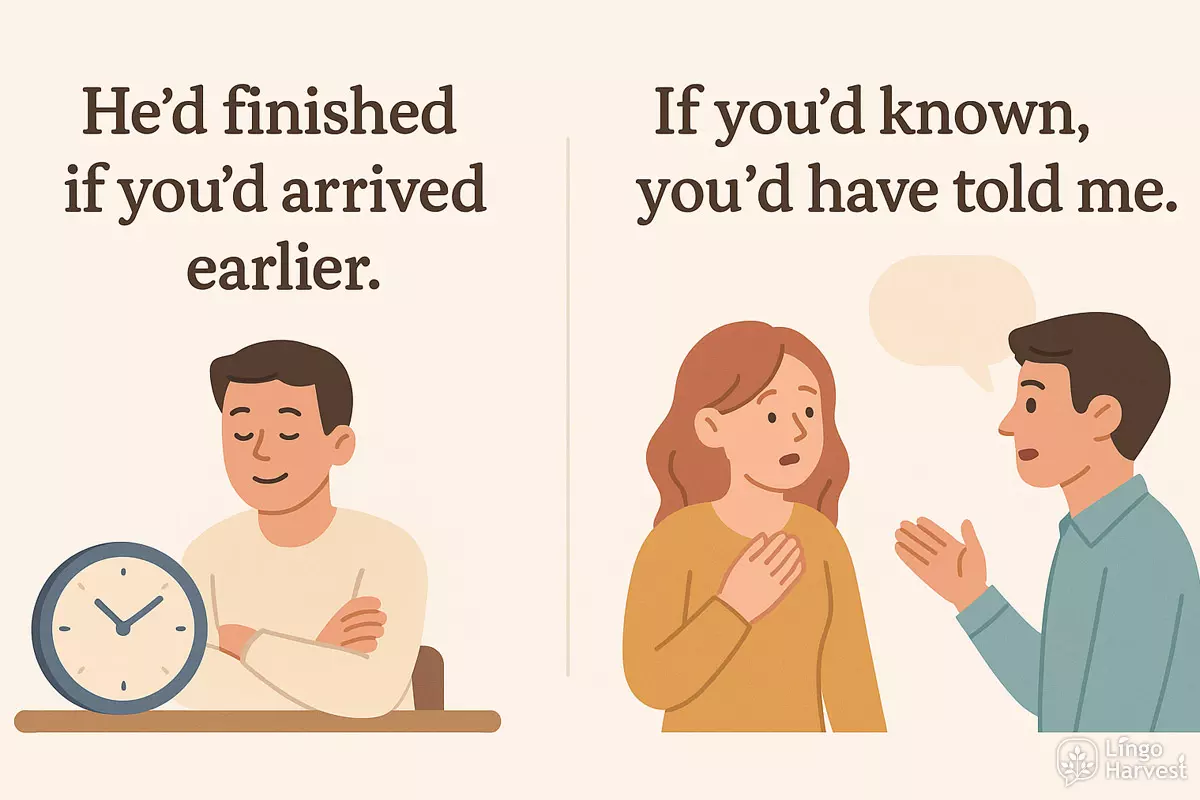
- He’d finished if you’d arrived earlier. (he had finished)
- If you’d known, you’d have told me. (you had known, you would have told)
- She’d help if she could. (she would help)
- She’d gone if she’d heard the news. (she had gone, she had heard)
- They’d stay if it wasn’t raining. (they would stay)
- They’d left before the party started. (they had left)
- If we’d won, we’d be celebrating. (we had won, we would be celebrating)
- If I’d seen him, I’d have said hello. (I had seen, I would have said)
- You’d understand if you tried. (you would understand)
- You’d told me, I’d have helped. (you had told, I would have helped)
- It’d be easier if you explained. (it would be easier)
- It’d been better if we’d left earlier. (it had been better, we had left)
Similar-sounding contractions in different conditionals
Context is crucial for understanding contracted forms. The same contraction can mean something different in first, second, or third conditional sentences. This can lead to errors, especially for learners who are not used to distinguishing between would and had by context alone.
| Contraction | Possible Meanings in Conditionals | Example Sentence |
|---|---|---|
| he’d | he had / he would | If he’d known, he’d have stayed. (had / would) |
| she’d | she had / she would | She’d help if she could. (would) |
| we’d | we had / we would | We’d go if it stopped raining. (would) |
| they’d | they had / they would | They’d left by the time we arrived. (had) |
| it’d | it had / it would | It’d be better if you called first. (would) |
| you’d | you had / you would | You’d have seen it if you’d looked. (had / had) |
Tips to avoid mix-ups
- Pay attention to verb forms after the contraction: a past participle usually signals had, while a base verb often means would.
- If your listener looks confused, try repeating with the full form for clarity.
- When speaking quickly, be careful with contractions at the start of conditionals, where ambiguity is highest.
- Practice recognizing both meanings in context to improve both listening and speaking skills.
Making these subtle distinctions will help you sound more natural and avoid the most common misunderstandings when contracting conditionals in speech.
Examples from dialogues and everyday speech
When people talk informally, conditional sentences are almost always contracted. This makes speech flow more naturally and sounds less stiff. Instead of saying “If you will go,” most speakers say “If you’ll go.” Listen closely in movies or everyday conversations, and you’ll notice these shortened forms everywhere.
Typical contracted conditional forms
The most common contractions in spoken conditionals involve auxiliary verbs like “would,” “had,” “will,” and “have.” Here are some patterns:
- I’d (I would/I had)
- You’d (you would/you had)
- He’ll (he will)
- She’d (she would/she had)
- We’ve (we have)
- They’ll (they will)
- If I’d known (If I had known)
- If you’ll wait (If you will wait)
- We’d go (We would go)
- They’d left (They had left)
- He’d help (He would help)
- I’ll do it (I will do it)
- You’ve got time (You have got time)
- If she’d come (If she had come)
Mini-dialogue samples
These short exchanges show how native speakers use contracted conditionals in realistic settings:
- A: If you’d told me, I’d have helped!
B: Sorry, I didn’t think you’d want to. - A: Will you come if it rains?
B: I’ll be there either way. - A: If they’ll wait a bit longer, we can join them.
- A: She’d go if you invited her.
- B: If I’d known earlier, I’d have changed my plans.
Direct comparison: contracted vs. full forms
The following table shows how the same idea is expressed with and without contractions. In real conversation, the contracted version is far more natural.
| Full Form | Contracted Form |
|---|---|
| If you would like to join us, let me know. | If you’d like to join us, let me know. |
| If she had called, we would have gone. | If she’d called, we’d have gone. |
| They will come if it does not rain. | They’ll come if it doesn’t rain. |
| We have finished if you want to check. | We’ve finished if you want to check. |
Tips for sounding natural
To speak more like a native, try using these contracted forms when you practice. Notice how they make your sentences shorter and more fluid. Remember, contractions are standard in spoken English, especially in conditional sentences. Don’t be afraid to use them in casual conversation!
Practice: rewrite full sentences using natural contractions
Getting comfortable with contracted forms in conditional sentences takes practice. Native speakers almost always use contractions like I'd, you'll, and he'd when speaking, especially in conditionals. Below you'll find exercises and examples to help you recognize and use these natural contractions in everyday English.
Common Conditional Contractions
Let's review some typical contractions found in conditional sentences. Notice how these forms make speech sound smoother and more natural:
- If I had → If I'd
- If you are → If you're
- If he would → If he'd
- If we have → If we've
- If they will → If they'll
- She would have → She would've
- I could have → I could've
- We should have → We should've
- He is not → He isn't
- They had not → They hadn't
- You would not → You wouldn't
- I will not → I won't
Rewrite Sentences: Practice Task
Try rewriting these full conditional sentences using natural contractions. This will help you internalize the patterns and sound more fluent.
- If you are ready, we can start the meeting.
- If I had known about the party, I would have come.
- If she will join us, we will have enough players.
- If they had not forgotten the tickets, we would not have missed the show.
- If he is tired, he should rest.
- If I could have helped, I would have.
- If you would like some tea, I will make it for you.
- If we have time, we will visit the museum.
- If you do not hurry, you will miss the train.
- If she does not call soon, we will leave without her.
Show answers
- If you're ready, we can start the meeting.
- If I'd known about the party, I would've come.
- If she'll join us, we'll have enough players.
- If they hadn't forgotten the tickets, we wouldn't have missed the show.
- If he's tired, he should rest.
- If I could've helped, I would've.
- If you'd like some tea, I'll make it for you.
- If we've got time, we'll visit the museum.
- If you don't hurry, you'll miss the train.
- If she doesn't call soon, we'll leave without her.
Quick Reference: Full vs. Contracted Conditional Forms
| Full Sentence | Natural Contraction |
|---|---|
| If I had seen him, I would have said hello. | If I'd seen him, I would've said hello. |
| If you are coming, let me know. | If you're coming, let me know. |
| If she does not reply, I'll try again. | If she doesn't reply, I'll try again. |
| If they will help, we can finish early. | If they'll help, we can finish early. |
| If we have finished, we can leave. | If we've finished, we can leave. |
Practicing these forms in context will help you sound more like a native speaker and make your spoken English more natural and relaxed.