B1–B2 Practice: Complete the Conditional Sentences

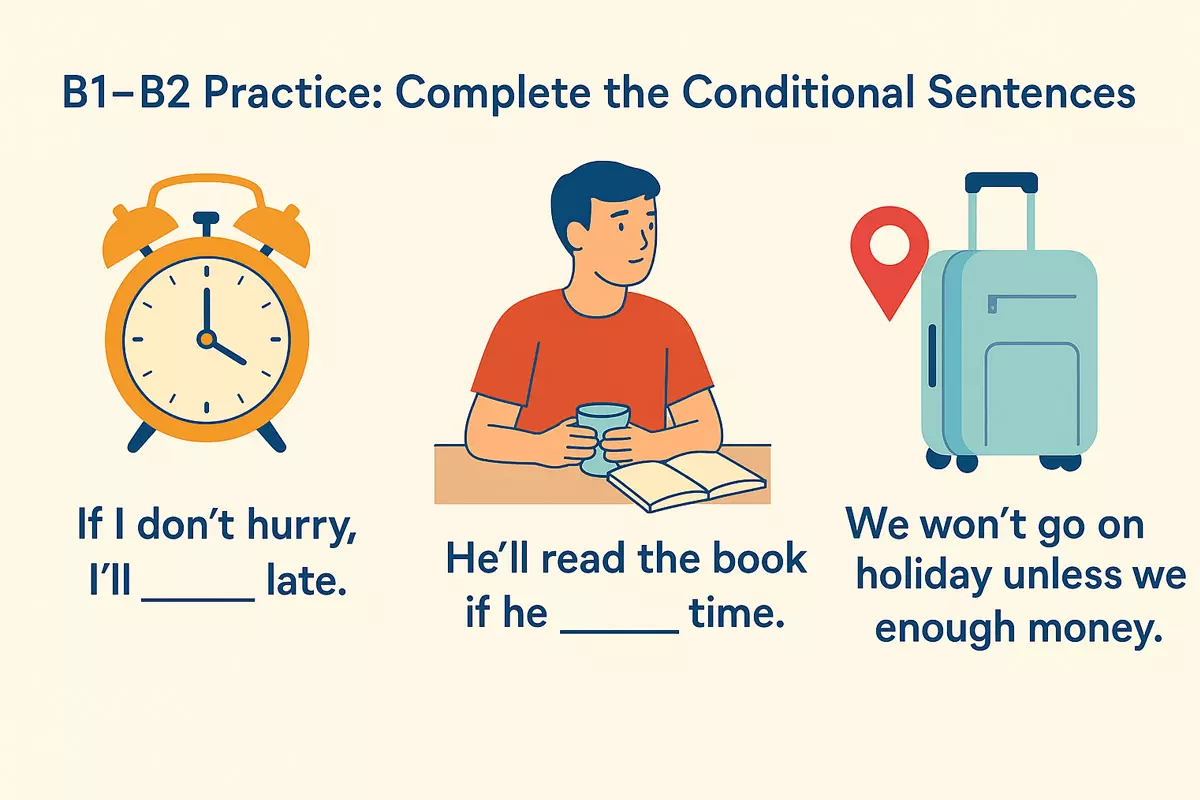 The article provides structured B1–B2 English practice with fill-in-the-blank tasks for all conditional types, exercises on real versus unreal meanings, modal verbs in results, and sentence transformations. An answer key with explanations is included.
If you want to improve your English and feel more confident using "if" statements, this activity is designed to help you practice completing sentences about possible or imaginary situations. It is especially useful for intermediate learners who wish to strengthen their grammar and expand their ability to express hypothetical ideas. By working through these exercises, you will develop greater fluency and accuracy in using conditional sentences, making your spoken and written English more natural and effective.
Instructions for structured B1–B2 practice
To develop your skills with conditional sentences at intermediate levels, try activities that focus on identifying patterns and using correct forms. This section guides you through targeted exercises and provides clear examples to help you understand how different types of conditional sentences function in English.
Step-by-step approach to practicing conditionals
- Review the forms: Familiarize yourself with the structure of zero, first, and second conditionals. Notice the differences in verb tenses and meaning.
- Complete sentence tasks: Fill in gaps or choose the correct verb forms for each type of conditional.
- Check your answers: Use the provided answer keys to self-correct and understand any mistakes.
Common structures for B1–B2 conditional sentences
| Type | Structure Example | Meaning |
|---|---|---|
| Zero Conditional | If + present simple, present simple | General truths, facts |
| First Conditional | If + present simple, will + base verb | Real future possibility |
| Second Conditional | If + past simple, would + base verb | Unreal or unlikely present/future |
| Mixed Conditional | If + past perfect, would + base verb | Unreal past with present result |
Quick tips for mastering conditionals
- Remember that “if” never uses “will” or “would” directly after it.
- Use the comma when the “if” clause comes first.
- Practice transforming direct speech into conditionals for variety.
- Experiment with negative forms to express what won’t or wouldn’t happen.
- Try creating your own examples to reinforce the patterns above.
Practice: Complete the sentences
- If you ________ (study), you will pass the exam.
- If it ________ (rain), the grass gets wet.
- If I ________ (have) more time, I would travel more.
- If she ________ (see) him yesterday, she would tell you.
- If they ________ (arrive) on time, we will start at six.
- If he ________ (be) taller, he would play basketball.
- If we ________ (not hurry), we will miss the train.
- If you ________ (heat) ice, it melts.
- If I ________ (know) the answer, I would tell you.
- If they ________ (have) more money, they would have bought a bigger house.
Show answers
- study
- rains
- had
- had seen
- arrive
- were
- don't hurry
- heat
- knew
- had had
Vocabulary and linking words for conditionals
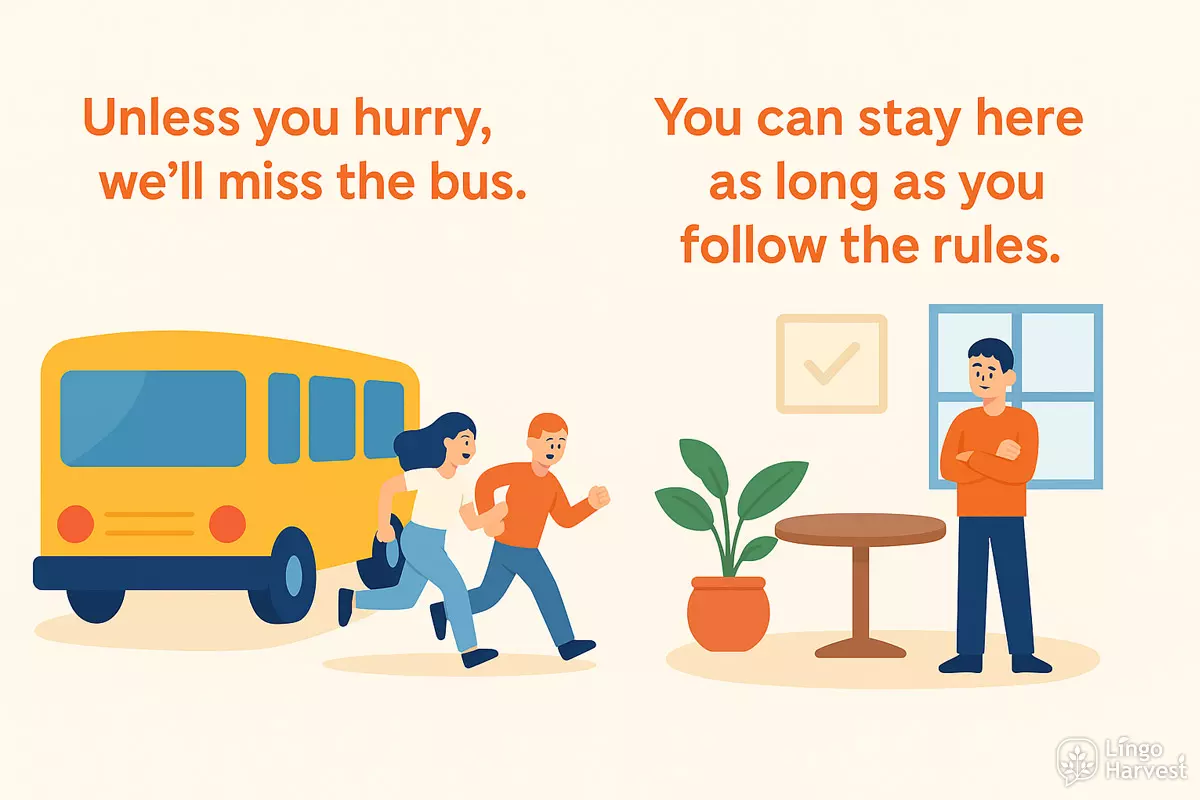
- unless → Unless you hurry, we’ll miss the bus.
- as long as → You can stay here as long as you follow the rules.
- provided (that) → You can borrow the car provided that you return it tonight.
- even if → Even if it rains, the game will continue.
- in case → Take a jacket in case it gets cold.
- suppose/supposing → Suppose you won the lottery—what would you do?
- on condition that → You may enter on condition that you show your ID.
- otherwise → Leave now; otherwise, you’ll be late.
- only if → You can open the gate only if you have the code.
- whether or not → I’m going whether or not you join me.
- assuming (that) → Assuming that the plan works, we’ll finish early.
- if not → Leave a message if not, I might miss your call.
- but for → But for your help, I wouldn’t have succeeded.
- in the event that → In the event that the power goes out, use the backup generator.
- so long as → You’re safe so long as you stay inside.
- what if → What if we get lost on the way?
Focus on one type of conditional at a time, then mix them to challenge your understanding. Regular practice and careful review of answers will help you use conditionals accurately and fluently in both spoken and written English.
Fill-in-the-blank tasks for all conditional types
Understanding how to form different types of conditional sentences is essential for intermediate English learners. Below, you'll find a range of fill-in-the-gap activities that cover zero, first, second, and third conditional structures. These exercises help you practice verb forms, sentence logic, and the nuances of each conditional type.
Practice: Complete the sentences
Read each sentence carefully and fill in the blanks with the correct form of the verb in brackets. Pay close attention to the meaning and time reference to determine which conditional fits best.
- If you ________ (heat) water to 100°C, it ________ (boil).
- If it ________ (rain) tomorrow, we ________ (cancel) the picnic.
- If I ________ (be) you, I ________ (take) the job offer.
- If they ________ (study) harder, they ________ (pass) the exam last year.
- If the train ________ (arrive) on time, we ________ (not/miss) the meeting.
- If my friend ________ (call) me, I ________ (tell) her the news.
- If you ________ (mix) blue and yellow, you ________ (get) green.
- If she ________ (know) about the party, she ________ (come).
- If I ________ (have) enough money, I ________ (travel) around the world.
- If we ________ (not/hurry), we ________ (be) late.
Show answers
- heat, boils
- rains, will cancel
- were, would take
- had studied, would have passed
- had arrived, wouldn't have missed
- calls, will tell
- mix, get
- had known, would have come
- had, would travel
- don't hurry, will be
Conditional sentence structures at a glance
Here’s a quick overview of the main patterns for each type. Notice how verb tenses change depending on the situation and meaning:
| Type | Form | Example | Typical Use |
|---|---|---|---|
| Zero | If + present simple, present simple | If you heat ice, it melts. | General truths |
| First | If + present simple, will + base verb | If it rains, we will stay inside. | Real future possibility |
| Second | If + past simple, would + base verb | If I had time, I would help. | Unreal present/future |
| Third | If + past perfect, would have + past participle | If she had left earlier, she would have caught the bus. | Unreal past |
Quick fill-in-the-gap quiz
- If you ________ (press) this button, the machine ________ (stop).
- If I ________ (see) her, I ________ (say) hello.
- If we ________ (not/leave) now, we ________ (miss) the bus.
- If they ________ (not/forget) the tickets, they ________ (get in).
- If he ________ (study) more, he ________ (pass) the test.
- If you ________ (heat) ice, it ________ (melt).
- If she ________ (arrive) earlier, she ________ (meet) him.
- If I ________ (be) you, I ________ (choose) a different option.
- If it ________ (rain) tomorrow, we ________ (stay) home.
- If they ________ (call) me earlier, I ________ (help).
Show answers
- press, stops
- see, will say
- don't leave, will miss
- hadn't forgotten, would have got in
- studied, would pass
- heat, melts
- had arrived, would have met
- were, would choose
- rains, will stay
- had called, would have helped
Practicing these sentence patterns regularly will help you feel more confident using English conditionals in conversation and writing. Focus on the verb tenses and the logical relationship between the two parts of each sentence for best results.
Real vs unreal meaning selection
Understanding when to use real or unreal conditionals is essential for expressing different types of situations in English. Real conditionals describe likely or possible events, while unreal conditionals refer to hypothetical, imaginary, or impossible scenarios. Choosing the correct form depends on the meaning you want to convey.
How to choose between real and unreal conditionals
When you want to talk about something that can actually happen now or in the future, use real conditionals. For situations that are contrary to fact, unlikely, or imagined, opt for unreal forms. Pay attention to the verb tenses: real conditionals often use present tenses, unreal ones require past forms or special modal verbs.
| Situation Type | Example Sentence | Typical Structure |
|---|---|---|
| Possible present or future (real) | If it rains, we will stay inside. | if + present simple, will + base verb |
| Habit or general truth (real) | If you heat ice, it melts. | if + present simple, present simple |
| Unlikely or imaginary present/future (unreal) | If I won the lottery, I would travel the world. | if + past simple, would + base verb |
| Impossible past situation (unreal) | If you had called me, I would have helped. | if + past perfect, would have + past participle |
Common signals for each type
Look for certain clues in the sentence that hint at reality or imagination. Time expressions (e.g. "every day", "yesterday", "tomorrow") and modal verbs (e.g. "would", "could", "might") can help you decide.
- ✅ Use present simple in the if-clause for real/possible events.
- ✅ Use past simple in the if-clause for unreal/hypothetical situations.
- ✅ Use past perfect in the if-clause for impossible past situations.
- ✅ Use "will" or "can" for real results; "would", "could", or "might" for unreal results.
- ✅ Facts or always-true statements use zero conditional.
- ✅ Imaginary or contrary-to-fact ideas use second or third conditional.
- ✅ If you see "If I were you", it’s always unreal/hypothetical.
- ✅ "Unless" can replace "if not" in real situations.
- ✅ "Suppose" or "imagine" often signal unreal meaning.
- ✅ "Should" in the if-clause sometimes makes a real condition more formal or polite.
Key points to remember
- Real forms are for genuine possibilities or facts; unreal forms express wishes, regrets, or imagined outcomes.
- The structure of the sentence changes depending on the meaning you want: tense and modal verbs are your main tools.
- Practice recognizing context and signal words to choose the right conditional every time.
Modal verbs in conditional results
When we create conditional sentences at B1–B2 level, it’s common to use modal verbs like will, would, can, could, might, or should in the result clause. These modals help us express possibility, permission, advice, ability, or certainty about the outcome. The choice of modal affects the meaning and tone, so it’s useful to be familiar with the most typical uses.
Typical Modal Verbs in Conditional Sentences
- will – for definite or likely results (If you study, you will pass.)
- would – for hypothetical or less certain results (If I had more time, I would travel more.)
- can – to express ability or possibility (If you call her, she can help.)
- could – for polite suggestions or less certain ability (If it rained, we could stay inside.)
- may / might – to show possibility or uncertainty (If you hurry, you might catch the bus.)
- should – to give advice or recommendations (If you feel sick, you should see a doctor.)
How Modal Verbs Change the Meaning
Depending on the modal, the sentence can sound more certain, more polite, or more hypothetical. Compare these examples:
| If-clause | Result with Modal |
|---|---|
| If you call me tonight, | I will tell you the news. |
| If it rains tomorrow, | we might cancel the picnic. |
| If I won the lottery, | I would buy a new car. |
| If you finish early, | you can go home. |
| If you are tired, | you should rest. |
| If we had more time, | we could visit the museum. |
Common Patterns and Tips
- First conditional: If + present simple, will/can/may + base verb.
- Second conditional: If + past simple, would/could/might + base verb.
- Use should for advice, not for certainty.
- Don’t use will or would in the if-clause.
- For suggestions or polite offers, could is often more appropriate than can.
Practising different modal verbs in conditional sentences helps you sound more natural and precise in English. Try making your own examples using a variety of modals to see how the meaning changes.
Sentence transformations for deeper understanding
Understanding how to transform conditional sentences is essential for mastering English at the B1–B2 level. By rephrasing conditionals, learners gain flexibility in expressing hypothetical situations, causes, and consequences using different grammatical structures. This skill also helps with paraphrasing and comprehension tasks often found in exams.
Why transform conditional sentences?
Changing the form of a conditional sentence can clarify meaning, emphasize different points, or show a range of possibilities. It also deepens your grasp of grammar by encouraging you to think about time, probability, and consequence.
Common ways to rephrase conditionals
- Switching between "if" clauses and equivalent expressions (e.g., "Unless", "Provided that")
- Using modal verbs to express probability or advice ("might", "could", "should")
- Transforming direct conditionals into reported speech
- Changing between types: zero, first, second, and third conditionals
- Using inversion for formal or literary effect ("Had I known…")
- Shortening conditionals (omitting "if" and using participle phrases)
- Expressing conditions with "in case", "as long as", "even if"
- Substituting "when" for "if" in certain real situations
- Using "but for" to replace "if not" in third conditionals
- Combining conditionals with time clauses ("when", "after", "before")
Transformations in practice: Examples
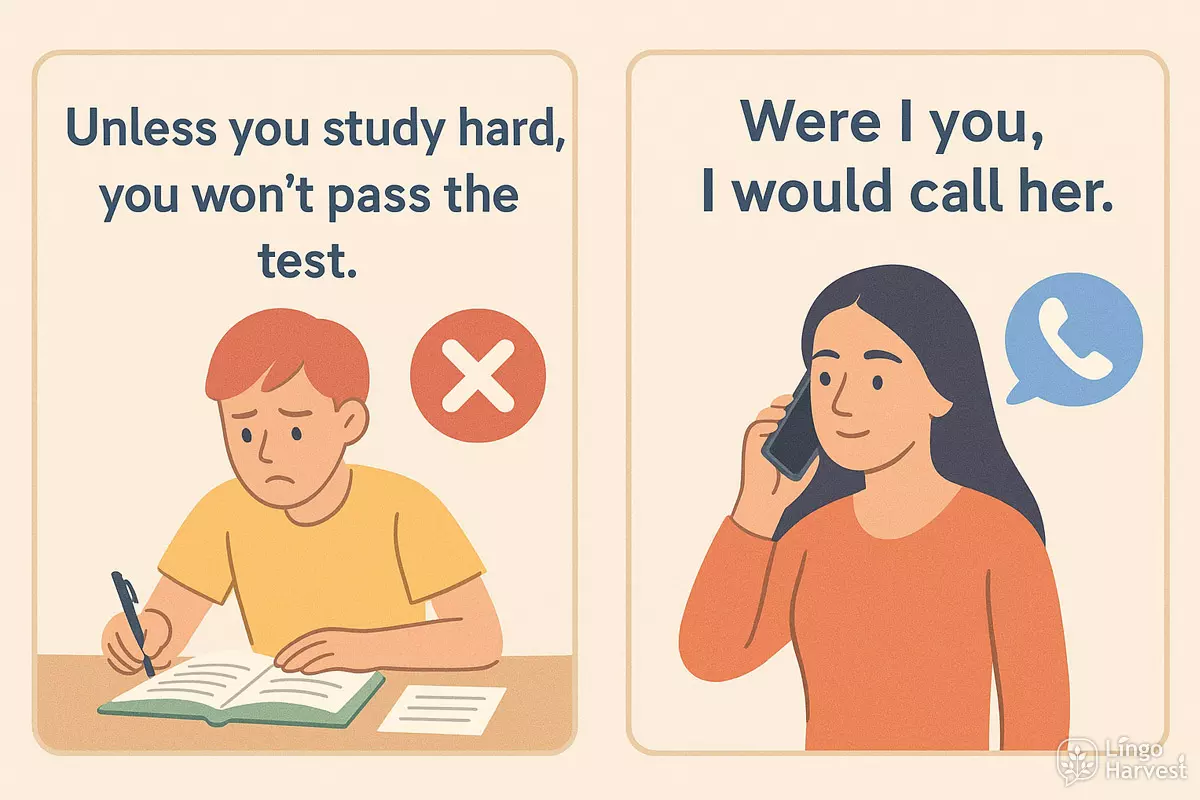
Here are some typical transformation patterns and their equivalents:
| If-clause | Transformed Sentence |
|---|---|
| If you study hard, you will pass the test. | Unless you study hard, you won't pass the test. |
| If I were you, I would call her. | Were I you, I would call her. |
| If it rains, we will stay inside. | Should it rain, we will stay inside. |
| If he had seen her, he would have told her. | Had he seen her, he would have told her. |
| If you need help, call me. | Call me in case you need help. |
| If not for your advice, I would have failed. | But for your advice, I would have failed. |
Tips for mastering transformations
- Practice by rewriting sentences using different conditional forms.
- Pay attention to verb tenses and modals when changing the type of conditional.
- Notice how meaning can subtly shift with each transformation.
- Use context to decide which form is most natural or formal.
Mastering these changes not only boosts your grammar skills, but also prepares you for real-life conversations and exam situations where flexibility and accuracy are valued.
Answer key with explanations
Understanding the logic behind conditional sentences helps you use them more naturally. Below, you’ll find clear answers for each gap, plus reasons for choosing each verb form. Reviewing these examples will strengthen your grasp of the first, second, and third conditionals at the B1–B2 level.
Typical Conditional Sentence Patterns
Conditional sentences in English often follow a set structure. Here are the most common types you’ll encounter at this level:
- Zero conditional: If + present simple, present simple (facts and general truths)
- First conditional: If + present simple, will + base verb (real future possibilities)
- Second conditional: If + past simple, would + base verb (unreal or hypothetical situations in the present/future)
- Third conditional: If + past perfect, would have + past participle (unreal situations in the past)
Sample Answers with Explanations
- If it rains, we will stay at home.
Explanation: This is a first conditional sentence. The present simple (“rains”) is used in the if-clause, and “will stay” expresses a likely future result. - If I were you, I would take the job.
Explanation: This uses the second conditional for advice about an unreal present situation. “Were” is the correct past simple form after “If I were you.” - If they had left earlier, they would have caught the train.
Explanation: Here, the third conditional is used to talk about a past situation that did not happen. “Had left” (past perfect) and “would have caught” (would have + past participle) create this structure. - If water boils, it evaporates.
Explanation: This is a zero conditional. Both clauses use the present simple to express a scientific fact. - If you don’t hurry, you will miss the bus.
Explanation: First conditional again, expressing a likely consequence in the near future. - If she studied harder, she would pass the exam.
Explanation: Second conditional for an unlikely or hypothetical present/future situation. - If we had known about the party, we would have come.
Explanation: Third conditional to talk about a missed opportunity in the past. - If you heat ice, it melts.
Explanation: Zero conditional for a natural law. - If I see him, I will tell him the news.
Explanation: First conditional, showing a real possibility. - If I had more time, I would travel more.
Explanation: Second conditional, imagining a different present.
Overview of Conditional Forms
| Type | Structure | Example | Usage |
|---|---|---|---|
| Zero | If + present simple, present simple | If you heat water, it boils. | General truths, facts |
| First | If + present simple, will + verb | If it rains, I will stay inside. | Real future possibilities |
| Second | If + past simple, would + verb | If I had money, I would travel. | Unreal/hypothetical present or future |
| Third | If + past perfect, would have + past participle | If they had called, we would have come. | Unreal past situations |
Common Mistakes to Watch For
- Using “will” or “would” directly after “if” (e.g., If you will come)—this is incorrect in standard conditionals.
- Mixing tenses across the two clauses (e.g., If I knew, I will tell you instead of would tell).
- Forgetting to use the past perfect in third conditional structures.
Practice regularly with these patterns and explanations to become more confident in forming English conditional sentences.