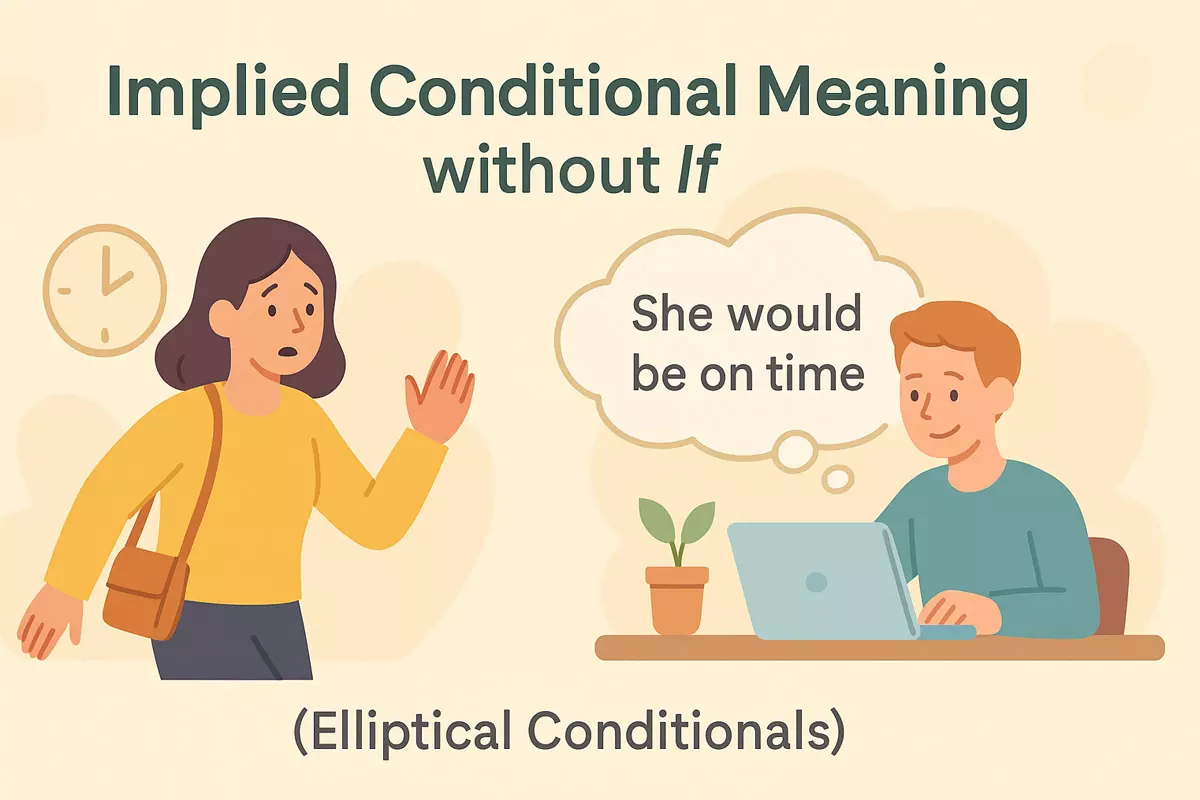
Implied Conditional Meaning Without If (Elliptical Conditionals)

 The article defines elliptical conditionals, explores how dropping if alters style and emphasis in speech, distinguishes them from reduced clauses, and provides examples from journalism, fiction, and academic writing, along with practice exercises for creating them.
- What elliptical conditionals are and how they function
- Common structures omitting if for stylistic effect
- Prosody and emphasis in spoken elliptical forms
- Examples from journalism, fiction, and academic arguments
- Difference between elliptical clauses and reduced clauses
- Practice: create elliptical conditionals from full sentences
English sometimes lets us express hypothetical situations without using the standard cue words like if. By omitting these explicit markers, speakers can still imply a conditional meaning through context, word order, or verb forms. This subtlety in language allows for more nuanced and flexible communication, as listeners are able to infer the intended condition even when it is not directly stated. Understanding these patterns helps reveal the complexity and richness of English expression.
What elliptical conditionals are and how they function
Elliptical conditionals are streamlined forms of conditional sentences where the typical marker "if" is omitted, but the meaning remains clear from context. Instead of stating the full conditional structure, speakers drop certain words—most commonly "if"—and rely on shared understanding or grammatical cues to convey the connection between the condition and the result. This form appears frequently in both spoken and written English, especially in casual or literary contexts.
How elliptical conditionals differ from standard conditionals
Traditional conditional sentences use explicit connectors like "if" or "unless." By contrast, elliptical constructions often present just the subject and verb of the conditional clause, omitting the conjunction. For example, "Had I known, I would have acted differently" omits "If I had known," yet the conditional sense is unmistakable.
Common patterns and forms
Several patterns are especially prevalent in elliptical conditionals. Here are some of the most typical structures:
- Inversion with auxiliary verbs: "Had I seen her, I would have waved." (instead of "If I had seen her…")
- Omitted "if" with "were," "should," or "had": "Were it not for you, I'd be lost."
- Imperative + result: "Ask me, and I’ll help."
- Without 'if' in colloquial speech: "You leave now, you miss the show."
- Ellipsis in spoken English: "Missed the bus, got late."
- Negative inversion: "Had I not tried, I'd never have known."
- Short answers or fragments: "Rain tomorrow, we’ll cancel."
- With "should" for future possibility: "Should you need assistance, call me."
- With "were" for unreal situations: "Were I you, I'd apologize."
- Conditional with imperative: "Touch that, and you’re grounded."
- Instructions or warnings: "Drive fast, get a ticket."
- Conjunction omitted in formal writing: "Had circumstances allowed, she would have joined."
- Result stated first: "I'd have helped, had I known."
- Series of conditions: "Miss the train, miss the meeting, miss the deal."
- With "unless" omitted: "You hurry, you’ll be late."
- Jokes or proverbs: "Early bird, worm."
How context clarifies meaning
Without explicit markers, these constructions depend on context and syntax to signal the conditional relationship. Listeners and readers infer the missing elements based on the structure and flow of the sentence. Intonation, punctuation, and the logical connection between clauses all help make the meaning clear.
Comparison: Full vs. elliptical conditionals
| Full Conditional | Elliptical Form |
|---|---|
| If you study, you will pass. | Study, and you will pass. |
| If I had known, I would have called. | Had I known, I would have called. |
| If it rains, we’ll stay inside. | Rain, we’ll stay inside. |
| If you see Tom, tell him. | See Tom, tell him. |
| If you hurry, you won’t miss the bus. | Hurry, and you won’t miss the bus. |
Elliptical conditionals provide efficiency and stylistic variation, allowing speakers and writers to convey nuanced meanings without redundancy. Their effectiveness relies on the reader’s or listener’s ability to supply the omitted elements from context.
Common structures omitting if for stylistic effect
Writers and speakers often drop the word "if" in conditional sentences to create a more concise or dramatic effect. This technique, sometimes called "elliptical conditional," relies on context and word order to make the conditional meaning clear, even though the usual conjunction is missing. Such forms are frequent in both formal and informal English, especially in spoken language, literature, and journalism.
Typical patterns omitting the conditional marker
Some structures naturally allow for leaving out "if" without causing confusion. Here are the most common forms where this stylistic omission occurs:
- Inversion with had, were, or should: Had I known, I would have acted differently.
- Imperative + and/or: Take this road and you’ll arrive faster.
- Suppose/supposing (without if): Suppose you missed the train, what then?
- Otherwise at sentence start: Otherwise, we risk being late.
- Let’s say/let’s suppose: Let’s say you win—what would you do?
- Were + subject (inverted): Were he here, he’d know what to do.
- Should + subject (inverted): Should you need help, call me.
- But for + noun phrase: But for your help, I would have failed.
- Otherwise clause: We must hurry, otherwise we’ll miss the show.
- Without + noun/gerund: Without your advice, I’d be lost.
- Provided/providing (that): Provided you agree, we’ll proceed.
- Only if (fronted): Only if you ask will I help.
- So long as/as long as: So long as you’re quiet, you can stay.
- On condition (that): On condition you pay now, I’ll deliver today.
- Otherwise inversion: Fail and you’ll regret it.
- Should inversion (present/future): Should anything happen, call me.
- Had inversion (past): Had we seen him, we would have waved.
- Were inversion (hypothetical): Were I you, I’d apologize.
Comparing full and elliptical forms
To clarify how these patterns work, here’s a table showing standard conditional sentences versus their elliptical (if-less) forms. Notice how meaning remains clear through context and inversion.
| Full Conditional | Elliptical (If Omitted) |
|---|---|
| If I had known, I would have helped. | Had I known, I would have helped. |
| If you see him, tell him to call me. | Should you see him, tell him to call me. |
| If you were here, you could help. | Were you here, you could help. |
| If you hurry, you’ll catch the train. | Hurry and you’ll catch the train. |
| If not for your support, I would have failed. | But for your support, I would have failed. |
| If you don’t listen, you’ll regret it. | Don’t listen and you’ll regret it. |
| If you need help, call me. | Should you need help, call me. |
| If it rains, we’ll stay inside. | Should it rain, we’ll stay inside. |
Stylistic impact and considerations
Omitting "if" can make statements sound more formal, urgent, or elegant. This technique is especially common in written English, speeches, and when emphasizing the hypothetical or unlikely nature of a situation. However, overusing these forms in casual conversation may sound unnatural. It’s important to choose the structure that best fits your context and audience.
Prosody and emphasis in spoken elliptical forms
How we say elliptical conditional sentences—those without “if”—plays a big role in how listeners understand them. In spoken English, pitch, stress, and intonation help listeners detect that a condition is implied, even when no explicit marker is present. For example, a raised intonation or a pause can signal that the first part of a sentence sets up a hypothetical scenario.
Intonation patterns that signal ellipsis
Speakers often use a noticeable rise or fall in pitch to indicate the start or end of an elliptical conditional. A higher pitch at the beginning can suggest a hypothetical, while a falling tone at the end helps signal completion and certainty. Pauses also serve to separate the implied condition from the result.
- Pause before the main clause: “Had I known… (pause) I would have acted differently.”
- Rising pitch on the conditional element: “Were I you,→ I’d reconsider.”
- Emphatic stress on the verb: “You miss the bus, you’re late.”
- Contrastive stress: “One more mistake, and you’re out.”
- Lengthened initial word: “Suppose you… didn’t call.”
- Lowered pitch to signal consequence: “No rain, we go hiking.”
- Quick tempo for urgency: “Any problems, let me know.”
- Slow, measured delivery for warning: “Touch that, you’re in trouble.”
- Sharp stress for humor or sarcasm: “Like you’d ever try, you’d win.”
- Segmented delivery for clarity: “You. Break it. You. Buy it.”
Common spoken forms and their prosodic features
Some elliptical conditionals rely on a set of familiar prosodic cues. These help listeners quickly recognize the implied meaning:
| Pattern | Typical Prosodic Cues |
|---|---|
| “You do that, you’re in trouble.” | Pause, stress on “do,” falling intonation on “trouble” |
| “No ticket, no entry.” | Flat intonation, equal stress, quick tempo |
| “Had I known, I’d have stayed.” | Rising intonation on “known,” pause, emphasis on “stayed” |
| “One more word, and you’re out.” | Stress on “one,” pause, sharp drop in pitch on “out” |
| “Rain tomorrow, we cancel.” | Stress on “rain,” rising pitch, falling tone on “cancel” |
Emphasis and pragmatic effects
Choosing which word to emphasize can change the nuance or even the meaning of an elliptical conditional. Stressing the subject may highlight who is responsible, while emphasizing the verb can underscore the action’s importance. Speakers often manipulate these prosodic features to convey urgency, warning, humor, or sarcasm. For learners and listeners, tuning in to these subtle cues is key to understanding not just the structure, but the intent behind elliptical conditional statements. Recognizing how tone, pitch, and pauses work together helps make sense of what’s left unsaid.
Examples from journalism, fiction, and academic arguments
Writers from various domains frequently employ elliptical conditionals—conditional sentences where the word "if" is omitted but the meaning remains clear from context. These constructions appear naturally in news articles, stories, and scholarly texts, allowing for brevity and stylistic variation. Below, we explore how such implied conditional meanings surface across genres and contexts.
Patterns Found in Real-World Writing
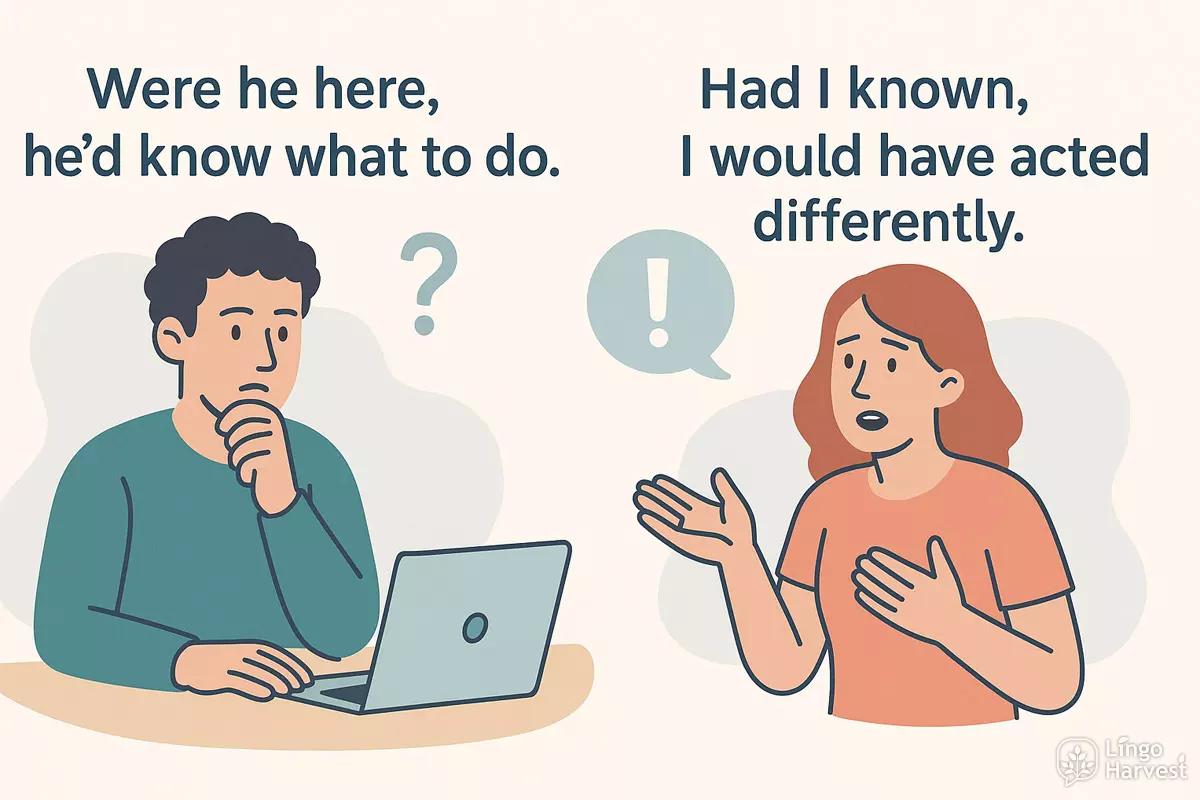
Journalistic and literary sources often use concise conditionals to create immediacy or dramatic effect. In academic writing, elliptical forms can streamline complex arguments or highlight logical relationships. Here are some typical examples:
- “Given more time, we could finish the project.” (implies: If we had more time…)
- “Were he here, he’d know what to do.” (implies: If he were here…)
- “Had I known, I would have acted differently.” (implies: If I had known…)
- “Should you need assistance, call the front desk.” (implies: If you need assistance…)
- “No rain, the match goes ahead.” (implies: If there is no rain…)
- “Only a miracle saves the team now.” (implies: If there is a miracle…)
- “Left unchecked, the problem will escalate.” (implies: If it is left unchecked…)
- “With luck, we’ll arrive on time.” (implies: If we have luck…)
- “Absent a confession, the case remains unsolved.” (implies: If there is no confession…)
- “But for your help, I’d have failed.” (implies: If not for your help…)
- “A little more effort, and you’ll succeed.” (implies: If you put in a little more effort…)
- “Supposing you were in my position, what would you do?” (implies: If you were in my position…)
- “Let a single error slip through, and the whole system is compromised.” (implies: If a single error slips through…)
- “Take away the safety net, and risk increases.” (implies: If you take away the safety net…)
- “Fail this test, and you’ll have to retake the course.” (implies: If you fail this test…)
- “Assuming all goes well, we’ll finish early.” (implies: If all goes well…)
- “Were that true, the results would be different.” (implies: If that were true…)
- “Let anyone try, they won’t succeed.” (implies: If anyone tries…)
- “Weather permitting, the festival will proceed outdoors.” (implies: If the weather permits…)
- “Provided no objections, the motion will carry.” (implies: If there are no objections…)
Comparing Forms Across Genres
Writers select elliptical conditional forms to suit their audience or stylistic needs. The table below contrasts how these forms typically appear in journalism, fiction, and academic prose:
| Context | Typical Form | Sample Usage |
|---|---|---|
| Journalism | Short, headline-like structures | “No deal, no Brexit.” |
| Fiction | Inverted or dramatic phrasing | “Had she known, she would have run.” |
| Academic | Formal, often beginning with participial phrases | “Assuming constant velocity, the results follow.” |
| Everyday Speech | Direct, often imperative or fragmentary | “Miss the bus, you’re late.” |
Stylistic and Pragmatic Effects
Choosing an implied conditional over a full “if” clause can change the tone or focus. In news reporting, it can make statements more forceful or urgent. In fiction, it often adds literary flair or suspense. Academic writers may prefer elliptical conditionals for conciseness and to emphasize logical connections. Understanding these subtle differences helps readers appreciate both the efficiency and expressiveness of this grammatical device.
Difference between elliptical clauses and reduced clauses
Understanding how elliptical clauses compare to reduced clauses helps clarify how English speakers imply meaning, especially in conditional sentences. Both forms involve leaving out certain words, but they do so for different reasons and with different grammatical results.
Elliptical Clauses: Omission for Context
Elliptical clauses are created when part of a sentence is dropped because it’s understood from context. In elliptical conditionals, the word “if” and sometimes other elements are omitted, but the full meaning remains clear. For example, in “Had I known, I would have called,” the subject and auxiliary verb are inverted to signal a condition, even though “if” is missing.
- Ellipsis relies on shared context — listeners fill in the missing words mentally.
- Common in spoken and written English for brevity or emphasis.
- Meaning is preserved by word order or auxiliary inversion.
Reduced Clauses: Shortening by Removing Words
Reduced clauses, on the other hand, occur when non-essential words are omitted, usually to simplify the structure while still retaining necessary information. These are typical with adverbial clauses (time, reason, condition) and often involve dropping the subject or auxiliary verb when it matches the main clause.
- Used to condense sentences, especially in formal or written English.
- Often involves participle phrases: “If finished, call me” (from “If you are finished, call me”).
- May omit “if” and the subject or auxiliary verb.
Key Contrasts at a Glance
| Feature | Elliptical Clauses | Reduced Clauses |
|---|---|---|
| Typical Use | Omit “if” but keep clause structure via inversion | Shorten by removing subject/verb or reducing to a phrase |
| Example | “Were I you, I’d stay.” | “Given more time, we’d finish.” |
| Grammatical Marker | Auxiliary inversion signals the condition | Participle phrase or dropped subject/verb |
| Context Dependency | Relies on listener’s knowledge of full form | Relies on main clause for full meaning |
Summary List: Elliptical vs. Reduced Patterns
- “Had I known, …” → Elliptical (from “If I had known, …”)
- “Should you need help, …” → Elliptical (from “If you should need help, …”)
- “Given the chance, …” → Reduced (from “If I am given the chance, …”)
- “Finished early, …” → Reduced (from “If it is finished early, …”)
- “Were I younger, …” → Elliptical (from “If I were younger, …”)
- “Provided with support, …” → Reduced
- “Had we seen her, …” → Elliptical
- “Left unchecked, …” → Reduced
- “Should problems arise, …” → Elliptical
- “Told the truth, …” → Reduced
In short, elliptical constructions hint at a hidden “if” through word order, while reduced clauses focus on trimming the sentence as much as possible yet keeping the core meaning clear. Both techniques add variety and efficiency to English conditional sentences.
Practice: create elliptical conditionals from full sentences
Understanding how to convert standard conditional sentences into elliptical forms helps you sound more natural and concise in English. In these exercises, you'll practice rephrasing full conditional statements by omitting "if" and using inversion or other elliptical structures. This is common in written and spoken English, especially in formal or literary contexts.
Transforming Full Sentences into Elliptical Conditionals
Below are several typical conditional sentences. Try to rewrite each as an elliptical conditional, removing "if" and applying the correct word order or auxiliary inversion.
- If you should need any help, call me.
- If I had known about the meeting, I would have come earlier.
- If she were here, she could explain everything.
- If they had listened to the weather forecast, they wouldn't have gone hiking.
- If you see John, tell him to call me.
- If you happen to be in town, drop by for a visit.
- If I were you, I would take the job offer.
- If it rains tomorrow, the match will be cancelled.
- If you had asked me, I would have helped.
- If he should call, let me know.
Show answers
- Should you need any help, call me.
- Had I known about the meeting, I would have come earlier.
- Were she here, she could explain everything.
- Had they listened to the weather forecast, they wouldn't have gone hiking.
- Should you see John, tell him to call me.
- Should you happen to be in town, drop by for a visit.
- Were I you, I would take the job offer.
- Should it rain tomorrow, the match will be cancelled.
- Had you asked me, I would have helped.
- Should he call, let me know.
Elliptical Conditional Patterns
Certain patterns frequently occur when forming these concise conditionals. Notice the auxiliary verbs and subject-verb inversion. Here are some key structures to remember:
- Should + subject + base verb (for possible or polite future events)
- Were + subject + to + base verb (for unlikely or hypothetical present/future)
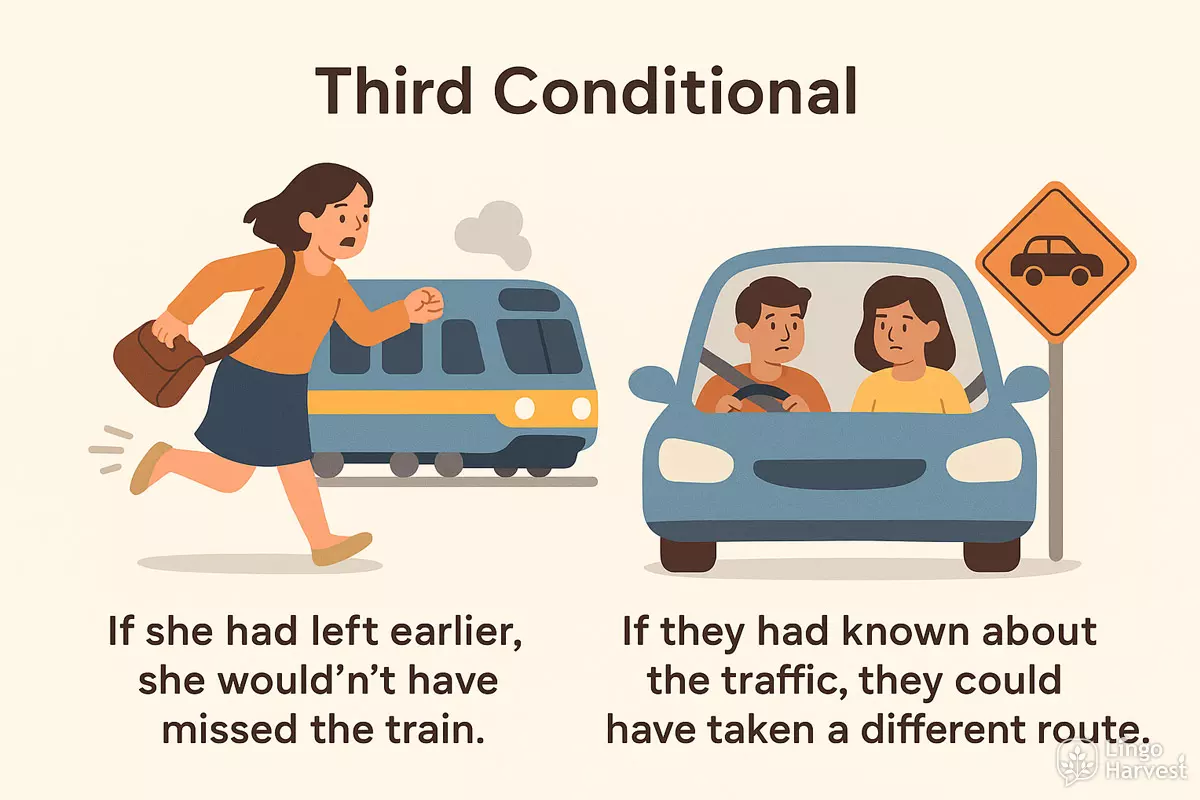
- Had + subject + past participle (for unreal past situations)
Further Practice: Identify the Pattern
Match each elliptical conditional to its pattern.
| Elliptical Conditional | Pattern |
|---|---|
| Had she known the answer, she would have replied. | Had + subject + past participle |
| Should you arrive early, wait in the lobby. | Should + subject + base verb |
| Were he to ask, I would say yes. | Were + subject + to + base verb |
| Should the need arise, contact support. | Should + subject + base verb |
Show answers
- Had she known the answer, she would have replied. → Had + subject + past participle
- Should you arrive early, wait in the lobby. → Should + subject + base verb
- Were he to ask, I would say yes. → Were + subject + to + base verb
- Should the need arise, contact support. → Should + subject + base verb
Try to notice these patterns in real texts, and practice converting regular conditional sentences into their elliptical forms. Mastery of these structures will add variety and sophistication to your English writing and speech.