Conditionals in Academic and Professional Writing

 Here we how conditionals function in formal analysis and argumentation, outlines preferred patterns for assumptions, predictions, and limitations in research writing, and offers examples and practice for revising informal conditionals into formal ones.
- Role of conditionals in formal analysis and argumentation
- Patterns for showing assumptions, predictions, and limitations
- Conditional structures preferred in research writing
- How to avoid informal forms in professional contexts
- Examples from reports, abstracts, and policy documents
- Practice: rewrite informal conditionals into formal ones
Effectively expressing possibilities and hypothetical scenarios is crucial for clear and persuasive communication in both academic and professional settings. By mastering these language skills, you can present ideas with greater nuance, explore alternative outcomes, and support your arguments more convincingly. Developing the ability to use conditional structures and modal verbs not only improves the clarity of your writing but also allows you to engage your audience and demonstrate critical thinking. This proficiency ultimately enhances your credibility and the overall impact of your message.
Role of conditionals in formal analysis and argumentation
Conditionals play a central part in structuring logical relationships, clarifying assumptions, and outlining possible outcomes in both academic and professional writing. By expressing hypothetical or contingent scenarios, writers can test the strength of arguments, present nuanced positions, and anticipate counterarguments. This flexibility allows for deeper exploration of ideas and more precise communication.
Clarifying Reasoning and Structure
Writers use conditional statements to make reasoning explicit. For example, "If the data are accurate, the hypothesis is supported," signals the dependency of the conclusion on a specific premise. Such constructions help readers follow the logical flow and understand the basis of conclusions.
Supporting Critical Analysis
Conditionals are essential tools for critical thinking. They allow authors to:
- Explore alternative explanations or scenarios
- Distinguish between necessary and sufficient conditions
- Evaluate the implications of changing variables
- Frame counterfactuals to test causality
- Set boundaries for the validity of claims
- Examine the robustness of arguments
- Highlight assumptions that may otherwise remain implicit
- Facilitate the construction of formal proofs or logical arguments
- Guide the reader through complex analytical reasoning
- Signal uncertainty or provisional conclusions
Types of Conditional Forms in Argumentation
Conditionals come in several forms, each serving distinct purposes in scholarly and technical texts. The table below summarizes common paradigms and their uses:
| Form | Typical Function in Analysis |
|---|---|
| Zero conditional ("If X occurs, Y happens") | Expresses general truths or established relationships |
| First conditional ("If X happens, Y will occur") | Predicts likely future outcomes based on present conditions |
| Second conditional ("If X happened, Y would occur") | Considers hypothetical or unlikely situations and their effects |
| Third conditional ("If X had happened, Y would have occurred") | Analyzes past counterfactuals to assess causality or missed opportunities |
| Mixed conditionals | Combines timeframes to explore complex logical relationships |
Anticipating Objections and Counterarguments
By using conditional language, writers can address potential critiques before they arise. For instance, statements such as "Even if the sample size were larger, the outcome would likely remain unchanged" proactively engage with possible objections, strengthening the overall persuasiveness of the analysis.
Examples of Effective Conditional Use
Writers in academic and professional contexts frequently employ conditional patterns to enhance clarity and rigor. Some commonly used structures include:
- If we assume X, then Y follows.
- Should the results differ, the interpretation must be revised.
- Provided that the assumptions hold, the model is valid.
- Unless otherwise indicated, the default parameters apply.
- Were this not the case, alternative explanations would be required.
- Suppose the trend continues, the implications are significant.
- Even if the method changes, the outcome remains robust.
- Only if these conditions are met can the conclusion be accepted.
- If not for the intervention, the results might differ.
- Had the policy been implemented earlier, the effects could be greater.
- Assuming the context is similar, the findings may generalize.
- Whether or not the hypothesis is correct, the data are informative.
Overall, conditional constructions enable writers to express complexity, manage uncertainty, and present arguments with precision. Their strategic use is a distinguishing feature of clear, logical, and persuasive academic and professional discourse.
Patterns for showing assumptions, predictions, and limitations
When writing academically or professionally, it's essential to clarify the basis of your claims. Writers frequently use specific grammatical structures and vocabulary to indicate when a statement is conditional, speculative, or bounded by certain factors. These linguistic cues help readers understand which ideas are hypothetical, which are forecasts, and which are restricted by context or data.
Common language for expressing assumptions
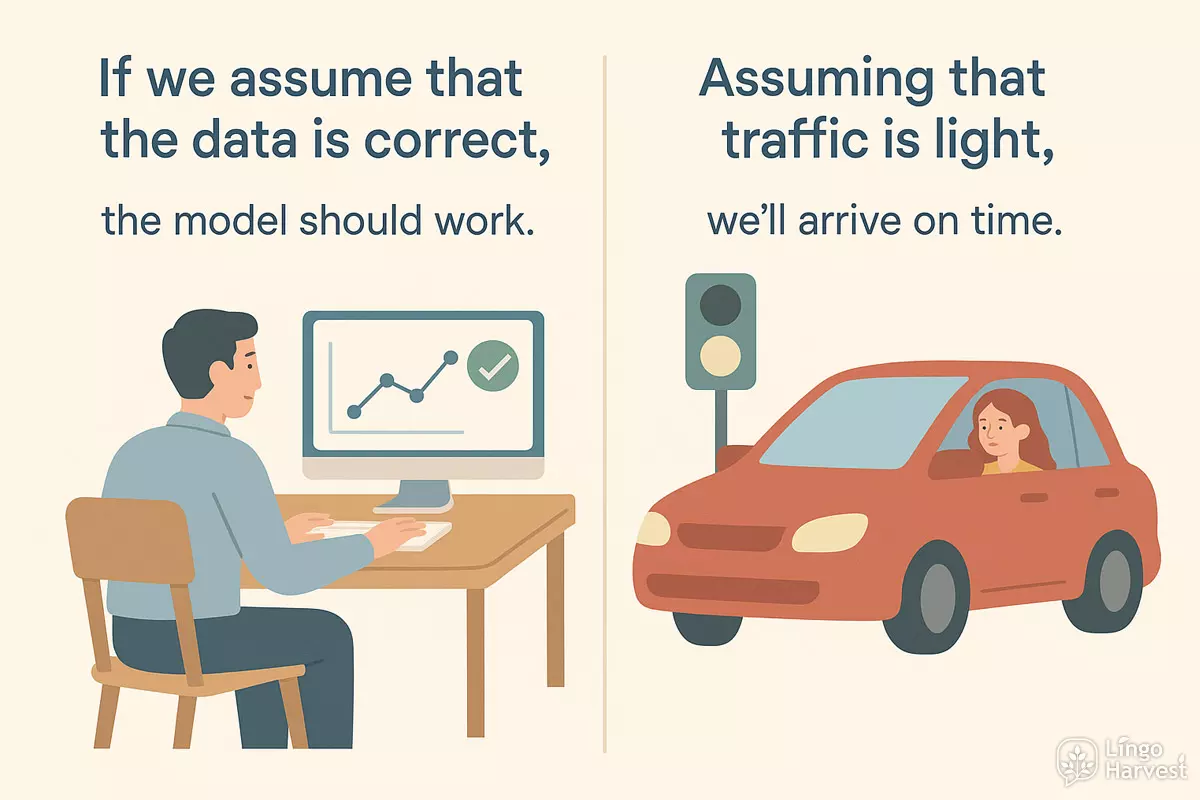
Writers often signal underlying conditions or suppositions to clarify their reasoning. These patterns help frame arguments and prevent misunderstandings. Typical ways to introduce assumptions include:
- If we assume that… → If we assume that the data is correct, the model should work.
- Assuming (that)… → Assuming that traffic is light, we’ll arrive on time.
- Provided that… → Provided that you follow the instructions, the device will function safely.
- Given that… → Given that he’s new here, he’s doing an excellent job.
- Supposing… → Supposing the plan fails, what will our backup strategy be?
- On the assumption that… → On the assumption that everyone agrees, we can move forward.
- In the event that… → In the event that the power goes out, emergency lights will switch on.
- Presuming… → Presuming everything goes smoothly, we’ll finish by noon.
- Only if… → You may leave only if your work is complete.
- Unless… → Unless we act now, the problem will get worse.
Patterns for making predictions
Forecasting future events or results is common in research and business. Writers typically hedge their predictions to acknowledge uncertainty. Useful expressions include:
- If X continues, Y will/may/might happen. → If the heatwave continues, power outages may happen.
- It is likely/unlikely that… → It is likely that demand will increase next month.
- Should this trend persist, … → Should this trend persist, prices will rise further.
- There is a possibility that… → There is a possibility that the event will be postponed.
- X is expected/predicted to… → The population is expected to grow steadily.
- In all probability… → In all probability, the project will be completed early.
- It is anticipated that… → It is anticipated that sales will double in the next quarter.
- X could result in… → Increased pressure could result in structural damage.
- Unless circumstances change, … → Unless circumstances change, the outcome will remain the same.
- X is projected to… → The system is projected to operate at full capacity by 2030.
Ways to indicate limitations
Academic and professional writers must often delineate the scope of their findings or arguments. These phrases highlight boundaries or exceptions:
- This analysis is limited to… → This analysis is limited to data collected in 2024.
- The findings apply only to… → The findings apply only to participants over the age of 18.
- Within the scope of this study… → Within the scope of this study, long-term effects were not examined.
- Under these conditions… → Under these conditions, the material becomes unstable.
- Results should be interpreted with caution because… → Results should be interpreted with caution because the sample size was small.
- Due to (a specific factor), … → Due to equipment failure, several measurements were delayed.
- The data do not account for… → The data do not account for seasonal variations.
- Except for… → Except for two anomalies, all results were consistent.
- Subject to the following constraints… → Subject to the following constraints, the model performs accurately.
- It should be noted that… → It should be noted that the experiment was conducted in controlled conditions.
Comparing conditional structures
Below is a structured overview of how different forms are used to express assumptions, predictions, and limitations in formal writing.
| Pattern Type | Example Expressions |
|---|---|
| Assumptions | If we assume that…, Given that…, Provided that…, Presuming…, Only if… |
| Predictions | X will/may/might happen if…, It is anticipated that…, X is projected to…, Should this trend persist, … |
| Limitations | This analysis is limited to…, Results should be interpreted with caution because…, The findings apply only to…, Due to (factor), … |
| Exceptions & Conditions | Unless…, Except for…, Subject to the following constraints…, In the event that… |
Choosing the right structure not only clarifies your meaning but also demonstrates critical thinking. Using these patterns thoughtfully strengthens your argument and helps readers accurately interpret your work.
Conditional structures preferred in research writing
Writers in academic settings often favor particular conditional forms to communicate nuanced relationships between evidence, claims, and interpretations. Instead of absolute statements, researchers frequently use conditional sentences to express probability, causality, or hypothetical scenarios, which allows for a balanced and cautious tone. This approach is essential when dealing with complex data or when discussing potential implications and limitations.
Common conditional patterns in scholarly texts
Scholarly articles and reports typically rely on several types of conditional structures, each serving a distinct rhetorical purpose. Some of the most frequently used forms include:
- If X is true, then Y may occur.
- Should X happen, Y would be expected.
- In the event that X is observed, Y could result.
- Unless X is controlled for, results may be skewed.
- Provided that X is consistent, Y can be inferred.
- If and only if X meets criteria, Y is valid.
- Assuming X holds, Y follows logically.
- Even if X changes, Y remains unaffected.
- Whereas X is constant, Y varies.
- Given that X occurs, Y is possible.
- When X increases, Y tends to decrease.
- Supposing X fails, Y will not materialize.
- Except when X is present, Y does not arise.
- Only if X is replicated, Y can be confirmed.
- Unless otherwise stated, X applies.
- When and if X is feasible, Y should be attempted.
- Even though X is unlikely, Y cannot be excluded.
- Whether or not X is included, Y persists.
Why these forms are favored
Such structures help academics hedge their claims, allowing for uncertainty and open-endedness. Using modal verbs like may, might, could, or would further signals that findings are subject to conditions or further evidence. This is crucial for maintaining objectivity and avoiding overgeneralization.
Functional comparison of academic conditionals
| Conditional Form | Typical Use in Research |
|---|---|
| If/then (If X, then Y) | Expresses direct cause-effect or hypothetical reasoning |
| Unless (Unless X, Y) | Highlights exceptions or necessary conditions |
| Provided that (Provided that X, Y) | Indicates a precondition for a claim or finding |
| Assuming (Assuming X, Y) | Frames an argument within a specific assumption |
| Even if/Even though (Even if X, Y) | Deals with unexpected or counterfactual scenarios |
Researchers prefer these nuanced constructions because they foster clarity, transparency, and intellectual honesty. By carefully selecting conditional phrases, writers can articulate the scope of their conclusions and acknowledge possible limitations, which is fundamental in the scientific method and scholarly communication.
How to avoid informal forms in professional contexts
Maintaining a formal tone is essential in academic and workplace writing, especially when constructing conditional sentences. Informal expressions, colloquialisms, and contractions can undermine credibility and clarity. Instead, use precise language and standard grammatical structures to convey your points effectively.
Recognizing Informal Conditional Patterns
Many everyday phrases and shortcuts appear natural in speech but are best avoided in professional writing. These include conversational contractions, slang, and vague language. Being able to spot these forms is the first step toward more polished communication.
- Avoid contractions (e.g., "if you’re" → "if you are")
- Replace slang ("gonna," "wanna") with standard forms ("going to," "want to")
- Use complete, explicit conditionals instead of dropping "if" or "would" ("Should you need..." is formal; "If you need..." is standard; "Need anything..." is informal)
- Steer clear of vague language ("stuff," "things")
- Refrain from rhetorical or tag questions ("If you think about it, isn’t it...?")
- Do not use double negatives ("If you don’t do nothing")
- Choose precise connectors ("provided that," "unless," "in the event that")
- Use passive voice judiciously, but avoid overuse ("If the report is submitted...")
- Prefer formal alternatives to phrasal verbs ("If you carry out the experiment..." instead of "If you do the experiment...")
- Eliminate filler words ("basically," "actually")
- Avoid direct address ("If you guys need...")
- Do not use exclamation marks in conditionals
- Opt for full words over abbreviations ("information" instead of "info")
- Keep tenses consistent ("If she had known, she would have attended")
- Limit the use of first-person unless required ("If I may suggest...")
- Do not use emojis or emoticons
- Replace informal connectors ("so," "but") with formal ones ("therefore," "however")
- Clarify reference ("If this happens, it will cause confusion" rather than "If it happens, it’ll confuse people")
Comparing Informal and Formal Conditional Constructions
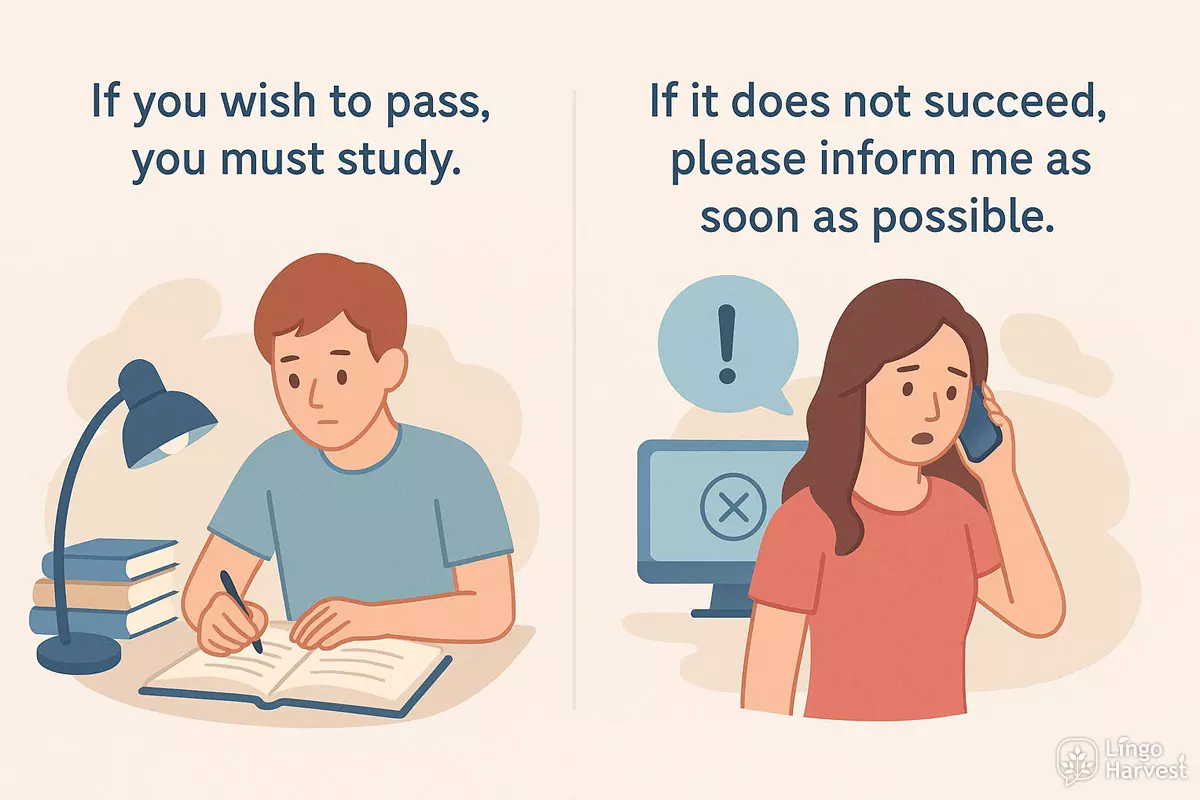
Identifying the differences between casual and professional conditional statements helps writers avoid common pitfalls. The table below demonstrates several typical transformations:
| Informal Example | Formal Alternative |
|---|---|
| If you wanna pass, you gotta study. | If you wish to pass, you must study. |
| If it doesn’t work out, let me know ASAP. | If it does not succeed, please inform me as soon as possible. |
| If you don’t get it, just ask! | If you do not understand, please ask for clarification. |
| If you’re interested, shoot me an email. | If you are interested, kindly send me an email. |
| If you need any info, let me know. | If you require any information, please inform me. |
Strategies for Maintaining Formality
To ensure your conditionals remain suitable for academic or workplace settings, review your writing for informal markers, read sentences aloud to catch casual phrasing, and consult style guides when uncertain. Remember, clear, direct, and respectful language enhances both understanding and professionalism.
Examples from reports, abstracts, and policy documents
Writers in academic and professional fields rely on conditional sentences to outline scenarios, predict outcomes, and clarify requirements or recommendations. These structures help communicate uncertainty, explain possible consequences, and set parameters for decisions or actions. In formal writing, conditionals often appear in policy recommendations, research findings, and technical summaries.
Common Uses of Conditionals in Formal Writing
- Stating requirements: “If applicants do not submit all required documents, their applications will not be considered.”
- Describing possible outcomes: “If the intervention is successful, patient recovery rates may improve.”
- Outlining procedures: “Should a discrepancy be identified, the case must be reviewed by the committee.”
- Making recommendations: “It is recommended that, if funding is secured, the project begin in Q3.”
- Predicting consequences: “If the policy is not revised, compliance issues could persist.”
- Expressing limitations: “Results should be interpreted with caution if sample sizes are small.”
- Proposing hypothetical scenarios: “Were the data to support this trend, further research would be warranted.”
- Specifying conditions for action: “The contract will be extended provided that performance targets are met.”
- Clarifying eligibility: “Eligibility is retained only if annual reviews are completed.”
- Signaling exceptions: “Unless otherwise stated, fees are non-refundable.”
- Outlining risks: “If supply chains are disrupted, delivery times may increase.”
- Setting priorities: “If resources are limited, priority will be given to high-impact projects.”
- Suggesting alternatives: “Alternatively, if the first method fails, Method B should be pursued.”
- Offering justifications: “If additional funding is not approved, the scope must be reduced.”
- Describing contingency plans: “In the event that negotiations break down, contingency measures will be implemented.”
- Highlighting dependencies: “The timeline is feasible only if all stakeholders cooperate.”
Conditional Structures in Professional Contexts
Writers use various forms of conditional sentences to suit formality and nuance. For instance, inverted conditionals (“Should the need arise, emergency protocols will be activated”) are common in policy documents for their concise, formal tone. Modal verbs such as “may,” “might,” and “could” often appear to soften predictions or recommendations.
| Conditional Pattern | Example from Professional Writing |
|---|---|
| If + present simple, will + base verb | If the data are validated, the findings will be published in the annual report. |
| If + past simple, would + base verb | If the policy were amended, compliance rates would likely improve. |
| Should + subject + base verb, ... | Should funding lapse, ongoing projects will be suspended. |
| Unless + present simple, ... | Unless further evidence emerges, the initial hypothesis stands. |
| Provided that / As long as + present simple, ... | Provided that all safety standards are met, the facility may reopen. |
These patterns allow professionals to clarify dependencies, communicate risk, and present nuanced arguments. Mastering these structures helps ensure that reports and policy documents are precise, persuasive, and clear about the circumstances under which findings or recommendations apply.
Practice: rewrite informal conditionals into formal ones
Academic and professional writing often requires a more precise, objective tone than everyday conversation. Informal conditional sentences—those starting with "if" or "when" in casual language—frequently use contractions, vague verbs, or colloquial phrasing. To enhance clarity and credibility, it is important to revise these statements into more formal, structured alternatives.
Common Features of Informal Conditionals
- Use of contractions (e.g., "If you don't...")
- Casual verbs ("get," "do," "go")
- Personal pronouns ("you," "we," "I")
- Ambiguous or imprecise outcomes ("things will be better")
- Colloquial language or idioms
Transforming Informal to Formal: Examples and Patterns
Below are several informal conditional sentences alongside their formal equivalents. Use these examples to guide your own revisions, focusing on removing contractions, specifying outcomes, replacing casual verbs, and adopting an impersonal tone where appropriate.
| Informal Conditional | Formal Version |
|---|---|
| If you don't finish the report, you won't get paid. | If the report is not completed, payment will not be issued. |
| If we mess up the data, it's going to be a problem. | If the data is inaccurate, this may result in complications. |
| If you want to get in, you have to show your ID. | Admission requires valid identification. |
| If you don't show up, they'll cancel the meeting. | If attendance is not confirmed, the meeting will be canceled. |
| If the weather's bad, we'll just stay in. | If adverse weather conditions occur, indoor activities will be pursued. |
| If you ask me, it's not fair. | It may be considered inequitable. |
| If we hurry, we can make it on time. | If time is managed efficiently, punctual arrival is possible. |
| If you don't agree, let me know. | Should there be any disagreement, notification is requested. |
| If things go wrong, we'll fix it later. | If issues arise, corrective action will be taken subsequently. |
| If you eat too much, you'll feel sick. | Excessive consumption may result in discomfort. |
| If it rains, we'll cancel the picnic. | If inclement weather occurs, the event will be canceled. |
| If you need help, just ask. | Assistance may be requested if necessary. |
| If we don't leave now, we'll be late. | Failure to depart promptly may result in tardiness. |
| If you break it, you'll have to pay for it. | Any damage incurred will require compensation. |
| If you don't understand, let me know. | Questions regarding clarity should be communicated. |
Practice: Rewrite Informal Conditionals
- If you don't hand in your assignment, you won't pass the course.
- If we don't get more funding, the project will stop.
- If you call her, she'll probably help.
- If you get here before 8, you can join us for dinner.
- If you don't follow the safety rules, you may get injured.
- If the report is late, the decision will be delayed.
- If you miss three classes, you will fail the module.
- If they don’t respond today, we’ll move on without them.
- If you don’t confirm your booking, your seat will be given to someone else.
- If you arrive late, you will have to wait for the next session.
Show answers
- If the assignment is not submitted, course completion will not be achieved.
- If additional funding is not secured, the project will be discontinued.
- If contacted, assistance may be provided.
- Arrival prior to 8:00 p.m. permits participation in dinner.
- If safety rules are not observed, injury may occur.
- If the report is not submitted on time, the decision will be postponed.
- If three classes are missed, the module will be failed.
- If no response is received today, the process will continue without them.
- If the booking is not confirmed, the seat will be reassigned.
- If arrival is delayed, access will be postponed until the next session.
When revising, focus on eliminating personal pronouns, clarifying consequences, and using precise, formal verbs. This approach ensures your writing meets academic and professional standards.