Complex Conditional Chains: Multi-Step Hypothetical Situations

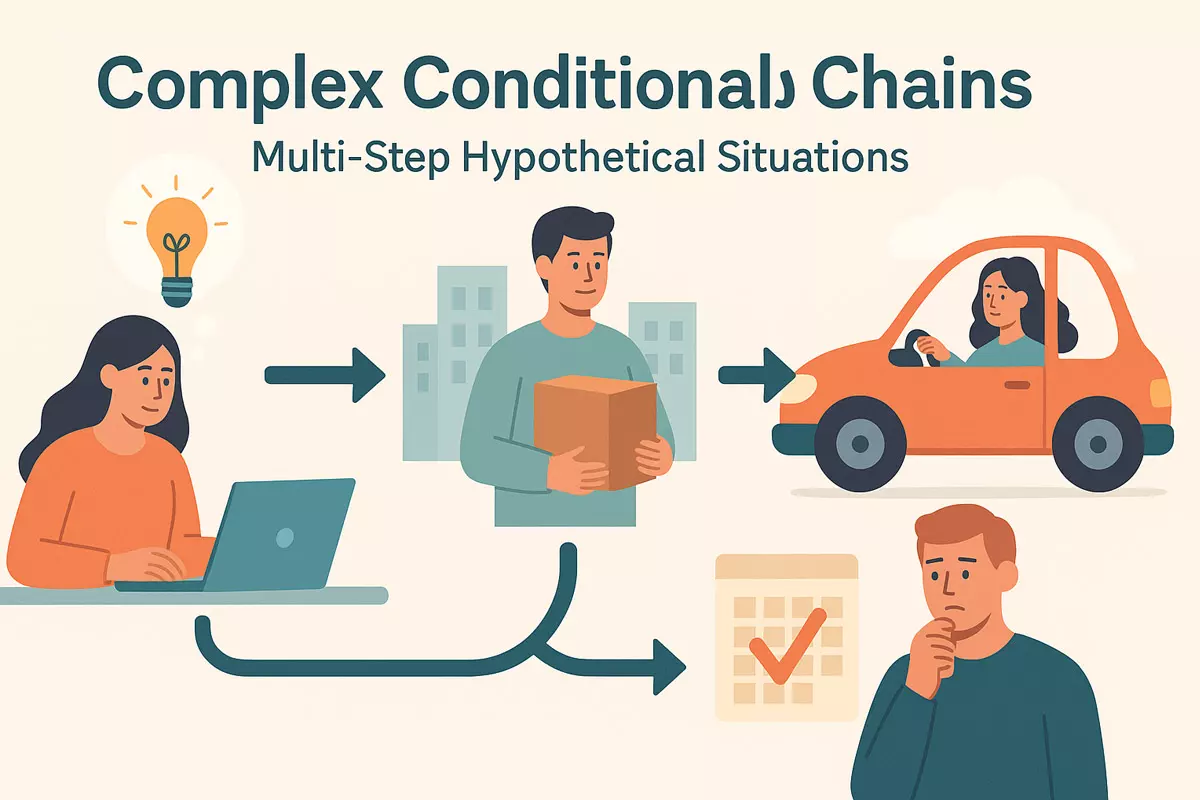 Here we what multi-step conditional chains are, how to construct sequences of dependent conditions and outcomes, strategies for clarity in lengthy logic, appropriate tone in technical writing, practical examples, and exercises for building such chains.
- What multi-step conditional chains are and where they appear
- Building sequences of conditions and dependent results
- Managing clarity in long conditional logic
- Tone and register in academic and technical scenarios
- Examples of conditional chains in planning and analysis
- Practice: construct multi-step hypothetical structures
Imagine exploring scenarios where each possible outcome leads to another, creating a chain of interconnected what-if situations. By examining these layers of hypothetical reasoning, we can uncover unexpected patterns and insights that lie beneath decisions that may at first appear straightforward. This article delves into how considering multiple layers of possibility not only enhances our understanding of complex situations but also helps us anticipate consequences, make better choices, and appreciate the intricate nature of decision-making.
What multi-step conditional chains are and where they appear
Multi-step conditional chains are sequences of hypothetical statements in which each condition depends on the outcome of the previous one. In these structures, the result of one "if" clause becomes the trigger for the next, creating a logical progression that can extend over several steps. This layered reasoning is common in both everyday speech and formal logic, especially when imagining complex scenarios or predicting outcomes that require several contingencies to align.
Common contexts for chained hypotheticals
You’ll often find these extended conditionals in problem-solving, storytelling, and decision-making. Some typical places where such chains are used include:
- Strategic planning (e.g., "If sales increase, we’ll hire more staff; if we hire more staff, we can expand operations.")
- Scientific reasoning and experiments
- Legal arguments and conditional contracts
- Mathematical proofs
- Games, puzzles, and logic exercises
- Speculative fiction and 'what if' storytelling
- Programming (nested if/else statements)
- Philosophical debates
- Personal decision trees ("If I get the job, I’ll move; if I move, I’ll buy a car...")
- Negotiations and contingency planning
- Historical analysis ("If the treaty had been signed, the conflict might have ended; if the conflict ended, trade could have resumed.")
- Medical diagnostics ("If the test is positive, we’ll do a biopsy; if the biopsy is clear, no further action is needed.")
How these chains are structured
Typically, each link in the chain has its own conditional clause, and the result of one forms the basis for the next. This can be seen in sentences like: "If A happens, then B will happen; if B happens, then C could follow." The chain can be as short as two steps or extend to many more, depending on the complexity of the situation.
Patterns and examples
Below is a variety of multi-step conditional patterns, illustrating how these chains might look in different situations:
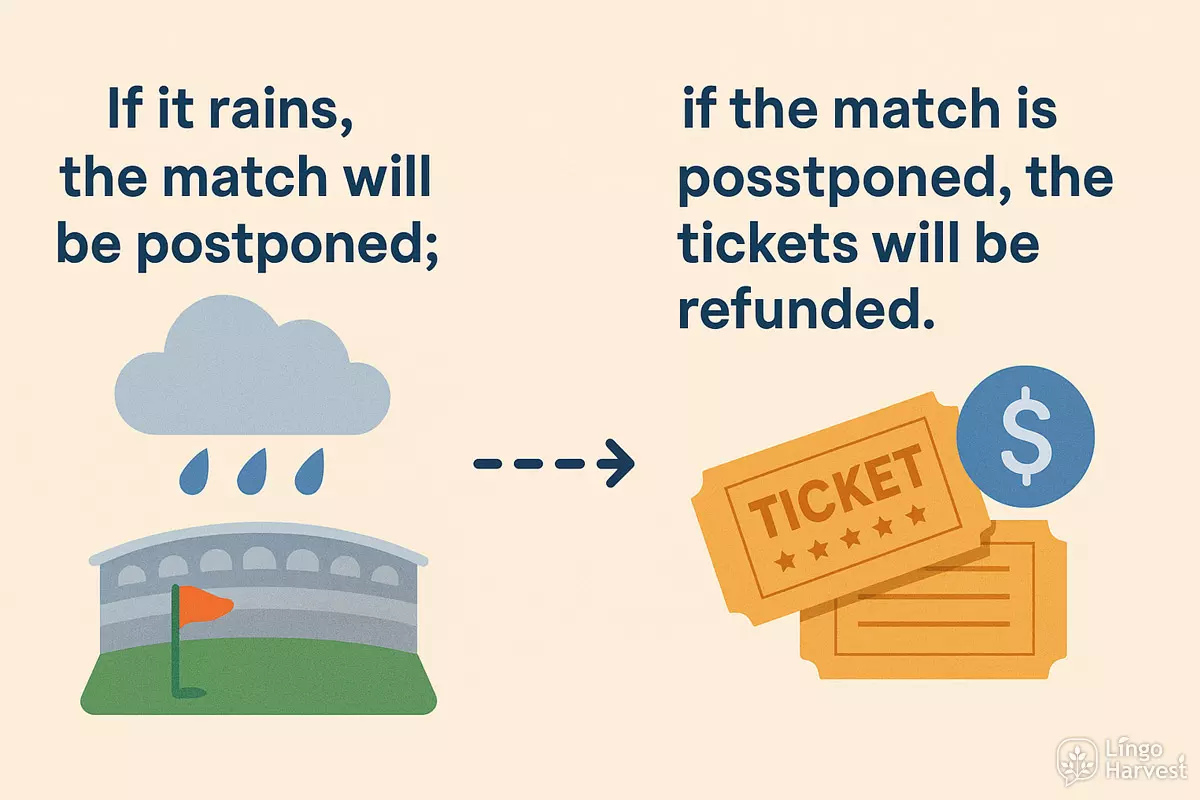
- If it rains, the match will be postponed; if the match is postponed, the tickets will be refunded.
- If you study hard, you’ll pass the exam; if you pass, you can apply for the scholarship.
- If the alarm goes off, call security; if security finds a problem, evacuate the building.
- If the computer crashes, restart it; if it won’t restart, call IT support.
- If the meeting ends early, I’ll catch the earlier train; if I catch it, I’ll be home by dinner.
- If the loan is approved, we’ll buy the house; if we buy the house, we’ll adopt a dog.
- If you accept the invitation, you’ll meet the director; if you impress the director, you might get the job.
- If the cake rises, frost it; if it doesn’t, bake another one.
- If the package arrives today, I’ll assemble the furniture; if not, I’ll wait until tomorrow.
- If the test is negative, you can return to work; if it’s positive, you’ll need to self-isolate.
- If the project is funded, development will start; if development starts, we’ll need to hire new engineers.
- If the proposal is accepted, we’ll launch the campaign; if the campaign succeeds, we’ll expand internationally.
Visualizing multi-step chains
Sometimes, it helps to see the logical progression side by side. Here’s a comparison of simple versus multi-step hypothetical structures:
| Single-step Conditional | Multi-step Conditional Chain |
|---|---|
| If it rains, the event will be canceled. | If it rains, the event will be canceled; if the event is canceled, tickets will be refunded. |
| If you call, I’ll answer. | If you call, I’ll answer; if I answer, we can discuss the plan. |
| If the alarm sounds, evacuate. | If the alarm sounds, evacuate; if you evacuate, gather at the assembly point. |
| If you’re hungry, eat. | If you’re hungry, eat; if you eat, you’ll feel better. |
Multi-step hypothetical reasoning enables more nuanced and realistic thinking about cause and effect, especially when the outcome relies on a series of interconnected events. This makes such chains invaluable in many areas where forecasting or planning is required.
Building sequences of conditions and dependent results
Understanding how to link multiple hypothetical scenarios is essential for analyzing complex situations. Rather than focusing on isolated "if-then" statements, multi-step conditional chains let us explore how one outcome can trigger another, forming a logical sequence. This approach is invaluable in fields like programming, logic puzzles, and even daily decision-making, where each choice can lead to a new set of possibilities.
How Conditional Chains Work
A conditional chain starts with an initial premise. If that premise is true, it leads to a specific result, which then becomes the condition for the next step. This creates a flow where each result is dependent on the previous condition. For example:
- If it rains, the match will be postponed.
- If the match is postponed, the tickets will be refunded.
- If the tickets are refunded, fans will be notified by email.
Here, each step relies on the outcome of the prior event, demonstrating a clear sequence of dependency.
Common Patterns and Vocabulary
Multi-step hypotheticals often use a variety of linking words and phrases to clarify relationships. Recognizing these structures helps in both constructing and interpreting complex logical statements:
- If ... then ... → If you press this button, then the machine starts.
- Unless ... → Unless you hurry, we will miss the train.
- Provided (that) ... → Provided that all forms are completed, the application will be accepted.
- As long as ... → You can stay here as long as you keep the noise down.
- In case ... → Take a jacket in case it gets cold.
- Only if ... → You may enter only if your name is on the list.
- Suppose / Supposing ... → Suppose we run out of time—what then?
- Assuming (that) ... → Assuming that the results are accurate, we can proceed.
- Given that ... → Given that the roads are icy, we should drive slowly.
- Otherwise ... → Finish the form; otherwise, it won’t be approved.
- Even if ... → Even if it rains, the event will continue.
- On condition that ... → You may borrow the car on condition that you return it today.
- Whenever ... → Whenever she calls, he answers immediately.
- Once ... then ... → Once you log in, then you can access all files.
- Unless otherwise stated ... → The fee is non-refundable unless otherwise stated.
- Should ... happen, then ... → Should an error happen, then the system restarts automatically.
- In the event that ... → In the event that power fails, backup generators will activate.
- Whereas ... → She prefers tea, whereas he likes coffee.
- Whether ... or ... → Whether you win or lose, you must follow the rules.
Paradigms of Multi-Step Hypothetical Reasoning
There are several ways to organize and express these chains. The table below illustrates three common paradigms, each with its structure and example:
| Paradigm | Example Structure |
|---|---|
| Linear Sequence | If A happens, then B; if B happens, then C; if C happens, then D. |
| Branching Conditions | If A happens, then either B or C; if B, then D; if C, then E. |
| Nested Conditions | If A, then (if B, then C; else D); else E. |
| Reverse Reasoning | If D happened, then C must have happened before; therefore, B and A as well. |
Practical Tips for Constructing Chains
When building a multi-step hypothetical, clarity is key. Break down each potential outcome and make sure every link in your chain is logically sound. Use clear indicators for dependencies, and avoid ambiguous language. Mapping out the sequence visually, with arrows or diagrams, can also help ensure you haven't missed any critical steps or possible branches. By mastering these conditional structures, you can analyze scenarios more thoroughly and anticipate the cascading effects of decisions or events.
Managing clarity in long conditional logic
Tackling extended chains of hypothetical statements can quickly become confusing, especially when each condition depends on previous ones. To keep reasoning clear and prevent misunderstandings, it helps to break down each part, use consistent language, and visually map out dependencies where possible.
Strategies for Clear Multi-Step Conditionals
- Divide into steps: Present each condition or consequence as a separate, numbered point. This helps readers follow the sequence without losing track.
- Use transitional phrases: Phrases like “if so,” “otherwise,” “in that case,” or “as a result” guide readers through the logic without ambiguity.
- Keep language parallel: When chaining multiple hypotheticals, use similar sentence structures to reinforce the logical flow.
- Summarize outcomes: After a long chain, briefly recap the possible final results to anchor the reader.
- Limit nesting: Excessive use of “if… then… if… then…” can be hard to parse; flatten the logic when possible.
- Use bullet lists for branches: When a condition leads to multiple possibilities, a list can clarify each path.
- Highlight key points: Emphasize crucial conditions or results with bold or italics for quick scanning.
- Employ diagrams or tables: For especially tangled logic, a visual or structured format can clarify relationships.
- Check for hidden assumptions: Make every dependency explicit to avoid confusion.
- Read aloud: Hearing the chain can reveal awkward phrasing or unclear jumps.
Sample Phrases for Multi-Step Hypotheticals
- If A happens, then B follows; if not, C occurs.
- Suppose X is true. In that event, Y would be possible, unless Z.
- Should P take place, Q may result; otherwise, R is expected.
- If and only if S, then T will happen.
- Provided U is available, V can proceed; failing that, W is necessary.
- Assuming M, N, and O all align, then P ensues.
- Unless Q, the process halts; if Q, it continues to R.
- First, check if D; next, determine E; finally, decide on F.
- Given that G occurs, H will be triggered, leading to I.
- Only when J is true does K become relevant.
- After L, if M, then N; else, O.
- If not P, skip to S; if P, proceed with Q and R.
- Should S fail, T is canceled; otherwise, U is scheduled.
Common Pitfalls to Avoid
- Overloading sentences with too many conditions.
- Using inconsistent terminology for the same concepts.
- Failing to specify what happens if none of the conditions are met.
- Neglecting to indicate the order of operations.
Visualizing Complex Chains
When multi-step logic involves several branches and possible outcomes, structured formats can make the options clearer. The table below illustrates how a chain of hypothetical scenarios can be organized for transparency:
| Step | Condition | Outcome |
|---|---|---|
| 1 | If the weather is good | Plan outdoor activities |
| 2 | If friends are available | Invite them to join |
| 3 | If supplies are in stock | Prepare a picnic |
| 4 | If not, choose a backup plan | Visit a museum instead |
By organizing each component this way, even a long series of interconnected conditions can remain understandable and actionable.
Tone and register in academic and technical scenarios
Understanding how language is shaped by context is crucial when constructing complex conditional chains in academic or technical writing. These environments typically call for a formal register, precise vocabulary, and clarity in logical connections, particularly when discussing multi-step hypothetical situations.
Characteristics of Formal Register in Conditionals
Writers often employ a measured, objective tone to ensure that hypothetical reasoning is both clear and authoritative. Passive constructions, hedging language, and modal verbs are frequently used to indicate degrees of certainty or possibility. For example, “If the system were to fail, additional protocols would be enacted,” demonstrates both hypothetical structure and formal tone.
Common Patterns and Vocabulary in Academic/Technical Hypotheticals
Precision is key when mapping out complex scenarios. Consider these common language patterns and phrases:
| Pattern / Structure | Example |
|---|---|
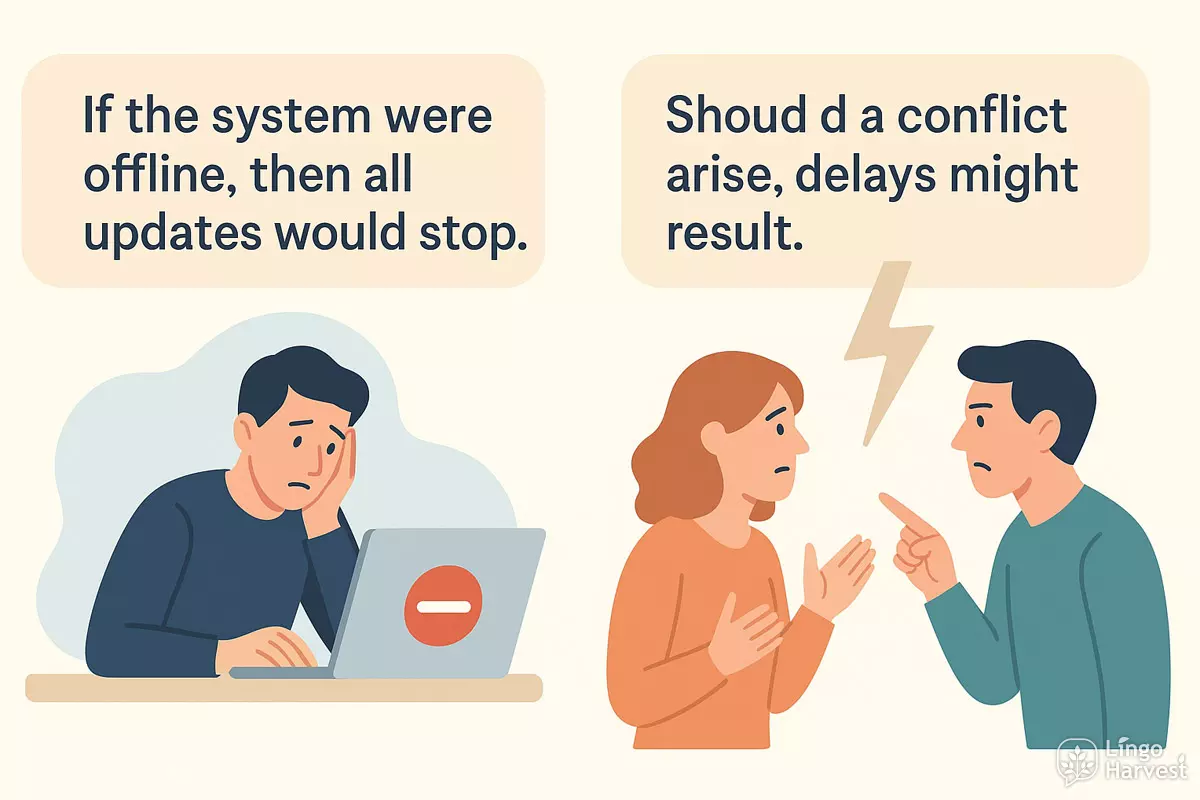
| If X were the case, then Y would occur. | If the system were offline, then all updates would stop. |
| Should X arise, Y might result. | Should a conflict arise, delays might result. |
| Assuming that X holds, it follows that Y would be necessary. | Assuming that budget limits hold, it follows that reductions would be necessary. |
| In the event that X fails, Y must be implemented. | In the event that the engine fails, emergency procedures must be implemented. |
| Provided that X is satisfied, Y can proceed. | Provided that all documents are submitted, the application can proceed. |
| Were X to happen, Y could ensue. | Were the temperature to rise further, equipment failure could ensue. |
| Unless X is addressed, Y will not be possible. | Unless the error is fixed, submission will not be possible. |
| Given that X is true, it is likely that Y will follow. | Given that demand is increasing, it is likely that prices will follow. |
| Supposing X occurs, Y should be considered. | Supposing the forecast is wrong, alternative plans should be considered. |
| Should X not meet the criteria, Y may be compromised. | Should the materials not meet the criteria, safety may be compromised. |
| If and only if X is established, Y will be permitted. | If and only if identity is verified, access will be permitted. |
| Contingent upon X, Y might be triggered. | Contingent upon the sensor reading, an alarm might be triggered. |
| Insofar as X is maintained, Y remains valid. | Insofar as confidentiality is maintained, the agreement remains valid. |
| On condition that X is achieved, Y becomes feasible. | On condition that funding is approved, expansion becomes feasible. |
| If X does not transpire, Y cannot be guaranteed. | If proper testing does not transpire, safety cannot be guaranteed. |
| Presuming X is accurate, Y would logically follow. | Presuming the data is accurate, the conclusion would logically follow. |
Comparison: Academic vs. Informal Conditional Chains
Academic and technical writing treats hypothetical chains differently from everyday conversation. The table below contrasts some of these aspects:
| Academic/Technical | Informal/Colloquial |
|---|---|
| If the experiment were repeated, the results might differ. | If we did it again, maybe things would change. |
| Should the data be inconclusive, further analysis would be warranted. | If it doesn’t work, we’ll just look at it more. |
| Provided that all variables are controlled, the hypothesis can be tested effectively. | If everything’s set, we can try it out. |
| In the event that an error is detected, the procedure must be repeated. | If there’s a mistake, we’ll have to do it again. |
Careful selection of grammatical forms and vocabulary helps maintain the expected level of formality and ensures that multi-step conditionals remain unambiguous. For writers and speakers in academic or technical fields, aligning tone and register with the audience’s expectations is not just a matter of style, but also of effective communication.
Examples of conditional chains in planning and analysis
When preparing for complex scenarios, planners and analysts often work through multi-step hypothetical situations. These chains of "if-then" reasoning help anticipate outcomes, manage risk, and identify dependencies. Below are common ways such conditional sequences appear in real-world planning and analysis processes.
Common Patterns of Multi-Step Conditionals
- Project scheduling: If the initial phase is delayed, then all subsequent tasks shift, and if the deadline cannot move, resources must be reallocated.
- Supply chain management: If a supplier misses a shipment, then production slows, and if inventory drops below a threshold, emergency orders are triggered.
- Financial forecasting: If interest rates rise, then borrowing costs increase, which may reduce investment unless offset by higher returns.
- Policy analysis: If a regulation changes, then compliance processes adapt, which may increase costs unless automation is implemented.
- Disaster response: If a weather event is predicted, then evacuation plans are activated, and if certain routes are blocked, alternative shelters are used.
- Product development: If prototype testing fails, then design revisions follow, and if issues persist, project timelines are revised.
- Healthcare triage: If a patient presents severe symptoms, then immediate intervention is required, and if resources are limited, prioritization protocols apply.
- Negotiation strategy: If the other party rejects an offer, then a counterproposal is prepared, and if that fails, mediation may be considered.
- IT security response: If a breach is detected, then containment steps are initiated, and if data is compromised, notification procedures follow.
- Event planning: If the venue becomes unavailable, then backup locations are considered, and if none are suitable, the event may be postponed.
- Marketing campaigns: If initial engagement is low, then messaging is adjusted, and if performance remains poor, budgets are reallocated.
- Research methodology: If initial data is inconclusive, then methods are revised, and if results improve, further studies are scheduled.
Comparing Linear and Branching Conditional Chains
| Type of Chain | Characteristic Example |
|---|---|
| Linear sequence | If Task A is finished, then Task B starts, then Task C follows. |
| Branching scenario | If Condition X occurs, then Option 1 or Option 2 is chosen, leading to different outcomes. |
| Nested conditionals | If Policy Y is adopted, then if Market Z reacts negatively, a contingency plan is triggered. |
| Feedback loop | If Output falls below target, then adjustments are made, which affect future inputs. |
Practical Tips for Building Conditional Chains
- Map dependencies clearly to avoid missing crucial steps.
- Anticipate both primary and secondary effects of each condition.
- Document assumptions at every stage to clarify reasoning.
- Regularly review and update chains as new information emerges.
- Consider both best-case and worst-case branches for comprehensive analysis.
By systematically structuring these multi-step hypotheticals, organizations can improve decision quality and resilience when facing uncertainty.
Practice: construct multi-step hypothetical structures
Building multi-step hypothetical chains is a valuable skill for expressing complex conditions and their consequences. These chains often involve linking several conditional statements, where the outcome of one step becomes the basis for the next. Practicing this helps you think through scenarios logically and articulate nuanced possibilities.
Task 1: Complete the Chains
Fill in the blanks to create logical multi-step conditionals. Each prompt starts a chain; continue it with two more "if" clauses.
- If I had woken up earlier, ____________________________, ____________________________.
- If the weather had been better, ____________________________, ____________________________.
- If she had finished her project on time, ____________________________, ____________________________.
Show answers
- If I had woken up earlier, I would have caught the bus, and I wouldn't have been late for work.
- If the weather had been better, we would have gone hiking, and we might have seen the sunrise.
- If she had finished her project on time, her manager would have been impressed, and she could have received a bonus.
Task 2: Identify the Chain Order
Below are sets of conditional statements. Put them in a logical order to form a coherent multi-step hypothetical scenario.
- a) He would have gotten a promotion.
b) If he had completed the training,
c) If he had received the invitation on time, - a) She would have met the author.
b) If she had gone to the event,
c) If she had heard about the event,
Show answers
- c) If he had received the invitation on time, b) If he had completed the training, a) He would have gotten a promotion.
- c) If she had heard about the event, b) If she had gone to the event, a) She would have met the author.
Useful Patterns and Vocabulary for Multi-Step Hypotheticals
Here are common phrases and connectors to help structure complex conditional scenarios:
- If… had happened, then… would have…
- Assuming that…, it would have led to…
- Had… been the case, … might have…
- If not for…, … could have…
- Supposing that…, … would have resulted in…
- Provided that…, … would have…
- If only…, … would be…
- Otherwise, … would have…
- Had it not been for…, … would not have…
- In case…, … would have…
- If… hadn’t…, … wouldn’t have…
- Given that…, … would have…
- Unless…, … wouldn’t…
- Consequently, … would have…
- Therefore, … would…
Task 3: Transforming Simple to Multi-Step Conditionals
Take the simple conditional sentences below and expand them into multi-step hypothetical chains.
- If he had saved more money, he could have traveled.
- If they had studied harder, they would have passed the exam.
Show answers
- If he had saved more money, he could have traveled, and he might have learned a new language.
- If they had studied harder, they would have passed the exam, and they could have qualified for the scholarship.
Examples of Multi-Step Hypothetical Structures
Below is a range of sample sentences showing how different connectors and conditional forms can be used to build layered hypothetical chains.
- If I had remembered the meeting, I would have attended, and I might have contributed useful ideas.
- Had you told me earlier, I could have prepared, so the presentation would have gone smoothly.
- If the train had not been delayed, we would have arrived on time, and we could have joined the tour.
- If she had checked her email, she would have seen the update and avoided the confusion.
- Supposing that it had rained, the event would have been cancelled, and everyone would have stayed home.
- If they had accepted the offer, they would have moved, and their lives would be different now.
- Had the team practiced more, they might have won the match, and qualified for the finals.
- If I had known about the deadline, I would have finished the report, and my manager would have been pleased.
- If we had brought a map, we wouldn't have gotten lost, and we would have arrived earlier.
- Given that he had the right resources, he could have completed the project, which would have impressed the client.