Using Conditionals to Express Criticism, Advice, and Softened Opinions

 This article explains how to use conditionals like would, could, and might to soften criticism, give polite advice, and make strategic suggestions. It includes workplace and academic examples, common mistakes, and practice exercises.
- How conditionals soften tone in advanced communication
- Patterns with would, could, and might for indirect criticism
- Using conditionals for polite advice and strategic suggestions
- Examples from workplace, negotiation, and academic feedback
- Mistakes that create unintended tone shifts
- Practice: rewrite direct statements using softened conditional forms
Navigating conversations delicately often requires special language tools, and one powerful method is using if statements to frame feedback or recommendations. By introducing suggestions or concerns with phrases like if you’d like or if you’re open to it, speakers can express their thoughts in a way that feels less confrontational and more collaborative. This subtle grammatical approach helps people share concerns, suggestions, or differing views without appearing harsh, making it easier to maintain positive relationships and encourage open dialogue in both personal and professional interactions.
How conditionals soften tone in advanced communication
Conditionals play a crucial role in making language more diplomatic and less direct, especially when expressing criticism, giving advice, or sharing opinions in professional or sensitive contexts. By introducing uncertainty or possibility, speakers can avoid sounding too blunt or confrontational. This subtlety is often appreciated in advanced communication, where maintaining positive relationships is as important as conveying information.
Why use conditionals for nuance?
Direct statements can sometimes come across as harsh or authoritative. Using conditional forms allows speakers to convey their message in a way that acknowledges other perspectives or possible outcomes. This approach is particularly useful for:
- Offering suggestions without imposing
- Delivering criticism with tact
- Presenting opinions as possibilities rather than facts
- Encouraging reflection rather than defensive reactions
Common conditional patterns that soften statements
Here are some ways conditionals are used to reduce the force of statements and make them sound more considerate:
| Expression | Function | Example |
|---|---|---|
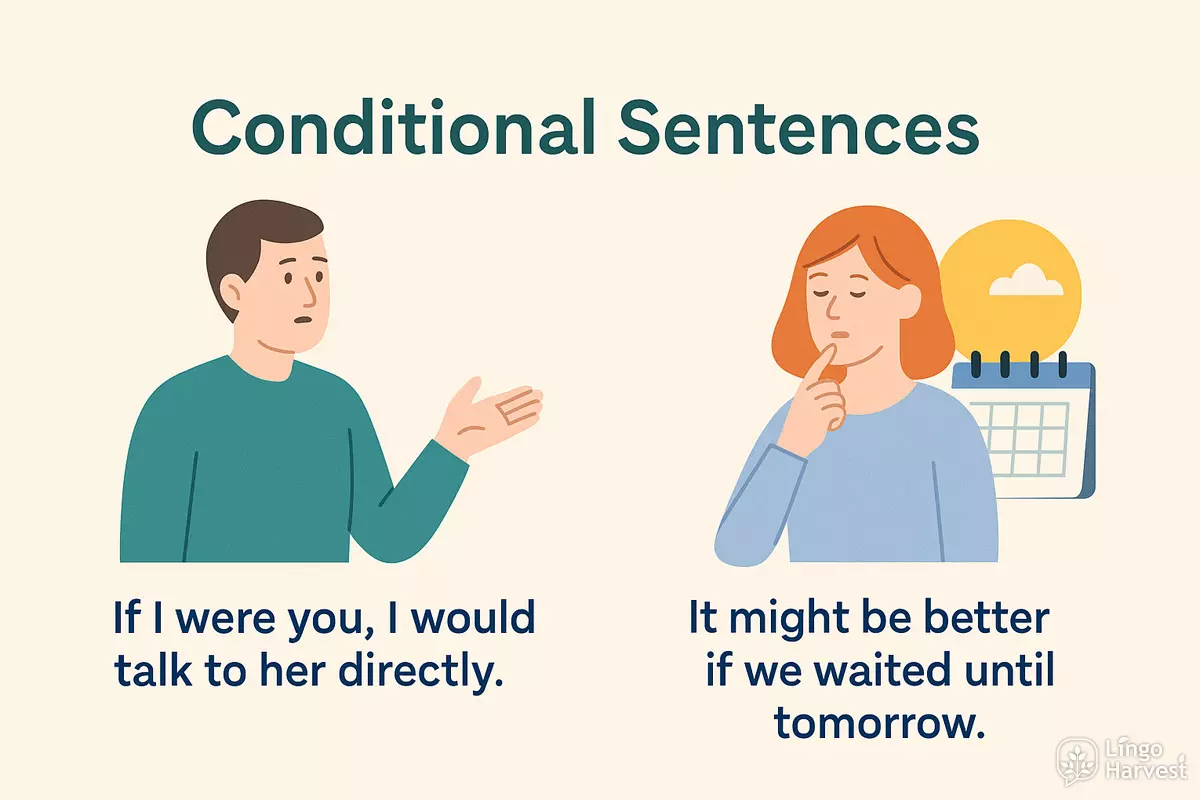
| If I were you, I would… | advice | If I were you, I would talk to her directly. |
| It might be better if… | suggestion | It might be better if we waited until tomorrow. |
| Would it be possible to…? | polite request | Would it be possible to reschedule the meeting? |
| If you have time, could you…? | softened request | If you have time, could you review this file? |
| Perhaps we could consider… | tentative proposal | Perhaps we could consider a different strategy. |
| If this is okay with you… | respecting autonomy | If this is okay with you, I'll make the final call. |
| It would help if… | gentle recommendation | It would help if you shared the document earlier. |
| If I may suggest… | polite advice | If I may suggest, try taking a short break. |
| If it’s not too much trouble… | minimizing imposition | If it’s not too much trouble, could you send the report again? |
| Would you mind if…? | soft inquiry | Would you mind if I opened the window? |
| If we look at it another way… | inviting alternative perspectives | If we look at it another way, the problem isn’t that big. |
| It would be better if… | careful criticism or guidance | It would be better if you emailed them directly. |
| If you don’t mind me saying… | preparing for a sensitive comment | If you don’t mind me saying, this part could be clearer. |
| If possible, try to… | gentle encouragement | If possible, try to practice every day. |
| Would it help if…? | offering support or solution | Would it help if I explained it again? |
| If you’re interested, I could… | offering assistance | If you’re interested, I could show you how it works. |
| If you’d like, I can… | offering options | If you’d like, I can prepare a summary for you. |
Comparing direct and conditional forms
Notice how conditional language transforms direct statements into more tactful alternatives:
| Direct Statement | Softened Conditional Form |
|---|---|
| You need to improve your report. | If you revised your report, it could be even better. |
| That’s not correct. | If I’m not mistaken, there might be a mistake here. |
| Do this by Friday. | If you could finish this by Friday, that would be great. |
| I disagree with your approach. | If I may, I’d suggest a different approach. |
| This is wrong. | It would be better if we tried a different method. |
Benefits of using conditionals for tone management
Adopting conditional forms helps avoid misunderstandings and keeps conversations constructive. This technique is especially valuable in international or multicultural environments, where directness can be interpreted as rudeness. By softening language, communicators demonstrate respect, encourage collaboration, and maintain professionalism—even when addressing challenging topics.
Patterns with would, could, and might for indirect criticism
Using modal verbs like "would," "could," and "might" is a tactful way to express criticism without sounding harsh or confrontational. These forms help soften the message, making it easier for the listener to accept feedback or suggestions. Instead of directly pointing out a problem, these structures allow you to hint at an issue or suggest improvement in a polite manner.
Common Indirect Criticism Structures
When giving feedback, English speakers often use certain patterns to avoid directness. Here are some typical ways to phrase indirect criticism using modals:
- You could try being more careful next time.
- I would suggest arriving a bit earlier.
- It might be better to double-check your work.
- I think you could have explained that more clearly.
- Maybe you would want to consider another approach.
- Perhaps you might want to review the instructions again.
- You could have mentioned that sooner.
- It would be helpful if you organized the files.
- Maybe it would be a good idea to take shorter breaks.
- I might have chosen a different format.
- You could have asked for help if you were unsure.
- It would have been better to check with the team first.
- Maybe you could slow down a bit when presenting.
- It might help to review your notes before the meeting.
Comparing Direct and Indirect Criticism
Notice how the use of modals can transform blunt feedback into something more diplomatic. The following table contrasts direct statements with their softened, indirect counterparts:
| Direct Criticism | Softened with Modals |
|---|---|
| You made a mistake in your report. | You might want to review your report for mistakes. |
| You’re always late. | It would be great if you could arrive a bit earlier. |
| This isn’t clear. | You could make this point a little clearer. |
| You don’t listen. | Maybe you could try listening more closely next time. |
| Your explanation is confusing. | I think you might want to clarify your explanation. |
Tips for Polite Feedback
Using these modal patterns not only softens criticism, but also encourages constructive dialogue. Try prefacing your feedback with phrases like "Perhaps," "Maybe," or "I think," and use positive body language to further reduce tension. This approach is especially useful in professional or sensitive situations where maintaining good relationships is important.
Using conditionals for polite advice and strategic suggestions
Conditionals are a subtle way to offer guidance or recommendations without sounding forceful or direct. By framing advice in hypothetical terms, speakers can soften their tone, making suggestions more palatable and less likely to cause offense or resistance. This approach is especially useful in professional, academic, or intercultural contexts where diplomacy is valued.
Common Patterns for Gentle Recommendations
English speakers often use the second and third conditional structures to suggest actions or alternatives in a tactful manner. Here are some of the most frequent patterns:
- If I were you, I would…
- If you happened to…, it might help.
- You could consider… if you wanted to…
- If you’d like, you might try…
- Should you feel comfortable, you could…
- If it were me, I’d probably…
- It might be a good idea if you…
- If possible, you might want to…
- Were you to…, you might find…
- If you’re open to it, perhaps you could…
- If you don’t mind me suggesting, you could…
- If the situation allows, you might…
- If you ever need to…, you could…
- If you’re considering…, it may be worth…
- If you’re unsure, you might ask…
- If you’d prefer, you could always…
Why Indirectness Matters
Offering advice in a conditional form allows the listener to retain autonomy. Rather than commanding or prescribing, the speaker acknowledges other options and the listener’s right to choose. This strategy is especially effective for sensitive topics, workplace feedback, or when advising superiors and peers.
Comparing Direct and Conditional Suggestions
Sometimes, the difference between sounding polite and sounding bossy comes down to word choice. The table below illustrates how conditional forms can transform direct advice into strategic, diplomatic suggestions.
| Direct Suggestion | Conditional (Polite) Suggestion |
|---|---|
| Take a break. | If I were you, I’d take a break. |
| Ask for help. | If you’re unsure, you might ask for help. |
| Start earlier next time. | If you started earlier next time, it might be less stressful. |
| Change your approach. | If you wanted, you could consider changing your approach. |
| Speak to your manager. | If you feel comfortable, you could speak to your manager. |
Tips for Effective Use
- Use modal verbs like would, could, and might for extra softness.
- Adjust your intonation and facial expressions to match the gentle intent.
- Consider cultural expectations: some cultures expect more directness, others value indirectness.
- Offer alternatives, not just one solution, to show respect for the listener’s judgment.
Strategic use of conditionals not only softens advice but can also build trust and rapport, making your guidance more likely to be received positively.
Examples from workplace, negotiation, and academic feedback
Conditionals play a key role in expressing criticism, giving advice, or softening opinions across professional, collaborative, and educational contexts. Instead of direct statements, using “if” or similar structures helps maintain politeness and opens space for dialogue. Below are practical illustrations showing how these patterns can be adapted to different settings.
Workplace Scenarios
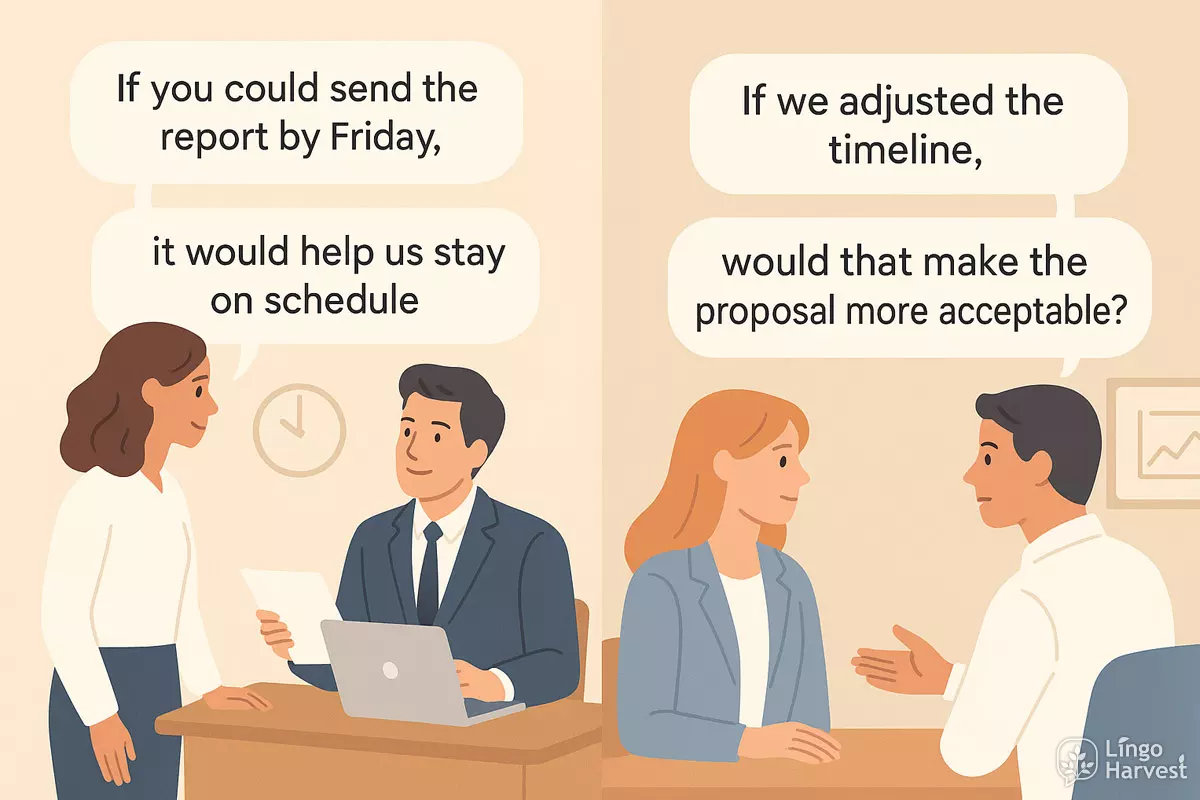
- If you could send the report by Friday, it would help us stay on schedule.
- If you have time, reviewing the presentation slides might catch any errors before the meeting.
- If I were in your position, I might try a different approach with the client.
- If we focused on the main priorities first, the project could progress more smoothly.
- If you’re open to feedback, I have a suggestion about your recent draft.
Negotiation Contexts
- If we adjusted the timeline, would that make the proposal more acceptable?
- If you’re willing to consider a higher volume, we could offer a better rate.
- If you have concerns about the contract, let’s discuss them openly.
- If there’s any flexibility on your side, we might be able to find common ground.
- If you could clarify your requirements, we’d be better positioned to meet them.
Academic Feedback
- If you included more references, your argument would be stronger.
- If you considered alternative perspectives, your analysis might be more balanced.
- If you revised the introduction, the purpose of your paper would be clearer.
- If you proofread your essay, minor errors could be corrected.
- If you’re interested, I can suggest additional reading on the topic.
Comparison: Direct vs. Conditional Phrasing
| Direct Statement | Conditional (Softened) Version |
|---|---|
| You made a mistake in this section. | If you review this section, you might notice a small error. |
| Revise your draft. | If you revised your draft, it could improve clarity. |
| That plan will not work. | If we try this plan, we may face some challenges. |
| You need to be more careful. | If you’re more careful, these issues could be avoided. |
| We can’t accept this offer. | If the terms were different, we could consider accepting the offer. |
Using conditional sentences in these ways not only softens criticism and suggestions but also encourages collaboration and constructive dialogue. This approach can help prevent defensiveness, making conversations more productive and respectful.
Mistakes that create unintended tone shifts
When using conditionals to give feedback or share opinions, it’s surprisingly easy to send the wrong message. Sometimes, phrasing that’s intended to soften criticism or advice can instead make you sound passive-aggressive, insincere, or even confusing. This often happens when the structure of your conditional sentences doesn’t match your intended level of directness or politeness.
Common pitfalls in conditional phrasing
- Using second conditionals (“If I were you, I would…”) for strong criticism, which can sound sarcastic if not carefully worded.
- Mixing direct statements with hedged conditionals, leading to mixed signals (e.g., “You should really finish this, but if you wanted, you could wait.”)
- Overusing “would” and “could,” which can make advice seem non-committal or vague.
- Neglecting to match conditional formality with the relationship (formal vs. informal) or context.
- Unintentionally implying blame or judgment with certain conditional forms (e.g., “If you had paid attention, this wouldn’t have happened.”)
- Choosing hypothetical structures where directness is expected, causing frustration or confusion.
- Accidentally downplaying urgency or importance by softening too much (e.g., “If you wanted, you might try submitting the report” when a deadline is near.)
- Using conditionals for praise, which can sound insincere (“If you were always this good, we’d have no problems.”)
- Switching between real and unreal conditionals mid-conversation, which can disrupt clarity.
- Relying on “if I were you” as a universal solution, making feedback impersonal or distancing.
- Using negative conditionals (“If you don’t do this, it will fail”) that sound threatening rather than helpful.
- Giving advice as a hypothetical when a direct recommendation is needed (“If someone were in your position, they might consider…”)
- Embedding too many conditions, making the message convoluted (“If you happened to have time, and if you wanted, you could maybe…”)
- Using “would have” or “could have” for past mistakes, which can come across as blaming (“If you had checked, this wouldn’t have been wrong.”)
- Failing to clarify the speaker’s intent, leading to misinterpretation of tone.
How conditional forms shift tone
Sometimes, the difference between sounding constructive and sounding critical lies in small grammatical choices. Take a look at how similar sentences can create very different impressions:
| Formulation | Possible Tone |
|---|---|
| If you want, you can revise this section. | Polite, open-ended |
| If you had checked your work, this error wouldn’t be here. | Blaming, accusatory |
| If I were you, I’d consider a different approach. | Soft advice, but potentially distancing |
| If you don’t make the changes, the project will fail. | Direct, possibly threatening |
| If you could look at this by Friday, that would be helpful. | Polite, deferential |
Tips to avoid unintended tone shifts
- Match your conditional structure to your relationship and the situation’s urgency.
- Be mindful of how hypothetical or unreal conditionals can sound less direct or even sarcastic.
- Use direct language when advice or criticism needs to be clear; reserve softened conditionals for sensitive feedback.
- Always check if your sentence could be misinterpreted as blaming or passive-aggressive.
- When in doubt, clarify your intention explicitly to prevent misunderstanding.
By choosing your conditional forms carefully, you can maintain both clarity and the right level of politeness in your advice or criticism.
Practice: rewrite direct statements using softened conditional forms
Learning to rephrase direct language into conditional forms is a valuable skill for expressing criticism, offering advice, or sharing opinions more diplomatically. This approach helps maintain politeness and encourages open communication, especially in formal or sensitive contexts.
Transforming Directness: Why and How
Direct statements can sometimes sound blunt or overly critical. By using conditional structures ("would," "could," "might," etc.), you can soften your message, making it more likely to be received positively. Compare these approaches:
- Direct: "You are wrong."
- Softened conditional: "I would suggest reconsidering your point."
Common Patterns for Softening
Here are several structures frequently used to turn direct statements into more tactful conditional forms:
- "I would recommend..." → I would recommend taking a break before continuing.
- "You might consider..." → You might consider rewriting the introduction.
- "It could be better if..." → It could be better if we started earlier.
- "Would it be possible to...?" → Would it be possible to move the meeting to Friday?
- "Perhaps you could..." → Perhaps you could check the numbers again.
- "If I were you, I would..." → If I were you, I would ask for clarification.
- "I would appreciate it if..." → I would appreciate it if you sent the file today.
- "Maybe you should..." → Maybe you should try another approach.
- "It might help to..." → It might help to review last week's notes.
- "Would you mind if...?" → Would you mind if I joined your group?
- "Have you thought about...?" → Have you thought about updating the design?
- "Is there a chance you could...?" → Is there a chance you could help me with this task?
Exercise: Rewriting Direct Statements
Try rephrasing the following blunt remarks using softened conditional forms. This will help you practice making your language more diplomatic and considerate.
- Close the window.
- You need to work faster.
- This report is not good.
- Stop talking so loudly.
- You made a mistake here.
- Don’t be late again.
- Your idea won’t work.
- Give me the file now.
- That color looks bad on you.
- You should not interrupt.
Show answers
- Would you mind closing the window?
- You might consider working a bit faster.
- I would suggest revising this report.
- Could you try speaking a little more quietly?
- It seems there might be a small mistake here.
- I would appreciate it if you could be on time next time.
- I'm not sure if that idea would work as intended.
- Could you please send me the file when you have a moment?
- Maybe another color would suit you better.
- Would it be possible to wait until someone finishes before adding your thoughts?
Comparing Direct and Softened Forms
Below is a structured comparison of direct statements and their softened conditional equivalents. Notice the difference in tone and politeness.
| Direct Statement | Softened Conditional Form |
|---|---|
| That’s wrong. | I would suggest looking at it another way. |
| Do it now. | Would you be able to do it now? |
| I don’t like your plan. | I might have some reservations about your plan. |
| You’re late. | Would it be possible to arrive a bit earlier next time? |
| This is confusing. | It might help to clarify this section. |
| Change your approach. | Perhaps you could try a different approach? |
Practicing these transformations will help you communicate more effectively and maintain positive relationships, especially in situations where direct language might cause offense.