Using May, Might, and Could for Degrees of Possibility in Conditionals

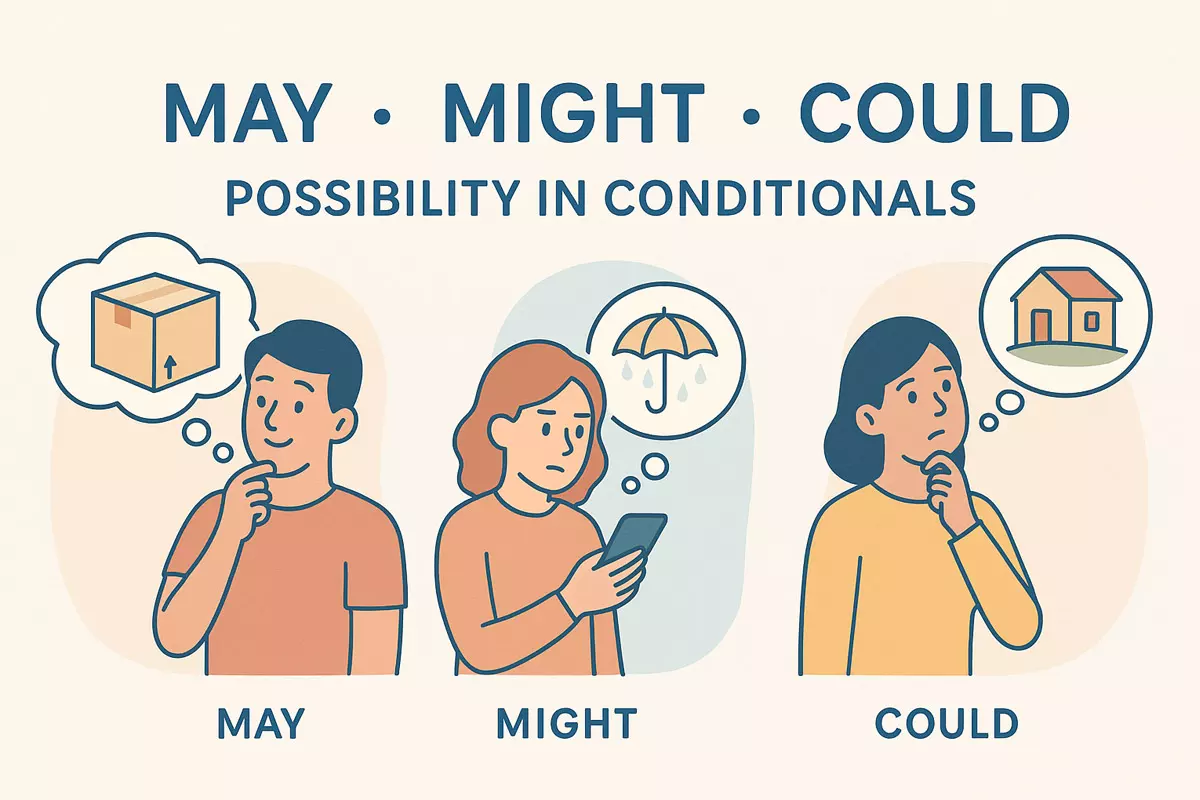 Here we how may, might, and could indicate different levels of possibility, compares their probability and tone, explains their use in second, third, and mixed conditionals with examples, highlights common errors, and offers practice in choosing the right…
- How may, might, and could express different levels of possibility
- Differences in probability and tone across modals
- Modal combinations in second, third, and mixed conditionals
- Examples from predictions, analysis, and hypothesis writing
- Common errors with weak or overly strong modality
- Practice: rewrite conditionals using the best modal choice
English uses modal verbs like may, might, and could to express uncertainty or possibility about future events, especially in conditional sentences. By choosing the appropriate modal, you can indicate different degrees of likelihood; for example, may often suggests a reasonable possibility, might implies a smaller chance, and could highlights a general possibility. Understanding how to use these modals helps you communicate potential outcomes more clearly and accurately in both spoken and written English.
How may, might, and could express different levels of possibility
Understanding the subtle differences among “may,” “might,” and “could” helps you communicate the likelihood of events in conditional sentences more precisely. Each modal verb suggests a different degree of probability, allowing speakers and writers to nuance their meaning and avoid ambiguity.
Degrees of Possibility: An Overview
When expressing hypothetical situations or possible outcomes, these modals each occupy a spot on the spectrum from probable to merely possible. Generally:
- May is often used for situations considered more likely or possible, sometimes even close to probable.
- Might tends to imply a lower chance, suggesting something is less certain or more speculative.
- Could focuses on potential or ability, and can sound even less definite, often emphasizing that something is possible under certain conditions but not particularly likely.
Comparing Usage in Conditional Sentences
Let’s look at how these verbs function in if-clauses and main clauses:
| Modal Verb | Typical Use & Example |
|---|---|
| May | Used when the possibility is real or expected. If you hurry, you may catch the bus. |
| Might | Suggests a smaller chance or a more hypothetical situation. If you hurry, you might catch the bus. |
| Could | Expresses general possibility or ability; often less definite. If you hurry, you could catch the bus. |
Expanded Examples in Context
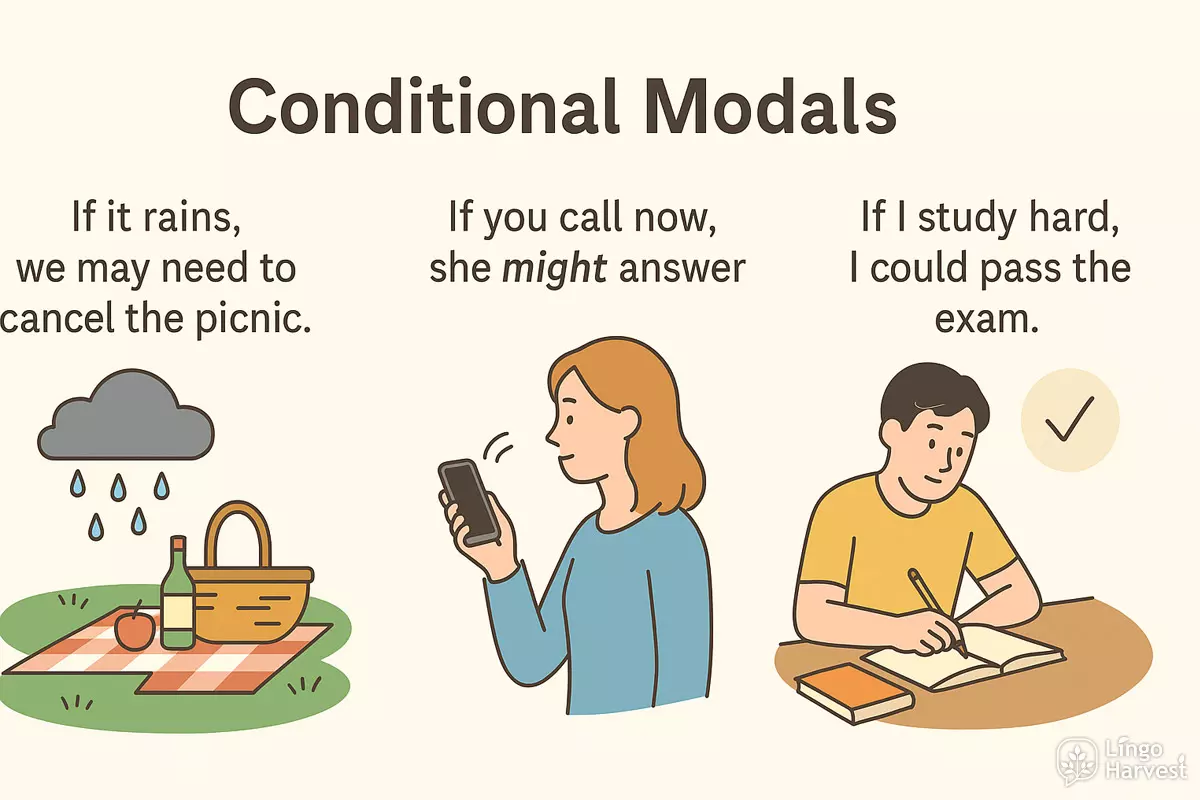
To show the gradation in meaning, here are more examples:
- If it rains, we may need to cancel the picnic. ✅ More likely
- If it rains, we might need to cancel the picnic. → Less certain
- If it rains, we could need to cancel the picnic. → Possible, but not definite
- If you call now, she may answer.
- If you call now, she might answer.
- If you call now, she could answer.
- If I study hard, I may pass the exam.
- If I study hard, I might pass the exam.
- If I study hard, I could pass the exam.
- If they leave soon, they may arrive before noon.
- If they leave soon, they might arrive before noon.
- If they leave soon, they could arrive before noon.
Summary of Nuances
Choosing between these modal verbs allows you to signal how likely or unlikely an event is, especially in conditional statements. May often suggests a reasonable chance, might is more tentative, and could broadens the scope to what is simply possible. This distinction is useful for clear, effective communication in both speech and writing.
Differences in probability and tone across modals
Grasping how "may," "might," and "could" function in conditional sentences helps you express different shades of possibility and subtlety. Each modal verb not only signals a particular level of likelihood but also conveys a certain tone, ranging from neutral to tentative or even polite. The choice among them can subtly shift the meaning or attitude behind your statement.
Levels of Likelihood
"May," "might," and "could" are often used to express uncertainty, but they are not interchangeable. Here's how they generally rank in terms of probability:
- May – suggests a reasonable or moderate chance; often neutral.
- Might – indicates a lower likelihood; more tentative.
- Could – expresses general possibility, sometimes less focused on probability and more on capability or theoretical chance.
Comparing Tone and Use
While probability is a key factor, the mood or attitude conveyed by each modal also matters. "May" can sound more formal or official, "might" tends to feel softer or more speculative, and "could" is often used to discuss hypothetical situations or abilities.
| Modal | Typical Probability | Tone & Typical Usage |
|---|---|---|
| May | Moderate (possible, but not certain) | Neutral, sometimes formal; used in permissions and likely outcomes |
| Might | Lower (less likely than "may") | Tentative, hypothetical; often used for polite suggestions or distant possibilities |
| Could | Variable (ability or potential possibility) | Open-ended, sometimes theoretical; focuses on what is possible or what someone is able to do |
Examples in Conditional Sentences
Choosing between these modals can change the nuance of your statement. Here are some examples illustrating their differences:
- If it rains tomorrow, we may cancel the picnic. (There's a fair chance of cancellation.)
- If you hurry, you might catch the early bus. (It's possible but not very likely.)
- If I had more time, I could help you with your project. (Ability or potential, not focused on likelihood.)
- If she studies harder, she may pass the exam. (A real possibility.)
- If we leave now, we might avoid the traffic. (A slim chance.)
- If you asked, he could lend you his notes. (He is able to, if the condition is met.)
- If they practice, they may win the competition. (Reasonably possible.)
- If you try, you might solve it. (Not very likely, but possible.)
- If we had more resources, we could expand the project. (Potential or capability.)
- If you are careful, you may avoid mistakes. (A fair chance.)
- If the weather improves, we might go hiking. (Uncertain, less probable.)
- If you explained, they could understand your point. (They have the ability, if you do it.)
Summary of Key Differences
Overall, "may" is typically used for moderate possibilities and often carries a neutral, sometimes formal tone. "Might" is more tentative, expressing weaker probability or polite uncertainty. "Could" is more about what is possible or what someone is capable of, rather than how likely something is. Picking the right modal helps your conditional sentences sound natural and accurately reflect your intended meaning.
Modal combinations in second, third, and mixed conditionals
Understanding how "may," "might," and "could" interact with unreal conditionals is key for expressing different shades of possibility and hypothetical outcomes. In English, these modals help signal uncertainty, potential, or alternative realities, especially in scenarios that didn't happen or are unlikely to occur.
Using modals in the second conditional
The second conditional discusses unreal or unlikely situations in the present or future. Instead of the standard "would," using "might," "could," or "may" as alternatives introduces subtle differences:
- might — suggests a lower probability (e.g., If I won the lottery, I might buy a yacht.)
- could — focuses on ability or possibility (e.g., If you studied more, you could pass the exam.)
- may — less common, but can indicate a tentative possibility (e.g., If she called, she may want to apologize.)
Modals in the third conditional
The third conditional deals with imagined past situations—events that didn’t happen. Here, "might have," "could have," or "may have" express hypothetical results:
- If they had left earlier, they might have caught the train. (possibility)
- If you had told me, I could have helped. (ability/opportunity)
- If she had seen the sign, she may have stopped. (uncertain possibility)
Mixed conditionals and modal choices
When the time in the if-clause and the result are different (often past condition + present result), modal verbs still play a crucial role:
- If I had listened to you, I might be happier now.
- If he had finished school, he could be working here.
- If they had saved money, they may be traveling now.
Comparing modal meanings in conditional structures
The table below shows typical forms and nuances for "may," "might," and "could" across the main unreal conditional types.
| Conditional Type | Modal Example | Meaning/Nuance |
|---|---|---|
| Second conditional (If + past simple, ... would/might/could + base verb) |
If I knew, I might help. If you tried, you could succeed. |
Less certain outcome or possible ability |
| Third conditional (If + past perfect, ... would/might/could + have + past participle) |
If we had seen her, we may have spoken. If he had asked, he could have joined. |
Possible but unreal past result |
| Mixed conditional (If + past perfect, ... would/might/could + base verb) |
If I had studied, I might know the answer. If she had moved, she could live here now. |
Past condition affecting present result |
Expanded examples of modals in conditionals
For more clarity, here are further patterns and sentences using "may," "might," and "could" to express degrees of possibility:
- If it rained, the match might be canceled.
- If you listened, you could understand.
- If she had asked, she might have learned the truth.
- If they had prepared, they could have won.
- If I had known, I may have acted differently.
- If it were warmer, we could go swimming.
- If you were here, I might feel better.
- If he had saved more, he could buy a car now.
- If I had seen you, I might have said hello.
- If you had told me, I may have reconsidered.
Choosing between "may," "might," and "could" allows speakers to fine-tune the perceived likelihood or nature of hypothetical outcomes, making your English more precise and natural.
Examples from predictions, analysis, and hypothesis writing
Understanding how to express varying levels of possibility is crucial in academic and scientific contexts, especially when making predictions, conducting analyses, or formulating hypotheses. Using "may," "might," and "could" helps clarify the degree of certainty or speculation involved in each statement.
Predictions Using Modal Verbs
When making forecasts about future events, writers often choose different modals to signal confidence levels. For instance:
- The weather may improve by tomorrow. (moderate possibility)
- This treatment might reduce symptoms in some patients. (lower probability)
- Our new approach could revolutionize the industry. (potential, but not certain)
Analysis and Interpretation
In analytical writing, these modals allow for nuanced interpretations without overcommitting to a single outcome. Consider the following examples:
- These results may indicate a previously unknown variable.
- The discrepancy might be due to experimental error.
- This pattern could suggest an emerging trend.
Hypothesis Formation
When proposing hypotheses, it's important to avoid absolute certainty. Modal verbs help maintain scientific caution:
- The reaction may accelerate in higher temperatures.
- Exposure to light might influence the outcome.
- This mutation could explain the observed resistance.
Comparing Modals in Conditionals
To illustrate how "may," "might," and "could" function in conditional sentences, here is a structured comparison:
| If-Clause | May | Might | Could |
|---|---|---|---|
| If we increase the temperature, | the reaction may speed up. | the reaction might speed up. | the reaction could speed up. |
| If the sample is contaminated, | the results may be invalid. | the results might be invalid. | the results could be invalid. |
| If funding is approved, | we may start next month. | we might start next month. | we could start next month. |
| If the data supports our theory, | it may change current understanding. | it might change current understanding. | it could change current understanding. |
Key Points on Usage
- May typically signals a moderate degree of possibility without strong doubt.
- Might often suggests a weaker or more speculative possibility.
- Could expresses potential, emphasizing what is possible rather than probable.
Using these modal verbs carefully allows for precise communication, especially in scientific and academic writing where certainty is rarely absolute.
Common errors with weak or overly strong modality
When using "may," "might," and "could" to express degrees of possibility in conditional sentences, learners often misjudge the strength of these modal verbs. This can lead to statements that sound either too certain or not possible enough, confusing the intended meaning. Choosing the right modal helps clarify how likely an event is, so understanding common pitfalls is essential.
Misjudging the Likelihood
One frequent mistake is using "may" when the situation is highly unlikely, or "might" when suggesting something fairly probable. "May" generally signals a reasonable possibility, while "might" typically marks something less likely. "Could" focuses on potential, but doesn't always indicate probability. Using these interchangeably can blur the nuance between possibility and probability.
Overusing Strong Modality
Sometimes, writers or speakers unintentionally make their conditionals sound too definite by using "may" or "could" where "might" would be more accurate. This can mislead the listener about how likely the result actually is. For example, "If you call her, she may answer" is stronger than "If you call her, she might answer." The first suggests a real chance, while the second is more hesitant.
Examples of Incorrect and Improved Usage
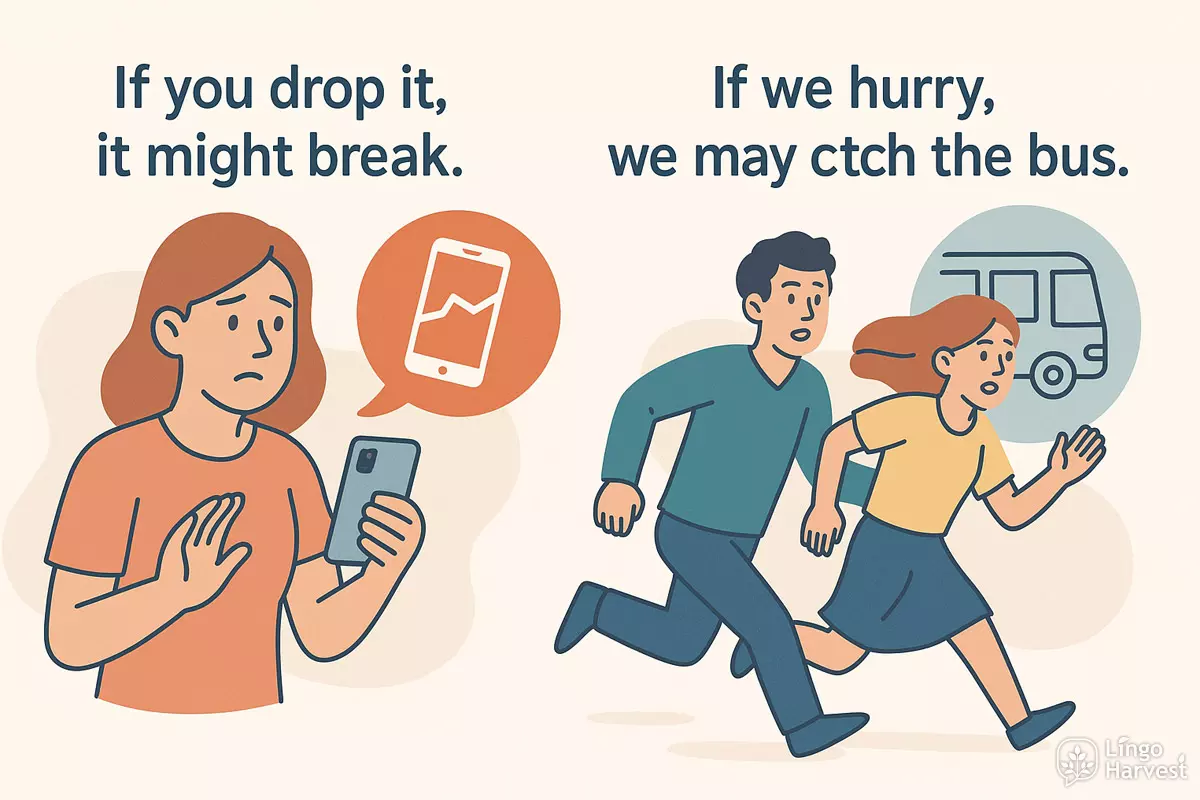
- ❌ If you drop it, it may break. → Too strong for a rare possibility.
- ✅ If you drop it, it might break. (Better for something unlikely.)
- ❌ If we hurry, we could catch the bus. → Implies ability, not chance.
- ✅ If we hurry, we may catch the bus. (Expresses a real possibility.)
- ❌ If it rains, the match might be canceled. → Sounds uncertain for a probable result.
- ✅ If it rains, the match may be canceled. (More suitable for a likely outcome.)
- ❌ If you ask, she could say yes. → Focuses on ability, not likelihood.
- ✅ If you ask, she might say yes. (Emphasizes possibility.)
- ❌ If you study, you might pass the exam. → Too weak for a probable result.
- ✅ If you study, you may pass the exam. (Stronger likelihood.)
Comparing Modal Strength in Conditionals
| Modal Verb | Typical Use in Conditionals | Example |
|---|---|---|
| May | Reasonable possibility | If it rains, the event may be postponed. |
| Might | Less likely possibility | If it rains, the event might be postponed. |
| Could | Potential (ability or chance) | If it rains, the event could be postponed. |
Tips to Avoid Modality Errors
- Match the modal with how probable the outcome is.
- Use "may" for realistic, likely possibilities.
- Choose "might" for outcomes that are possible but not probable.
- Reserve "could" for expressing potential or ability, not just possibility.
- Read your conditional aloud—does it sound too certain or too uncertain?
- Compare with native-like examples to check your choice.
Getting the right level of modality helps your conditional sentences sound natural and convey your intended meaning more clearly.
Practice: rewrite conditionals using the best modal choice
Understanding how to use "may," "might," and "could" in conditional sentences helps express different levels of possibility, uncertainty, or suggestion. Below you'll find practice activities to strengthen your ability to choose the most natural modal for each context. Rewrite each conditional so that it best fits the intended meaning—whether the situation is likely, uncertain, or simply possible.
Task 1: Rewrite the conditionals with an appropriate modal
Read each sentence. Then, rewrite it using "may," "might," or "could" to express the correct degree of possibility. Consider which modal best matches the likelihood or uncertainty of the result.
- If you hurry, you get there on time.
- If it rains tomorrow, we cancel the picnic.
- If she studies harder, she pass the exam.
- If they call, tell them I am busy.
- If you eat that, you feel sick.
- If we don’t leave now, we miss the bus.
- If he doesn’t show up, we have to start without him.
- If you ask, they help you.
- If the weather improves, we go hiking.
- If you mix these chemicals, the solution turn blue.
- If the team wins tonight, they reach the finals.
- If you try again, you succeed.
- If I see her, I tell her the news.
- If you don’t water the plant, it die.
- If we leave now, we catch the train.
Show answers
- If you hurry, you may get there on time.
- If it rains tomorrow, we might cancel the picnic.
- If she studies harder, she could pass the exam.
- If they call, they may be told I am busy.
- If you eat that, you might feel sick.
- If we don’t leave now, we could miss the bus.
- If he doesn’t show up, we may have to start without him.
- If you ask, they might help you.
- If the weather improves, we could go hiking.
- If you mix these chemicals, the solution may turn blue.
- If the team wins tonight, they might reach the finals.
- If you try again, you could succeed.
- If I see her, I may tell her the news.
- If you don’t water the plant, it might die.
- If we leave now, we could catch the train.
Task 2: Modal choice in context
Now, look at the following situations and decide which modal—"may," "might," or "could"—fits best in the conditional statement. Think about how certain or uncertain the result is.
- The sky is cloudy. (Possibility, not certainty)
If it rains, the streets ____ get slippery. - You are considering a risky investment. (Uncertainty)
If you invest now, you ____ lose money. - Your friend is thinking about joining a club. (Suggestion/possibility)
If you join, you ____ meet new people. - You are not sure if the store will be open. (Low certainty)
If we go now, the store ____ still be open.
Show answers
- If it rains, the streets may get slippery.
- If you invest now, you might lose money.
- If you join, you could meet new people.
- If we go now, the store might still be open.
Quick Reference: Choosing the Right Modal for Conditionals
Here's a summary of how each modal expresses possibility in conditional sentences:
| Modal | Degree of Possibility | Example |
|---|---|---|
| may | Medium, real possibility | If you call him, he may answer. |
| might | Lower, more uncertain | If you call him, he might answer. |
| could | Possible, also ability or suggestion | If you call him, he could answer. |
Practice regularly by rewriting or creating your own conditional sentences using these modals to convey the right nuance of possibility or uncertainty.