Advanced Expressions Equivalent to Conditionals: Otherwise, Or Else, Provided

 Here we how expressions such as otherwise, or else, and provided that function as conditionals, compares their tone and usage in different contexts, and gives examples and practice for replacing if-clauses with these alternatives.
- What makes a phrase function like a conditional
- Using otherwise and or else to show negative consequences
- Using provided and provided that for strict or limiting conditions
- Register and tone differences among advanced alternatives
- Examples from formal, technical, and persuasive writing
- Practice: replace if-clauses with equivalent expressions
Mastering nuanced ways to express conditions can significantly enhance your writing by providing both clarity and sophistication. Rather than relying solely on traditional if-then constructions, you can introduce variety and depth by incorporating alternatives such as otherwise, provided, or unless. These options not only prevent repetition but also allow for more precise expression of relationships between ideas. Expanding your conditional vocabulary enables you to convey complex thoughts more effectively and keeps your writing engaging for readers.
What makes a phrase function like a conditional
The essential quality that allows certain expressions to act as conditionals is their ability to set up a situation where one outcome depends on another. Instead of using traditional "if...then" structures, phrases like "otherwise," "or else," and "provided" establish a relationship of cause and effect, consequence, or stipulation. These alternatives can signal what must happen, what might happen, or what will not happen unless a specific condition is met.
Core Features of Conditional-Like Phrases
Several characteristics allow a phrase to serve this logical function:
- Dependency: They indicate that one event or action is dependent on another.
- Consequence or alternative: They often present a result or alternative if the first statement is not true.
- Implicit or explicit requirement: They convey a requirement that must be fulfilled for the outcome to occur.
- Clarity of relationship: The connection between the condition and result is clear, even without "if."
Phrases That Commonly Substitute for Conditionals
Here are some expressions and patterns frequently used instead of standard conditional forms:
- Otherwise → Hurry up; otherwise, we’ll be late.
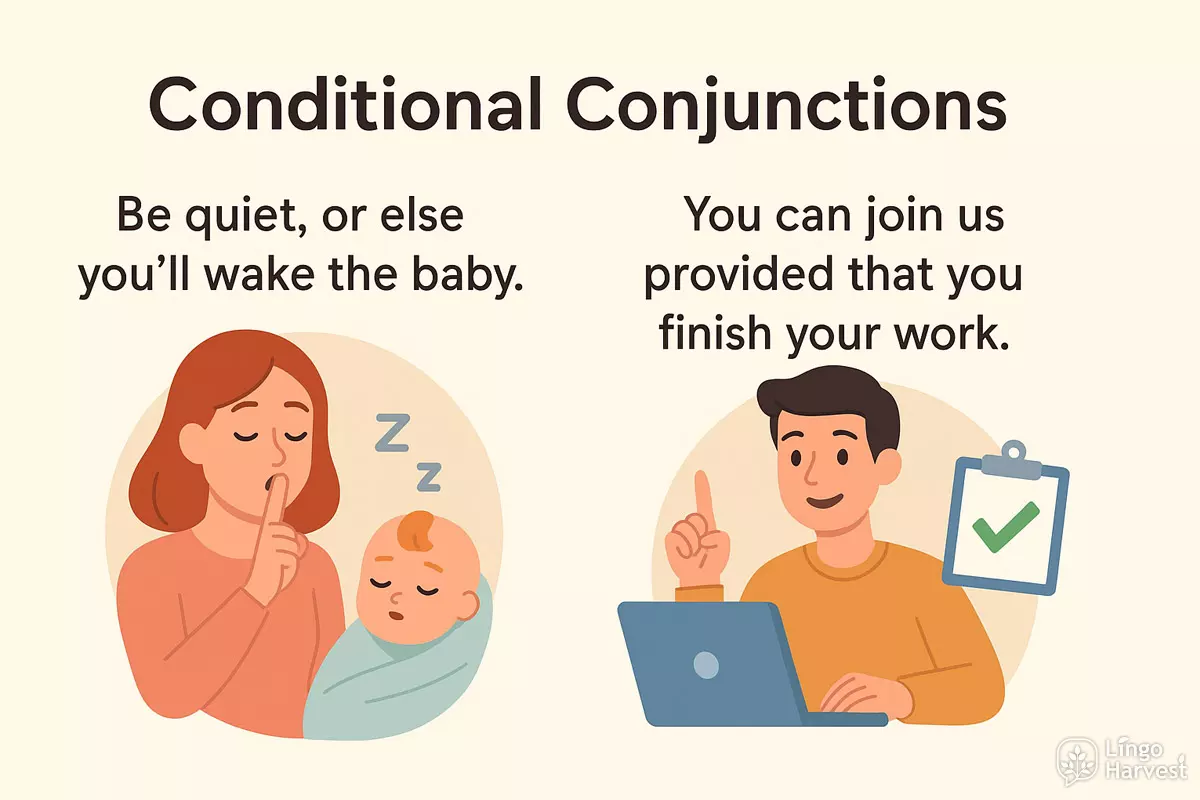
- Or else → Be quiet, or else you’ll wake the baby.
- Provided (that) → You can join us provided that you finish your work.
- Unless → Unless it stops raining, the game will be canceled.
- As long as → You can borrow my car as long as you drive carefully.
- In case → Take an umbrella in case it rains.
- Suppose / Supposing (that) → Suppose you lost your keys—what would you do?
- On condition (that) → You may enter on condition that you show your ID.
- Only if → You can leave only if you complete the assignment.
- Even if → Even if he apologizes, she won’t forgive him.
- Assuming (that) → Assuming that prices drop, we’ll buy a house.
- In the event (that) → In the event that the flight is delayed, we’ll notify you.
- Should (at sentence start) → Should you need help, just call me.
- So long as → You’re welcome to stay so long as you follow the rules.
- But for → But for your help, I would have failed.
- Without → Without sunlight, plants cannot grow.
- In case of → In case of fire, use the stairs.
- If not → Be ready by 8; if not, we’ll leave without you.
- Failing that → We need fresh milk; failing that, powdered milk will do.
- Given (that) → Given that you’re new here, we’ll explain everything slowly.
Comparing Conditional Equivalents
Some phrases are nearly interchangeable, but subtle differences exist in tone or usage. The table below compares several advanced expressions that serve the same logical function as conditionals:
| Expression | Conditional Function | Example |
|---|---|---|
| Otherwise | Indicates what will happen if the previous condition is not met | Take an umbrella; otherwise, you'll get wet. |
| Or else | Presents a negative alternative if the condition fails | Finish your homework, or else you can't go out. |
| Provided (that) | Sets a clear requirement for the main action to happen | You can borrow my car provided you drive carefully. |
| Unless | States an exception or negative condition | I won’t go unless you come with me. |
| As long as | Signals a condition that must be continuously true | You may stay as long as you like. |
Summary
In short, what makes these phrases powerful is their ability to set up a logical link between actions and outcomes, just like "if." Understanding how to use them fluently can add nuance and sophistication to your language, making your communication more flexible and precise.
Using otherwise and or else to show negative consequences
When expressing what might happen if a condition is not met, English often uses “otherwise” and “or else” instead of standard conditional forms. These alternatives are especially useful in both spoken and written English to signal negative consequences, warnings, or implied threats. Understanding how to use them improves fluency and adds nuance to your communication.
How “otherwise” and “or else” function in sentences
Both “otherwise” and “or else” introduce what will happen if the previous statement is not true or not acted upon. They directly follow the sentence containing the requirement or condition, clearly connecting the two ideas. While “otherwise” tends to sound a bit more formal, “or else” is more conversational, often implying a stronger or more immediate result.
- Lock the door, otherwise someone might break in.
- You need to submit the form today, or else your application won’t be accepted.
- Take an umbrella, otherwise you’ll get wet.
- Finish your homework now, or else you can’t go out later.
- Speak quietly, otherwise you’ll wake the baby.
- Pay the bill on time, or else you’ll receive a penalty.
- Save your work, otherwise you might lose everything.
- Drive carefully, or else you could have an accident.
- Wear sunscreen, otherwise you’ll get sunburned.
- Charge your phone, or else it will die during the day.
- Be on time, otherwise you’ll miss the train.
- Follow the instructions, or else the program won’t work.
- Don’t touch that, otherwise you’ll get hurt.
- Leave now, or else you’ll be late.
- Keep the receipt, otherwise you can’t return the item.
Common patterns for expressing negative outcomes
These expressions are typically used after commands or advice, making the possible negative result clear. Notice how the structure is concise and direct, often omitting “if you don’t…” at the start:
- Imperative + otherwise/or else + negative consequence
- Statement of necessity + otherwise/or else + what will go wrong
Comparing “otherwise” and “or else”
| Expression | Typical Use/Connotation | Example |
|---|---|---|
| otherwise | Neutral or formal; suitable in writing and polite speech | Bring your ID, otherwise you can’t enter. |
| or else | Informal or emphatic; sometimes sounds like a threat or warning | Hurry up, or else we’ll leave without you. |
| otherwise | Often used for logical consequences, not always threats | Follow the rules, otherwise you may be disqualified. |
| or else | Frequently used with imperatives, especially in spoken English | Stop shouting, or else the teacher will get angry. |
Tips for natural use
- Use “otherwise” for objective or neutral consequences.
- Choose “or else” when you want to sound more forceful or urgent.
- Both forms are often used in instructions, warnings, and advice.
- Do not use a comma before “otherwise” if it starts a new sentence; use one if it’s in the same sentence.
Mastering these alternatives allows you to express conditions and their negative outcomes with greater variety and precision.
Using provided and provided that for strict or limiting conditions
When you want to express a condition that is especially strict, or to set a clear boundary for when something is true, the phrases provided and provided that are ideal. Unlike more general conditionals such as if, these expressions communicate that the result will happen only in the specific circumstances described—no more, no less. In formal writing, academic work, contracts, and technical instructions, these structures help prevent ambiguity.
How these phrases work in context
Both provided and provided that introduce a clause specifying an exact requirement. The action or statement in the main clause is valid exclusively when the condition is fully met. For example:
- You may leave early provided your supervisor agrees.
- We will approve your request provided that all documents are submitted on time.
- The offer stands provided (that) payment is received within 30 days.
Notice that omitting or failing the condition invalidates the result.
Common uses and patterns
Provided and provided that are interchangeable in most cases. They often appear in formal settings, such as:
- You can attend the event, provided you RSVP by Friday.
- Students may retake the exam provided that they have a valid reason.
- The machine operates safely provided it is used as instructed.
- Refunds will be issued provided that the item is returned unopened.
- Guests are welcome provided they follow the dress code.
- The contract is renewable provided that all terms are met.
- Access is granted provided you show identification.
- Parking is free provided that you validate your ticket.
- Applications will be considered provided they arrive before the deadline.
- Discount applies provided that you purchase two or more items.
- The guarantee is valid provided proof of purchase is shown.
- Replacement parts are available provided that you supply the serial number.
Comparing "provided (that)" and "if" in restrictive contexts
The distinction between provided (that) and the standard if becomes clear when you need to emphasize exclusivity or strictness. While if can be used for both open and limiting conditions, provided (that) signals that the condition is the one and only factor allowing the result.
| Condition word | Implication | Example |
|---|---|---|
| If | General possibility; can be open or flexible | You can borrow the book if you ask. |
| Provided (that) | Strict, limiting; only under this exact condition | You can borrow the book provided (that) you return it tomorrow. |
Summary of function and tone
Choosing provided or provided that signals a precise, sometimes non-negotiable boundary. These phrases are preferred when you want to avoid loopholes or misunderstandings about when an action, permission, or result is valid. For less strict circumstances, alternatives like if or as long as may be more appropriate.
Register and tone differences among advanced alternatives
When choosing between "otherwise," "or else," and "provided," the level of formality and the subtle tone each conveys can affect clarity and appropriateness in both spoken and written contexts. These alternatives to classic conditional forms each bring their own nuances, and understanding these distinctions can help tailor your communication.
Formality and Context
- Otherwise is neutral to slightly formal. It's common in both written and spoken English, especially in explanations, instructions, or warnings. For example: "Submit your application by Friday; otherwise, it will not be considered."
- Or else tends to be informal or even slightly threatening. It is used in everyday speech, often to warn or threaten consequences: "Hurry up, or else we’ll be late."
- Provided (that) is formal and often appears in legal, academic, or official contexts. It introduces conditions in a precise and unemotional way: "You may attend the meeting, provided you have registered in advance."
Implications for Tone
The tone set by these expressions can vary from neutral and explanatory to stern or conditional. "Otherwise" implies a logical result or consequence without sounding harsh. "Or else" can sound like an ultimatum or threat, depending on delivery. "Provided" is unemotional and objective, emphasizing requirements more than threats or warnings.
Expanded Examples: Comparing Uses
- Bring your ID, otherwise you can't enter.
- Be quiet, or else you’ll be asked to leave.
- Access is allowed provided you are over 18.
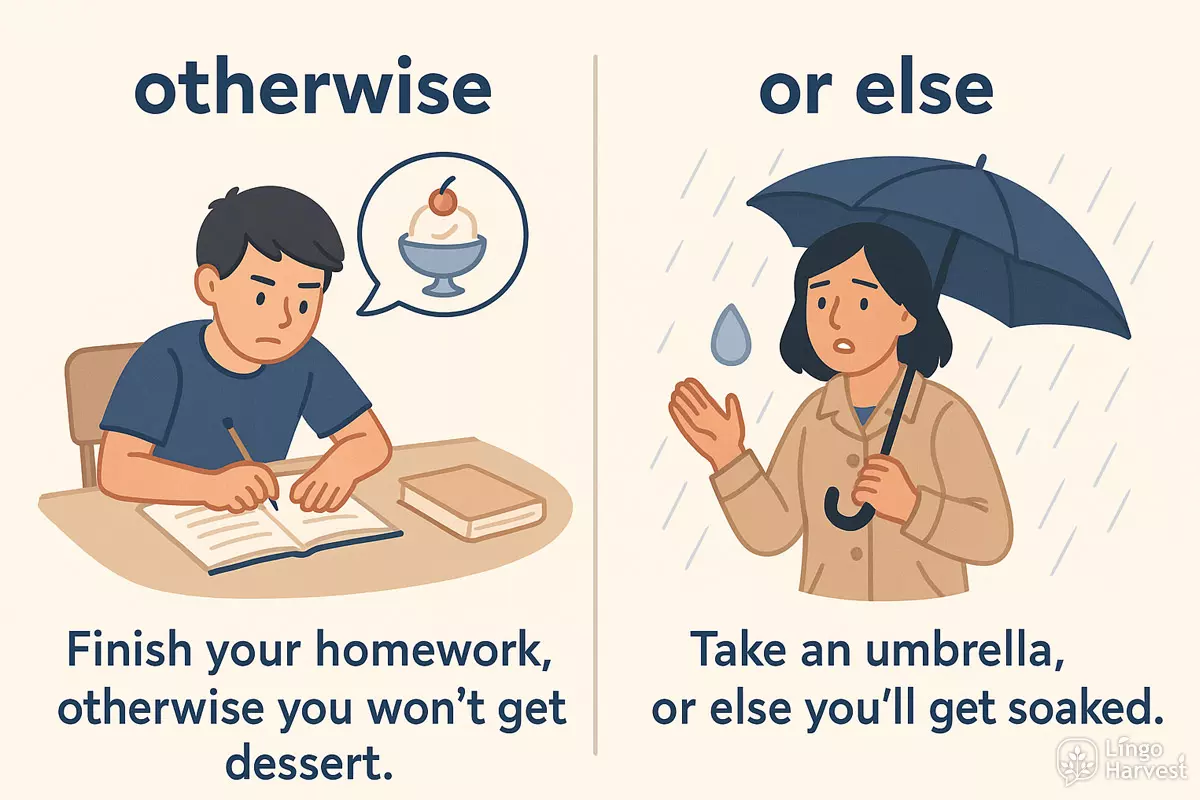
- Finish your homework, otherwise you won’t get dessert.
- Take an umbrella, or else you’ll get soaked.
- You can borrow the car provided that you return it by 10pm.
- Pay the fee by Monday, otherwise your registration will be cancelled.
- Call ahead, or else we might not be home.
- The offer stands provided all terms are met.
- Arrive on time, otherwise you’ll miss the bus.
- No phones allowed, or else you’ll be asked to leave.
- You may participate provided you agree to the rules.
Summary Table: Register and Tone Comparison
| Expression | Register | Tone | Typical Context |
|---|---|---|---|
| Otherwise | Neutral–Formal | Explanatory, logical | Instructions, written warnings |
| Or else | Informal | Threatening, urgent | Spoken warnings, casual speech |
| Provided (that) | Formal | Objective, conditional | Legal, academic, contracts |
In summary, the choice among these advanced alternatives should reflect the context, audience, and desired tone. Picking the right one can help ensure your message is both clear and appropriate.
Examples from formal, technical, and persuasive writing
Writers often substitute standard “if…then” conditionals with advanced alternatives such as “otherwise,” “or else,” and “provided.” These alternatives are especially common in manuals, contracts, academic texts, and persuasive arguments where clarity, conciseness, or a specific tone is needed.
Formal and Technical Contexts
In technical documents or legal agreements, clarity is paramount. Instead of lengthy conditional sentences, concise alternatives help avoid ambiguity. Here are some typical patterns:
- “Submit the form by Friday; otherwise, your application will not be considered.”
- “Payment must be received in full; or else, access will be suspended.”
- “Access is granted provided that all fields are completed accurately.”
- “Documents should be signed, otherwise the process cannot proceed.”
- “The device may be used provided it is calibrated regularly.”
- “All safety checks must be performed; or else, operation is prohibited.”
- “Complete the installation steps as outlined. Otherwise, system errors may occur.”
- “Warranty applies provided the product is used as directed.”
- “Return the item within 30 days; otherwise, refunds cannot be issued.”
- “The experiment will continue provided no adverse effects are observed.”
Persuasive and Policy Writing
When aiming to influence readers or establish policies, these conditional forms create strong, memorable directives or arguments:
- “Follow the guidelines; otherwise, disciplinary action may result.”
- “Support this initiative, or else risk losing funding.”
- “You may participate provided you meet all prerequisites.”
- “Act now; otherwise, the opportunity will be lost.”
- “Access is granted provided users comply with the terms.”
- “Report all incidents promptly, otherwise liability may increase.”
- “Renew your subscription or else service will be interrupted.”
- “The proposal is accepted provided revisions are made.”
Comparing Advanced Conditional Forms
| Expression | Sample Contextual Use |
|---|---|
| Otherwise | “Submit your assignment by midnight; otherwise, it will not be graded.” |
| Or else | “Comply with the safety regulations, or else operations will cease.” |
| Provided (that) | “The contract is valid provided all parties sign.” |
| Unless | “Access is denied unless credentials are verified.” |
| As long as | “Employees may work remotely as long as productivity remains high.” |
These structures enable writers to express nuanced conditions, highlight consequences, and maintain a tone of authority or precision. Whether drafting a technical manual, a legal clause, or a persuasive policy, choosing the right conditional form can clarify intent and improve readability.
Practice: replace if-clauses with equivalent expressions
When refining your use of advanced conditional expressions, it's helpful to convert standard "if" statements into more nuanced phrases like "otherwise," "or else," and "provided." This practice not only diversifies your language but also sharpens your understanding of subtle logical relationships.
Transforming Conditionals: Examples & Patterns
Below are several typical "if" clauses rephrased using equivalent expressions. Notice how the meaning is preserved, but the structure becomes more sophisticated.
- If you finish early, you can leave. → You can leave, provided you finish early.
- If it rains, we will stay inside. → We will stay inside; otherwise, we will go out.
- If you don’t call, I’ll assume you’re not coming. → I’ll assume you’re not coming unless you call.
- If the file is missing, the program will crash. → The program will crash if the file is missing.
- If you want dessert, you must finish your dinner. → You must finish your dinner in order to have dessert.
- If you hurry, you’ll catch the bus. → You’ll catch the bus provided you hurry.
- If the alarm sounds, leave the building. → Leave the building should the alarm sound.
- If you disagree, say so now. → Say so now if you disagree.
- If the light is red, stop. Otherwise, proceed with caution.
- If you see Anna, tell her I called. → Tell Anna I called if you see her.
- If you don’t understand, ask for help. → Ask for help if you don’t understand.
- If you’re tired, you can rest. → You can rest provided you’re tired.
- If you fail the test, you will have to retake it. → You will have to retake the test if you fail.
- If the weather is good, we’ll go hiking; otherwise, we’ll stay home.
- If you have questions, raise your hand. → Raise your hand if you have questions.
- If you need more time, let me know. → Let me know if you need more time.
- If you’re not sure, check with your supervisor. → Check with your supervisor if you’re not sure.
- If you want to participate, sign up now. → Sign up now if you want to participate.
Task: Rephrase the following sentences
Rewrite each sentence using an advanced conditional expression ("otherwise," "or else," or "provided") instead of the basic "if" clause.
- If you forget your ticket, you won’t be allowed in.
- If you want to join us, meet at the station by 8:00.
- If you don’t water the plants, they’ll die.
- If you study hard, you’ll pass the exam.
- If you don’t pay the bill, your service will be disconnected.
- If it rains tomorrow, the match will be postponed.
- If you finish early, call me.
- If you don’t follow the rules, you’ll be asked to leave.
- If the store is open, we’ll buy some groceries.
- If you feel sick, visit a doctor.
Show answers
- You won’t be allowed in unless you bring your ticket.
- Meet at the station by 8:00 if you want to join us.
- The plants will die unless you water them.
- You’ll pass the exam provided you study hard.
- Your service will be disconnected if you don’t pay the bill.
- The match will be postponed if it rains tomorrow.
- Call me if you finish early.
- You’ll be asked to leave if you don’t follow the rules.
- We’ll buy some groceries if the store is open.
- Visit a doctor if you feel sick.
Comparing Approaches: "Otherwise" vs. "Or Else"
| Standard If-Clause | With "Otherwise" | With "Or Else" |
|---|---|---|
| If you lock the door, the alarm won’t go off. | Lock the door; otherwise, the alarm will go off. | Lock the door, or else the alarm will go off. |
| If you submit on time, you’ll avoid a penalty. | Submit on time; otherwise, you’ll get a penalty. | Submit on time, or else you’ll get a penalty. |
| If you wear a coat, you won’t get cold. | Wear a coat; otherwise, you’ll get cold. | Wear a coat, or else you’ll get cold. |
| If you save your work, you won’t lose data. | Save your work; otherwise, you’ll lose data. | Save your work, or else you’ll lose data. |
By practicing these transformations, you’ll develop a more versatile and precise command of conditional logic in English. Try creating your own examples and experiment with "otherwise," "or else," and "provided" to reinforce these structures.