Reality Shifts in Conditional Stories and Narrative Writing

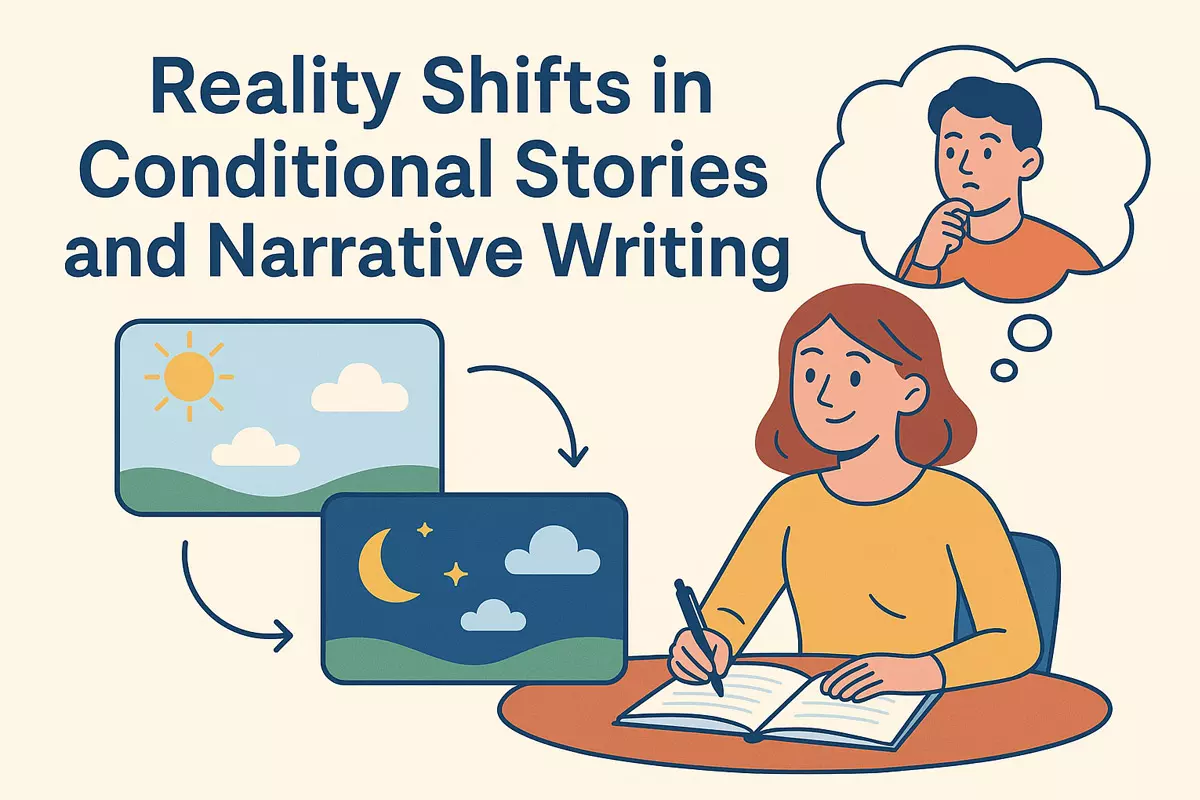 Here we how authors use conditionals to shift timelines and perspectives, differentiate imagined from real events, and create parallel realities. It includes examples from fiction and nonfiction, plus practice writing narrative reality shifts.
- How authors use conditionals to shift timelines and perspectives
- Hypothetical frames in storytelling: imagined vs real events
- Creating parallel realities using conditional sequences
- Blending narrative past and hypothetical outcomes
- Examples from fiction and creative nonfiction
- Practice: write short narrative segments using reality shifts
When stories bend the rules of their worlds or shift perspectives to explore imagined possibilities, they encourage readers to question the boundaries between reality and invention. By examining these narrative shifts, we see how writers skillfully use uncertainty and alternate outcomes to draw readers in, prompting deeper engagement and curiosity. This approach not only makes the storytelling more dynamic but also challenges readers to reconsider their assumptions, fostering a more interactive and thought-provoking reading experience.
How authors use conditionals to shift timelines and perspectives
Writers frequently rely on conditional structures to manipulate the flow of time and viewpoint within a narrative. By introducing "what if" scenarios, authors can move beyond linear storytelling, exploring alternate realities, hypothetical consequences, and character motivations in depth. This technique not only enriches plot complexity but also allows readers to engage with multiple possible outcomes, fostering a more interactive reading experience.
Common Conditional Patterns in Narrative Writing
Conditionals are versatile. Authors might use them to:
- Introduce alternate histories ("If Napoleon had won at Waterloo, Europe would look different.")
- Reveal character regrets or desires ("If only I had told her the truth, things might have changed.")
- Foreshadow events ("If you trust him, you'll regret it.")
- Explore parallel universes ("If the train had not been late, she would never have met him.")
- Highlight moral dilemmas ("If you help, you risk everything; if you don't, someone suffers.")
- Convey wishes or impossible scenarios ("If I could fly, I'd see the world from above.")
- Build suspense ("If he enters that room, nothing will be the same.")
- Express uncertainty about the past ("If she was there, I never saw her.")
- Suggest future consequences ("If they lose, the kingdom will fall.")
- Prompt reflection ("If we had known, would we have acted differently?")
- Frame unreliable narration ("If what he says is true, then everything changes.")
- Establish cause and effect across timelines ("If the letter arrives, the story shifts direction.")
Shifting Perspectives Through Conditional Voice
By embedding conditional statements, storytellers can seamlessly transition between the present, past, and possible futures. This fluidity enables them to:
- Juxtapose a character’s current reality with imagined alternatives
- Layer multiple viewpoints or timelines in a single narrative
- Challenge the reader’s perception of what is real versus what is possible
- Encourage empathy by showing how different choices lead to different outcomes
Types of Conditionals and Their Narrative Effects
| Conditional Type | Narrative Use |
|---|---|
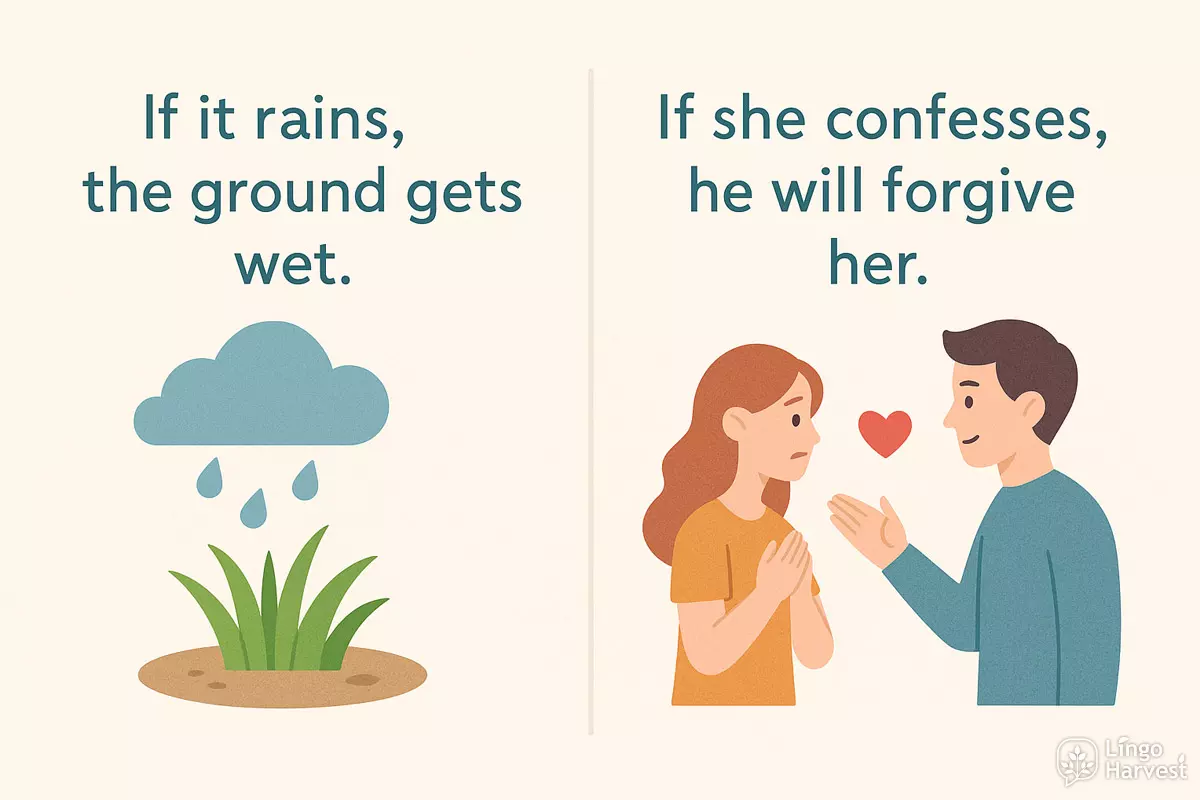
| Zero Conditional | Expresses universal truths or habits ("If it rains, the ground gets wet.") |
| First Conditional | Presents real, possible futures ("If she confesses, he will forgive her.") |
| Second Conditional | Introduces hypotheticals or unlikely events ("If he were king, he would change the laws.") |
| Third Conditional | Explores alternate pasts or regrets ("If I had known, I would have acted differently.") |
| Mixed Conditional | Combines time frames for nuanced effects ("If I had studied, I would be a doctor now.") |
Writers skillfully blend these forms to create layered realities and challenge readers’ assumptions. The use of conditionals opens doors to rich, multifaceted storytelling—inviting us to question not just what happened, but what might have been or could still be.
Hypothetical frames in storytelling: imagined vs real events
Writers frequently blur the line between what actually happens in a narrative and what could have happened under different circumstances. This interplay between imagined possibilities and established facts is crucial for building tension, exploring character motivations, and challenging readers’ perceptions of what’s “real” within a story.
Understanding hypothetical frames
A hypothetical frame is a narrative device that allows an author to present scenarios that are not part of the main timeline or reality of the story. These frames often use conditional language—such as “if,” “would,” “could have,” or “might”—to signal to readers that events described are speculative, not factual. This kind of framing is especially common in genres like speculative fiction, but even realist stories use it for flashbacks, regrets, or imagined futures.
- Exploring alternative outcomes (e.g., “If she had taken the train, she would have arrived on time.”)
- Revealing character desires or fears through daydreams or nightmares
- Setting up moral dilemmas by presenting “what if” scenarios
- Foreshadowing events by hinting at possible futures
- Providing counterfactual background to explain motivations
- Offering unreliable narration where imagined events are mistaken for real ones
- Highlighting missed opportunities or moments of regret
- Introducing parallel universes or alternate realities
- Allowing readers to compare “real” events to imagined ones
- Framing stories within stories, such as a character telling a hypothetical tale
- Using dreams or hallucinations to blur fact and fiction
- Discussing consequences of choices not taken
- Examining cultural or historical “what if” questions
- Creating suspense by withholding which events are real
- Developing character growth through imagined resolutions
- Signaling internal conflict via conflicting imagined futures
- Juxtaposing collective vs. individual hypothetical experiences
- Playing with reader expectations using red herrings or false clues
Comparing imagined and real narrative events
Imagined situations and factual events serve different purposes in storytelling. While “real” events drive the plot forward and establish the canon of a narrative, hypothetical situations add depth, complexity, and emotional resonance.
| Feature | Imagined (Hypothetical) Events | Actual (Real) Events |
|---|---|---|
| Language cues | “If,” “would have,” “could,” “might” | Simple past, present, or future tense |
| Effect on plot | Suggests possibilities, explores alternatives | Advances the main narrative |
| Reader’s role | Invites speculation and interpretation | Follows established facts |
| Emotional impact | Heightens suspense, regret, or hope | Grounds emotion in the story’s reality |
| Purpose | Deepens theme, explores character psyche | Establishes what “actually happened” |
Why writers use hypothetical storytelling
Incorporating imagined situations allows authors to probe deeper into “what could be” rather than “what is.” This technique reveals characters’ inner worlds, creates space for thematic exploration, and keeps readers questioning the boundaries between reality and possibility. By skillfully shifting between the actual and the hypothetical, narrative writing becomes more dynamic, unpredictable, and emotionally engaging.
Creating parallel realities using conditional sequences
Writers often build branching storylines through the careful use of conditional logic, allowing characters’ choices or external events to split the narrative into multiple threads. This approach not only adds depth and replay value to stories but also mirrors the way decisions can shape different possible worlds within a single narrative framework. By structuring their stories with “if-then” statements, authors can explore the consequences of actions, reveal hidden motivations, or construct intricate alternate timelines.
Conditional structures in narrative writing
Conditional sequences act as the engine for divergence in storytelling. These can take the form of explicit choices (such as “If the hero opens the door, they find...”) or implicit developments (“Should the storm arrive before dawn, the village will...”). Such mechanisms empower writers to build layered realities, each with its own logic and outcome.
- If a character accepts a mysterious invitation, they enter a world of magic.
- Should the protagonist refuse to help, they remain unaware of the secret plot.
- If the weather turns, the journey becomes perilous.
- Should the villain escape, a new antagonist rises.
- If trust is broken, alliances crumble.
- Should hope persist, the group finds a hidden path.
- If the relic is destroyed, history rewrites itself.
- Should the plan fail, unexpected allies appear.
- If the message is intercepted, danger increases.
- Should forgiveness be granted, old wounds begin to heal.
- If a secret is revealed, loyalties are tested.
- Should courage falter, darkness spreads.
- If the past returns, the present shifts.
- Should the prophecy be fulfilled, a new era begins.
Managing complexity with conditional patterns
As narratives become more complex, authors often rely on patterns to organize their branching realities. Some common paradigms include:
- Binary forks: Each choice leads to one of two outcomes, creating a tree-like structure.
- Nested conditions: Outcomes depend on previous choices, leading to interconnected branches.
- Converging paths: Separate branches eventually merge, allowing for shared events or resolutions.
- Parallel but independent threads: Multiple realities develop in tandem, sometimes interacting or remaining isolated.
Comparison of conditional sequence paradigms
| Paradigm | Features | Example Use | Complexity Level |
|---|---|---|---|
| Binary fork | Each decision point splits the narrative into two distinct paths | Choose to trust or betray an ally | Low |
| Nested branching | Subsequent choices are influenced by earlier ones, creating interdependent outcomes | Actions in chapter one affect options in chapter three | Medium |
| Convergent branches | Separate storylines eventually merge into a common event | Multiple characters’ paths leading to the same final battle | Medium-High |
| Parallel threads | Independent realities develop side by side, sometimes interacting | Alternate universes influencing each other | High |
By thoughtfully employing these conditional devices, writers can craft stories that feel alive and responsive, offering readers or players a sense of agency and genuine surprise. This dynamic approach is especially valuable in interactive fiction, game narratives, and experimental literature, where exploring multiple realities is part of the experience.
Blending narrative past and hypothetical outcomes
Writers often weave together events that have already happened with imagined possibilities, especially in stories exploring what might have been. This technique lets characters reflect on real experiences while also speculating about alternate realities. By drawing on the past and layering it with “if only” scenarios, an author can highlight regrets, wishes, and pivotal decisions.
Techniques for merging past events with hypotheticals
When combining recollections with imagined alternatives, writers frequently rely on specific grammatical structures and narrative devices. Some common approaches include:
- Using the past perfect (“had gone”) to set up a real event, then shifting to conditional forms (“would have gone”) for the imagined outcome
- Embedding counterfactuals in a character’s internal monologue
- Employing “if” clauses to pivot between what occurred and what might have happened
- Juxtaposing a factual sequence with a parallel, hypothetical thread
- Incorporating flashbacks that lead into “what if” musings
- Letting dialogue reveal characters’ alternative scenarios
- Switching tenses to differentiate between the actual past and speculative outcomes
- Using narrative questions to prompt consideration of different realities
- Highlighting cause and effect by comparing real consequences with imagined ones
- Blending memory and wishful thinking in descriptive passages
- Introducing unreliable narrators who blur fact and possibility
- Structuring chapters or scenes around key turning points and their potential alternatives
Common patterns in conditional narrative writing
Writers often rely on recurring linguistic patterns to express these blended realities. Here are some widely used forms and their narrative functions:
| Pattern | Function in Storytelling |
|---|---|
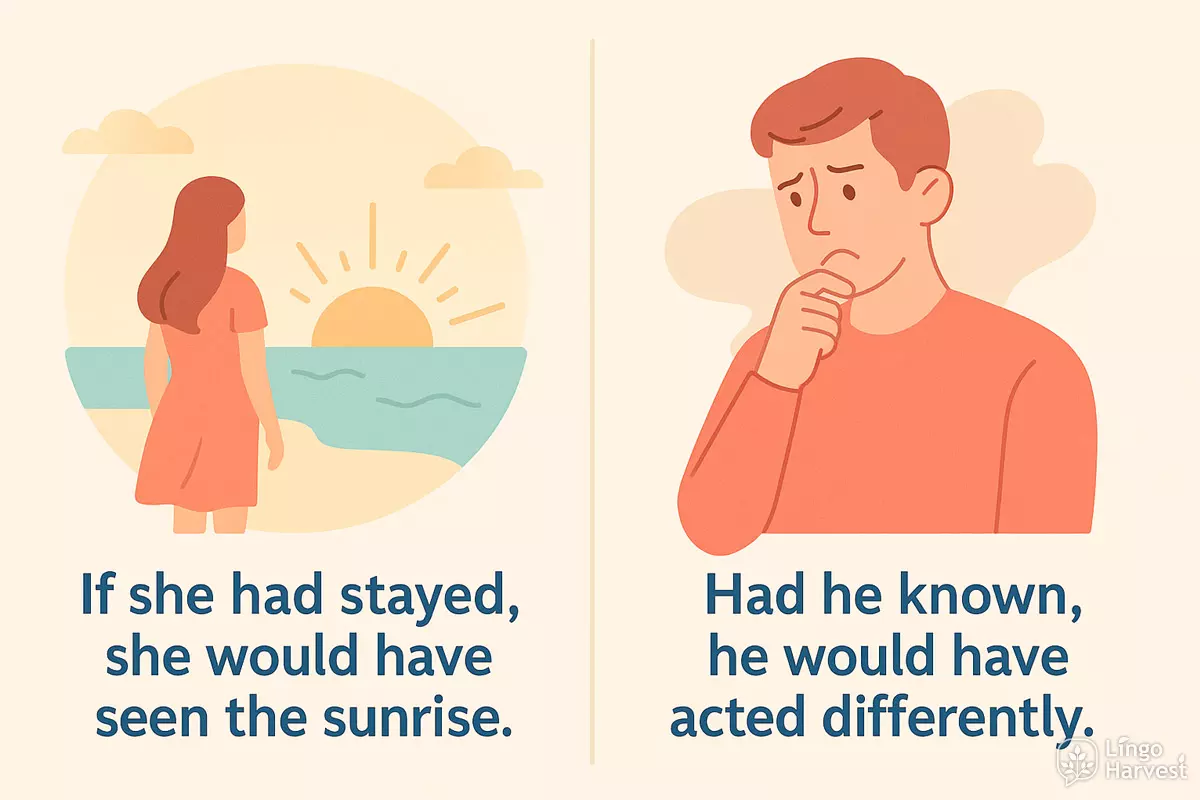
| If + past perfect, would have + past participle | Expresses regret or missed opportunity (e.g., “If she had stayed, she would have seen the sunrise.”) |
| Had + subject + past participle, subject + would have + past participle | Inverts the conditional for emphasis (e.g., “Had he known, he would have acted differently.”) |
| Suppose/Supposing + past perfect, would have + past participle | Invites the reader into hypothetical reflection (e.g., “Suppose they had met earlier, would things have changed?”) |
| What if + past perfect + ? | Poses open-ended questions about alternate outcomes (e.g., “What if I had taken the other road?”) |
| Wish + subject + past perfect | Expresses longing for a different past (e.g., “I wish I had spoken up.”) |
| If only + past perfect | Emphasizes strong regret (e.g., “If only they had listened.”) |
Narrative effects and reader engagement
This fusion of actual memory and imagined possibility deepens character development and emotional resonance. Readers become more invested when they see not just what happened, but how things might have unfolded differently. It also allows exploration of fate, choice, and consequence in a nuanced way. By skillfully intertwining these narrative strands, writers create richer, more thought-provoking stories that linger in the reader’s mind.
Examples from fiction and creative nonfiction
Stories that hinge on shifting realities or "what if" scenarios appear in many genres, offering readers unique perspectives and narrative twists. Writers use conditional structures to explore alternate histories, parallel universes, and the consequences of divergent choices. Below are several ways authors employ these techniques, along with notable instances from literature and memoir.
Common Patterns of Reality Shifts
- Alternate timelines: Characters experience or imagine life if a pivotal event had gone differently.
- Unreliable narrators: The line between what is true and what is perceived blurs, often intentionally.
- Sliding doors moments: A single choice branches the narrative into multiple possible outcomes.
- Magical realism: Everyday reality is subtly altered by fantastical elements, shifting the reader’s expectations.
- Conditional memoir: Authors reflect on their lives by speculating about unexplored paths or choices.
- Counterfactual history: Stories reimagine real events with different outcomes ("What if the South had won the Civil War?").
- Dream sequences: Reality is temporarily suspended, allowing for exploration of subconscious possibilities.
- Parallel worlds: Characters traverse or glimpse realities that run alongside their own.
- Mental shifts: A protagonist's internal reality diverges from external events, creating ambiguity.
- Metafiction: The story acknowledges its own fictionality, sometimes breaking the fourth wall to question reality itself.
Illustrative Examples
- The Man in the High Castle by Philip K. Dick – imagines an America where the Axis powers won WWII.
- Life After Life by Kate Atkinson – follows a protagonist who repeatedly dies and is reborn, living out different possible lives.
- Sliding Doors (film, but often referenced in fiction) – explores two parallel narratives based on whether the protagonist catches a train.
- If on a winter’s night a traveler by Italo Calvino – plays with narrative structure, leading readers through branching stories.
- Fun Home by Alison Bechdel – uses speculative reflection to consider how family revelations reshaped her understanding of the past.
- Joan Didion’s essays – often use counterfactual musings to interrogate memory and reality in nonfiction.
- Never Let Me Go by Kazuo Ishiguro – introduces a world with subtle but chilling differences from our own, revealed gradually.
- Black Mirror (series) – each episode constructs a near-future scenario, challenging assumptions about technology and society.
- The Left Hand of Darkness by Ursula K. Le Guin – explores a world with radically different gender norms, prompting readers to reconsider their own reality.
- Recitatif by Toni Morrison – deliberately withholds key details, forcing readers to question their assumptions about identity and truth.
Comparing Techniques in Fiction and Creative Nonfiction
| Approach | Typical Use | Example |
|---|---|---|
| Alternate Timeline | Explores consequences of different choices/events | The Plot Against America by Philip Roth |
| Speculative Reflection | Author imagines how life could have unfolded | Fun Home by Alison Bechdel |
| Unreliable Narration | Blurs boundary between reality and perception | Fight Club by Chuck Palahniuk |
| Metafictional Play | Story comments on its own artifice | If on a winter’s night a traveler by Calvino |
| Counterfactual History | Imagines major historical events with different outcomes | The Man in the High Castle by Philip K. Dick |
| Magical Realism | Integrates fantastical elements into ordinary settings | One Hundred Years of Solitude by Gabriel García Márquez |
These approaches demonstrate how writers in both fiction and nonfiction can use conditional structures and reality shifts to deepen narrative complexity, challenge readers’ expectations, and illuminate the significance of choice, perception, and possibility within storytelling.
Practice: write short narrative segments using reality shifts
Exploring reality shifts in storytelling helps writers create dynamic, surprising, or thought-provoking narratives. In this section, you'll find practical exercises and creative prompts to develop short story segments that incorporate changes in reality—such as alternate outcomes, sudden twists, or shifting perspectives.
Getting Started: Simple Reality Shift Prompts
Begin by selecting a familiar scenario. Then, introduce a change that alters the fabric of reality within the story. These shifts can be subtle (a character realizes their memory is false) or dramatic (the laws of physics suddenly stop working). Use the following prompts to spark ideas:
- A character wakes up to find time is flowing backward.
- Mid-conversation, everyone in the room starts speaking a language the protagonist doesn’t know.
- The protagonist receives a letter from their future self, changing their next decision.
- Gravity reverses for five minutes each day.
- After making a wish, small details—colors, sounds, people—start shifting unpredictably.
- Every mirror in the world shows a different reality.
- The main character swaps lives with someone else for a day, but only one of them realizes it.
- An item in the protagonist's home is suddenly missing, and no one else remembers it ever existed.
- Each time the protagonist blinks, the setting changes slightly.
- Dreams begin to leak into waking life, causing confusion about what is real.
Exercise: Write and Transform Mini-Narratives
- Write a 3–4 sentence scene set in a mundane, everyday context.
- Now, rewrite the scene by introducing a reality shift. Consider how characters react, and how the tone or outcome changes.
Try this with different genres or tones to see how the same shift can create humor, suspense, or drama.
Common Reality Shift Techniques
- Sudden revelation (the world isn’t what it seems)
- Conditional "what if" scenarios (if X had happened instead…)
- Parallel timelines or universes intersecting
- Unreliable narration leading to a twist
- Characters with altered memories or perceptions
- Breaking the fourth wall: characters aware of being fictional
- Shifts between first-person and third-person perspectives
- Physical laws or environmental rules changing mid-story
- Rewriting history or cause-and-effect relationships
- Objects or people behaving contrary to expectation
Practice Task: Identify the Reality Shift
Read the following narrative segments and identify the moment when the reality shift occurs.
- As Mia poured her coffee, she noticed the clock ticking backward, counting down to an unknown event.
- Jared opened the door to his apartment and stepped into a bustling medieval marketplace.
- Every time Anna looked at her phone, the date changed to a different year, though only she seemed to notice.
- After the thunderstorm, everyone in town had forgotten how to read—except for one person.
- When Oliver blinked, the entire room rearranged itself into a different layout.
- Lucy’s shadow began moving independently, pointing toward something she could not see.
- Each night, Daniel dreamed of a city he’d never visited—until he found it on a real map.
- The old radio in Emma’s attic played news from a decade that hadn’t happened yet.
- No matter what path Noah took to school, he always arrived at a completely different building.
- Whenever Sophia touched water, she heard voices speaking in an unknown language.
Show answers
- The clock begins ticking backward.
- The apartment door opens into a different era.
- The phone’s date changes with each glance.
- Literacy disappears after the storm, except for one person.
- The room rearranges itself when he blinks.
- The shadow moves on its own, giving directions.
- The dream city turns out to be real.
- The radio broadcasts news from the future.
- Every route leads to a different school building.
- Touching water reveals mysterious voices.
Tips for Effective Reality Shifts in Short Narratives
- Ground your scene in reality before introducing the shift for greater impact.
- Show character reactions to highlight the strangeness of the new situation.
- Use sensory details to make the change vivid for readers.
- Experiment with pacing: a sudden shift can shock, while a gradual one can build intrigue.
- Consider the consequences—how does the change affect the world and the characters?
By practicing these techniques and experimenting with different forms of reality alteration, you can enrich your storytelling and engage readers with unexpected twists and thought-provoking scenarios.