Cause-and-effect Conjunctions for Beginners: because, since

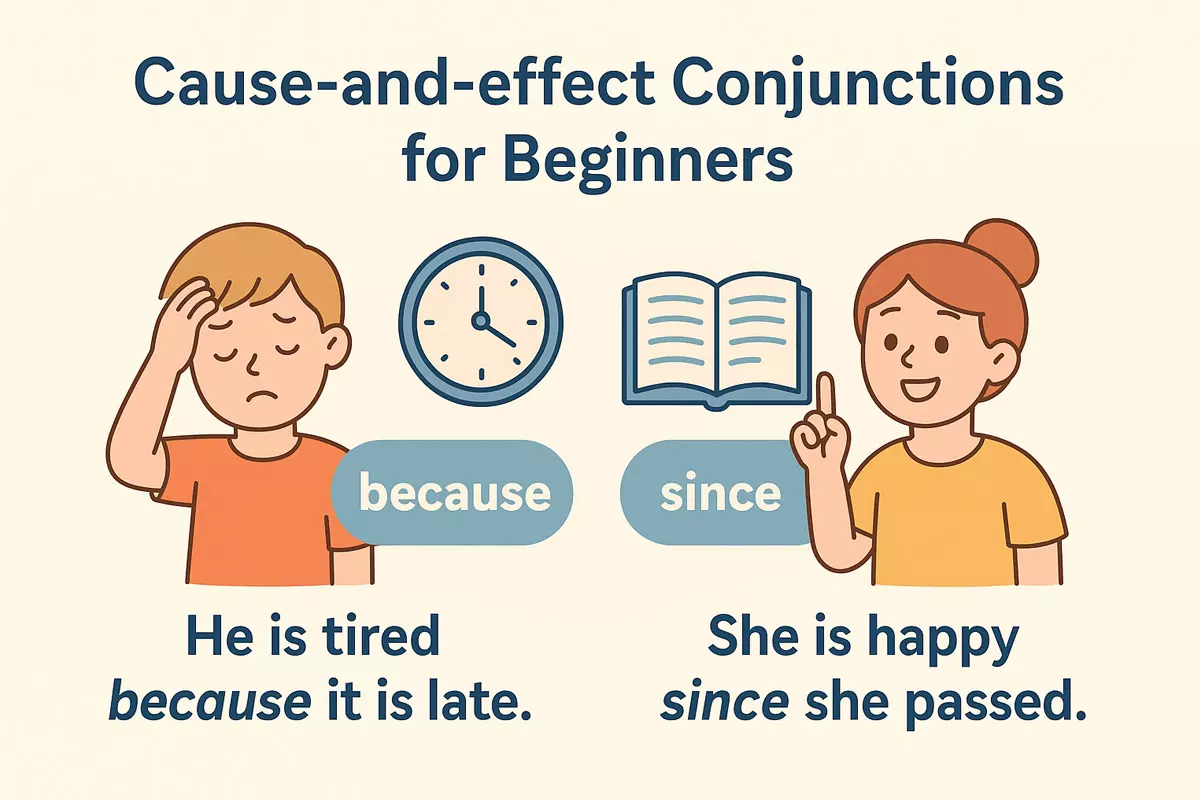 This article explains how to express cause and effect in everyday English sentences using because and since. It covers when to use each word, where to place reason clauses, punctuation rules, and includes practice matching reasons to results.
- Idea of cause and effect in everyday sentences
- Using because to give a simple reason
- Using since to give a reason in a slightly more formal way
- Where to place the reason clause in a sentence
- Punctuation basics with because and since
- Practice: match reasons with correct results using because or since
Learning to connect reasons and results is essential for clear communication in English, as it allows speakers and writers to explain why something happens and make their ideas more understandable. By using words such as "because" and "since," we can link causes with their effects, helping readers or listeners follow our reasoning more easily. Mastering these connections not only improves the flow of sentences but also strengthens arguments and explanations, making communication more logical and persuasive in both everyday and academic contexts.
Idea of cause and effect in everyday sentences
Understanding how actions and events connect is an important part of communicating clearly in English. We often explain reasons for what happens in daily life, such as why we are late, why we feel happy, or why plans change. Connecting events and their reasons helps listeners or readers follow your logic and see the relationship between different facts or actions.
How cause and effect works in simple language
When we talk about cause and effect, we explain why something happens (the cause) and what happens as a result (the effect). In English, words like "because" and "since" are commonly used to link these ideas. For example, you might say you brought an umbrella because it was raining. Here, "it was raining" is the cause, and "you brought an umbrella" is the effect.
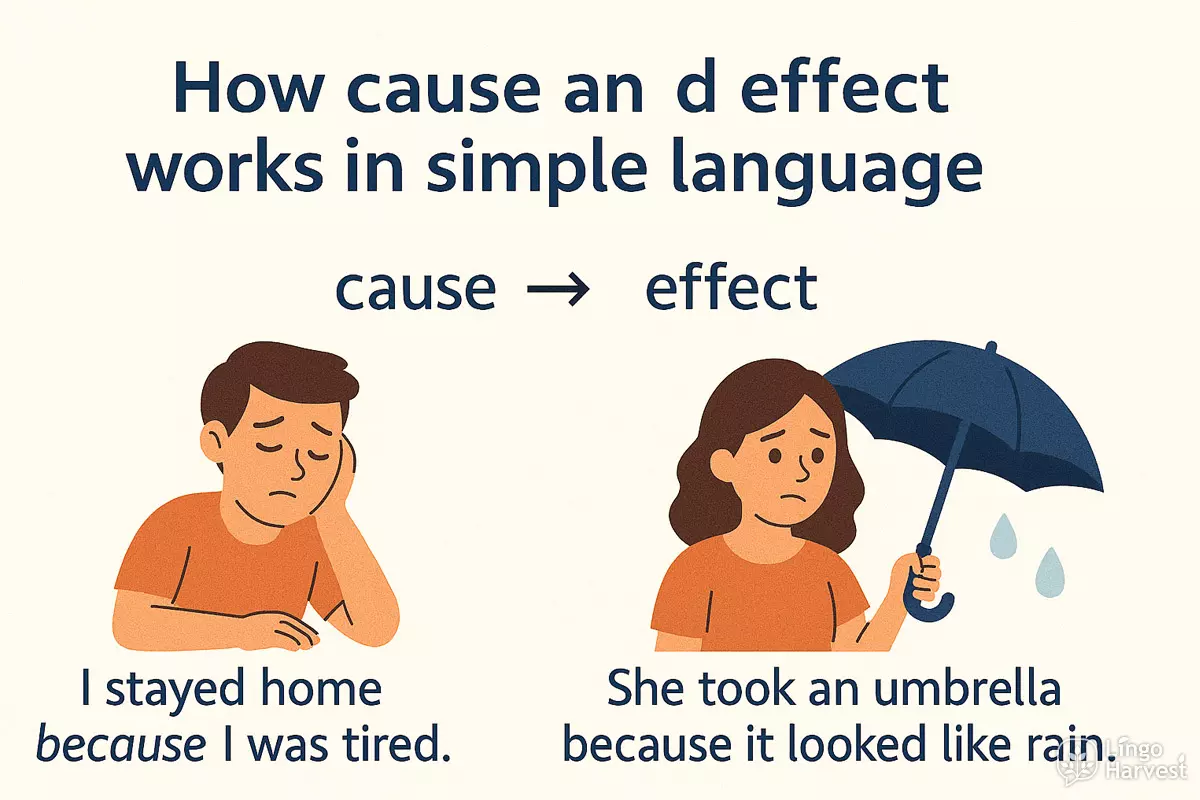
- I stayed home because I was tired.
- She took an umbrella because it looked like rain.
- We missed the bus since we left the house late.
- He is happy because he passed his exam.
- They ate early since they were hungry.
- The ground is wet because it rained last night.
- I didn’t go out because I had homework.
- She is wearing a coat since it’s cold outside.
- The shop is closed because today is a holiday.
- We are celebrating because it’s her birthday.
- He called me since I needed help.
- The baby is crying because she is hungry.
Spotting causes and effects in conversation
In conversations, recognizing which part of the sentence gives the reason and which gives the result can help you understand and respond better. For instance, in “I’m wearing boots because it’s snowing,” the snow is the reason, and wearing boots is what happens as a result.
Patterns and word order
You can usually put the reason (cause) after "because" or "since," but sometimes the order can be reversed for emphasis:
- Because it was dark, we used a flashlight.
- Since you’re here, let’s start the meeting.
Quick comparison of cause-and-effect connectors
| Connector | Example sentence |
|---|---|
| because | I went to bed early because I was tired. |
| since | Since it’s raining, let’s stay inside. |
| so | It was cold, so I wore a jacket. |
| as | As she was busy, she couldn’t come. |
By practicing these patterns, you’ll start to notice how often people use them in real conversations. This will make it easier to express your own reasons and understand others, whether you are chatting with friends or writing simple sentences.
Using because to give a simple reason
"Because" is a common conjunction that helps us clearly show the reason for something. In English, this word directly connects an action or situation with its cause. People use it every day in conversations, explanations, and answers to "why" questions. The structure is straightforward: the main statement comes first, followed by "because" and the reason.
Basic Patterns with "because"
The typical word order is: Result + because + Reason. This makes it easy for beginners to explain motives or causes. Here are some useful patterns:
- I am late because I missed the bus.
- She is happy because she passed the exam.
- We stayed inside because it was raining.
- He left early because he felt sick.
- They are tired because they worked all night.
- The dog is barking because it hears a noise.
- I am learning English because I want to travel.
- The shop is closed because today is Sunday.
- She is wearing a coat because it is cold.
- We are excited because we have tickets to the concert.
- He is smiling because he got good news.
- I can't come because I have to work.
Tips for Beginners
- Use "because" after the main idea to keep your sentence clear.
- Don't use a comma before "because" in short sentences.
- If the reason comes first, use a comma: "Because I was tired, I went to bed early."
- Keep your reasons simple and direct for easy understanding.
Common Mistakes to Avoid
- Do not use "because" and "so" together in the same sentence (❌ "I was late because so I missed the bus.").
- Remember: "because" gives the reason, not the result.
- Avoid sentence fragments: always include both the result and the reason.
Remember, "because" is your go-to word when you want to make your explanations clear and logical, especially at the beginner level. Practice with different situations to get comfortable expressing simple causes in English.
Using since to give a reason in a slightly more formal way
When you want to explain why something happens, "since" is often used to introduce the reason, especially in situations that call for a touch of formality or when writing. While both "since" and "because" express cause and effect, "since" can sound less direct and a bit more polite, making it suitable for essays, emails, and presentations.
Common contexts for "since"
"Since" is frequently chosen in written English or in polite conversation. It's useful when the reason is already known or not the main focus. For example, in professional or academic writing, "since" helps your sentences flow smoothly.
- Since the weather was bad, the picnic was postponed.
- We will reschedule the meeting since several members are absent.
- Since you have finished your work, you may leave early.
- He didn't attend the event since he was feeling unwell.
- Since it's your birthday, let's have dinner together.
- The store is closed since today is a public holiday.
- She was given extra time since she started late.
- Since you’re new here, let me show you around.
- The results were delayed since the data was incomplete.
- Since nobody objected, the proposal was accepted.
- We left early since the traffic was getting worse.
- Since the project is finished, we can start a new one.
- She was tired since she had worked all night.
- Since Mark knows the answer, let’s ask him.
- They canceled the trip since there was a storm warning.
Comparing "since" and "because"
Although both conjunctions can introduce reasons, "since" is less forceful than "because." Use "since" to sound more neutral or when the reason is not the main focus. "Because" is more direct and usually highlights the cause as important information.
| Sentence with "since" | Sentence with "because" |
|---|---|
| She left early since she wasn’t feeling well. | She left early because she wasn’t feeling well. |
| We stayed inside since it was raining. | We stayed inside because it was raining. |
| They postponed the game since the field was wet. | They postponed the game because the field was wet. |
| I will help you since you asked nicely. | I will help you because you asked nicely. |
Tips for beginners
- Choose "since" if you want your sentence to sound softer or more formal.
- Use "since" at the beginning of a sentence to smoothly introduce background information.
- For everyday conversation or when the reason is very important, "because" is usually the better choice.
- "Since" is a handy alternative to "because" when you want to sound a little more formal, gentle, or indirect while explaining reasons.
Where to place the reason clause in a sentence
Understanding where to add the reason part in sentences with "because" or "since" helps your English sound natural. The reason clause (the part starting with "because" or "since") can appear at the end or at the beginning of a sentence. Both are correct, but the choice affects emphasis and flow. When the reason comes after the main statement, the focus is usually on the result or action. For example, "I stayed home because it was raining." Here, the action (staying home) is most important, and the explanation follows. If you start with the reason clause, you put more emphasis on the cause. For example, "Because it was raining, I stayed home." This structure is common in writing or when you want to highlight the reason.
Examples of reason clause positions
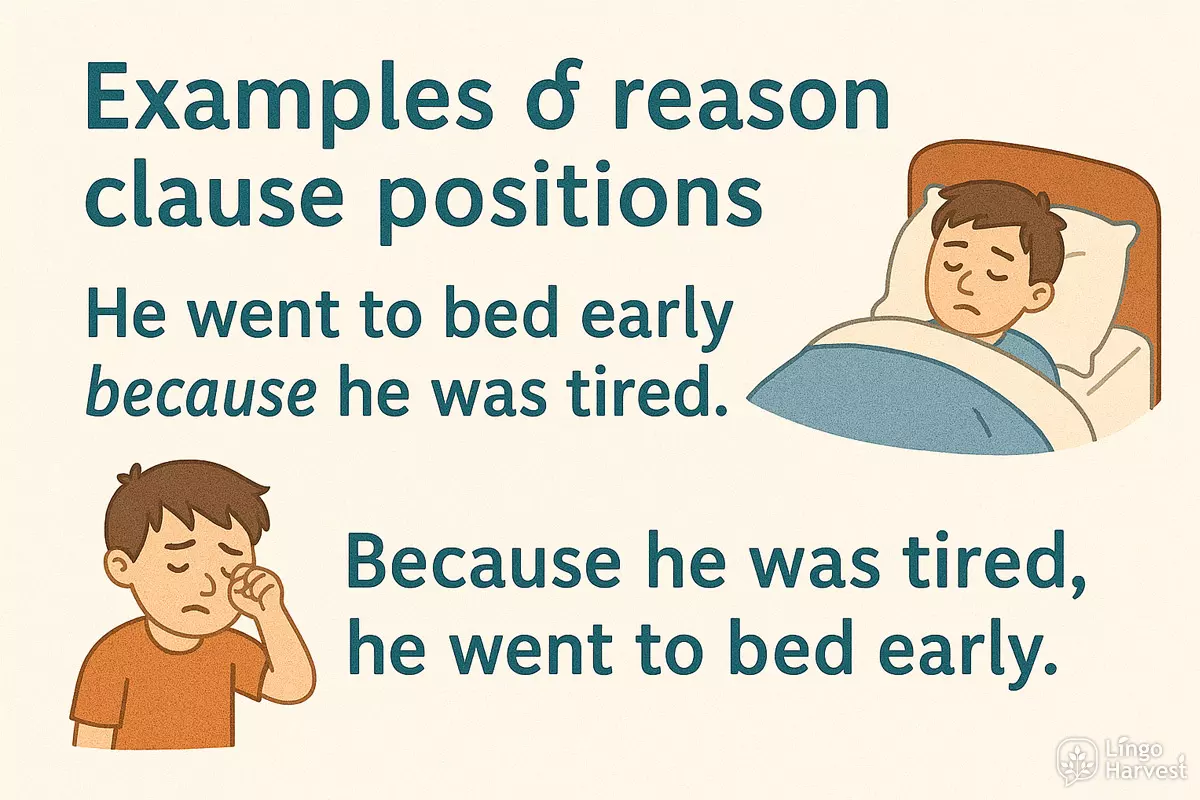
- He went to bed early because he was tired.
- Because he was tired, he went to bed early.
- We canceled the picnic since it was cold.
- Since it was cold, we canceled the picnic.
Commas with initial reason clauses
When the reason clause comes first, use a comma after it. If it comes second, a comma is not usually needed. This small punctuation rule helps your sentences read smoothly.
Comparing sentence patterns
| Main Clause First | Reason Clause First |
|---|---|
| I wore a jacket because it was windy. | Because it was windy, I wore a jacket. |
| She is studying hard since the test is tomorrow. | Since the test is tomorrow, she is studying hard. |
| They left early because they had an appointment. | Because they had an appointment, they left early. |
| We are inside since it’s too hot outside. | Since it’s too hot outside, we are inside. |
| The match was canceled because it rained. | Because it rained, the match was canceled. |
Tips for beginners
- Both positions are correct; pick the one that feels natural for your message.
- Use a comma after the reason clause if it comes at the start.
- In spoken English, the reason often comes last for a more relaxed sound.
- Try switching the order to see which sentence feels clearer in your context.
Practice placing the reason clause in different spots to become more comfortable. This flexibility lets you shape your sentences for clearer communication.
Punctuation basics with because and since
Understanding how to use commas with “because” and “since” can help your writing become clearer and easier to read. These conjunctions join two clauses, explaining cause and effect, but their punctuation depends on where they appear in a sentence and what you want to emphasize.
When to use a comma
A comma is usually not needed when “because” or “since” comes between two clauses. For example:
- She went inside because it was raining.
- I stayed home since I was feeling sick.
However, if placing a comma helps avoid confusion or if the sentence could be misunderstood, it’s acceptable to use one.
Comma with introductory clauses
When the clause with “because” or “since” comes first (at the start of the sentence), separate the clauses with a comma:
- Because he forgot his keys, he couldn’t get in.
- Since you asked, I’ll explain the answer.
This comma signals the end of the introductory idea and helps the reader follow your meaning.
Structured punctuation patterns
The following table shows typical punctuation patterns for sentences using these conjunctions:
| Pattern | Example |
|---|---|
| Main clause + because/since + reason (no comma) | He left early because he was tired. |
| Because/since + reason, + main clause (comma after reason) | Since it was late, we went home. |
| Main clause, + because/since + reason (comma for emphasis or clarity) | She didn’t call, because she was busy. (emphasis) |
| Ambiguous sentence: add comma to clarify | I didn’t marry John, because I loved him. (Implies a different reason) |
Common mistakes to avoid
- Don’t add a comma before “because” or “since” in the middle of a sentence unless you need to avoid misunderstanding.
- Always use a comma after an introductory “because” or “since” clause.
- Be careful: adding or omitting a comma can change the meaning of your sentence.
In summary, punctuation with these cause-and-effect conjunctions is mostly straightforward. Remember the main patterns, and use commas thoughtfully to ensure your meaning is clear and unambiguous.
Practice: match reasons with correct results using because or since
Understanding how to connect reasons and results is a key part of using cause-and-effect conjunctions like "because" and "since." Let’s practice by pairing explanations with their logical outcomes. This exercise will help reinforce how these conjunctions link ideas in English sentences.
Match the reason to the correct result
Below you’ll find a list of reasons and a separate list of results. Your task is to connect each pair with "because" or "since" so that the sentences make sense. Think about which result logically follows each reason.
- 1. She wore a coat
- 2. He stayed at home
- 3. The store is closed
- 4. I didn’t eat breakfast
- 5. They are laughing
- 6. We missed the bus
- 7. My phone battery died
- 8. The ground is wet
- 9. I passed the test
- 10. The lights went out
Results:
- A. it was very cold outside.
- B. it rained last night.
- C. I studied hard.
- D. I was late for school.
- E. there is a holiday today.
- F. he felt sick.
- G. there was a funny movie on TV.
- H. I could not call you.
- I. there was a power cut.
- J. he did not feel well.
Choose the best match for each pair and join them into sentences using "because" or "since". For example: "She wore a coat because it was very cold outside."
Show answers
- A: She wore a coat because it was very cold outside.
- J: He stayed at home because he did not feel well.
- E: The store is closed because there is a holiday today.
- F: I didn’t eat breakfast because he felt sick.
- G: They are laughing because there was a funny movie on TV.
- D: We missed the bus because I was late for school.
- H: My phone battery died so I could not call you. (Note: with “because”: I could not call you because my phone battery died.)
- B: The ground is wet because it rained last night.
- C: I passed the test because I studied hard.
- I: The lights went out because there was a power cut.
Extra Practice: Complete the sentences
Fill in the blanks with "because" or "since" to complete the sentences.
- I am tired ______ I went to bed late.
- ______ it’s raining, we can’t have a picnic.
- She smiled ______ she saw her friend.
- We left early ______ we had an appointment.
- He stayed home ______ he wasn’t feeling well.
- ______ the weather was terrible, the match was cancelled.
- I took an umbrella ______ it looked like it might rain.
- She didn’t join us ______ she had a lot of work.
- ______ he was hungry, he bought a sandwich.
- They moved the meeting indoors ______ it was too hot outside.
Show answers
- because
- Since
- because
- because
- because
- Since
- because
- because
- Since
- because
Practice combining reasons and results with these cause-and-effect connectors to make your English sentences clearer and more natural.