Contrast Conjunctions: but vs yet (Beginner Focus)

 This article explains how contrast works in English sentences, focusing on using but for simple contrast and yet for surprising contrast. It compares their meanings, highlights common mistakes, and includes practice choosing the right word.
Learning to express opposing ideas is an important skill in English, especially for beginners. Words like "but" and "yet" are commonly used to connect contrasting thoughts, though they are not always interchangeable. "But" typically introduces a direct contrast or exception, while "yet" often suggests something unexpected or surprising in relation to the previous statement. By understanding these differences, you can make your communication clearer and sound more natural in everyday conversations.
What contrast means in a sentence
When we use contrast in English sentences, we are showing a difference or an opposite idea between two statements or facts. This helps make our meaning clearer by highlighting how two things do not match, or how one thing is surprising compared to another. For example, in “She is tired, but she keeps working,” the two parts of the sentence show a contrast: being tired is different from continuing to work.
How contrast works in communication
Contrast connects ideas that don’t go together naturally. It’s useful when you want to show exceptions, unexpected outcomes, or opposing facts. By using contrast, you make your point stronger and your writing more interesting.
- Expresses differences between two actions or facts
- Makes opposing ideas clear to the reader or listener
- Often signals a surprise or exception
- Helps organize thoughts logically
- Common in explanations, arguments, and stories
Common words that signal contrast
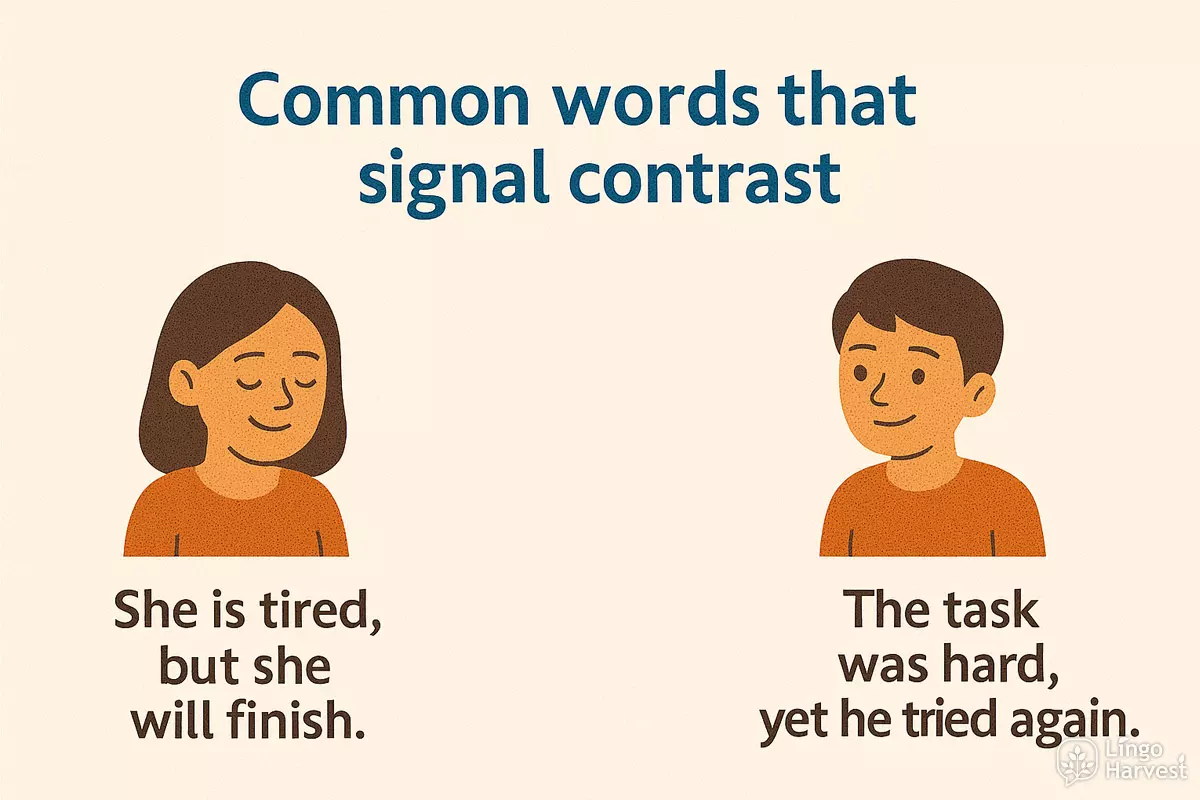
You can indicate contrast using conjunctions and linking words. Here are some of the most frequent ones:
- but → She is tired, but she will finish.
- yet → The task was hard, yet he tried again.
- however → It was raining; however, we went out.
- although → Although it was late, they kept talking.
- though → She agreed, though she wasn’t sure.
- even though → Even though he was sick, he went to work.
- whereas → She loves tea, whereas he prefers coffee.
- while → He cooked dinner while I cleaned the kitchen.
- on the other hand → The city is noisy; on the other hand, it’s exciting.
- nevertheless → It was cold; nevertheless, we went swimming.
- still → It was dark, still they continued walking.
- despite → Despite the rain, they played football.
- in spite of → In spite of his fear, he spoke in public.
- instead → I wanted coffee; instead, I drank tea.
- nonetheless → The exam was difficult; nonetheless, she passed.
Examples of contrast in sentences
- He wanted to go for a walk, but it was raining.
- She studied hard, yet she didn’t pass the test.
- It’s cold outside, however we went swimming.
- They are twins, but they look very different.
- I am allergic to cats, yet I have two cats at home.
Using these conjunctions and structures allows you to easily compare and contrast ideas in your sentences, making your communication clearer and more precise.
Using but to show a simple contrast
The word but is often used to connect two ideas that are different or opposite in some way. This coordinating conjunction helps highlight a basic difference between the first and second parts of a sentence. When you use but, the meaning of the sentence changes direction, signaling something unexpected or not the same as what came before.
Common patterns with "but"
Here are some typical ways to use this conjunction to show contrast:
- She is tired, but she keeps working.
- I wanted to go outside, but it was raining.
- He likes tea, but not coffee.
- The test was hard, but I passed.
- They called me, but I didn’t answer.
- The food is cheap, but delicious.
- She sings well, but she is shy on stage.
- I am allergic to cats, but I have two.
- We arrived early, but the doors were closed.
- He is young, but very wise.
- The dress is beautiful, but expensive.
- I studied hard, but I forgot everything.
- The weather was cold, but sunny.
- She tried to call, but no one answered.
- He is friendly, but not talkative.
How "but" works in sentences
Notice that but usually comes between two clauses or phrases. Both sides of the sentence can be simple or complex, but the key point is the contrast. The first idea sets up an expectation, and the second idea with but shows something different.
Quick tips for using "but"
- Use a comma before but when joining two full sentences (independent clauses):
It was late, but they kept playing. - No comma is needed when joining two short words or phrases:
Sweet but sour. - "But" is not used to start formal sentences, but in everyday speech, it is sometimes acceptable.
In summary, but is a simple and direct way to show a basic difference between ideas. It is one of the first words English learners use to point out contrasts in daily conversation and writing.
Using yet to show a surprising contrast
“Yet” is often used in English to introduce a contrast that is unexpected or surprising, especially after a positive or negative statement. Unlike “but,” which simply connects two different ideas, “yet” suggests that the second idea is surprising or goes against what you might expect from the first idea.
How “yet” works in a sentence
When you use “yet,” you highlight a twist or an unexpected result. It usually comes after a comma and before the surprising part of the sentence. For example:
- He is very young, yet he is the team leader.
- The sun was shining, yet it felt cold outside.
- She studied hard, yet she didn’t pass the exam.
- The recipe is simple, yet the dish tastes amazing.
Difference between “but” and “yet” in contrasts
Both “but” and “yet” connect contrasting ideas, but “yet” adds a sense of surprise or contradiction. “But” is more neutral and commonly used in everyday speech. If you want to show that something is not what you expect, “yet” is often the better choice.
| Example with “but” | Example with “yet” |
|---|---|
| She is tired, but she keeps working. | She is tired, yet she keeps working. |
| The movie was long, but I enjoyed it. | The movie was long, yet I enjoyed it. |
| He was late, but the teacher let him in. | He was late, yet the teacher let him in. |
| It rained, but we went outside. | It rained, yet we went outside. |
More examples of “yet” for unexpected results
- The book is old, yet it is still popular.
- They lost the match, yet their spirits remain high.
- I was nervous, yet I gave a good presentation.
- The task was difficult, yet everyone finished on time.
- He is shy, yet he sings on stage.
- The food looked strange, yet it tasted delicious.
- We had little time, yet we completed everything.
- She felt sick, yet she came to class.
- The road was closed, yet we found another way.
- It’s expensive, yet people buy it.
In summary, “yet” signals that the second idea is surprising compared to the first. This makes it a useful word when you want to stress an unexpected result or contrast in your sentences.
Comparing but and yet in meaning and tone
Understanding how "but" and "yet" function in sentences helps English learners express contrast more naturally. Both words connect ideas that are different or surprising, but they’re not always interchangeable. The difference often depends on the level of contrast and the feeling you want to show.
Meaning: Similarities and Differences
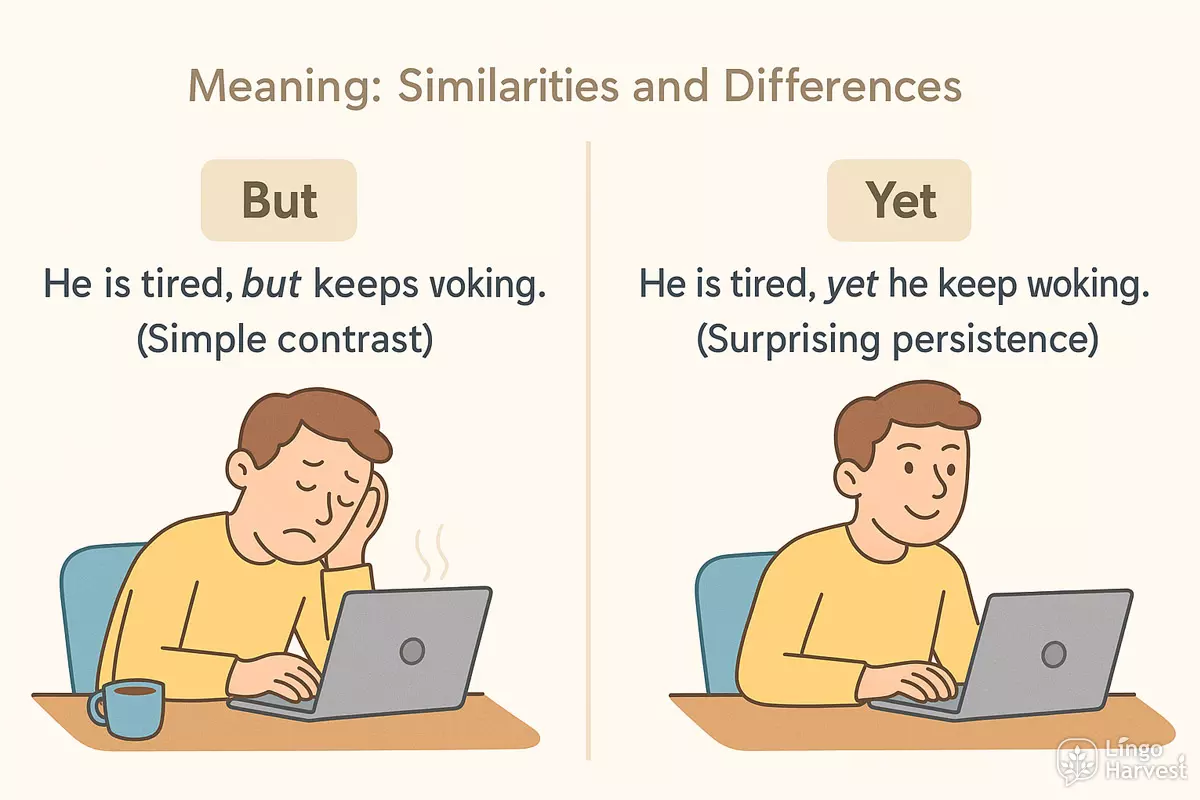
"But" is the most common word for showing contrast. It signals a clear difference between two ideas. "Yet" also shows contrast, but it often adds a feeling of surprise, or suggests that the second idea is unexpected based on the first.
- But: He is tired, but he keeps working. (Simple contrast)
- Yet: He is tired, yet he keeps working. (Surprising persistence)
- But: She studied hard, but she failed the test. (Unexpected result)
- Yet: She studied hard, yet she failed the test. (Stronger surprise)
- But: The restaurant is small, but it is very popular. (Contrast in quality)
- Yet: The restaurant is small, yet it is very popular. (Emphasis on contrast)
- But: It was cold, but they went swimming. (Contrasting action)
- Yet: It was cold, yet they went swimming. (More dramatic contrast)
Tone and Emphasis
The choice between these conjunctions can affect the tone of your sentence. "But" is neutral and direct. "Yet" can sound a little more formal or dramatic, adding a sense of something unexpected.
- "She studied hard, but she didn’t pass." (Just a fact)
- "She studied hard, yet she didn’t pass." (A sense of surprise or disappointment)
- "He was tired, but he finished the report." (Neutral contrast)
- "He was tired, yet he finished the report." (Impressive effort)
- "The movie was long, but I enjoyed it." (Simple contrast)
- "The movie was long, yet I enjoyed it." (Unexpected enjoyment)
- "It was raining, but they played outside." (Basic opposition)
- "It was raining, yet they played outside." (Stronger surprise)
Common Usage Patterns
Both words often appear in the middle of a sentence, but "yet" is sometimes used at the beginning for emphasis, especially in written or formal English.
- "I wanted to go, but I was too busy."
- "I wanted to go, yet I was too busy."
- "Yet, I was too busy." (Less common, more formal)
- "He tried to help, but he couldn’t fix it."
- "He tried to help, yet he couldn’t fix it."
- "Yet, he couldn’t fix it." (Emphasizes the unexpected failure)
- "They invited me, but I didn’t come."
- "They invited me, yet I didn’t come."
- "Yet, I didn’t come." (Adds a reflective or formal tone)
- "She wanted to smile, but she felt too sad."
- "She wanted to smile, yet she felt too sad."
- "Yet, she felt too sad." (Highlights emotional contrast)
Quick Comparison Table
| Conjunction | Typical Use and Tone |
|---|---|
| But | Shows a simple contrast or opposite idea. Tone: neutral, commonly used in speech and writing. |
| Yet | Expresses contrast with a sense of surprise or something unexpected. Tone: slightly formal or dramatic, less frequent in casual conversation. |
Expanded Examples
Here are more example sentences to help you feel the difference:
- I wanted to sleep, but I had to finish my homework.
- I wanted to sleep, yet I had to finish my homework.
- It was raining, but we went outside.
- It was raining, yet we went outside.
- He is young, but very wise.
- He is young, yet very wise.
- They called her, but she didn’t answer.
- They called her, yet she didn’t answer.
- The task is hard, but I will try.
- The task is hard, yet I will try.
- She was late, but the meeting had not started.
- She was late, yet the meeting had not started.
- He failed the test, but he didn’t give up.
- He failed the test, yet he didn’t give up.
- We waited for hours, but the bus didn’t come.
- We waited for hours, yet the bus didn’t come.
In summary, "but" is your go-to for clear and simple contrast, while "yet" adds a layer of surprise or unexpectedness. Choosing the right word helps you express your ideas more clearly and with the right feeling.
Typical mistakes learners make with contrast conjunctions
Many English learners struggle to use "but" and "yet" correctly, especially when trying to show contrast in sentences. These small words can cause big confusion, and it's easy to mix them up or use them in unnatural ways. Below are some of the most common issues beginners face and practical tips to avoid them.
Confusing "but" and "yet"
The most frequent error is using "yet" in places where only "but" sounds natural, or vice versa. While both words connect contrasting ideas, "yet" often suggests something unexpected or surprising, while "but" simply shows a difference. Beginners sometimes use them interchangeably, which can make sentences feel awkward.
- Using "yet" when only "but" fits: I am tired, yet I will go to the party. (Correct: This works, but it's more formal. In everyday speech, "but" is more common.)
- Forgetting that "yet" adds a sense of surprise: She studied hard, yet she failed the test. (Shows surprise at the result.)
Incorrect punctuation
Punctuation errors are another stumbling block. Both "but" and "yet" are coordinating conjunctions and should be preceded by a comma when joining two independent clauses. Omitting the comma or adding it incorrectly can confuse readers.
- Missing comma: He wanted to go but he was too tired. ❌ (Correct: He wanted to go, but he was too tired. ✅)
- Unnecessary comma: She is smart, but also hardworking. ❌ ("Also hardworking" is not an independent clause, so no comma is needed.)
Overusing one conjunction
Sticking to only "but" in all contrast situations is common among beginners. While "but" is more frequent in everyday English, sometimes "yet" is a better choice, especially for emphasis or to show something unexpected. Not varying your connectors can make your speech or writing sound repetitive.
Word order and sentence structure problems
Some learners place "but" or "yet" in the wrong part of the sentence, or forget that they connect two complete ideas. Trying to use these words to join incomplete thoughts leads to sentences that don't make sense.
- Fragmented idea: I like tea. But not coffee. ❌ (Should be: I like tea, but not coffee. ✅)
- Wrong order: Yet, she didn't pass she studied hard. ❌ (Should be: She studied hard, yet she didn't pass. ✅)
Comparing "but" and "yet" in context
| Example | Explanation |
|---|---|
| I wanted to go, but I was sick. | But shows a simple contrast between wanting and being unable to go. |
| I wanted to go, yet I was sick. | Yet adds a sense of surprise or unexpectedness to being sick after wanting to go. |
| He is young, but very wise. | Use but for straightforward contrast. |
| She practiced a lot, yet she lost the game. | Yet highlights the unexpected result despite her effort. |
Quick checklist for avoiding common errors
- Use a comma before "but" or "yet" when joining two complete sentences.
- Choose "yet" for contrasts that feel surprising; use "but" for general differences.
- Don’t start a new sentence with "but" or "yet" unless you’re writing informally.
- Make sure both sides of the conjunction are complete ideas, not fragments.
- Vary your connectors to make your writing more interesting and natural.
By watching out for these common mistakes, you’ll be able to use contrast conjunctions more accurately and sound more fluent in English.
Practice: choose but or yet to complete short sentences
Learning to distinguish between but and yet can help you express contrast more naturally in English. Both words link two ideas that are different or surprising, but they are used in slightly different ways. Below, you'll find short exercises to practice selecting the correct conjunction for each sentence. Read each sentence, and decide which word fits best to show contrast or an unexpected result.
Fill in the blanks: Which word fits?
- He is tired, ____ he keeps working.
- The weather was cold, ____ we still went swimming.
- She studied hard, ____ she did not pass the test.
- I called her, ____ she didn’t answer.
- It’s late, ____ I am not sleepy.
- Tom wants to come, ____ he cannot find his keys.
- We ran fast, ____ we missed the bus.
- They are rich, ____ they are not happy.
- I like coffee, ____ I don’t drink it at night.
- He is young, ____ he is very wise.
Show answers
- yet
- yet
- but
- but
- yet
- but
- yet
- but
- but
- yet
Quick reference: Common sentence patterns
- I want to go, but I have to work.
- She is small, yet she is strong.
- We tried our best, but we lost the game.
- It looks easy, yet it is difficult.
- He is poor, but he is happy.
- The movie was long, yet it was interesting.
- I am hungry, but I have no food.
- She wants to help, yet she doesn’t know how.
- The road is narrow, but cars drive fast here.
- He is shy, yet he gave a speech.
Tips for choosing between but and yet
- Use but for simple contrast: two ideas that go against each other.
- Use yet for surprising or unexpected results, often when the second idea is more surprising than the first.
- Both are used to join two independent clauses (full sentences).
- Yet is a bit more formal or dramatic than but in many situations.
Try to notice how these words are used in real conversations and simple texts. Practicing with short sentences will help you feel more confident when expressing contrast in English.