Everyday Conjunctions for Kids and Beginners

 The article lists the most common everyday conjunctions, explains their meanings with simple examples, provides fun daily and story examples, shows short dialogues, gives memory tips, and includes fill-in-the-gap practice activities.
Using simple joining words helps connect ideas and words, making sentences clearer and more engaging to read or write. For children and beginners, these connectors are valuable tools that transform short, choppy statements into smoother, more interesting stories or explanations. By practicing with basic joining words, new writers can develop their skills, improve the flow of their sentences, and create writing that is easier for others to understand and enjoy.
List of the most common everyday conjunctions
Conjunctions are small words that help us connect ideas, sentences, or parts of sentences. In daily conversation and writing, these linking words make our speech smoother and more understandable. For young learners and beginners, it’s helpful to start with the most frequently used connectors. Here you’ll find the main types and examples to get you started.
Coordinating Conjunctions
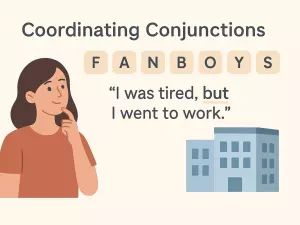
Coordinating conjunctions are used to link words, phrases, or sentences that are equally important. The most common ones are easy to remember with the acronym FANBOYS:
- For – shows reason or purpose (e.g., "I stayed home for it was raining.")
- And – adds information (e.g., "She likes apples and oranges.")
- Nor – connects negative ideas (e.g., "He doesn't eat meat nor does he drink milk.")
- But – shows contrast (e.g., "I want to play but I have homework.")
- Or – presents choices (e.g., "Do you want tea or coffee?")
- Yet – introduces something surprising (e.g., "It was cold, yet we went swimming.")
- So – shows a result (e.g., "She was tired, so she slept early.")
Common Subordinating Conjunctions
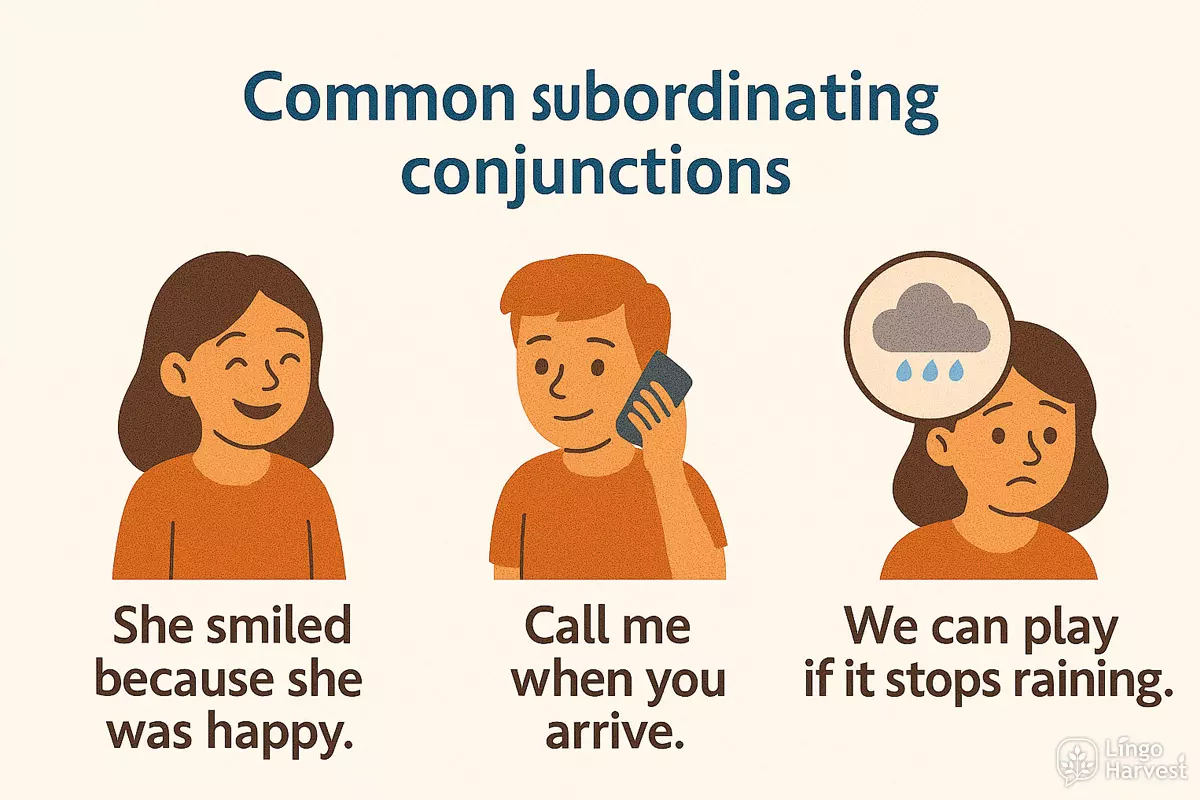
Subordinating conjunctions connect a main idea with a less important one. Here are some you’ll often hear:
- Because – "She smiled because she was happy."
- When – "Call me when you arrive."
- If – "We can play if it stops raining."
- While – "I read while I eat breakfast."
- Although – "He runs fast although he is young."
- Before – "Brush your teeth before bed."
- After – "We will leave after lunch."
- Since – "I have known her since kindergarten."
- Unless – "You can’t go unless you finish your work."
- Until – "Wait here until I return."
Conjunctions in Action
Here’s a quick guide showing how these connectors work in real sentences:
| Conjunction | Example Sentence |
|---|---|
| And | I have a cat and a dog. |
| But | I want ice cream, but we have none. |
| Because | He is happy because it's his birthday. |
| Or | Would you like juice or water? |
| So | She was late, so she ran. |
| When | Call me when you get home. |
Learning to use these connecting words helps kids and new learners build longer sentences and express ideas clearly. Practice using each in your own sentences to make your conversations and writing more colorful and connected!
Simple meanings with picture-like examples
Understanding how we join words and sentences can be much easier with clear explanations and visual-style samples. Conjunctions are little words like "and," "but," and "or" that help connect ideas. Think of them as bridges that let sentences flow smoothly. Below, you’ll find easy meanings and situations where these connectors are used, along with short, vivid examples to help you picture how they work.
Common connectors and how they work
- And: joins similar things.
Example: I have a dog and a cat. (Both are pets.) - But: shows contrast or something different.
Example: She is tall, but her brother is short. - Or: offers a choice.
Example: Would you like milk or juice? - So: shows a result.
Example: It rained, so we stayed inside. - Because: tells the reason.
Example: He is happy because it’s his birthday. - While: two things happening at the same time.
Example: She draws while he reads. - If: talks about conditions or possibilities.
Example: If you are tired, take a nap. - When: tells about time.
Example: When it gets dark, we go home. - Because: gives the cause.
Example: We wear coats because it’s cold. - After: shows what happens next.
Example: Wash your hands after you eat.
Visual-style scenarios for understanding
Imagine a playground:
- Tom swings and Anna slides. (Both play together.)
- It is sunny, but it is windy. (Good and bad weather together.)
- Pick a red ball or a blue ball. (You can’t have both at once.)
- He ran fast, so he won the race. (His action caused the result.)
Quick comparison of conjunctions in use
| Conjunction | How It Connects Ideas |
|---|---|
| And | Adds similar things We have apples and bananas. |
| But | Shows difference I want to play, but it’s raining. |
| Or | Gives a choice Do you want pizza or pasta? |
| So | Shows result He was tired, so he slept early. |
| Because | Explains why She laughed because it was funny. |
By thinking of these connectors as helpers that join ideas, kids and beginners can better understand how sentences are built. Try making your own simple sentences using these patterns to practice!
Fun examples from daily routines and stories
Everyday speech is full of little connecting words, or conjunctions, that help us link ideas. Let’s look at how these connectors appear in familiar activities and simple tales. Seeing them in action makes it easier to remember when and how to use them.
Connecting words in morning routines
Imagine your morning: you wake up, brush your teeth, and get ready for the day. Here are some sentences using common connectors:
- I wake up and I stretch my arms.
- I want cereal or toast for breakfast.
- I brushed my teeth, but I forgot to comb my hair.
- I will wear my blue shirt because it’s my favorite.
- We can play outside if it’s not raining.
- I washed my hands before eating.
- Mom makes pancakes while I set the table.
- I have to finish my homework so I can watch cartoons.
- I wanted to run, but I was too tired.
- Dad will read a story after dinner.
Favorite story examples
Stories are full of these linking words. Here are some you might hear in fairy tales or bedtime books:
- The princess was brave, and she saved the kingdom.
- The wolf huffed and puffed, but the house didn’t fall.
- The cat ran fast because it was scared.
- You can have a cookie if you finish your vegetables.
- The knight fought the dragon while the villagers watched.
- The bear woke up when the sun rose.
- She wanted a pet so she could have a friend.
- He was small, yet he was very strong.
- They went to the park after school ended.
- You can stay up late if you’re quiet.
Comparing common conjunctions in use
Here’s a table showing how different connectors change the meaning or feeling of a sentence. Notice how each one helps express a different relationship:
| Sentence | Connector Used & Meaning |
|---|---|
| I like apples and bananas. | and = adds two things together |
| I want juice or milk. | or = gives a choice |
| I wanted to play, but it was raining. | but = shows a contrast or opposite |
| I stayed inside because it was cold. | because = gives a reason |
| We can go outside if we finish our homework. | if = sets a condition |
| I read a book while I waited. | while = two things happen at the same time |
Seeing how connectors fit into everyday actions and tales makes them much easier to use. Try making your own sentences about your day or favorite stories using these helpful linking words!
Short dialogues showing conjunctions in natural speech
Learning how people actually use linking words in daily conversations helps kids and beginners understand their real purpose. Instead of just memorizing definitions, it’s useful to see how words like and, but, or, and because connect ideas naturally. The following short exchanges demonstrate these connectors in action, making it easier to grasp their meaning and use.
Sample dialogues with common conjunctions
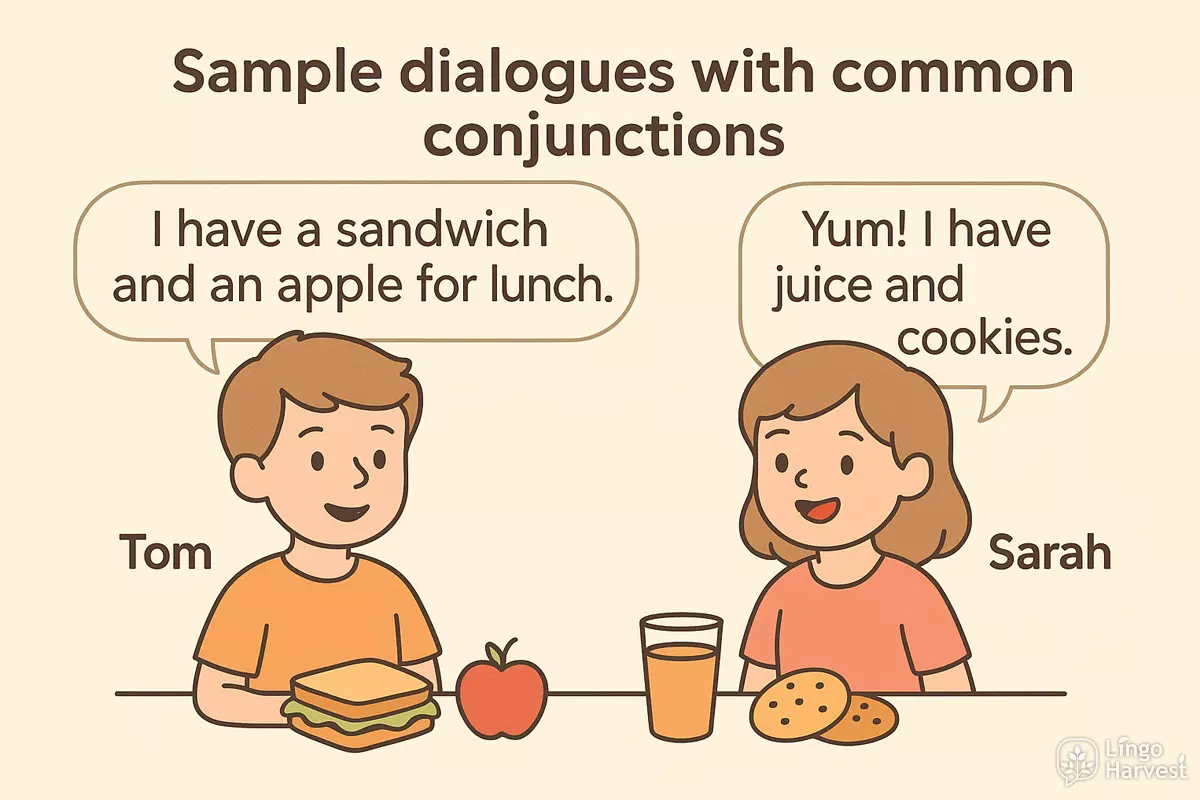
- and:
Tom: I have a sandwich and an apple for lunch.
Sarah: Yum! I have juice and cookies. - but:
Mom: Did you finish your homework?
Alex: I tried, but it was too hard. - or:
Teacher: Would you like to draw or paint today?
Lily: I want to paint! - because:
Dad: Why are you wearing your raincoat?
Ben: Because it might rain. - so:
Anna: The bell rang, so we went inside. - if:
Emma: If you hurry, you won’t be late. - when:
Max: When I finish my chores, I can play. - because:
Sara: I’m tired because I didn’t sleep well. - so:
Jake: I forgot my hat, so I felt cold. - but:
Nina: I wanted to go outside, but it started to rain. - if:
Dad: If you eat your dinner, you can have dessert. - or:
Teacher: Please use a pencil or a blue pen.
Comparing how conjunctions change meaning
| Conjunction | Example Dialogue |
|---|---|
| and | I like apples and bananas. |
| but | It’s sunny, but it’s cold. |
| or | Do you want milk or water? |
| because | I’m happy because it’s my birthday. |
| so | He was tired, so he went to bed early. |
Notice how these short exchanges use connectors to join ideas, show choices, or explain reasons. Practicing with real-life situations helps children and new learners remember how to use these words when speaking or writing. Try making your own short conversations using different connectors to build confidence and fluency.
Tips for remembering conjunctions with easy patterns
Understanding how to use connecting words can feel tricky at first, but there are some simple ways to make them easier to remember. Patterns, songs, and visual cues help many young learners keep track of which word to use and when. Here are some practical strategies and examples to support your learning.
Group Conjunctions by Function
One effective way is to sort these words by what they do in a sentence. For instance, some join similar ideas, while others show choices or reasons. Recognizing these groups can make it easier to recall which one fits.
- And – adds ideas together
- But – shows contrast or difference
- Or – offers a choice
- So – shows result
- Because – gives a reason
- Yet – introduces a surprising contrast
- Nor – connects negative ideas
- For – gives an explanation (formal)
- Although – introduces a contrast
- While – contrasts two actions or ideas
Use Easy Memory Tricks
Mnemonic devices and rhymes are helpful tools:
- FANBOYS – This word helps you remember seven common coordinating conjunctions: For, And, Nor, But, Or, Yet, So.
- Make up a silly sentence using the first letter of each conjunction. For example: Frogs And Newts Bake Orange Yam Soufflés.
- Clap or tap when you say each word in a list to create a rhythm.
Practice with Patterns
Seeing how conjunctions fit into sentences helps cement their use. Try repeating short sentence frames with different connecting words. Here’s a table showing how the meaning changes depending on the conjunction:
| Sentence Pattern | Use of Conjunction |
|---|---|
| I like apples and oranges. | Combines similar things ✅ |
| I want cake, but I have no eggs. | Shows a contrast ❌ |
| Do you want tea or juice? | Offers a choice → |
| She was tired, so she went to bed. | Shows a result ✅ |
| He stayed home because it was raining. | Gives a reason ✅ |
Practice Makes Perfect
Finally, create your own sentences using these patterns. Try switching out one connector for another and see how the meaning changes. Reading stories aloud or playing games that use these words can also help make them stick. Over time, these shortcuts and routines will help you use connectors naturally in both writing and conversation.
Practice: fill in the gaps with everyday conjunctions
Understanding how to use common joining words helps sentences flow and ideas connect clearly. Below you'll find a variety of fill-in-the-blank tasks and short activities designed for learners who are just starting to use words like "and," "but," "or," "because," "so," and "when" in daily conversation.
Fill in the blanks: Choose the right joining word
Pick from: and, but, or, because, so, when
- I like apples ______ I don't like bananas.
- Do you want tea ______ juice?
- She was tired, ______ she went to bed early.
- We can play outside ______ it stops raining.
- He didn't eat lunch ______ he wasn't hungry.
- Tom has a cat ______ a dog.
- We stayed home ______ it was too cold outside.
- Take an umbrella ______ it might rain.
- He is very smart ______ he works hard.
- You can watch a movie ______ read a book.
- I will call you ______ I arrive.
- She didn’t come ______ she was sick.
Show answers
- but
- or
- so
- when
- because
- and
- because
- because
- because
- or
- when
- because
Matching activity: Sentences and conjunctions
Match the two parts of each sentence using the best everyday conjunction.
- We went to the park ____ we played soccer.
- She wanted to go swimming ____ she forgot her swimsuit.
- Do your homework now ____ after dinner?
- He is smiling ____ he got a new toy.
- My sister likes pizza ____ I like pasta.
- I washed my hands ____ I could eat.
- We stayed inside ____ it was raining.
- Take an umbrella ____ it might rain later.
- He studied a lot ____ he passed the test.
- You can read a book ____ watch TV.
- I will visit you ____ I finish work.
- She didn’t come ____ she was sick.
Show answers
- and
- but
- or
- because
- but
- so
- because
- because
- so
- or
- when
- because
Quick reference: Common conjunctions and their uses
| Conjunction | How to use | Example |
|---|---|---|
| and | Connects similar ideas or things | We have apples and oranges. |
| but | Shows a difference or contrast | I am small, but I am fast. |
| or | Gives a choice | Do you want milk or water? |
| because | Explains a reason | She is happy because it is her birthday. |
| so | Shows a result or effect | It was raining, so we stayed inside. |
| when | Tells about time, or when something happens | Call me when you get home. |
Make your own sentences
Try making sentences with these connectors. Here are some ideas to start:
- I want to go outside ______ it is sunny.
- We can have cake ______ ice cream for dessert.
- He was scared ______ he saw a spider.
- Do you want to read ______ draw?
- She is young ______ she is very smart.
- I took an umbrella ______ it looked like rain.
- He stayed home ______ he wasn’t feeling well.
- You can choose tea ______ juice.
- We didn’t go out ______ it was too late.
- She smiled ______ she heard the good news.
- He is tall ______ he cannot reach the shelf.
- I will call you ______ I arrive.
Show answers
- because
- and
- when / because
- or
- but
- because
- because
- or
- because
- because
- but
- when
Practicing with these simple activities helps you remember how to use basic conjunctions in your everyday speaking and writing. Try to use at least one joining word in your next conversation or story!