Coordinating Conjunctions (FANBOYS): Theory

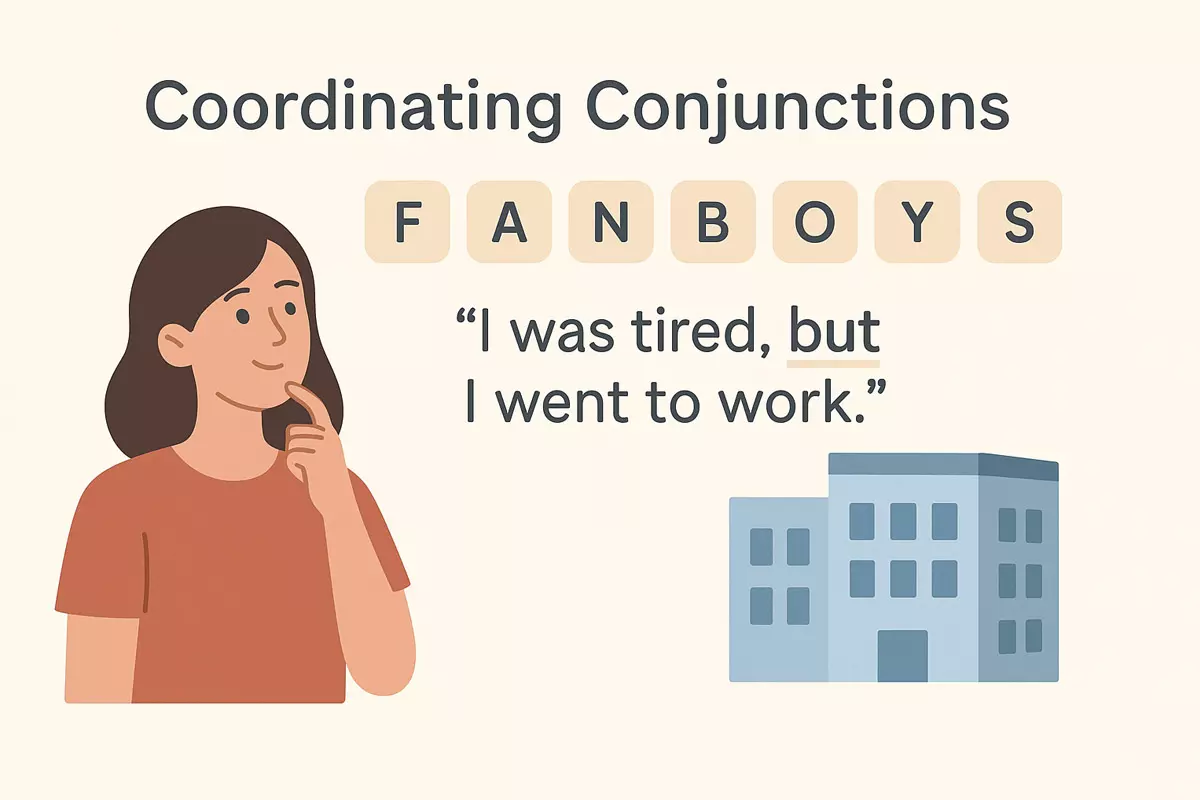 The article defines coordinating conjunctions, lists and explains each FANBOYS word, shows sentence patterns and comma usage, highlights common errors, and offers a brief practice section to reinforce understanding.
Connecting ideas smoothly and logically in sentences relies on using words such as for, and, nor, but, or, yet, and so. These linking words, known as coordinating conjunctions, are essential for joining thoughts and creating clear, cohesive writing. By understanding how and when to use them, you can improve both your writing and communication skills, making your ideas easier for others to follow and understand. Developing this awareness leads to more effective and engaging expression in any context.
What Coordinating Conjunctions Are
Coordinating conjunctions are linking words that connect elements of equal grammatical importance within a sentence. Rather than joining a main clause to a subordinate one, these connectors link two or more words, phrases, or independent clauses that are structurally parallel. In English, the most familiar set is known by the acronym FANBOYS: for, and, nor, but, or, yet, so.
Core Function and Usage
The primary role of these connectors is to signal relationships like addition, contrast, choice, and consequence between the connected items. They prevent choppy writing and help create smooth, logical flow. For example, in “She wanted coffee, but he preferred tea,” the word “but” highlights a contrast between preferences.
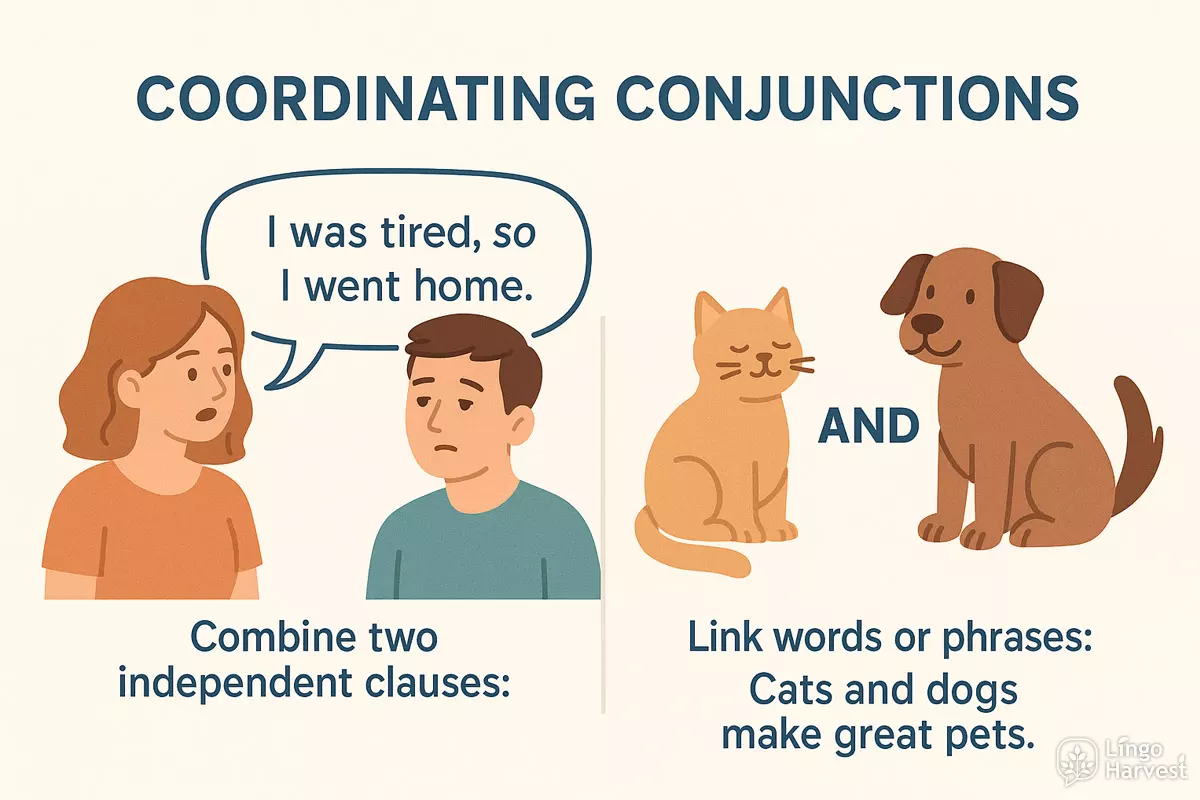
- Combine two independent clauses: “I was tired, so I went home.”
- Link words or phrases: “Cats and dogs make great pets.”
- Show alternatives: “You can have cake or ice cream.”
- Express contrast: “He is smart yet humble.”
The FANBOYS List
Here’s a breakdown of each member of the FANBOYS group with its common use:
| Conjunction | Typical Function |
|---|---|
| For | Indicates reason or cause (similar to “because”) |
| And | Adds one element to another |
| Nor | Presents an additional negative idea |
| But | Introduces contrast or exception |
| Or | Offers an alternative or choice |
| Yet | Shows contrast, similar to “but,” often with a surprising twist |
| So | Expresses result or consequence |
Common Patterns and Examples
These connectors often appear in the middle of sentences, with a comma before them if they join two independent clauses. Here are typical patterns:
- Word + and + word: “Bread and butter”
- Phrase + or + phrase: “To read or to write”
- Clause + but + clause: “She called, but no one answered.”
- Clause + so + clause: “It rained, so we stayed inside.”
Understanding these connectors helps build clearer, more effective sentences by showing precise relationships between ideas. They are essential tools for anyone aiming to write or speak with clarity and coherence.
FANBOYS List
Understanding the acronym FANBOYS helps learners identify the seven coordinating conjunctions in English. Each letter represents a different conjunction, which is used to connect words, phrases, or independent clauses of equal importance. Recognizing these connectors is essential for building clear and varied sentences.
What Does Each Letter Stand For?
The term "FANBOYS" is a mnemonic device that stands for:
- F – For
- A – And
- N – Nor
- B – But
- O – Or
- Y – Yet
- S – So
Brief Explanations of Each Conjunction
- For: Indicates reason or cause (similar to "because").
- And: Adds one element to another.
- Nor: Presents a non-contrasting negative idea (often after "neither").
- But: Shows contrast between two ideas.
- Or: Offers an alternative or choice.
- Yet: Introduces a contrast, like "but," but often adds surprise or unexpectedness.
- So: Shows effect, result, or consequence.
Usage Patterns and Examples
To illustrate how these conjunctions function, here are typical sentence structures and sample sentences:
| Conjunction | Example Sentence |
|---|---|
| For | She stayed home, for she was not feeling well. |
| And | I bought apples and oranges. |
| Nor | He doesn’t like tea, nor does he drink coffee. |
| But | We wanted to go hiking, but it rained all day. |
| Or | Would you like pizza or pasta? |
| Yet | She is young, yet she is very wise. |
| So | The sun set, so we went inside. |
Common Patterns with Coordinating Conjunctions
Coordinating conjunctions typically join two independent clauses. A comma is generally used before the conjunction when connecting full sentences. For example:
- He wanted to read, but he was too tired.
- You can come with us, or you can stay home.
- She didn’t call, nor did she write.
These connectors are not only useful for joining clauses but also for linking words or phrases within a sentence: “We need pens and paper.”
Quick Reference: When to Use Each
If you’re unsure which coordinator fits, consider the intended relationship:
- Reason/Cause: For
- Addition: And
- Negative alternative: Nor
- Contrast: But, Yet
- Choice: Or
- Result: So
Mastering these seven connectors helps make your writing more fluid and expressive.
Meaning of Each
Understanding what each coordinating conjunction stands for is essential to mastering their use. The acronym FANBOYS makes them easier to remember, but each word serves a different purpose in connecting ideas within a sentence. These connectors—For, And, Nor, But, Or, Yet, So—help join clauses or items of equal grammatical weight, but the relationship they express varies.
Overview of FANBOYS
Each member of FANBOYS is used to link elements in a sentence, but the logic behind their use differs. Some add information, others show contrast, while a few present choices or consequences.
| Conjunction | Purpose / Typical Use |
|---|---|
| For | Indicates reason or cause; similar to "because". Example: She stayed home, for it was raining. |
| And | Adds one idea to another; combines similar or related elements. Example: I bought apples and oranges. |
| Nor | Links two negative alternatives; often follows another negative. Example: He doesn’t eat meat, nor does he drink milk. |
| But | Shows contrast or exception. Example: She tried hard, but she didn’t succeed. |
| Or | Presents alternatives or choices. Example: Would you like tea or coffee? |
| Yet | Expresses contrast, similar to "but", but often with a sense of surprising outcome. Example: The task was difficult, yet he finished it quickly. |
| So | Shows result or consequence. Example: She was tired, so she went to bed early. |
Key Points to Remember
- For is less common in modern speech but occasionally appears in formal or literary contexts.
- Nor almost always follows a negative clause and inverts subject and verb when joining independent clauses.
- Yet often signals a twist or unexpected result, making it more emphatic than "but".
- So cannot be used to mean "so that" (purpose); it only means "as a result".
Examples in Context
Seeing these conjunctions in real sentences helps clarify their roles. Consider the following:
- We could go hiking, or we could stay home and read.
- She was nervous, yet she spoke confidently.
- He didn’t call, nor did he write.
- The sun was shining, and the birds were singing.
- He is allergic to nuts, but he loves peanut butter cookies.
- The train was late, so we missed the meeting.
- I brought an umbrella, for I expected rain.
Sentence Patterns
Understanding how coordinating conjunctions (the FANBOYS: for, and, nor, but, or, yet, so) work in English sentences is essential to writing with clarity and variety. These connectors join words, phrases, or independent clauses, creating compound structures that allow for richer expression and logical relationships.
Common Structures with FANBOYS
The most frequent pattern involves joining two independent clauses with a coordinating conjunction and a comma. Here are some typical ways these connectors appear in sentences:
- Clause → FANBOYS → Clause (e.g., "She was tired, but she finished her work.")
- Word → FANBOYS → Word (e.g., "Cats and dogs")
- Phrase → FANBOYS → Phrase (e.g., "in the morning or at night")
Expanded Examples of Clause Patterns
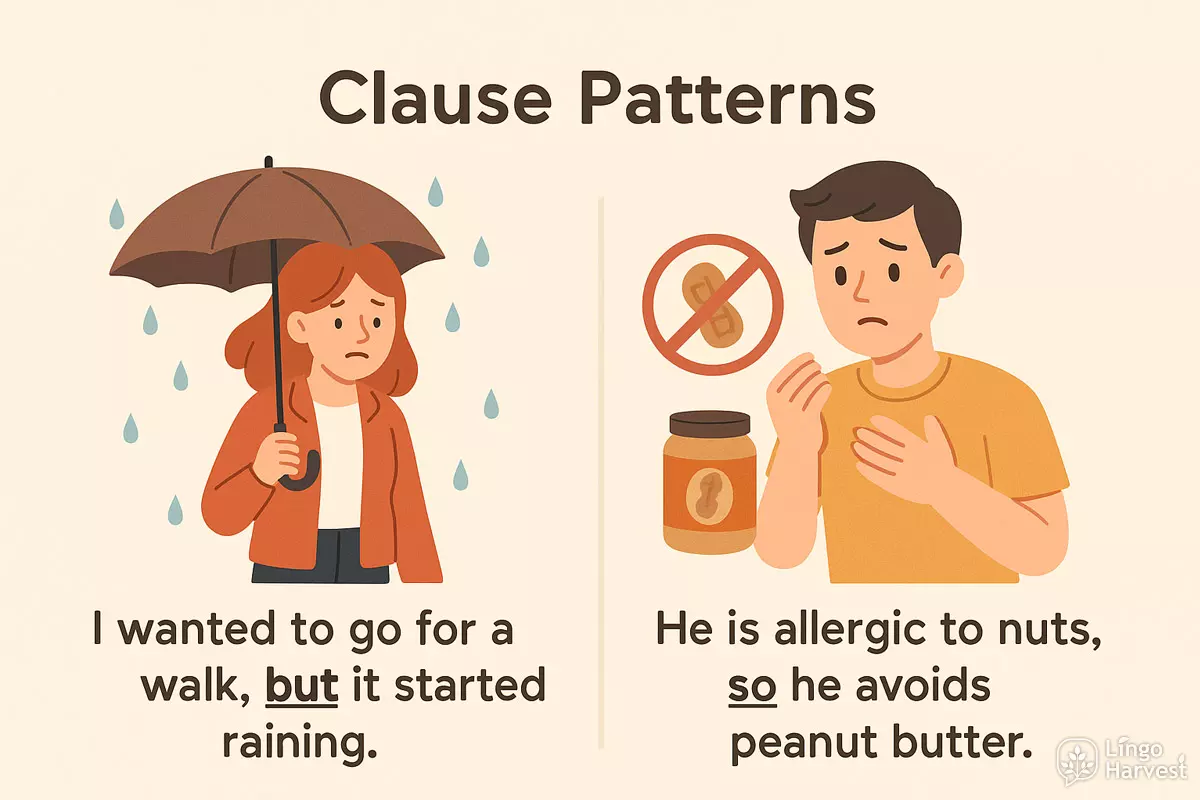
Below is a list of patterns using each coordinating conjunction to join two independent clauses. Notice the punctuation and structure:
- I wanted to go for a walk, but it started raining.
- He is allergic to nuts, so he avoids peanut butter.
- She can come early, or she can meet us there.
- You can have tea, and you can have coffee.
- He doesn't like spinach, nor does he enjoy broccoli.
- We tried to call you, yet there was no answer.
- She was late, for the bus broke down.
Coordinating Conjunctions: Usage Patterns
The table below summarizes how coordinating conjunctions function in different sentence constructions, with examples for clarity.
| Pattern Type | Example |
|---|---|
| Connecting words | pens or pencils |
| Connecting phrases | in the kitchen and on the porch |
| Connecting independent clauses | She studied hard, so she passed the exam. |
| Negative clause with "nor" | He isn’t here, nor is his sister. |
| Contrast with "yet" or "but" | It was cold, yet they went swimming. |
| Reason with "for" | He stayed home, for he was sick. |
Quick Tips
- Use a comma before the conjunction when joining two independent clauses.
- Don’t use a comma when connecting single words or short phrases.
- Each conjunction adds a specific nuance: choice (or), contrast (but, yet), addition (and), cause (for, so), or negative addition (nor).
By mastering these formats, you can write more varied and precise sentences, linking ideas smoothly and logically.
Comma Use
Correct punctuation is essential when connecting independent clauses with coordinating conjunctions. In English, the most common scenario is joining two complete sentences with one of the FANBOYS (for, and, nor, but, or, yet, so). A comma is typically placed before the conjunction to clarify the boundary between clauses.
Standard Rule for FANBOYS
When two independent clauses are joined by a coordinating conjunction, a comma is required before the conjunction. Omitting this comma can lead to confusion or run-on sentences. For example:
- She wanted to go for a walk, but it started to rain.
- I could stay home, or I could go to the party.
However, if the conjunction connects two items that are not independent clauses (such as two verbs, adjectives, or nouns), the punctuation is different. In these cases, no comma is needed. For example:
- He bought apples and oranges.
- She ran and jumped.
Common Patterns and Exceptions
Writers sometimes wonder when a comma is optional or unnecessary. The main exception is when the clauses are short and closely related. Some style guides allow you to omit the comma if both clauses are very brief, but consistency is generally recommended.
| Structure | Comma Needed? |
|---|---|
| Two independent clauses joined by FANBOYS | ✅ Yes: He was tired, so he went to bed. |
| Single subject with compound verb | ❌ No: She cooked and cleaned all day. |
| List of items | ✅ Yes, between items; final comma (Oxford comma) is optional: Milk, eggs, and bread |
| Short independent clauses (style-dependent) | Optional: I came and I saw. (Comma may be omitted if both are brief) |
Quick Reference: When to Add a Comma
- Before a FANBOYS conjunction joining two full sentences
- In lists of three or more items (serial/Oxford comma optional)
- Omit before conjunctions joining simple words or phrases, not full clauses
- Optional in very short, similar independent clauses (for style)
Remember, clarity is the top priority. If omitting a comma makes the sentence harder to read, include it. Over time, recognizing these patterns will make punctuation with coordinating conjunctions more intuitive.
Common Errors
Misusing coordinating conjunctions can lead to awkward sentences, run-ons, or confusion. Many learners assume that simply adding "and," "but," or another FANBOYS word will fix any connection between ideas. However, there are several pitfalls to watch out for when linking clauses or items.
Frequent Mistakes with FANBOYS
- Using a comma before a coordinating conjunction that connects only two words or phrases (not clauses):
Incorrect: I like apples, and oranges.
Correct: I like apples and oranges. - Omitting the comma when joining two independent clauses:
Incorrect: She studied hard but she failed.
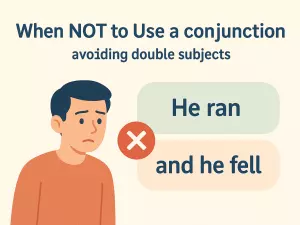
Correct: She studied hard, but she failed. - Combining sentences with a FANBOYS word without a comma, resulting in a run-on sentence.
- Using a coordinating conjunction to start a sentence incorrectly, especially in formal writing.
- Repeating the same conjunction unnecessarily:
Incorrect: I wanted to go, but, but it was raining. - Adding a conjunction where it’s not needed, creating fragments:
Incorrect: And because I was late. - Confusing FANBOYS with other connectors (like "however," "therefore") that aren’t coordinating conjunctions.
- Misplacing the conjunction, which disrupts sentence flow.
- Switching between conjunctions mid-sentence:
Incorrect: I was tired, and but I finished my work. - Using "so" as a filler without a clear cause-effect relationship.
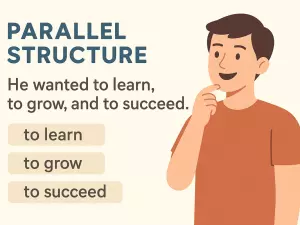
- Forgetting parallel structure when linking items:
Incorrect: He likes running and to swim. - Inserting too many ideas in one sentence, making it confusing even with correct conjunction use.
Comparison: Correct vs. Incorrect Use
| Mistake | Improved Version |
|---|---|
| We went to the park and, we played soccer. | We went to the park, and we played soccer. |
| She likes pizza but not pasta. | She likes pizza, but she does not like pasta. |
| He finished the project so he went home. | He finished the project, so he went home. |
| I want to read or watching TV. | I want to read or watch TV. |
| For I was tired, I went to bed early. | Because I was tired, I went to bed early. |
Quick Tips to Avoid Problems
- Use a comma before a FANBOYS word only when connecting two independent clauses.
- Don’t use a comma if you’re joining two items, not full clauses.
- Check that both parts of your sentence can stand alone when joined by a coordinator.
- Be mindful of parallelism in lists or compound structures.
- Remember: "for," "and," "nor," "but," "or," "yet," and "so" are the only true coordinating conjunctions in English.
By watching out for these issues, you can craft clearer, more effective sentences using coordinating conjunctions.
Mini Practice
Ready to check your understanding of FANBOYS? Try these short exercises to reinforce how coordinating conjunctions connect ideas in English sentences.
Identify the Coordinating Conjunction
Read each sentence below. Underline or note the coordinating conjunction (FANBOYS word) in each one.
- She wanted to go for a walk, but it started to rain.
- Do you want tea or coffee?
- He studied hard, so he passed the exam.
- We can watch a movie, or we can play board games.
- I would like to attend, yet I have another appointment.
Show answers
- but
- or
- so
- or
- yet
Complete the Sentences
Fill in each blank with an appropriate FANBOYS conjunction: for, and, nor, but, or, yet, so.
- He was tired, ______ he kept working.
- Would you like pizza ______ pasta for dinner?
- She does not like apples, ______ does she enjoy oranges.
- I wanted to join you, ______ I was too busy.
- The train was late, ______ we missed the meeting.
Show answers
- yet
- or
- nor
- but
- so
FANBOYS at a Glance
The table below summarizes the seven key coordinating conjunctions, their meanings, and example uses. Use this as a quick reference.
| Conjunction | Meaning/Use | Example |
|---|---|---|
| For | Reason | She was tired, for she had worked all day. |
| And | Addition | Tom likes coffee, and he likes tea. |
| Nor | Negative addition | He doesn’t eat meat, nor does he drink milk. |
| But | Contrast | I wanted to help, but I was busy. |
| Or | Choice | Would you like juice or water? |
| Yet | Unexpected contrast | It is sunny, yet it feels cold. |
| So | Result | She forgot her umbrella, so she got wet. |
Combine the Sentences
Join the pairs of simple sentences using an appropriate coordinating conjunction.
- He is allergic to cats. He has two cats.
- The store was closed. We went home.
- Would you like to travel by train? Would you prefer to fly?
- She didn’t study. She failed the test.
- He didn’t call. He didn’t write.
Show answers
- He is allergic to cats, yet he has two cats.
- The store was closed, so we went home.
- Would you like to travel by train, or would you prefer to fly?
- She didn’t study, so she failed the test.
- He didn’t call, nor did he write.
Practicing with real examples helps you internalize how each coordinating conjunction connects ideas. Review these patterns, and try making your own sentences using all seven FANBOYS to build fluency.