Common Mistakes with Conjunctions (Beginner Edition)

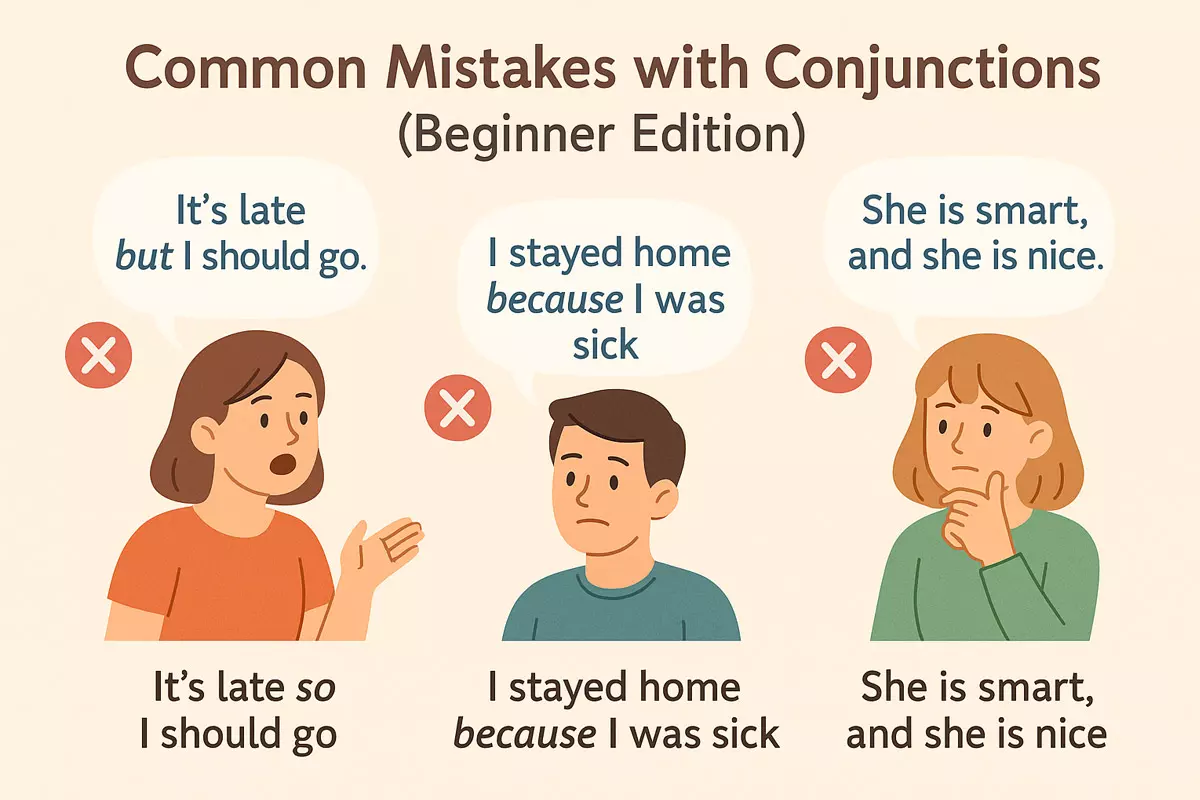 This article explains common mistakes with conjunctions like and, but, or, because, and so, such as run-on sentences, missing subjects, and starting sentences incorrectly. It gives step-by-step fixes and practice sentences to help you improve.
Connecting words and ideas smoothly can be challenging, especially for beginners in English, and it's common for simple mistakes to occur when linking sentences. However, by learning effective ways to join your thoughts—such as using conjunctions, transition words, or appropriate punctuation—you can make your writing clearer and more natural. Paying attention to these details not only helps you avoid common errors but also boosts your confidence and ability to express yourself more effectively in both writing and conversation.
Typical errors with and, but, or, because, so
Learning to use coordinating conjunctions like and, but, or, because, and so can be tricky for English beginners. Many common mistakes happen when these words are used incorrectly in sentences. Let’s explore frequent issues and clarify how to avoid them.
Mixing up sentence structure
One of the most frequent slip-ups is using a conjunction to join two sentences without proper punctuation or missing a subject. For example, learners sometimes write:
- I went to the shop and bought milk. ✅
- I went to the shop. And bought milk. ❌
The second example is incorrect because "And bought milk" is not a complete sentence. Always ensure both parts can stand alone or that the conjunction connects two related ideas smoothly.
Wrong conjunction for meaning
Choosing the wrong connector can change the meaning or make the sentence confusing. Here are clearer, corrected, and expanded examples:
- I wanted to go, but it was raining. (contrast: two opposing ideas)
- I wanted to go, so I left early. (result: one action causes another)
- I wanted to go, because my friend invited me. (reason: explains the cause)
- ❌ I wanted to go, or stay home. → ✅ I wanted to go or stay home. (choice: no comma needed)
- ❌ She studied hard, but she passed the test. → ✅ She studied hard, so she passed the test. (result, not contrast)
- ❌ He was tired, because he went to bed early. → ✅ He was tired, so he went to bed early. (result, not reason)
- ❌ I took an umbrella, because it was sunny. → ✅ I took an umbrella, although it was sunny. (contrast, not reason)
- ❌ We stayed home, so it was raining. → ✅ We stayed home, because it was raining. (reason, not result)
- ❌ She is friendly, although she has many friends. → ✅ She is friendly, and she has many friends. (addition, not contrast)
- ❌ He didn’t call me, and I was worried. → (better) He didn’t call me, so I was worried. (result, not simple addition)
Forgetting commas in compound sentences
When connecting two independent clauses with one of these conjunctions, a comma is usually needed before the connector:
- She likes tea, but he prefers coffee.
- We can watch a movie, or we can play a game.
Omitting the comma is a common beginner error, especially in longer sentences.
Using 'because' and 'so' together
Another mistake is using both because and so in the same sentence. They express cause and effect, but only one is needed:
- I was tired, so I went to bed. ✅
- I went to bed because I was tired. ✅
- I was tired, so I went to bed because I was tired. ❌
Examples of correct and incorrect sentences
| Incorrect Usage | Corrected Sentence |
|---|---|
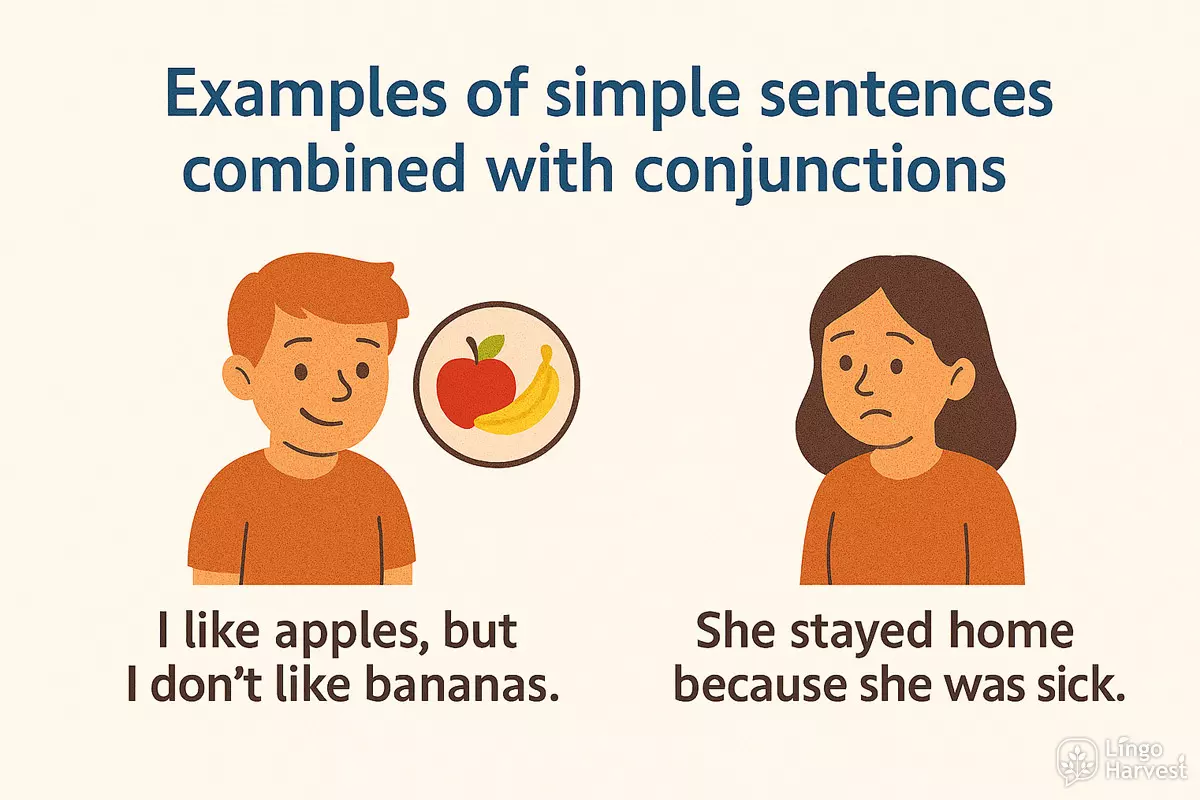
| I like apples but I don’t like bananas | I like apples, but I don’t like bananas. |
| She stayed home, because she was sick. | She stayed home because she was sick. |
| We can go to the park or we can stay at home | We can go to the park, or we can stay at home. |
| He was hungry so he eat lunch. | He was hungry, so he ate lunch. |
| I want pizza and burger. | I want pizza and a burger. |
Extra tips for avoiding mistakes
- Don’t start a sentence with because unless it is followed by a complete idea.
- Remember to use a comma before but, or, and so when joining two full sentences.
- Use and to add similar ideas, but for contrast, or for choices, because for reasons, and so for results.
- Watch verb tense consistency after these connectors.
- Avoid double conjunctions: “but so”, “and because”, etc.
- If in doubt, break your sentence into two shorter ones.
By paying attention to these points, you’ll make your sentences clearer and avoid typical conjunction mix-ups in beginner English writing.
Run-on sentences: using too many conjunctions
Using several conjunctions in a single sentence often leads to run-on sentences, which can make your writing unclear and hard to follow. Beginners sometimes link too many ideas with words like "and", "but", or "so", forgetting to break up their thoughts or use proper punctuation. This habit can confuse the reader and bury the main point of your message.
How excessive conjunctions create problems
When sentences become overloaded with connectors, they lose clarity. Each conjunction joins clauses, but too many at once can make sentences long and tangled. It’s easy to lose track of the subject, verb, or main idea.
- I wanted to go to the store and I needed to buy bread and I saw my friend and we talked for a while but I forgot to buy milk.
- She finished her homework but she didn’t understand the lesson and she asked for help so the teacher explained again but she was still confused.
How to fix overloaded sentences
Breaking long sentences into shorter ones improves readability. Use conjunctions to join only closely related ideas, and add periods to separate different points. If you have more than two conjunctions in one sentence, check if you can split it up.
Common conjunctions that cause run-ons
- and → I like tea and coffee.
- but → She is tired but happy.
- or → Do you want water or juice?
- so → It was cold, so I stayed home.
- because → I left early because I was sick.
- while → She cooked while I cleaned the room.
- although → Although it was raining, we went out.
- if → If it rains, we’ll stay inside.
- when → Call me when you arrive.
- since → Since I was hungry, I made a sandwich.
- though → He was tired, though he kept working.
- yet → She studied hard, yet she failed the test.
- unless → I won’t go unless you come with me.
- until → Wait here until I return.
- before → Wash your hands before you eat.
- after → After we finished, we went home.
- as → As it got dark, we went inside.
- whereas → She likes winter, whereas I prefer summer.
- even though → Even though he was busy, he helped us.
- while → She read a book while he watched TV.
Examples: before and after correction
| Original Sentence | Improved Version |
|---|---|
| I woke up late and I missed the bus and I was late for school so my teacher was angry. | I woke up late and missed the bus. I was late for school, so my teacher was angry. |
| She wanted to bake a cake but she had no eggs and the store was closed so she made cookies instead. | She wanted to bake a cake, but she had no eggs. The store was closed, so she made cookies instead. |
| We went to the park and we played soccer and we had a picnic but it started to rain so we left early. | We went to the park and played soccer. We had a picnic, but it started to rain, so we left early. |
| He studied hard for the test but he was nervous and he forgot the answers so he didn’t do well. | He studied hard for the test, but he was nervous and forgot the answers. As a result, he didn’t do well. |
Tips to avoid conjunction overload
- Limit each sentence to one or two main ideas.
- Use conjunctions to connect closely related thoughts only.
- Read your writing out loud—if you run out of breath, consider splitting the sentence.
- Replace some conjunctions with periods or semicolons when appropriate.
- Revise by identifying unnecessary connectors and removing them.
Writing clear, concise sentences helps your reader understand your message. Practice breaking up long chains of clauses, and soon your writing will become more effective and easier to follow.
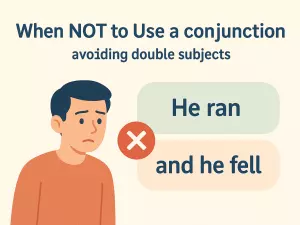
Missing subjects after conjunctions
Forgetting to include a subject after a linking word is a frequent error, especially in beginner writing. In English, each clause needs its own subject, even when two actions are performed by the same person. Learners often skip the second subject, assuming it is understood, but this can lead to confusion or ungrammatical sentences.
Why is the subject necessary?
Each clause joined by a conjunction like and, but, or, so, or because should clearly state who or what is performing the action. English does not usually allow the subject to be dropped, unlike some other languages.
Common incorrect patterns
- She likes pizza and wants ice cream. ❌ (Who wants ice cream?)
- We went to the park but forgot the ball. ❌ (Who forgot the ball?)
- You can stay here or go home. ❌ (Who can go home?)
- He was tired so went to bed. ❌ (Who went to bed?)
Correct usage examples
- She likes pizza, and she wants ice cream. ✅
- We went to the park, but we forgot the ball. ✅
- You can stay here, or you can go home. ✅
- He was tired, so he went to bed. ✅
List of conjunctions that require subjects in both clauses
- whereas → She likes tea, whereas he prefers coffee.
- even though → Even though it was late, they kept talking.
- as soon as → Call me as soon as you arrive.
- in case → Take an umbrella in case it rains.
- provided that → You can enter provided that you have a ticket.
- as if → He looks as if he didn’t sleep at all.
- as long as → You can stay as long as you are quiet.
- whenever → Whenever I see her, she smiles.
- wherever → Sit wherever you like.
- even if → I will come even if it rains.
- unless → I won’t go unless you join me.
- once → Once you finish, we can leave.
- in order that → He whispered in order that no one could hear.
- so that → She left early so that she could catch the bus.
- as though → He talks as though he knows everything.
Quick comparison: Subject included vs. missing
| Incorrect (Missing Subject) | Correct (Subject Included) |
|---|---|
| I finished my homework and went outside. | I finished my homework and I went outside. |
| She called me but didn’t say hello. | She called me but she didn’t say hello. |
| They wanted to leave because were tired. | They wanted to leave because they were tired. |
| We can eat now or wait for John. | We can eat now or we can wait for John. |
To sum up, always check that every clause connected by a linking word has its own subject. This simple habit will make your writing clearer and more accurate.
Using a conjunction at the beginning with no main clause
Many English learners start a sentence with a conjunction such as "and," "but," or "because," but then forget to include a complete main clause. This leads to incomplete thoughts or fragments, which can confuse readers or listeners. A conjunction’s job is to connect ideas, so if there’s nothing to connect, the sentence feels unfinished.
Why does this mistake happen?
It’s easy to think that adding a word like "because" makes a sentence complete, but in English, these words need to be followed by a full clause. For example, "Because I was tired." is not a complete sentence; it leaves the listener waiting for more information. The correct version would be "Because I was tired, I went to bed early."
Examples: Fragments vs. complete sentences
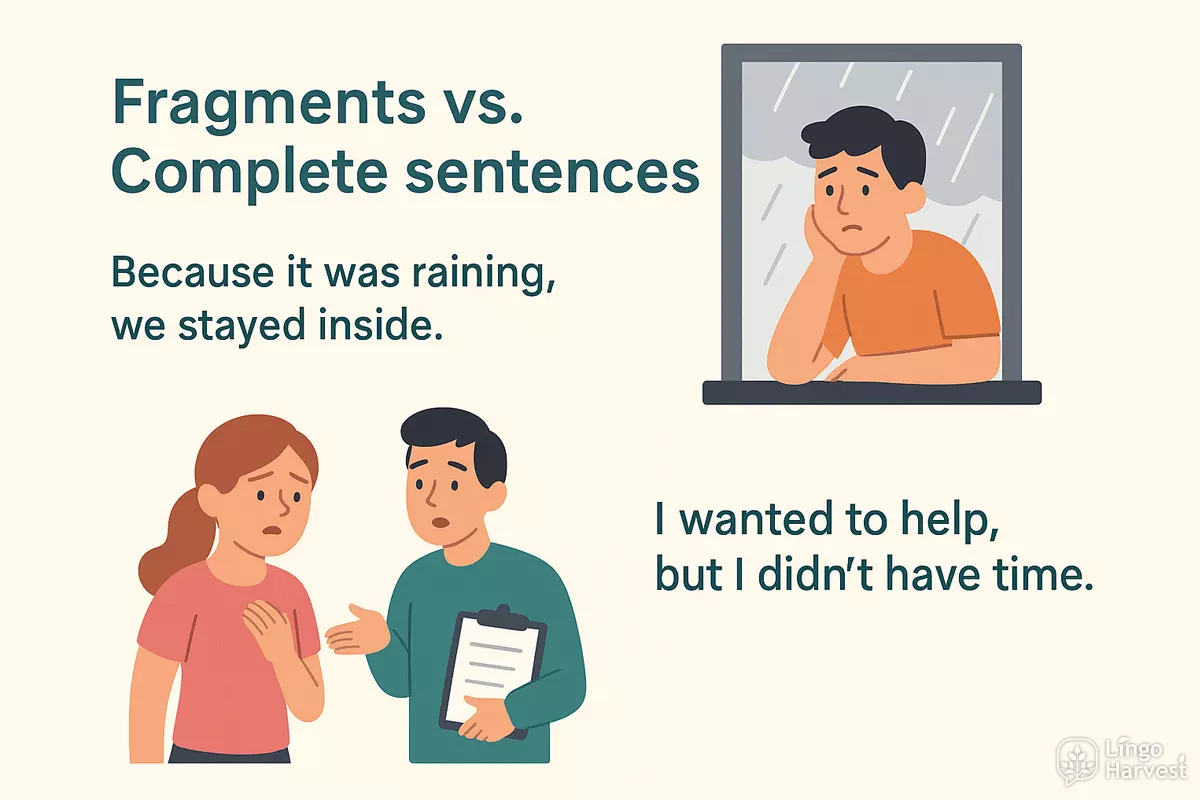
- Fragment: Because it was raining.
- Complete: Because it was raining, we stayed inside.
- Fragment: But I didn’t have time.
- Complete: I wanted to help, but I didn’t have time.
- Fragment: Although she tried.
- Complete: Although she tried, she couldn’t finish the test on time.
Quick tips to avoid this error
- Always check if your sentence after a conjunction is a complete thought.
- Read your sentence aloud; if it sounds unfinished, add the main clause.
- Practice combining dependent and independent clauses.
- Remember: a conjunction alone cannot make a full sentence.
Recognizing sentence fragments
Sentence fragments often start with a conjunction but lack a subject or verb that completes the idea. Watch for sentences that leave the reader asking, "What happened next?" or "Why?" If your answer is missing, you likely need to add a main clause.
Practice: Correcting mistakes
Try fixing these fragments by adding a main clause:
- If you want to join.
- So I decided to leave.
- When we arrived.
- Unless you call me.
Possible corrections:
- If you want to join, let me know.
- I was tired, so I decided to leave.
- When we arrived, everyone was already there.
- I won't go unless you call me.
Focusing on complete sentences, especially when using conjunctions at the start, will make your writing much clearer and more effective.
How to correct common beginner mistakes step by step
Understanding how to fix errors with conjunctions is essential for clear communication. Many learners struggle with using words like "and," "but," "or," and "because" correctly, but there are practical strategies to help you improve. Let’s break down the process into manageable steps and see how to apply them in real sentences.
1. Identify the Type of Conjunction
First, figure out whether you’re dealing with coordinating, subordinating, or correlative conjunctions. Each type connects words or ideas differently. Recognizing the category helps you understand the rules that apply.
2. Learn Common Patterns and Pitfalls
Many mistakes happen because of confusion between similar words or incorrect sentence structure. Here are some typical errors and how to fix them:
- Using "and" to combine unrelated ideas
- Starting a sentence with "because" but leaving it incomplete
- Forgetting to use a comma before "but" in compound sentences
- Mixing up "so" and "because"
- Using "or" when "nor" is needed
- Repeating conjunctions unnecessarily
- Leaving out conjunctions, making the sentence choppy
- Using "although" and "but" together in the same sentence
- Placing conjunctions at the wrong spot in the sentence
- Using "and" or "but" to begin too many sentences in a row
- Creating run-on sentences by adding too many ideas with "and"
- Using "if" when "whether" is needed
3. Check Your Sentence Structure
After writing, pause and review your sentences. Ask yourself:
- Are both parts of the sentence complete thoughts?
- Is a comma needed before the conjunction?
- Does the conjunction actually fit the relationship between ideas?
4. Practice with Corrected Examples
Comparing incorrect and correct sentences is a fast way to learn. Notice how the meaning changes when the conjunction is used properly.
| Incorrect | Corrected |
|---|---|
| I like apples and I don’t like oranges. | I like apples, but I don’t like oranges. |
| She didn’t come because she was sick. | She didn’t come, because she was sick. |
| Although he was tired, but he finished his work. | Although he was tired, he finished his work. |
| I don’t know if I will go nor stay. | I don’t know whether I will go or stay. |
| He is smart so he works hard. | He is smart, so he works hard. |
| I will call you and I arrive. | I will call you when I arrive. |
5. Build Good Habits
Read your sentences aloud to spot awkward connections. Practice writing sentences with different conjunctions, and pay attention to how native speakers use them. Over time, you’ll avoid the most common errors and write more naturally.
Practice: find and fix errors in short sentences
Mastering English conjunctions often means spotting where sentences connect ideas incorrectly. In this section, you'll review short sentences with common mistakes—see if you can identify and correct the errors. Focus on basic conjunctions like and, but, or, so, and because.
Spot the conjunction problem
Read each sentence below. Decide if there is a mistake with the conjunction. Rewrite the sentence correctly.
- I like tea but I don't like coffee, and I drink tea every morning.
- She wanted to go shopping, so she didn't have any money.
- We can go to the park or we can stay home.
- He is tired, because he didn't sleep well last night.
- They studied hard, but they passed the test.
- Do you want pizza or pasta for dinner?
- Anna forgot her keys and she couldn't open the door.
- It was raining, so we stayed inside.
- He likes apples, but bananas.
- She called me, because she needed help.
Show answers
- Correct: I like tea, but I don't like coffee. I drink tea every morning.
Explanation: The sentence is too long and joins unrelated ideas with and. Separate into two sentences. - Correct: She wanted to go shopping, but she didn't have any money.
Explanation: Use but to show contrast, not so. - Correct as written. No error.
- Correct: He is tired because he didn't sleep well last night.
Explanation: No comma before because in short sentences. - Correct: They studied hard, so they passed the test.
Explanation: Use so for result, not but. - Correct as written. No error.
- Correct as written. No error.
- Correct as written. No error.
- Correct: He likes apples, but he doesn't like bananas.
Explanation: Complete the contrast with a full clause. - Correct as written. No error.
Common conjunction errors and corrections
Here are typical mistakes with joining words and how to fix them:
- Using so for contrast instead of but
- Leaving out part of the sentence after a conjunction
- Adding unnecessary commas before because
- Combining too many ideas in one sentence
- Forgetting to repeat the subject after a conjunction when needed
Quick review: Correct vs. incorrect usage
| Incorrect Sentence | Corrected Version |
|---|---|
| I wanted to call her, so I forgot my phone. | I wanted to call her, but I forgot my phone. |
| He likes pizza, and not pasta. | He likes pizza, but not pasta. |
| We didn't go out, because it was raining. | We didn't go out because it was raining. |
| She is tired, because she worked late. | She is tired because she worked late. |
| Tom wanted ice cream so he didn't buy any. | Tom wanted ice cream, but he didn't buy any. |
Try correcting these yourself
Rewrite the sentences below to fix conjunction mistakes:
- We can eat now or wait for John arrives.
- She likes to read but also she likes to write stories.
- He was late because, he missed the bus.
- I want to play tennis, and go swimming.
- She stayed at home although she was very tired.
- Because he was busy, so he didn’t call.
- We went to the park, but because it was raining.
- They didn’t go to the party, and because they were sick.
- If you will study, you will pass the exam.
- When he arrived, but everyone had already left.
Show answers
- We can eat now or wait for John to arrive.
- She likes to read, and she also likes to write stories.
- He was late because he missed the bus.
- I want to play tennis and go swimming.
- She stayed at home because she was very tired.
- Because he was busy, he didn’t call. / He was busy, so he didn’t call.
- We went to the park, although it was raining.
- They didn’t go to the party because they were sick.
- If you study, you will pass the exam.
- When he arrived, everyone had already left.