Mini Test: Choose the Correct Conjunction (A1–A2)

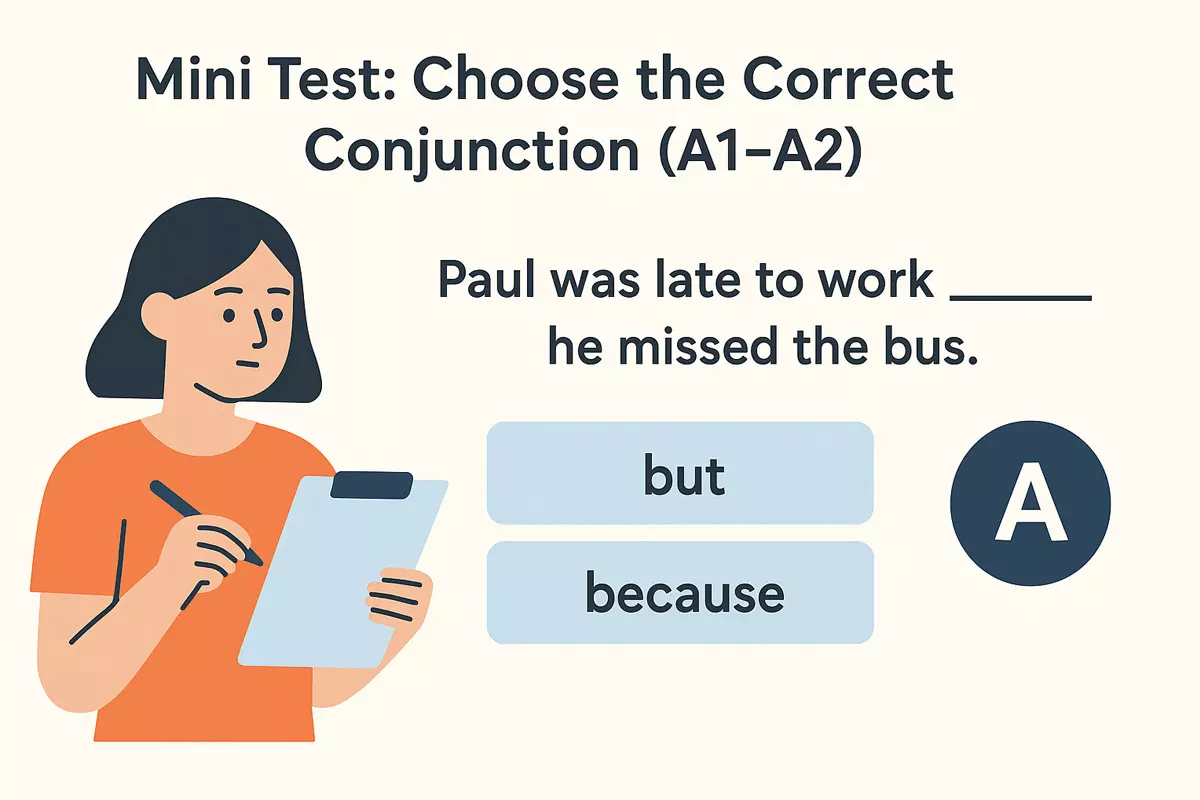 The article provides instructions for a mini test on basic English connectors. It features multiple-choice questions, tasks to choose the right conjunction, mixed practice with common connectors, an answer key with explanations, and a review guide.
Are you ready to test and improve your basic English skills? This short quiz gives you the chance to practice joining sentences using the correct connecting words. By taking part, you can check your understanding and learn how to link ideas more smoothly, all at a beginner level. Whether you want to build confidence or simply refresh your knowledge, this activity offers a simple and effective way to strengthen your grasp of sentence structure and make your writing clearer. Give it a try and see how well you can connect your thoughts.
Short instructions for the mini test
Before starting, make sure you understand the basic function of conjunctions in English. In this exercise, you will need to select the most suitable conjunction to complete each sentence. These tasks are designed for beginner to elementary learners (A1–A2), focusing on common connecting words such as and, but, or, because, and so.
How to complete the tasks
- Read each sentence carefully and think about the logical connection between the ideas.
- Choose the conjunction that best fits the meaning.
- Only one answer is correct for each item.
- Try to finish without using a dictionary; this will help you test your real knowledge.
Types of conjunctions you may see
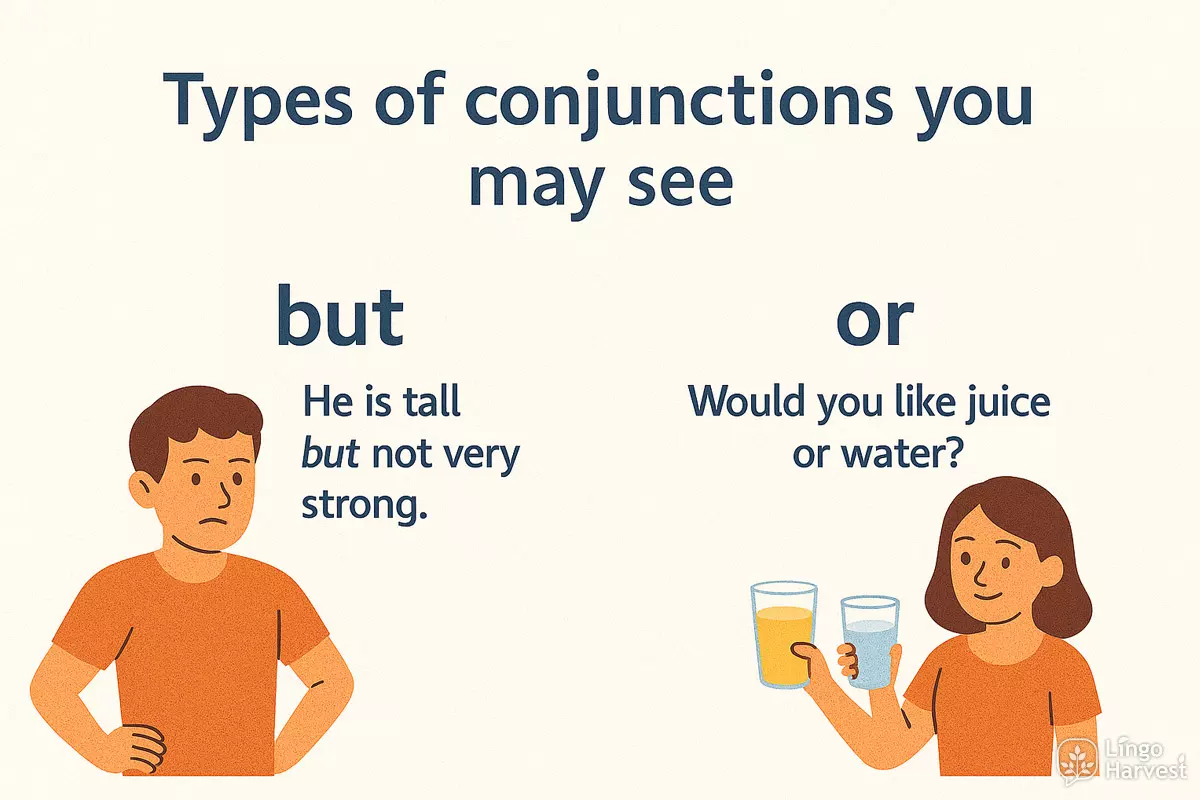
The mini test includes the most frequent coordinating and subordinating conjunctions found at A1–A2 level. Here is a quick overview of their main uses:
- and – to add similar information: "She likes tea and coffee."
- but – to show contrast: "He is tall but not very strong."
- or – for alternatives: "Would you like juice or water?"
- because – to give a reason: "I’m late because the bus was slow."
- so – to show result: "It was cold, so we stayed inside."
- when – for time: "Call me when you arrive."
- if – for conditions: "If it rains, we will stay home."
- although – for unexpected contrast: "Although he is young, he is very wise."
- while – for actions happening at the same time: "She cooked while I cleaned."
- so that – to express purpose: "I left early so that I could catch the bus."
Example mini test items
- We can go to the park ___ stay at home. (and/or)
- She is tired ___ she worked all day. (because/so)
- He wanted to go out, ___ it was raining. (but/so)
- I will call you ___ I arrive. (when/because)
- Do you want tea ___ coffee? (and/or)
- He studied hard, ___ he passed the test. (so/but)
- She stayed home ___ she wasn’t feeling well. (because/and)
- We can watch a movie ___ play a game. (or/and)
- I took an umbrella ___ it looked like rain. (because/so)
- She likes apples ___ doesn’t like oranges. (but/and)
Show answers
- or
- because
- but
- when
- or
- so
- because
- or
- because
- but
Tips for best results
- Don’t rush—read every option before choosing your answer.
- Look for words that signal contrast, reason, time, or alternatives.
- If you’re not sure, try reading the sentence aloud with each option.
Review the example conjunctions above if you need a reminder. Good luck with your practice!
Multiple-choice questions with simple sentences
Practicing conjunctions in straightforward sentences helps learners at the A1–A2 levels build confidence with the basics of English grammar. These short questions often present two parts of a sentence, where the correct linking word must be chosen. This format makes it easier to focus on the function of each conjunction without the distraction of complex vocabulary or structures.
Common conjunctions used in beginner questions
- and → Do you want tea and cookies?
- but → Is it cheap but good?
- or → Do you prefer tea or coffee?
- because → Are you tired because you worked late?
- so → Is it raining, so we should stay inside?
- when → What will you do when you get home?
- if → What should I do if it rains?
- while → Can you wait here while I check?
- although → Can you finish the task although it’s difficult?
- until → Should we wait until she arrives?
- before → What do you usually do before class?
- after → Where will you go after the meeting?
Sample simple sentence patterns
Most test items at this level are direct and clear. Here are some typical structures you might see:
- I like tea and coffee.
- She is tired but happy.
- Do you want pizza or pasta?
- He stayed home because it was raining.
- We went to the park after lunch.
- I’ll call you when I arrive.
- You can go out if you finish your homework.
- Wait here until I return.
- She reads while she eats breakfast.
- Although it was cold, we went swimming.
Quick guide: conjunctions and their use
| Conjunction | Typical meaning | Example sentence |
|---|---|---|
| and | addition | Tom and Anna are friends. |
| but | contrast | It is sunny, but cold. |
| or | choice | Do you want tea or juice? |
| because | reason | I’m late because the bus was slow. |
| so | result | He was hungry, so he ate. |
| when | time | Call me when you get home. |
| if | condition | If it rains, we’ll stay inside. |
| while | simultaneous actions | She listens to music while she runs. |
| although | unexpected contrast | Although it’s late, I’m not tired. |
| until | time (up to a point) | Stay here until I return. |
Tips for answering these questions
- Read both parts of the sentence carefully and think about the relationship between them.
- Look for clue words: “because” for reasons, “but” for opposites, “and” for additions.
- Use process of elimination if you are unsure (remove options that do not make sense).
- Practice with short, clear examples to build your confidence.
Simple conjunction questions help reinforce core grammar skills, preparing learners to build longer and more complex sentences as they progress.
Tasks to choose the best conjunction for meaning
Selecting the right connecting word in English can change the meaning of a sentence. For learners at A1–A2 level, practice with conjunctions such as and, but, or, so, and because helps build more accurate and natural sentences. Below are different types of exercises to help you recognize which conjunction fits best in various contexts.
Practice: Fill in the blank with the correct conjunction
- I want to go to the park, ____ it is raining.
- She is tired ____ she finished her homework.
- Do you want tea ____ coffee?
- He studied hard, ____ he passed the test.
- We can watch a movie ____ play a game.
- I stayed home ____ I wasn’t feeling well.
- He tried to call you, ____ your phone was off.
- Do you want to walk ____ take the bus?
- We were late ____ there was a lot of traffic.
- She took an umbrella ____ it might rain.
Show answers
- but
- because
- or
- so
- or
- because
- because
- or
- because
- because
Common conjunctions and their uses
Understanding the main function of each linking word helps you decide which one to use. Here’s a quick guide:
- and – adds information: “I like apples and oranges.”
- but – shows contrast: “It’s cold, but sunny.”
- or – offers a choice: “Would you like water or juice?”
- so – shows result: “I was hungry, so I ate lunch.”
- because – gives a reason: “She is happy because it’s her birthday.”
Match the sentences with the correct conjunction
Choose the word that makes the sentence meaningful.
- I don’t eat meat, ____ I am a vegetarian. (and / so / or)
- He can speak French ____ German. (and / but / so)
- We can go by bus ____ by train. (or / so / because)
- She was tired ____ she went to bed early. (because / but / or)
- I stayed home, ____ it was raining. (so / but / or)
- He likes coffee ____ tea. (and / or / but)
- She studied hard, ____ she passed the test. (so / but / or)
- You can call me ____ send me a message. (or / because / so)
- I wanted to buy the shoes, ____ they were too expensive. (but / and / so)
- We left early ____ we didn’t want to be late. (because / or / and)
Show answers
- so
- and
- or
- because
- so
- or
- so
- or
- but
- because
Quick reference: Conjunctions in action
Here are more examples with different connectors to reinforce your understanding:
- We wanted to go out, but it was too late.
- He likes pizza and pasta.
- Is it Monday or Tuesday?
- I was cold, so I wore a jacket.
- She is sad because her cat is lost.
- Take an umbrella because it might rain.
- Do you want to come now or later?
- He is tall and strong.
- I like ice cream, but I don’t eat it often.
- She was late, so she missed the bus.
Contrast, cause, and choice: quick comparison
| Conjunction | Example sentence |
|---|---|
| but | He is short, but fast. |
| so | She was hungry, so she ate. |
| because | I stayed home because I was sick. |
| or | Tea or coffee? |
| and | Tom and Jerry are friends. |
Regular practice with these connectors helps you build clearer, more expressive sentences for everyday situations.
Mixed practice with and, but, or, because, so
Combining ideas in English is easier when you know how to use common connectors. These words—such as "and", "but", "or", "because", and "so"—help you join phrases smoothly, show contrast, give reasons, or explain results. Practicing these conjunctions in different sentences helps you build more natural conversations and writing.
When to Use Each Connector
- and – joins similar ideas or adds information
- but – introduces contrast or an opposite idea
- or – shows a choice or alternative
- because – gives a reason for something
- so – shows a result or consequence
Example Sentences for Practice
- She likes apples and oranges.
- He is tired, but he wants to go out.
- Would you like tea or coffee?
- I stayed home because it was raining.
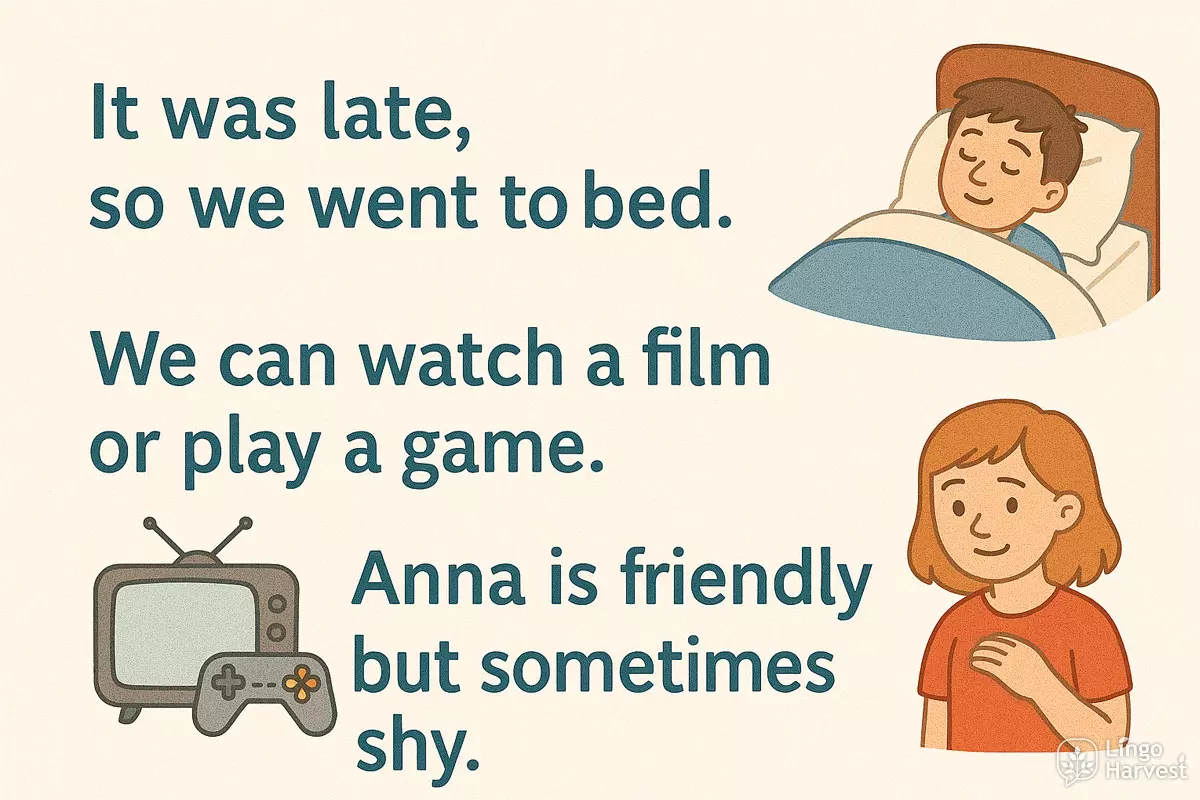
- It was late, so we went to bed.
- We can watch a film or play a game.
- Anna is friendly but sometimes shy.
- He works hard because he needs money.
- You can take the bus or walk.
- I was hungry, so I made a sandwich.
- They bought bread and cheese.
- My brother loves pizza, but I prefer pasta.
- We stayed inside because it was cold.
- She is smart and funny.
- I forgot my keys, so I called my friend.
Practice: Fill in the Blanks
- We can go to the park _____ stay at home.
- He was late, _____ he ran to school.
- I want tea _____ coffee, not both.
- She didn’t come _____ she was ill.
- I like bananas _____ apples.
- He studied hard, _____ he passed the exam.
- You can call me _____ send me an email.
- It was raining, _____ we stayed inside.
- Do you want pasta _____ rice?
- I was hungry, _____ I made a sandwich.
Show answers
- or
- so
- or
- because
- and
- so
- or
- so
- or
- so
Mini Quiz: Choose the Correct Word
- Tom is tall, _____ he cannot play basketball. (and / but / so)
- I was tired, _____ I went to bed early. (because / so / or)
- Do you want juice _____ water? (and / or / but)
- He is happy _____ he passed the test. (so / because / but)
- We can walk, _____ we can take a taxi. (or / and / so)
- She studied a lot, _____ she got a good grade. (so / or / but)
- He likes apples, _____ he doesn’t like bananas. (but / or / so)
- I stayed home _____ it was raining. (because / but / so)
- You can call me _____ send me a message. (or / so / because)
- He didn’t eat breakfast, _____ he was hungry later. (so / or / but)
Show answers
- but
- so
- or
- because
- or
- so
- but
- because
- or
- so
Common Mistakes to Watch For
- Don’t use "because" to connect two results: Wrong: I was late because I missed the bus, so I called my boss.
- Don’t use "so" for giving a reason: Wrong: I stayed home so it was raining. Correct: I stayed home because it was raining.
- Don’t use "but" for adding similar ideas: Wrong: She likes pizza but pasta. Correct: She likes pizza and pasta.
Answer key with short explanations
Understanding which conjunction to use is essential for building clear and correct sentences, especially at the beginner (A1–A2) level. Below, you'll find the correct answers for the test, each followed by a brief reason to clarify the choice. This should help reinforce how and when to use basic connectors in English.
Common conjunctions and their use
- and – connects similar ideas or adds information.
Example: She likes tea and coffee. (Both are drinks she enjoys.) - but – shows contrast or difference.
Example: He is tall but his sister is short. (Opposite qualities are compared.) - or – offers a choice between options.
Example: Would you like juice or water? (You can choose one.) - because – explains a reason.
Example: I stayed home because it was raining. (Gives the reason for staying home.) - so – shows result or consequence.
Example: She was tired, so she went to bed early. (One action leads to another.)
Mini test explanations
- 1. I am hungry, ____ I will make a sandwich.
Correct answer: so
Explanation: "so" is used to show the result of being hungry. - 2. He likes apples ____ oranges.
Correct answer: and
Explanation: "and" links two things he likes. - 3. She can sing ____ she can’t dance.
Correct answer: but
Explanation: "but" shows a contrast between abilities. - 4. Do you want tea ____ coffee?
Correct answer: or
Explanation: "or" offers a choice. - 5. I am happy ____ it’s my birthday.
Correct answer: because
Explanation: "because" gives a reason for being happy. - 6. She was cold, ____ she closed the window.
Correct answer: so
Explanation: "so" introduces the result of feeling cold. - 7. He is tired ____ he didn’t sleep well.
Correct answer: because
Explanation: "because" explains why he is tired. - 8. We can go to the park ____ stay home.
Correct answer: or
Explanation: "or" is used when giving alternatives. - 9. She likes reading ____ writing.
Correct answer: and
Explanation: "and" joins two hobbies. - 10. He’s friendly ____ a little shy.
Correct answer: but
Explanation: "but" shows an unexpected detail or contrast.
Quick reference: Conjunctions at a glance
| Conjunction | Typical Use |
|---|---|
| and | Adding similar ideas or items |
| but | Showing contrast or exception |
| or | Offering a choice or alternative |
| because | Giving a reason |
| so | Expressing a result or effect |
Reviewing these explanations and examples should help you feel more confident choosing the right connector in simple English sentences. If you make a mistake, look at the logic of the sentence – is it showing addition, contrast, choice, reason, or result? This will guide you to the correct word.
Final score guide and suggestions for review
Understanding your results on this mini test helps you see which types of conjunctions you already use with confidence and where you might need extra practice. After completing the quiz, compare your score with the guide below to identify your strengths and areas for improvement.
Score interpretation
| Score range | What it means | Next steps |
|---|---|---|
| 9–10 | Excellent! You use basic conjunctions very well. | Try more challenging conjunctions or longer sentences. |
| 7–8 | Good understanding, but a few mistakes. | Review incorrect answers and focus on similar sentence patterns. |
| 5–6 | Some gaps in your knowledge. | Practice the most common conjunctions with short exercises. |
| 0–4 | It’s time to review the basics. | Start with simple sentences and build up step by step. |
Suggestions for further practice
Focus on the conjunctions that gave you trouble. Here are practical ways to boost your skills:
- Make your own sentences using "and", "but", "or", "because", and "so".
- Read short texts or dialogues and underline every conjunction you find.
- Join two simple sentences together with a suitable connector.
- Write a short story (4–5 sentences) using at least three different conjunctions.
- Ask a friend to quiz you with fill-in-the-blank exercises.
- Say sentences aloud and add conjunctions to extend them.
- Listen to simple conversations and note how speakers link ideas.
- Review a list of common conjunctions and their uses (see below).
Common conjunctions to review
These linking words often appear at A1–A2 level:
- and
- but
- or
- because
- so
- when
- if
- while
- although
- before
- after
- until
- since
- as
- unless
- whereas
- though
- even if
- once
- as soon as
Self-check: Practice task
Try joining these pairs of sentences using an appropriate connector:
- I like apples. I don't like bananas.
- She stayed at home. She was tired.
- Do you want tea? Do you want coffee?
- We went out. It was raining.
- He can't come. He is busy.
- I was hungry. I made a sandwich.
- We can watch a movie. We can play a game.
- She didn’t take an umbrella. It was sunny.
- He finished his work. He went to bed.
- It was late. They continued talking.
Show answers
- I like apples but I don't like bananas.
- She stayed at home because she was tired.
- Do you want tea or coffee?
- We went out although it was raining.
- He can't come because he is busy.
- I was hungry so I made a sandwich.
- We can watch a movie or play a game.
- She didn’t take an umbrella because it was sunny.
- He finished his work and went to bed.
- It was late, but they continued talking.
Review your answers and note which connectors you find easiest and which need more practice. Consistent review and active use in writing and speaking will help you master these essential words.