Identify the Conjunction: Grammar Drill (Beginner)

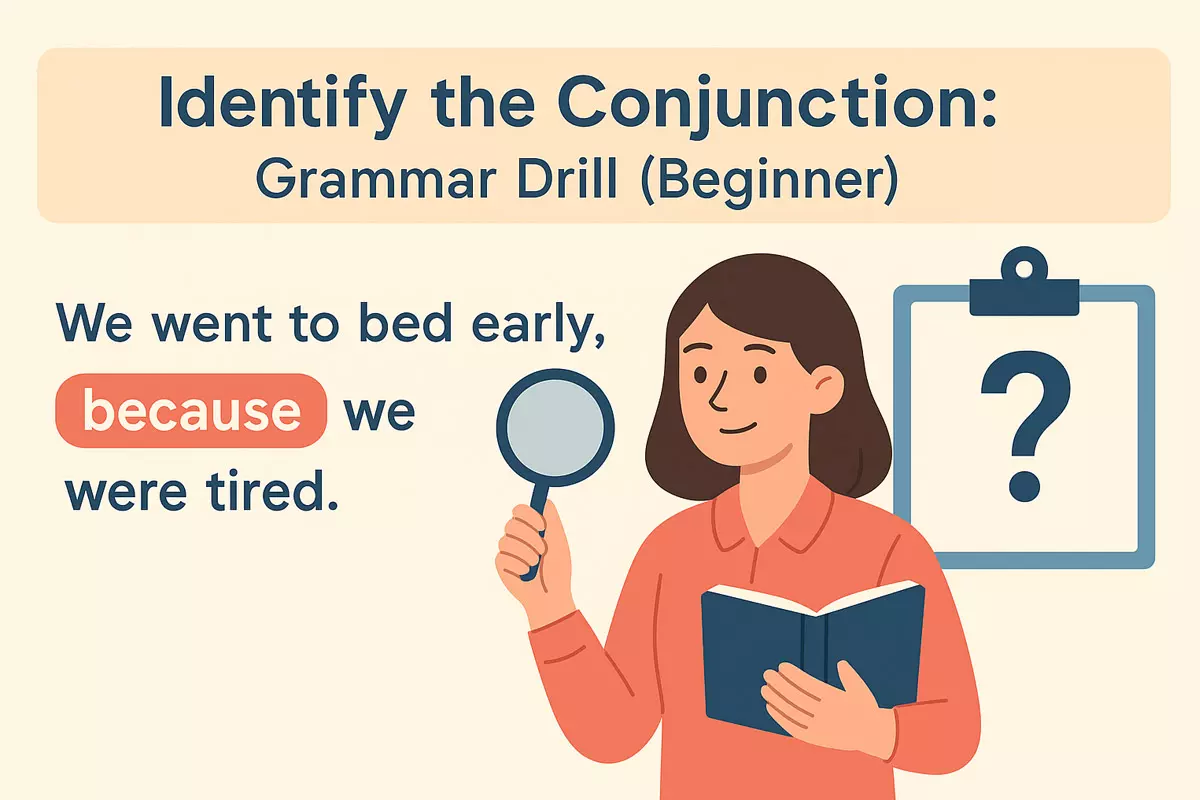 This article reviews what conjunctions look like, gives step-by-step sentence examples, and offers exercises to identify conjunctions, including mixed and challenge tasks. An answer key is included so you can check your work and improve your grammar.
- Quick review of what conjunctions look like
- Step-by-step examples of sentences with and without conjunctions
- Exercise: underline or highlight the conjunction in each sentence
- Mixed practice with one and two conjunctions per sentence
- Challenge task: find the conjunction in a short text
- Answer key so learners can check their work
Are you looking to improve your grammar skills? This beginner-friendly exercise is designed to help you identify connecting words that link ideas within sentences. By practicing regularly, you'll become more confident in spotting these essential parts of speech, which play a crucial role in making your writing clearer and more coherent. Strengthening your understanding of connecting words can enhance both your writing and communication, so take this opportunity to practice and develop your grammar abilities in a supportive and straightforward way.
Quick review of what conjunctions look like
Conjunctions are connecting words that link other words, phrases, or clauses within a sentence. They are often short and simple, but their role is crucial: they help ideas flow smoothly and logically. You’ll see them joining two nouns, connecting whole sentences, or even adding conditions and contrasts.
Common Types of Conjunctions
There are three main categories you’ll encounter:
- Coordinating conjunctions: Join words, phrases, or independent clauses of equal importance. Example: and, but, or, nor, for, so, yet.
- Subordinating conjunctions: Connect a dependent clause to an independent clause. Example: because, although, since, unless, if, when, while, after, before.
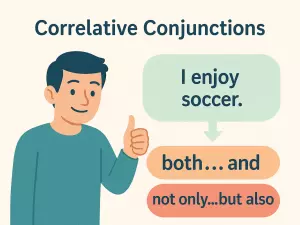
- Correlative conjunctions: Work in pairs to join equal elements. Example: either...or, neither...nor, both...and, not only...but also.
How to Spot a Conjunction
Look for small words that serve as bridges between ideas. They often appear between two parts of a sentence, but sometimes at the start of a clause. Some can be tricky, since they’re also used as prepositions or adverbs in other contexts.
| Conjunction | Example sentence |
|---|---|
| and | She likes tea and coffee. |
| but | He tried hard, but he didn’t win. |
| or | Would you like juice or water? |
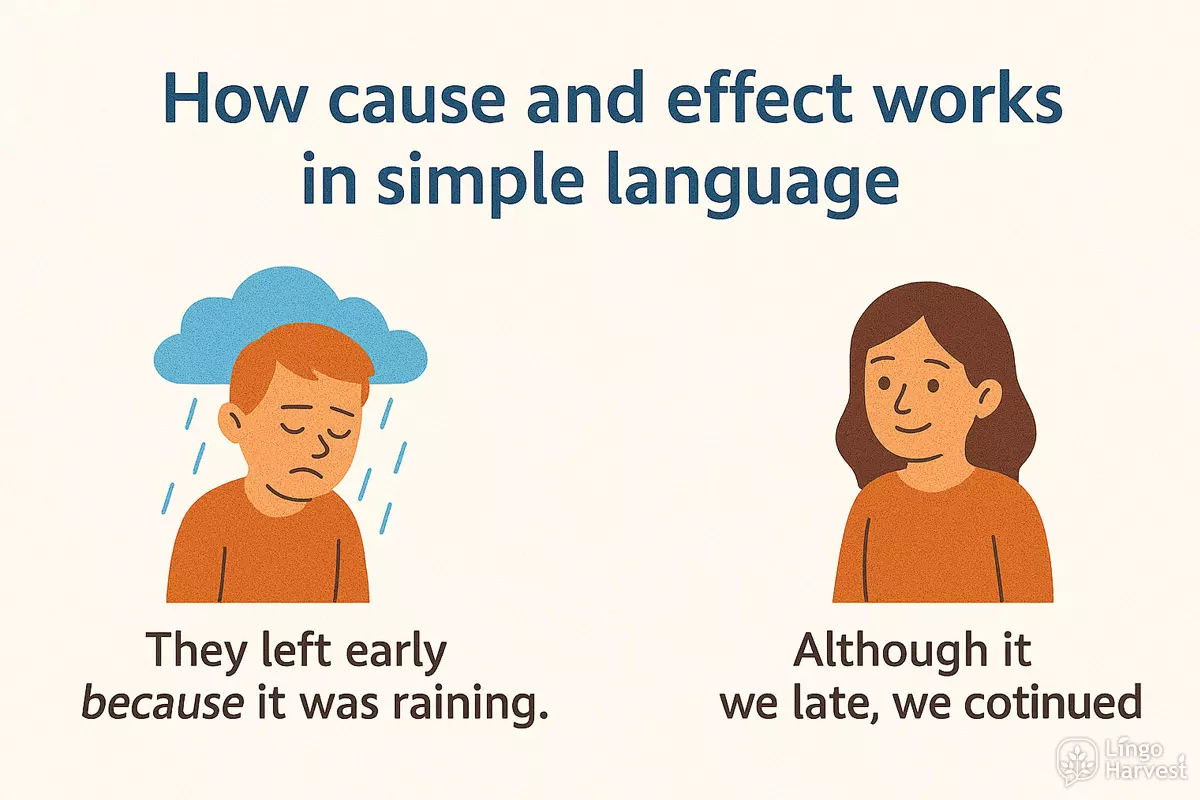
| because | They left early because it was raining. |
| although | Although it was late, we continued. |
| if | If you study, you will pass. |
| while | She cooked while he cleaned. |
| since | Since you’re here, let’s start. |
| either...or | Either you apologize or you leave. |
| neither...nor | Neither John nor Mary was present. |
Practice: Spot the Conjunction
Read these sentences and pick out the connecting word:
- We can play outside or we can stay indoors.
- He ran fast because he was late.
- They were tired, but they finished the project.
- If it rains, we will cancel the picnic.
Show answers
- or
- because
- but
- if
Keep in mind: conjunctions are usually short words, but their meaning is essential for building complex, clear sentences. Spotting them quickly will help you read and write more confidently.
Step-by-step examples of sentences with and without conjunctions
Understanding how conjunctions work can make your sentences clearer and more interesting. Below, you'll see how statements change when you add or remove these important linking words.
Comparing Simple and Combined Sentences
Let’s look at some basic sentences first, and then see how conjunctions can join them to express more complex ideas:
- I like apples. I like oranges. → I like apples and oranges.
- She was tired. She finished her homework. → She was tired, but she finished her homework.
- We can go to the park. We can stay home. → We can go to the park or stay home.
- He missed the bus. He ran to school. → He missed the bus, so he ran to school.
- They studied hard. They wanted to pass the test. → They studied hard because they wanted to pass the test.
- You can have tea. You can have coffee. → You can have tea or coffee.
- She sings. She dances. → She both sings and dances.
- I will call you. I get home. → I will call you when I get home.
- He is smart. He is kind. → He is smart and kind.
- We waited. The rain stopped. → We waited until the rain stopped.
- It was cold. We wore jackets. → It was cold, so we wore jackets.
- She can come. She can send a message. → She can come, or she can send a message.
- I want pizza. I want pasta. → I want pizza and pasta.
- He didn’t study. He failed the exam. → He didn’t study, so he failed the exam.
- We went to the store. We bought milk. → We went to the store and bought milk.
- She likes reading. She doesn’t like writing. → She likes reading, but she doesn’t like writing.
- The sun set. The sky turned orange. → The sun set, and the sky turned orange.
- He will come. He finishes work. → He will come after he finishes work.
- Bring an umbrella. It might rain. → Bring an umbrella because it might rain.
- We started early. We finished early. → We started early, so we finished early.
Side-by-side Comparison
Sometimes, it helps to see the difference visually. Here’s a table showing how two short sentences can be combined with a conjunction:
| Without Conjunction | With Conjunction |
|---|---|
| I was hungry. I made a sandwich. | I was hungry, so I made a sandwich. |
| It is raining. We will stay inside. | It is raining, so we will stay inside. |
| She likes cats. She likes dogs. | She likes cats and dogs. |
| He can play soccer. He can play tennis. | He can play soccer or tennis. |
Key Takeaways
Adding conjunctions helps link ideas smoothly, making your writing less repetitive and more natural. Practice turning separate statements into longer, connected sentences to improve your grammar skills.
Exercise: underline or highlight the conjunction in each sentence
Understanding how to spot conjunctions is an essential skill in beginner grammar. In this practice section, you will find a series of sentences that each contain at least one conjunction. Your task is to underline or highlight the word(s) that join ideas, words, or clauses. This focus on conjunctions helps you build more complex and accurate sentences in English.
Practice Sentences
Read the following sentences. Identify the conjunction in each one by underlining or highlighting it. Try to do this without referring to a list of conjunctions, then check your answers at the end.
- He wanted to go to the park, but it started to rain.
- Maria and John are coming to dinner tonight.
- I will call you when I arrive.
- She is tired, so she will rest for a while.
- You can have tea or coffee.
- We stayed at home because it was cold outside.
- Although it was late, he finished his homework.
- Do your homework before you play video games.
- She likes apples and bananas.
- He can come if he finishes his work.
- They danced until midnight.
- We will leave after lunch.
Common Conjunctions to Look For
- and
- but
- or
- so
- because
- if
- when
- although
- before
- after
- until
Conjunctions link ideas smoothly and help avoid choppy sentences. Take a moment to review your answers and see if you can spot all the joining words.
Show answers
- but
- and
- when
- so
- or
- because
- Although
- before
- and
- if
- until
- after
Once you are comfortable with these examples, try writing your own sentences using different conjunctions. This will help you internalize their use and improve your writing fluency.
Mixed practice with one and two conjunctions per sentence
Practicing with sentences that include either one or two linking words is a great way to build confidence in recognizing how these words connect ideas. Below, you’ll work through a variety of sample sentences. Some sentences contain just one joining word, while others use two. This will help you notice how different conjunctions function together and separately.
Practice: Spot the conjunction(s)
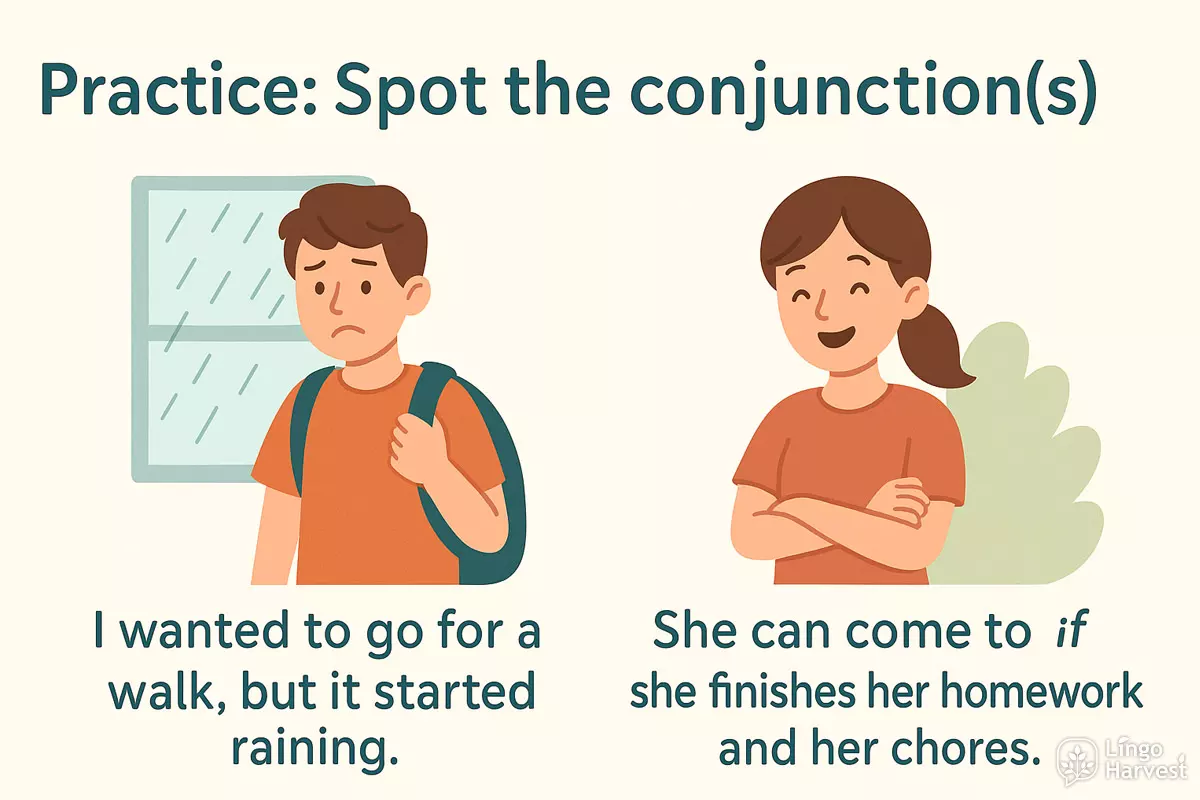
Read each sentence and identify all the connecting words (conjunctions) present. Some sentences may have only one; others might have two. Write down all that you find.
- I wanted to go for a walk, but it started raining.
- She can come to the party if she finishes her homework and her chores.
- He was tired, so he went to bed early.
- They wanted pizza or pasta, yet they couldn’t decide.
- Tom will call you when he arrives or send a message if he is late.
- We can watch a movie or play a game, but not both.
- Because it was cold and windy, we stayed inside.
- I will help you with your project if you need it, and I can bring some supplies.
- She didn’t go to the concert because she was sick and her friend was busy.
- You can have dessert after you finish your dinner or if you clean your room.
- He missed the bus, so he walked home and called his mom.
- Unless you hurry, you will miss the train and be late for the meeting.
Show answers
- 1. but
- 2. if, and
- 3. so
- 4. or, yet
- 5. when, or, if
- 6. or, but
- 7. because, and
- 8. if, and
- 9. because, and
- 10. after, or, if
- 11. so, and
- 12. unless, and
Quick review: Common conjunctions used together
It’s helpful to see how certain joining words often appear together in longer sentences. Here are some common pairs and combinations:
- if … and → If it rains, we will stay home and watch a movie.
- or … but → You can take the bus or walk, but it may take longer.
- because … and → She stayed home because she was sick and needed rest.
- so … and → It was very cold, so I wore a jacket and a scarf.
- when … or → Call me when you arrive, or send a message instead.
- unless … and → Don’t go out unless you finish your homework and clean your room.
- after … or → We can go for ice cream after school, or we can go tomorrow.
- if … or → If you are tired, rest now or take a short walk.
- when … and → When he comes home, we will eat dinner and talk.
- but … so → She was tired, but she kept studying, so she passed the test.
Mini challenge: Write your own
Create three sentences: one with a single conjunction, one with two different conjunctions, and one with two of the same conjunction. Try using a mix of words from the review list above.
Show answers
- Examples:
- Single: I took an umbrella because it looked like rain.
- Two different: She will join us if she finishes work and if she feels well.
- Two of the same: You can have tea or coffee, or you can just have water.
Challenge task: find the conjunction in a short text
Spotting conjunctions in context is a great way to reinforce your understanding of how they connect ideas. In this activity, you’ll read a short passage and identify the linking word or words that join phrases or clauses. Remember, conjunctions include words like and, but, or, so, because, although, and more. They can connect words, phrases, or even complete sentences.
Task: Read and identify
Read the following short text. Find the word(s) that act as connectors between ideas. List all the conjunctions you find:
Sam wanted to go to the park, but it started to rain, so he stayed home and read a book.
- Which words join two ideas or actions?
- Are there any that show contrast or reason?
Show answers
- but (shows contrast between Sam’s wish and the weather)
- so (shows result: it rained, so Sam stayed home)
- and (links two actions: stayed home and read a book)
Common conjunctions to look for
Here are some frequent linking words you might encounter in beginner texts. Watch for these in any reading exercise:
- and
- but
- or
- so
- because
- although
- if
- when
- while
- before
- after
- since
- until
- unless
- where
- as
- whether
- yet
- though
- nor
Try another quick example
Identify the connector(s) in this sentence:
Maria can have tea or coffee, but she doesn’t want milk.
Show answers
- or (offers a choice: tea or coffee)
- but (shows contrast: she doesn’t want milk)
Practicing with short texts helps you get comfortable spotting connectors in real situations. With time, you’ll notice how these small words shape the meaning and flow of sentences.
Answer key so learners can check their work
Review your responses to the conjunction identification tasks below. This guide highlights which words acted as conjunctions in each exercise sentence. Compare your answers and take note of common patterns to help you recognize these linking words in future grammar activities.
Conjunctions in Example Sentences
- I wanted to go outside, but it was raining. ✅ (but joins two contrasting ideas)
- She likes tea and coffee. ✅ (and adds similar items)
- We can leave now or wait for Anna. ✅ (or offers a choice)
- He was tired, so he went to bed early. ✅ (so shows result)
- Call me when you arrive. ✅ (when connects time clauses)
- She studied hard because she wanted to pass. ✅ (because gives a reason)
- We’ll eat dinner after we finish the movie. ✅ (after indicates sequence)
- He didn’t study, but he passed the test. ✅ (but contrasts statements)
- I will go if you come with me. ✅ (if shows condition)
- She sings while she cooks. ✅ (while links simultaneous actions)
- Take your umbrella in case it rains. ✅ (in case gives a precaution)
- They went to the park although it was cold. ✅ (although expresses contrast)
- He will not go unless you invite him. ✅ (unless sets a condition)
- I’ll call you before I leave. ✅ (before indicates time)
- We can go to the museum or the zoo. ✅ (or gives an alternative)
- She not only plays the piano but also sings. ✅ (but also adds emphasis)
- I’ll stay home unless you need help. ✅ (unless sets a condition)
- He acts as if he knows everything. ✅ (as if shows manner)
- I’m happy because you’re here. ✅ (because gives reason)
- She will succeed if she works hard. ✅ (if states a condition)
If you missed any, revisit the original sentences and try to spot the linking words. Practicing with these answers should help you build confidence in identifying conjunctions in beginner-level texts.