Combine the Clauses Using a Natural Conjunction (A1–A2)

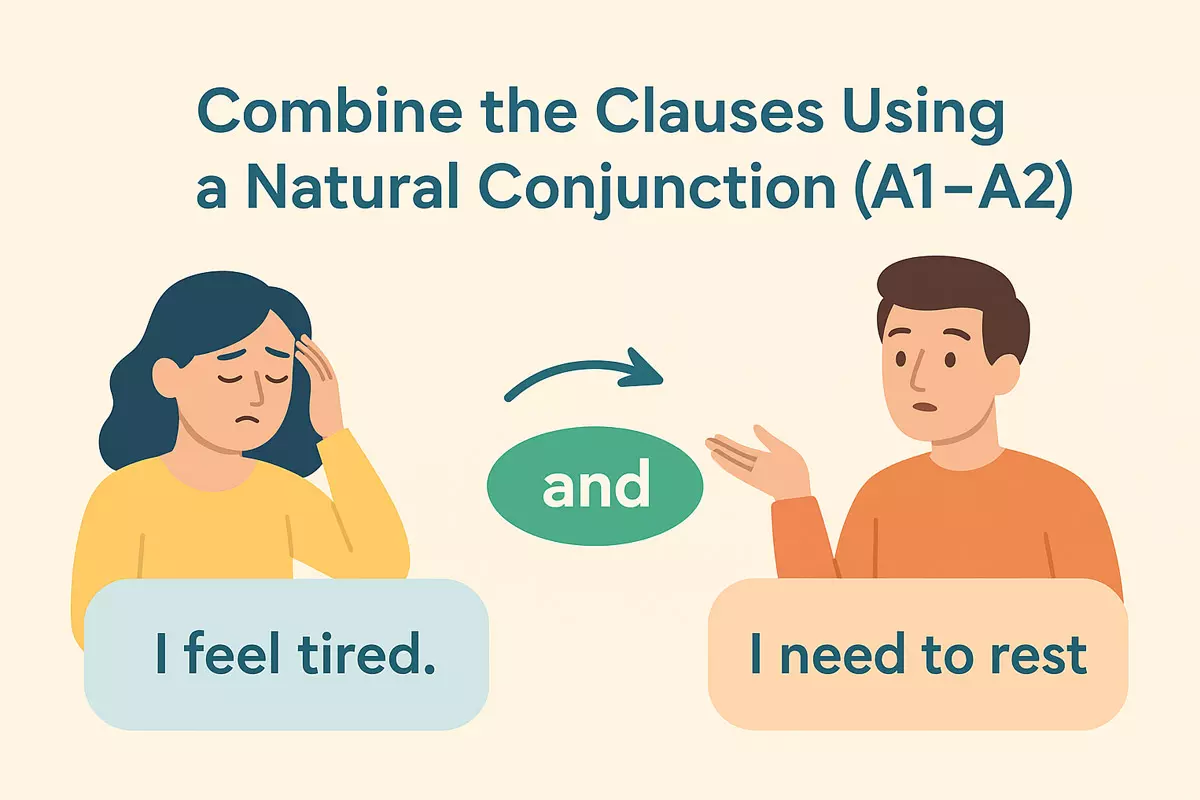 Here we why joining short sentences makes English sound natural, how to pick the right conjunction for meaning, examples for each, patterns for combining ideas, and includes both guided and free exercises for practice.
- Why we combine short sentences into longer ones
- Choosing a natural conjunction based on meaning
- Examples of combining clauses with and, but, or, because, so
- Patterns for combining reason, contrast, and result ideas
- Guided exercises: rewrite two sentences as one
- Free practice: students choose a conjunction and write their own sentence pairs
Connecting simple sentences smoothly is an essential skill for clear and effective English communication. When you learn to join clauses with common linking words such as and, but, or because, your writing and speech become more fluid and easier to understand. This not only helps your ideas flow logically from one to another but also makes your English sound more natural and closer to that of native speakers. Practicing these techniques can greatly improve your confidence and ability to express yourself in a variety of situations.
Why we combine short sentences into longer ones
Connecting shorter statements into a single, more complex sentence helps make communication smoother and clearer. When we use natural conjunctions like and, but, or because, our ideas flow better and listeners or readers can follow our thoughts more easily. Instead of jumping from one short idea to another, linking them shows how the ideas relate.
Benefits of joining clauses
- Clarity: Shows the relationship between ideas (reason, contrast, addition).
- Efficiency: Reduces repetition and keeps writing concise.
- Natural flow: Sounds more like how people speak in real conversations.
- Interest: Prevents texts from sounding choppy or robotic.
- Variety: Allows writers to use different structures, making the text more engaging.
Examples of simple sentences combined with conjunctions
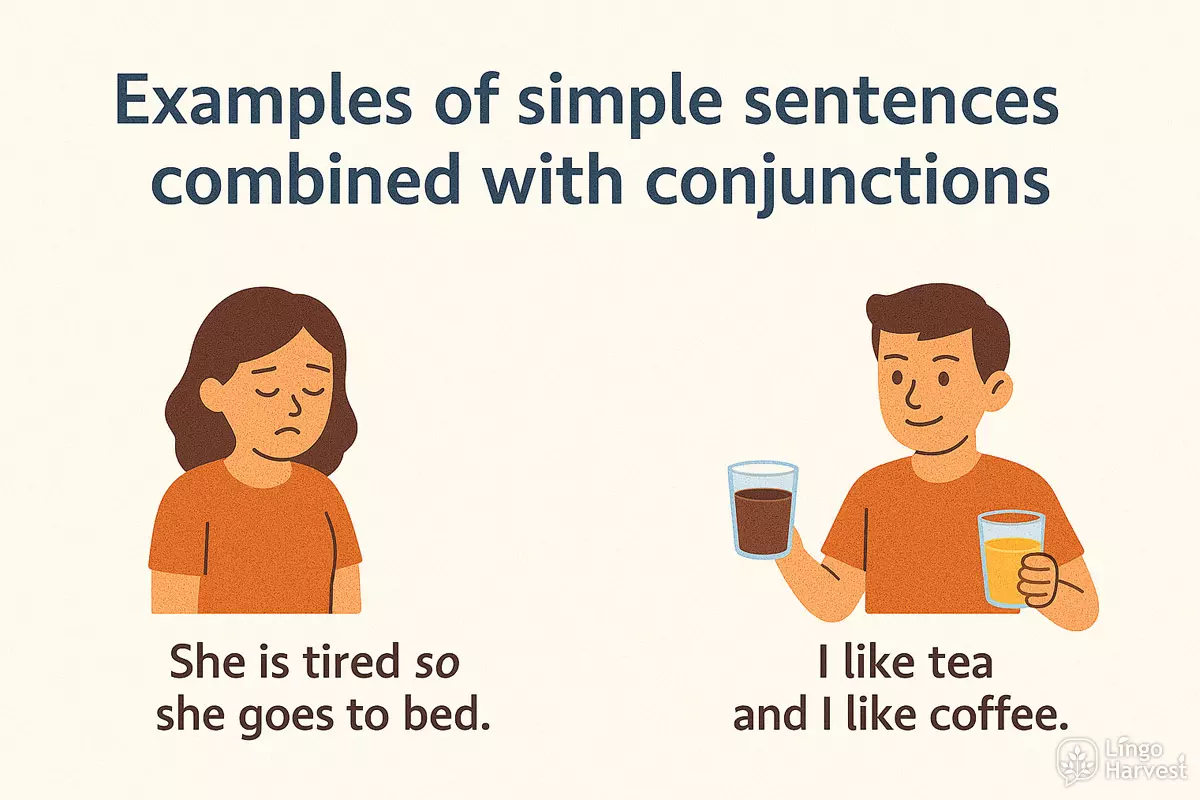
- She is tired. She goes to bed. → She is tired so she goes to bed.
- I like tea. I like coffee. → I like tea and I like coffee.
- He is hungry. He has no food. → He is hungry but he has no food.
- It is raining. We will stay inside. → Because it is raining, we will stay inside.
- They studied. They passed the exam. → They studied and they passed the exam.
- She called me. I was not at home. → She called me but I was not at home.
- We finished our work. We went for a walk. → We finished our work and we went for a walk.
- You can have tea. You can have coffee. → You can have tea or coffee.
- He was late. He missed the bus. → He was late so he missed the bus.
- She is friendly. She is helpful. → She is friendly and helpful.
- I want pizza. I want pasta. → I want pizza or pasta.
- They are tired. They keep working. → They are tired but they keep working.
When not to combine
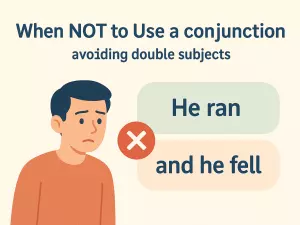
Sometimes, using shorter statements is better—especially when you want to emphasize each idea or when the information is unrelated. However, for related thoughts, combining them with a conjunction usually makes your English sound more natural and fluent.
Choosing a natural conjunction based on meaning
When you want to join two simple sentences, it’s important to select a linking word that fits the relationship between them. Different conjunctions express different ideas—such as addition, contrast, reason, or time. Picking the right connector helps your sentences sound clear and natural, even at beginner (A1–A2) level.
Common conjunctions and their uses
Some conjunctions are used to add information, while others show contrast, cause, result, or time. Here are some of the most useful options for new learners:
- and – for adding similar ideas or actions
Example: She likes apples and oranges. - but – for showing contrast or difference
Example: He is tall but his brother is short. - or – for offering choices or alternatives
Example: Would you like tea or coffee? - because – to give a reason
Example: I am tired because I worked late. - so – to show a result
Example: It was raining, so we stayed inside. - when – for talking about time
Example: I eat breakfast when I get up. - if – for conditions or possibilities
Example: If it rains, we will stay home. - while – to show two actions happening at the same time
Example: She reads while she waits. - because of – to state the reason (followed by a noun)
Example: The game was canceled because of rain. - so that – to show purpose
Example: He speaks loudly so that everyone can hear. - before – to show which action comes first
Example: Wash your hands before you eat. - after – to show what happens next
Example: We went home after the movie. - although – for unexpected contrast
Example: Although it was cold, we went swimming. - as – for cause (similar to “because”)
Example: She left early as she was tired. - until – to show a limit in time
Example: Wait here until I come back. - unless – for negative condition
Example: You can’t go out unless you finish your homework.
How to choose the right conjunction
To select the most natural connector, ask yourself: What is the relationship between the two ideas? Are you adding information, giving a reason, showing a result, or talking about time? Use these questions to guide your choice.
| Situation | Conjunction Example |
|---|---|
| Adding information | I have a cat and a dog. |
| Showing contrast | He is young but very wise. |
| Giving a reason | They stayed inside because it was cold. |
| Showing a result | She was hungry, so she ate lunch. |
| Talking about time | Call me when you arrive. |
| Offering a choice | Do you want juice or water? |
| Describing condition | If you study, you will pass. |
Remember, using the right linking word makes your sentences smoother and easier to understand. Practice with different connectors to get comfortable expressing various relationships between ideas.
Examples of combining clauses with and, but, or, because, so
Combining two simple sentences with conjunctions helps your English sound natural and connected. Here, you’ll see how to link short statements using “and,” “but,” “or,” “because,” and “so.” Each word adds a different meaning—sometimes joining similar ideas, showing contrast, giving a reason, or talking about a result.
Basic patterns with conjunctions
- I have a dog and I have a cat.
- She is tired but she wants to go out.
- We can eat pizza or we can eat pasta.
- He stayed at home because it was raining.
- It was late, so we went home.
More sample sentences
- Tom likes apples and he likes oranges.
- Anna tried hard but she didn’t win.
- Do you want tea or coffee?
- I took an umbrella because it might rain.
- We finished the work so we relaxed.
- She can play the piano and she can sing.
- He is friendly but he is very shy.
- You can come now or you can come later.
- I am happy because I passed my exam.
- The bus was full, so we walked.
- We cooked dinner and set the table.
- He wanted to go out but he was sick.
- Would you like juice or water?
- They stayed inside because it was cold.
- She forgot her keys, so she called her friend.
Quick guide: choosing the right conjunction
| Conjunction | When to use | Example |
|---|---|---|
| and | To add similar ideas | Lisa reads and writes stories. |
| but | To show contrast | It’s sunny, but it’s cold. |
| or | To offer a choice | Do you want cake or ice cream? |
| because | To give a reason | I’m staying home because I’m tired. |
| so | To show a result | I was hungry, so I ate. |
Practice using these words to connect your sentences for clearer and more natural English. Notice how each conjunction changes the relationship between the two ideas.
Patterns for combining reason, contrast, and result ideas
Understanding how to join clauses to express cause, opposition, and outcomes is essential for clear communication, especially at the beginner (A1–A2) level. These basic sentence structures help you explain why something happens, show differences, or describe consequences. Using natural conjunctions makes your speech and writing more fluent and easy to follow.
Expressing Reasons
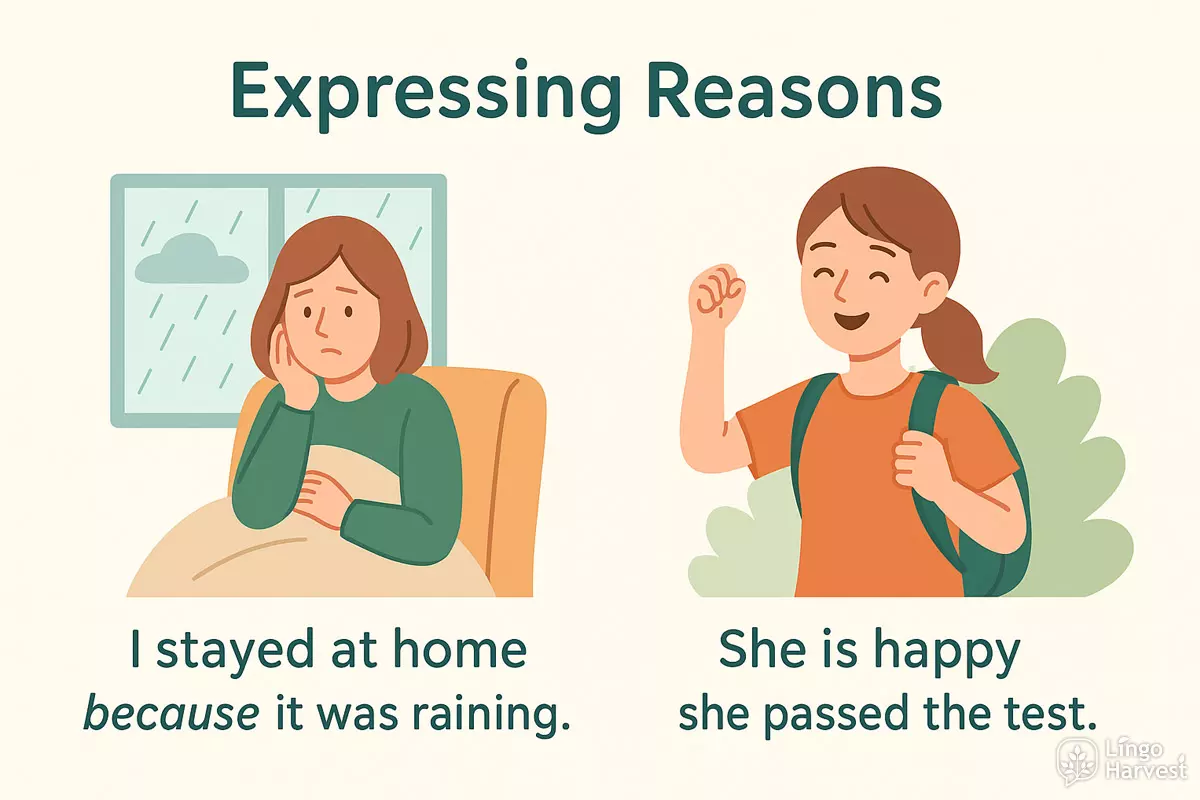
To give a reason, simple connectors like because, as, and since are common. These words introduce a cause or explanation. Here are some typical ways to do this:
- I stayed at home because it was raining.
- She is happy because she passed the test.
- We left early as we were tired.
- He didn't eat the cake since he wasn't hungry.
Showing Contrast
When you want to show contrast, words like but, although, though, and however are useful. These help you connect two ideas that are different or opposite.
- I like tea, but I don't like coffee.
- Although it was cold, we went outside.
- He is young, but he is very responsible.
- She was tired. However, she finished her homework.
Stating Results
To express results or consequences, connectors such as so, therefore, and as a result are often used. These help you show what happens next or the effect of an action.
- It started to rain, so we went inside.
- He studied hard, so he got good marks.
- The shop was closed, therefore we went home.
- She missed the bus, as a result, she was late.
Common Conjunctions at A1–A2 Level
Below is a handy reference for typical connectors that join clauses for reason, contrast, and result at beginner levels:
| Type | Common conjunctions/examples |
|---|---|
| Reason | because, as, since She is sad because her friend left. |
| Contrast | but, although, though, however I wanted to go, but I was busy. |
| Result | so, therefore, as a result It was late, so we went to bed. |
Tips for Natural Combinations
- Place the connector between two simple clauses for clarity.
- Keep sentences short when starting out; combine only two ideas at once.
- Practice switching the order of clauses: Because it was cold, we stayed inside. vs. We stayed inside because it was cold.
- Listen for these patterns in everyday speech and try using them in your own sentences.
By practicing these connectors, you can add variety and clarity to your writing and speaking, making your ideas easier to understand and more engaging.
Guided exercises: rewrite two sentences as one
Combining two short statements into one is a key skill for beginners learning to use conjunctions naturally. This practice helps you form longer, more fluent sentences while expressing ideas clearly. Focus on using simple connectors such as and, but, or, because, and so. Try to notice how the meaning changes depending on the word you choose.
Common conjunctions at A1–A2 level
- and – adds information (e.g. I like apples and oranges.)
- but – shows contrast (e.g. She is tall but he is short.)
- or – offers a choice (e.g. Do you want tea or coffee?)
- because – gives a reason (e.g. I am tired because I worked late.)
- so – shows a result (e.g. It rained so we stayed inside.)
Practice: Join the sentences using a suitable conjunction
- He likes pizza. He doesn’t like pasta.
- I have a bike. I ride it to school.
- We can go to the park. We can go to the museum.
- She is hungry. She eats a sandwich.
- It’s cold. I wear a jacket.
- Tom is tired. He goes to bed early.
- Anna studies hard. She wants good grades.
- I lost my keys. I can’t open the door.
- They play football. They play basketball.
- He is late. The bus was slow.
Show answers
- He likes pizza but he doesn’t like pasta.
- I have a bike and I ride it to school.
- We can go to the park or we can go to the museum.
- She is hungry so she eats a sandwich.
- It’s cold so I wear a jacket.
- Tom is tired so he goes to bed early.
- Anna studies hard because she wants good grades.
- I lost my keys so I can’t open the door.
- They play football and they play basketball.
- He is late because the bus was slow.
Tips for success
- Choose the conjunction that best fits the relationship between the ideas.
- Pay attention to word order; usually, the conjunction goes between the two clauses.
- Use a comma before but, so, or because in longer sentences for clarity.
- Practice with your own sentences to build confidence.
This approach helps you to connect thoughts smoothly and makes your English more natural and clear. Try combining simple ideas in your daily conversations or writing for extra practice.
Free practice: students choose a conjunction and write their own sentence pairs
Encouraging learners to create their own examples is a great way to build confidence with conjunctions. After reviewing basic joining words like "and," "but," "or," and "because," students can try making original sentence pairs by choosing a conjunction themselves. This activity supports both creativity and understanding of how these words connect ideas.
How to Practice
Ask students to think of two short, simple sentences. Then, they pick a conjunction from the list below and combine their sentences into one. This can be done in writing or as a speaking exercise in pairs or small groups.
- and → I bought apples and oranges.
- but → She is tired but happy.
- or → Do you want tea or juice?
- because → He stayed home because he was sick.
- so → It was cold, so I wore a jacket.
- when → Call me when you arrive.
- if → If it rains, we’ll stay inside.
- while → She cooked dinner while he set the table.
- although → Although it was late, they kept talking.
- after → We went home after the movie.
- before → Wash your hands before you eat.
- since → Since it’s warm, we can go for a walk.
- until → Wait here until I come back.
- unless → Don’t go out unless you need to.
- as → As it got dark, they went inside.
Here are some steps to guide the process:
- Write two related simple sentences.
Example: "She is tired." "She goes to bed early." - Choose an appropriate conjunction.
For example, "because". - Combine the sentences.
"She goes to bed early because she is tired."
Practice Tasks
Try combining the following pairs of sentences using any conjunction from the list above. Write your new sentences.
- I have an umbrella. It is raining.
- He is late. The bus was slow.
- We can watch a movie. We can play a game.
- She likes tea. She does not like coffee.
- They finished their homework. They went outside.
- The shop is closed. It is Sunday.
- I will call you. I arrive home.
- Tom is hungry. He did not eat breakfast.
- You study hard. You will pass the test.
- It is cold. I forgot my jacket.
Show answers
- I have an umbrella because it is raining.
- He is late because the bus was slow.
- We can watch a movie or we can play a game.
- She likes tea but she does not like coffee.
- They finished their homework and they went outside.
- The shop is closed because it is Sunday.
- I will call you when I arrive home.
- Tom is hungry because he did not eat breakfast.
- If you study hard, you will pass the test.
- It is cold, but I forgot my jacket.
Tips for Creating Your Own Sentences
- Think about the relationship between your two ideas. Do they add together, show contrast, or explain a reason?
- Try using different conjunctions to see how the meaning changes.
- Check your sentences for natural flow and correct word order.
- Practice aloud to improve your speaking confidence.
By making your own sentence pairs with conjunctions, you deepen your understanding of how to connect thoughts in clear, natural English. This skill is useful for both writing and conversation.