Conjunctions of Contrast: although, though, whereas

 The article explains how to express contrast using although, though, and whereas, including their specific uses, sentence placement, and comma rules. It also provides practice exercises for rewriting sentences with different contrast conjunctions.
- Review of contrast vs simple difference
- Using although to show a surprising or opposite idea
- Using though in spoken and informal written English
- Using whereas to compare two people, things, or situations
- Position of contrast clauses at the beginning or end of a sentence
- Comma rules and style notes for each conjunction
- Practice: rewrite sentences using different contrast conjunctions
Learning the subtle differences between words that convey contrast or unexpected information can significantly improve your English fluency and precision. By mastering terms such as although, though, and whereas, you will be able to connect ideas more smoothly and enrich your writing. Each of these words serves a unique function in linking contrasting statements, so understanding when and how to use them appropriately allows you to express complex thoughts clearly and effectively. This skill not only enhances your communication but also makes your writing more engaging and nuanced.
Review of contrast vs simple difference
Understanding the difference between expressing contrast and simply noting a difference is crucial when choosing conjunctions like although, though, and whereas. Contrast highlights opposition or unexpected relationships between ideas, while a simple difference just points out that two things are not the same.
What is contrast?
Contrast emphasizes a relationship where two ideas seem to pull against each other. With conjunctions of contrast, the second clause often surprises or contradicts expectations set by the first. These are common with although, though, and whereas.
- Although it was raining, we went for a walk. (Expectation: rain prevents walking; reality: we walked anyway.)
- Though she was tired, she finished her project. (Expectation: tiredness stops work; reality: she completed it.)
- He is very friendly, whereas his brother is quite shy. (Direct opposition in personalities.)
Simple difference
A simple difference is just a factual distinction, without the element of contradiction or surprise. Words like but or and sometimes appear, but the relationship isn't strongly adversative.
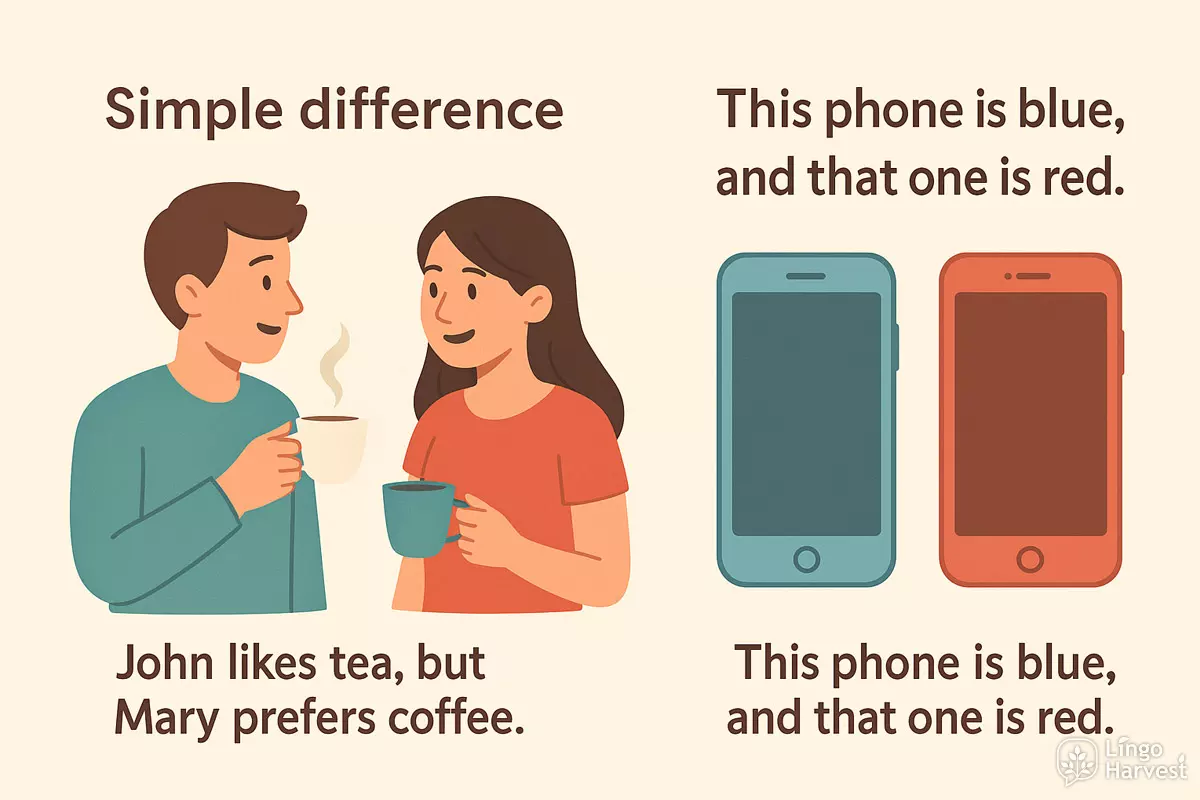
- John likes tea, but Mary prefers coffee. (Just a difference in preference.)
- This phone is blue, and that one is red. (No implied opposition.)
- My car is new; yours is older. (Simple comparison.)
Comparing contrast and simple difference
| Contrast (Opposition) | Simple Difference |
|---|---|
| Although he’s rich, he lives simply. | He is rich. She is not. |
| She smiled, though she was upset. | She smiled. He frowned. |
| Whereas cats are independent, dogs need attention. | Cats sleep more; dogs bark more. |
| He failed the exam, although he studied hard. | He failed. She passed. |
| My room is messy, whereas yours is tidy. | My room is blue; yours is green. |
Recognizing contrast in context
To spot true contrast, look for sentences where the second idea is unexpected based on the first. Conjunctions of contrast often highlight these situations, while simple differences lack this element.
Practice: Identify the type of relationship
Decide if each sentence pair shows contrast (C) or simple difference (D):
- He is tall, whereas his brother is short.
- She likes apples. He likes oranges.
- Although it was late, they kept working.
- This pen is black; that one is blue.
- Though it was cold, she went swimming.
- She enjoys travelling; her sister prefers staying home.
- While he loves jazz, she listens only to rock.
- He studied hard, yet he failed the exam.
- The old model is heavy; the new one is much lighter.
- Even though he was tired, he continued training.
Show answers
- C
- D
- C
- D
- C
- D
- C
- C
- D
- C
Using although to show a surprising or opposite idea
The conjunction although helps connect two ideas when the second one is surprising or contrasts with the first. This word introduces a clause that sets up an unexpected result, making it clear that there is a contrast or contradiction between two facts. For example, you might say, “Although it was raining, we went for a walk.” Here, the expectation is that rain would prevent a walk, but the outcome is the opposite.
Common sentence patterns with "although"
You can use although at the beginning or in the middle of a sentence. Both structures are correct, but punctuation differs:
- Although + clause, main clause.
Although she was tired, she finished her project. - Main clause + although + clause.
She finished her project although she was tired.
Examples of "although" showing contrast
Here are several examples that illustrate how this conjunction introduces a surprising or opposite idea:
- Although I studied hard, I didn’t pass the test.
- Although the weather was cold, the children played outside.
- She smiled although she was upset.
- Although he’s allergic to cats, he adopted one.
- Although the food looked delicious, it tasted bland.
- He arrived on time although he missed the bus.
- Although they disagreed, they remained friends.
- Although the instructions were clear, I made a mistake.
- She wore the dress although it was too big.
- Although the concert was expensive, it sold out quickly.
- Although he tried his best, he didn’t win the race.
- The team won although they played poorly.
- Although she loves chocolate, she didn’t eat any cake.
- Although it’s late, I’m not tired.
- He kept working although everyone else left.
- Although my phone is old, it still works well.
Key points to remember
- Although cannot be followed directly by a noun or gerund; it must connect clauses with subjects and verbs.
- A comma is usually used when the subordinate clause comes first.
- It is more formal than though, but both can be used interchangeably in many cases.
By using although, you can clearly indicate when one situation is unexpected based on another, which helps make your writing and speaking more nuanced and precise.
Using though in spoken and informal written English
In everyday conversations and casual writing, "though" is extremely common and often used differently from its formal cousin "although." Unlike more formal connectors, "though" frequently appears at the end of sentences and can express a mild contrast, soften disagreement, or add an afterthought. This flexibility makes it a favorite in chats, texts, and informal emails.
Typical uses and positions of "though"
"Though" can appear at the start, middle, or end of a sentence. In informal contexts, it's especially popular at the end, where it sounds less formal and more conversational. Here are some typical patterns:
- I like this movie. It's a bit long, though.
- She said she’d join us, though I’m not sure she’ll make it.
- It’s cold outside. Nice weather for a walk, though!
- He failed the test. He tried hard, though.
- We could go out. I’m tired, though.
- The cake looks messy. It tastes great, though.
- They didn’t win. They played well, though.
- He’s busy. He’ll call you back, though.
- That’s expensive. Worth it, though.
- We’re late. No one’s here yet, though.
- I can’t come tonight. Thanks for inviting me, though.
- She’s quiet. She’s really friendly, though.
- This is tricky. Not impossible, though.
- I’ll try. No promises, though.
- The answer’s wrong. Good guess, though!
- He’s not here. He left a note, though.
- The shop’s closed. The café next door is open, though.
- It rained all day. We had fun, though.
Comparing "though" and "although" in informal English
While "although" is more common in written or formal language, "though" is preferred in speech and informal writing. "Though" is also more flexible in word order.
| Formality | Placement in Sentence | Typical Example |
|---|---|---|
| Formal ("although") | Usually at the start or middle | Although it was late, they kept talking. |
| Informal ("though") | Flexible: start, middle, or end | They kept talking. It was late, though. |
Extra notes and tips
- "Though" is rarely used at the start of a sentence in spoken English; it usually appears mid-sentence or at the end.
- Adding "though" at the end of a statement can make speech sound softer or less direct.
- In quick text exchanges, "though" is often shortened to "tho" to save time.
- Using "though" at the end can signal an unspoken contrast, letting the listener fill in the gap.
Overall, "though" adds a natural, conversational flavor and is highly versatile in less formal settings.
Using whereas to compare two people, things, or situations
The conjunction whereas is a useful tool in English for highlighting contrasts between two subjects, objects, or circumstances. It often connects two independent clauses, showing that they are in some way opposite or different from each other. This word is commonly found in both formal writing and everyday speech when making clear, direct comparisons.
How "whereas" functions in sentences
Typically, whereas is placed at the beginning of the second clause, but it can also come at the start of a sentence. The two clauses it connects are generally separated by a comma for clarity. Using this conjunction helps to clarify differences, making your statements more precise and nuanced.
Common patterns and examples
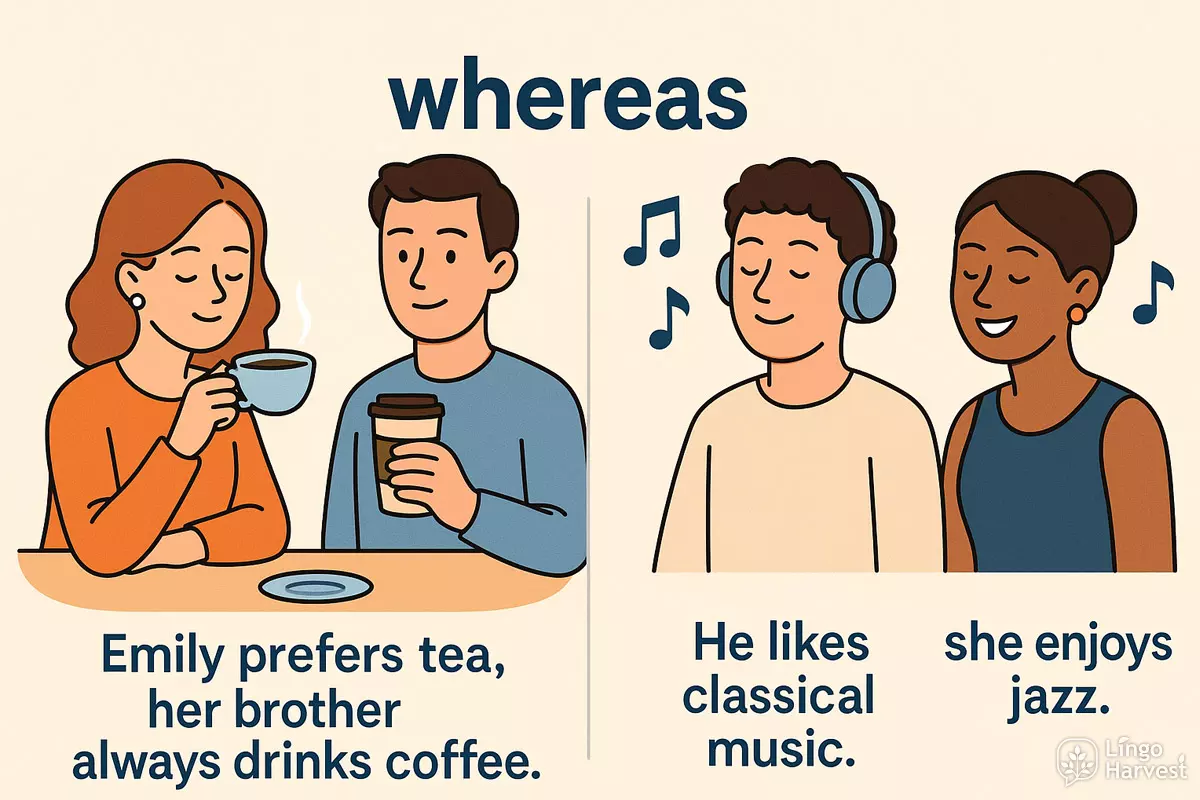
- Emily prefers tea, whereas her brother always drinks coffee.
- Cats are independent animals, whereas dogs often seek attention from their owners.
- This phone is very affordable, whereas the other model is quite expensive.
- My job is mostly desk-based, whereas my friend works outside all day.
- The city is noisy and crowded, whereas the countryside is peaceful.
- He likes classical music, whereas she enjoys jazz.
- Some people learn languages quickly, whereas others need more time.
- This computer runs on Windows, whereas that one uses MacOS.
- My parents grew up in a small town, whereas I was raised in a big city.
- One solution is cost-effective, whereas the other is faster.
- We start work at 8 a.m., whereas our partners begin at 10 a.m.
- Her shoes are comfortable, whereas mine are too tight.
- This project is nearly finished, whereas the other has just begun.
- He speaks three languages fluently, whereas his sister only knows one.
- Our office is in the city center, whereas theirs is in the suburbs.
- The north of the country is cold, whereas the south is warm year-round.
Comparing features side by side
When showing differences between two people, objects, or situations, it can be helpful to organize information visually. Here’s a table that illustrates how whereas structures contrast in sentences:
| First Clause | Second Clause (with "whereas") |
|---|---|
| John enjoys hiking on weekends | whereas Mark prefers to stay indoors. |
| The red car is very fast | whereas the blue car is more economical. |
| Our department focuses on research | whereas theirs handles customer service. |
| She likes modern art | whereas he prefers classical paintings. |
| This restaurant serves Italian food | whereas that one offers Japanese cuisine. |
Tips for using "whereas" correctly
- Use whereas to link two complete ideas that contrast.
- A comma is usually placed before whereas to separate the clauses.
- Do not use whereas to introduce a reason; it is strictly for contrast.
- In very formal writing, whereas can introduce legal or official statements, but in everyday use, it simply highlights differences.
By incorporating whereas into your comparisons, you can express differences between people, things, or situations with clarity and precision.
Position of contrast clauses at the beginning or end of a sentence
Deciding where to place contrast clauses using conjunctions like although, though, and whereas can affect both emphasis and flow. These subordinate clauses can appear at the start or end of a sentence, but the choice often shapes the nuance or style. Placing the contrasting clause first highlights the unexpected or surprising information, while positioning it at the end often makes for a smoother, more conversational tone.
Common Patterns for Contrast Clauses
- At the beginning: Although it was late, he kept working.
- At the end: He kept working, although it was late.
- Start: Though she was tired, she finished the race.
- End: She finished the race, though she was tired.
- Start: Whereas John prefers tea, Mary likes coffee.
- End: John prefers tea, whereas Mary likes coffee.
Usage Notes and Emphasis
- When the contrast is important or surprising, beginning with the subordinate clause adds emphasis.
- For more neutral or backgrounded contrasts, ending with the clause is common in spoken and informal writing.
- Although and though are flexible; whereas nearly always introduces the second part, especially in formal contexts.
- Commas are usually needed when the subordinate clause comes first, but may be optional at the end in short sentences.
- Though is often used in informal speech at the end: “It was raining. Nice day, though.”
Expanded Examples: Front vs. End Placement
- Although he studied hard, he didn’t pass the exam. → He didn’t pass the exam, although he studied hard.
- Though it’s expensive, many people buy it. → Many people buy it, though it’s expensive.
- Whereas my brother loves sports, I prefer reading. → I prefer reading, whereas my brother loves sports.
- Although the weather was bad, we went hiking. → We went hiking, although the weather was bad.
- Though he apologized, she was still upset. → She was still upset, though he apologized.
- Whereas some people like city life, others prefer the countryside. → Others prefer the countryside, whereas some people like city life.
- Although I was nervous, the presentation went well. → The presentation went well, although I was nervous.
- Though he tried his best, he didn’t succeed. → He didn’t succeed, though he tried his best.
- Whereas cats are independent, dogs need more attention. → Dogs need more attention, whereas cats are independent.
- Although it was noisy, she managed to concentrate. → She managed to concentrate, although it was noisy.
Summary Table: Clause Placement and Effect
| Clause Position | Effect & Example |
|---|---|
| Beginning of sentence | Emphasizes the contrast or surprising info Although it was raining, we went outside. |
| End of sentence | Gives a more relaxed, conversational feel We went outside, although it was raining. |
| With “though” at the end | Very informal, often in speech Nice day, though. |
| “Whereas” (usually mid-sentence) | Contrasts two subjects or facts, often formal Some enjoy skiing, whereas others do not. |
In short, the placement of contrast clauses with although, though, and whereas is flexible and purposeful. Choose the position that best matches the emphasis and style you want to convey.
Comma rules and style notes for each conjunction
Understanding when to use commas with contrast conjunctions like although, though, and whereas helps your writing stay clear and natural. Each conjunction has its own style guidelines, depending on sentence structure and position.
Although
When although introduces a subordinate clause at the start of a sentence, a comma is usually needed before the main clause. But if the clause comes after the main statement, you typically don’t need a comma before although. For example:
- Although it was raining, we went for a walk.
- We went for a walk although it was raining.
- Although she was tired, she finished the report.
- Although he tried his best, he didn’t win.
- Although they practiced a lot, they still made mistakes.
- Although the shop was busy, we found what we needed.
Though
Avoid putting a comma after "though" when it starts a clause. When used at the end, it takes a comma before it.
- He passed the test, though he didn’t study much.
- He didn’t study much. He passed the test, though.
- She stayed quiet, though she disagreed.
- The food was delicious, though a bit spicy.
- They enjoyed the trip, though the weather was bad.
- I liked the movie, though it was too long.
Whereas
"Whereas" contrasts two ideas and normally has a comma before it.
- She likes tea, whereas he prefers coffee.
- The north is cold, whereas the south is warm.
- John is outgoing, whereas his sister is shy.
- This phone is expensive, whereas that one is affordable.
- Dogs are loyal, whereas cats are more independent.
- He loves sports, whereas I prefer reading.
Don't use a comma after whereas.
Summary Table: Comma Use with Contrast Conjunctions
| Conjunction | Comma Rule Example |
|---|---|
| Although | Comma after the clause if it starts the sentence: Although it was late, they kept talking. |
| Though | Comma before when at end/afterthought: He was tired, though. |
| Whereas | Comma before: She enjoys hiking, whereas he prefers reading. |
Quick Style Notes
- Although and though are not interchangeable in very formal writing; use although for higher formality.
- Whereas often appears in legal or formal contexts.
- Never use a comma directly after although, though, or whereas.
- Keep sentences clear by not overusing contrast conjunctions in the same sentence.
- When in doubt, read the sentence aloud—if you naturally pause, a comma is probably needed.
Practice: rewrite sentences using different contrast conjunctions
Understanding how to use contrast conjunctions such as although, though, and whereas is essential for expressing differences between ideas. Below, you'll find guided exercises and examples to help you practice substituting one conjunction for another, and to see how the meaning or emphasis can shift depending on your choice.
Rewrite the Sentences
Try to transform each sentence by replacing the contrast word with a different one from the set: although, though, whereas. Pay attention to word order and punctuation changes that may be necessary.
- Although it was raining, we went for a walk.
- The blue shirt is expensive, whereas the red one is cheap.
- I enjoyed the film, though it was a bit long.
- She likes rock music, whereas he prefers jazz.
- Although he studied hard, he failed the test.
- The train was delayed, though it eventually arrived.
- He is very outgoing, whereas his brother is shy.
- Although they invited her, she didn’t come.
- The soup was cold, though it tasted good.
- My sister is tall, whereas I am short.
Show answers
- We went for a walk, though it was raining. / We went for a walk, whereas it was raining. (Note: "whereas" is less natural here.)
- The blue shirt is expensive, although the red one is cheap. / The blue shirt is expensive, though the red one is cheap.
- Although the film was a bit long, I enjoyed it. / I enjoyed the film, whereas it was a bit long. (Less common usage for "whereas" here.)
- She likes rock music, although he prefers jazz. / She likes rock music, though he prefers jazz.
- He studied hard, though he failed the test. / He studied hard, whereas he failed the test. (Unusual with "whereas", but possible.)
- Although the train was delayed, it eventually arrived. / The train was delayed, whereas it eventually arrived. (Not typical, but possible.)
- He is very outgoing, although his brother is shy. / He is very outgoing, though his brother is shy.
- They invited her, though she didn’t come. / They invited her, whereas she didn’t come. (Awkward, but possible.)
- Although the soup was cold, it tasted good. / The soup was cold, whereas it tasted good. (Again, less natural.)
- My sister is tall, although I am short. / My sister is tall, though I am short.
Comparing Conjunctions of Contrast
Sometimes, the choice between these conjunctions depends on sentence structure and the level of contrast you wish to express. Here’s a comparison of how the same idea can be expressed with each conjunction:
| Original Sentence | Alternative with a Different Conjunction |
|---|---|
| Although it was late, they kept talking. | They kept talking, though it was late. |
| He likes tea, whereas she prefers coffee. | He likes tea, although she prefers coffee. |
| The exam was difficult, though I passed. | Although the exam was difficult, I passed. |
| I enjoy hiking, whereas my friend prefers cycling. | I enjoy hiking, though my friend prefers cycling. |
| Although the weather was cold, we went swimming. | We went swimming, whereas the weather was cold. |
Quick Practice: Identify the Most Natural Conjunction
For each sentence below, choose the most appropriate contrast conjunction.
- ______ she was tired, she finished her homework.
- My brother is quiet, ______ I am talkative.
- I love spicy food, ______ my friend does not.
- We arrived early, ______ the others were late.
- ______ it was raining, they continued playing outside.
- She enjoys action films, ______ her sister prefers comedies.
- He studied hard, ______ he didn’t pass the exam.
- ______ he was very young, he won the championship.
- The first task was easy, ______ the second was quite difficult.
- ______ she didn’t feel well, she went to work.
Show answers
- Although
- whereas
- whereas / although (context-dependent)
- whereas
- Although
- whereas
- but / yet
- Although
- whereas
- Although / Even though
Practicing these transformations helps you become flexible in expressing contrast, and allows you to choose the most suitable conjunction for each context.