Conjunctions of Time (B1–B2): while, as soon as, once

 This article explains how time conjunctions like while, as soon as, and once order actions on a timeline. It covers their use in real examples, rules for tense, and tips for avoiding will in future sentences, plus practice exercises.
- How time conjunctions place actions on a timeline
- Using while to show two actions in progress together
- Using as soon as to show immediate sequence
- Using once to show an action that must finish before another starts
- Tense choices with these time conjunctions in real examples
- Avoiding will after time conjunctions in future sentences
- Practice: fill in the gaps with the best time conjunction
Mastering how to connect actions and events in English can make your conversations smoother and more precise. By learning to use linking words such as while, as soon as, and once, you can clearly describe when things happen, whether they occur at the same time or one after another. This skill allows you to share your experiences, tell stories, and give instructions in a way that is easy for others to follow. With practice, you will gain confidence in expressing complex ideas and timelines, making your communication much more effective.
How time conjunctions place actions on a timeline
Understanding how time conjunctions like while, as soon as, and once work helps you describe when events happen in relation to each other. These words give structure to our sentences, letting us connect actions and clarify their order or overlap.
Sequencing and Overlapping Events
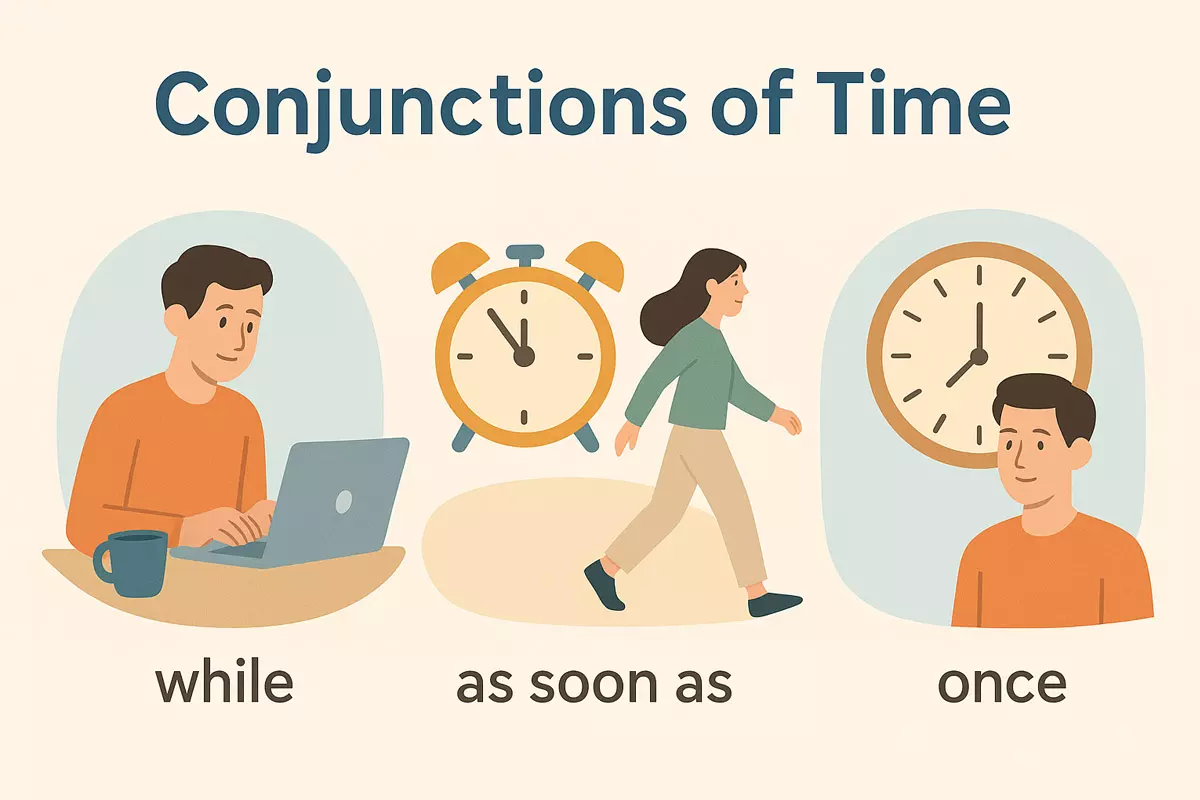
With these conjunctions, you can show whether two actions happen at the same time, one after the other, or immediately following one another. For example, while highlights simultaneous activities, whereas as soon as and once signal a sequence or immediate transition.
- While – indicates two actions happening at the same time: She listened to music while she cooked dinner.
- As soon as – marks something that happens immediately after another: Call me as soon as you arrive.
- Once – shows that one event follows another, often after a condition is met: Once you finish your homework, you can watch TV.
Visualizing Time Relationships
The way these conjunctions function can be compared and contrasted by looking at their use in context. Here’s a structured overview:
| Conjunction | Relationship on Timeline | Example Sentence |
|---|---|---|
| While | Actions happen at the same time (overlap) | He reads while he waits for the bus. |
| As soon as | One action follows another immediately | As soon as the bell rings, students leave the classroom. |
| Once | Second action happens after the first is complete/condition is met | Once you learn the rules, the game becomes easy. |
Common Patterns with Time Conjunctions
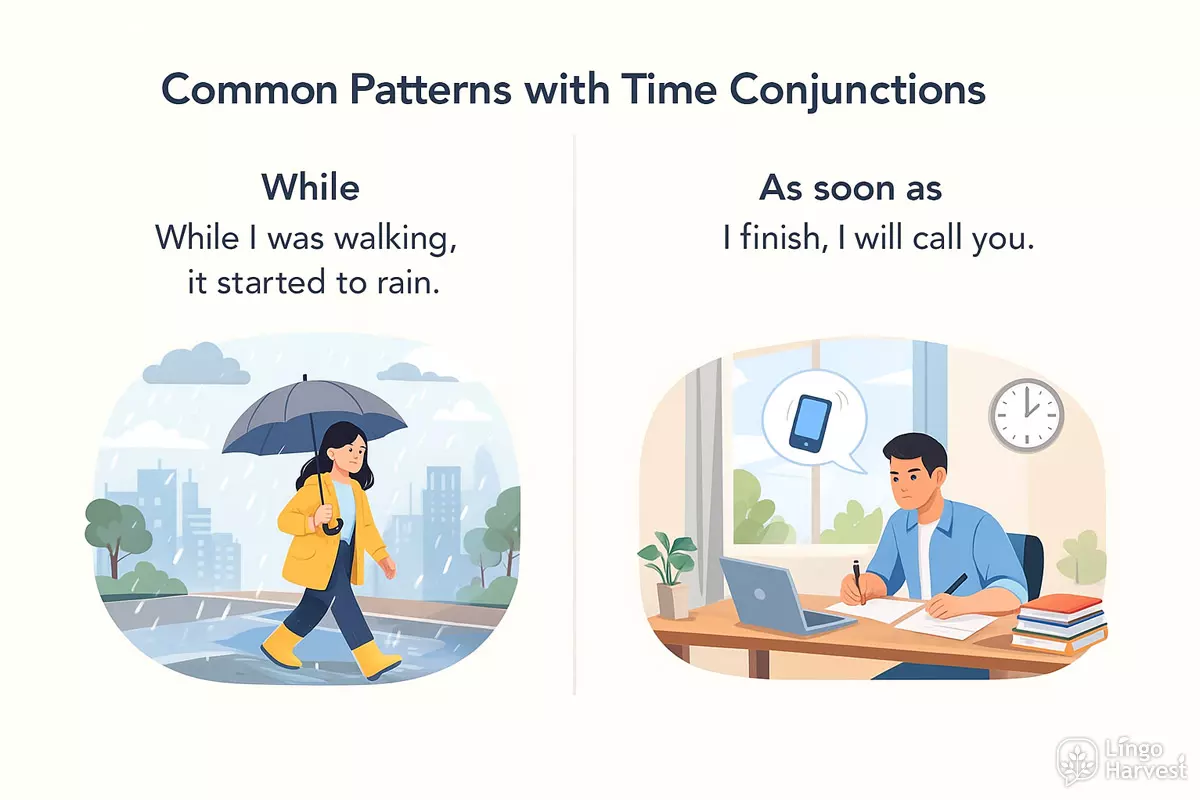
These linking words often appear in similar sentence structures. Some typical patterns include:
- While + past continuous, past simple: While I was walking, it started to rain.
- As soon as + present simple, future simple: As soon as I finish, I will call you.
- Once + present perfect, present simple: Once I have eaten, I feel better.
- While + subject + verb, subject + verb: While he played, she studied.
- As soon as + subject + verb, subject + verb: As soon as the sun rises, birds start singing.
- Once + subject + verb, subject + verb: Once you understand, the task is easy.
- While can start or join two clauses: He watched TV while eating dinner.
- As soon as and once often signal a quick change: As soon as the movie ended, everyone left.
- Use commas if the time clause comes first: Once you arrive, call me.
- Both as soon as and once can describe conditions for a next step.
These devices are essential for expressing the timing and connection between actions, making your communication clearer and more precise.
Using while to show two actions in progress together
The word while is commonly used to connect two actions that are happening at the same time. This conjunction helps us describe parallel activities, especially when both actions are in progress. In English, this often means using the past continuous or present continuous tense in both parts of the sentence.
How "while" works with simultaneous actions
When you want to show that two events are occurring together, place while between two clauses. Each clause usually contains a verb in a continuous tense, highlighting that both things are happening at once. For example:
- She was reading while he was cooking.
- I listen to music while I do my homework.
This structure is especially useful in storytelling or giving background information about ongoing situations.
Common patterns and vocabulary with "while"
Here are some typical ways to use this conjunction for parallel actions:
- He was talking on the phone while driving.
- They studied while waiting for the bus.
- We laughed while watching the movie.
- She takes notes while listening to lectures.
- The children played while their parents prepared dinner.
- My friend cleaned while I organized the papers.
- He worked while his brother slept.
- I write emails while having breakfast.
- She paints while listening to the radio.
- We chatted while walking to school.
- He practiced guitar while his sister sang.
- They played cards while waiting for dinner.
Word order and punctuation tips
You can start the sentence with the while-clause or place it in the middle. Both are correct:
- While I was studying, my brother was watching TV.
- My brother was watching TV while I was studying.
If you begin with the while-clause, use a comma after it.
Summary table: Tenses commonly used with "while"
| Sentence Example | Tense Used |
|---|---|
| She was cooking while I was cleaning. | Past Continuous + Past Continuous |
| I listen to music while I study. | Present Simple + Present Simple |
| He reads while he eats breakfast. | Present Simple |
| We were talking while waiting for the bus. | Past Continuous + Present Participle |
Using while in this way makes your descriptions of activities clearer and more natural, especially when you want to show that multiple things are happening at the same time.
Using as soon as to show immediate sequence
"As soon as" is commonly used to connect two actions where the second happens immediately after the first. This conjunction is especially useful for describing cause-and-effect relationships or quick transitions in time. It helps speakers emphasize that there is no delay between two events.
How to use "as soon as" in sentences
When forming sentences with "as soon as," place it before the clause that marks the initial event. The main action comes in the other clause, showing what happens right after. You can use "as soon as" with present, past, or future tenses, depending on the context.
- As soon as I got home, I called my friend.
- We’ll leave as soon as the meeting finishes.
- She started studying as soon as she arrived.
- The baby stopped crying as soon as he saw his mother.
- Let me know as soon as you are ready.
- He will call you as soon as he gets the news.
- The lights turned on as soon as it got dark.
- We’ll eat as soon as everyone is here.
- As soon as the bell rings, the students run outside.
- She’ll text me as soon as her plane lands.
- They went inside as soon as it started to rain.
- I’ll do my homework as soon as I finish dinner.
- As soon as the movie ends, let’s go for a walk.
- He left as soon as the class was over.
- We can talk as soon as you have time.
Comparing "as soon as" with other time conjunctions
While "while" and "once" also connect actions in time, "as soon as" focuses on the immediate start of the second event. Here’s a comparison to clarify their differences:
| Conjunction | Typical Use | Example |
|---|---|---|
| as soon as | Immediate sequence; one action happens directly after another | As soon as I arrived, it started to rain. |
| while | Two actions happening at the same time | I listened to music while I cooked. |
| once | One action happens after another is complete (focus on completion) | Once I finish this book, I’ll start another. |
Tips for using "as soon as" correctly
- Do not use "will" after "as soon as" in future sentences. Instead, use the present simple: As soon as you arrive, we will start.
- Use this conjunction to show no time gap between events.
- It works well in both spoken and written English for clear, efficient communication.
By integrating "as soon as" into your sentences, you express quick succession and help listeners understand the order and timing of events effortlessly.
Using once to show an action that must finish before another starts
The word once is often used to connect two actions, where the first must be completed before the second one begins. This is common in English when talking about instructions, processes, or describing events in sequence. Once introduces the condition: as soon as the first action is finished, the next one can happen. This structure makes it clear that there is a necessary order.
How to use once in sentences
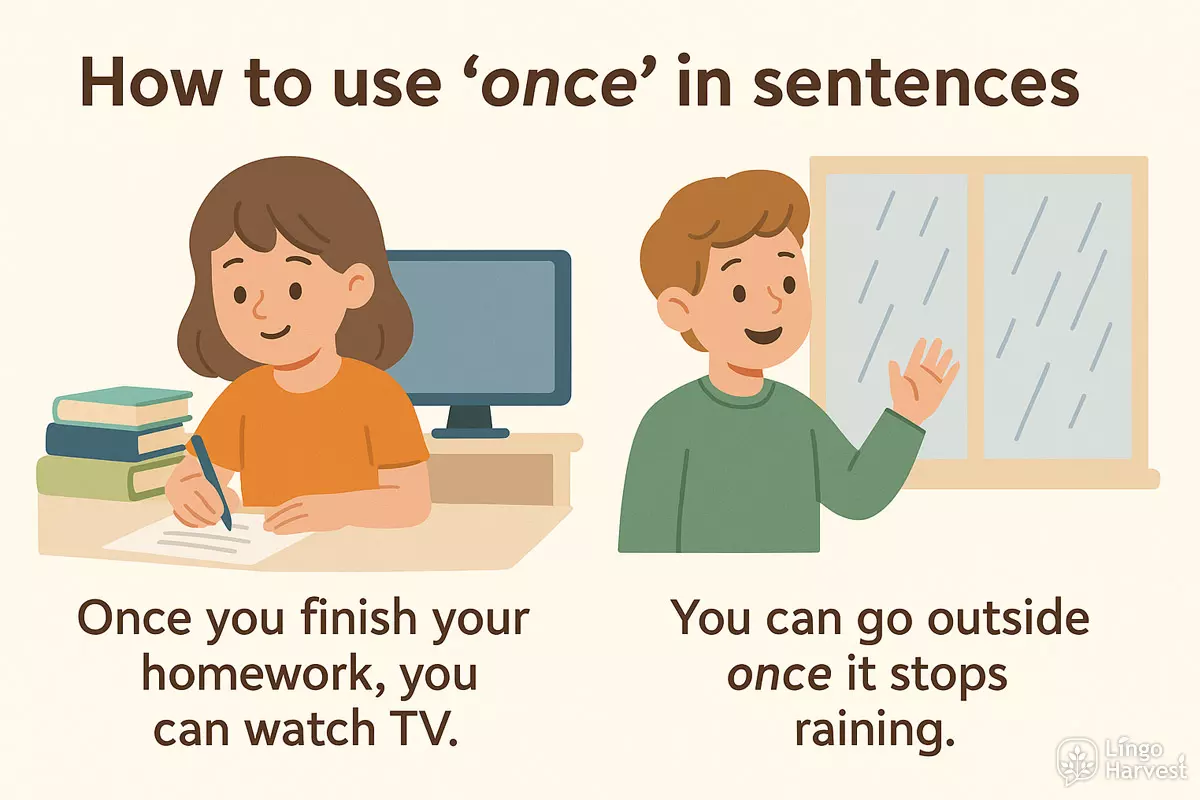
You can place once at the beginning or in the middle of a sentence. Both forms are correct, but starting with once often adds emphasis to the condition. Here are some ways to use it:
- Once you finish your homework, you can watch TV.
- You can go outside once it stops raining.
- Once the meeting ends, let me know.
- He’ll call you once he arrives.
- Once the paint is dry, you can hang the picture.
- Once you understand the rules, the game is easy.
- They’ll serve dinner once everyone is seated.
- Once you’ve signed the form, hand it to the receptionist.
- The door unlocks once you enter the code.
- Once the sun rises, we’ll start our hike.
- You’ll receive your password once you register.
- Once your flight lands, text me.
- Once the cake has cooled, you can frost it.
- I’ll give you the details once I have them.
- Once you pass the test, you’ll get a certificate.
- It gets easier once you practice a few times.
- Once the guests arrive, we’ll start dinner.
- She’ll leave once the movie is over.
Key points for using once
- Once always refers to the completion of the first event.
- The second action cannot begin before the first is done.
- It often replaces “after” in these situations, but adds the idea of a condition that must be met.
- Use the present tense after once for future actions (“Once you finish, I’ll help”).
Comparing once with other time conjunctions
Sometimes, learners confuse once with “when” or “after.” Here’s a quick comparison:
| Conjunction | Use & Example |
|---|---|
| Once | Action 1 must finish before Action 2 starts. Example: Once you lock the door, leave the key on the table. |
| When | Action 2 happens at the same time or after Action 1 starts. Example: When you see Anna, say hello. |
| After | Action 2 happens later than Action 1, but doesn’t always require completion. Example: After you eat, wash your hands. |
| As soon as | Action 2 happens immediately after Action 1 is finished. Example: As soon as the bell rings, leave the room. |
Using once helps your listener understand that the first event is essential before moving on, making instructions or sequences clear and logical.
Tense choices with these time conjunctions in real examples
Choosing the right tense when using "while," "as soon as," and "once" is essential for clear, natural English. Each conjunction tends to pair with certain verb forms, and understanding these patterns helps you express timing relationships correctly.
Common tense patterns with "while," "as soon as," and "once"
"While" often links two continuous actions happening at the same time, so it's usually followed by past continuous or present continuous tenses. "As soon as" and "once" signal a quick sequence, so they're typically followed by present simple for future meaning, or past simple for past events.
| Conjunction | Typical Tense Patterns ✅ | Example Sentence |
|---|---|---|
| while | Past Continuous + Past Simple Past Continuous + Past Continuous |
While I was cooking, she watched TV. While they were studying, it started to rain. |
| as soon as | Present Simple + Future Simple Past Simple + Past Simple |
As soon as you arrive, call me. As soon as he finished, he left. |
| once | Present Simple + Future Simple Past Simple + Past Simple |
Once the meeting ends, we'll go. Once I heard the news, I called my friend. |
Expanded real-life examples
- While I was waiting for the bus, it started to rain.
- She listens to music while she does her homework.
- As soon as the bell rings, the students leave the classroom.
- As soon as I saw her, I waved.
- Once you understand the rules, the game becomes easier.
- Once they had eaten, they went for a walk.
- While we were talking, the lights went out.
- As soon as he gets home, he will call you.
- Once I finish this report, I’ll take a break.
- While she was living in London, she learned a lot of English.
- As soon as you finish, let me know.
- Once the movie starts, please be quiet.
- While the children were playing, their parents prepared dinner.
- As soon as it stops raining, we’ll go outside.
- Once you open the box, you can’t return it.
Tips for choosing the right tense
- Use continuous forms with "while" for ongoing actions.
- For quick actions in sequence, "as soon as" and "once" usually take simple tenses.
- With future meaning, use present simple after "as soon as" and "once," not future forms.
- Check if both actions are long (continuous) or if one happens immediately after the other (simple).
Understanding these patterns will help you link actions naturally and accurately when discussing events in English.
Avoiding will after time conjunctions in future sentences
When talking about future events, English speakers often use time conjunctions such as while, as soon as, and once. After these conjunctions, it’s important to use a present tense, not will, even if you are talking about a future situation. This rule can seem confusing at first, but it helps sentences sound natural and is standard in both spoken and written English.
Why we don’t use ‘will’ after time conjunctions
The present tense is used after time conjunctions because it expresses a future event that is certain to happen or is part of a sequence. The main clause (the second part of the sentence) can use will to show the future, but the time clause (the part after the conjunction) uses the present simple.
- I’ll call you as soon as I arrive. ✅
- I’ll call you as soon as I will arrive. ❌
- She’ll start cooking once she gets home. ✅
- She’ll start cooking once she will get home. ❌
- We’ll talk while we wait for the bus. ✅
- We’ll talk while we will wait for the bus. ❌
Common time conjunctions and correct usage
Here are some typical time conjunctions used with the present tense for future meaning:
- before → We must finish the report before the meeting starts.
- after → She always goes for a walk after she finishes work.
- when → Call me when you arrive.
- while → He fell asleep while watching TV.
- as soon as → I’ll text you as soon as I get home.
- once → Once he understood the rule, the exercise became easy.
- until → They waited until the rain stopped.
- by the time → By the time we got there, the show had already started.
- whenever → Whenever I see him, he’s smiling.
- the moment → The moment she saw the dog, she started laughing.
Comparison: Correct and incorrect forms
Below is a table showing how to construct future sentences with time conjunctions. Notice the use of present simple (not will) after the conjunction.
| Time Conjunction | Correct Sentence | Incorrect Sentence |
|---|---|---|
| as soon as | I’ll help you as soon as I finish. | I’ll help you as soon as I will finish. |
| once | Call me once you arrive. | Call me once you will arrive. |
| when | We’ll leave when the movie ends. | We’ll leave when the movie will end. |
| while | I’ll read while you cook. | I’ll read while you will cook. |
| until | Stay here until I come back. | Stay here until I will come back. |
Quick tips for mastering this rule
- Use the present simple after time conjunctions for future events.
- Reserve will for the main clause, not the time clause.
- Practice by writing your own sentences with these patterns.
- Listen for these structures in native English conversations or media.
Remember, using the present tense after time conjunctions is a small detail, but it makes your English sound much more natural and accurate.
Practice: fill in the gaps with the best time conjunction
Understanding how to use “while,” “as soon as,” and “once” is essential for expressing the timing of actions and events in English. Below, you’ll find several exercises to help you choose the most suitable time connector for each sentence. Read each example carefully and pick the word that best fits the context.
Choose the correct time conjunction
Fill in each blank with while, as soon as, or once.
- I’ll call you ______ I arrive at the airport.
- ______ you finish your homework, you can watch TV.
- He listened to music ______ he was cleaning his room.
- ______ they got the news, they started celebrating.
- ______ I was walking to work, it started to rain.
- We’ll leave ______ the meeting is over.
- ______ you press this button, the machine will start.
- She read a book ______ waiting for her friend.
- ______ the teacher entered, the students became quiet.
- ______ you have your passport, you can check in.
Show answers
- as soon as
- once
- while
- as soon as
- while
- as soon as
- once
- while
- as soon as
- once
Common Patterns and Examples
Here are some typical sentence structures using each conjunction. Note how the meaning changes depending on which word you use.
- while: action happens at the same time as another
She cooked dinner while listening to the radio. - as soon as: one action follows another immediately
Call me as soon as you get home. - once: after one action is complete, another can begin
Once you finish the test, hand it to the teacher.
Quick Practice: Which fits best?
Decide which conjunction is most natural in each sentence:
- ______ you arrive, let me know.
- He fell asleep ______ reading.
- We’ll eat ______ everyone is here.
- She called me ______ she heard the news.
- ______ I was walking home, it started to rain.
- We had lived there for ten years ______ we moved abroad.
- ______ the movie ended, we left the cinema.
- He likes to listen to music ______ he studies.
- ______ I finish this task, I’ll take a break.
- We waited in the café ______ the storm passed.
Show answers
- As soon as
- while
- once
- as soon as
- While
- before
- After
- while
- once
- until
Practicing with real sentences helps you master the use of time conjunctions in context. Aim to notice these connectors in texts you read or conversations you hear, and try writing your own examples to reinforce your understanding.