Conjunctions of Purpose: in order that, so that, lest

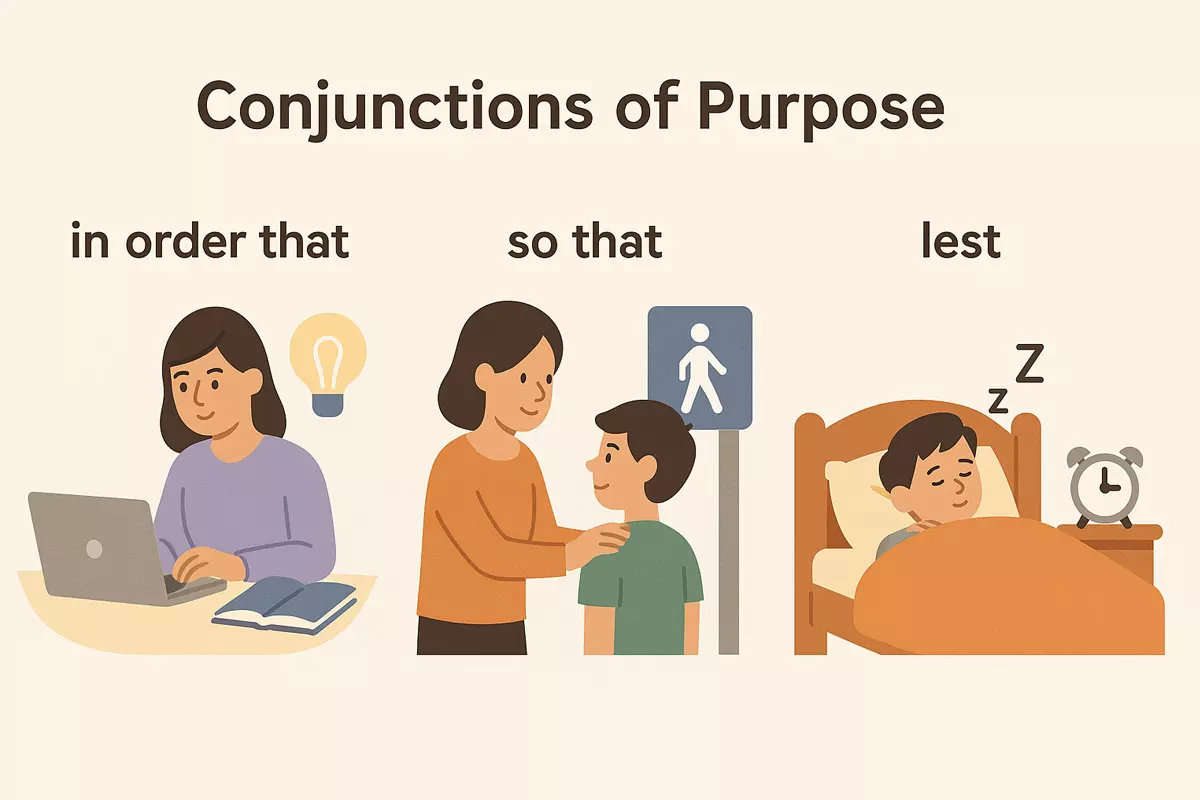 The article reviews purpose clauses, showing how and why we use so that, in order that, and lest. It explains their meanings, verb forms, frequency in modern English, and includes practice rewriting sentences with these conjunctions.
- Review of purpose clauses and why we use them
- Using so that to show intention and possible result
- Using in order that for more formal purpose statements
- Introducing lest and its meaning of avoiding a negative result
- Typical verb forms after purpose conjunctions
- Register and frequency of each conjunction in modern English
- Practice: rewrite simple sentences using these purpose conjunctions
Have you ever wondered how to clearly express the reason or purpose behind an action in English? Using specific connecting words, such as because, so that, in order to, or to avoid, allows you to communicate intention, explanation, or caution within your sentences. Mastering these connectors not only improves the clarity of your writing and speech but also helps you convey your thoughts more precisely and effectively, making your communication easier to understand.
Review of purpose clauses and why we use them
Purpose clauses are essential in English for expressing the reason or goal behind an action. They allow speakers and writers to clarify why something is done, not just what is done. Typically, these clauses answer questions like “Why did you do that?” or “For what reason?” Understanding the different ways to construct such clauses helps make communication more precise and natural.
What is a purpose clause?
A purpose clause is a dependent clause that indicates the intention or aim of an action described in the main clause. In English, these are often introduced by conjunctions like so that, in order that, and lest. Each has its own nuance and typical usage.
Why do we need purpose clauses?
- To clarify the reason for an action (e.g., “He whispered so that no one would hear.”)
- To avoid ambiguity by making goals explicit
- To show cause and effect within a single sentence
- To add variety and complexity to writing and speech
Common conjunctions for expressing purpose
Here are some frequently used conjunctions and patterns for expressing purpose:
- so that – expresses purpose in both formal and informal contexts
- in order that – more formal, often used in writing
- lest – somewhat formal/old-fashioned, introduces a negative purpose (“so that... not”)
- to + infinitive – the most concise way to express purpose (“He left early to catch the train.”)
- for + noun/gerund – less common for purpose, but possible (“for protection,” “for eating”)
Examples of purpose clauses in context
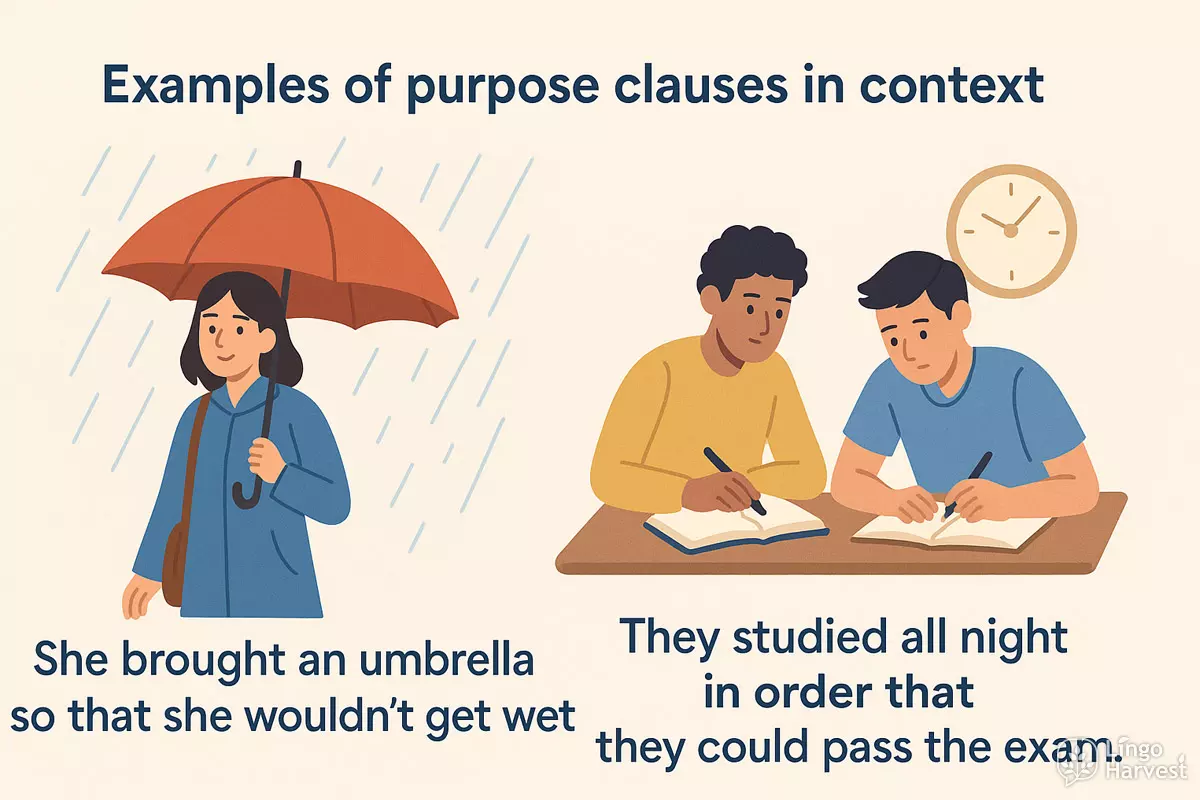
- She brought an umbrella so that she wouldn’t get wet.
- They studied all night in order that they could pass the exam.
- I checked twice lest I forget my keys.
- We whispered so that we wouldn’t wake the baby.
- He wore gloves in order that his hands stayed warm.
- She hurried lest she miss the bus.
- He left early to avoid the traffic.
- They arrived on time so that the meeting could start promptly.
- She saved money in order that she might travel abroad.
- He tiptoed lest he disturb anyone.
Comparing conjunctions of purpose
| Conjunction | Typical Meaning/Use | Example |
|---|---|---|
| so that | Expresses a positive purpose; common and neutral | She lowered her voice so that others wouldn’t hear. |
| in order that | More formal; often interchangeable with “so that” | He left early in order that he could catch the train. |
| lest | Negative purpose; often means “so that... not” | Take your umbrella lest it rain. |
Key points to remember
- Purpose clauses connect actions with their intended outcomes.
- Choice of conjunction can affect formality and clarity.
- Using a range of purpose expressions improves both written and spoken English.
Using so that to show intention and possible result
"So that" is a common conjunction for expressing purpose or possible outcomes in English. It creates a clear link between an action and its intended effect or a potential result. Typically, "so that" introduces a subordinate clause that explains why something is done or what might happen as a consequence.
Expressing Purpose and Intention
When you want to explain the reason behind an action, "so that" is often used. This structure helps clarify intentions, especially in both spoken and formal written English. The clause following "so that" frequently contains a modal verb such as "can," "could," "will," or "would," indicating possibility or ability.
- She left early so that she could catch the first train.
- Turn off the lights so that we save energy.
- I wrote down the address so that I wouldn’t forget it.
- They spoke quietly so that nobody would hear them.
- We’re making extra copies so that everyone can have one.
- He wore a hat so that he wouldn’t get sunburned.
- Keep your phone nearby so that you can answer quickly.
- She studied hard so that she would pass the exam.
- I’ll leave a note so that you know where I went.
- He paused so that everyone could catch up.
- We locked the door so that nothing would get stolen.
- He lowered his voice so that the children wouldn’t wake up.
Showing Possible Results
Besides intention, this conjunction can also highlight a result that may happen. The effect is often not certain, but possible, depending on the circumstances or actions taken.
- She wore gloves so that her hands wouldn’t get cold.
- We’ll leave now so that we might avoid the traffic.
- He set a reminder so that he wouldn’t forget the meeting.
- Put the milk in the fridge so that it doesn’t spoil.
Common Patterns with "So That"
The clause after "so that" often includes modals to express varying degrees of certainty or possibility. Here’s a quick reference to the most frequent patterns:
| Pattern | Example Sentence |
|---|---|
| so that + can/could | She left early so that she could catch the bus. |
| so that + will/would | I’ll explain it again so that everyone will understand. |
| so that + may/might | He whispered so that he might not disturb the others. |
| so that + present simple | Keep your keys handy so that you don’t lose them. |
Quick Tips
- Use "so that" to make intentions or results explicit.
- Choose the right modal verb depending on the level of certainty or possibility.
- In formal contexts, "so that" is generally preferred over just "so" for clarity.
- Commas are optional but can be used when the sentence is long or complex.
By using "so that" effectively, you can clearly communicate reasons and potential outcomes in both everyday and academic English.
Using in order that for more formal purpose statements
The phrase in order that is a classic way to express purpose in English, especially in formal writing and speech. While so that is common in everyday conversation, in order that tends to appear in official documents, academic papers, legal language, and formal communications. It introduces a subordinate clause explaining the reason or intended result of an action.
When to Choose "in order that"
Writers and speakers select in order that to clarify intentions with precision or to achieve a more elevated tone. This conjunction is particularly useful where ambiguity must be avoided or where formality is expected. For instance, in policies, contracts, instructions, or research, in order that can signal careful reasoning and explicit goals.
Structure and Use
The typical structure is: Main clause + in order that + subordinate clause (with modal verb). The subordinate clause often contains can, could, may, or might to indicate possibility or permission.
- We provide training in order that employees may use the equipment safely.
- He spoke slowly in order that everyone could understand.
- The law was changed in order that citizens might have more freedom.
- She left early in order that she could catch the last train.
- They took notes in order that they would remember the details.
- The form must be signed in order that the process can continue.
- He explained the rules in order that there would be no confusion.
- We raised funds in order that the project might proceed.
- The room was heated in order that the guests would be comfortable.
- Instructions are provided in order that users can assemble the product correctly.
Comparison: "in order that" vs "so that"
| Expression | Context & Example |
|---|---|
| in order that | Formal or written English We implemented new policies in order that employees might feel safer. |
| so that | Informal or spoken English We implemented new policies so that employees would feel safer. |
To sum up, in order that is chosen for its clarity and formal tone, especially when it is important to state the purpose directly and unambiguously. It's less common in speech but remains a useful tool for precise, elevated communication.
Introducing lest and its meaning of avoiding a negative result
When we want to express the idea of preventing something undesirable, the conjunction lest is a classic—though somewhat formal—choice. It introduces a clause that explains what someone is trying to avoid. Rather than simply stating a purpose, lest specifically highlights a negative outcome that someone does not want to happen.
How “lest” works in sentences
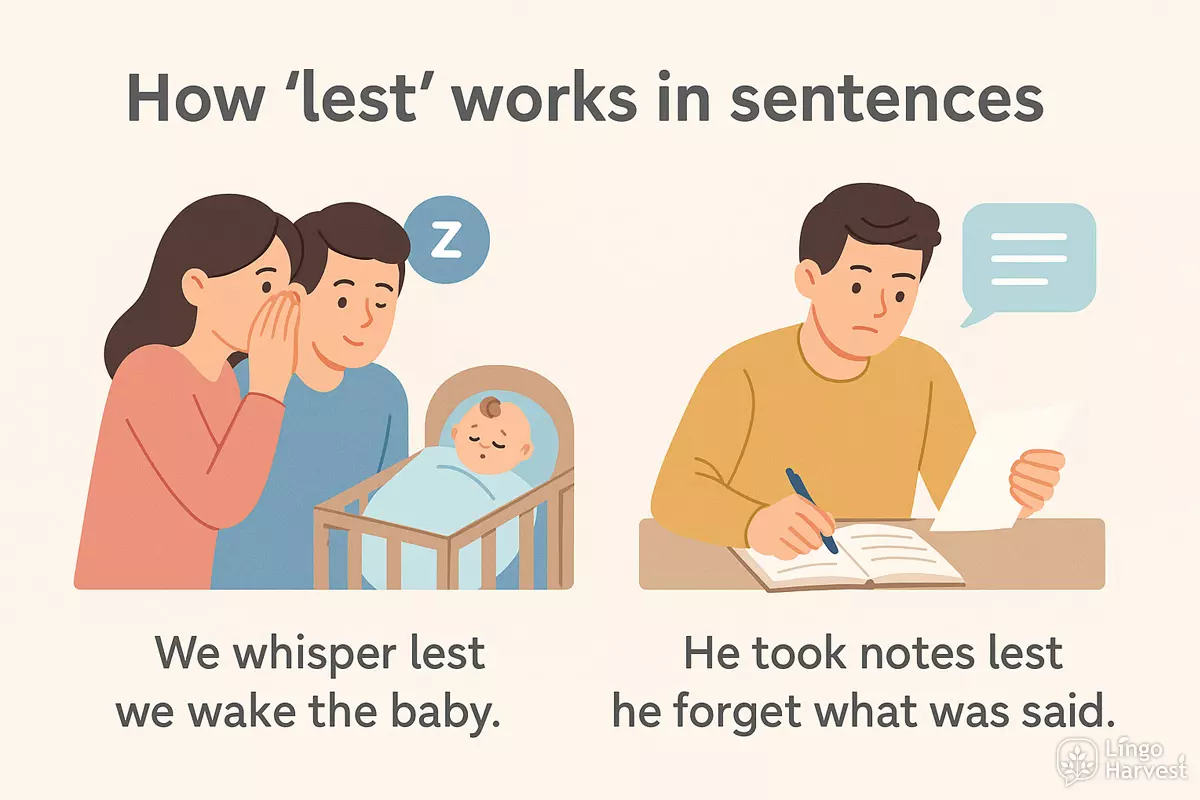
The word lest is usually followed by a verb in the subjunctive mood, especially in more traditional or formal English. It signals caution, worry, or preventative action. Here are some typical patterns and uses:
- We whisper lest we wake the baby.
- He took notes lest he forget what was said.
- Bring an umbrella lest it rain.
- She hurried lest she be late for the meeting.
- Keep your voice down lest the neighbors complain.
- Lock the door lest someone break in.
- They wore gloves lest they catch a cold.
- He checked twice lest he make a mistake.
- Don’t touch that lest you get shocked.
- She reminded him lest he forget again.
- He left early lest traffic delay him.
- They spoke quietly lest anyone overhear them.
- I set an alarm lest I oversleep.
- Write it down lest you lose track.
- He avoided sweets lest his toothache worsen.
Comparing “lest” with other purpose conjunctions
While “so that” and “in order that” express a positive aim or intention, “lest” is always about avoiding negatives. For example, “She left early so that she could catch the train” (positive purpose) versus “She left early lest she miss the train” (preventing a negative outcome).
Key points about “lest” usage
- Often considered formal or literary in modern English.
- Usually not used in everyday casual conversation.
- Verb after “lest” often takes the base form (subjunctive), especially in careful or older usage.
- Focuses on prevention or caution.
This conjunction is a useful tool for expressing the motivation to avoid risks, problems, or unwanted results. Although rare in speech, it appears in writing, literature, and formal contexts where precision is important.
Typical verb forms after purpose conjunctions
Understanding which verb forms follow conjunctions of purpose like in order that, so that, and lest is key to writing clear, correct sentences. These conjunctions set up a reason or goal, often affecting the verb tense or mood that comes next.
Verb patterns after "in order that" and "so that"
Both in order that and so that are usually followed by a clause with a modal verb. The choice of modal often depends on formality and the speaker’s intention. Common modals include can, could, will, would, and may.
- She left early so that she could catch the train.
- I’m explaining this in order that you may understand.
- We saved money so that we can travel this summer.
- He whispered in order that nobody would hear.
Verb form after "lest"
Lest is more formal and is followed by a bare infinitive (the base form of the verb, without "to"), often with should as an optional modal. The meaning is generally negative — to prevent something undesirable.
- Take an umbrella lest it rain.
- He spoke quietly lest anyone should overhear.
- She hurried lest she be late.
Comparison of verb structures
| Conjunction | Typical Verb Structure | Example |
|---|---|---|
| in order that | Modal + base verb | She took notes in order that she could remember later. |
| so that | Modal + base verb | We left early so that we would not be late. |
| lest | (should) + base verb | He tiptoed lest he should disturb anyone. |
Summary list of common verb patterns
- so that + can/could/will/would/may/might + base verb
- in order that + modal (may, might, can, could, will, would) + base verb
- lest + (should) + base verb (no "to")
- Negative purpose: avoid double negatives after "lest"
- For present/future reference: use "can/will/may"
- For past reference: use "could/would/might/should"
- Do not use "to" + verb after "lest"
- Subject is always expressed (unlike "to" + verb structures)
- After "lest," prefer base verb or "should" + base verb
- Formal texts may use "may/might" after "in order that"
Choosing the correct verb form after these conjunctions helps clarify the intended purpose and ensures grammatical accuracy in both speech and writing.
Register and frequency of each conjunction in modern English
When it comes to expressing purpose in English, the conjunctions "in order that," "so that," and "lest" each carry their own stylistic tone and are used with differing regularity. Understanding where and how these phrases appear in modern usage helps learners and writers choose the right expression for any context.
Usage in formal and informal English
- So that is by far the most common and versatile among these connectors. It appears frequently in both spoken and written English, especially in everyday conversation and general writing.
- In order that tends to be more formal and is often found in academic, legal, or technical texts. It is less likely to appear in casual speech or informal writing.
- Lest is now quite rare and typically restricted to literary, poetic, or very formal contexts. Its use can sound old-fashioned or even archaic in modern conversation.
Comparing frequency and register
| Conjunction | Register | Frequency | Typical Contexts |
|---|---|---|---|
| So that | Neutral / Informal / Formal | Very common | Everyday speech, writing, academic, business |
| In order that | Formal | Rare | Academic papers, legal documents, technical manuals |
| Lest | Very formal / Literary | Very rare | Poetry, classic literature, historical texts |
Sample sentences showing frequency in context
- He left early so that he could catch the train. ✅ (frequent, natural)
- Please submit your reports in order that we may review them promptly. ✅ (formal, less common)
- She spoke quietly, lest she wake the baby. ❌ (rare, literary)
Overall, "so that" is your safest choice for most situations, while "in order that" and "lest" should be reserved for more formal or stylistic writing. Being aware of these differences helps ensure your language sounds natural and appropriate for the context.
Practice: rewrite simple sentences using these purpose conjunctions
When learning conjunctions of purpose like in order that, so that, and lest, it's helpful to practice rewriting everyday statements. This will help you incorporate these structures naturally into your writing and speech. Below, you’ll find a set of basic sentences. Try to transform them using one of the conjunctions of purpose discussed in the article.
Task: Transform the Sentences
Rewrite each simple sentence using in order that, so that, or lest, as appropriate. Consider the meaning and choose the most suitable conjunction for each situation.
- She left early. She wanted to catch the first train.
- He whispered. He didn’t want to wake the baby.
- We study hard. We hope to pass the exam.
- Close the window. You might catch a cold.
- I will call you. I want to make sure you’re safe.
- They spoke quietly. They didn’t want anyone to hear.
- I set an alarm. I don’t want to oversleep.
- He practiced every day. He aimed to improve his skills.
- Wear sunscreen. You could get sunburned.
- The teacher explained the rules. The students would understand.
- Lock the door. Someone might come in.
- We left a note. Our friend would know where we are.
Patterns and Usage Tips
- So that and in order that both introduce the purpose of an action, but in order that is more formal.
- Lest means "to avoid the risk that" and is always followed by the subjunctive or simple form of the verb.
Quick Reference: Comparing Purpose Conjunctions
| Conjunction | Example Usage | Notes |
|---|---|---|
| so that | He spoke quietly so that nobody would hear. | Common in spoken and written English; neutral tone. |
| in order that | She left early in order that she could catch the train. | More formal; often found in written contexts. |
| lest | He whispered lest he wake the baby. | Formal/literary; negative purpose, often with subjunctive. |
Check Your Answers
Show answers
- She left early so that she could catch the first train. / She left early in order that she might catch the first train.
- He whispered lest he wake the baby.
- We study hard so that we can pass the exam. / We study hard in order that we may pass the exam.
- Close the window lest you catch a cold.
- I will call you so that I can make sure you’re safe. / I will call you in order that I may make sure you’re safe.
- They spoke quietly so that no one would hear. / They spoke quietly lest anyone hear.
- I set an alarm lest I oversleep.
- He practiced every day so that he could improve his skills.
- Wear sunscreen lest you get sunburned.
- The teacher explained the rules so that the students would understand.
- Lock the door lest someone come in.
- We left a note so that our friend would know where we are.