Conjunctions for Giving Alternatives: whether…or

 This article explains the difference between if and whether in reported and indirect questions, details the structure of whether…or with verbs and clauses, covers using whether…or not for outcomes, shows formal uses, common phrases, and practice…
- Difference between if and whether in reported and indirect questions
- Basic structure of whether…or with verbs and clauses
- Using whether…or not to show two possible outcomes
- Formal writing uses of whether in academic and professional texts
- Common fixed expressions with whether
- Practice: rewrite sentences using whether…or for clearer alternatives
Offering choices in English often involves using structures that clearly present two possibilities, making communication more effective and straightforward. By mastering these pairings, such as using "either...or," you can express alternatives with clarity and help your listener or reader easily understand the options available. This approach not only enhances precision but also ensures that your intent is communicated without confusion, which is especially valuable in both spoken and written interactions where clear choices must be conveyed.
Difference between if and whether in reported and indirect questions
When transforming direct yes/no questions into indirect or reported speech, both "if" and "whether" can introduce the indirect question. However, they are not always interchangeable. Understanding their distinctions helps you sound more natural and precise in English.
General Usage
In most indirect questions, "if" and "whether" can both be used:
- She asked if he was coming.
- She asked whether he was coming.
Both sentences are correct, but "whether" is slightly more formal.
Key Differences
- "Whether" is preferred when presenting two clear alternatives, especially with "or" (e.g., whether…or not).
- "If" is not used before "or not" when the phrase comes at the end of the sentence. Use "whether" in these cases.
- After prepositions, only "whether" is used (e.g., It depends on whether you agree).
- In formal writing, "whether" is more common; "if" is typical in spoken or informal contexts.
Examples in Context
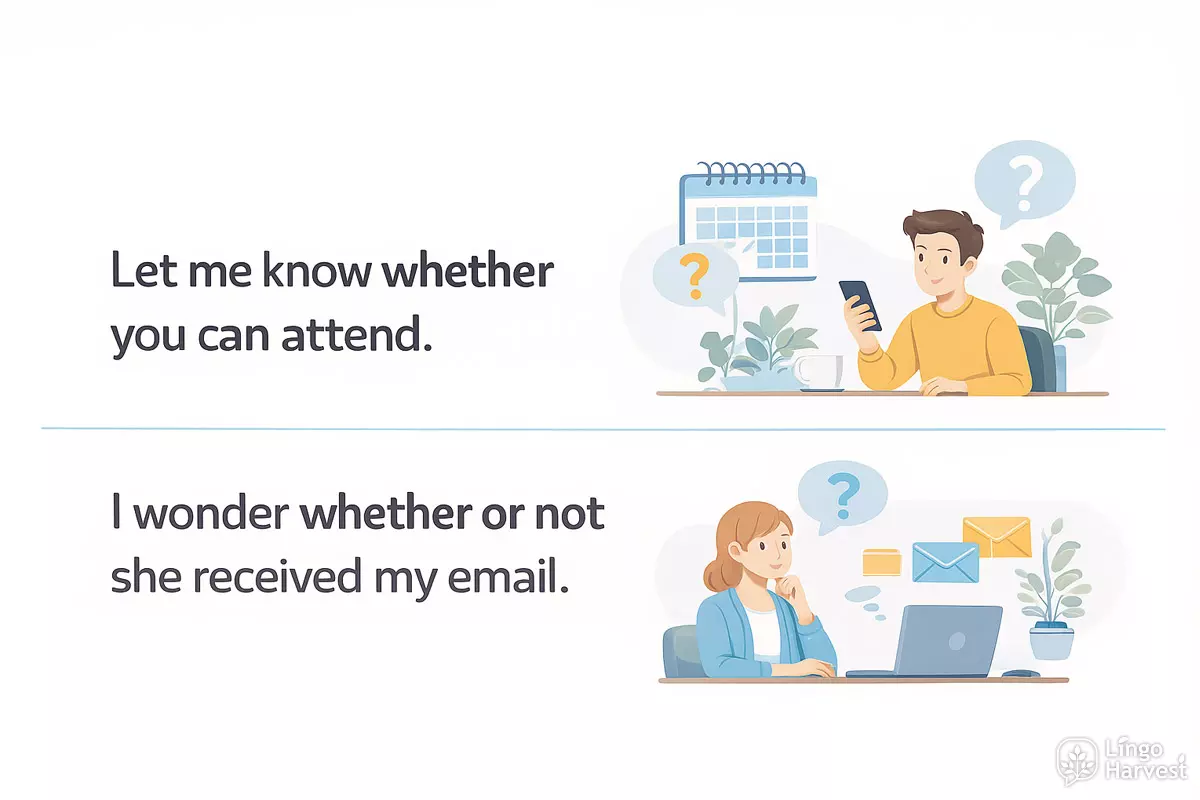
- Let me know whether you can attend. ✅ (formal, two possibilities)
- I wonder whether or not she received my email. ✅
- I don’t know if she received my email. ✅
- She asked whether to stay or leave. ✅ (alternative options)
- She asked if to stay or leave. ❌ (incorrect with alternatives)
- It depends on whether he agrees. ✅
- It depends on if he agrees. ❌ (incorrect after preposition)
- Tell me whether or not you’re coming. ✅
- Tell me if you’re coming or not. ✅ (acceptable, but less formal)
- We discussed whether to continue or stop. ✅
| When to Use "if" | When to Use "whether" |
|---|---|
| Indirect yes/no questions without alternatives (She asked if he was ready.) |
When presenting two possibilities or alternatives (She asked whether he was ready or not.) |
| Informal spoken English (I don’t know if she called.) |
After prepositions or infinitives (It depends on whether she called.) |
| After reporting verbs, when “or not” is not at the end (I’m not sure if he’ll come or not.) |
Formal writing or speech (Let me know whether you agree.) |
| Never with “or not” at the end (Tell me if she’s coming or not. ❌ at end) |
Always with “or not” at the end (Tell me whether or not she’s coming.) |
Summary
While both "if" and "whether" can introduce indirect yes/no questions, "whether" is required in certain structures—especially when alternatives are given, after prepositions, or in formal contexts. Use "if" mainly in informal, simple indirect questions where no alternatives are presented. Remember: "whether…or" is the standard for offering clear options.
Basic structure of whether…or with verbs and clauses
Understanding how to use "whether…or" in sentences can help you give clear alternatives or choices. This conjunction pair is typically used before two possible options, and it often connects clauses or verbs. The structure usually follows this pattern: whether + clause/verb… or + clause/verb. Both options are connected equally, and the meaning is similar to "if… or if…", but "whether" is more formal and common in writing or careful speech.
Typical patterns
There are a few common ways to arrange sentences with this pair:
- Whether + subject + verb… or + subject + verb
- Whether + to-infinitive… or + to-infinitive
- Whether + clause… or not
- Whether… or… (short forms, especially after prepositions or verbs like "decide," "know," "discuss")
Key points for usage
- Both parts should be parallel: If the first part uses a verb, the second should also.
- Subject can be omitted in the second clause: If it's the same as the first.
- “Or not”: Sometimes "or not" is added for emphasis, but it’s not always necessary.
- Common after certain verbs: "Wonder," "decide," "discuss," "know," "ask," and "see."
- Can be used with nouns, adjectives, or prepositional phrases, but most often with verbs and clauses.
Expanded examples
Here are several example structures to show how alternatives are presented:
- Whether you agree or disagree, the decision is final.
- She hasn't decided whether to go or stay.
- Let me know whether you can attend or not.
- They need to choose whether to invest now or wait.
- We discussed whether he should apologize or explain.
- I'm not sure whether it will rain or be sunny.
- Tell me whether you want tea or coffee.
- The outcome is uncertain, whether we try or not.
- Ask her whether she prefers morning or afternoon shifts.
- He wondered whether to call her or write an email.
- We must decide whether to proceed or cancel.
- It's unclear whether the meeting is today or tomorrow.
- Check whether the door is locked or open.
- Whether you pass or fail depends on your effort.
- They debated whether to move or stay put.
- Let us know whether you need help or have questions.
- It's important whether you finish early or late.
- Do you know whether the test is hard or easy?
Summary of form
When building sentences with this alternative-giving conjunction, keep the pattern balanced and clear. Use "whether" to introduce the first option, then "or" before the second. Both verbs or clauses should match in form. If the alternatives are short, sometimes only the verbs or objects are mentioned after "or".
Comparison: whether…or vs. if…or
| Form | Example |
|---|---|
| Whether…or (formal, written, after prepositions/verbs) | They haven’t decided whether to accept or decline. |
| If…or (informal, mostly in speech, rarely after prepositions) | I don’t know if you’re coming or staying. |
| Whether…or not (full form, for emphasis) | Let us know whether you can come or not. |
| If…or not (less common, sometimes awkward) | I’m not sure if he’ll join or not. |
Using whether…or not to show two possible outcomes
When you want to express that something will happen in either case—regardless of one particular condition—“whether…or not” is a helpful structure. This pattern is used to show that there are two possible results, but the outcome or action remains the same in both situations. It works well for emphasizing that a decision, feeling, or event does not depend on a single factor.
How “whether…or not” works in sentences
The phrase usually sets up a scenario with two alternatives: one where the condition is true, and one where it is not. You can use it in the middle or at the start of a sentence. For example:
- I’ll go to the meeting whether it rains or not.
- She plans to apply, whether or not she meets all the requirements.
- We’re leaving at 8, whether you’re ready or not.
- They will finish the project, whether or not the funding comes through.
Common uses and variations
This construction is especially useful when you want to stress persistence, certainty, or inevitability. Here are some typical ways it appears:
- With verbs of planning or intention: “He’s going to run the marathon, whether or not he feels prepared.”
- In rules or instructions: “You must submit the form, whether or not you have all the details.”
- To show emotional reactions: “She’ll be upset, whether he apologizes or not.”
- When describing universal consequences: “The rule applies, whether or not you agree.”
- For expressing conditions in the past, present, or future.
Examples of “whether…or not” in context
Here are further examples to clarify how the structure functions in real communication:
- We have to finish the assignment whether we like it or not.
- He’ll buy the tickets whether or not anyone else wants to go.
- Whether you pass or not, you gave it your best effort.
- The dog will bark whether or not someone is at the door.
- She will call you back, whether she finds the information or not.
- The class starts at 9, whether or not you are on time.
- Whether the weather is good or not, the picnic will happen.
- He keeps his promise whether or not it’s convenient.
- We’re going to celebrate, whether the test results are positive or not.
- Whether you agree or not, the decision has been made.
Comparing “whether…or not” to “if”
Sometimes “if” can be used instead of “whether…or not,” but “whether…or not” is more formal and emphasizes that the outcome is the same in both scenarios. Here’s a simple comparison:
| “Whether…or not” | “If” |
|---|---|
| We’ll start, whether she arrives or not. | We’ll start if she doesn’t arrive. |
| I’m going, whether or not you come. | I’ll go if you don’t come. |
| The game continues, whether it rains or not. | The game continues if it rains. |
| They’ll finish the work, whether or not there’s help. | They’ll finish if there’s no help. |
This structure is especially valuable in both spoken and written English when you want to highlight that a plan, rule, or feeling is not dependent on a single condition being met.
Formal writing uses of whether in academic and professional texts
In academic and professional documents, the conjunction “whether” is frequently used to present alternatives, indicate uncertainty, or highlight possible outcomes. Unlike informal speech, which often relies on “if” for similar purposes, scholarly and business writing prefers “whether” to clarify that two or more possibilities are being considered. This precision is valued in research papers, reports, proposals, and official correspondence.
Common contexts and structures
Writers use “whether” in several recurring patterns to introduce alternatives or test hypotheses. Some of the most common contexts include:
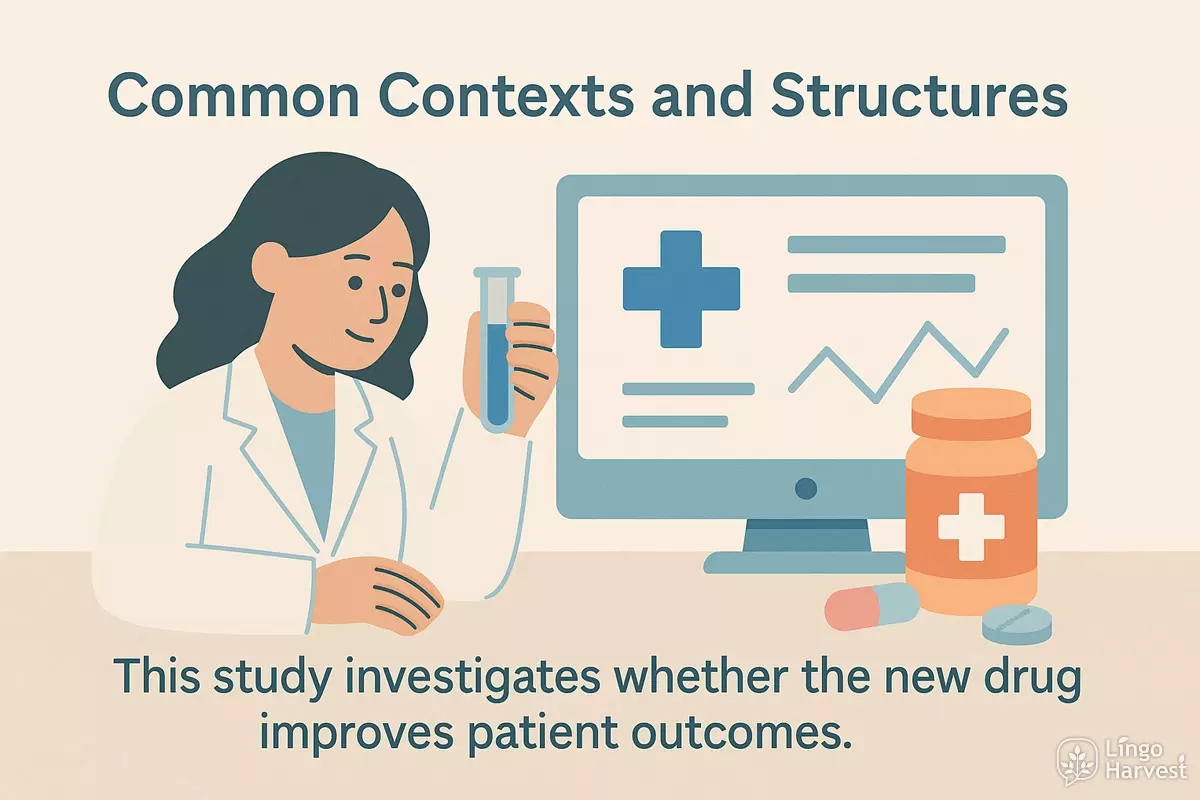
- Stating research aims or questions: “This study investigates whether the new drug improves patient outcomes.”
- Reporting results: “It is unclear whether these findings can be generalized.”
- Describing procedures: “Participants were asked whether they had previous experience.”
- Discussing recommendations: “The report considers whether to implement new policies.”
- Legal or formal decisions: “The board will determine whether the proposal meets requirements.”
- Setting conditions: “The contract specifies whether payment is due upon delivery.”
- Comparing alternatives: “Researchers debated whether to use qualitative or quantitative methods.”
- Expressing doubt or uncertainty: “It remains to be seen whether the approach is effective.”
- Clarifying choices: “Please indicate whether you will attend the meeting.”
- Stating prerequisites: “Applicants must specify whether they hold a valid license.”
“Whether…or” for presenting options
The full structure “whether…or” is especially useful when emphasizing two or more alternatives. In formal texts, it often replaces “if…or” to avoid ambiguity. Here are some typical ways this structure appears:
- “The study will examine whether the treatment is effective or not.”
- “Please state whether you agree or disagree.”
- “It is important to determine whether the results are significant or due to chance.”
- “The committee must decide whether to approve or reject the application.”
- “We are unsure whether the error is systematic or random.”
- “The analysis will show whether the policy benefits all groups or only a few.”
- “Authors should indicate whether tables or figures were adapted from previous work.”
- “The survey asked whether respondents worked full-time or part-time.”
- “It is uncertain whether the deadline can be extended or must remain fixed.”
- “The procedure applies whether the device is new or refurbished.”
Comparison: “Whether” vs. “If” in formal contexts
| Usage | Example |
|---|---|
| “Whether” for alternatives or uncertainty | “The study will assess whether the intervention is effective.” |
| “If” for conditional statements (not alternatives) | “If the results are positive, further testing will follow.” |
| “Whether…or” for presenting two options explicitly | “The policy applies whether employees work onsite or remotely.” |
| Ambiguity when “if” replaces “whether” in alternatives | ❌ “Let us know if you will attend or not.” ✅ “Let us know whether you will attend or not.” |
Summary
“Whether” is a key conjunction for formally presenting alternatives, especially when clarity and precision are required. Its careful use helps avoid ambiguity in academic and professional writing, making arguments and decisions more transparent for the reader.
Common fixed expressions with whether
Many everyday phrases in English use "whether" in a set way, making them easy to recognize but sometimes tricky for learners. These expressions often help to introduce options, uncertainty, or conditions in a sentence. Getting familiar with these structures will make your English sound more natural and fluent. Below are some of the most frequent and useful patterns involving "whether."
Typical phrases and idioms with "whether"
- whether or not — Used to show that something is true in both possible cases.
Example: "I'll go whether or not it rains." - decide whether (to) — Used when making a decision between alternatives.
Example: "She can't decide whether to stay or leave." - see whether — Used when checking or verifying something.
Example: "Let me see whether he’s available." - find out whether — Used to discover if a statement is true.
Example: "We need to find out whether the shop is open." - wonder whether — Used to express curiosity or doubt.
Example: "I wonder whether they understood." - ask whether — Used for indirect questions.
Example: "He asked whether I was coming." - know whether — Indicates awareness of options.
Example: "Do you know whether she called?" - consider whether — Used when thinking about possibilities.
Example: "They’ll consider whether to expand." - determine whether — Used when making a formal or careful decision.
Example: "Tests will determine whether it’s safe." - discuss whether — For talking about alternatives in a group.
Example: "We should discuss whether to postpone." - question whether — To doubt or challenge a statement.
Example: "Some question whether the plan will work." - check whether — For verifying information.
Example: "Can you check whether the file has arrived?" - uncertain whether — To express doubt.
Example: "I’m uncertain whether that’s correct." - indicate whether — To show one of two options.
Example: "Please indicate whether you’ll attend." - regardless of whether — Means that the outcome does not affect the result.
Example: "We’ll continue regardless of whether it’s difficult."
Patterns and variations
Sometimes, "whether" is used with or without "or not." For example, "Let me know whether you’re coming (or not)." Both forms are correct, but including "or not" often makes the meaning clearer, especially when you want to stress that both options are possible.
Comparison: "if" vs. "whether" in set expressions
| Expression with "whether" | Can "if" replace "whether"? ✅/❌ |
|---|---|
| decide whether (to do something) | ❌ (use "whether", not "if") |
| ask whether | ✅ (sometimes possible, but "whether" is more formal) |
| whether or not | ❌ ("if or not" is incorrect) |
| find out whether | ✅ (can use "if", but "whether" is preferred in writing) |
| determine whether | ❌ ("determine if" is less formal and sometimes ambiguous) |
Learning these set phrases will help you sound more natural, especially in formal writing or speech. Try using some of these in your own sentences to get comfortable with the patterns.
Practice: rewrite sentences using whether…or for clearer alternatives
Choosing the right conjunction can clarify your meaning, especially when you want to offer two alternatives. "Whether...or" is particularly useful for expressing options or uncertainty. Below, you’ll find practice tasks and examples to help you learn how to recast sentences using this structure for clearer alternatives.
Rewrite the Sentences
For each sentence below, transform it by using "whether...or" to make the alternatives more explicit. This will help you communicate choices or doubts in a more precise way.
- She will attend the meeting if it rains or if it doesn’t rain.
- He can call me at home. He can call me at work.
- You must finish your project today. You must finish it tomorrow.
- We will go hiking if the weather is good. We will go hiking if it is bad.
- They accept cash. They accept credit cards.
- The store opens at 8 am on weekdays. The store opens at 8 am on weekends.
- The exam will be held in Room 101. The exam will be held in Room 102.
- She wants to know if you are coming. She wants to know if you are not coming.
- He will buy the car if it is red. He will buy the car if it is blue.
- I am not sure if I should take the train. I am not sure if I should take the bus.
Show answers
- She will attend the meeting whether it rains or not.
- He can call me whether I am at home or at work.
- You must finish your project whether it’s today or tomorrow.
- We will go hiking whether the weather is good or bad.
- They accept payment whether it is cash or credit cards.
- The store opens at 8 am whether it’s a weekday or a weekend.
- The exam will be held whether it is in Room 101 or Room 102.
- She wants to know whether you are coming or not.
- He will buy the car whether it is red or blue.
- I am not sure whether I should take the train or the bus.
Common Patterns Using "Whether...or"
Here are some typical ways to use this conjunction for alternatives. Notice how each pattern clarifies the options:
- whether you like it or not
- whether he agrees or disagrees
- whether it is possible or impossible
- whether she comes or stays home
- whether we win or lose
- whether the answer is yes or no
- whether it’s finished or unfinished
- whether the meeting is in person or online
- whether you pay by card or cash
- whether the deadline is soon or far away
- whether it’s raining or sunny
- whether the result is positive or negative
Quick Check: Identify the Clearer Option
Choose the sentence that more clearly shows two alternatives:
- ✅ I will help you whether you ask or not.
- ❌ I will help you if you ask or if you don’t ask.
Show answers
The first sentence ("I will help you whether you ask or not.") is clearer and avoids repetition.