Conjunctions for Showing Comparison: as…as, than

 This article reviews how to form comparative and equality structures in English, covers adjective and adverb comparisons with than, explains as…as usage, word order in long clauses, common mistakes, collocations, and provides practice sentences.
- Review of comparative and equality structures
- Forming comparisons with adjectives and adverbs + than
- Using as…as for equal comparison and not as…as for negative comparison
- Word order issues with long comparative clauses
- Typical collocations with as…as in everyday English
- Common mistakes with double comparatives and missing than
- Practice: write comparative sentences using as…as and than
Using comparison phrases such as as…as and than helps make your writing and speech clearer by highlighting similarities and differences between people, things, or situations. These expressions allow you to draw direct connections, making your points more precise and understandable. By mastering how to compare and contrast effectively, you can communicate your ideas with greater impact, ensuring your audience grasps the relationships you want to emphasize. This skill is valuable not only in academic or professional contexts but also in everyday conversations.
Review of comparative and equality structures
Comparative and equality forms are essential for expressing similarities and differences in English. These structures often rely on specific conjunctions like as...as and than to connect the two items or ideas being compared. Recognizing how and when to use each form helps you communicate more precisely.
Using "as...as" for expressing equality
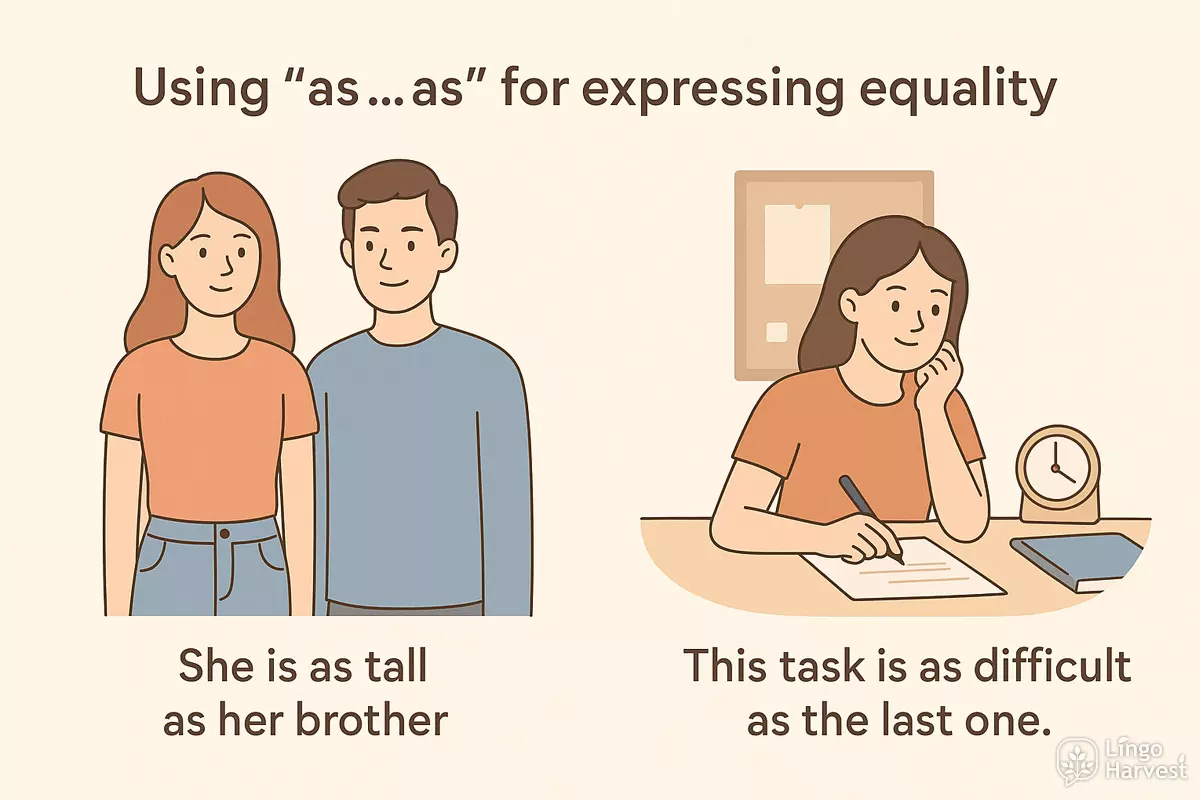
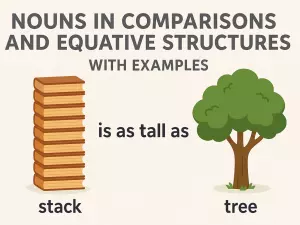
The pattern as + adjective/adverb + as shows that two things are equal in some way. It can be used with both adjectives and adverbs:
- She is as tall as her brother.
- This task is as difficult as the last one.
- He runs as quickly as his teammate.
Negative forms are also common:
- This book is not as interesting as I expected.
- He doesn’t speak as fluently as his friend.
Forming comparatives with "than"
Comparative adjectives and adverbs are used to highlight differences. The common structure is:
- adjective/adverb + -er + than (for short adjectives):
John is taller than Mike. - more/less + adjective/adverb + than (for longer adjectives):
This problem is more complicated than the last one.
Irregular forms also exist, such as:
- good → better than
- bad → worse than
- far → farther/further than
Key patterns: Equality vs. Comparison
| Structure | Example |
|---|---|
| as + adjective + as | She is as smart as her sister. |
| not as + adjective + as | This movie is not as funny as the last one. |
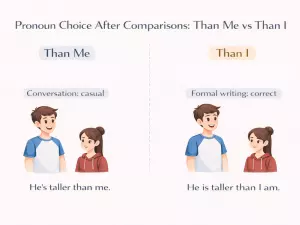
| adjective + -er + than | He is older than me. |
| more/less + adjective + than | This exam is more difficult than the previous one. |
| Irregular: better/worse/farther than | Her results are better than last year. |
Common mistakes to avoid
- Using than with as...as structures (❌ She is as tall than him)
- Forgetting "than" after comparatives (❌ He is older me)
- Using double comparatives (❌ more taller than)
- Applying -er to long adjectives (❌ beautifuller than)
Practice: Identify the correct comparative or equality structure
- My bag is ____ (heavy) yours.
- He doesn’t drive ____ (careful) his brother.
- This test is ____ (easy) the last one.
- Anna is ____ (intelligent) her colleague.
- This song is not ____ (popular) the previous one.
- Today is ____ (cold) yesterday.
- He works ____ (hard) his teammates.
- My phone is ____ (expensive) yours.
- She sings ____ (beautiful) her sister.
- This book is ____ (short) the one we read before.
Show answers
- heavier than
- as carefully as
- easier than
- as intelligent as
- as popular as
- colder than
- as hard as
- more expensive than
- as beautifully as
- shorter than
Forming comparisons with adjectives and adverbs + than
Comparing people, things, or actions often involves using adjectives or adverbs followed by "than." This construction highlights differences between two items or groups. The word "than" acts as a conjunction, introducing the second element in the comparison.
How to build comparative sentences
For most short adjectives, add "-er" to the adjective and follow with "than." With longer adjectives, use "more" before the adjective. Adverbs ending in "-ly" also usually take "more." Irregular adjectives and adverbs have unique comparative forms.
- smaller than
- taller than
- more beautiful than
- more quickly than
- better than
- worse than
- happier than
- more carefully than
- faster than
- older than
- less expensive than
- farther than
- more interesting than
- more quietly than
- busier than
- more easily than
- colder than
- more comfortable than
- more slowly than
Comparative forms: structure and examples
The structure for these sentences is straightforward: Subject + comparative adjective/adverb + than + comparison. For example:
- My car is faster than yours.
- She speaks more fluently than her brother.
- This book is less interesting than the last one.
Common mistakes to avoid
- Don't use "more" with adjectives that already have "-er" endings (e.g., more taller than ❌).
- Remember to use "than" after the comparative form.
- Be careful with irregular forms: "better," not "more good"; "worse," not "more bad."
Quick reference: Comparative forms
| Base form | Comparative form + than |
|---|---|
| fast | faster than |
| interesting | more interesting than |
| good | better than |
| carefully | more carefully than |
| old | older than |
| bad | worse than |
| quietly | more quietly than |
| busy | busier than |
Using these patterns, you can clearly express comparisons in English, making your communication more precise and engaging.
Using as…as for equal comparison and not as…as for negative comparison
The structure as…as is commonly used to express that two things share the same degree of a particular quality. This form is ideal for showing that people, objects, or situations are equal in some way. For example, saying, “This book is as interesting as that one,” means both books are equally interesting. On the other hand, the negative form, not as…as, shows that one thing does not possess a quality to the same extent as another. For instance, “My house is not as big as yours” means your house is bigger.
How to Use as…as for Equal Comparison
When you want to state that two things or people are on the same level regarding an adjective or adverb, use the pattern: as + adjective/adverb + as. This construction works with a wide range of qualities, such as size, speed, intelligence, or frequency.
- She is as tall as her brother.
- This car runs as smoothly as the new one.
- He can swim as fast as his coach.
- The test was as difficult as I expected.
- That movie was as funny as the first part.
- The soup is as hot as before.
- My laptop is as light as a tablet.
- She worked as hard as anyone in the team.
- The weather isn’t as cold as last week.
- This route is as direct as the highway.
Using not as…as for Negative Comparison
To highlight that one subject falls short of another in some quality, use the negative pattern: not as + adjective/adverb + as. This construction is direct and clear, making it easy to compare without using more complicated comparative forms.
- He is not as old as he looks.
- This problem is not as serious as it seems.
- My phone is not as expensive as yours.
- The train was not as crowded as usual.
- Her answer was not as clear as yours.
- I don’t feel as tired as yesterday.
- This painting is not as colorful as the others.
- He didn’t run as fast as last time.
- The instructions were not as helpful as I hoped.
- Our team isn’t as experienced as theirs.
Summary Table: Patterns and Examples
| Pattern | Example |
|---|---|
| as + adjective/adverb + as | Her dress is as beautiful as mine. |
| not as + adjective/adverb + as | This test is not as easy as the last one. |
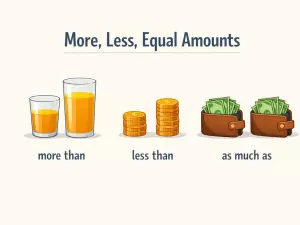
| as + much/many + noun + as | He has as many books as I do. |
| not as + much/many + noun + as | We don’t have as much time as they have. |
Remember, as…as emphasizes equality, while not as…as clearly points out a difference or lesser degree. This makes your comparisons in English both precise and easy to understand.
Word order issues with long comparative clauses
When comparative sentences get longer, keeping the words in the right order can be tricky. The more details you add after “than” or “as…as,” the easier it is for the sentence to sound awkward or confusing. This is especially common when extra phrases, clauses, or modifiers are included in the comparison.
Common patterns and pitfalls
Adding extra information to comparisons can lead to misplaced modifiers or unclear references. For example, compare these sentences:
- ✔ She is as talented as her brother who won the award last year.
Correct. “Who won the award…” clearly refers to the brother. - ✔ She is as talented as her brother, who won the award last year.
Also correct. The comma shows that the clause adds extra (non-essential) information about the brother. - ❌ She is as talented as her brother is, who won the award last year.
Incorrect. “Who won the award…” grammatically attaches to “is,” not “brother,” creating an illogical modifier.
Notice how the placement of “who won the award last year” changes the meaning or makes the sentence less clear. Keeping related ideas together helps maintain clarity.
Typical word order with long comparative clauses
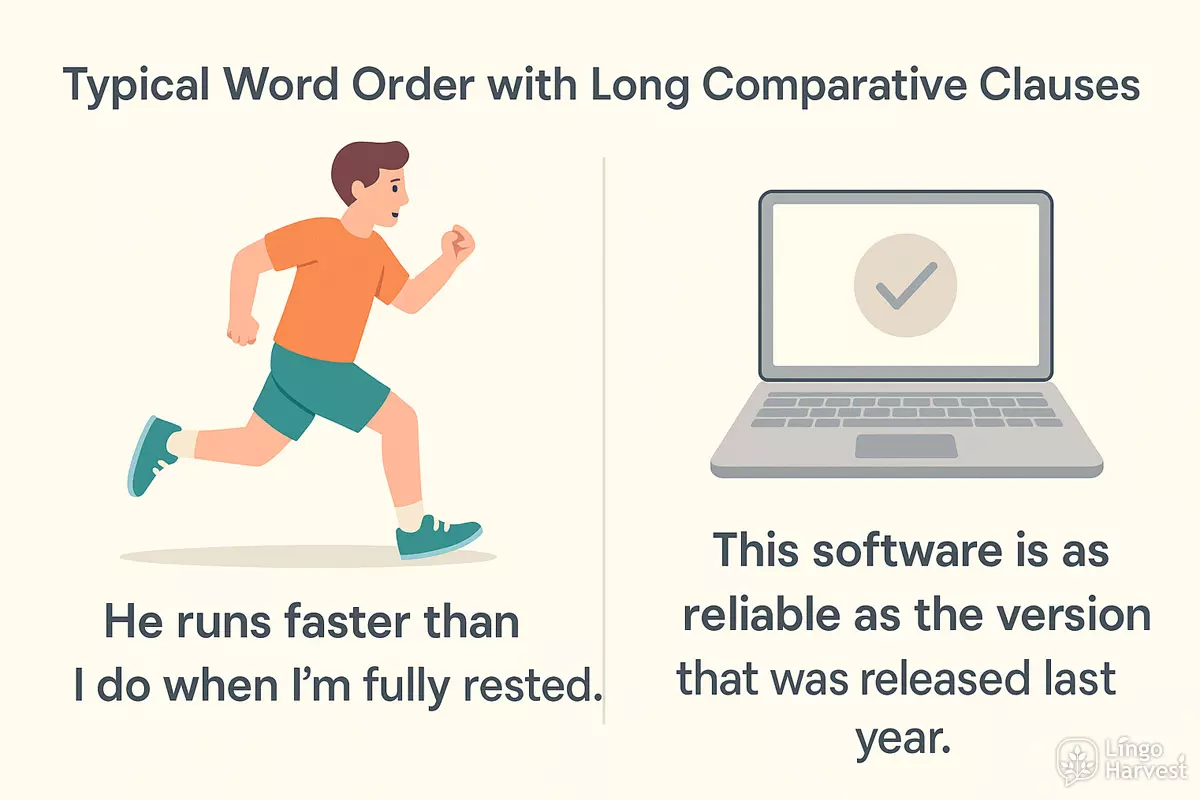
When the second part of a comparison contains a full clause, it’s important to keep the subject and verb close together. Here are some patterns to follow:
- He runs faster than I do when I’m fully rested.
- This software is as reliable as the version that was released last year.
- She cooks better than anyone else I have ever met.
- He works as hard as he did before the promotion.
- The exam was more difficult than we had anticipated it would be.
- She is as interested in art as her sister, who studies painting in Paris.
- He can solve problems faster than most people can think of them.
- The mountain is higher than we thought it was.
- Her explanation was clearer than the teacher’s, who often confuses us.
- This project is as important as the one we completed last year.
Tips for managing complex comparisons
- Keep the comparative structure parallel: match what comes before and after “as…as” or “than.”
- Place additional clauses or modifiers as close as possible to the noun they describe.
- If the sentence feels confusing, try breaking it into two shorter sentences.
- Avoid unnecessary repetition of verbs or pronouns.
- Use commas to separate extra information, especially non-defining relative clauses.
Examples of clear vs. unclear word order
| Clear | Unclear or Awkward |
|---|---|
| He is taller than his brother who lives in Paris. | He is taller than his brother is who lives in Paris. |
| This phone is as fast as the one I bought last year. | This phone is as fast as the one that I bought it last year. |
| She is more dedicated than anyone else I know in the office. | She is more dedicated than anyone else who I know in the office is. |
| The task was more complicated than we first assumed it would be. | The task was more complicated than we first assumed would be it. |
| My results are as impressive as those of my classmates, who studied abroad. | My results are as impressive as my classmates who studied abroad’s. |
By paying attention to the placement of clauses and modifiers, you can keep even lengthy comparative sentences clear and natural. The goal is always readability and precision, especially when the comparison includes extra details.
Typical collocations with as…as in everyday English
When comparing qualities or quantities in English, the “as…as” structure is frequently paired with certain adjectives and adverbs. These combinations are called collocations, and they help speakers express similarity or equality in a natural way. Recognizing these familiar patterns makes your comparisons sound more fluent and idiomatic.
Common adjective collocations
Some adjectives appear much more often in this pattern, especially when describing physical characteristics, abilities, or feelings. Here are several everyday examples:
- as tall as → He is as tall as his father.
- as fast as → She runs as fast as a professional athlete.
- as big as → This box is as big as the table.
- as old as → My house is as old as yours.
- as good as → Her cooking is as good as a restaurant’s.
- as cold as → The water was as cold as ice.
- as strong as → He is as strong as a weightlifter.
- as quiet as → The library was as quiet as a whisper.
- as easy as → The test was as easy as I expected.
- as bright as → Her smile was as bright as the sun.
- as soft as → The blanket feels as soft as cotton.
- as busy as → She is as busy as a bee today.
- as quick as → He finished the task as quick as lightning.
- as heavy as → This bag is as heavy as a suitcase.
- as sharp as → The knife is as sharp as a razor.
- as clean as → The kitchen is as clean as a hospital room.
- as dark as → The room was as dark as a cave.
- as warm as → The blanket was as warm as wool.
- as clear as → His explanation was as clear as glass.
- as safe as → This neighborhood is as safe as it gets.
Adverb collocations
The structure is also common with adverbs, especially when talking about the manner or degree of an action:
- as quickly as → She finished the task as quickly as possible.
- as carefully as → He packed the glassware as carefully as he could.
- as quietly as → The children moved as quietly as mice.
- as soon as → Call me as soon as you arrive.
- as often as → I visit my grandparents as often as I can.
- as much as → She studies as much as her classmates.
- as little as → He spent as little as necessary.
- as far as → We walked as far as the old bridge.
Set expressions and idioms
English also features some expressions where “as…as” is used in a fixed, sometimes colorful way. These idioms are widely recognized and add flavor to everyday speech.
| Expression | Meaning |
|---|---|
| as cool as a cucumber | very calm, not nervous |
| as blind as a bat | unable to see well |
| as busy as a bee | very busy, always working |
| as light as a feather | very light in weight |
| as stubborn as a mule | very stubborn |
| as free as a bird | completely free |
| as quiet as a mouse | very quiet |
| as white as snow | very white |
Usage notes
The “as…as” form can be made negative by inserting “not” before the first “as” (e.g., “not as tall as”), which is a common way to show difference rather than similarity. These collocations are practical for everyday conversation and writing, helping you express comparisons naturally and clearly.
Common mistakes with double comparatives and missing than
Learners often slip up when using comparative structures, especially when showing differences or similarities. Two of the most frequent issues are creating double comparatives (using two comparative forms together) and omitting "than" in constructions where it’s needed. Both errors can make sentences awkward or even change the intended meaning.
Double comparatives: What goes wrong?
A double comparative happens when someone combines two comparative forms, usually by adding "-er" to an adjective and using "more" or "less" at the same time. In standard English, only one comparative form is correct. Here are some examples of incorrect and correct usage:
- ❌ more better → ✅ better
- ❌ less faster → ✅ slower или not as fast
- ❌ more easier → ✅ easier
- ❌ more harder → ✅ harder
- ❌ more stronger → ✅ stronger
- ❌ more bigger → ✅ bigger
- ❌ less happier → ✅ less happy или not as happy
- ❌ more quicker → ✅ quicker или more quickly
- ❌ more older → ✅ older
- ❌ more nearer → ✅ nearer или closer
Omitting "than" in comparisons
Another common error is forgetting to include "than" after a comparative adjective or adverb. This makes the comparison incomplete or unclear. "Than" is essential when you want to clearly show contrast between two things. Some typical mistakes and their corrections:
- ❌ She is taller her brother. → ✅ She is taller than her brother.
- ❌ This test is harder last time. → ✅ This test is harder than last time.
- ❌ My car is faster yours. → ✅ My car is faster than yours.
- ❌ He works more quickly me. → ✅ He works more quickly than me.
- ❌ Anna is less patient John. → ✅ Anna is less patient than John.
- ❌ This solution is better the previous one. → ✅ This solution is better than the previous one.
- ❌ The new phone is more expensive my old one. → ✅ The new phone is more expensive than my old one.
Tips to avoid these mistakes
- Use only one comparative form per adjective (either "-er" or "more/less," not both).
- Always check if "than" is needed after a comparative.
- Remember: "as...as" is for equality, while "-er/more/less...than" is for comparisons.
- When in doubt, reread the sentence out loud; if it sounds crowded or unfinished, adjust it.
Recognizing and correcting these patterns will help you write and speak more naturally when making comparisons.
Practice: write comparative sentences using as…as and than
To master comparison in English, it’s helpful to make your own sentences using both “as…as” and “than.” Below, you’ll find sample tasks, useful phrases, and a variety of comparative structures. Try these exercises to check your understanding and improve your fluency.
Examples of Comparative Sentences
- My backpack is as heavy as yours.
- This book is more interesting than that one.
- She can run as fast as her brother.
- Winter is colder than autumn in my country.
- His explanation was as clear as possible.
- This puzzle is harder than the last one.
- The new phone is not as expensive as I expected.
- Tom is taller than Sam.
- Your handwriting is as neat as a printed text.
- Today is hotter than yesterday.
- This exam was not as difficult as the previous one.
- The blue shirt is as comfortable as the red one.
- My cat is older than my dog.
- Her house is as big as mine.
- He is more polite than his classmates.
Task: Complete the Sentences
Fill in the blanks using “as…as” or “than.”
- This chair is not __________ comfortable __________ that one.
- My brother is younger __________ me.
- The train was __________ late __________ usual.
- She sings better __________ her friend.
- My bag is __________ light __________ a feather.
- This book is more interesting __________ the last one.
- He runs __________ fast __________ his teammate.
- My phone is not __________ expensive __________ yours.
- She speaks English better __________ her classmates.
- The movie was __________ long __________ I expected.
Show answers
- This chair is not as comfortable as that one.
- My brother is younger than me.
- The train was as late as usual.
- She sings better than her friend.
- My bag is as light as a feather.
- This book is more interesting than the last one.
- He runs as fast as his teammate.
- My phone is not as expensive as yours.
- She speaks English better than her classmates.
- The movie was longer than I expected.
Useful Patterns for Comparison
Here’s a structured look at how “as…as” and “than” are used. Review these forms to reinforce the grammar:
| Pattern | Example |
|---|---|
| as + adjective + as | She is as tall as her father. |
| not as + adjective + as | This film is not as exciting as the last one. |
| adjective + -er + than | This road is shorter than the highway. |
| more/less + adjective + than | Math is more difficult than English. |
| as + adverb + as | He works as quickly as possible. |
| not as + adverb + as | She doesn’t run as fast as her sister. |
Challenge: Create Your Own Sentences
Write five original sentences—some with “as…as,” some with “than.” Try to use a variety of adjectives and adverbs. If you’re unsure, use the table above for reference.
Show answers
- My coffee is as hot as yours.
- This street is quieter than the main road.
- He isn’t as busy as last week.
- The movie was longer than I expected.
- She finished the race as quickly as her teammate.
Practice like this helps you become more comfortable with comparative structures and expands your ability to describe similarities and differences effectively in English.