Nouns in Comparisons and Equative Structures with Examples

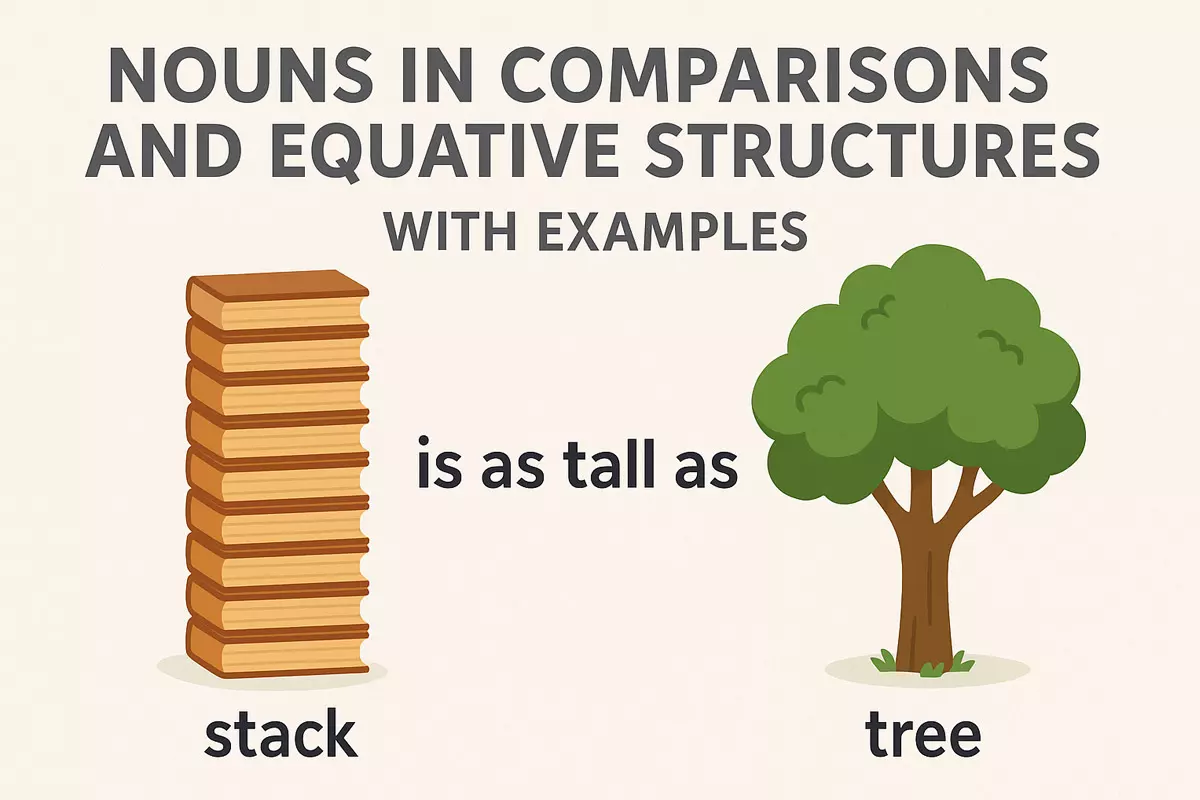 Here we how to form comparative and equative sentences with nouns, including patterns like as plus noun as and using more or less with nouns. It also explains count versus mass noun comparisons, common errors, and provides practice exercises.
- Using nouns in comparative sentence structures
- Equative patterns with as + noun + as
- Nouns with more and less comparison patterns
- Comparison of quantity using count and mass nouns
- Common errors with noun-based comparison structures
- Difference between adjective and noun comparisons
- Practice: form correct equative and comparative sentences
Examining how we compare people, places, or things in English highlights intriguing patterns, particularly in the way nouns are used within comparative structures. By understanding these patterns, we can communicate similarities and differences more effectively, making our language clearer and more precise. This knowledge is useful not only for everyday conversations but also for academic writing, where expressing nuanced comparisons is often essential. Mastering these structures enhances both comprehension and expression in English.
Using nouns in comparative sentence structures
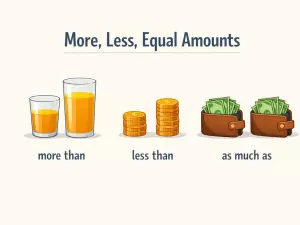
Comparing nouns in English often involves highlighting differences or similarities in quantity, quality, or degree. Rather than focusing on adjectives or adverbs, these patterns use nouns directly to express comparison. The most common way is with structures like "more... than," "fewer... than," or "less... than" when discussing countable or uncountable things.
Common Comparative Patterns with Nouns
When you want to compare quantities or amounts, you can use various constructions. Here are some typical ways to build comparisons using nouns:
- more + noun + than — "She has more books than her brother."
- fewer + countable noun + than — "There are fewer cars on the road today than yesterday."
- less + uncountable noun + than — "This recipe needs less sugar than that one."
- as many + plural noun + as — "He owns as many guitars as his friend."
- as much + uncountable noun + as — "You have as much patience as a teacher."
- not as much/many + noun + as — "They do not have as many opportunities as we do."
- twice/three times as much/many + noun + as — "She has twice as much experience as her colleague."
- the same number/amount of + noun + as — "We have the same number of chairs as tables."
- a greater/lesser amount of + noun + than — "This job requires a greater amount of responsibility than the last one."
- no more/no fewer + noun + than — "No more than ten students passed the test."
Examples of Noun Comparisons in Sentences
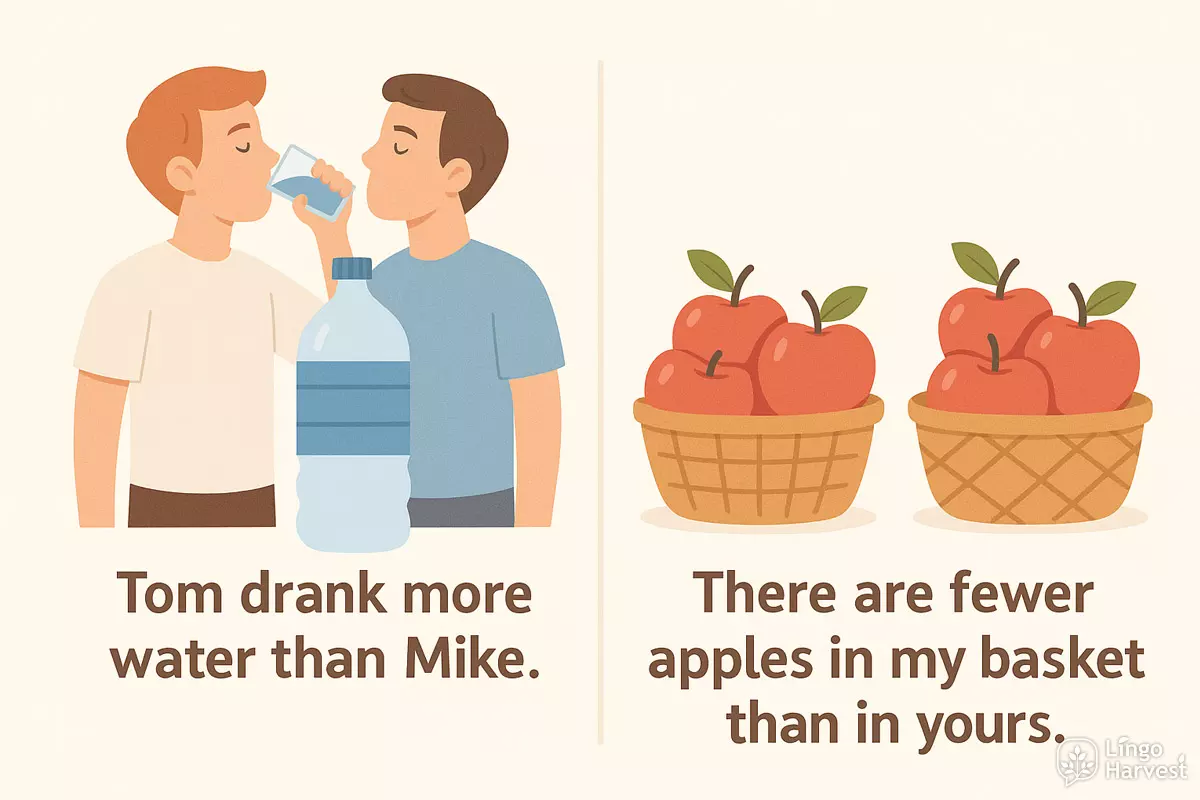
Looking at real sentences can clarify these structures:
- Tom drank more water than Mike.
- There are fewer apples in my basket than in yours.
- She has less free time than before.
- We need as many volunteers as possible.
- This project has as much funding as the last one.
- He has not as much experience as his boss.
- The city has twice as many parks as the neighboring town.
- They received the same amount of support as we did.
- My phone has a greater amount of storage than yours.
- No fewer than twenty people attended the seminar.
- There are more options now than last year.
- Less noise would be appreciated in this room.
Comparison Structures: Countable vs. Uncountable Nouns
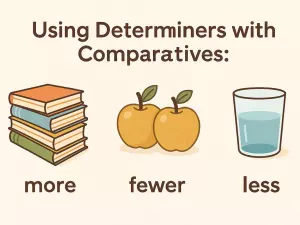
It's important to distinguish between countable and uncountable nouns when making these comparisons. The word "fewer" is used for countable nouns (apples, cars, students), while "less" fits uncountable nouns (water, time, money). "More" and "as many/as much" can be used with both, depending on the noun type.
| Pattern | Example Sentence |
|---|---|
| more + countable noun + than | She owns more cars than her neighbor. |
| fewer + countable noun + than | We have fewer chairs than needed. |
| less + uncountable noun + than | This solution uses less energy than the old one. |
| as many + plural noun + as | They have as many books as the library. |
| as much + uncountable noun + as | This project has as much importance as the first. |
Tips for Accurate Comparisons
- Always match the comparative word ("fewer," "less," "more") to the noun type.
- Use "the same number of" for plural countable nouns and "the same amount of" for uncountable nouns.
- For clarity, avoid using "less" with countable nouns in formal writing.
- Double-check which nouns are countable or uncountable if unsure.
Mastering these patterns helps you express differences and similarities with precision and clarity in English.
Equative patterns with as + noun + as
Equative constructions allow us to compare quantities, qualities, or characteristics in English, highlighting that two things are equal in some way. When nouns are used in these structures, the pattern is typically "as + noun + as." This form is useful for expressing that one person, thing, or group has the same amount or degree of something as another.
How the pattern works
Instead of comparing adjectives (like "as tall as"), using a noun lets you focus on the amount or existence of something. This can make your comparisons more specific or concrete. For example, you might say someone has as much patience as another, or that an event drew as large a crowd as last year.
Examples of equative structures with nouns
Here are some common examples that demonstrate how this type of comparison works in real sentences:
- She has as much experience as her colleague.
- They earned as many points as the winning team.
- This recipe uses as little sugar as possible.
- He received as little support as anyone else.
- The concert attracted as large a crowd as the festival.
- We faced as many challenges as last year.
- You showed as much courage as anyone could hope for.
- The student gave as good an answer as the teacher expected.
- My cat has as much energy as a kitten.
- She made as big a mistake as possible.
- The movie received as little attention as its predecessor.
- He has as many friends as his brother.
- We found as much evidence as we needed.
- This solution brings as few problems as the last one.
- The new product offers as many features as the competitor’s model.
- She displayed as much talent as the other performers.
- He has as little time as I do for hobbies.
- They faced as serious an issue as before.
Key points to remember
- Use as much with uncountable nouns (e.g., "as much water as").
- Use as many with plural countable nouns (e.g., "as many books as").
- With singular countable nouns, insert an article: "as big a mistake as".
- Negative forms: "not as much money as", "not as many options as".
Pattern overview and typical forms
| Pattern | Example |
|---|---|
| as much + uncountable noun + as | She has as much patience as her mentor. |
| as many + plural noun + as | We have as many ideas as they do. |
| as little + uncountable noun + as | He had as little sleep as anyone. |
| as few + plural noun + as | They made as few mistakes as possible. |
| as + adjective + a/an + noun + as | It was as big a surprise as last time. |
These structures are flexible and widely used in both formal and informal English. They enable you to make precise comparisons using nouns, and mastering them will help make your speech and writing clearer and more nuanced.
Nouns with more and less comparison patterns
When comparing quantities or amounts, English uses specific patterns with nouns to show “more” or “less” of something. These structures are especially common in both spoken and written language when highlighting differences or similarities in countable or uncountable nouns.
Standard patterns for noun comparisons
The most common way to compare nouns involves the phrases “more … than” and “less … than.” These are used to express greater or smaller amounts of a particular thing. Here are the main structures:
- more + noun + than (for a higher quantity): “She has more books than her brother.”
- less + noun + than (for a lower quantity): “We have less time than we thought.”
- fewer + plural count noun + than: “There are fewer apples than oranges.” (Note: “fewer” is used with countable nouns; “less” with uncountable nouns.)
- the most + noun: “He brought the most food to the party.”
- the least + noun: “This solution caused the least trouble.”
Examples of “more” and “less” with nouns
These patterns can be used with a wide range of vocabulary. Here are some examples to show how they work in context:
- more information than → This report provides more information than the previous one.
- less water than → This recipe uses less water than the original version.
- more opportunities than → The city offers more opportunities than the countryside.
- fewer mistakes than → She made fewer mistakes than last time.
- less sugar than → This drink contains less sugar than soda.
- more traffic than → There is more traffic than usual this morning.
- fewer students than → This class has fewer students than the evening group.
- less noise than → The new office has less noise than the old one.
- more support than → He received more support than he expected.
- less pollution than → Electric cars produce less pollution than petrol cars.
- more energy than → She has more energy than anyone else on the team.
- fewer problems than → The updated system causes fewer problems than before.
- less interest than → The sequel attracted less interest than the first movie.
- more choices than → Online shopping gives you more choices than local stores.
- less competition than → Small towns usually have less competition than big cities.
- more experience than → He has more experience than most new employees.
- fewer options than → Without a car, you have fewer options for travel.
- less furniture than → This room needs less furniture to feel spacious.
Comparative noun structures: Summary table
| Pattern | Example |
|---|---|
| more + [countable noun] + than | She owns more cars than her neighbor. |
| more + [uncountable noun] + than | We need more information than before. |
| less + [uncountable noun] + than | He drank less milk than his sister. |
| fewer + [plural count noun] + than | There are fewer chairs than people. |
| the most + noun | This team has the most experience. |
| the least + noun | It caused the least confusion. |
Key points and tips
- Use “fewer” with plural countable nouns (e.g., fewer books, fewer ideas).
- Use “less” with uncountable nouns (e.g., less money, less time).
- “More” works with both countable and uncountable nouns.
- For superlative forms, use “the most” or “the least” before the noun.
- Be careful to match the noun type (countable vs. uncountable) with the correct comparative word.
These patterns are essential for making clear, accurate comparisons in English, both in writing and conversation.
Comparison of quantity using count and mass nouns
When comparing amounts, English distinguishes between objects you can count individually and substances or concepts measured in bulk. This difference affects which comparative words and structures are appropriate. Understanding how to compare using both types of nouns helps create more accurate and natural sentences.
Comparing with count nouns
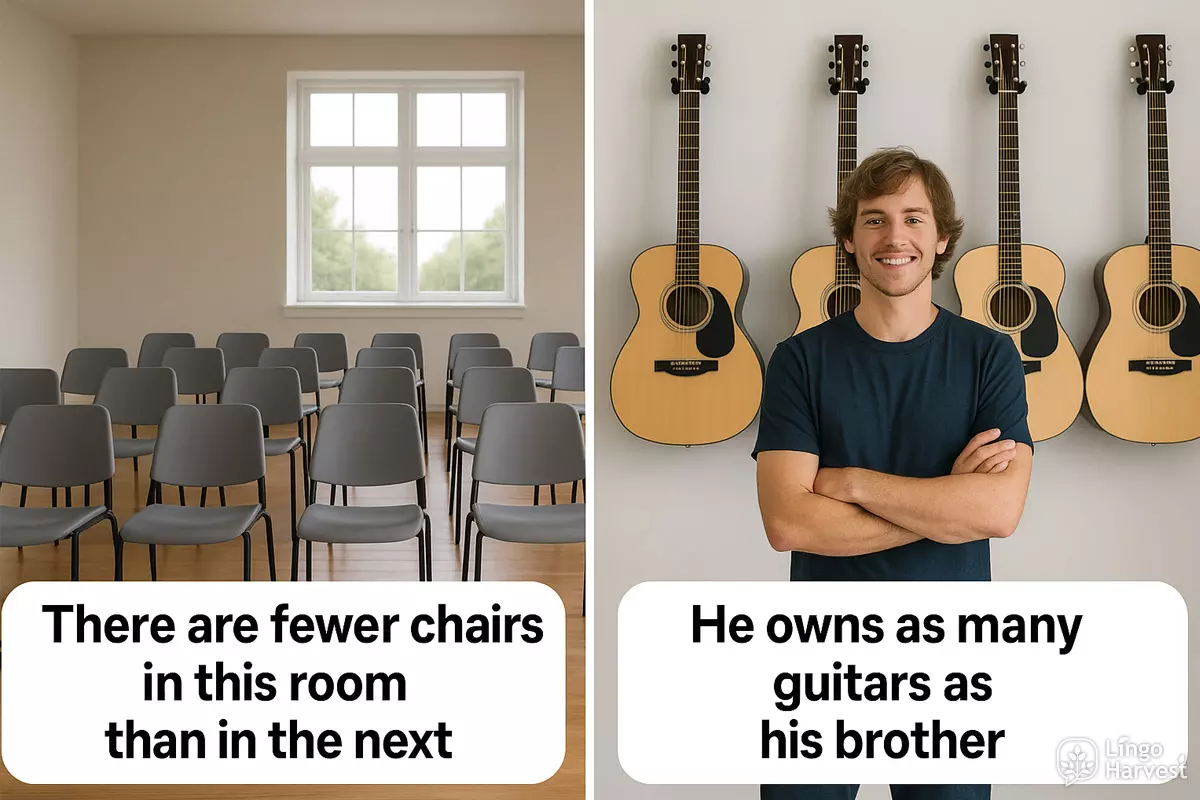
Count nouns refer to items that can be counted as separate units (e.g., apples, books, cars). To compare quantities, use words like more, fewer, and as many as. Here are some patterns and examples:
- She has more pens than I do.
- There are fewer chairs in this room than in the next.
- He owns as many guitars as his brother.
- Do you have as many questions as before?
- We saw more birds this morning.
Comparing with mass nouns
Mass nouns (also called non-count nouns) refer to substances or concepts that cannot be counted individually (e.g., water, information, rice). For these, use more, less, and as much as instead. Common patterns include:
- He drank more water than anyone else.
- There's less sugar in this recipe.
- We need as much time as possible.
- She has more patience than her colleague.
- The box contains less rice than before.
Summary of comparative structures
The table below contrasts the main comparative words and phrases used with count and mass nouns, along with example sentences for each pattern.
| Type of Noun | Comparative Phrase | Example |
|---|---|---|
| Count noun | more + plural noun | We have more books than last year. |
| Count noun | fewer + plural noun | There are fewer students today. |
| Count noun | as many + plural noun + as | He ate as many cookies as his friend. |
| Mass noun | more + mass noun | She needs more money for the project. |
| Mass noun | less + mass noun | This tea has less sugar. |
| Mass noun | as much + mass noun + as | We have as much information as possible. |
Common mistakes to avoid
Mixing up the comparative forms for count and mass nouns is a frequent error. For example, saying "less apples" (❌) instead of "fewer apples" (✅), or "as many water as" (❌) instead of "as much water as" (✅). Remember to match the comparative word to the noun type.
Quick reference: Typical mass and count nouns
- Count nouns: apples, cars, dogs, chairs, pencils, ideas, computers, coins, bottles, tickets
- Mass nouns: milk, rice, advice, furniture, sand, equipment, luggage, knowledge, air, traffic
Mastering these comparative structures allows for clearer, more precise expression when discussing amounts, whether you’re talking about individual items or bulk substances.
Common errors with noun-based comparison structures
When using nouns in comparative and equative constructions, learners often make specific mistakes that can affect clarity and correctness. Many of these issues arise from confusion about structure, incorrect word forms, or misplacement of comparison markers. Understanding these pitfalls can help you communicate more naturally and accurately.
Omitting necessary articles or determiners
In English, articles like the, a, or possessives are often required before nouns in comparative statements. Leaving them out can make sentences sound incomplete or ambiguous.
- ❌ Cats are better pets than dog.
- ✅ Cats are better pets than dogs.
- ❌ She has more patience than teacher.
- ✅ She has more patience than the teacher.
Confusing singular and plural forms
It's important to match the number in the compared nouns. Using a singular form for one item and a plural for another can cause confusion.
- ❌ This store has more selection than the other stores.
- ✅ This store has more selections than the other stores.
Incorrect use of comparative markers
Comparative structures with nouns often require words like more, fewer, or as many as. Using the wrong marker leads to grammatical errors.
- ❌ She has as money as her brother.
- ✅ She has as much money as her brother.
- ❌ There are less people here than yesterday.
- ✅ There are fewer people here than yesterday.
Mixing up equative and comparative structures
Equative structures (showing equality) and comparative structures (showing difference) are not interchangeable. Learners sometimes confuse as...as with more/less than patterns.
- ❌ He has more cars as his neighbor.
- ✅ He has as many cars as his neighbor.
Omitting the second noun or comparison target
Sometimes, the second part of the comparison is left out, making the sentence incomplete or unclear.
- ❌ She has more books.
- ✅ She has more books than her sister.
Common noun-based comparison mistakes: Summary Table
| Incorrect Example | Corrected Version |
|---|---|
| He has as much books as I do. | He has as many books as I do. |
| There is less chairs than before. | There are fewer chairs than before. |
| She got more advice than her friends did. | She received more advice than her friends did. |
| My bag is heavier as yours. | My bag is heavier than yours. |
| This restaurant has the best food from all. | This restaurant has the best food of all. |
| He owns as much cars as his brother. | He owns as many cars as his brother. |
Quick checklist for noun-based comparisons
- Use as much with uncountable nouns and as many with countable nouns.
- Apply correct articles or determiners for each noun.
- Keep noun forms consistent (singular/plural) on both sides of the comparison.
- Always include both elements being compared for clarity.
- Choose fewer for countable nouns and less for uncountable nouns.
- Don’t mix up as...as (equative) with more/less than (comparative) structures.
- Check that prepositions like of, than, or from are used correctly.
Difference between adjective and noun comparisons
Comparing adjectives and nouns in English involves distinct structures and serves different purposes. Adjective comparisons focus on qualities or characteristics, while noun comparisons deal with quantities, types, or identities. Understanding these differences is essential for constructing clear and accurate comparative and equative sentences.
Adjective Comparisons
When comparing adjectives, the emphasis is on how much more or less of a quality something has. This is commonly done using comparative and superlative forms, or with "as...as" for equative comparisons. Examples include:
- She is taller than her brother.
- This exam is easier than the last one.
- His car is as fast as mine.
- The book was more interesting than the movie.
- Anna is the most creative in the group.
Noun Comparisons
Noun comparisons typically involve quantity or identity, often using "as many/much...as," "more/less/fewer...than," or "the same...as." These structures focus on comparing things or amounts, not qualities. For example:
- She has as many books as her friend.
- They own more cars than we do.
- We have less time than yesterday.
- He drank the same amount of water as his teammate.
- There are fewer students than last year.
| Feature | Adjective Comparison | Noun Comparison |
|---|---|---|
| Focus | Quality or characteristic | Quantity, identity, or type |
| Typical Patterns | Comparative/superlative forms (taller, more beautiful), "as...as" | "more/fewer/less...than", "as many/much...as", "the same...as" |
| Examples | She is smarter than him. He is as old as his cousin. |
We have more apples than you. He has as much money as his brother. |
| Equative Structure | as + adjective + as | as many/much + noun + as |
Common Mistakes
- Using adjective forms when a noun comparison is needed: Incorrect: "She has more smarter books."
- Confusing "many" (count nouns) and "much" (uncount nouns): "more books" vs. "more water"
- Mixing patterns: Incorrect: "He is as much tall as his friend."
In summary, adjective-based comparisons highlight qualities, while noun-based comparisons focus on amounts or identities. Selecting the correct structure ensures clarity and grammatical accuracy in both comparative and equative sentences.
Practice: form correct equative and comparative sentences
Mastering how to use nouns in both equative and comparative constructions is a key skill for clear communication. Below, you’ll find targeted exercises and examples to help reinforce these structures. First, review the main patterns, then try the practice activities to test your understanding.
Key Patterns for Comparison and Equative Structures
- Equative: as + noun + as (e.g., as strong as a lion)
- Comparative: more/less + noun + than (e.g., more books than her)
- Countable noun comparison: more/fewer + plural noun + than (e.g., fewer apples than John)
- Uncountable noun comparison: more/less + uncountable noun + than (e.g., less water than before)
Transform Examples: Equative vs. Comparative
Below are pairs of sentences showing how to express similarity and difference using nouns. Compare the structures side by side:
| Equative Example | Comparative Example |
|---|---|
| She has as many books as Tom. | She has more books than Tom. |
| My backpack is as heavy as yours. | My backpack is heavier than yours. |
| There is as much sugar in this tea as in that one. | There is less sugar in this tea than in that one. |
| He owns as many cars as his neighbor. | He owns fewer cars than his neighbor. |
| This assignment has as many questions as the previous one. | This assignment has more questions than the previous one. |
Practice Activities
Rewrite the following sentences using the correct equative or comparative noun structure as indicated:
- Jane has 5 pencils. Mike has 5 pencils. (Express similarity)
- Our class has 25 students. Their class has 30 students. (Express difference)
- This recipe needs 200 g of flour. That recipe needs 150 g. (Express difference)
- Both teams scored 3 goals. (Express similarity)
- Anna drank 2 cups of coffee. Ben drank 1 cup. (Express difference)
- The red box weighs 10 kg. The blue box weighs 10 kg. (Express similarity)
- We have 3 meetings today. Yesterday we had 1 meeting. (Express difference)
- This phone costs $500. That phone costs $700. (Express difference)
- Both routes are 5 kilometers long. (Express similarity)
- She made 4 mistakes. He made 6 mistakes. (Express difference)
Show answers
- Jane has as many pencils as Mike.
- Our class has fewer students than their class.
- This recipe needs more flour than that recipe.
- Both teams scored as many goals as each other.
- Anna drank more cups of coffee than Ben.
- The red box weighs as much as the blue box.
- We have more meetings today than yesterday.
- This phone costs less than that phone.
- Both routes are as long as each other.
- She made fewer mistakes than he did.
Identify the Error
Each sentence below contains a mistake in the use of equative or comparative forms. Find and correct it:
- He has as much friends as I do.
- There are less chairs than tables in this room.
- She has as many money as her brother.
- This exam has more question than the last one.
- We have less apples than they do.
- I made fewer soup than yesterday.
- He drank fewer water than usual.
- They have as many furniture as we do.
- This class has less students than that one.
- She has as much books as her sister.
Show answers
- He has as many friends as I do.
- There are fewer chairs than tables in this room.
- She has as much money as her brother.
- This exam has more questions than the last one.
- We have fewer apples than they do.
- I made less soup than yesterday.
- He drank less water than usual.
- They have as much furniture as we do.
- This class has fewer students than that one.
- She has as many books as her sister.
Keep practicing with different nouns and contexts to become confident forming both types of structures. Focus on countable and uncountable nouns to avoid common mistakes in comparisons and equative phrases.