Reducing Clauses After Conjunctions (B2 level)

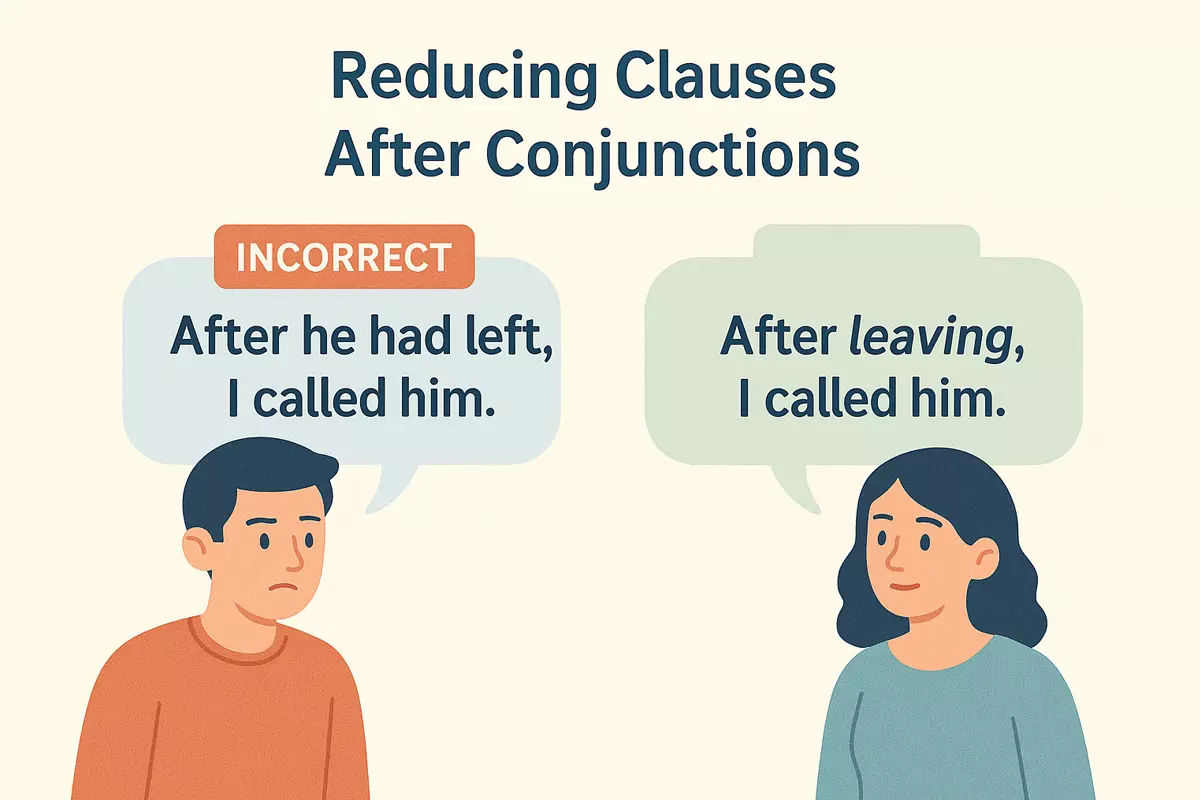 Here we clause reduction, showing how to shorten time, reason, and contrast clauses with conjunctions using -ing forms or past participles. It also discusses differences in spoken and written English and provides practice with rewriting clauses.
- What clause reduction is and why it is used
- Reducing time clauses with when, while, after, before
- Reducing reason and contrast clauses in natural English
- Using -ing forms and past participles after conjunctions
- Register considerations: spoken vs written style
- Practice: rewrite full clauses as reduced constructions after conjunctions
Learning how to shorten sentences that follow linking words can significantly improve your English fluency and make your communication sound more sophisticated. At the B2 level, developing this skill allows you to express ideas more clearly and efficiently, as it helps eliminate unnecessary repetition and keeps your message concise. By practicing sentence reduction after linking words, you not only enhance your writing and speaking style but also make your points easier for others to understand.
What clause reduction is and why it is used
Clause reduction refers to making sentences shorter and more natural by shortening subordinate clauses, especially after conjunctions such as after, before, while, or because. Instead of repeating the subject or using a full clause, English often allows you to use a participle phrase or an infinitive. This technique helps make your writing and speech clearer and less repetitive.
Why do English speakers reduce clauses?
Native speakers use reduced constructions for several reasons:
- To avoid repeating the subject when it is the same in both clauses
- To create smoother, more fluent sentences
- To sound more natural and less formal in everyday communication
- To make complex ideas easier to follow
- To save time and space, especially in writing
Common conjunctions for clause reduction
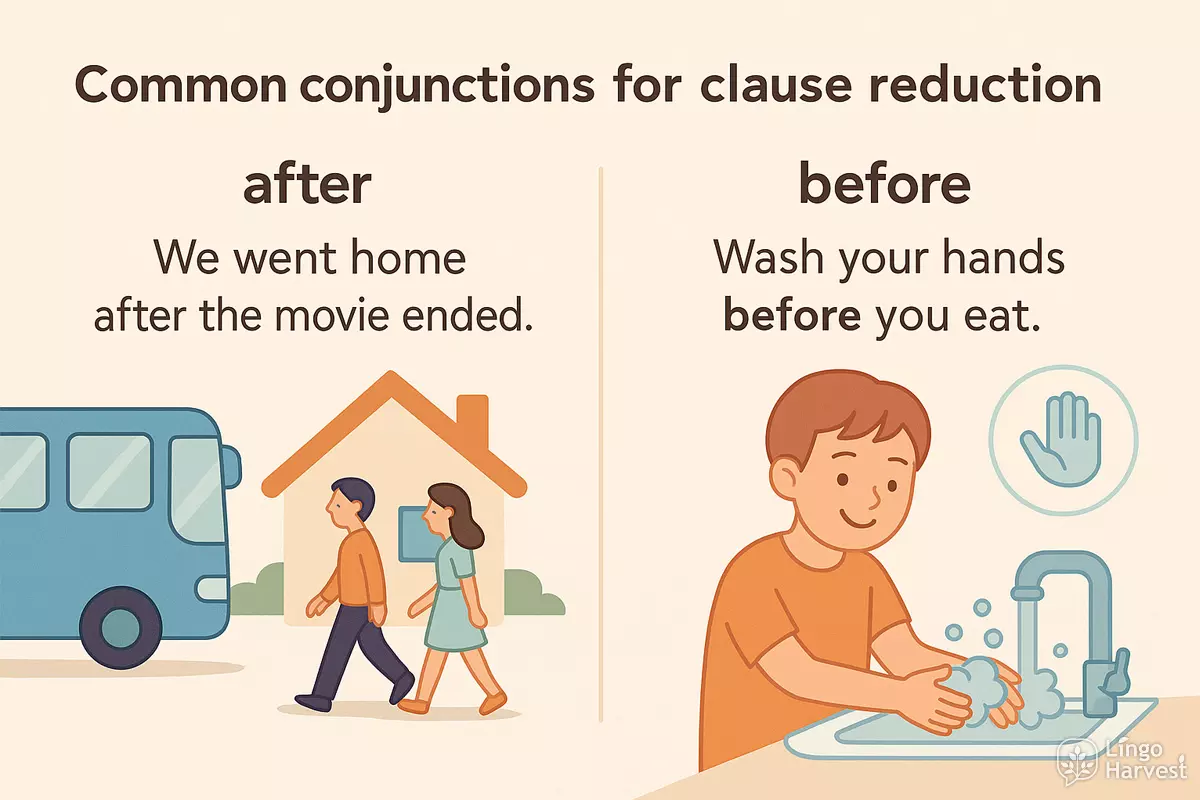
Some conjunctions are especially common for this pattern. Here are several:
- after → We went home after the movie ended.
- before → Wash your hands before you eat.
- while → She cooked dinner while he set the table.
- when → Call me when you arrive.
- since → Since it’s raining, we should stay inside.
- because → He stayed home because he felt sick.
- once → Once he finished his work, he took a break.
- as → As it was getting dark, we headed home.
- though → He tried hard, though he didn’t succeed.
- if → If it rains, we’ll stay inside.
- until → Wait here until I return.
- unless → You can’t leave unless you finish your homework.
How does clause reduction work?
Typically, if the subject of the main clause and the subordinate clause is the same, you can reduce the subordinate clause. This often means removing the subject and auxiliary verb, and changing the verb form to a participle or infinitive. Here are some typical forms:
| Full Clause | Reduced Clause |
|---|---|
| After she finished her homework, she watched TV. | After finishing her homework, she watched TV. |
| Before he left the house, he locked the door. | Before leaving the house, he locked the door. |
| While I was walking to work, I listened to music. | While walking to work, I listened to music. |
| Because he wanted to help, he arrived early. | Wanting to help, he arrived early. |
Benefits of using reduced clauses
- Sentences become less repetitive
- Your English sounds more advanced and fluent
- Ideas are expressed more efficiently
- Text and speech flow more smoothly
- You avoid unnecessary words, making your point clearer
Mastering clause reduction after conjunctions is an important step at the B2 level. It helps your communication feel more natural and closer to that of native speakers.
Reducing time clauses with when, while, after, before
Reducing time clauses helps make your sentences shorter and smoother, especially in spoken English or more advanced writing. This process is common with conjunctions like when, while, after, and before. Instead of saying two full clauses, you can often drop the subject and change the verb to its -ing or past participle form.
How to reduce time clauses
When two actions have the same subject, you can usually omit the subject in the dependent clause and use the -ing form of the verb. If the actions happen at the same time or one quickly follows another, this technique is especially useful.
- When + subject + verb → When + verb-ing
- While + subject + verb → While + verb-ing
- After + subject + verb → After + verb-ing
- Before + subject + verb → Before + verb-ing
Examples of reduced time clauses
Here are some typical examples to see the difference:
- When she finishes her homework, she watches TV.
→ When finishing her homework, she watches TV. - While he was driving, he listened to music.
→ While driving, he listened to music. - After they eat dinner, they go for a walk.
→ After eating dinner, they go for a walk. - Before you leave, call me.
→ Before leaving, call me. - When I arrived, she smiled.
→ On arriving, she smiled. (Alternative: "When arriving...") - After he finished work, he went home.
→ After finishing work, he went home. - While we were waiting, it started to rain.
→ While waiting, it started to rain. - Before they start the meeting, they check the equipment.
→ Before starting the meeting, they check the equipment. - When she was asked, she agreed.
→ When asked, she agreed. - After the movie ended, everyone left.
→ After the movie ended, everyone left. (No reduction here, since the subjects are different.)
When NOT to reduce
Do not reduce the clause if the subjects of the main and dependent clauses are different. Also, avoid reduction in very formal writing unless it improves clarity.
Common patterns for time clause reduction
| Full clause | Reduced clause |
|---|---|
| When she leaves the house, she locks the door. | When leaving the house, she locks the door. |
| While he was talking, he smiled. | While talking, he smiled. |
| After I read the email, I replied. | After reading the email, I replied. |
| Before they have lunch, they wash their hands. | Before having lunch, they wash their hands. |
| When the bell rings, students leave the class. | When the bell rings, students leave the class. (No reduction: different subjects) |
Tips for using reduced time clauses
- Use the -ing form when the subject is the same in both clauses.
- Do not reduce if the subjects are different; the meaning may change or become unclear.
- Reduction works best in informal or neutral writing and speech.
- Practice identifying when both subjects match to use this structure correctly.
Reducing reason and contrast clauses in natural English
When speaking or writing, English speakers often shorten clauses that show reason or contrast to make their sentences smoother. This kind of clause reduction is especially common after conjunctions like because, since, although, and while. By removing repeated subjects or auxiliary verbs, you can express ideas more efficiently and sound more natural.
How to reduce reason clauses
To condense reason clauses, you usually drop the subject and auxiliary verb if they match the main clause. The verb often changes to the -ing form. For example:
- Full clause: Because she was tired, she went home early.
- Reduced: Being tired, she went home early.
Other patterns for showing cause include:
- Since moving to London, he has made many friends.
- Having finished the project, we celebrated.
- Because of feeling unwell, he stayed in.
- Due to the late hour, the store was closed.
- Not knowing the answer, she stayed silent.
- Given the weather, we stayed inside.
- Owing to traffic, we were late.
- Seeing no reason to wait, they left.
- Feeling hungry, he made a sandwich.
- Faced with a problem, she asked for help.
Reducing contrast clauses
Contrast clauses (with although, even though, while, though) can also be shortened, especially when the subject is the same in both clauses. This is often done by using an -ing or past participle form, or by omitting unnecessary words.
- Full clause: Although he was inexperienced, he got the job.
- Reduced: Inexperienced, he got the job.
- Though tired, she finished her work.
- Despite being late, they let us in.
- While working, he listened to music.
- Even though injured, he played the match.
- Although not invited, she came to the party.
- Despite having little money, they were happy.
- Though warned, he ignored the advice.
- While unprepared, she managed well.
Common patterns for clause reduction
| Full Clause | Reduced Clause |
|---|---|
| Because she didn’t study, she failed. | Not having studied, she failed. |
| Although it was raining, we went out. | Despite the rain, we went out. |
| Since he lives nearby, he walks to work. | Living nearby, he walks to work. |
| While I was cooking, the phone rang. | While cooking, the phone rang. |
| Although he had no experience, he applied. | Having no experience, he applied. |
Tips for natural usage
- Make sure the reduced clause’s subject matches the main clause’s subject.
- Use participle forms (-ing or past participle) for clarity.
- Don’t overuse reductions; use them where they sound natural.
- Practice with real examples to build confidence.
By mastering these reductions, you’ll make your English more fluent and closer to native usage, especially in writing and advanced speaking.
Using -ing forms and past participles after conjunctions
Many English speakers make their sentences more concise by reducing clauses after conjunctions like “when,” “while,” “after,” “before,” and “since.” Instead of repeating the subject and verb, you can use an -ing form or a past participle to shorten the sentence. This is especially common in written English and helps avoid unnecessary repetition.
How -ing forms work after conjunctions
When the subject of both clauses is the same, the verb in the subordinate clause can often be replaced by its -ing form. This makes the sentence shorter without changing the meaning. For example:
- After finishing his homework, he went out. (Instead of: After he finished his homework, he went out.)
- While waiting for the bus, she read a book.
- Before leaving the house, check you have your keys.
- Since moving to the city, he has made many friends.
- When working late, I drink a lot of coffee.
Using past participles after conjunctions
Past participles are used after conjunctions when the reduced clause is passive, or when you want to focus on the result of an action. This is typical when the subject of the main clause receives the action. For example:
- After being given instructions, the students started the test.
- Once completed, the form should be sent to the office.
- When invited to the party, she gladly accepted.
- Before served, the meal is kept warm.
- While watched by the audience, the performer felt nervous.
Common conjunctions used with reduced clauses
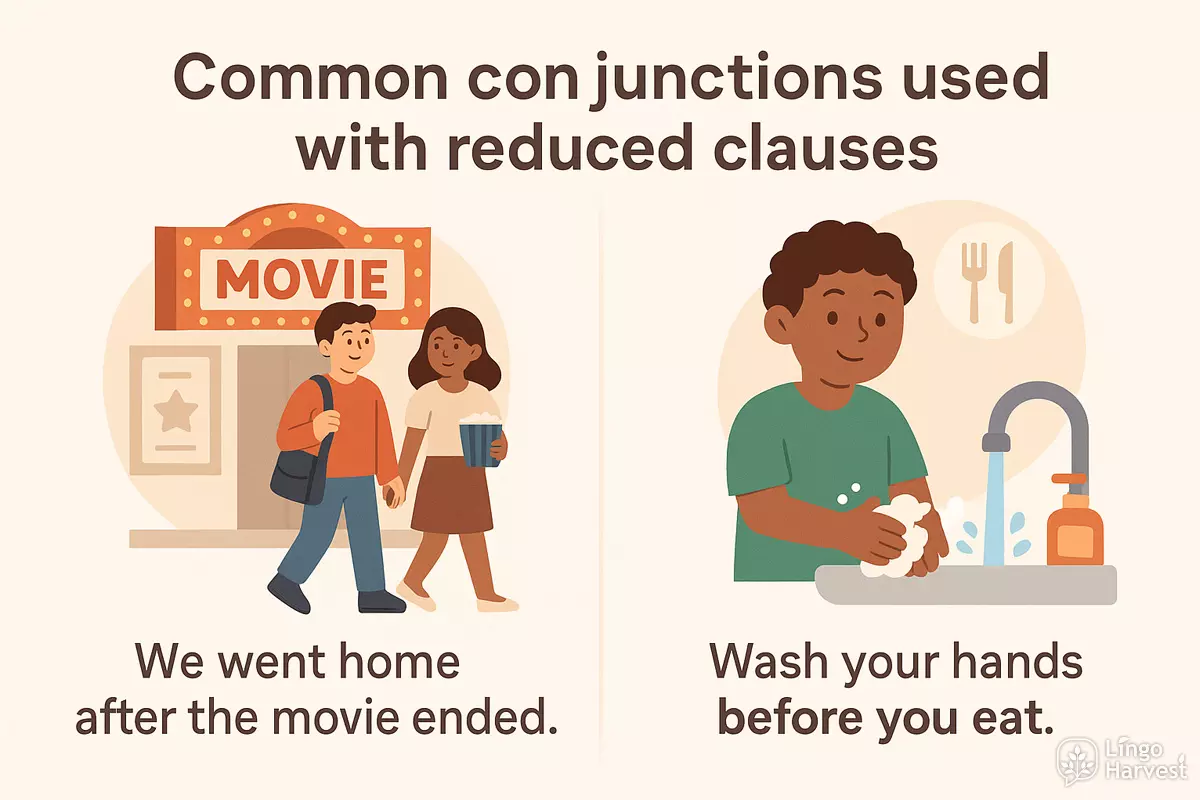
Several conjunctions frequently introduce clauses that can be reduced in this way. Here are some of the most common:
- after → We went home after the movie ended.
- before → Wash your hands before you eat.
- when → Call me when you arrive.
- while → She read a book while he cooked dinner.
- since → Since it’s cold, we should wear jackets.
- once → Once he finished the task, he relaxed.
- until → Wait here until I return.
- as soon as → Call me as soon as you’re ready.
- if → If it rains, we’ll stay inside.
- although → Although it was late, they went for a walk.
Comparing full and reduced clauses
Below is a table showing how sentences change when you use reduced forms instead of full clauses:
| Full Clause | Reduced Clause |
|---|---|
| After she finished her meal, she left the restaurant. | After finishing her meal, she left the restaurant. |
| While he was walking home, he saw a friend. | While walking home, he saw a friend. |
| Once the documents are signed, you can collect them. | Once signed, you can collect the documents. |
| Before the band was introduced, the audience waited eagerly. | Before introduced, the audience waited eagerly. |
| Since I moved here, I have learned a lot. | Since moving here, I have learned a lot. |
Points to remember ✅
- Use the -ing form when the subject of both clauses is the same.
- Past participles are common when the reduced clause is passive.
- Not all clauses can be reduced; make sure the meaning stays clear.
- Reduced clauses are more formal and often seen in written English.
Mastering these patterns helps your writing become more natural and efficient, especially at the B2 level and above.
Register considerations: spoken vs written style
When reducing clauses after conjunctions, your choice of structure often depends on whether you’re speaking or writing. Spoken language is usually less formal, so shorter, simpler reduced clauses are common. In contrast, written texts (especially academic or professional) typically favor full clauses or more formal reductions to ensure clarity.
Differences in everyday speech and formal writing
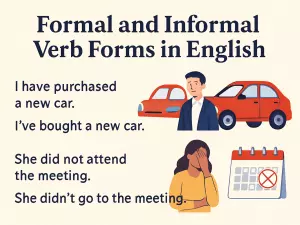
In conversation, speakers often omit words or use participle phrases to sound more natural and efficient. For example, after conjunctions like "when," "while," or "because," it’s common to drop the subject if it’s the same as in the main clause. Writing, however, may keep the subject or use more precise reductions to avoid ambiguity.
- Spoken: "Because feeling tired, I went home early."
- Written: "Because I was feeling tired, I went home early."
- Spoken: "While eating dinner, he watched TV."
- Written: "While he was eating dinner, he watched TV."
- Spoken: "If finished early, call me."
- Written: "If you have finished early, call me."
- Spoken: "After graduating, she moved abroad."
- Written: "After she graduated, she moved abroad."
- Spoken: "Though surprised, he didn’t show it."
- Written: "Though he was surprised, he didn’t show it."
- Spoken: "When done, let me know."
- Written: "When you are done, let me know."
- Spoken: "Before leaving, lock the door."
- Written: "Before you leave, lock the door."
Common conjunctions for clause reduction
Certain conjunctions are especially frequent in clause reduction, both in speech and writing. These include "after," "before," "while," "when," "since," "because," "if," "though," and "although." In spoken English, reductions are more flexible, while in writing, they may be limited to avoid confusion.
Comparing spoken and written forms
| Conjunction + Reduced Clause (Spoken) | Full Clause (Written) |
|---|---|
| After finishing the project, we celebrated. | After we finished the project, we celebrated. |
| While waiting for the bus, she read a book. | While she was waiting for the bus, she read a book. |
| If invited, I’ll come to the party. | If I am invited, I’ll come to the party. |
| Because feeling ill, he stayed home. | Because he was feeling ill, he stayed home. |
| Though tired, he finished his work. | Though he was tired, he finished his work. |
Tips for learners
- In informal situations, it’s fine to reduce clauses after conjunctions if the meaning is clear.
- In formal writing, use reduced forms only when there is no risk of confusion.
- Always check that the subject of the reduced clause matches the subject of the main clause.
- Practice listening for reduced clauses in native speech to improve fluency.
- Use clause reduction to sound more natural in everyday conversation.
- Be more careful with reductions in academic or professional writing.
- Choose full clauses when precision is more important than brevity.
- Think about your audience before deciding whether to reduce clauses.
Practice: rewrite full clauses as reduced constructions after conjunctions
Understanding how to shorten clauses after conjunctions like "after," "while," "before," "since," and "although" is a useful skill for creating more natural, fluent English sentences. This practice section will help you recognize and apply reduced forms in sentences where the subject of both clauses is the same.
Below, you will find a set of full-clause sentences. Your task is to rewrite each one, replacing the full clause after the conjunction with a reduced (participial) construction where possible. Pay attention to the verb tense and make sure the meaning stays clear.
Rewrite the sentences:
- After he finished his homework, he went out to play.
- While she was cooking dinner, she listened to music.
- Before you leave the house, check if the windows are closed.
- Since I moved to this city, I have made many friends.
- Although he was tired, he continued working.
- After they had eaten breakfast, they went for a walk.
- While he was waiting for the bus, he read a book.
- Before she started her new job, she traveled abroad.
- Although she was feeling sick, she attended the meeting.
- Since she graduated, she has worked in several countries.
Show answers
- After finishing his homework, he went out to play.
- While cooking dinner, she listened to music.
- Before leaving the house, check if the windows are closed.
- Since moving to this city, I have made many friends.
- Although tired, he continued working.
- After eating breakfast, they went for a walk.
- While waiting for the bus, he read a book.
- Before starting her new job, she traveled abroad.
- Although feeling sick, she attended the meeting.
- Since graduating, she has worked in several countries.
Tips for reducing clauses after conjunctions
- Use the present participle ("-ing" form) for actions happening at the same time as the main verb.
- Use the past participle for passive meanings or when the action is finished before the main verb.
- If the subject is the same in both clauses, you can usually reduce the subordinate clause.
- Do not reduce if the subjects are different.
- Make sure the meaning of the reduced clause is clear and natural.
Common conjunctions for clause reduction
- provided that → You can join us provided that you finish your work.
- even if → I’ll help you even if I’m tired.
- as long as → You can stay here as long as you keep quiet.
- in case → Take a jacket in case it gets cold.
- now that → Now that you’re here, we can begin.
- insofar as → The plan is good insofar as it saves time.
- regardless of → We will continue regardless of the difficulties.
- whether or not → I’m going for a walk whether or not it rains.
- in the event that → In the event that he calls, let me know.
- supposing that → Supposing that you win, what will you do?
- rather than → She chose tea rather than coffee.
- except that → The trip was nice, except that it rained a lot.
- lest → Be quiet lest you wake the baby.
- inasmuch as → She is lucky inasmuch as she has supportive friends.
- whereby → They created a system whereby everyone could contribute ideas.
More examples: full clauses vs. reduced constructions
| Full Clause | Reduced Construction |
|---|---|
| After he finished reading, he went to bed. | After finishing reading, he went to bed. |
| While she was taking notes, she listened carefully. | While taking notes, she listened carefully. |
| Before he entered the room, he knocked on the door. | Before entering the room, he knocked on the door. |
| Although he was warned, he took the risk. | Although warned, he took the risk. |
| Since they arrived, things have improved. | Since arriving, things have improved. |
Practice rewriting sentences in this way to improve your fluency and understanding of reduced clause structures in English. This skill will make your writing and speaking more concise and advanced.