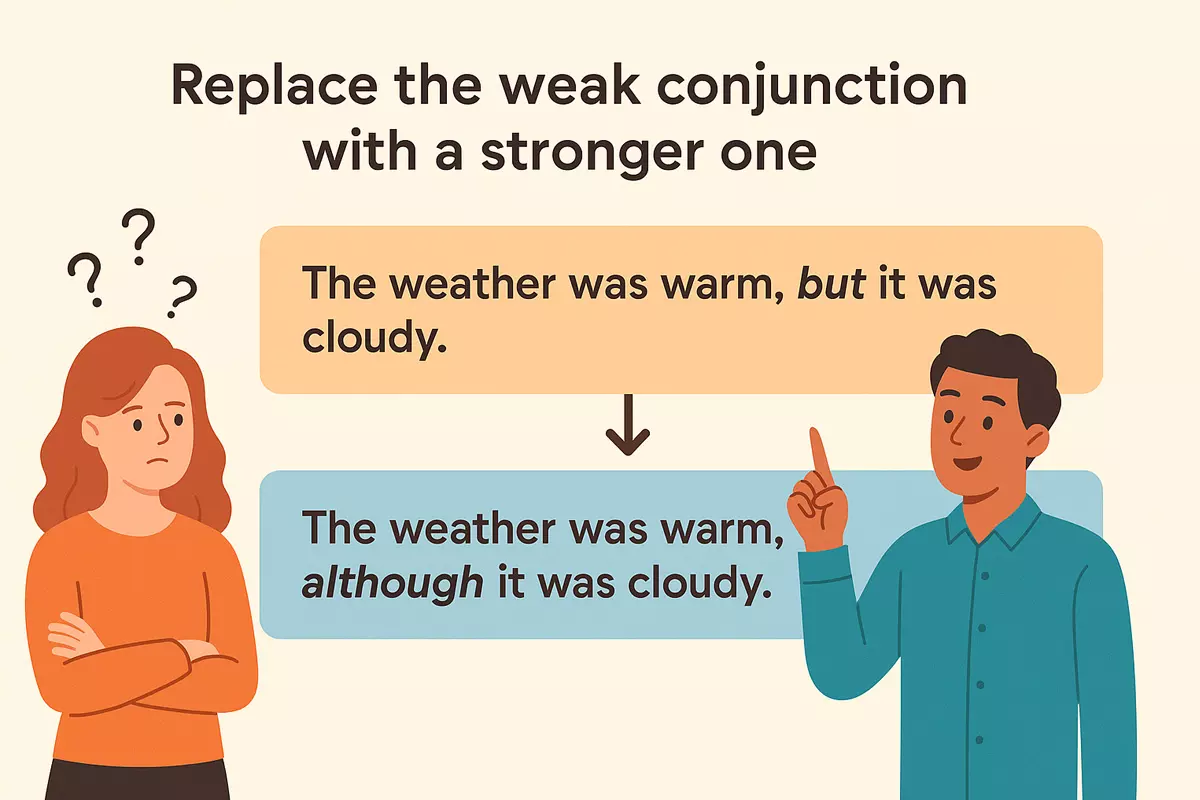
Replace the Weak Conjunction with a Stronger One

 The article reviews weak versus strong conjunctions for intermediate learners, highlights vague and effective linking words by function, offers practice exercises at sentence and paragraph levels, and includes an answer key with expert suggestions for improvement.
- Review of weak vs strong conjunctions from intermediate perspective
- List of vague conjunctions to watch out for
- List of stronger linking words grouped by function
- Short sentences where the conjunction can be improved
- Paragraph-level practice: upgrade connections in a text
- Answer key with suggested strong conjunctions and comments
Improving your writing often depends on selecting strong connectors to link your ideas effectively. By replacing weak transitional words with more powerful alternatives, you can make your message clearer and your sentences more engaging. Thoughtful use of connectors not only enhances the flow of your writing but also helps readers follow your arguments more easily. Ultimately, choosing the right linking words brings clarity, coherence, and a sense of purpose to your work, making your communication more compelling and professional.
Review of weak vs strong conjunctions from intermediate perspective
Choosing the right conjunction can significantly impact the clarity and forcefulness of your writing. Intermediate learners often use basic connectors like "and," "but," or "so" out of habit, missing opportunities to express more complex relationships or add precision. Understanding the difference between weaker and stronger conjunctions helps you achieve greater nuance and sophistication.
What makes a conjunction "weak" or "strong"?
Weak connectors are typically general-purpose and may create only a loose link between ideas. In contrast, strong conjunctions clarify cause and effect, contrast, purpose, condition, or sequence more explicitly. Stronger options improve cohesion, guide the reader, and reduce ambiguity.
Common weak conjunctions and their stronger alternatives
Below is a comparison of frequently used basic conjunctions and more precise, advanced alternatives that convey richer meaning:
| Weak Conjunction | Stronger Alternative(s) |
|---|---|
| and | furthermore, moreover, in addition, as well as, not only... but also |
| but | however, nevertheless, on the other hand, although, whereas, yet |
| so | therefore, thus, as a result, consequently, for this reason |
| or | alternatively, otherwise, either... or |
| because | since, as, due to, owing to, inasmuch as |
| if | provided that, unless, in case, on condition that, assuming that |
| when | while, whenever, as soon as, once, after, before |
| then | subsequently, afterwards, next, following that |
| also | additionally, likewise, similarly |
| because | since, as, for, in view of the fact that |
Why upgrade to stronger connectors?
More advanced conjunctions do more than simply join clauses; they clarify relationships such as contrast, consequence, or emphasis. This makes arguments clearer and helps your writing stand out in academic or professional contexts. For example, "however" signals clear contrast, while "therefore" directly shows cause and effect.
Practice: Choose the stronger conjunction
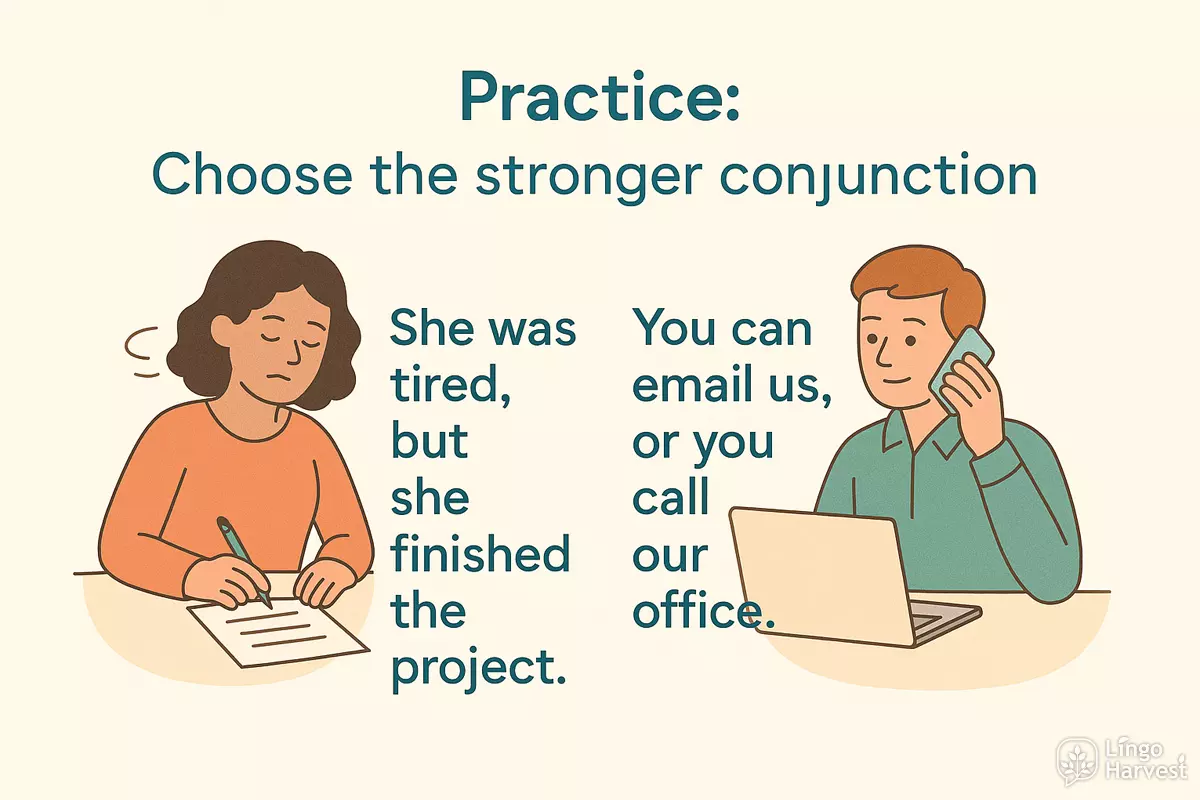
Replace the weak conjunction in each sentence with a more precise alternative:
- She was tired, but she finished the project.
- You can email us, or you can call our office.
- He studied hard, so he passed the exam.
- We missed the bus because we left late.
- They wanted to join us, and they brought snacks.
- It was raining, but we still went for a walk.
- You can take a taxi, or you can wait for the bus.
- He didn’t understand the lesson, so he asked for help.
- She stayed home because she wasn’t feeling well.
- I was cooking dinner, and my brother was setting the table.
Show answers
- She was tired; however, she finished the project.
- You can email us; alternatively, you can call our office.
- He studied hard; therefore, he passed the exam.
- We missed the bus since we left late.
- They wanted to join us; in addition, they brought snacks.
- It was raining; however, we still went for a walk.
- You can take a taxi; otherwise, you can wait for the bus.
- He didn’t understand the lesson; therefore, he asked for help.
- She stayed home since she wasn’t feeling well.
- I was cooking dinner; meanwhile, my brother was setting the table.
Summary: Building stronger connections
Mastering a wider range of conjunctions allows you to be more precise and persuasive. As you continue developing your writing skills, experiment with stronger connectors to see how they affect your tone and argument structure. This practice will help you move beyond basic sentence links and toward richer, more varied expression.
List of vague conjunctions to watch out for
Writers often rely on certain linking words that can make sentences less precise or create ambiguity. These "weak" conjunctions tend to blur relationships between ideas, making arguments less compelling. When editing, it's helpful to recognize which connectives tend to be overused or unclear so you can swap them for more specific alternatives.
Commonly Overused or Ambiguous Conjunctions
- And → She cooked dinner and washed the dishes.
- But → He wanted to go out, but it was too late.
- So → It was very cold, so we stayed inside.
- Or → You can take the bus or walk.
- Also → She speaks English and also learns French.
- Besides → It was raining; besides, I didn’t feel well.
- As → As it was getting dark, we went home.
- Then → We ate lunch, then we went shopping.
- Yet → He is young, yet very responsible.
- Still → It was late; still, he continued working.
- However → The task looked easy; however, it was difficult.
- While → She read a book while he cooked.
- Though → She was tired, though she didn’t show it.
- Even though → Even though it was raining, they played outside.
- Because → He stayed home because he was sick.
- Though → I liked the movie, though it was too long.
- Whereas → She loves hiking, whereas he prefers swimming.
- Thus → She studied hard; thus, she passed the exam.
- Since → Since you’re here early, let’s start.
- Meanwhile → He cooked dinner; meanwhile, she set the table.
Some of these connectors, like and or but, are grammatically correct but may lack clarity when the relationship between clauses is more complex than simple addition or contrast. Others, such as so or then, may fail to express the true cause, effect, or sequence.
Potential Pitfalls When Using Vague Conjunctions
- They can obscure the specific relationship between ideas (cause, contrast, result, condition).
- They may introduce logical gaps or leave the reader questioning the connection.
- Overuse can make writing monotonous and less engaging.
To strengthen your writing, look for these connectors and ask if a more precise alternative would clarify your meaning. For example, instead of so, consider therefore, as a result, or consequently if you want to highlight causation. Similarly, swap but for however, on the other hand, or nevertheless when you need to show contrast more explicitly.
Careful revision and thoughtful word choice will help you replace weak transitions with stronger, more meaningful ones, improving the clarity and impact of your writing.
List of stronger linking words grouped by function
When you want to replace weak conjunctions, it helps to choose connectors that clearly show the relationship between ideas. Stronger linking words not only clarify your intent but also make your writing more precise. Below, connectors are grouped by how they function in a sentence—whether they contrast, add information, show cause, or indicate result.
Adding Information
If you need to add details or examples, opt for these alternatives:
Showing Addition
- Moreover → She is smart; moreover, she works very hard.
- Furthermore → The plan is risky; furthermore, it’s expensive.
- Additionally → The hotel is cheap; additionally, it’s close to the beach.
- In addition → He plays guitar; in addition, he writes his own songs.
- As well as → She enjoys reading as well as painting.
- Not only... but also → Not only did he win, but he also broke a record.
- Similarly → She loves hiking; similarly, her sister enjoys outdoor activities.
- Equally important → The design is good; equally important, the product is durable.
- Besides → I’m too tired; besides, I have work to do.
- What’s more → The meal was delicious; what’s more, it was inexpensive.
Showing Contrast
- However → She studied hard; however, she didn’t pass.
- Nevertheless → It was raining; nevertheless, they played outside.
- On the other hand → He loves cats; on the other hand, his brother prefers dogs.
- Conversely → She is very strict; conversely, her colleague is relaxed.
- In contrast → The north is cold; in contrast, the south is very warm.
- Yet → He had no experience, yet he got the job.
- Still → It was difficult; still, she didn’t give up.
- Instead → I didn’t buy coffee; instead, I made tea.
- Alternatively → You can book online; alternatively, you can visit the office.
- Even so → The task was hard; even so, he completed it.
Expressing Cause and Effect
When explaining reasons or outcomes, use connectors that make the relationship explicit:
| To Show Cause | To Show Effect |
|---|---|
| Because | Therefore |
| Since | As a result |
| Due to | Consequently |
| Owing to | Thus |
| Given that | Hence |
Clarifying or Explaining
When you need to clarify a point or give an example, these words work well:
- For example → She loves outdoor activities; for example, hiking and cycling.
- For instance → Many people enjoy spicy food; for instance, Thai or Indian dishes.
- In other words → He’s frugal; in other words, he doesn’t like to spend money.
- Namely → Only two students passed the test, namely Tom and Sarah.
- That is to say → The weather was terrible, that is to say, windy and rainy all day.
- To illustrate → The city is growing fast; to illustrate, three new malls opened this year.
- Specifically → We need more volunteers, specifically people with teaching experience.
- Such as → She enjoys creative hobbies, such as drawing and photography.
- To clarify → The meeting is tomorrow, to clarify, at 9 AM sharp.
- In particular → I like classical music, in particular piano concerts.
Summarizing or Concluding
To wrap up or summarize ideas, these expressions can be effective:
- In conclusion → In conclusion, the project was a great success.
- To sum up → To sum up, we learned a lot from this experience.
- Overall → Overall, the trip was amazing despite the rain.
- In summary → In summary, the data supports our original idea.
- Ultimately → Ultimately, the decision is yours to make.
- All things considered → All things considered, the results were positive.
- To conclude → To conclude, teamwork played a major role in our win.
- Briefly → Briefly, the plan needs more work.
- In short → In short, we must act quickly.
- On the whole → On the whole, customers were satisfied.
Choosing the right connector for the context makes your writing flow better and helps readers follow your logic. Try substituting these more precise words in place of basic conjunctions like “and,” “but,” or “so” for clearer, more engaging sentences.
Short sentences where the conjunction can be improved
Many simple sentences rely on basic conjunctions like "and," "but," or "so." While these work, they often make writing feel flat or repetitive. Choosing a more precise connector can clarify meaning, add emphasis, or create a smoother flow between ideas. Below are several short sentences that use weak conjunctions, along with suggestions for stronger alternatives.
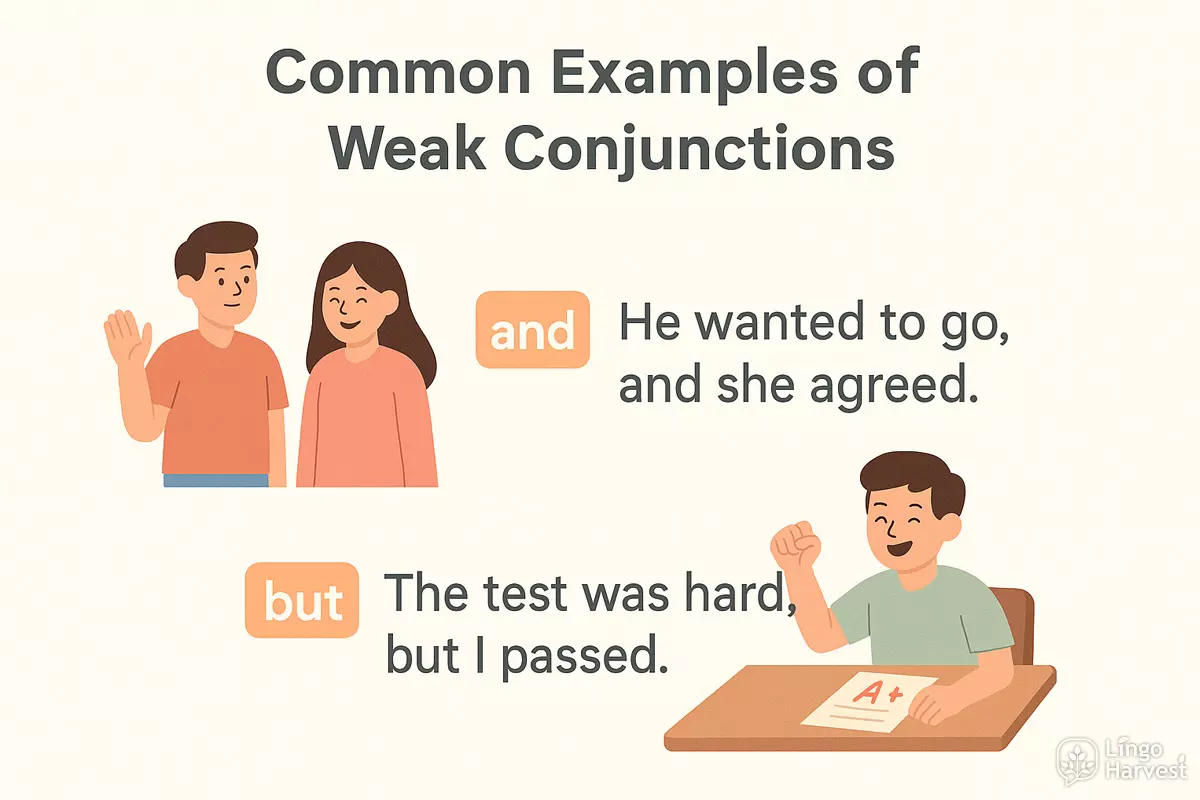
Common examples of weak conjunctions in short sentences
- She was tired, but she kept working.
- It was raining, so we stayed inside.
- He wanted to go, and she agreed.
- The test was hard, but I passed.
- I forgot my umbrella, so I got wet.
- She studied, and she improved her grades.
- They argued, but they made up.
- The movie was long, so we took a break.
- He didn't call, so I went alone.
- The sun set, and the sky turned pink.
- She was late, but she apologized.
- We waited, and they arrived.
- It was cold, so we wore jackets.
- The dog barked, but it was friendly.
- I wanted coffee, but the shop was closed.
Suggested improvements: Replacing basic conjunctions
Upgrading the conjunctions in these sentences can make them more engaging and nuanced. Consider the following alternatives:
- She was tired, yet she kept working.
- It was raining; therefore, we stayed inside.
- He wanted to go; likewise, she agreed.
- The test was hard; nevertheless, I passed.
- I forgot my umbrella; as a result, I got wet.
- She studied; consequently, she improved her grades.
- They argued; however, they made up.
- The movie was long; thus, we took a break.
- He didn't call; accordingly, I went alone.
- The sun set; meanwhile, the sky turned pink.
Comparison of weak and strong conjunctions
| Original Sentence | With Stronger Conjunction |
|---|---|
| She was tired, but she kept working. | She was tired, yet she kept working. |
| It was raining, so we stayed inside. | It was raining; therefore, we stayed inside. |
| He wanted to go, and she agreed. | He wanted to go; likewise, she agreed. |
| The test was hard, but I passed. | The test was hard; nevertheless, I passed. |
| I forgot my umbrella, so I got wet. | I forgot my umbrella; as a result, I got wet. |
| They argued, but they made up. | They argued; however, they made up. |
| The movie was long, so we took a break. | The movie was long; thus, we took a break. |
| He didn't call, so I went alone. | He didn't call; accordingly, I went alone. |
By carefully choosing more specific conjunctions, writers can sharpen their sentences and express relationships between ideas more clearly. This simple change can make even brief statements more persuasive and memorable.
Paragraph-level practice: upgrade connections in a text
When you want to make your writing clearer and more persuasive, upgrading weak conjunctions is a practical skill. Instead of relying on overused connectors like "and," "but," or "so," writers can select more precise or emphatic alternatives that better express relationships between ideas. Practicing this at the paragraph level helps you spot opportunities for improvement in real texts.
Spotting Weak Connections
Writers often default to basic conjunctions, which can make paragraphs seem flat or ambiguous. Consider how often you use words like "and" or "but" when a more specific connector would clarify your logic.
- Replace "and" with "furthermore," "in addition," or "moreover" for emphasis.
- Swap "but" for "however," "nevertheless," or "on the other hand" to show contrast.
- Change "so" to "therefore," "as a result," or "consequently" for cause and effect.
- Use "because," "since," or "as" instead of "and" when you mean to show reason.
Exercise: Revise the Connections
Below are short paragraphs with weak conjunctions. Rewrite each paragraph, improving the logical flow with stronger connectors.
- The weather was cold and we decided to stay inside. It rained, and we watched movies together.
- She wanted to go for a run, but she felt tired. She stayed home, so she read a book instead.
- He studied hard, but he didn’t pass the exam. He was disappointed, and he promised to try again.
- The team practiced every day, and their skills improved. They won the championship, and everyone celebrated.
Show answers
- The weather was cold; therefore, we decided to stay inside. Since it rained, we watched movies together.
- Although she wanted to go for a run, she felt tired. Consequently, she stayed home and read a book instead.
- Even though he studied hard, he didn’t pass the exam. As a result, he was disappointed but promised to try again.
- Because the team practiced every day, their skills improved. Consequently, they won the championship and everyone celebrated.
Connector Upgrades: Quick Reference
Choosing the right connector depends on what you want to express. Here’s a reference list of alternatives for common weak conjunctions:
- And: also, furthermore, moreover, additionally, besides, similarly
- But: however, nevertheless, on the contrary, still, yet, on the other hand
- So: therefore, thus, consequently, as a result, for this reason
- Because: since, as, due to, owing to the fact that, given that
- Or: alternatively, otherwise, or else
- For example: for instance, such as, to illustrate
- In conclusion: finally, in summary, to sum up, overall
- Before: previously, earlier, prior to
- After: subsequently, afterwards, later on
- While: whereas, meanwhile, although
Comparison Table: Weak vs. Stronger Connectors
| Weak Conjunction | Stronger Alternatives |
|---|---|
| and | furthermore, moreover, in addition, additionally |
| but | however, nevertheless, on the other hand, yet |
| so | therefore, consequently, thus, as a result |
| because | since, as, due to, owing to the fact that |
| or | alternatively, otherwise, or else |
Applying these alternatives in your own paragraphs will help you communicate relationships between ideas with greater precision and sophistication. Practice regularly by revising your drafts, and soon, upgrading connections will become second nature.
Answer key with suggested strong conjunctions and comments
Understanding how to upgrade weak conjunctions can make your writing clearer and more persuasive. Below, you'll find examples of commonly used, less forceful conjunctions, along with suggested alternatives that add nuance or precision. Each suggestion is followed by a brief comment on why the replacement works better in context.
Common Weak Conjunctions and Enhanced Alternatives
- And → Moreover, Additionally, Furthermore
Use these to emphasize an added point or to link similar ideas more emphatically. - But → However, Nevertheless, On the other hand
These choices clarify contrast and highlight exceptions more clearly. - So → Therefore, Consequently, As a result
These express cause and effect with more authority and logic. - Or → Alternatively, Otherwise
These suggest a clearer choice or condition. - Because → Since, As, Due to the fact that
These alternatives vary in formality and can fit different sentence structures. - When → Whenever, Once, As soon as
These add precision to the timing or frequency of events. - If → Provided that, Unless, In case
These can clarify conditions and exceptions. - While → Whereas, Although, Even though
These alternatives highlight contrast or concession more distinctly. - Also → In addition, Besides, What's more
These can smoothly introduce further points. - Then → Subsequently, Afterwards, Thereafter
These signal sequence with more clarity and variation.
Illustrative Examples
To further clarify, here’s how sentences can be strengthened by substituting a more precise linking word:
- Weak: She was tired, so she went to bed early.
Stronger: She was tired; therefore, she went to bed early. - Weak: I like tea, but I prefer coffee.
Stronger: I like tea; however, I prefer coffee. - Weak: Call me when you arrive.
Stronger: Call me as soon as you arrive.
Quick Reference Comparison
Below is a summary chart showing weak conjunctions and their suggested replacements, along with reasons for the change:
| Weak Conjunction | Stronger Alternative(s) | Comment |
|---|---|---|
| And | Moreover, Furthermore | Emphasizes addition more strongly |
| But | However, Nevertheless | Clarifies contrast or exception |
| So | Therefore, Consequently | Highlights logical result or effect |
| Or | Alternatively, Otherwise | Suggests choice or condition clearly |
| Because | Since, As | Varies tone and formality |
| If | Provided that, Unless | Clarifies condition or exception |
| While | Whereas, Although | Signals contrast or concession |
| Also | Besides, In addition | Introduces further points smoothly |
| Then | Subsequently, Afterwards | Shows sequence more precisely |
| When | Once, As soon as | Specifies timing or immediacy |
Choosing a more vivid or specific conjunction helps your writing flow and ensures your intended meaning is clear. When editing, look for opportunities to replace basic linking words with alternatives that better fit your sentence’s logic and tone. This not only sharpens your style but also makes your arguments more compelling for your readers.