Paragraph Practice: Choose the Best Conjunction (B1–B2)

 This article explains how choosing the right conjunctions shapes paragraph flow and logic. It includes a gap-fill exercise, a conjunction selection task, a writing activity, and an answer key with model and alternative solutions.
- How conjunction choice affects paragraph flow
- Sample paragraph with gaps for conjunctions
- Practice: choose from a box of suitable conjunctions
- Focus on logical sequence, contrast, and result within a paragraph
- Second task: write your own short paragraph using target conjunctions
- Answer key with model solutions and alternative options
Do you ever feel uncertain about which connecting words to use in your writing? Strengthening your ability to link ideas with the right conjunctions can significantly enhance the clarity and flow of your English. By practicing how to choose and use appropriate connecting words, you can make your paragraphs more cohesive and easier to understand. This guide will offer practical advice and exercises to help you develop confidence in selecting the best conjunctions for your writing, whether you are working on essays, reports, or everyday communication.
How conjunction choice affects paragraph flow
Selecting the right conjunction can shape the way sentences connect, making writing smoother and easier to follow. When you choose an appropriate connector, ideas flow naturally from one sentence to the next. On the other hand, using an unsuitable linking word may create confusion or make the paragraph sound awkward.
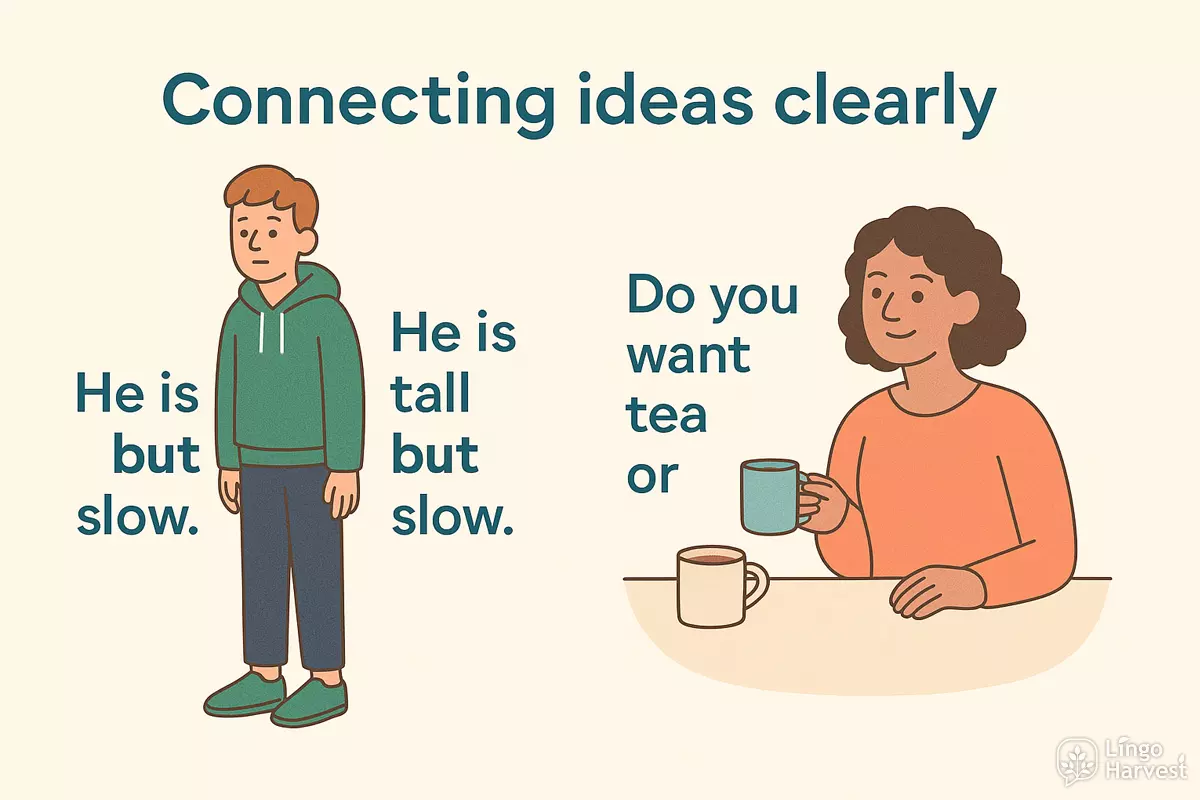
Connecting ideas clearly
Conjunctions such as and, but, because, and so each signal a different relationship between thoughts. For example, and adds information, while but introduces contrast. Understanding these connections helps readers anticipate what comes next, which improves comprehension.
- and – adds similar ideas: She likes apples and oranges.
- but – shows contrast: He is tall but slow.
- or – presents choices: Do you want tea or coffee?
- so – shows result: It was raining, so we stayed inside.
- because – gives reasons: She left early because she was tired.
- although – introduces unexpected info: Although it was cold, we went out.
- while – shows two actions at the same time: He cooked while she cleaned.
- if – states a condition: If it rains, we will cancel.
- when – expresses time: Call me when you arrive.
- unless – gives a negative condition: We won’t go unless you come.
- since – shows cause or time: Since you’re here, let’s start.
- because of – gives a noun reason: We stayed home because of the storm.
- so that – shows purpose: I left early so that I could catch the bus.
- as soon as – for immediate actions: Call me as soon as you finish.
- before – for earlier events: Wash your hands before you eat.
- after – for later events: We went out after dinner.
Impact on rhythm and coherence
Mixing different conjunctions can make your writing more engaging and varied. If you repeat the same connector too often, your paragraph might sound repetitive or dull. By choosing the most suitable linking words for each relationship, you help the reader follow your logic and keep the text lively.
Common mistakes and how to avoid them
Writers sometimes use connectors incorrectly, which can confuse the reader or change the meaning of a sentence. Here are some typical errors and how to fix them:
- ❌ He was tired and he went to bed early. → Better: He was tired, so he went to bed early.
- ❌ She studied hard but she passed the exam. → Better: She studied hard and she passed the exam.
- ❌ We stayed inside because it was cold, but it was snowing. → Better: We stayed inside because it was cold and snowing.
Understanding how each connector works helps you organize your ideas and guide your reader through your writing. With practice, you’ll find it easier to make your paragraphs clear, logical, and enjoyable to read.
Sample paragraph with gaps for conjunctions
To practice linking ideas, learners often fill in missing words in paragraphs. Read the example below and decide which connector fits best in each blank. Consider meaning, punctuation, and flow as you choose your answers.
Example Paragraph with Missing Connectors
Yesterday was a busy day for me, _____ I had many things to do. I woke up early, _____ I wanted to finish my homework before breakfast. _____ I was tired, I managed to complete it on time. My friend called me _____ invited me to go for a walk, _____ I was still a bit sleepy. We went to the park, _____ played football together. Later, I went home _____ helped my mother cook dinner. It was a long day, _____ I felt happy at the end.
Common Linking Words to Use
- and
- but
- because
- so
- although
- or
- while
- since
- when
- if
- even though
- as
- unless
- before
- after
- whereas
- however
- therefore
Show answers
Yesterday was a busy day for me, because I had many things to do. I woke up early, because I wanted to finish my homework before breakfast. Although I was tired, I managed to complete it on time. My friend called me and invited me to go for a walk, although I was still a bit sleepy. We went to the park and played football together. Later, I went home and helped my mother cook dinner. It was a long day, but I felt happy at the end.
Tips for Choosing the Right Connector
- Use and to add similar ideas.
- Choose but or although to show contrast.
- Pick because or since to explain reasons.
- Use so or therefore to show results.
Try filling in each gap with the most logical conjunction. This exercise will help you connect sentences smoothly and express your ideas more clearly.
Practice: choose from a box of suitable conjunctions
When building strong paragraphs, selecting the right conjunction can clarify meaning and improve flow. Below, you’ll find a set of practice activities where you can pick from a list of appropriate connectors to complete sentences. Try to focus on the logic of each sentence—does it show contrast, reason, addition, or result?
Useful conjunctions to choose from
- and → She made tea and sandwiches.
- but → He wanted to go out, but it was raining.
- because → I stayed home because I felt tired.
- so → It was late, so we went to bed.
- although → Although it was cold, they went for a walk.
- while → She cooked dinner while he set the table.
- since → Since you’re here, let’s start the meeting.
- unless → You can’t leave unless you finish your work.
- if → If it rains, we’ll stay inside.
- even though → Even though he was tired, he kept studying.
- however → It looked easy; however, it was very difficult.
- therefore → It was very late; therefore, we took a taxi.
- as soon as → Call me as soon as you arrive.
- until → Wait here until I come back.
- when → I’ll text you when I get home.
- before → Wash your hands before you eat.
- after → After he finished work, he went to the gym.
- yet → She is very young, yet very experienced.
- whereas → She loves city life, whereas he prefers the countryside.
- so that → He spoke slowly so that everyone could understand.
Complete the sentences
- Maria wanted to go for a walk, ______ it was raining heavily.
- I finished my homework early ______ I could watch my favorite show.
- He was tired, ______ he kept working.
- We will start dinner ______ Dad gets home.
- James didn’t eat breakfast, ______ he was hungry by noon.
- ______ the train arrived, everyone rushed to the platform.
- Lisa forgot her umbrella, ______ she got wet.
- ______ you study hard, you will pass the test.
- She likes tea, ______ her brother prefers coffee.
- The museum is closed on Mondays, ______ check the schedule before you visit.
Show answers
- but
- so that
- yet
- when
- so
- As soon as
- therefore
- If
- whereas
- so
Conjunctions: functions and examples
| Conjunction | Typical use / Example |
|---|---|
| and | Joining similar ideas: "She likes apples and oranges." |
| but | Showing contrast: "He is tall, but his brother is short." |
| because | Giving a reason: "They stayed home because it was cold." |
| although | Introducing contrast: "Although he was tired, he finished the race." |
| so | Showing result: "It rained, so the match was cancelled." |
| unless | Condition: "You can’t go out unless you finish your work." |
| while | Time or contrast: "While she cooked, he set the table." |
| if | Condition: "If it snows, schools may close." |
Short paragraph task
Write a short paragraph (3–4 sentences) using at least three different conjunctions from the list above. Try to make your ideas connect smoothly. When you finish, check your writing for logical connections and variety.
Show answers
Sample paragraph:
I woke up early because I wanted to finish my project. Although I was sleepy, I worked hard and completed everything before breakfast.
Focus on logical sequence, contrast, and result within a paragraph
Understanding how to connect ideas within a paragraph is essential for clear writing. When you organize sentences, it helps to think about how one point leads to the next, how you might show differences, or how to express outcomes. Conjunctions are words that help signal these relationships and improve the flow of your text.
Sequencing Ideas Logically
To show the order of events or steps, use conjunctions and linking words that indicate sequence. This helps the reader follow your reasoning or the progression of actions.
- First, I get up early in the morning.
- Then, I have breakfast.
- After that, I leave for school.
- Next, we start our first lesson.
- Finally, I return home in the afternoon.
Expressing Contrast
Sometimes, you need to show that two ideas are different or unexpected together. Contrast conjunctions help you do this smoothly.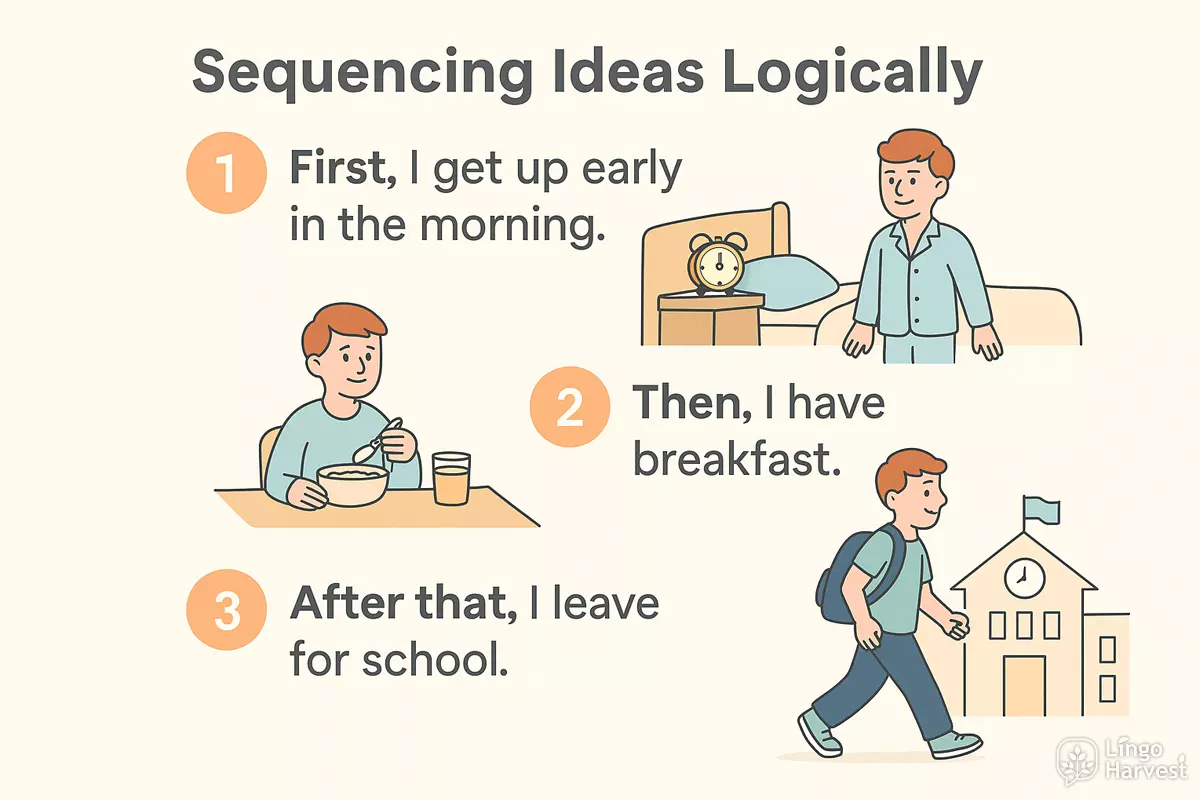
- I wanted to go for a walk, but it started raining.
- She likes tea, whereas her brother prefers coffee.
- He is very young, yet he plays chess very well.
- However, the solution was not easy.
- On the other hand, some people enjoy cold weather.
Showing Results and Consequences
To explain the result of an action or situation, use conjunctions that signal cause and effect. This makes your writing more logical and easy to follow.
- It was very cold, so we stayed inside.
- He studied a lot, therefore he passed the exam.
- She was tired, thus she went to bed early.
- The bus was late, as a result we missed the meeting.
- I forgot my keys, consequently I couldn’t open the door.
Common Conjunctions and Linking Words
Here is a comparison of words you can use to join sentences or ideas for different purposes:
| Purpose | Conjunctions & Linking Words |
|---|---|
| Sequence | first, then, after that, next, finally, before, afterwards, meanwhile |
| Contrast | but, however, whereas, yet, although, even though, on the other hand, while |
| Result | so, therefore, thus, as a result, consequently, hence, for this reason |
Using these words appropriately helps your writing sound natural and well-organized. Practice combining sentences with different conjunctions to see how the meaning changes. This skill makes your paragraphs clearer and more engaging for the reader.
Second task: write your own short paragraph using target conjunctions
Writing your own paragraph with conjunctions is a great way to improve your linking skills and sentence flow. Try to use a range of conjunctions to show cause and effect, contrast, or sequence. Below, you’ll find a short guide and a list of commonly used conjunctions at the B1–B2 level to help you get started.
Useful conjunctions for paragraph writing
- and
- but
- so
- because
- although
- while
- however
- since
- unless
- when
- if
- therefore
- as soon as
- even though
- whereas
- instead
- on the other hand
- in order to
- before
- after
Example task: Write your own paragraph
Compose a short paragraph (3–5 sentences) about a daily routine, hobby, or past event. Use at least three different conjunctions from the list above. Try to show how ideas connect or contrast.
Sample paragraph
I usually wake up early because I like to have a quiet breakfast before the day begins. Although I sometimes feel tired, I still go for a walk, so I can get some fresh air. After that, I start my work, and I try to finish my main tasks before lunch. If I have extra time, I read a book or listen to music, whereas my friend prefers to watch TV.
Practice: Identify the conjunctions
Read the sample paragraph above and list all the conjunctions you find. Then, write your own paragraph using at least three conjunctions from the earlier list.
Show answers
- Conjunctions in the sample: because, although, so, after, and, before, if, whereas.
- Possible student paragraph (sample): "I wanted to go to the park, but it started raining, so I stayed home. While I waited for the rain to stop, I played games and read a book. When the sun came out, I finally went outside."
Answer key with model solutions and alternative options
Below you’ll find clear solutions for each paragraph conjunction exercise, along with explanations and practical alternatives. This section is designed to help you understand why a particular conjunction fits best and how alternatives could change the meaning or flow of the text. For each example, consider how the choice of word affects the relationship between sentences.
Model Solutions and Explanations
- and – Joins two similar ideas or actions.
Example: She went to the shop and bought some bread. ✅ - but – Shows contrast or an unexpected result.
Example: He studied hard, but he didn’t pass the test. - because – Expresses reason or cause.
Example: We stayed inside because it was raining. - so – Indicates a result or consequence.
Example: She was tired, so she went to bed early. - although – Introduces a contrast within one sentence.
Example: Although it was cold, they went swimming. - while – Shows two things happening at the same time, or contrast.
Example: While I was cooking, he set the table. - or – Offers a choice or alternative.
Example: Would you like tea or coffee? - if – Expresses a condition.
Example: If you are hungry, I can make you a sandwich. - when – Refers to time.
Example: Call me when you arrive. - so that – Shows purpose.
Example: He spoke slowly so that everyone could understand.
Alternative Conjunctions: Comparison Table
| Conjunction | Alternative / Similar Use |
|---|---|
| and | as well as, also |
| but | however, yet |
| because | since, as |
| so | therefore, thus |
| although | even though, though |
| while | whereas, as |
| or | either...or, alternatively |
| if | provided (that), unless (for negative conditions) |
| when | as soon as, whenever |
| so that | in order that, for the purpose of |
Tips for Choosing the Best Conjunction
- Focus on the relationship: Is it cause, contrast, addition, time, or condition?
- Check if the sentence needs to show a result (so), a reason (because), or a contrast (but, although).
- Remember that some alternatives are more formal or informal. For example, however is often more formal than but.
- Practice by rewriting sentences using different conjunctions to see how the meaning changes.
By reviewing these solutions and alternatives, you can develop a stronger sense for choosing the most natural and accurate conjunctions in various paragraph contexts at the B1–B2 level.