Advanced Subordinating Conjunctions: whereas, whilst, although, even though

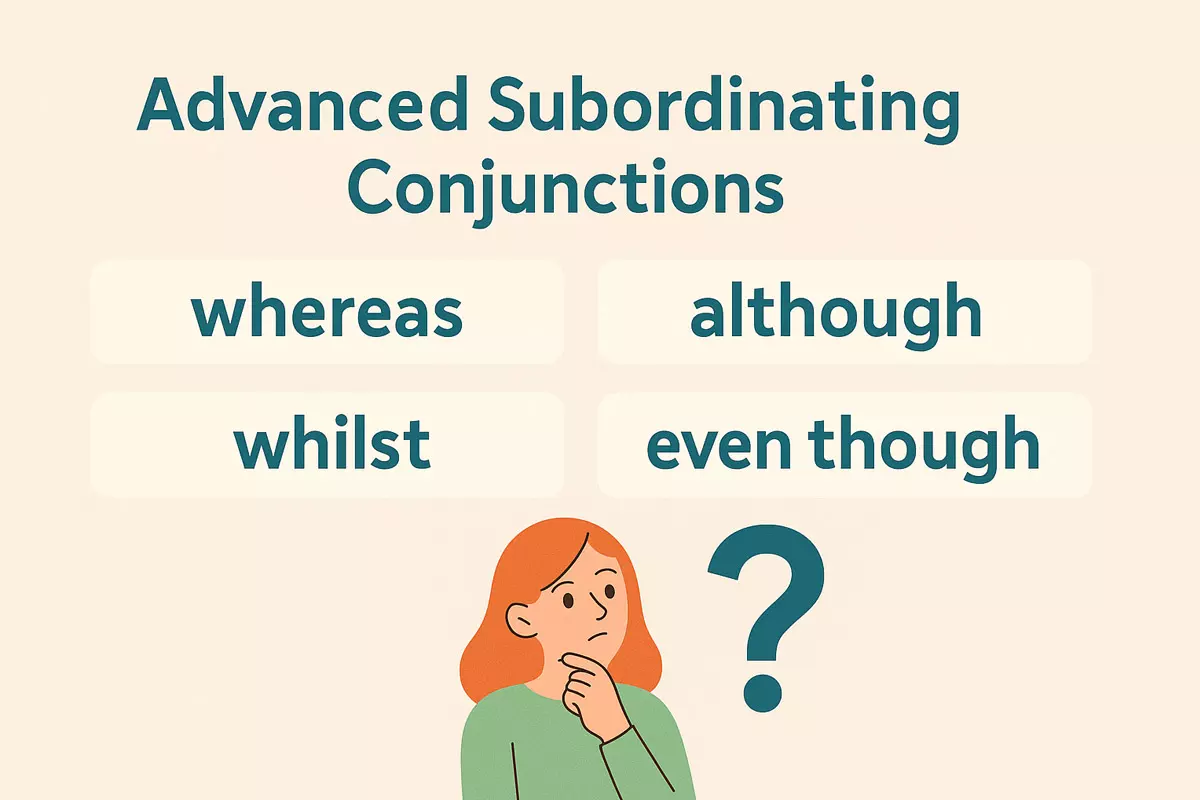 Here we how advanced subordinating conjunctions such as whereas, whilst, although, and even though affect sentence meaning, their distinct functions and regional uses, their role in argument structure, and practical ways to use them in formal writing.
- What advanced subordinating conjunctions add to sentence meaning
- Functional differences among whereas, whilst, although, even though
- Formality levels and regional preferences in academic writing
- How contrastive clauses shape argument structure
- Placing advanced conjunctions at the front or middle of a sentence
- Examples from formal essays and analytical writing
- Practice: improve basic contrast sentences using advanced subordinators
Mastering complex connectors such as whereas, whilst, although, and even though can significantly improve your writing by enabling you to express contrasts and exceptions with clarity and precision. These connectors help you create more nuanced and sophisticated sentences, making your arguments stronger and your ideas clearer. By learning to use them effectively, you can elevate the overall quality of your writing and communicate your thoughts in a more compelling and organized manner, which is especially valuable in both academic and professional contexts.
What advanced subordinating conjunctions add to sentence meaning
Using advanced subordinators like whereas, whilst, although, and even though allows writers and speakers to express complex relationships between ideas. These words go beyond simply connecting clauses—they create contrast, highlight exceptions, and clarify nuances in logic or opinion. By selecting the right conjunction, you can direct the reader’s attention to subtle differences or unexpected turns in a sentence.
Expressing Contrast and Exception
Many of these conjunctions focus on showing contrast or exception. For example, whereas is used to compare two facts that are different or opposite, emphasizing the distinction. Although and even though introduce surprising or contradictory information, signaling that the second clause does not follow expectedly from the first. Whilst (chiefly British English) can function similarly to while, but often adds a formal or literary tone.
Clarity and Precision in Relationships
Advanced subordinators help clarify the logical relationship between clauses. This precision is useful in academic writing, debates, and detailed explanations. They allow you to:
- Compare and contrast ideas directly
- Show exceptions to general statements
- Indicate surprising or unexpected outcomes
- Balance opposing viewpoints in one sentence
- Emphasize the main clause by demoting less important information
- Control sentence rhythm and emphasis
- Add variety and sophistication to writing
- Guide the reader’s interpretation of facts
- Highlight simultaneous actions with different qualities (especially with whilst)
- Signal concessions or contrasts in arguments
Comparing Advanced Subordinating Conjunctions
| Conjunction | Typical Use |
|---|---|
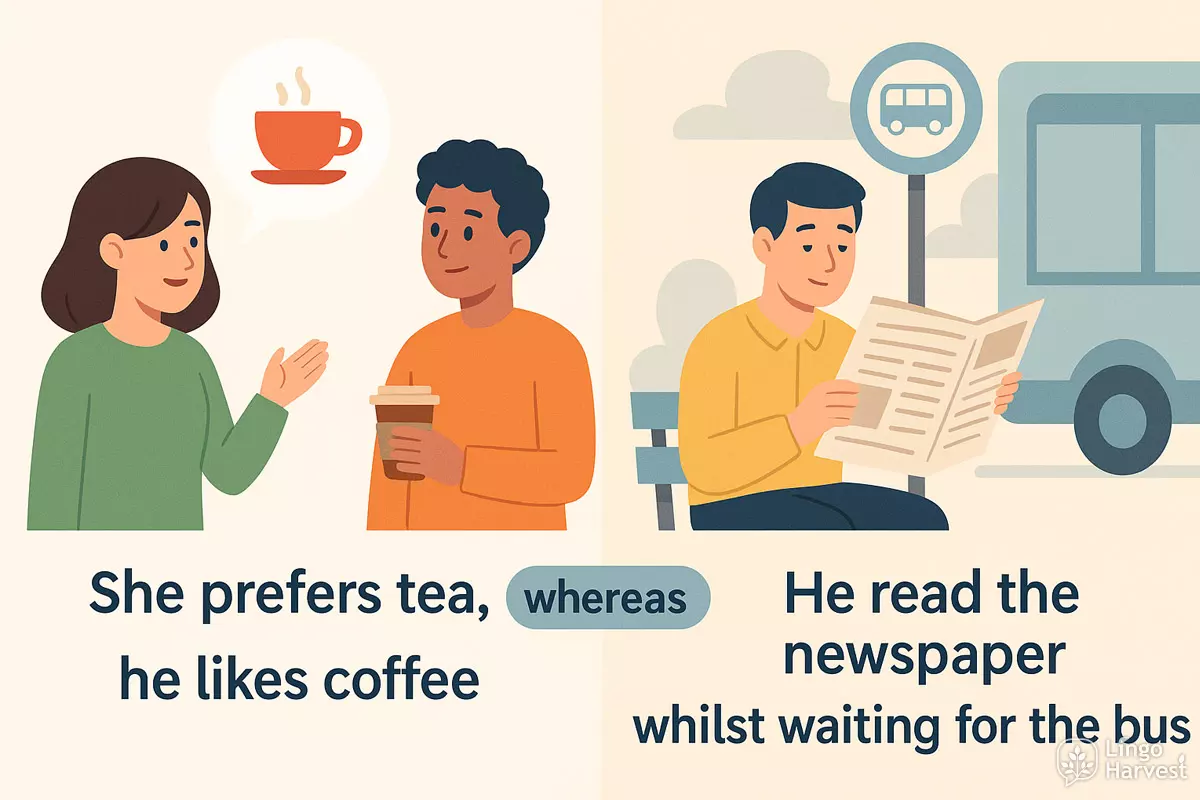
| whereas | Introduces a direct contrast between two facts or situations. Example: She prefers tea, whereas he likes coffee. |
| whilst | Shows two actions happening at the same time, or contrasts them; more formal or literary. Example: He read the newspaper whilst waiting for the bus. |
| although | Presents a concession or unexpected result; the main clause is true despite the subordinate clause. Example: Although it was raining, we went for a walk. |
| even though | Stronger form of "although," emphasizing the surprising nature of the contrast. Example: Even though he was tired, he finished the project. |
In summary, these advanced words enrich your sentences by allowing you to express complex contrasts, concessions, and simultaneous actions. Mastering them will help you communicate more precisely and effectively in both writing and speech.
Functional differences among whereas, whilst, although, even though
Understanding how to use “whereas,” “whilst,” “although,” and “even though” helps you convey contrast, concession, and comparison. These subordinating conjunctions often appear in complex sentences, but their specific roles and usage patterns set them apart.
Contrasting Ideas: “whereas” vs. “whilst”
“Whereas” and “whilst” both introduce contrasts, but their tone, regional use, and context differ:
- Whereas is common in both formal and neutral writing, especially in legal or academic contexts. It links contrasting facts or situations.
- Whilst is chiefly British English and more formal or literary. It can mean “while” (simultaneity) or highlight a contrast, but is less common in American usage.
Examples:
- She enjoys classical music, whereas her brother prefers jazz.
- Whilst I understand your point, I still disagree.
Concession and Emphasis: “although” and “even though”
Both “although” and “even though” signal concession, but “even though” is stronger, emphasizing an unexpected result.
- Although introduces a contrast or exception, often in written and spoken English.
- Even though intensifies the concession, underlining that the main clause happens despite a significant obstacle.
Examples:
- Although it was raining, they went hiking.
- Even though she was tired, she finished the marathon.
Summary Table: Usage Patterns
| Conjunction | Primary Function | Typical Context/Example |
|---|---|---|
| whereas | Shows contrast between two facts or situations | Formal, legal, academic “Cats are independent, whereas dogs are loyal.” |
| whilst | Marks contrast or simultaneity (mainly UK English) | Formal, literary “Whilst you were out, I finished the report.” |
| although | Introduces a concession or exception | General use “Although he studied, he failed the test.” |
| even though | Strong concession, highlights unexpected result | Emphatic, spoken and written “Even though it was late, she called him.” |
Quick Reference: When to Use Each
- Choose whereas for clear, factual contrasts.
- Use whilst in UK English for contrast or “while.”
- Pick although for a simple concession.
- Opt for even though to stress how surprising or strong the contrast is.
Mastering these conjunctions lets you express nuanced relationships between ideas, especially when comparing, contrasting, or highlighting unexpected outcomes.
Formality levels and regional preferences in academic writing
When choosing between subordinating conjunctions like whereas, whilst, although, and even though, writers often need to consider both the degree of formality required and the regional norms of their academic community. These conjunctions can subtly influence the perceived sophistication and clarity of a text, particularly in scholarly communication.
Differences in formality
Some conjunctions naturally lend themselves to more formal contexts. For instance, whereas is commonly used in legal and academic texts to establish contrast between two statements. Whilst is generally seen as more formal, but its use varies significantly by region. On the other hand, although and even though are widely accepted in both formal and semi-formal writing, though even though is slightly more emphatic.
- Whereas: Preferred for explicit, formal contrasts.
- Whilst: Formal, but less common outside British English.
- Although: Neutral; fits most academic registers.
- Even though: Slightly informal; emphasizes unexpected contrasts.
Regional usage preferences
The choice of conjunction can also signal the writer’s linguistic background. British and American English, for example, differ in their acceptance of certain forms.
| Conjunction | Common Usage | Preferred Region(s) | Formality Level |
|---|---|---|---|
| Whereas | Contrast in academic/legal texts | Both UK & US | High |
| Whilst | Alternative to "while"; rare in US | UK, Commonwealth | High |
| Although | General concessive | Global | Medium–High |
| Even though | Stronger emphasis on contrast | Global | Medium |
Examples of academic usage
Writers can choose from a range of structures depending on the nuance they wish to convey. Here are several patterns for integrating these conjunctions into academic writing:
- Whereas previous studies focused on X, this research examines Y.
- Whilst the results are promising, further analysis is required. (more common in UK publications)
- Although the hypothesis was not supported, the data revealed unexpected trends.
- Even though the sample size was limited, the findings are significant.
- The intervention was effective, whereas the control group saw minimal change.
- Whilst some argue for stricter methods, others prioritize flexibility.
- Although widely criticized, the theory remains influential.
- Even though funding was scarce, the project was completed on time.
- Whereas Smith (2020) claims X, recent research suggests otherwise.
- Whilst this approach is traditional, alternative models exist.
- Although the correlation is weak, it cannot be ignored.
- Even though the data is preliminary, it offers valuable insights.
Writers should always consider both the expectations of their academic audience and the conventions of their discipline when selecting subordinating conjunctions. Matching the register and regional norms helps ensure clarity, appropriateness, and credibility in scholarly work.
How contrastive clauses shape argument structure
Contrastive subordinating conjunctions like whereas, whilst, although, and even though play a key role in organizing information and positioning arguments within complex sentences. By connecting clauses that present opposing ideas, these conjunctions clarify relationships between statements and help readers or listeners follow the logic of a discussion.
Clarifying relationships between ideas
Using contrastive clauses, writers and speakers can highlight differences, exceptions, or unexpected outcomes. This not only adds nuance but also helps to anticipate counterarguments or alternative perspectives. For example, in academic writing, a contrastive clause may introduce a limitation or exception to a general claim, making the argument more balanced and robust.
Typical patterns and examples
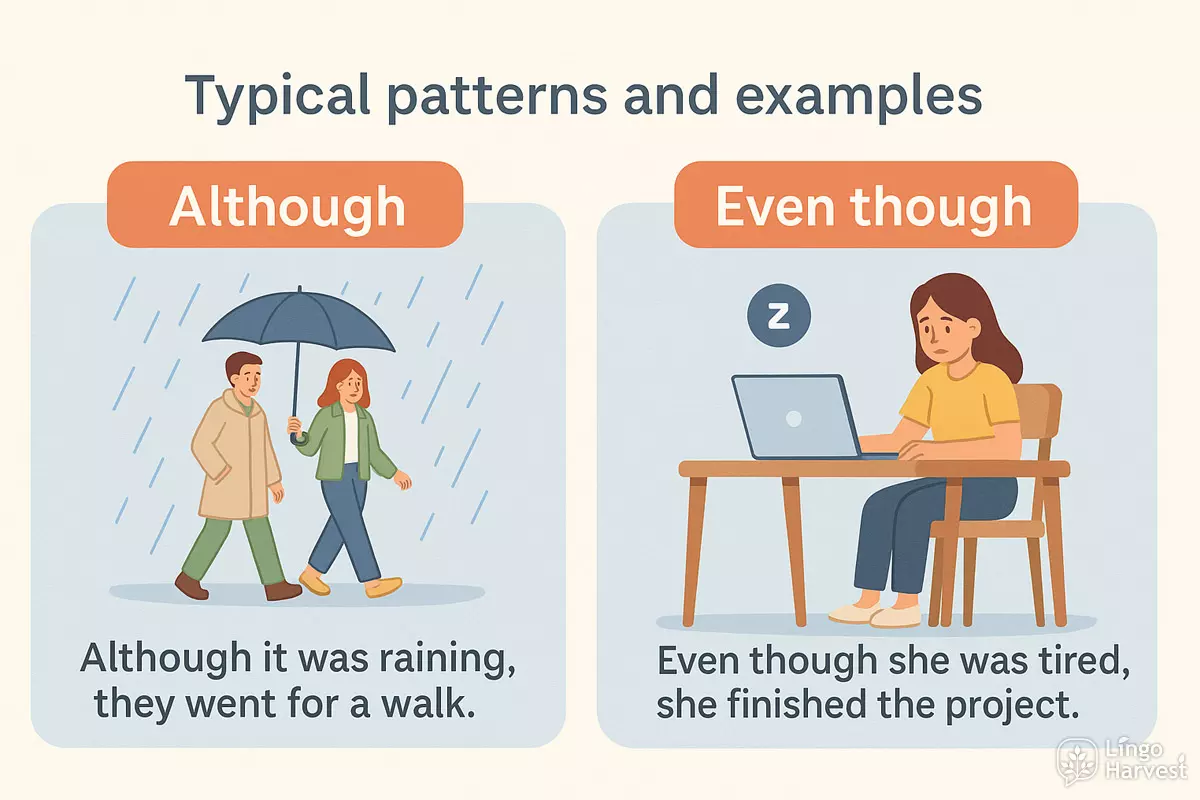
Here are some common ways these conjunctions appear in sentences:
- Although it was raining, they went for a walk.
- Even though she was tired, she finished the project.
- He prefers tea, whereas his sister likes coffee.
- Whilst some students found the exam easy, others struggled.
- Although the concept seems simple, it is difficult to apply.
- Even though the price increased, demand remained high.
- She enjoys classical music, whereas he prefers rock.
- Whilst I understand your point, I still disagree.
- Although he apologized, she remained upset.
- Even though the evidence is clear, some deny the facts.
- Our office is open late, whereas theirs closes early.
- Whilst most agreed, a few voiced concerns.
Impact on argument structure
Contrastive clauses often mark a shift in perspective or signal a concession, which can strengthen an argument by acknowledging complexity. They allow writers to present both sides of an issue or to emphasize the unexpected. In persuasive writing, this technique can pre-empt objections and demonstrate critical thinking.
| Conjunction | Typical Use | Example |
|---|---|---|
| whereas | Contrast between two facts or groups | Some prefer the city, whereas others like the countryside. |
| whilst | Simultaneous contrast or exception (mainly UK English) | Whilst he enjoys sports, his brother does not. |
| although | Concession or unexpected result | Although the task was hard, she completed it. |
| even though | Stronger concession, often with surprising outcome | Even though he practiced, he lost the match. |
Summary
By weaving together contrasting elements, these clauses enable more sophisticated arguments and clearer communication. Mastery of such structures is essential for advanced writing and nuanced debate, as they help manage complexity and guide readers through multifaceted reasoning.
Placing advanced conjunctions at the front or middle of a sentence
Understanding where to position subordinating conjunctions like whereas, whilst, although, and even though helps you create more nuanced and flexible sentences. These connectors can generally appear at the beginning or in the middle, with slight differences in emphasis and rhythm. Choosing the right placement gives your writing variety and clarity.
Front Position: Creating Contrast or Emphasis
Starting with a conjunction often highlights the contrast or concession that follows. This is common in formal and academic English. For example:
- Although it was raining, we decided to go hiking.
- Even though she was tired, she finished the project on time.
- Whilst I appreciate your opinion, I must disagree.
- Whereas John prefers tea, Mary always drinks coffee.
Leading with these words typically requires a comma after the first clause.
Middle Position: Balancing Two Ideas
Inserting the conjunction between two clauses is just as common, especially in spoken English. This placement often sounds more neutral and connects ideas smoothly:
- We decided to go hiking although it was raining.
- She finished the project on time even though she was tired.
- I must disagree whilst I appreciate your opinion.
- John prefers tea, whereas Mary always drinks coffee.
Here, a comma is often used with whereas and sometimes with although if the sentence is long or complex.
Direct Comparison of Placement
The table below shows how meaning and tone shift depending on where you place the conjunction:
| Front Position | Middle Position |
|---|---|
| Although he studied hard, he didn't pass the exam. | He didn't pass the exam although he studied hard. |
| Whilst I enjoy classical music, I rarely listen to it. | I rarely listen to classical music whilst I enjoy it. |
| Even though it was late, they kept working. | They kept working even though it was late. |
| Whereas cats are independent, dogs crave attention. | Cats are independent, whereas dogs crave attention. |
Quick Tips
- Starting with a conjunction highlights contrast or concession.
- Middle placement is more conversational and flows naturally.
- Always use a comma after the first clause when the conjunction is at the front.
- With whereas, a comma usually precedes it in the middle.
- Front and middle placements are both grammatically correct, but style and emphasis may differ.
Experimenting with both positions will help you master subtle shifts in tone, making your writing and speaking more sophisticated and precise.
Examples from formal essays and analytical writing
Writers often use advanced subordinating conjunctions such as whereas, whilst, although, and even though to create nuanced contrasts or present complex relationships between ideas. These conjunctions are essential tools for constructing clear arguments and highlighting subtle distinctions in academic or analytical contexts.
Sample Sentences Demonstrating Usage
- Whereas previous studies focused on quantitative data, this research prioritizes qualitative analysis.
- Many believe that technological progress leads to social advancement, whereas others remain skeptical.
- Whilst the proposal has merit, it lacks sufficient empirical support.
- Whilst some critics praise the author’s style, others find it overly complex.
- Although the theory is widely accepted, significant counterarguments persist.
- The results remained inconclusive although the methodology was rigorous.
- Even though the sample size was limited, the findings were statistically significant.
- Even though the hypothesis was plausible, the data did not support it.
- Productivity increased although working hours were reduced.
- Resource allocation improved whereas overall expenditure decreased.
- Whilst the initial response was positive, subsequent feedback highlighted several issues.
- Employee satisfaction rose even though wages remained unchanged.
- Although the experiment was repeated several times, the outcome did not vary.
- Some scholars advocate stricter regulations, whereas others call for deregulation.
- Whilst acknowledging the limitations, the report offers valuable insights.
- The company expanded internationally although domestic sales declined.
Comparing Subordinating Conjunctions in Context
| Conjunction | Purpose & Example |
|---|---|
| Whereas | Used to contrast two statements. Example: "Whereas the control group showed improvement, the experimental group did not." |
| Whilst | Highlights simultaneous but differing actions or opinions (mainly UK English). Example: "Whilst some participants preferred online surveys, others favored in-person interviews." |
| Although | Introduces a concession or exception. Example: "Although the data were incomplete, the analysis proceeded." |
| Even though | Emphasizes a stronger contrast or unexpected result. Example: "Even though funding was limited, the project succeeded." |
Common Patterns in Analytical Writing
Writers frequently combine these conjunctions with complex clauses to add depth to their arguments. For example:
- “Although X is commonly believed, evidence Y suggests otherwise.”
- “Even though the policy was unpopular, it achieved the desired outcome.”
- “Whilst acknowledging previous research, this essay introduces a new perspective.”
- “Whereas Smith (2019) argues for decentralization, Jones (2021) advocates centralization.”
These structures help clarify contrasts, concessions, and simultaneous conditions, lending formality and precision to academic discourse.
Practice: improve basic contrast sentences using advanced subordinators
To master advanced subordinating conjunctions such as whereas, whilst, although, and even though, it's helpful to upgrade simple contrast sentences. Instead of connecting ideas with "but" or "however," use these connectors to create more fluent and nuanced contrasts in your writing.
Transforming Basic Contrasts
Below are several simple contrast sentences. Try rewriting each one using one of the advanced subordinators. Focus on making the relationship between the ideas clearer and more sophisticated.
- She likes tea. He prefers coffee.
- I studied hard. I didn't pass the exam.
- It was raining. They went for a walk.
- Tom is outgoing. His brother is quite shy.
- The hotel was expensive. The service was poor.
- He was tired. He finished the project.
- Mary enjoys classical music. Her sister listens to rock.
- The journey was long. We enjoyed the scenery.
- She applied for the job. She didn’t get it.
- He is allergic to cats. He has two cats at home.
Show answers
- She likes tea, whereas he prefers coffee.
- Although I studied hard, I didn't pass the exam.
- Even though it was raining, they went for a walk.
- Tom is outgoing, whilst his brother is quite shy.
- Although the hotel was expensive, the service was poor.
- He finished the project, even though he was tired.
- Mary enjoys classical music, whereas her sister listens to rock.
- We enjoyed the scenery, although the journey was long.
- She applied for the job, but she didn’t get it. (Try: Although she applied for the job, she didn’t get it.)
- He has two cats at home, even though he is allergic to cats.
Comparing Connectors: Subtle Differences
The choice of subordinator can affect the tone or emphasis of your sentence. Here is a comparison of how each conjunction can be used to show contrast:
| Connector | Example Sentence | Usage Note |
|---|---|---|
| whereas | She is very organized, whereas her colleague is quite messy. | Highlights a direct contrast between two subjects or facts. |
| whilst | He enjoys hiking, whilst his wife prefers reading at home. | Mainly British English; formal or literary tone. |
| although | Although it was late, they continued working. | Shows concession; one fact exists despite the other. |
| even though | Even though she was nervous, she spoke confidently. | Stronger than "although"; emphasizes the contrast. |
Quick Practice: Choose the Best Connector
Select the most natural advanced subordinator for each sentence:
- ______ she was tired, she kept working.
- My brother is quiet, ______ I am talkative.
- ______ he apologized, she was still upset.
- She loves the city, ______ her partner prefers the countryside.
- ______ it was raining, they continued their walk.
- He wanted to join us, ______ he had too much work.
- She enjoys classical music, ______ her sister prefers pop.
- ______ he tried hard, he didn’t win the competition.
- We arrived early, ______ the others were late.
- She likes tea, ______ he prefers coffee.
Show answers
- Although
- whereas
- even though
- whereas
- Although
- but / whereas
- whereas
- although / even though
- whereas
- whereas
Upgrading your sentences with these advanced connectors will help your writing sound more natural and sophisticated. Pay attention to the context and choose the subordinator that best fits the contrast you want to express.