Conjunctions for Contrast in Academic Style: whereas vs while

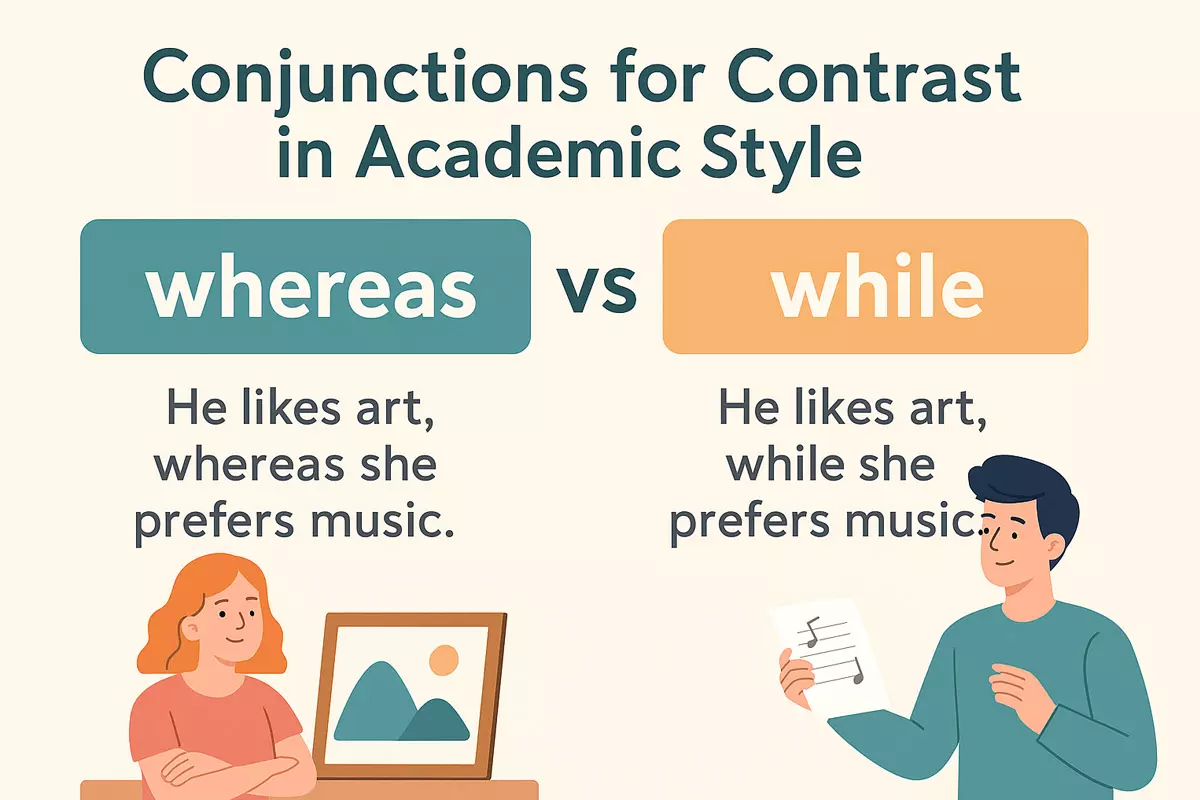 Here we the difference between contrastive and temporal uses of while, explains why whereas is preferred for formal comparisons, and offers tips to avoid ambiguity. It also provides examples and practice revising unclear while-clauses.
- Difference between contrastive and temporal uses of while
- Whereas as a preferred conjunction for formal comparisons
- Avoiding ambiguity in academic writing with while
- Sentence structures that highlight contrast effectively
- Examples comparing two facts, groups, or processes
- Practice: change unclear while-clauses into precise whereas-clauses
Academic writing frequently depends on specific linking words to emphasize contrasts between ideas, and selecting the appropriate connector can sometimes be challenging. Mastering the use of terms such as "whereas" and "while" is essential for clearly presenting opposing viewpoints and making your arguments more precise. By carefully choosing these connectors, writers can improve the clarity and effectiveness of their writing, making it easier for readers to follow the progression of ideas within an essay or research paper.
Difference between contrastive and temporal uses of while
Understanding how "while" functions in academic English is essential for clarity and precision. "While" can signal either a contrast between two ideas or indicate that two actions happen at the same time. These distinct uses depend on context and sentence structure.
Contrastive use of "while"
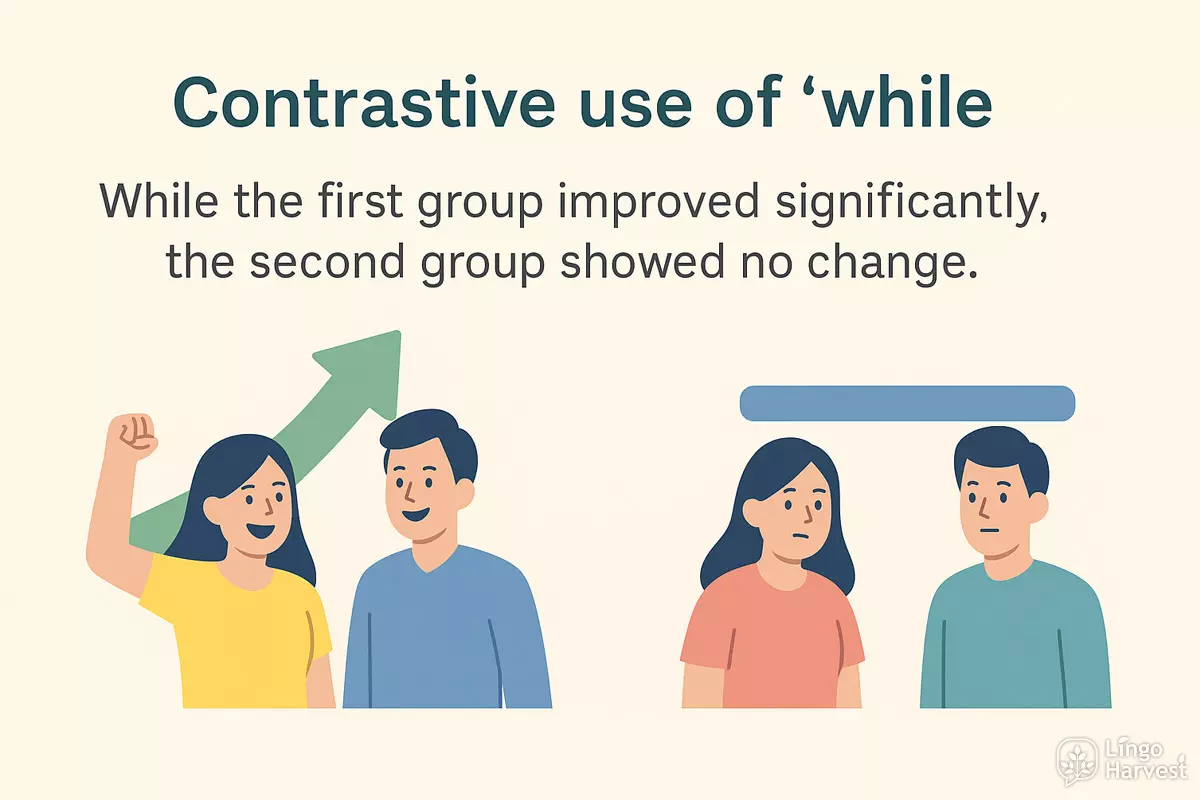
When "while" introduces contrast, it acts much like "whereas." In this role, it sets up a comparison between two statements, typically to highlight differences or opposing viewpoints. This contrastive function is especially common in academic writing, where nuanced distinctions are important.
- Example: "While the first group improved significantly, the second group showed no change."
- Function: Emphasizes a difference or opposition between two clauses.
- Typical context: Comparisons, discussions of differing findings, or highlighting exceptions.
Temporal use of "while"
Alternatively, "while" can indicate that two events occur simultaneously. In this temporal sense, it means "during the time that." This usage is more narrative or descriptive and is less about comparison, more about timing.
- Example: "The students completed the survey while the instructor prepared the next activity."
- Function: Shows events happening at the same time.
- Typical context: Describing overlapping actions or sequences.
Key differences at a glance
| Use | Purpose | Example |
|---|---|---|
| Contrastive | Highlighting differences or opposing ideas | While some students preferred online classes, others favored traditional lectures. |
| Temporal | Indicating simultaneous actions or events | She listened to music while she studied for the exam. |
Recognizing which meaning is intended
Context clues help determine how "while" is being used. When the two clauses express actions or states that could logically occur at the same time, the temporal meaning is likely. If the clauses contrast in content or perspective, the contrastive function is intended.
Patterns and signals
Here are some cues and patterns to help distinguish between the two uses of "while":
- Look for verbs expressing action in both clauses (temporal use).
- If the clauses present opposing facts, findings, or viewpoints, "while" is probably contrastive.
- Contrastive "while" often appears in academic arguments, literature reviews, and results sections.
- Temporal "while" is common in methods sections, process descriptions, or narrative contexts.
- Replacing "while" with "whereas" can clarify meaning; if the sentence still makes sense, the contrastive use applies.
- Temporal "while" can often be rephrased with "as" or "during the time that."
- Contrastive "while" cannot be replaced with "as" without changing the meaning.
- In spoken English, intonation may signal contrast, but in writing, careful reading is needed.
- Academic style favors clarity, so if ambiguity is possible, consider using "whereas" for contrast and reserving "while" for timing.
Choosing between these uses of "while" is not just a matter of grammar; it can affect the precision and persuasiveness of academic writing. Recognizing the intended meaning will help avoid confusion and strengthen your arguments.
Whereas as a preferred conjunction for formal comparisons
In academic writing, whereas is frequently chosen to introduce formal contrasts, particularly when comparing two or more distinct ideas, groups, or data sets. This conjunction provides a clear signal to the reader that a direct comparison or opposition is being drawn, which is especially useful in analytical or argumentative contexts. Unlike more conversational alternatives, whereas carries a formal tone that suits research papers, reports, and scholarly articles.
Common contexts for using whereas
- Comparing findings, results, or trends
- Contrasting theories or approaches
- Highlighting differences between groups or populations
- Setting up opposing viewpoints in introductions or discussions
- Juxtaposing policy implications or recommendations
- Describing variations in data or methodology
- Comparing historical periods or case studies
- Contrasting definitions or conceptual frameworks
- Outlining different experimental conditions
- Distinguishing between causes and effects
- Summarizing contrasting literature perspectives
- Presenting competing hypotheses
Typical sentence patterns
Writers often place whereas at the beginning or in the middle of a sentence to connect two contrasting clauses. This structure helps clarify the relationship between the compared elements. Here are some common patterns:
- Clause A, whereas Clause B.
- Whereas Clause A, Clause B.
- Group X demonstrates [feature], whereas Group Y shows [contrasting feature].
- Method A is effective in [context], whereas Method B is preferred in [different context].
Why whereas is favored in academic comparisons
The preference for whereas stems from its precision and lack of ambiguity. It unambiguously signals a contrast, unlike while, which can also refer to time. This reduces confusion and supports clear, logical argumentation. In addition, whereas often appears in legal, scientific, and technical documents for its clarity and neutrality.
| Function | Example Using Whereas |
|---|---|
| Comparing groups | Urban residents reported higher stress levels, whereas rural respondents reported lower stress. |
| Contrasting theories | The behavioral model emphasizes external stimuli, whereas the cognitive model focuses on internal processes. |
| Highlighting data differences | Sales increased in Q2, whereas profits declined during the same period. |
| Opposing viewpoints | Some researchers argue for stricter regulations, whereas others advocate for deregulation. |
| Juxtaposing definitions | Efficiency refers to output per input, whereas effectiveness relates to achieving objectives. |
| Comparing time periods | Productivity improved in 2020, whereas it stagnated in 2019. |
Ultimately, choosing whereas for formal contrasts helps maintain academic tone and clarity. It is particularly effective when a writer needs to draw sharp, unambiguous distinctions within a text.
Avoiding ambiguity in academic writing with while
Academic writing demands clarity, and the conjunction while can sometimes introduce confusion if not used carefully. This is because while has two main functions: expressing contrast (similar to whereas) and indicating simultaneity (meaning "at the same time"). In formal texts, readers may misinterpret your intended meaning if the sentence structure does not make the relationship clear.
Two Functions of While
- Contrast: Used to show a difference between two ideas (e.g., "Some studies support this theory, while others do not.").
- Time/Simultaneity: Used to indicate that two actions are happening at the same time (e.g., "The students discussed the results while the instructor prepared the next activity.").
Common Sources of Ambiguity
Ambiguity often arises when sentences using while can logically be read both ways. This is particularly problematic in technical or scientific writing, where precise meaning is essential. Compare the following:
- "The temperature increased while the pressure decreased." (Does this mean at the same time, or is there a contrast?)
- "While the treatment is effective, it has significant side effects." (Is this contrast, or are both true at once?)
Best Practices for Clarity
- Use whereas for contrast when possible—especially in complex or formal contexts.
- If you use while for contrast, ensure the sentence cannot be misread as temporal.
- Restructure sentences to avoid ambiguity, such as splitting into two sentences or adding clarifying phrases.
- In lists, tables, or descriptions of variables, prefer whereas to keep distinctions clear.
- If simultaneity is meant, add time markers or choose an alternative phrase (e.g., "during," "as").
Examples: Ambiguous vs. Clear Usage
| Ambiguous Sentence | Clearer Alternative |
|---|---|
| The signal increased while the noise decreased. | The signal increased, whereas the noise decreased. |
| While the model is simple, it is powerful. | Although the model is simple, it is powerful. |
| While some participants agreed, others did not. | Some participants agreed; others did not. |
| She recorded the data while he analyzed it. | She recorded the data at the same time that he analyzed it. |
| The results improved while the method changed. | The results improved as the method changed. |
| While this approach is efficient, it lacks precision. | This approach is efficient; however, it lacks precision. |
Summary Tips
- Check if while could be misread as indicating time instead of contrast.
- In high-stakes writing (papers, theses), err on the side of explicitness.
- When describing opposing ideas, whereas is usually safer.
- For simultaneous actions, clarify with time indicators or alternative conjunctions.
- Proofread for possible double meanings, especially in complex sentences.
By choosing the right conjunction and structuring sentences thoughtfully, writers can improve precision and avoid misinterpretation in academic texts.
Sentence structures that highlight contrast effectively
Academic writing often relies on specific sentence patterns to show contrast clearly and formally. Using "whereas" and "while" as conjunctions can help present differences between ideas, research findings, or perspectives in a nuanced way. Understanding how to structure sentences for this purpose is key to clarity and precision.
Common patterns using "whereas" and "while"
Writers usually place contrasting elements in parallel clauses. The conjunction generally appears at the start of the second clause, but both "whereas" and "while" can be flexible. Here are some typical structures:
- Main clause, whereas contrasting clause.
- Whereas contrasting clause, main clause.
- Main clause, while contrasting clause.
- While contrasting clause, main clause.
Effective contrast sentence starters and connectors
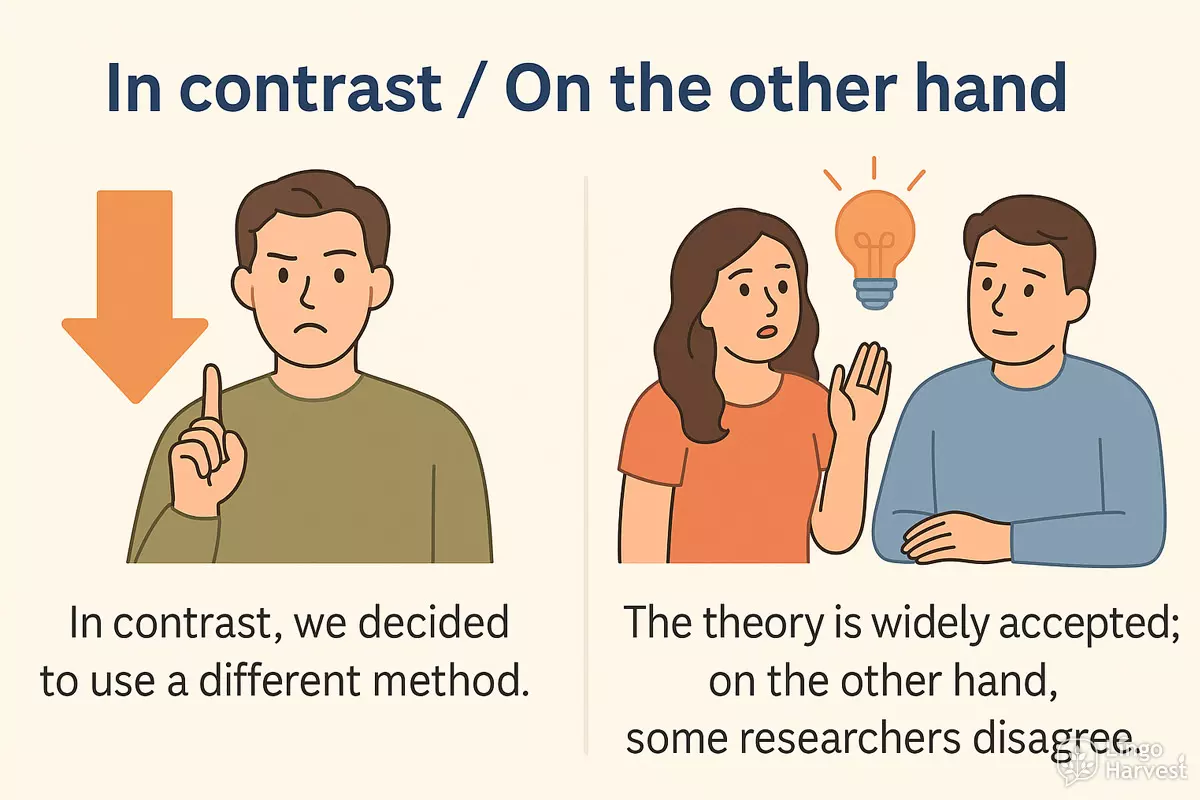
These starters and connectors help signal contrast in academic contexts. They can be used with "whereas" or "while" or as alternatives for variety:
- In contrast → In contrast we decided to use a different method.
- On the other hand → The theory is widely accepted; on the other hand some researchers disagree.
- However → The results were promising; however more tests are needed.
- Nevertheless → The task was difficult; nevertheless they completed it.
- Conversely → She prefers winter; conversely he loves summer.
- By comparison → The first model was slow; by comparison the new one is much faster.
- Although → Although it was raining they continued playing.
- Even though → Even though he was tired he finished the report.
- Yet → The argument seems logical yet it lacks evidence.
- Despite this → The plan faced criticism; despite this it was approved.
- Unlike → Unlike her brother she enjoys public speaking.
- While it is true that → While it is true that the study was small it still provides useful insights.
- Whereas X, Y → Whereas cats are independent dogs need more attention.
- On one hand ... on the other hand ... → On one hand the project is expensive on the other hand it could bring great benefits.
- Though → Though the task was complex they managed to finish it.
- Still → The evidence is limited still the claim is worth investigating.
- In spite of → In spite of the challenges the team succeeded.
- Alternatively → We can extend the deadline alternatively we can reduce the workload.
- Nonetheless → The sample size was small nonetheless the findings were significant.
Comparing "whereas" and "while" in academic contrast
The table below summarizes how these conjunctions function in contrasting sentence structures:
| Conjunction | Typical Use in Contrast |
|---|---|
| whereas | Used to introduce a direct comparison between two opposing facts or ideas. Often emphasizes the difference more formally. Example: The northern region is mountainous, whereas the south is flat. |
| while | Can indicate contrast, but may also refer to time depending on context. In academic texts, it often softens the contrast. Example: While some researchers support this theory, others disagree. |
Tips for clarity in contrasting sentence construction
- Keep clauses parallel in structure for balance and readability.
- Avoid ambiguous use of "while" where it could be mistaken for a temporal meaning.
- Place the more surprising or important information at the end of the sentence for emphasis.
- Vary your sentence openings and connectors to maintain reader interest.
Mastering these sentence forms helps writers present complex arguments and subtle distinctions with clarity and confidence in academic writing.
Examples comparing two facts, groups, or processes
When discussing differences in academic writing, "whereas" and "while" are often used to set contrasting facts, groups, or processes side by side. These conjunctions help highlight distinctions clearly, making comparisons more precise and objective. Below are illustrative sentences showing how each can function in context.
Sample sentences using "whereas" and "while"
- Undergraduates are required to attend all lectures, whereas postgraduates have more flexibility in their schedules.
- The northern region receives significant rainfall, while the southern region remains relatively dry throughout the year.
- Some students prefer online learning, whereas others find face-to-face classes more effective.
- English nouns are not gendered, while in French, nouns are either masculine or feminine.
- Urban areas tend to have better healthcare facilities, whereas rural communities often face shortages.
- In one experiment, the temperature was kept constant, while in the other, it was varied systematically.
- Group A received the standard treatment, whereas Group B received the experimental drug.
- Some countries rely heavily on fossil fuels, while others invest in renewable energy sources.
- Older adults showed improved memory retention, whereas younger participants did not display significant changes.
- In the control group, no intervention was applied, while the test group received weekly training sessions.
- Domestic production increased by 5%, whereas exports declined over the same period.
- One species migrates seasonally, while the other remains in the same location year-round.
Structured comparison of usage
| Context | Example Sentence |
|---|---|
| Comparing groups | Children are more likely to enjoy group activities, whereas teenagers often prefer individual pursuits. |
| Contrasting processes | Photosynthesis requires sunlight, while respiration can occur in the dark. |
| Juxtaposing facts | The east coast experiences mild winters, whereas the west coast faces heavy snowfall. |
| Opposing research findings | Previous studies found no correlation, while recent data suggest a strong link. |
Using "whereas" often signals a more formal or explicit contrast, while "while" can sometimes indicate both contrast and simultaneity, depending on context. Selecting the appropriate conjunction clarifies relationships between facts, groups, or processes, ensuring academic writing remains clear and logically structured.
Practice: change unclear while-clauses into precise whereas-clauses
Clarity in academic writing often depends on choosing the right conjunctions for contrast. The word while can introduce either time or contrast, which sometimes leads to ambiguity. In contrast, whereas is used only for contrast, making it a more precise option in formal contexts. In this section, you'll find practical exercises to help you revise sentences that use while in vague or ambiguous ways, replacing them with clear, contrastive statements using whereas.
Identify and Revise: Practice Sentences
Below are several sentences where while is used to show contrast, but the meaning could be clearer. Try to rewrite each sentence, replacing while with whereas for greater precision.
- The northern region is cold, while the southern region is warm.
- Some students prefer online courses, while others choose traditional classes.
- While cats are independent, dogs are more social.
- Profits rose in Europe, while they fell in Asia.
- While the first method is costly, the second is more affordable.
- Men scored higher in math, while women performed better in reading.
- While the results were positive for adults, children showed no improvement.
- City A’s population increased, while City B’s declined.
- While wheat production grew, rice yields remained stable.
- The experiment succeeded in summer, while it failed in winter.
Show answers
- The northern region is cold, whereas the southern region is warm.
- Some students prefer online courses, whereas others choose traditional classes.
- Whereas cats are independent, dogs are more social.
- Profits rose in Europe, whereas they fell in Asia.
- Whereas the first method is costly, the second is more affordable.
- Men scored higher in math, whereas women performed better in reading.
- Whereas the results were positive for adults, children showed no improvement.
- City A’s population increased, whereas City B’s declined.
- Whereas wheat production grew, rice yields remained stable.
- The experiment succeeded in summer, whereas it failed in winter.
Common Patterns: Before and After
Compare typical sentences that use while for contrast with their improved versions using whereas. Note how the revised versions avoid time-related ambiguity.
| Original with while | Revised with whereas |
|---|---|
| He supports the proposal, while she opposes it. | He supports the proposal, whereas she opposes it. |
| While the theory is popular, evidence is lacking. | Whereas the theory is popular, evidence is lacking. |
| While Company A reduced prices, Company B increased them. | Whereas Company A reduced prices, Company B increased them. |
| Product X is efficient, while Product Y is affordable. | Product X is efficient, whereas Product Y is affordable. |
| While some argue for stricter laws, others disagree. | Whereas some argue for stricter laws, others disagree. |
Tips for Clear Academic Contrast
- Use whereas when you want to highlight a direct contrast between two clauses.
- Avoid while for contrast if there is any risk of confusion with time.
- Place whereas at the start or middle of the sentence to link contrasting ideas explicitly.
- For longer or more complex contrasts, whereas provides unambiguous structure.
- Reserve while for temporal (time-related) relationships when clarity is essential.