Among vs Between: Easy Guide to Groups, Pairs and Usage Rules

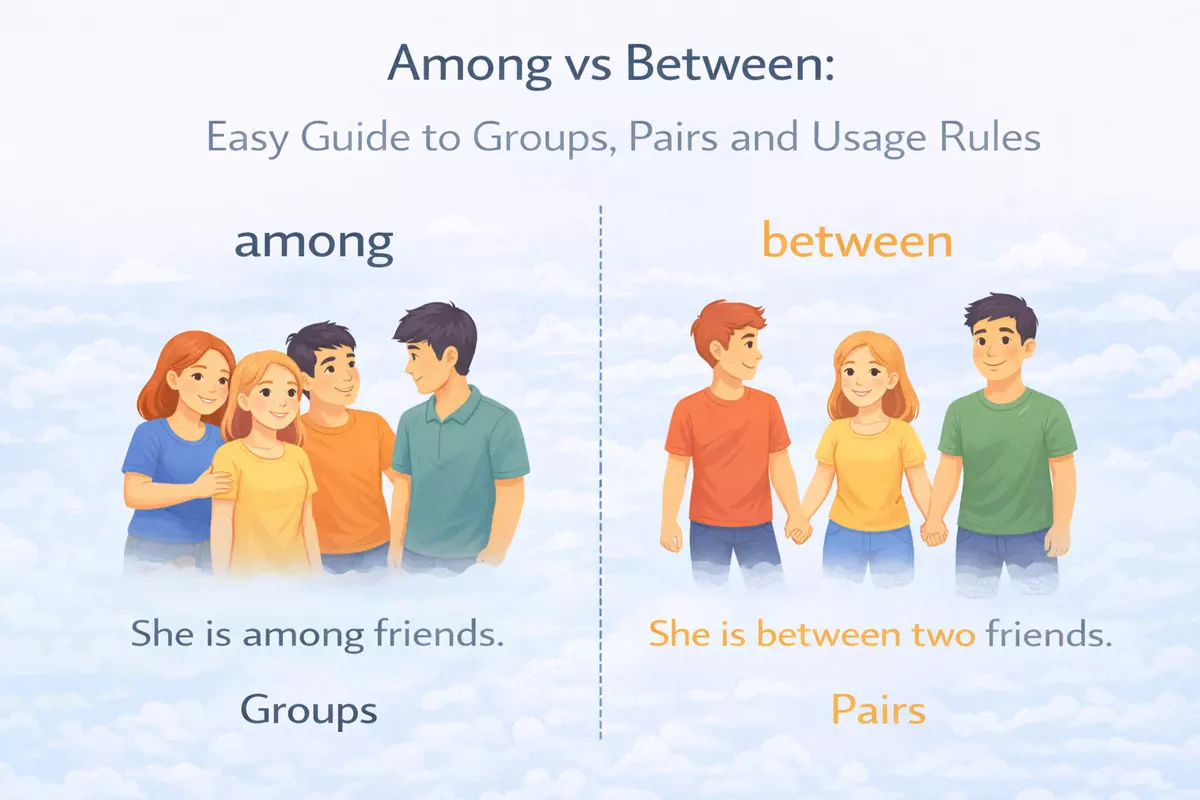 Here we when to use among or between, explaining both traditional and modern grammar rules. It discusses their use with people and things, gives real-life and academic examples, highlights common errors, and offers practice correcting misuse.
Choosing the correct word when referring to dividing things or people, particularly when deciding between terms for groups or pairs, can greatly improve the clarity and precision of your writing. Many writers hesitate over whether to use words like "each," "either," "both," or "among" depending on the number involved. Generally, "each" and "either" refer to two, while "among" is used for more than two. Being mindful of these distinctions not only helps avoid confusion but also ensures your message is communicated accurately and professionally.
Traditional rule about two vs more than two
For a long time, English teachers have emphasized a straightforward guideline: use “between” when referring to two items, and “among” for more than two. This classic distinction was taught for generations and can still guide you in many situations. The idea is simple—“between” suggests a one-to-one relationship, while “among” implies being part of a group without specifying individual connections.
How the rule works in practice
When you’re choosing which word to use, consider the number of things or people involved:
- “Between” is used with two specific, distinct items or people.
- “Among” is applied when there are three or more, especially if the group is collective or not individually named.
Classic examples
- She divided the candy between her two children.
- The teacher walked among the students in the classroom.
- The negotiations between France and Germany were successful. ✅
- There was disagreement among the committee members. ✅
- He shared the secret between his best friends (if there are only two).
- Happiness was found among friends.
- The money was split between John and Mary.
- There is trust between a doctor and a patient.
- She was sitting between her parents at the movie.
- There was laughter among the guests.
- The rivalry between the two teams was intense.
- He wandered among the trees.
- The difference between right and wrong is clear.
- She felt at home among strangers.
- The secret was kept between us.
Key points to remember
- “Between” often involves a direct relationship or comparison.
- “Among” is about being in the midst of a group, with less focus on individual connections.
- Modern usage sometimes bends these rules, but the traditional guideline remains a helpful starting point.
Summary Table: When to Use “Between” vs “Among”

| Use “Between” | Use “Among” |
|---|---|
| Exactly two people or things ✅ Example: The argument between Tom and Jerry. |
Three or more, often as a group ✅ Example: Sharing jokes among friends. |
| Distinct, separate items ✅ Example: The road runs between the park and the river. |
Not individually named or specified ✅ Example: There was confusion among the crowd. |
| Direct, one-to-one relationships ✅ Example: The difference between tea and coffee. |
Group or collective context ✅ Example: Agreement among committee members. |
| Comparisons or choices ✅ Example: Choose between chocolate and vanilla. |
Distribution or sharing in a group ✅ Example: Divide the tasks among the team. |
This old rule is a reliable starting point, especially for clear, simple sentences. However, as language evolves, exceptions and nuances arise—these are covered in other sections. For now, remembering this basic guideline helps avoid common mistakes, especially in formal writing.
Modern grammar view of among and between
Current linguistic analysis recognizes that the old “rule” — use between for two and among for more than two — is too simplistic. In reality, the choice depends more on the relationship and distribution described than on the number of items. Modern grammar experts point out that between is used when referring to distinct, individual items (even if there are more than two), while among is appropriate for things considered as a group or mass, where individual identities are less important.
Usage in contemporary English
Writers and speakers today often rely on context to decide which preposition fits best. For example, you might say, “negotiations between the five companies,” because each company is distinct, or “shared among the team,” because the team is viewed as a collective. This subtle distinction reflects how English has evolved to favor clarity and nuance over rigid numerical rules.
Common patterns and examples
- Between two friends (distinct individuals)
- Between three cities (if considering each city separately)
- Among the crowd (mass or group)
- Among several options (no clear division)
- Between the lines (two boundaries)
- Among the trees (general area, not specific trees)
- Between parents and children (distinct groups)
- Among friends (group context)
- Between the covers of a book (two sides)
- Among the ruins (collective setting)
- Between you and me (two parties)
- Among the participants (group members)
- Between each pair of numbers (distinct pairs)
- Among the candidates (pool or group)
- Between the mountains (separate entities)
- Among the audience (collective)
- Between multiple options (when each is clearly defined)
- Among the choices (as a collective)
Summary of distinctions
| Preposition | Typical Modern Usage | Example |
|---|---|---|
| Between | Distinct, individual items (often two, but can be more) | “The treaty was signed between six nations.” |
| Among | Group or collective entities, less distinction | “She felt comfortable among friends.” |
| Between | Specific, individual relationships | “Divide the money between John, Sarah, and Mike.” |
| Among | General distribution or location within a group | “He was popular among students.” |
In summary, modern English usage is less about rigid numbers and more about how the speaker views the relationship: use between for clear, separate entities, and among for things seen as part of a group or collective. This flexible approach helps you choose the right preposition for the context you want to express.
Spatial vs abstract relationships with people and things
When choosing between “among” and “between,” it helps to notice whether you’re talking about physical positions or more figurative, abstract connections. “Between” is often used for specific, clear boundaries—think of something located in a physical gap or a defined relationship. “Among” is more about being part of a group, either physically surrounded or included in a less defined set.
Physical placement and proximity
If you’re describing where something is in relation to others, “between” usually fits when there are two (or occasionally more, if each boundary is distinct), while “among” works when something is surrounded or mixed in with many.
- She sat between her two friends at the movie.
- The cat hid among the tall grasses.
- The letter fell between the couch cushions.
- He wandered among the crowd at the festival.
Abstract and non-physical connections
Relationships aren’t always about location. When expressing things like feelings, choices, or abstract divisions, “between” often signals a direct relationship, while “among” suggests being one of many or part of a group dynamic.
- Negotiations between the two companies were tense.
- There was a sense of unity among the team members.
- You must choose between tea and coffee.
- There’s a lot of talent among the applicants.
- She divided the tasks between herself and her assistant.
- Rumors spread quickly among the students.
Comparing usage: people vs things
Whether you’re discussing people or objects, the same patterns apply. Here’s a quick comparison of typical usage:
| When to use “between” | When to use “among” |
|---|---|
| Two people: “The secret is between us.” | A group: “He felt lost among strangers.” |
| Distinct objects: “The park is between the school and the library.” | Non-specific things: “Happiness among friends is priceless.” |
| Clear choices: “Choose between red, blue, or green.” | Unclear set: “The answer is hidden among the clues.” |
| Direct relationships: “Trust between partners is vital.” | General inclusion: “There’s excitement among the audience.” |
In summary, “between” points to clear, separate options or boundaries, whether concrete or abstract; “among” covers being part of a collective or surrounded by many, people or things alike. Understanding this difference helps you make your language precise, whether you’re describing locations, choices, or social dynamics.
Examples from everyday speech and academic writing
Distinguishing when to use "among" and "between" is easier with real-world sentences. Everyday language and formal texts each have their own patterns, but the core rules remain the same: "between" is typically used for two distinct items or people, while "among" fits with groups or things not individually named. Below, you'll see how these words appear in both casual conversation and academic contexts.
Common expressions and phrases
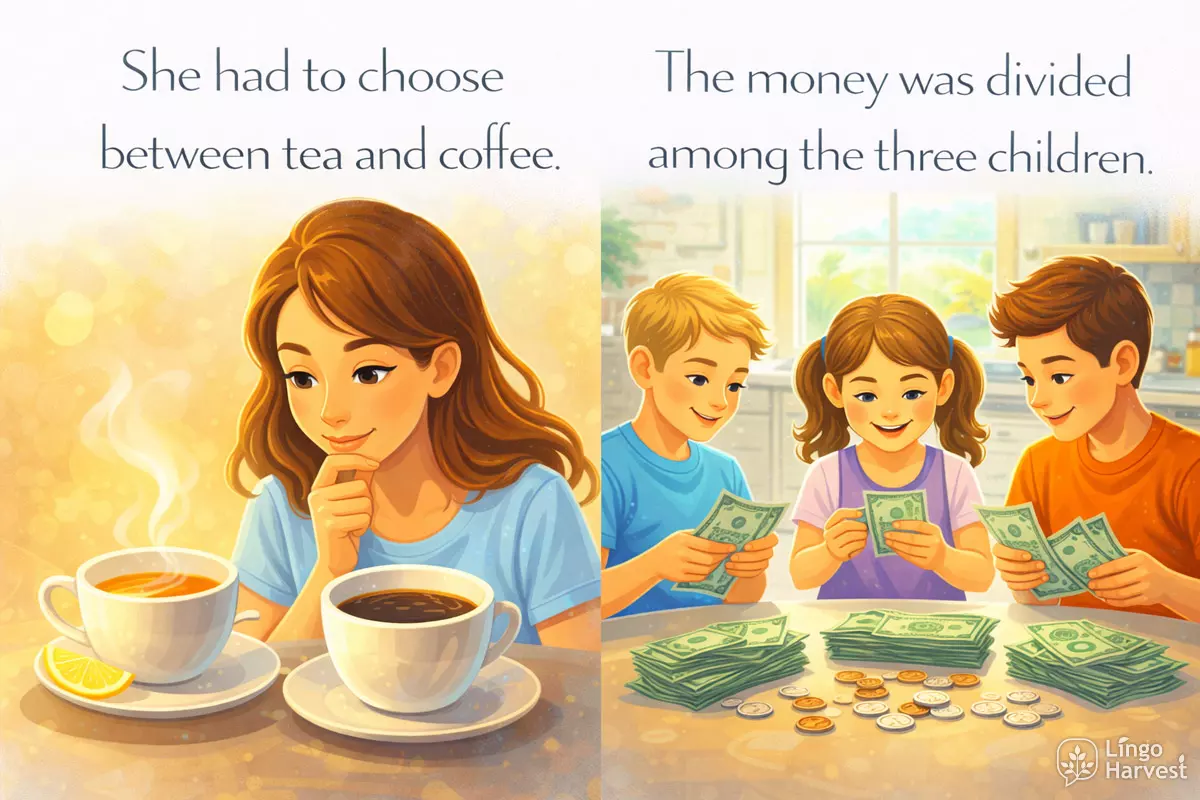
- She had to choose between tea and coffee.
- The money was divided among the three children.
- There is a big difference between these two products.
- He felt comfortable among his friends.
- The negotiations between the two companies were successful.
- They hid the treasure among the rocks.
- She walked between the houses to reach the park.
- There is little agreement among the experts.
- The treaty between France, Germany, and Italy was signed in 1950. (Here, "between" is correct because the agreement is seen as individual relationships with each party.)
- The competition among the students was fierce.
- He divided the tasks between his two assistants.
- It’s hard to choose among so many options.
Academic writing patterns
In formal writing, the distinction is especially important for clarity. For example:
- "The correlation between variables A and B was significant."
- "There were notable differences among the three experimental groups."
- "Communication between departments improved after the policy change."
- "Consensus was reached among committee members."
Quick reference: When to use "among" or "between"
| Use "between" | Use "among" |
|---|---|
| Two people or things (e.g., between John and Mary) | Three or more, or when individual items aren’t named (e.g., among the crowd) |
| Distinct, separate entities (e.g., between France, Germany, and Italy in a treaty) | Groups or collections (e.g., among the trees) |
| Comparisons or choices involving two or more items seen individually (e.g., choose between options A, B, and C) | General distribution or shared situation (e.g., harmony among nations) |
| Physical location separating two points (e.g., between the library and the café) | Unspecified or mingled locations (e.g., among the ruins) |
These examples highlight how context determines the correct word. While some situations have exceptions, following these patterns will help you make the right choice in both casual and scholarly communication.
Common errors when describing groups and choices
Misusing “among” and “between” often leads to unclear or incorrect sentences, especially when talking about groups, pairs, or selections. Recognizing frequent mistakes can help you express relationships and choices more precisely.
Mixing up “between” and “among” with groups
A common slip is using “between” for more than two items or “among” for exactly two. Traditionally, “between” refers to choices involving two distinct items, while “among” is used when talking about more than two or when items aren't individually named.
- Incorrect: She divided the candy between her friends. ❌
- Correct: She divided the candy among her friends. ✅
- Incorrect: The secret is among you and me. ❌
- Correct: The secret is between you and me. ✅
Forgetting exceptions to the “two vs. many” rule
While the “two = between, more = among” guideline works most of the time, there are exceptions. Use “between” when choices are distinct, even with more than two options. For example: “Choose between tea, coffee, and juice.”
Confusing distribution and relationships
“Between” typically describes relationships or choices involving clearly separated elements. “Among” is about being part of a group or mass without emphasis on individual elements. Mixing these up can make sentences awkward or ambiguous.
- Incorrect: Share this secret among the twins. ❌
- Correct: Share this secret between the twins. ✅
- Incorrect: The discussion was between the team members. ❌
- Correct: The discussion was among the team members. ✅
Sample errors and corrections
Here are several more examples to clarify proper usage:
- He walked between the crowd. ❌ → He walked among the crowd. ✅
- The house is among the river and the hills. ❌ → The house is between the river and the hills. ✅
- Distribute the gifts between all the children. ❌ → Distribute the gifts among all the children. ✅
- The negotiations among the three companies went well. ❌ → The negotiations between the three companies went well. ✅
- She sits among her two best friends. ❌ → She sits between her two best friends. ✅
- There is a strong bond between the group. ❌ → There is a strong bond among the group. ✅
- He chose among the two options. ❌ → He chose between the two options. ✅
- The secret is among us. ✅ (Correct for more than two people.)
- The prize was split between the winners. ✅ (Correct if there are two winners.)
- The prize was split among the winners. ✅ (Correct if there are more than two winners.)
Summary of key pitfalls
- Using “between” for groups instead of pairs or distinct items
- Applying “among” to situations with only two elements
- Overlooking exceptions where “between” is correct for more than two distinct, named items
- Switching “among” and “between” in set phrases or idioms
Paying attention to the relationship and number of items in your sentence will help you choose the right word and avoid these mix-ups.
Practice: correct sentences that misuse among and between
When learning the distinction between "among" and "between," it’s common to confuse the two, especially in sentences involving multiple people or things. Below, you'll find a variety of practice items to help spot and correct these errors. First, try identifying which word should be used in each case. Then check your answers by expanding the answers section.
Spot the Error: Choose the Correct Word
Decide whether each sentence should use "among" or "between." In some cases, the sentence may already be correct.
- She divided the cake among her two children.
- The negotiations between the three countries lasted for weeks.
- I found my keys among the cushions on the sofa.
- There is a lot of trust among the team members.
- He sat between his parents at the ceremony.
- The secret was shared between all five participants.
- Distribute the documents among the group.
- Let’s keep this secret just between you and me.
- The prize money will be split among the winners.
- A fence runs between the two houses.
- She had to choose between tea, coffee, and juice.
- The conversation among the guests was lively.
- There’s a rivalry between the three leading brands.
- The treasure was hidden among the rocks.
- They shared the workload among themselves.
- He divided his time between work, family, and hobbies.
- The seats are arranged between the aisles.
- The discussion among the panelists was fascinating.
- The friendship between the twins is strong.
- She walked among the trees in the park.
Show answers
- Incorrect: Should be "between" (two children).
- Incorrect: "Among" is preferred for three or more; "between" is possible for distinct, separate items, but "among" is more natural here.
- Correct as is: "among the cushions".
- Correct as is: "among the team members".
- Correct as is: "between his parents".
- Incorrect: Should be "among" (more than two participants).
- Correct as is: "among the group".
- Correct as is: "between you and me".
- Correct as is: "among the winners".
- Correct as is: "between the two houses".
- Incorrect: Modern usage allows "between" for distinct options, but "among" is also acceptable; traditionalists prefer "among" with three or more.
- Correct as is: "among the guests".
- Incorrect: Should be "among" (three brands, not just two).
- Correct as is: "among the rocks".
- Correct as is: "among themselves".
- Incorrect: Should be "among" (three things, not just two). However, "between" is increasingly accepted for clearly distinct choices.
- Correct as is: "between the aisles".
- Correct as is: "among the panelists".
- Correct as is: "between the twins".
- Correct as is: "among the trees".
Common Patterns: "Among" vs. "Between"
Some patterns can help you quickly decide which word to use. Here are some typical uses:
- Use between for two items or people.
- Use among for three or more, or when items are part of a group or mass.
- "Between" can be used for more than two if the items are individual and distinct.
- Use among when something is distributed or shared within a group.
Quick Correction Exercise
Rewrite the following sentences to use the correct word:
- She shared the secret among her best friend and her sister.
- The prize will be divided between the five finalists.
- The conversation between the guests was friendly.
- He sat among his two cousins at the show.
- The responsibilities were shared between the whole team.
- She walked between the crowd of tourists.
- The teacher moved among the two students to help them.
- We need to choose one house among these two.
- The candies were shared between all the children.
- He tried to hide between the crowd.
Show answers
- She shared the secret between her best friend and her sister.
- The prize will be divided among the five finalists.
- The conversation among the guests was friendly.
- He sat between his two cousins at the show.
- The responsibilities were shared among the whole team.
- She walked among the crowd of tourists.
- The teacher moved between the two students to help them.
- We need to choose one house between these two.
- The candies were shared among all the children.
- He tried to hide among the crowd.