Complex Conditional Conjunctions: provided that, assuming that, in case

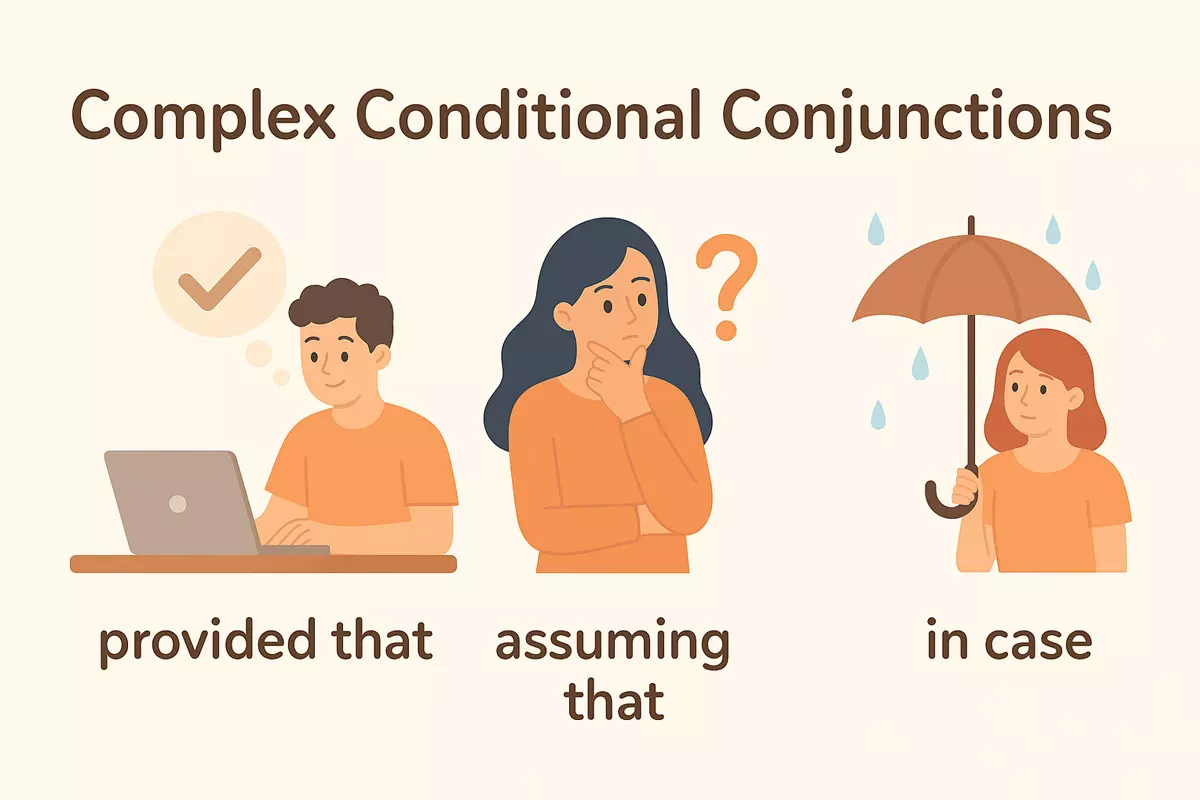 This article explains how advanced conditional conjunctions like provided that, assuming that, and in case expand meaning. It covers their use in formal writing, with examples from policies and essays, and offers practice with complex conditionals.
- How advanced conditional conjunctions expand meaning
- Using provided that to set strict or limiting conditions
- Using assuming that to express hypothetical expectations
- Using in case to show precaution or preventive action
- Formality levels and professional writing contexts
- Examples from instructions, policies, and academic essays
- Practice: complete or rewrite sentences with complex conditional forms
Understanding how to construct English sentences that depend on certain conditions or possible scenarios can be challenging, particularly when incorporating phrases such as provided, assuming, or in case. Using these nuanced connectors correctly not only clarifies your intended meaning but also enhances the sophistication and effectiveness of your communication. By mastering these subtle elements, you can express complex ideas more precisely and engage your audience with greater confidence in both writing and conversation.
How advanced conditional conjunctions expand meaning
Using conjunctions like provided that, assuming that, and in case allows speakers and writers to convey more nuanced relationships between actions, situations, or requirements. These structures go beyond the basic "if" by introducing specific expectations, conditions, or hypothetical scenarios, making statements more precise and flexible. With them, you can clarify under what circumstances something is true, possible, or necessary.
Subtle distinctions in meaning
Each of these complex conjunctions introduces a slightly different type of conditionality. For example, provided that tends to express a strict requirement, while assuming that suggests an imagined or supposed situation. In case is often used to talk about precautions or preparations for possible events. Choosing the right phrase helps avoid ambiguity and communicates your intention more clearly.
- Provided that: sets a precondition that must be met (You can borrow my car, provided that you return it by 6 PM).
- Assuming that: introduces a premise or hypothesis (Assuming that it doesn't rain, we'll hold the meeting outside).
- In case: refers to taking action as a precaution (Take an umbrella in case it rains).
Comparing advanced conditional conjunctions
| Conjunction | Typical Use & Example | Nuance |
|---|---|---|
| provided that | “You may leave early, provided that your work is finished.” | Sets a firm requirement or stipulation |
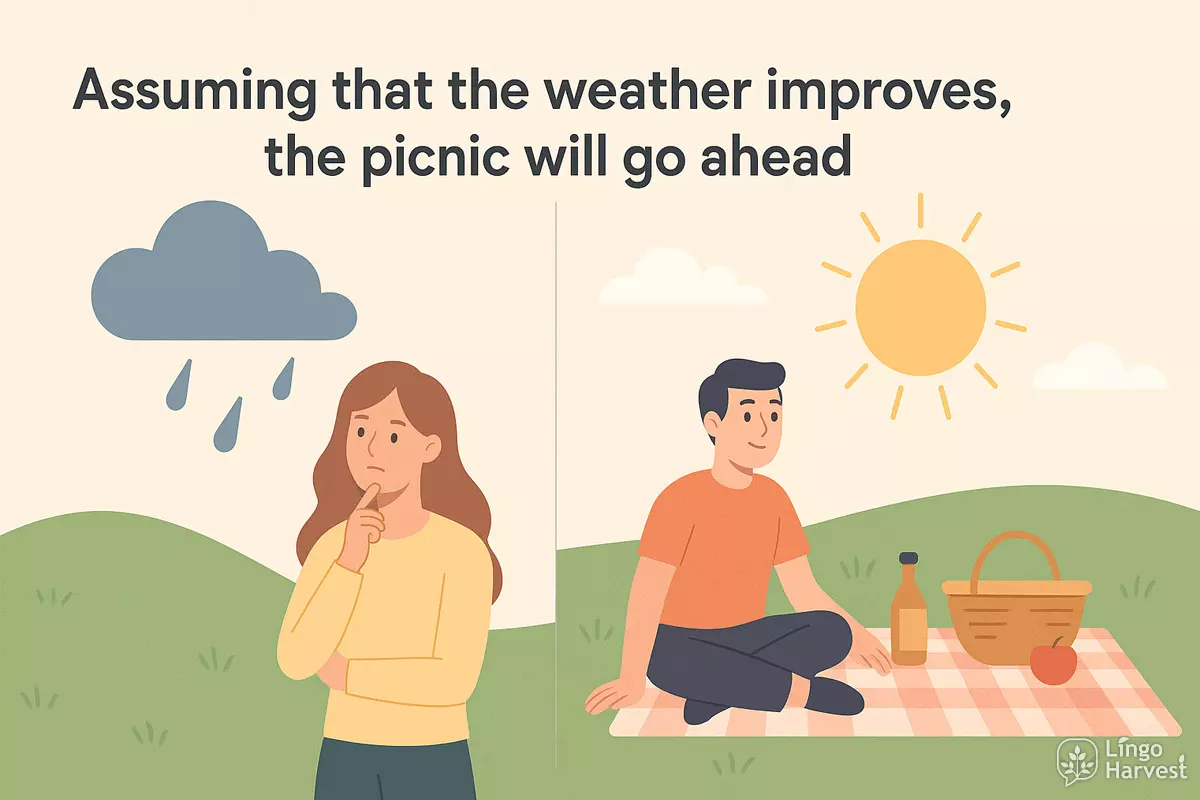
| assuming that | “Assuming that the weather improves, the picnic will go ahead.” | Imagines a scenario or condition as true for argument’s sake |
| in case | “Bring water in case you get thirsty.” | Prepares for a possible situation or outcome |
| unless | “I’ll go for a walk unless it rains.” | States an exception to a plan or action |
| even if | “I’ll help you even if I’m tired.” | Shows determination regardless of a negative condition |
| on condition that | “You can use my laptop on condition that you don’t change any settings.” | Similar to ‘provided that’, often more formal |
| as long as | “You can stay out as long as you call me.” | Sets a permissive boundary, often friendly or informal |
| so long as | “You may participate so long as you meet the criteria.” | Nearly interchangeable with ‘as long as’ |
| supposing that | “Supposing that you win, what will you do next?” | Poses a hypothetical scenario |
| in the event that | “In the event that the flight is delayed, we’ll notify passengers.” | Prepares for a specific, possible event |
Why subtle conditional phrases matter
Mastering these conjunctions lets you express requirements, hypotheses, and contingency plans with accuracy. Rather than relying on simple cause-and-effect language, you gain tools for describing real-world situations where outcomes depend on specific factors or where multiple possibilities exist. This is especially useful in formal writing, business communication, academic contexts, and nuanced everyday conversation.
Using provided that to set strict or limiting conditions
When you want to make a rule, agreement, or plan that depends on a single, often non-negotiable requirement, “provided that” is a precise choice. This conjunction is common in legal documents, contracts, and formal speech, where it sets out a strict prerequisite that must be met for something else to occur. In everyday English, it can sound quite formal, but it’s still useful when you want to be absolutely clear about what is—and isn’t—allowed.
How “provided that” operates in sentences
Rather than merely suggesting a possibility, this phrase establishes a boundary or limitation. The action or condition in the main clause will only happen if the stipulation in the clause with “provided that” is fulfilled. If the condition is not met, the main statement does not apply.
Examples of strict or limiting use
- You can borrow my car provided that you return it by 7 PM.
- Employees may access the building after hours provided that they have a security pass.
- The event will proceed provided that at least 20 participants register.
- We will approve your application provided that all documents are complete.
- Children are allowed on the trip provided that a parent accompanies them.
- Refunds are available provided that you present a valid receipt.
- Members may vote provided that their dues are paid in full.
- Use of the facility is permitted provided that safety rules are followed.
- The discount applies provided that you book online.
- Pets are welcome provided that they remain leashed at all times.
- Students can retake the exam provided that they failed on the first attempt.
- Travel is allowed provided that all vaccinations are up to date.
- The offer is valid provided that you respond within 24 hours.
- He may participate provided that he meets the age requirement.
- Access will be granted provided that you sign the confidentiality agreement.
Comparing “provided that” with other conditional conjunctions
This phrase is often stricter than “if,” which may imply a general condition. “Provided that” tends to allow less flexibility and signals that the condition is essential, not optional. For example, “You can go if you finish your homework” is less formal and potentially less strict than “You can go provided that you finish your homework.”
Common contexts for “provided that”
- Contracts and agreements
- Legal or official rules
- Academic or institutional policies
- Instructions with safety or compliance requirements
- Eligibility criteria
This conjunction helps clarify boundaries and prevent misunderstandings, making it a valuable tool whenever clear, limiting terms are necessary.
Using assuming that to express hypothetical expectations
When you want to talk about a situation that depends on a certain condition, "assuming that" provides a clear way to introduce your expectation. This phrase helps set up a scenario where the outcome relies on something being true, often in the future or in theory. It is especially useful for making predictions, giving instructions, or outlining plans that hinge on particular factors.
How "assuming that" works in context
"Assuming that" is typically used at the start or in the middle of a sentence to introduce a hypothetical cause or situation. It signals that what follows is conditional, but often quite probable or reasonable if the assumption holds. This makes it ideal for academic, business, or everyday speech when you need to clarify that your statement depends on a premise.
- Assuming that the weather stays clear, the event will be held outdoors.
- We can finish the project on time, assuming that everyone meets their deadlines.
- Assuming that you have all the required documents, the process should be straightforward.
- He’ll join us for dinner, assuming that his flight isn’t delayed.
- The plan works, assuming that all the numbers are correct.
- Assuming that you agree, we’ll proceed as discussed.
- They will invest more, assuming that initial results are positive.
- Assuming that the test results are accurate, treatment can begin next week.
- We’ll visit the park, assuming that it doesn’t rain.
- Assuming that you follow the instructions, there shouldn’t be any issues.
- She will pass the exam, assuming that she studies hard.
- Assuming that the package arrives on time, we can start the installation tomorrow.
- The meeting will proceed, assuming that enough people confirm attendance.
- Assuming that no changes are made, the deadline remains the same.
- He can travel, assuming that he gets a visa.
Common uses and nuances
This conditional conjunction often appears in planning, negotiations, or when outlining possible outcomes. It’s less formal than "provided that," but more explicit than just using "if." The phrase can also be used to gently challenge someone’s claim or to highlight underlying expectations.
- Highlighting dependencies: "Assuming that" makes it clear what your expectations rely on.
- Making polite suggestions: It softens the tone, making it less direct than stating conditions outright.
- Clarifying hypothetical scenarios: Useful in discussions where outcomes are uncertain or based on projections.
Comparison with similar expressions
To better understand where "assuming that" fits among other conditional conjunctions, consider the following comparison:
| Expression | Typical Use | Formality |
|---|---|---|
| assuming that | Stating a hypothetical or likely scenario as a basis for expectation | Neutral |
| provided that | Setting a firm condition that must be met | More formal |
| in case | Preparing for a possible situation, often precautionary | Neutral |
| if | General conditional for all types of situations | Neutral |
In summary, "assuming that" gives you a flexible way to present hypothetical expectations and clarify the basis for your predictions or plans. Its role is to make your reasoning transparent whenever an outcome depends on a specific assumption.
Using in case to show precaution or preventive action
When we want to talk about doing something as a safeguard against a possible event, the phrase "in case" is a practical choice. It introduces actions taken not because something will definitely happen, but because it might. This structure is common in both spoken and written English, especially when discussing preparation or readiness for unexpected situations.
How "in case" works in sentences
The conjunction "in case" is used to explain the reason behind a preventive action. It answers the question: "Why are you doing this?" The action is taken before the possible event, as a precaution. For example, "Take an umbrella in case it rains." Here, taking the umbrella is the preventive measure, and the potential rain is the reason.
Typical patterns and usage
You can use "in case" with different tenses, but the most common pattern is:
- Main action (often present or future simple) + in case + possible event (present simple)
Examples:
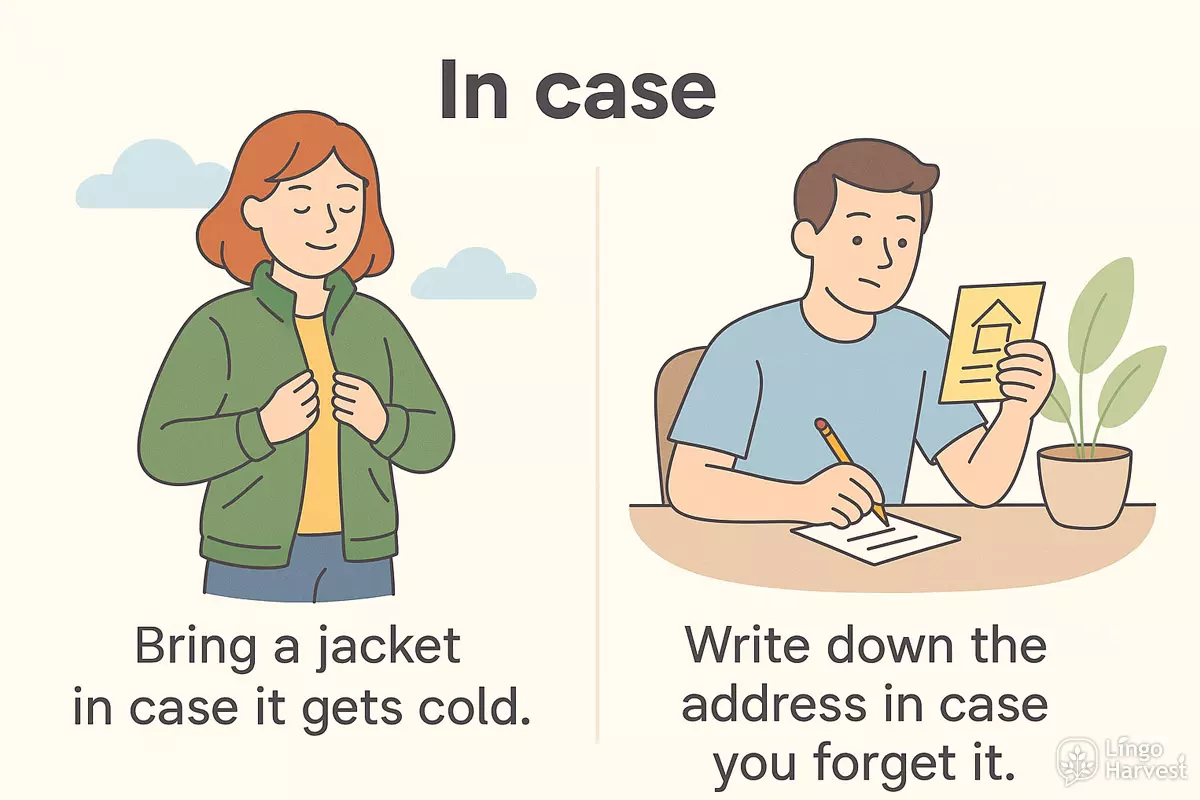
- Bring a jacket in case it gets cold.
- Write down the address in case you forget it.
- I’ll charge my phone in case I need to call someone.
- Take some cash in case the card machine doesn’t work.
- Save your work often in case the computer crashes.
- She left early in case there was traffic.
- Pack some snacks in case you get hungry later.
- I’ll leave the light on in case you come home late.
- Lock the door in case someone tries to get in.
- Buy extra batteries in case of a power cut.
- Wear sunscreen in case the sun comes out.
- Take notes in case you need to review them.
- Keep an umbrella in your bag in case of sudden rain.
- Set an alarm in case you oversleep.
- Store water in case the supply is interrupted.
Common mistakes to avoid
One frequent error is confusing "in case" with "if." "In case" is about preparing for a possible event, while "if" introduces a condition that may or may not happen.
- Correct: Take your keys in case you get locked out. ✅
- Incorrect: Take your keys if you get locked out. ❌ (Too late!)
Summary of "in case" for preventive actions
- Use "in case" to explain actions taken as a precaution.
- It prepares for something that might happen, not something certain.
- Usually followed by the present simple tense to describe the possible event.
This usage is especially helpful in everyday planning, ensuring you are ready for the unexpected.
Formality levels and professional writing contexts
Choosing between "provided that," "assuming that," and "in case" often depends on the tone, expectations, and audience of your writing. Each conjunction carries subtle differences in formality and implication, which can affect clarity and appropriateness in various professional documents.
Register and Tone Differences
"Provided that" tends to sound more formal and is frequently used in contracts, academic writing, and official policies to specify conditions that must be met. "Assuming that" is a bit less formal and suits business emails, technical documentation, or any text where a hypothetical situation is being discussed. "In case" is often the most conversational, fitting for instructions, memos, and less formal workplace communication.
Common Usage Contexts
Writers should match the conjunction to both the subject matter and the expectations of their audience. For example, legal agreements favor precise, unambiguous language, while internal communications may prioritize accessibility and ease of understanding.
- Legal documents: "provided that" is preferred for its exactness.
- Business proposals: "assuming that" is suitable for outlining scenarios or projections.
- Technical reports: "provided that" or "assuming that" can clarify requirements or dependencies.
- Instructional materials: "in case" helps prepare readers for contingencies.
- Emails to colleagues: "in case" and "assuming that" both work, depending on the level of formality required.
Comparing Conjunctions by Formality and Use
| Conjunction | Typical Contexts | Formality Level | Example |
|---|---|---|---|
| provided that | Contracts, policies, academic papers | High | The warranty is valid provided that you register within 30 days. |
| assuming that | Business reports, presentations, emails | Medium | Assuming that sales increase, we will expand the team. |
| in case | Instructions, informal memos, reminders | Low to Medium | Take an umbrella in case it rains. |
Choosing the Right Conjunction
Selecting the most suitable phrase enhances both clarity and professionalism. Consider the following when making your choice:
- Audience expectations (formal vs. informal)
- Document type (legal, technical, casual)
- Degree of certainty or hypothetical nature
- Potential for ambiguity or misinterpretation
- Consistency with organizational style guides
In summary, adapting your use of complex conditional conjunctions to fit the context ensures your communication is both effective and appropriate for the intended readers.
Examples from instructions, policies, and academic essays
Complex conditional conjunctions such as provided that, assuming that, and in case often appear in formal documents, academic writing, and official guidelines. These connectors help clarify conditions or stipulations attached to actions, permissions, or conclusions. Understanding their practical use is essential for drafting clear, precise texts in both professional and academic environments.
Usage in Instructions and Policies
In administrative documents and rules, these conjunctions introduce requirements or exceptions. Notice how each phrase sets a distinct tone or level of certainty.
- Access to the laboratory is permitted provided that all safety protocols are followed.
- Employees may work remotely assuming that their duties do not require physical presence.
- Keep your contact information updated in case of emergency notifications.
- Visitors are allowed entry provided that they sign in at reception.
- Reimbursement will be processed assuming that receipts are submitted within 30 days.
- Store backup files off-site in case of system failure.
Academic Essay and Formal Writing Patterns
In scholarly contexts, these conjunctions are used to frame arguments, state hypotheses, or outline conditional reasoning. Here are more examples:
- The hypothesis holds true provided that external variables remain constant.
- The results are valid assuming that the sample was randomly selected.
- Additional controls were implemented in case unforeseen variables affected the outcome.
- Funding will be granted provided that the research proposal meets ethical standards.
- The theory can be extended assuming that further evidence supports the initial findings.
- Include supplementary data in case reviewers request clarification.
Comparing Conditional Conjunctions in Context
Each of these conjunctions serves a unique function. The table below summarizes typical uses and nuances:
| Conjunction | Typical Function / Example |
|---|---|
| provided that | Sets a strict requirement or precondition. Example: "Approval is granted provided that all criteria are met." |
| assuming that | Introduces a supposition or hypothetical scenario. Example: "The plan will succeed assuming that resources remain available." |
| in case | Expresses precaution or preparation for a possible event. Example: "Bring identification in case you are asked for proof." |
Summary Notes
When drafting instructions or academic arguments, selecting the appropriate conditional phrase strengthens clarity and precision. Provided that emphasizes obligatory conditions, assuming that deals with hypothetical or expected situations, and in case signals preparation for contingencies. Reviewing authentic samples from guidelines, essays, and policy documents helps writers choose the best fit for each context.
Practice: complete or rewrite sentences with complex conditional forms
Mastering complex conditionals with conjunctions like provided that, assuming that, and in case takes practice. Below, you'll find various exercises to help you use these structures more naturally. These tasks include both completion and rewriting activities, so you can build flexibility and accuracy in expressing nuanced conditions.
Complete the sentences
Fill in each blank with the correct complex conditional conjunction (provided that, assuming that, or in case) and, if needed, adjust the verb forms.
- __________ you finish your work early, you can join us for dinner.
- We'll go hiking tomorrow, __________ the weather is good.
- Take an umbrella __________ it rains later.
- __________ you need any help, just call me.
- You may borrow the car __________ you drive carefully.
- __________ they have already left, leave a message at the desk.
- __________ the meeting runs long, I’ll text you.
- We’ll start the project next week __________ everyone agrees.
Show answers
- Provided that you finish your work early, you can join us for dinner.
- We'll go hiking tomorrow, assuming that the weather is good.
- Take an umbrella in case it rains later.
- In case you need any help, just call me.
- You may borrow the car provided that you drive carefully.
- Assuming that they have already left, leave a message at the desk.
- If the meeting runs long, I’ll text you. (Or: In case the meeting runs long, I’ll text you.)
- We’ll start the project next week provided that everyone agrees.
Rewrite with complex conditionals
Transform these sentences using the specified conjunction. Change verb forms as necessary.
- I will bring extra snacks if we get hungry. (Use: in case)
- You may borrow my laptop only if you return it today. (Use: provided that)
- We'll start the presentation if everyone arrives on time. (Use: assuming that)
- Take a jacket if it gets cold. (Use: in case)
- He will join the project if the manager approves. (Use: provided that)
- I’ll message you if I find the documents. (Use: in case)
- You can enter the lab only if you have permission. (Use: provided that)
- We'll continue the trip if the weather improves. (Use: assuming that)
- Take your phone if you need directions. (Use: in case)
- They will support the plan if it benefits the team. (Use: provided that)
Show answers
- I will help you in case you ask.
- You can go to the party provided that you finish your homework.
- We'll leave at 8 a.m., assuming that the weather is good.
- Call me in case you arrive late.
- She will attend the meeting provided that she is invited.
- I will bring extra snacks in case we get hungry.
- You may borrow my laptop provided that you return it today.
- We'll start the presentation assuming that everyone arrives on time.
- Take a jacket in case it gets cold.
- He will join the project provided that the manager approves.
Spot the correct structure
Identify which sentence in each pair uses the appropriate complex conditional form.
- A. We will buy the tickets provided that there are still seats left.
B. We will buy the tickets in case there are still seats left. - A. Assuming that you agree, we’ll proceed with the plan.
B. Provided that you agree, we’ll proceed with the plan. - A. Take your charger provided that your phone battery is low.
B. Take your charger in case your phone battery is low. - A. In case you finish early, let me know.
B. Provided that you finish early, let me know.
Show answers
- A (provided that there are still seats left)
- Both A and B are acceptable, but A (assuming that you agree) is more natural for a hypothetical agreement.
- B (in case your phone battery is low)
- B (provided that you finish early)
Common patterns: comparison table
| Conjunction | Typical Use & Example |
|---|---|
| provided that | Expresses a strict condition; something will happen only if the requirement is met. Example: You can stay out late provided that you call home. |
| assuming that | Introduces a supposition or hypothesis, often used for planning. Example: Assuming that the weather improves, we’ll go for a walk. |
| in case | Used to prepare for a possible situation; often for precautions. Example: Take your keys in case you get locked out. |
With regular practice and by comparing typical uses, you’ll soon be able to choose the right conditional conjunction for any situation.