Multi-word Conjunctions: as long as, as far as, in order that, now that

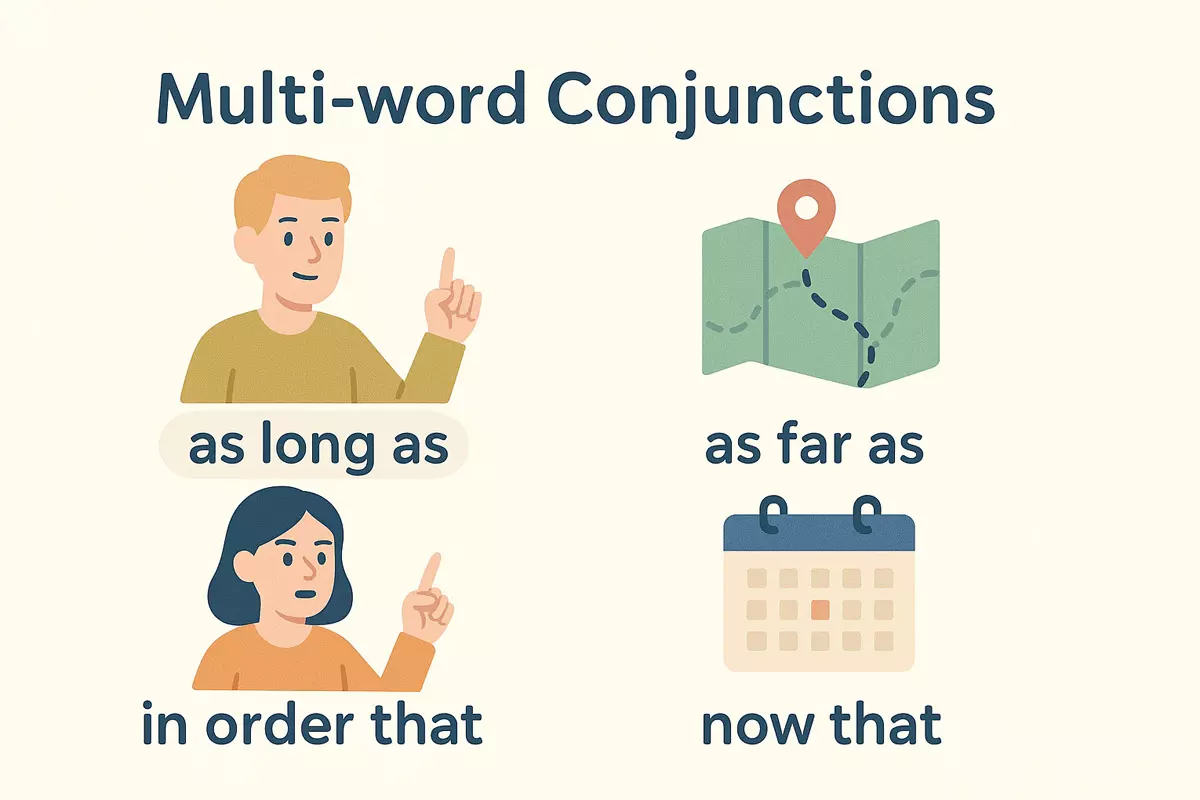 This article explains what multi-word conjunctions are and why they matter, covering how to use as long as, as far as, in order that, and now that. It includes register notes, common mistakes, and practice exercises.
- What multi-word conjunctions are and why they matter
- Using as long as for conditions and limitations
- Using as far as for scope and topic boundaries
- Using in order that for formal purpose clauses
- Using now that to introduce new situations or changes
- Register notes and common error patterns
- Practice: complete sentences using each multi-word conjunction
Have you ever noticed how English uses phrases longer than a single word, such as provided that or so that, to connect ideas and clarify relationships between them? These multi-part connectors function as bridges, allowing speakers and writers to express conditions, reasons, or purposes with greater precision. By using such expressions, communication becomes more nuanced and ideas are linked in ways that single-word conjunctions sometimes cannot achieve. Understanding how these connectors work can enhance both your comprehension and your ability to express complex thoughts more clearly.
What multi-word conjunctions are and why they matter
Multi-word conjunctions, sometimes called compound conjunctions or phrasal conjunctions, are phrases that connect clauses or sentences, functioning much like single-word conjunctions such as "and" or "because." However, these expressions are made up of two or more words that work together to establish relationships between ideas. Examples include as long as, as far as, in order that, and now that.
Understanding these phrases is important because they help us express complex relationships—like time, reason, purpose, or condition—more precisely. Native speakers use them to clarify meaning, avoid ambiguity, and add nuance to their writing and speech. Mastering these forms makes your English sound more natural and allows you to form more sophisticated sentences.
Common Functions of Multi-word Conjunctions
- Condition: Expressing situations that must be true for something else to happen (as long as)
- Purpose: Explaining why something is done (in order that)
- Time: Indicating when something happens (now that)
- Limitation or Scope: Setting boundaries or limits (as far as)
Examples of Multi-word Conjunctions in Context
- We can stay here as long as we keep quiet.
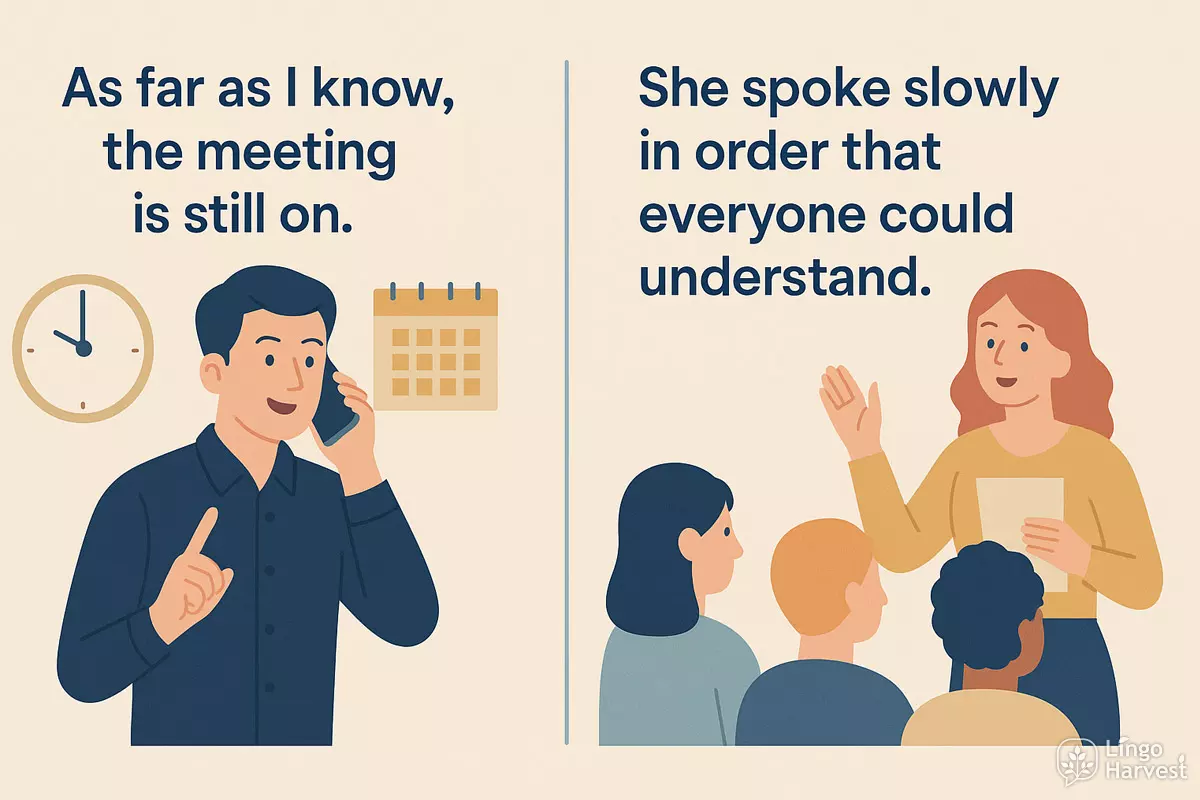
- As far as I know, the meeting is still on.
- She spoke slowly in order that everyone could understand.
- Now that the rain has stopped, we can go outside.
- So that you don't forget, write it down.
- Even though it was late, he kept working.
- Provided that you finish, you can leave early.
- As soon as you arrive, call me.
- In case you need help, let me know.
- As if he didn't care, he walked away.
- In spite of the fact that he was tired, he finished the job.
- Even if it rains, we will go hiking.
- So long as you agree, I'll support the plan.
- For fear that she might fall, he held her hand.
- On condition that you return it, you can borrow my car.
- As much as I want to help, I can't.
- In the event that you are late, call me.
- Such that everyone can see, place it on the table.
- Only if you study will you pass.
- Rather than complain, he fixed the problem.
Why Use Multi-word Conjunctions?
Relying solely on basic connectors can make your language sound repetitive or simplistic. Phrasal conjunctions allow for greater flexibility and subtlety. They also help you mirror the patterns used by proficient speakers, which is crucial for both academic and professional contexts.
Using as long as for conditions and limitations
The phrase as long as is commonly used to introduce a condition or specify a limitation on an action or situation. When you use this expression, you’re setting a requirement that must be met for something else to happen. It’s similar to if, but often emphasizes a more definite or ongoing requirement.
How "as long as" functions in sentences
In everyday English, this structure helps clarify the terms under which something is true or acceptable. It can express both positive and negative conditions, making it a flexible choice for a range of contexts.
- We can stay here as long as we’re quiet.
- You may borrow my bike as long as you return it by 6 PM.
- He’ll help you as long as you ask nicely.
- I don’t mind, as long as you’re careful.
- The offer is valid as long as supplies last.
- You can watch TV as long as your homework is finished.
- Visitors are welcome as long as they follow the rules.
- She will join us as long as she feels well.
- He can stay out as long as he calls home first.
- We’ll support you as long as you need us.
Comparing "as long as" with similar expressions
While as long as is similar to if and provided that, it often sounds more natural in spoken English when talking about ongoing situations or permissions. Here’s how it compares:
| Expression | Example Sentence |
|---|---|
| as long as | You can play outside as long as you stay in the yard. |
| if | You can play outside if you stay in the yard. |
| provided that | You can play outside provided that you stay in the yard. |
| so long as | You can play outside so long as you stay in the yard. |
In summary, as long as sets clear boundaries or requirements and is especially useful when you want to make sure that a condition is ongoing or non-negotiable. It’s a practical tool for expressing both permissions and restrictions in English.
Using as far as for scope and topic boundaries
When you want to clearly state the limits of your knowledge, opinion, authority, or a specific topic, the phrase as far as is especially useful. It helps set boundaries, making it clear where information or responsibility begins and ends. Native speakers often use this multi-word conjunction to avoid overgeneralizing, or to politely signal uncertainty or limitation.
Common Patterns and Usage
The construction typically appears as as far as + noun phrase + (be) concerned, but there are other variations. It can relate to knowledge, ability, relevance, or even geography. Here are typical patterns:
- As far as I know, the meeting is still on.
- As far as our budget allows, we’ll support the project.
- As far as the law is concerned, you have done nothing wrong.
- As far as the weather goes, it should be sunny tomorrow.
- As far as I’m aware, she hasn’t arrived yet.
- As far as my experience tells me, this approach works best.
- As far as I can see, there are no objections.
- As far as the results show, we are on track.
- As far as possible, avoid distractions during study.
- As far as your application is concerned, we need more details.
- As far as I’m concerned, you’re welcome to join us.
- As far as the eye can see, there are fields of wheat.
- As far as research indicates, this is a safe method.
Clarifying the Limits
This phrase is ideal for clarifying the scope of a statement or discussion. For example, saying as far as I know makes it clear that your statement may not cover all possible information. It’s frequently used in both spoken and written English to avoid assuming universal knowledge or agreement.
Comparison with Other Multi-word Conjunctions
To better understand its use, here’s a comparison with similar expressions that set boundaries or conditions:
| Expression | Typical Use | Example |
|---|---|---|
| as far as | Defines scope or limits of knowledge, topic, or relevance | As far as I’m concerned, it’s fine. |
| as long as | Sets a condition for an action or statement | You can borrow it as long as you return it. |
| in order that | States a purpose or aim | She left early in order that she could catch the train. |
| now that | Introduces a new situation or reason | Now that you’re here, we can start. |
Politeness and Precision
Using as far as helps soften statements, making them less absolute and more diplomatic. It’s especially helpful in professional or academic contexts, where stating the boundaries of one’s knowledge or responsibility is important. In summary, as far as is a valuable tool for indicating the specific reach of your statement or involvement, keeping communication both precise and considerate.
Using in order that for formal purpose clauses
The phrase in order that is commonly used in formal English to introduce clauses expressing purpose or intended results. While everyday speech often prefers so that or simply to, this multi-word conjunction is valued for its clarity and precision in academic, legal, and official documents. It helps to make the intention behind an action explicit, especially when there is a need to avoid ambiguity.
Structure and Usage
Typically, in order that is followed by a subject and a modal verb (such as can, could, may, or might). This structure signals the purpose for which something is done. Unlike the more informal so that, this phrase gives sentences a more formal or written tone.
- She left early in order that she might catch the first train.
- We are providing extra resources in order that the team can complete the project on time.
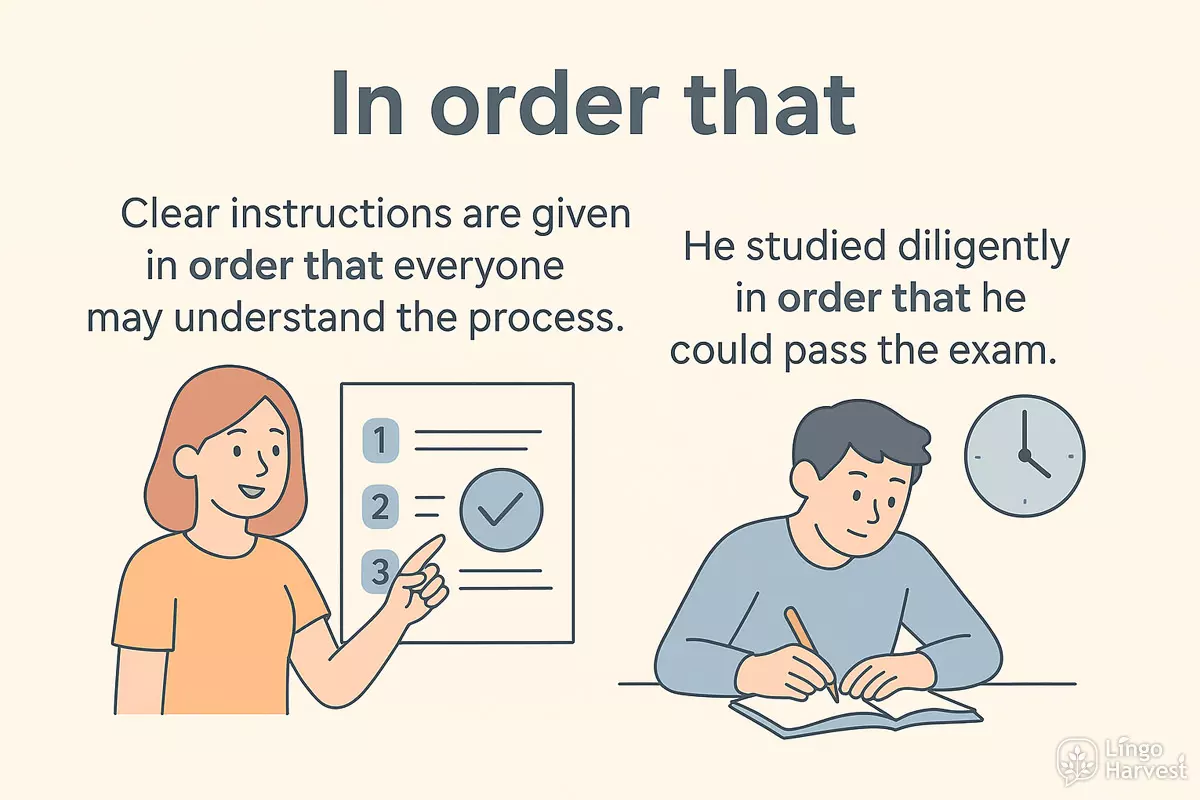
- Clear instructions are given in order that everyone may understand the process.
- He studied diligently in order that he could pass the exam.
- The company updated its policies in order that employees might feel safer.
- They adjusted the schedule in order that all participants could attend.
- Protective equipment is supplied in order that accidents may be prevented.
- We revised the document in order that errors might be eliminated.
- Extra lighting was installed in order that the area could be better monitored.
- She spoke slowly in order that everyone might understand her message.
Comparison with Other Purpose Conjunctions
It is helpful to see how in order that contrasts with alternatives like so that and the infinitive form (to). The table below provides a structured comparison of usage, formality, and grammatical patterns.
| Purpose Clause | Formality | Typical Pattern |
|---|---|---|
| in order that | Formal, written | in order that + subject + modal + verb |
| so that | Neutral, spoken/written | so that + subject + modal + verb |
| to (infinitive) | Informal, spoken/written | to + verb |
When to Prefer "in order that"
Choose in order that when writing in a formal register or when you need to emphasize the purpose and make the sentence unambiguous. It is also useful if the subject of the main clause and the purpose clause are different, or if you want to use a wider range of modal verbs to convey possibility, permission, or necessity.
Using now that to introduce new situations or changes
"Now that" is a multi-word conjunction used to signal that something has changed or a new situation exists, and as a result, something else is possible or relevant. This phrase is most often used at the beginning of a clause to highlight the cause-and-effect relationship between a recent development and its consequences.
How "now that" works in sentences
When you use "now that," you are pointing out a new reality or set of circumstances. It's commonly used to explain why something can or should happen, given a recent change. This makes it especially useful for discussing transitions, updates, or new information.
- Now that you have finished your homework, you can go outside.
- Now that the weather is warmer, we can have a picnic.
- Now that I have a car, commuting is much easier.
- Now that the meeting is over, let's discuss our next steps.
- Now that everyone has arrived, we can begin.
- Now that you mention it, I do remember her.
- Now that the project is complete, we can take a break.
- Now that he’s back from vacation, the team feels complete again.
- Now that you know the truth, what will you do?
- Now that we've solved the problem, let's celebrate.
- Now that she’s graduated, she’s looking for a job.
- Now that it’s stopped raining, we can go for a walk.
- Now that the deadline has passed, we can review the results.
- Now that I understand the rules, the game is more fun.
- Now that you are here, we can start the lesson.
Grammar notes and usage tips
"Now that" is followed by a clause (subject + verb). It is not used with nouns alone, and it refers specifically to present or recent changes, unlike "because," which can refer to any time.
- Correct: Now that the store is open, we can buy groceries.
Incorrect: Now that the opening of the store, we can buy groceries. - Correct: Now that I understand the topic, the exercises are easier.
Incorrect: Now that understanding the topic, the exercises are easier. - Correct: Now that she has arrived, we can begin the meeting.
Incorrect: Now that her arrival, we can begin the meeting. - Correct: Now that the weather has improved, we can go outside.
Incorrect: Now that the better weather, we can go outside. - Correct: Now that he knows the truth, everything makes sense.
Incorrect: Now that the truth, everything makes sense. - Correct: Now that the semester has ended, students can rest.
Incorrect: Now that the end of the semester, students can rest.
Comparing "now that" and "because"
Although both can introduce reasons, "now that" emphasizes a *new* situation, while "because" can refer to past, present, or general causes.
| Conjunction | Example Sentence |
|---|---|
| Now that | Now that you've arrived, we can start. |
| Because | Because you arrived, we started the meeting. |
| Now that | Now that I have more time, I’ll read more books. |
| Because | Because I had more time, I read more books. |
In summary, "now that" is particularly useful for drawing attention to changes and their immediate effects, making your communication clearer and more precise when describing how new circumstances influence what happens next.
Register notes and common error patterns
When using multi-word conjunctions like as long as, as far as, in order that, and now that, it's important to consider both the context and the level of formality. Some of these phrases are more common in spoken or informal English, while others tend to appear in formal writing or official speech.
Formality and usage notes
- As long as is widely used in both formal and informal contexts, often as a substitute for if when expressing conditions.
- As far as frequently introduces opinions or knowledge limits. It’s common in conversation, but can sound vague in academic writing.
- In order that is formal and sometimes replaced by so that or simply so in everyday speech.
- Now that introduces a new situation or reason. It appears in both spoken and written English, but may sound abrupt if overused in formal texts.
Typical mistakes with multi-word conjunctions
Learners often make predictable errors with these phrases. Misplacing them or confusing their structure can lead to unclear or awkward sentences. Common pitfalls include:
- Using as long as when if or provided that is more appropriate.
- Omitting “that” in in order that or using in order to with a clause instead of a verb.
- Adding unnecessary words, e.g., as far as when or now that because.
- Incorrect verb tense after these conjunctions (e.g., using past tense when present perfect is needed).
- Confusing as far as (opinion) with as long as (condition).
- Placing the conjunction at the end of the sentence instead of at the beginning.
- Using in order that with an infinitive instead of a clause: in order that to help ❌ vs in order that he can help ✅.
- Using now that for future situations instead of current or completed changes.
- Overusing these conjunctions, causing repetitive or unnatural style.
- Forgetting subject-verb agreement after the conjunction.
- Mixing up word order, such as: as long as can you finish instead of as long as you can finish.
- Direct translation from another language, leading to non-standard phrases.
Comparison of usage and register
| Conjunction | Typical register & notes |
|---|---|
| as long as | Neutral; common in speech and writing; means “if” or “provided that”. |
| as far as | Informal to neutral; introduces limits of knowledge or opinion. |
| in order that | Formal; often replaced by “so that” in spoken English. |
| now that | Neutral; signals a change or new situation; avoid overuse in formal writing. |
Paying attention to these points will help ensure your multi-word conjunctions sound natural and clear, whether you’re writing an essay, giving a presentation, or having a conversation.
Practice: complete sentences using each multi-word conjunction
Understanding how to use multi-word conjunctions is essential for expressing complex ideas clearly. Let’s reinforce their usage by completing sentences with the correct connector: as long as, as far as, in order that, and now that. Read each prompt and fill in the blank with the appropriate phrase.
Fill in the blanks
- You can borrow my notes __________ you return them by tomorrow.
- __________ I know, there won’t be a quiz this week.
- She set two alarms __________ she wouldn’t oversleep for the exam.
- __________ the rain has stopped, we can go outside and play football.
- I will help you with your homework __________ you try your best.
- __________ I am concerned, everyone did their part in the group project.
- He spoke slowly __________ everyone could understand him.
- __________ you have finished your chores, you may watch TV.
- __________ you follow the instructions, the recipe should work out well.
- __________ the meeting is over, we can discuss our weekend plans.
- __________ I’m aware, she hasn’t replied to the email yet.
- We need to leave early __________ we arrive on time.
- You can stay out late __________ you let me know where you are.
- __________ the semester has ended, I can finally relax.
- I have no objections __________ the policy is fair.
- I made a list __________ I wouldn’t forget anything at the store.
- __________ I can tell, the project is progressing smoothly.
- You can go to the party __________ you finish your assignments first.
- __________ you’ve explained it, I understand the problem much better.
- The teacher speaks loudly __________ everyone at the back can hear.
Show answers
- as long as
- As far as
- in order that
- Now that
- as long as
- As far as
- in order that
- Now that
- as long as
- Now that
- As far as
- in order that
- as long as
- Now that
- as long as
- in order that
- As far as
- as long as
- Now that
- in order that
Usage Tips
- as long as – expresses a condition, similar to “if.”
- as far as – introduces the extent of someone’s knowledge, opinion, or concern.
- in order that – shows purpose or intention, usually followed by a clause.
- now that – used to indicate a new situation or reason, typically at the beginning of a sentence.
Practicing with these sentences can help you confidently use these connectors in your writing and speech. Try creating your own examples to build fluency with each multi-word conjunction.