Register Shift: formal vs informal conjunction use

 This article explains register in English, focusing on how conjunctions and transitions vary between formal and informal contexts. It provides examples from emails, essays, and speech, and guides you in rewriting informal text in a formal style.
- What register means in English communication
- Formal vs informal conjunctions and transitions
- Replacing informal linkers with academic equivalents
- Tone, politeness, and clarity across registers
- Examples from emails, essays, and spoken English
- Practice: change a paragraph from informal to formal style
Navigating different levels of formality in communication involves more than just changing vocabulary; it also requires careful selection of appropriate connectors. Knowing how linking words vary between casual and formal contexts can significantly improve both clarity and suitability in writing and speaking. By choosing the right connectors, you can ensure that your message is not only understood but also received in the intended tone, whether you are composing an informal email or delivering a formal presentation.
What register means in English communication
When discussing register in English, we are talking about the level of formality and the stylistic choices speakers or writers make depending on the context. Register is not just about “formal” or “informal” language; it also includes the tone, vocabulary, syntax, and even the types of conjunctions you choose. These shifts help us adapt our communication to fit the audience, setting, and purpose—whether that’s a business email, a friendly chat, or an academic essay.
Key factors that influence register
- Audience: Who you are speaking or writing to (friends, colleagues, strangers, authority figures).
- Purpose: The goal of your message (to inform, persuade, request, entertain).
- Medium: The channel used (spoken conversation, formal letter, text message).
- Relationship: The social distance or closeness between communicators.
- Setting: The environment or situation (classroom, workplace, online forum).
How register affects language choices
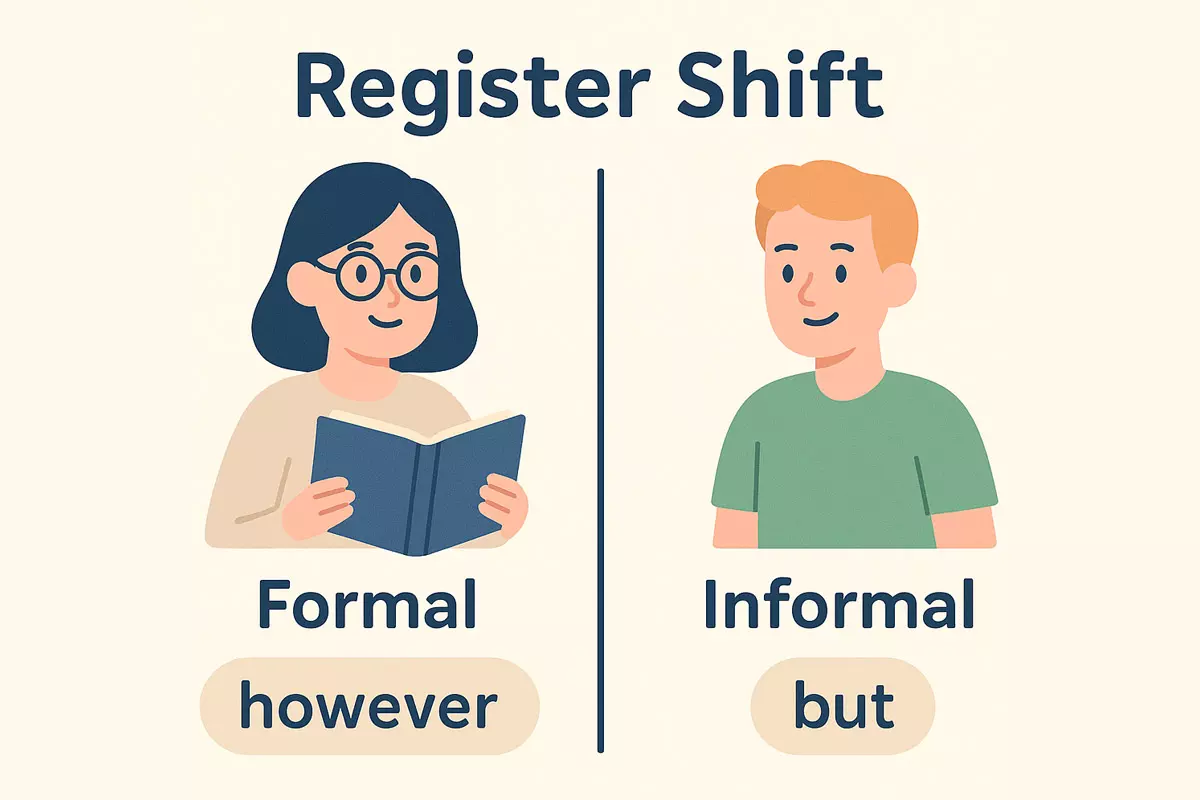
Register determines how we construct sentences, select words, and connect ideas. For example, in formal writing, you might use conjunctions like however or therefore, whereas in casual speech, you’d more likely connect ideas with so or but. This choice helps listeners or readers interpret the tone and intent behind the communication.
Common features of formal and informal registers
- Formality: Use of complete sentences and precise vocabulary in formal contexts; contractions and colloquialisms in informal settings.
- Conjunctions: Words like furthermore, nevertheless, in addition in formal texts; and, but, so in everyday conversation.
- Pronouns: Limited use of first-person pronouns in formal writing; more frequent use in informal speech.
- Idioms and slang: Rare in formal communication, common in casual interactions.
- Sentence structure: Complex and passive constructions in formal English; shorter, active sentences in informal talk.
- Vocabulary: Technical or academic terms vs. simple, familiar words.
- Greetings and closings: “Dear Sir or Madam,” “Yours sincerely” (formal) vs. “Hey,” “See you later” (informal).
- Abbreviations: Generally avoided in formal writing; common in informal messages (e.g., “BTW,” “LOL”).
- Directness: Indirect or polite requests in formal situations; direct or straightforward speech informally.
- Emphasis: Formal English may use adverbs for emphasis; informal English often relies on intonation or repetition.
Register in practice: Adjusting to context
Choosing the right register is about matching your language to the expectations of the situation. This awareness is especially important for learners and professionals, as using an inappropriate register can lead to misunderstandings or make communication feel awkward. Mastery of register means being able to shift smoothly between styles, signaling respect, clarity, and social awareness.
Formal vs informal conjunctions and transitions
Choosing between formal and informal linking words depends on context, audience, and purpose. In academic writing, business communication, or official documents, more formal connectors are expected, while casual conversations, messages, and social media posts often use informal alternatives. Understanding how register affects your choice of conjunctions or transitions helps your writing sound natural and appropriate.
Common features of formal and informal connectors
Formal connectors tend to be longer, less conversational, and sometimes more abstract. Informal ones are direct, familiar, and often shorter. For example, "therefore" sounds more official compared to "so." The register shift affects not only which words we choose, but also how we combine sentences and clauses.
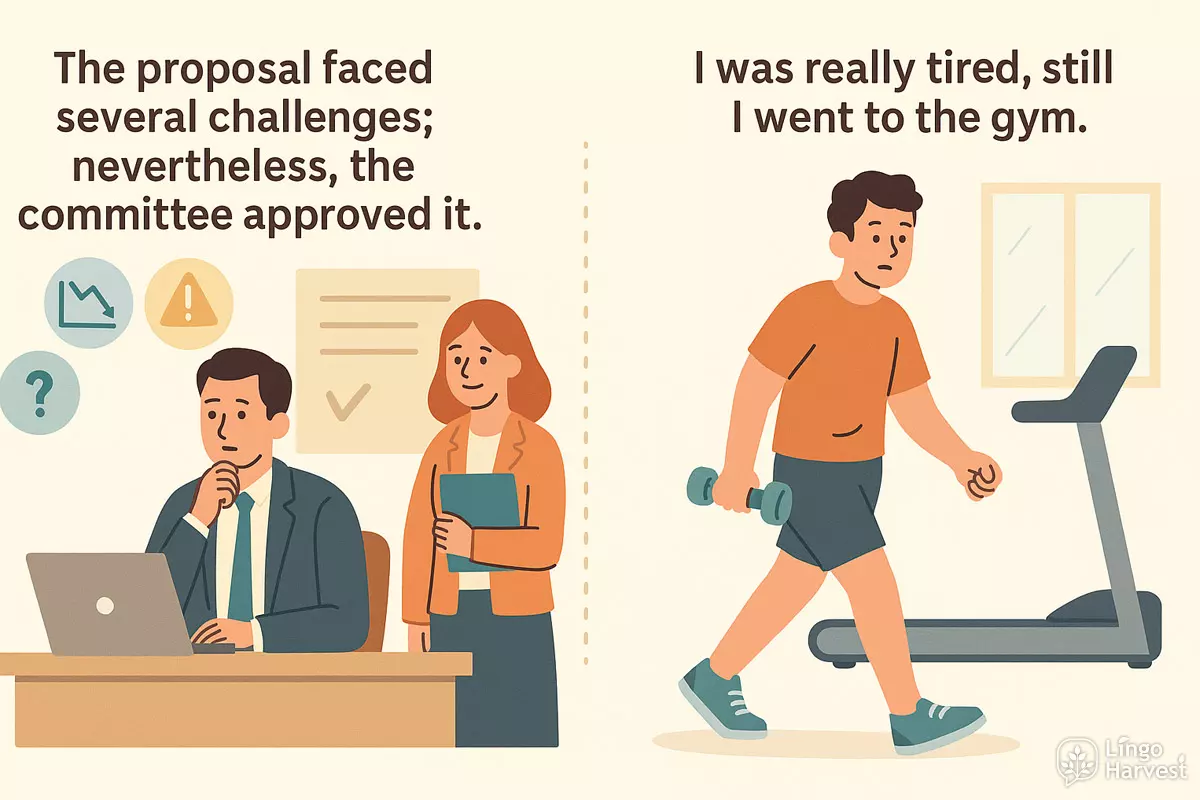
| Formal Connector | Informal Equivalent |
|---|---|
| However | But |
| Therefore | So |
| Consequently | As a result |
| Nevertheless | Still |
| Furthermore | Also |
| Moreover | Plus |
| In addition | And |
| In contrast | On the other hand |
| Thus | So |
| Whereas | While |
| Hence | So |
| Nonetheless | Anyway |
When to use which type
Choose formal transitions for essays, reports, or professional emails where clarity and precision are valued. Informal conjunctions work well in everyday speech, texts, blogs, or friendly correspondence. Switching between registers can help you connect better with your audience.
- Emails to a manager: "However, we must consider..."
- Chat with a friend: "But we should think about..."
- Academic paper: "Furthermore, the data suggest..."
- Social media post: "Plus, it looks great!"
Tips for shifting register
- Be aware of your audience and the context.
- Use longer, Latinate words for formal writing.
- Opt for shorter, common words in informal settings.
- Avoid mixing registers within the same sentence.
- Practice by rewriting sentences using both styles.
Mastering the art of register shift means your language always fits the situation—whether you’re drafting a research paper or sending a quick message.
Replacing informal linkers with academic equivalents
Shifting from casual to scholarly writing often means swapping out conversational conjunctions and transitions for their more formal counterparts. This adjustment not only elevates the tone but also clarifies relationships between ideas, enhancing coherence and precision. Understanding which connectors to use in academic contexts is key for students and professionals alike.
Common Informal Connectors and Their Formal Alternatives
Many everyday linkers are considered too colloquial for academic writing. Recognizing these and knowing suitable replacements can make a significant difference. Here are some frequent examples:
- So → Therefore, Consequently
- But → However, Nevertheless, On the other hand
- Also → Additionally, Furthermore, Moreover
- And → In addition, As well as
- Because → Since, As, Due to the fact that
- Besides → Moreover, Furthermore
- Anyway → Nevertheless, Nonetheless
- Plus → Moreover, In addition
- Maybe → Perhaps, It is possible that
- Really → Indeed, In fact
- For example → For instance, To illustrate
- In the end → Ultimately, In conclusion
- So that’s why → For this reason, Thus
- Like → Such as, For instance
- Anyways → Nevertheless, Regardless
- First/Second/Third → Firstly/Secondly/Thirdly
- To sum up → In summary, To conclude
Structured Comparison: Informal vs. Academic Linkers
Below is a structured overview of how informal conjunctions compare to their academic equivalents, which helps illustrate the differences in register and appropriateness for scholarly contexts.
| Informal Linker | Academic Equivalent | Example |
|---|---|---|
| So | Therefore / Consequently | It was raining; therefore, the event was canceled. |
| But | However / Nevertheless | She tried her best; however, she didn’t succeed. |
| Also | Additionally / Moreover | The project is complex; moreover, it requires extra funding. |
| Because | Since / As / Due to the fact that | Since the data was incomplete, the results were delayed. |
| And | In addition / Furthermore | The study was thorough; in addition, it offered practical solutions. |
| For example | For instance / To illustrate | Many regions face water shortages; for instance, the southern area. |
| Anyway | Nonetheless / Nevertheless | The task was difficult; nonetheless, they completed it on time. |
| First | Firstly | Firstly, the team analyzed the requirements. |
| To sum up | In summary / To conclude | In summary, the experiment confirmed the hypothesis. |
| Like | Such as / For instance | Several tools, such as spreadsheets, were used in the research. |
Tips for Academic Writing
When aiming for a formal register, consider the following strategies:
- Review your writing for everyday connectors and replace them with more precise academic transitions.
- Read scholarly articles to familiarize yourself with common formal linkers.
- Remember that consistency in register is as important as accuracy; avoid mixing informal and formal transitions in the same text.
Shifting to academic connectors helps present arguments more logically and signals a higher level of writing proficiency. Mastery of these alternatives will improve both clarity and credibility in formal communication.
Tone, politeness, and clarity across registers
Choosing between formal and informal conjunctions goes beyond grammar; it directly shapes how a message is received and interpreted. The selection of connectors—whether neutral or marked by a particular register—signals the writer’s stance, level of respect, and the intended relationship with the audience. In formal writing, such as academic essays or business correspondence, conjunctions like however, therefore, and moreover help maintain a respectful and distance-keeping tone. In contrast, informal contexts favor connectors like so, but, because, and also, which create a more conversational and approachable feel.
Impact on politeness and reader perception
Formality in conjunctions often correlates with politeness and consideration for the reader. Using more sophisticated connectors can show deference, especially in requests or critiques. Informal connectors, while friendly, risk being too blunt if not matched to the context. Consider these differences:
- Formal: "I would appreciate your feedback; however, please note the deadline."
- Informal: "Let me know what you think, but remember the deadline."
The first sounds more tactful, while the second is direct but potentially less courteous.
Clarity and flow in different registers
Clarity doesn’t always mean using the simplest conjunctions. In formal settings, precise connectors help organize arguments and clarify relationships between ideas. Overly casual conjunctions can make complex points sound vague or ambiguous. Still, in everyday speech or friendly emails, simple connectors make the message more relatable and easier to process quickly.
Common conjunctions by register
The following table highlights typical conjunctions used in formal and informal language, illustrating their impact on tone and clarity.
| Formal Conjunction | Informal Equivalent |
|---|---|
| However | But |
| Therefore | So |
| Furthermore | Also |
| Nevertheless | Still |
| Consequently | As a result |
| Moreover | Plus |
| Thus | So |
| In addition | And |
| Whereas | While |
| On the contrary | Actually |
Tips for effective conjunction use
- Match your connector to the social context and relationship.
- Prioritize clarity: don’t sacrifice meaning for formality or casualness.
- Be mindful of tone; formal connectors can soften criticism or requests.
- Use informal conjunctions for warmth and approachability in relaxed settings.
- Mixing registers can be confusing—stay consistent within a message.
Choosing the right conjunction shapes not just the logical flow, but also the subtle cues of respect, friendliness, and clarity in communication.
Examples from emails, essays, and spoken English
Understanding how conjunctions shift between formal and informal contexts helps writers and speakers choose the right tone. In professional writing such as academic essays, conjunctions like "however," "therefore," and "moreover" are common. In contrast, everyday speech and casual emails often rely on simple conjunctions like "and," "but," or "so." The context determines whether a more formal or conversational connector is appropriate.
Typical Conjunctions in Different Registers
- Formal (academic essays, business emails): however, consequently, nevertheless, furthermore, thus, although, whereas, in addition, therefore, notwithstanding
- Informal (casual emails, spoken English): but, so, and, or, plus, also, anyway, though, because, then
Sample Sentences by Register
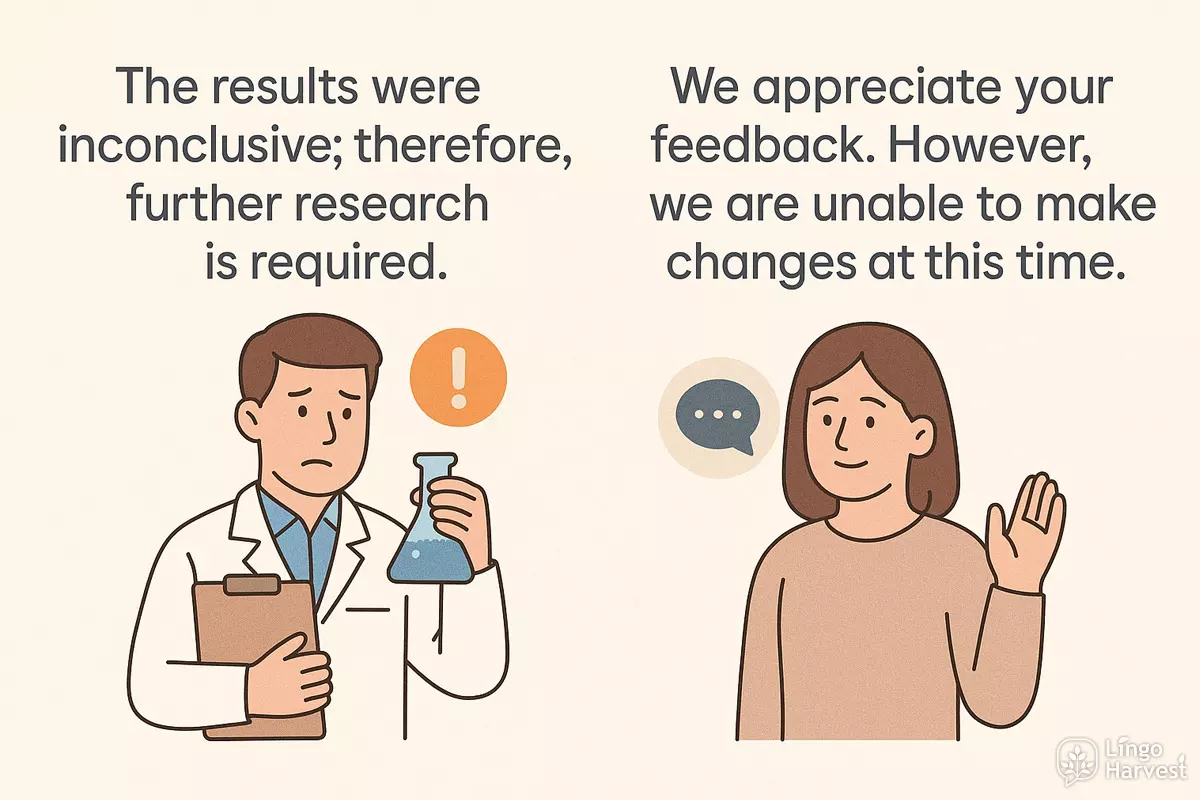
- Essay: "The results were inconclusive; therefore, further research is required."
- Business email: "We appreciate your feedback. However, we are unable to make changes at this time."
- Casual email: "I tried to call, but you didn’t answer, so I left a message."
- Conversation: "I was tired, so I just stayed home."
- Spoken English: "It was raining, but we went out anyway."
- Academic essay: "Furthermore, the evidence supports the hypothesis."
- Casual chat: "I lost my keys, and then I found them in my bag."
- Formal report: "Nevertheless, the project was completed on time."
- Text message: "Can’t come tonight, got work. Plus, it’s raining."
- Presentation: "In addition, these results suggest a new direction."
Direct Comparison of Formal and Informal Conjunctions
| Formal Context | Informal Context | Example (informal) |
|---|---|---|
| However | But | I wanted to go out, but it started raining. |
| Therefore | So | I was tired, so I went to bed early. |
| Furthermore | Also | She speaks French, and she also studies German. |
| Nevertheless | Anyway | It was cold outside, but we went for a walk anyway. |
| In addition | Plus | We bought bread, plus some fresh fruit. |
| Whereas | While | I love spicy food, while my brother prefers mild dishes. |
| Although | Though | He tried his best, though he didn’t win. |
| Consequently | So | The roads were icy, so the school closed for the day. |
| Notwithstanding | Even so | The task was difficult; even so, she managed to complete it. |
| Thus | So | We missed the bus, so we had to walk home. |
When writing or speaking, notice how these connectors signal shifts in formality. Swapping "however" for "but," or "in addition" for "plus," can instantly change the perceived register. Being aware of these patterns is useful for adapting your message to fit the audience and context.
Practice: change a paragraph from informal to formal style
Understanding how to shift from an informal to a formal register is essential, especially when it comes to using appropriate conjunctions. This section guides you through practical steps to transform everyday language into a more academic or professional tone by focusing on conjunction selection and overall sentence structure.
Sample Informal Paragraph
So, I was really tired yesterday, but I still went to the meeting because my boss said it was important. And then, everyone just talked about stuff we already knew, so I felt like it was kind of a waste of time. But at least I got to see my friends.
Task: Convert to Formal Register
- Read the informal paragraph above.
- Identify informal conjunctions and expressions (e.g., “so,” “but,” “and then”).
- Rewrite the paragraph using formal equivalents and more precise language.
Useful Formal Conjunctions and Phrases
- Therefore → The experiment failed; therefore, we repeated it.
- However → The plan was good; however, it was too expensive.
- Nevertheless → He was tired; nevertheless, he continued working.
- Furthermore → The article is well-written; furthermore, it is well-researched.
- Consequently → Traffic was heavy; consequently, we arrived late.
- In addition → She speaks French; in addition, she teaches Spanish.
- Although → Although it was cold, they went swimming.
- As a result → He forgot the password; as a result, he couldn’t log in.
- Moreover → The book is informative; moreover, it is enjoyable to read.
- Despite this → The task was difficult; despite this, he managed to finish it.
- Subsequently → He moved abroad; subsequently, he started a new career.
- Thus → She worked hard; thus, she succeeded.
- On the other hand → The city is noisy; on the other hand, it’s exciting.
- In contrast → The north is cold; in contrast, the south is warm.
- Nonetheless → The evidence was limited; nonetheless, the theory was accepted.
- For this reason → The machine was unsafe; for this reason, it was replaced.
- Additionally → The hotel offers free breakfast; additionally, parking is included.
- In conclusion → In conclusion, the study supports the initial hypothesis.
Comparison: Informal vs Formal Conjunctions
| Informal Conjunction | Formal Equivalent |
|---|---|
| so | therefore, thus, consequently |
| but | however, nevertheless, although |
| and then | subsequently, afterwards |
| because | since, as, due to the fact that |
| also | in addition, moreover, furthermore |
| so that | in order that, so as to |
| if | provided that, in the event that |
| when | whenever, at the time when |
| then | subsequently, thereafter |
| anyway | nevertheless, regardless |
Practice Exercise
Rewrite the given informal paragraph using formal language and suitable conjunctions from the list or table above. Pay attention to sentence flow and logical connections.
Show answers
I was extremely tired yesterday; nevertheless, I attended the meeting because my supervisor stated that it was important. Subsequently, all participants discussed topics that were already familiar, which made me feel that the meeting was somewhat unproductive. However, I appreciated the opportunity to interact with my colleagues.