Conjunction Stacking in Long Academic Sentences (C1–C2)

 Here we conjunction stacking in complex writing, including how to connect multiple clauses with layered conjunctions, common academic patterns, typical mistakes, and practical steps for reorganizing confusing sentences to improve clarity.
- What conjunction stacking means in complex writing
- Using multiple clauses connected by layered conjunctions
- Maintaining clarity and readability in long structures
- Typical academic patterns with contrast + reason + result
- Common mistakes that make sentences confusing
- Practice: reorganize stacked sentences into clear versions
Complex scholarly writing frequently employs sentences with several connecting words, resulting in dense structures that can be difficult to comprehend and may obscure the intended meaning. Mastering the use of these layered linkers is essential for effective academic communication, as it enables writers to convey intricate ideas clearly and logically. By carefully managing the number and placement of connecting words, scholars can improve both the clarity and the impact of their arguments, ensuring that readers can follow complex lines of reasoning without confusion.
What conjunction stacking means in complex writing
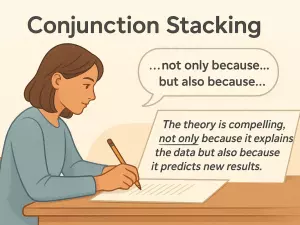
In academic English, writers often join multiple clauses within a single sentence by using several conjunctions in sequence. This practice, sometimes called stacking connectives, creates long, information-dense sentences. Such sentence construction is especially common at advanced proficiency levels (C1–C2), where writers aim for precision and nuance, linking causes, contrasts, conditions, and results together.
Why writers stack conjunctions
Academic authors frequently use this technique to:
- Show logical relationships between different ideas
- Combine evidence and reasoning efficiently
- Clarify complex arguments by connecting multiple points
- Demonstrate advanced control of grammar and syntax
- Avoid repetitive sentence structures
Common patterns in stacked conjunctions
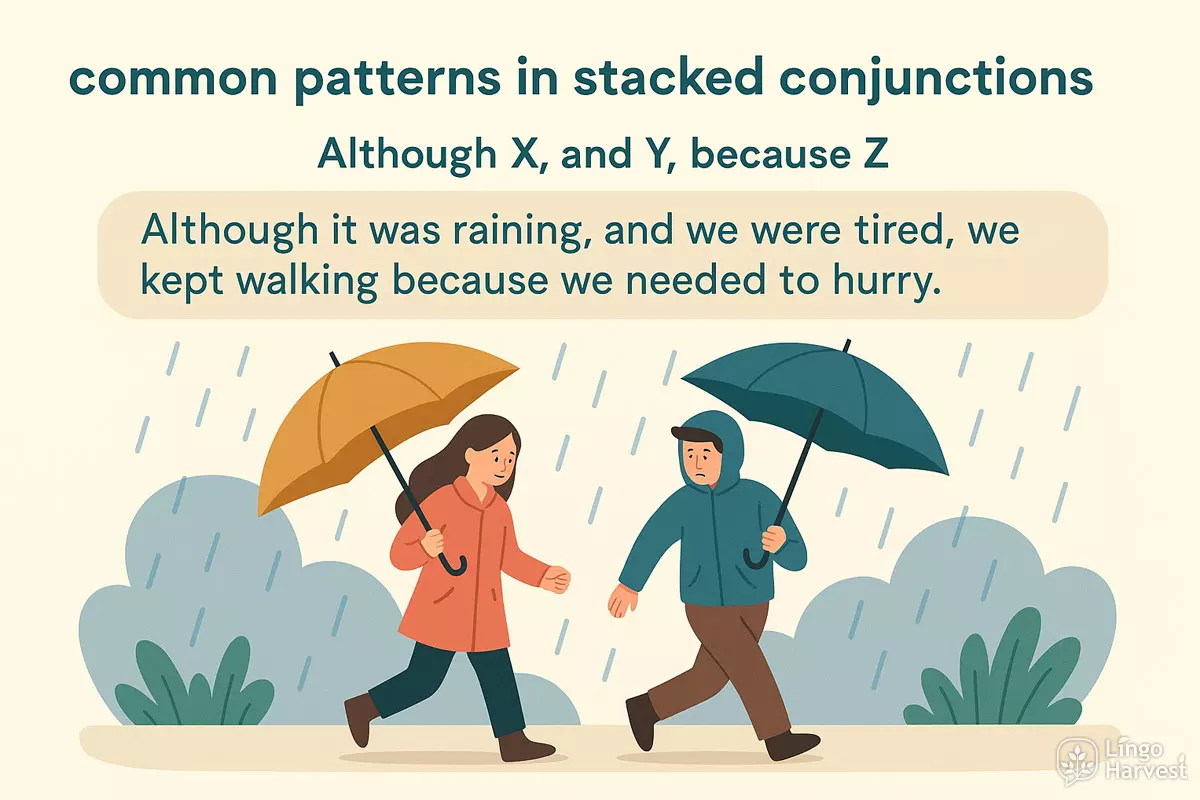
Conjunction stacking often involves mixing coordinating and subordinating conjunctions, sometimes with conjunctive adverbs. Here are some typical patterns:
- Although X, and Y, because Z → Although it was raining, and we were tired, we kept walking because we needed to hurry.
- X, but Y while Z → I wanted to go out, but I stayed home while it was storming.
- X if Y and Z → We will start the meeting if everyone arrives and the room is ready.
- X, so Y although Z → He forgot his umbrella, so he got wet although he tried to stay under the roof.
- While X, yet Y, and Z → While the weather was bad, yet we continued, and we reached the top.
- X because Y and since Z → She left early because she felt sick and since she had no more tasks.
- X, even though Y, but Z → He finished the race, even though he was injured, but he needed help afterward.
- X unless Y or Z → You cannot enter unless you have a ticket or you are on the guest list.
- After X, and before Y, Z → After he finished work, and before he met his friends, he stopped by the store.
- X as long as Y and Z → You can stay here as long as you are quiet and you clean up afterwards.
- Despite X, yet Y and Z → Despite the noise, yet she kept reading and she finished the book.
- X so that Y and Z → He spoke loudly so that everyone could hear and understand him.
- Because X, and since Y, Z → Because it was late, and since the roads were empty, he drove home quickly.
Benefits and challenges
Stacking conjunctions lets writers express layered reasoning and subtle contrasts, but it can also lead to sentences that are hard to parse. Overuse may cause confusion or fatigue for readers, especially when too many ideas are packed into a single sentence.
Examples of conjunction stacking in academic writing
Here are some sample sentences illustrating this technique:
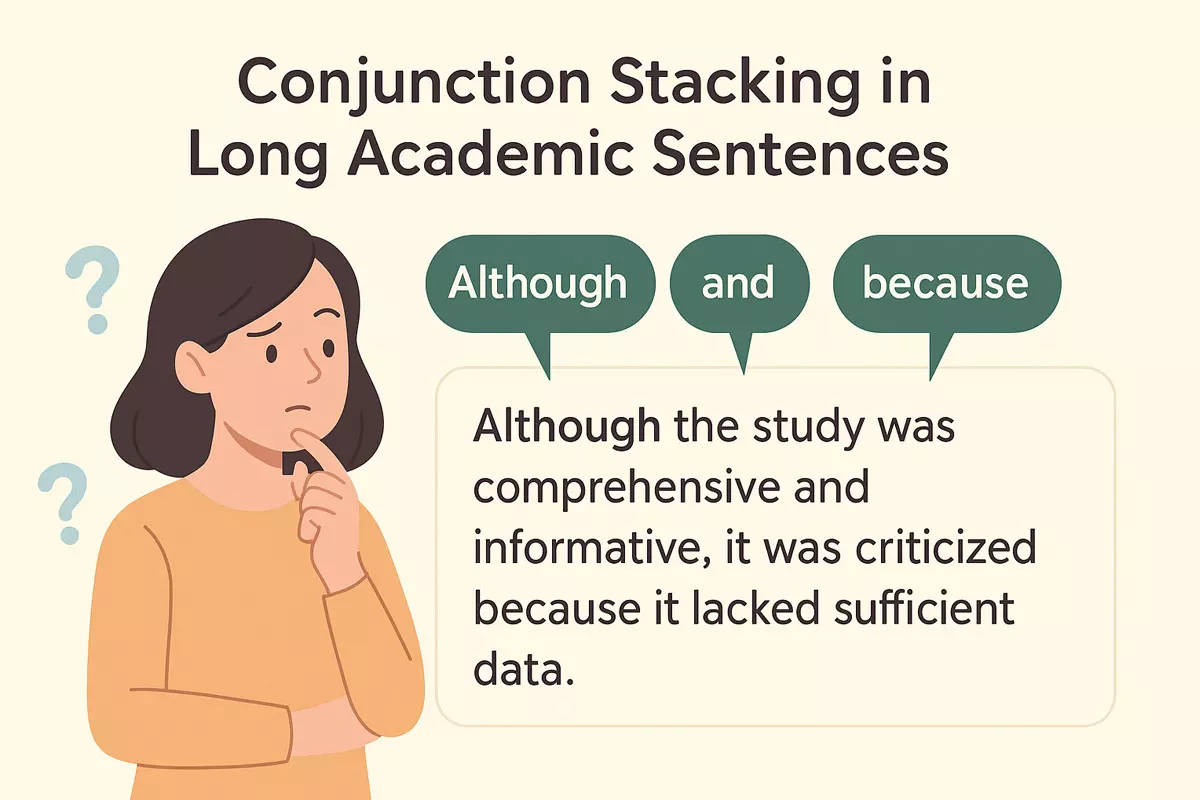
- Although the results were inconclusive, and because the sample size was limited, further research is required.
- The hypothesis was rejected, but while the data supported the alternative, additional variables must be considered.
- Students perform better if they are motivated and if the learning environment is supportive.
- Because the experiment was delayed and since the equipment malfunctioned, the timeline was adjusted.
- While access to resources improved, yet disparities in outcomes persisted and new challenges emerged.
Coordinating vs. subordinating conjunctions in stacks
| Type | Common Examples |
|---|---|
| Coordinating | and, but, or, nor, for, so, yet |
| Subordinating | because, although, since, if, unless, while, after, before, as long as |
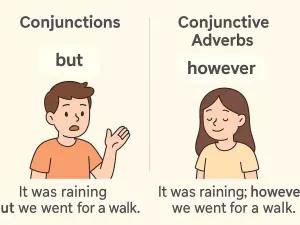
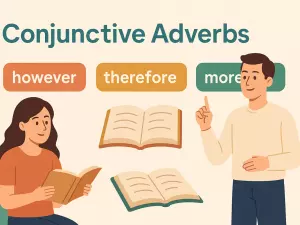
| Conjunctive Adverbs | however, therefore, moreover, nevertheless, consequently, meanwhile |
Summary
Stacking conjunctions is a hallmark of sophisticated academic style, allowing for intricate logical connections. Used thoughtfully, this approach can clarify relationships among ideas, but clarity should always take priority over complexity.
Using multiple clauses connected by layered conjunctions
Academic writing at advanced levels often features sentences where several clauses are linked together by a sequence of conjunctions. This technique allows writers to express nuanced relationships, such as cause and effect, contrast, or conditionality, within a single, coherent sentence. Mastering such structures is essential for C1–C2 level proficiency, as it demonstrates the ability to handle complexity and subtlety in argumentation.
Common conjunctions for stacking
Writers frequently employ a range of conjunctions to build layered sentences. Some of the most useful include:
- because → She stayed home because she wasn’t feeling well.
- although → Although it was cold, they went for a walk.
- while → He cooked dinner while she set the table.
- unless → You won’t pass unless you study more.
- since → Since you’re here, let’s start the meeting.
- so that → He spoke loudly so that everyone could hear him.
- even though → Even though he was tired, he continued working.
- as long as → You can stay as long as you are quiet.
- if → If it rains, we’ll cancel the trip.
- when → Call me when you arrive.
- whereas → She loves coffee, whereas he prefers tea.
- provided that → You can join us provided that you finish your work.
- in order that → He saved money in order that he could buy a new laptop.
- after → After she finished her meal, she left the restaurant.
- before → Wash your hands before you eat.
- once → Once he understood the task, he worked quickly.
- until → Wait here until I return.
- though → He enjoyed the trip, though it was exhausting.
Layered conjunction patterns in academic sentences
Complex sentences can combine these connectors in various ways. For example, a single sentence might begin with a concessive clause (although...), followed by a main clause, and conclude with a purpose clause (so that...). Such structures allow for precise argumentation and logical flow.
| Pattern | Example Sentence |
|---|---|
| Concession + Cause + Result | Although the data set was limited, the researchers continued the study because preliminary results were promising, so that they could justify further funding. |
| Condition + Contrast + Purpose | If the participants agree, while some remain hesitant, the survey will proceed in order that comprehensive feedback is obtained. |
| Time + Reason + Concession | After the policy was implemented, since public opinion had shifted, the government maintained its stance, even though opposition persisted. |
| Contrast + Condition + Result | Whereas most studies focus on adults, provided that sufficient data exist, this analysis includes adolescents so that broader trends can be identified. |
Tips for clear layered conjunction use
- Keep the logical relationship between clauses explicit to avoid ambiguity.
- Use punctuation (commas, semicolons) strategically to guide readers through multiple clauses.
- Revise for conciseness; overly long sentences may reduce clarity.
- Vary your sentence structure to maintain reader engagement.
- Check that each conjunction is necessary and contributes meaningfully.
Combining several clauses with layered connectors is a powerful tool for advanced academic communication. Practicing these patterns will help you create writing that is both sophisticated and precise.
Maintaining clarity and readability in long structures
When academic sentences become lengthy, especially due to conjunction stacking, it is essential to guide the reader smoothly through complex ideas. Overly extended structures can obscure meaning, so writers should consciously organize information and signal relationships clearly.
Break up information logically
Long sentences often combine several clauses with multiple conjunctions (e.g., "and," "but," "although," "because," "while"). To keep your message clear:
- Ensure each clause adds distinct information and is not simply repeating or rephrasing.
- Use punctuation (commas, semicolons, dashes) to separate ideas and highlight connections.
- Group related points together before moving to the next linked idea.
Choose conjunctions purposefully
Not all linking words serve the same function. Selecting precise conjunctions helps readers follow your argument:
- and (addition)
- but, yet (contrast)
- because, since (cause)
- although, even though (concession)
- so, therefore (result)
- while, whereas (comparison)
Common issues and solutions
| Problem | Effective Strategy |
|---|---|
| Too many clauses make the sentence hard to follow | Split into two or more sentences for clarity |
| Ambiguous connections between ideas | Use specific conjunctions to clarify relationships |
| Overuse of similar conjunctions (e.g., many "and"s) | Vary conjunctions and use linking adverbials |
| Punctuation errors disrupt meaning | Review comma and semicolon placement carefully |
Tips for readable academic sentences
- Limit the number of stacked conjunctions per sentence.
- Read sentences aloud to check natural pauses and flow.
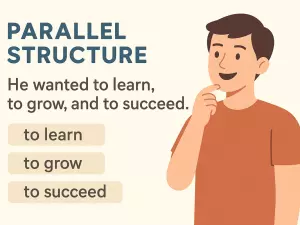
- Revise for parallel structure when listing multiple ideas.
- Highlight the main point early, then add supporting details.
- Use referencing words (this, such, these) to avoid repetition.
- Balance sentence length within paragraphs for rhythm.
- Ask a peer to review for possible confusion.
- Keep subject-verb-object order whenever possible.
- Use topic sentences to frame complex chains of reasoning.
- Be concise: remove redundant or unnecessary clauses.
Ultimately, thoughtful structuring and careful word choice help readers navigate intricate academic discussions, even when sentences grow long due to necessary conjunction stacking.
Typical academic patterns with contrast + reason + result
Academic English frequently relies on complex sentence structures that combine contrast, explanation, and outcome within a single sentence. These constructions help writers convey nuanced arguments and justify their claims, especially in advanced writing (C1–C2 levels). The typical approach involves stacking conjunctions or linking words to connect opposing ideas, provide reasons, and state results in a logical progression.
Common conjunctions and linking words
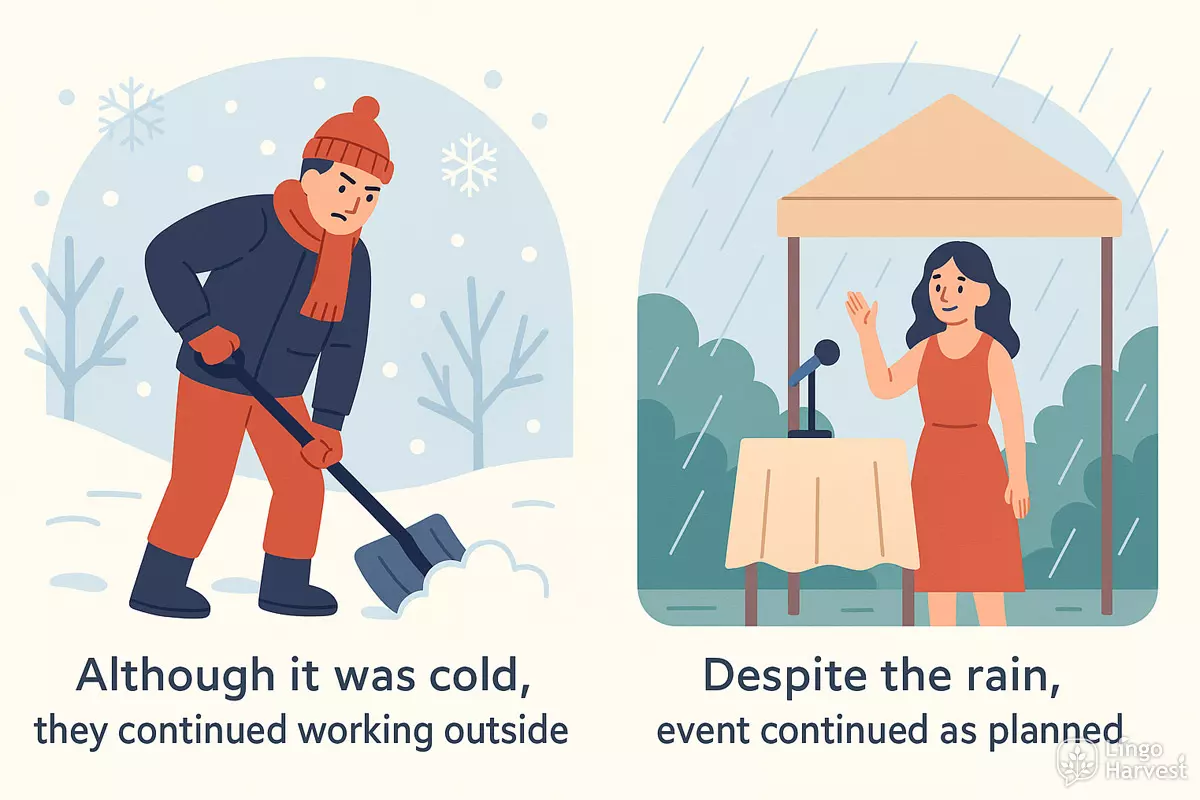
Writers often use a combination of connectors for these patterns. Here are some of the most frequent choices:
- Although / Though / Even though → Although it was cold, they continued working outside.
- Despite / In spite of → Despite the rain, the event continued as planned.
- Because / Since / As → Since it was late, they decided to leave.
- So / Therefore / Thus / Consequently → It was getting dark; therefore, we headed home.
- However / Nevertheless → The task was difficult; however, she completed it on time.
- Yet / Still → He was tired; still, he finished the project.
Pattern structure
Academic writing often follows a layered pattern, such as:
- Contrast clause + Reason clause + Result clause
- Despite / Although + because / since + so / therefore
Examples of conjunction stacking
Writers combine multiple connectors within a single sentence to show the relationship between opposing ideas, explanations, and outcomes. Here are some extended examples:
- Although the results were inconclusive because the sample size was limited, the researchers decided to publish the findings so that further studies could be encouraged.
- Despite the project’s high cost, since it addressed urgent infrastructure needs, the city council approved additional funding.
- Even though the evidence was largely anecdotal, as no controlled trials had been conducted, policymakers proceeded with the intervention, hoping for positive results.
- While participation rates increased because the new policy reduced barriers, overall engagement remained low, so additional outreach was implemented.
- Although student feedback was mixed, since many appreciated the flexibility, the university maintained the blended learning model.
- Despite limited resources, as the community was highly motivated, significant progress was achieved in a short period.
- Even though the methodology had limitations because of time constraints, the data collected was sufficient for a preliminary analysis.
- Although the hypothesis was not fully supported, since some variables showed significant change, the research was considered valuable.
- While the initial findings were promising, as further analysis revealed inconsistencies, the conclusions were revised.
- Despite technical difficulties, since the team collaborated effectively, the project was completed on schedule.
Summary of conjunction stacking patterns
| Pattern | Example |
|---|---|
| Contrast + Reason + Result | Although data were limited because of funding shortages, the team produced a comprehensive report. |
| Despite + Reason + Result | Despite initial skepticism as the theory was untested, further experiments confirmed its validity. |
| Contrast + Result | Even though the process was lengthy, the final outcome justified the effort. |
| Reason + Contrast + Result | Because the deadline was tight, although resources were sufficient, the quality suffered. |
These patterns help writers build clear, logical, and persuasive arguments, especially when discussing complex relationships between ideas. Mastery of such structures is a hallmark of advanced academic writing.
Common mistakes that make sentences confusing
When writing at an advanced academic level, it's easy to overload sentences with too many conjunctions, causing ideas to blur together and making it difficult for readers to follow the argument. Overuse of linking words, unclear reference points, and misplaced clauses often contribute to confusion. Recognizing these frequent pitfalls is essential for anyone aiming to improve clarity and coherence in complex texts.
Overstacking Conjunctions
Packing several conjunctions into one sentence can result in tangled logic and ambiguity. Readers may lose track of which ideas are connected or subordinate. Instead, dividing long sentences into two or more can help.
- Using "and", "but", "so", and "because" all in a single sentence without clear structure.
- Chaining "although", "while", and "however" together and creating contradictions.
- Linking more than three clauses in one sentence, which often leads to reader fatigue.
Misplaced Clauses and Ambiguous References
Complex sentences often hide the main point when clauses or reference words (like "this" or "which") are not placed carefully. The reader may be left wondering what exactly a pronoun or modifier refers to.
- Starting with a subordinate clause and never clearly stating the main clause.
- Using "it", "this", or "which" without specifying the noun being described.
- Separating the subject and verb with too many embedded clauses.
Overuse of Formal Connectors
Advanced writers sometimes feel compelled to use as many academic connectors as possible, but this can make prose heavy and unnatural.
- Stringing together "moreover", "furthermore", "in addition", and "consequently" in one paragraph.
- Replacing simple conjunctions with unnecessarily complex ones (e.g., "notwithstanding the fact that" instead of "although").
- Repeating similar connectors without adding new information.
Examples: Problematic vs. Improved Sentences
Below is a comparison of sentences that suffer from excessive conjunction stacking and their clearer alternatives.
| Confusing Sentence | Clearer Alternative |
|---|---|
| Although the results were significant and the sample size was large, but because some variables were not controlled, therefore the conclusions may not be reliable. | The results were significant and the sample size was large. However, since some variables were not controlled, the conclusions may not be reliable. |
| While the theory is widely accepted, but there are critics, and although their evidence is limited, yet it should not be ignored. | While the theory is widely accepted, there are critics. Although their evidence is limited, it should not be ignored. |
| Because the experiment was delayed and since the materials were unavailable, so the research timeline was extended, but only slightly. | Because the experiment was delayed and materials were unavailable, the research timeline was extended, but only slightly. |
| Even though the data were incomplete, but the researchers proceeded, and consequently, the findings were questioned. | Even though the data were incomplete, the researchers proceeded. As a result, the findings were questioned. |
Quick Checklist for Avoiding Sentence Confusion
- Limit the number of conjunctions in each sentence.
- Make sure each pronoun clearly refers to a specific noun.
- Break long sentences into shorter ones where possible.
- Use connectors only when they genuinely clarify relationships.
- Read sentences aloud to check for natural flow and clarity.
By being mindful of these stumbling blocks, academic writers can produce text that is both sophisticated and easy to understand.
Practice: reorganize stacked sentences into clear versions
Long sentences in academic writing often use multiple conjunctions, which can create confusion or obscure the main point. Practicing how to untangle these "stacked" constructions will help you write more precisely and improve readability.
Task: Simplify and clarify
Below you will find a set of complex sentences. Each one contains several conjunctions ("and," "but," "because," "although," "while," "so that," etc.) linking multiple ideas. Rewrite each sentence for clarity by breaking it into shorter sentences, reordering information, or using clearer connectors. Focus on expressing the main idea directly.
- Although the experiment was successful and the data were consistent with previous research, there were still several anomalies, and because the sample size was limited, the conclusions should be interpreted with caution.
- The committee approved the proposal, but only after several revisions had been made and despite concerns about the timeline and the budget, so the project will begin next month.
- While the new method is effective for large datasets and reduces processing time, it requires expensive equipment and extensive training, and therefore it may not be feasible for all institutions.
- The author argues that the policy is beneficial because it increases accessibility and promotes equality, but critics claim that it is too costly and that its long-term effects are uncertain.
- Students must submit their assignments by the deadline, and if they fail to do so, they will lose marks, but extensions may be granted in exceptional circumstances.
Useful strategies for untangling stacked conjunctions
- Identify and separate distinct ideas or clauses.
- Use transition words to clarify relationships (e.g., "however," "therefore," "in addition").
- Break very long sentences into two or more shorter ones.
- Restate complex cause-effect links with explicit language.
- Highlight contrasts and conditions using clearer connectors.
Before and after: Example transformations
| Original (Stacked) | Clear Version |
|---|---|
| Although the results were promising and most participants responded positively, the study was limited by its short duration and small sample size, so further research is needed. | Most participants responded positively, and the results were promising. However, the study was limited by its short duration and small sample size. Therefore, further research is needed. |
| The software is user-friendly and efficient, but it requires frequent updates and can be expensive, which discourages some users. | The software is user-friendly and efficient. However, it requires frequent updates and can be expensive. This discourages some users. |
| While the policy aims to improve access and reduce inequality, it faces criticism because implementation is inconsistent and funding is insufficient. | The policy aims to improve access and reduce inequality. However, it faces criticism because implementation is inconsistent and funding is insufficient. |
| Researchers collected data from multiple sources and analyzed it thoroughly, but since the variables were not controlled, the findings should be interpreted cautiously. | Researchers collected data from multiple sources and analyzed it thoroughly. However, since the variables were not controlled, the findings should be interpreted cautiously. |
| Participants completed both surveys and interviews, so the researchers obtained comprehensive insights, although some responses were incomplete. | Participants completed both surveys and interviews. As a result, the researchers obtained comprehensive insights. However, some responses were incomplete. |
Try it yourself: Rewrite for clarity
Attempt to revise the sentences from the earlier list. Aim to untangle the ideas and present them logically.
Show answers
- The experiment was successful, and the data were consistent with previous research. However, there were several anomalies. Because the sample size was limited, the conclusions should be interpreted with caution.
- The committee approved the proposal after several revisions had been made. Despite concerns about the timeline and the budget, the project will begin next month.
- The new method is effective for large datasets and reduces processing time. However, it requires expensive equipment and extensive training. Therefore, it may not be feasible for all institutions.
- The author argues that the policy is beneficial because it increases accessibility and promotes equality. However, critics claim that it is too costly and that its long-term effects are uncertain.
- Students must submit their assignments by the deadline. If they fail to do so, they will lose marks. However, extensions may be granted in exceptional circumstances.