because vs so: Explaining Reasons and Results

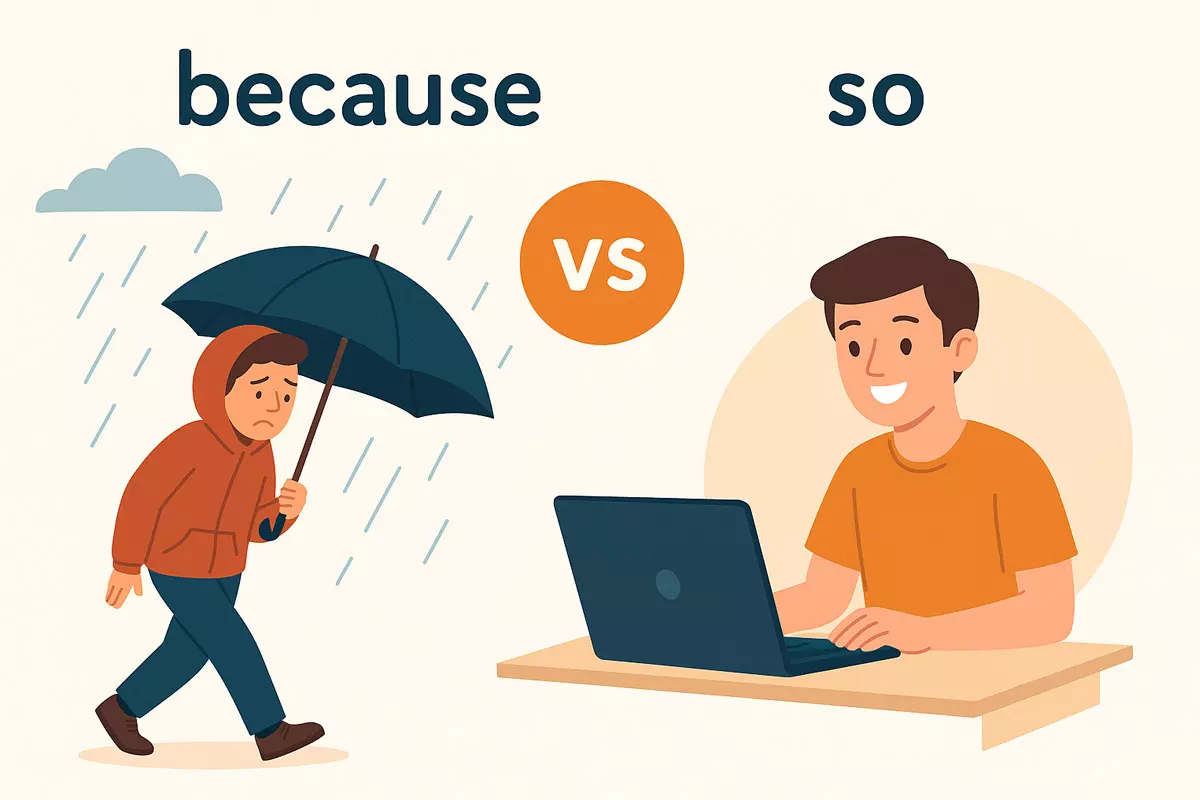 This article explains how to use because and so to show reasons and results. It covers sentence order, comma use, common mistakes, and includes mini dialogues with explanations plus practice rewriting sentences for better understanding.
Expressing why something happens or what results from it is key to clear communication. Recognizing the difference between a cause and its effect helps us explain situations more effectively. Causes answer the question of why an event occurs, while effects describe what happens as a result. By using language that clearly links reasons and outcomes, we make our explanations easier to understand and more persuasive. Mastering this distinction not only improves our writing and speaking but also helps others follow our logic.
Reason (because) vs Result (so)
English speakers often use because to give reasons, and so to show results. These words help us connect ideas in a logical way, but their roles in sentences are quite different. Understanding how to use each can make explanations clearer and conversations more natural.
How "because" works
We use because to explain the reason for something. It answers the question "Why?" and usually introduces the cause. For example: "She wore a coat because it was cold." Here, "it was cold" explains why she wore a coat.
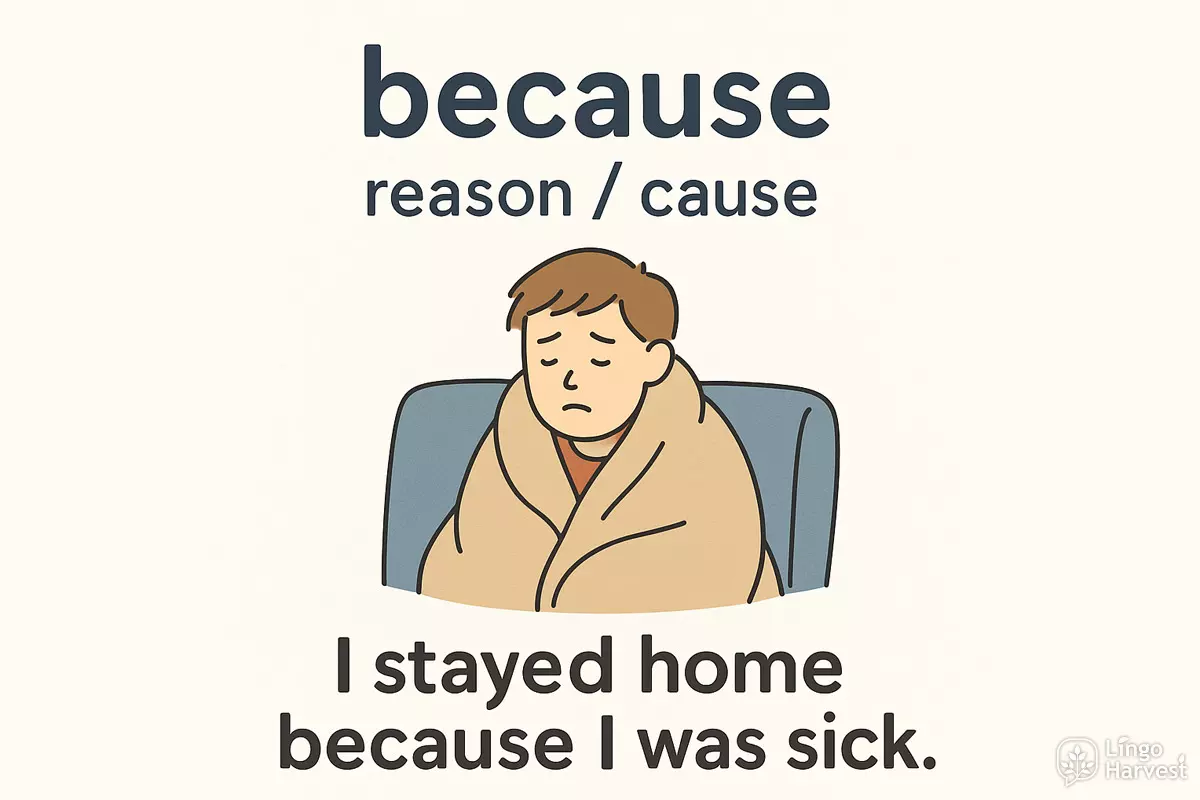
- I stayed home because I was sick.
- We left early because the movie was boring.
- He failed the test because he didn’t study.
- They smiled because they were happy.
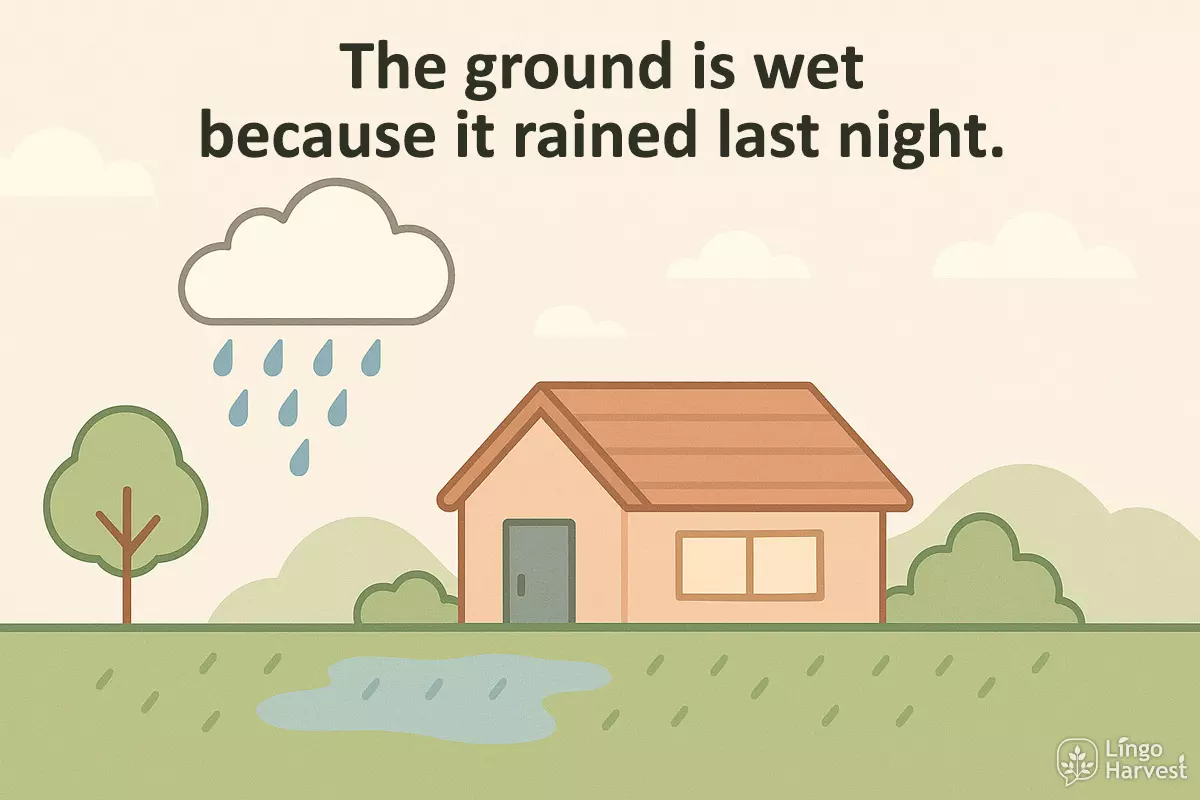
- The ground is wet because it rained last night.
How "so" is used
So introduces a result or consequence. It answers "What happened as a result?" and connects the cause to its effect. For example: "It was cold, so she wore a coat." The cold weather led to her choice.
- I was sick, so I stayed home.
- The movie was boring, so we left early.
- He didn’t study, so he failed the test.
- They were happy, so they smiled.
- It rained last night, so the ground is wet.
Comparing "because" and "so"
The structure changes depending on which word you use. "Because" introduces the reason after the main action, while "so" leads into the outcome. Notice how the same ideas can be expressed in two ways by switching the connector:
| Sentence with "because" | Sentence with "so" |
|---|---|
| I was tired because I worked late. | I worked late, so I was tired. |
| She went inside because it started to rain. | It started to rain, so she went inside. |
| They called a taxi because the bus was late. | The bus was late, so they called a taxi. |
| He wore glasses because he couldn’t see well. | He couldn’t see well, so he wore glasses. |
| The match was cancelled because it was snowing. | It was snowing, so the match was cancelled. |
Key points to remember
- Because = gives a reason (answers "Why?")
- So = gives a result (answers "What happened?")
- Word order changes depending on which word you use.
- Both can be used to connect clauses, but not in the same sentence.
Mastering the difference between these connectors makes explanations more precise and helps avoid confusing sentences. Pay attention to what you want to express: the cause or the result. That will guide your choice between because and so.
Sentence Order Variations
Changing the arrangement of clauses in sentences that use "because" and "so" can affect both the tone and clarity of your explanation. Understanding the flexibility in structure can help you express reasons and results more naturally in English.
Placing the Cause and the Result
The word "because" introduces a reason, while "so" introduces a consequence. With "because," you can start with either the result or the cause, depending on what you want to emphasize. "So" is typically used to begin the result clause, which usually comes after the reason.
- I stayed home because it was raining. → Reason follows the result.
- Because it was raining, I stayed home. → Reason comes first for emphasis.
- It was raining, so I stayed home. → Result follows the cause.
Comparing Structures: "Because" vs "So"
Below is a structured comparison showing how sentence order changes with each connector:
| Connector & Pattern | Example |
|---|---|
| Because (Result + because + Reason) | She apologized because she was late. |
| Because (Because + Reason, + Result) | Because she was late, she apologized. |
| So (Reason + so + Result) | She was late, so she apologized. |
| So (So at sentence start: Rare/Colloquial) | So she apologized. (Usually context-dependent; less formal) |
Key Points for Natural Usage
- When you want to highlight the reason, begin with "because".
- For a more conversational flow, place the reason after the result with "because".
- "So" almost always follows the reason, introducing what happened as a result.
- Avoid using "because" and "so" in the same sentence to prevent redundancy. ❌
- Commas: Use a comma after the "because" clause if it comes first, and before "so" when it joins two clauses.
Expanded Examples of Order Choices
- He missed the bus because he woke up late.
- Because he woke up late, he missed the bus.
- He woke up late, so he missed the bus.
- I brought an umbrella because I thought it might rain.
- Because I thought it might rain, I brought an umbrella.
- I thought it might rain, so I brought an umbrella.
- The store was closed because it was a holiday.
- Because it was a holiday, the store was closed.
- It was a holiday, so the store was closed.
- She studied hard because she wanted to pass the test.
- Because she wanted to pass the test, she studied hard.
- She wanted to pass the test, so she studied hard.
Choosing the right order helps your sentence sound clear and purposeful. Adjusting the position of the reason or result can subtly shift what your listener or reader focuses on.
Comma Use and Natural Speech
In everyday English, punctuation often follows the rhythm of how we naturally speak. The choice to insert a comma before "because" or "so" can depend on clarity, emphasis, and the flow of the sentence. While formal writing has clear rules, spoken English and informal text sometimes bend them for easier understanding or to mirror speech patterns.
Commas with "because" and "so": When and Why
Grammatically, a comma before "because" is generally unnecessary, except when the pause helps avoid confusion. For example, "He didn't come, because he was sick" can mean he stayed away due to illness. Without the comma—"He didn't come because he was sick"—the meaning could shift, implying a different reason. With "so," a comma is common when joining two independent clauses, such as "It was raining, so we stayed inside."
- No comma before "because" in most cases: "I left because I was tired."
- Comma before "because" for clarity or contrast: "She didn’t fail, because she didn’t try."
- Comma before "so" when linking two complete sentences: "He was late, so he missed the meeting."
- No comma before "so" when "so" means "so that": "He whispered so no one would hear."
How Natural Speech Influences Comma Choices
Native speakers often pause before "so" but not before "because," reflecting how ideas connect in conversation. This pause can guide where a comma feels natural. In writing that mimics dialogue, punctuation may follow these speech-based rhythms more than strict grammatical rules.
Examples from Everyday Conversation
- "I was hungry, so I made a sandwich."
- "She left because she was tired."
- "He didn't call, because he forgot."
- "We hurried so we wouldn't be late."
- "The movie was boring, so we left early."
- "I stayed home because it was raining."
- "They argued, because they disagreed."
- "He saved money so he could travel."
- "She didn't eat, because she felt sick."
- "I took notes so I wouldn't forget."
- "The lights went out, so we used candles."
- "They laughed because the joke was funny."
- "He worked late, so he was tired the next day."
- "She whispered so no one would hear."
- "I missed the bus because I woke up late."
- "He smiled, because he was happy."
Understanding the subtle differences in punctuation can help your writing sound more natural and clear, bridging the gap between formal rules and the way people actually communicate.
Typical Learner Errors
Many English learners struggle to distinguish when to use "because" and when to use "so" to connect ideas, leading to awkward or incorrect sentences. This confusion often stems from misunderstanding their grammatical roles: "because" introduces a reason, while "so" introduces a result. Below are some common mistakes and how to avoid them.
Mixing Up Cause and Result
Learners sometimes swap "because" and "so," using one where the other is required. For instance, "I was tired so I went home because I needed to rest" is incorrect if both connectors are used together in a single clause.
- Using "so" to introduce a reason:
❌ I stayed home so I was sick. → ✅ I stayed home because I was sick. - Using "because" to introduce a result:
❌ She was late because she missed the bus. (Correct as a reason, but not if you want to show the result:
✅ She missed the bus, so she was late.)
Incorrect Sentence Structure
Another frequent problem is sentence structure. "Because" usually connects two clauses, but "so" cannot begin a sentence in formal writing. Here are more patterns to watch out for:
- Starting a sentence with "So" in academic writing:
❌ So, I left early. (Better: ✅ Therefore, I left early.) - Double conjunctions:
❌ Because I was tired, so I went home. - Fragmented clauses:
❌ I left because. I was tired.
Common Confusions: Examples Table
| Incorrect Example | Corrected Version |
|---|---|
| I ate a lot because I was hungry, so I finished quickly. | I ate a lot because I was hungry. I finished quickly. |
| He left early so he was tired. | He left early because he was tired. |
| I didn’t call her because I forgot, so she was worried. | I didn’t call her because I forgot. She was worried. |
| Because it was raining, so we stayed inside. | Because it was raining, we stayed inside. OR It was raining, so we stayed inside. |
| She was sad so because she lost her keys. | She was sad because she lost her keys. |
Other Frequent Issues
Learners may also:
- Overuse "so" in informal speech, weakening clarity.
- Forget to use a comma before "so" when joining two independent clauses.
- Misplace "because" at the start of a sentence without a main clause following.
- Use both conjunctions in the same clause, leading to redundancy.
- Assume both words are interchangeable without considering logical flow.
To improve, practice identifying which part of your sentence expresses the reason and which part expresses the result. This will help you choose the appropriate connector and create sentences that are both clear and grammatically correct.
Mini Dialogues with Explanations
Understanding the difference between “because” and “so” becomes much easier with real-life snippets. Let’s look at how each is used in natural conversation, and why one is chosen over the other in each case.
Sample Exchanges and Why They Work
- A: Why are you late?
B: I missed the bus because I woke up late.
Explanation: “Because” gives the reason for missing the bus. - A: I woke up late, so I missed the bus.
Explanation: “So” connects the cause (waking up late) to the result (missing the bus). - A: Why didn’t you eat lunch?
B: I wasn’t hungry because I had a big breakfast.
Explanation: The cause (big breakfast) comes after “because.” - B: I had a big breakfast, so I wasn’t hungry at lunchtime.
Explanation: Here, “so” introduces the effect of the big breakfast.
Patterns to Notice
Notice how “because” always introduces a cause or reason, while “so” points to a result or consequence. This affects the order and structure of each sentence. The two words are not interchangeable, even if the meaning is related.
| Using because | Using so |
|---|---|
| I stayed home because it was raining. | It was raining, so I stayed home. |
| She’s tired because she didn’t sleep well. | She didn’t sleep well, so she’s tired. |
| They left early because they had an appointment. | They had an appointment, so they left early. |
| He’s smiling because he passed the test. | He passed the test, so he’s smiling. |
| We ordered pizza because there was no food at home. | There was no food at home, so we ordered pizza. |
Quick Reference: More Mini-Dialogues
- A: Why is she crying?
B: She lost her favorite toy because she took it to the park. - A: He forgot his keys, so he couldn’t open the door.
- A: Why did you call me?
B: Because I needed your help. - A: I needed your help, so I called you.
- A: Why are they celebrating?
B: Because they won the match. - A: They won the match, so they’re celebrating.
- A: Why didn’t you come?
B: Because I was sick. - A: I was sick, so I didn’t come.
- A: Why is he smiling?
B: Because he got good news. - A: He got good news, so he’s smiling.
These dialogues and patterns help highlight the function of each connector. With practice, recognizing when to use each structure becomes second nature. Remember: “because” introduces reasons, while “so” shows what happens as a result.
Practice: Rewrite with because / so
Explaining reasons and results clearly is easier when you know how to use "because" and "so." Try rewriting the sentences below to practice linking cause and effect. Think about which word fits best to show why something happens, or what happens as a result.
Rewrite the sentences
Change each sentence by replacing the phrase in brackets with either "because" or "so." Pay attention to word order and punctuation.
- It was raining, [which is why] we stayed inside.
- She was tired, [as a result] she went to bed early.
- I missed the bus [due to the fact that] I woke up late.
- He didn't study, [therefore] he failed the test.
- They brought umbrellas [since] it looked cloudy.
- The store was closed, [that’s why] we went home.
- My phone died [because of] I forgot to charge it.
- We were hungry, [so that] we ordered pizza.
- She smiled [because] she saw her friend.
- He got a promotion [as] he worked very hard.
Spot the difference
Some sentences can be expressed with either "because" or "so," but the structure changes. Notice how the order of information shifts:
- I was late because I missed the train.
- I missed the train, so I was late.
Try creating your own sentences using both words. Remember, "because" introduces the reason, while "so" introduces the result.
Show answers
- It was raining, so we stayed inside.
- She was tired, so she went to bed early.
- I missed the bus because I woke up late.
- He didn't study, so he failed the test.
- They brought umbrellas because it looked cloudy.
- The store was closed, so we went home.
- My phone died because I forgot to charge it.
- We were hungry, so we ordered pizza.
- She smiled because she saw her friend.
- He got a promotion because he worked very hard.