Using Because to Give Reasons in Sentences

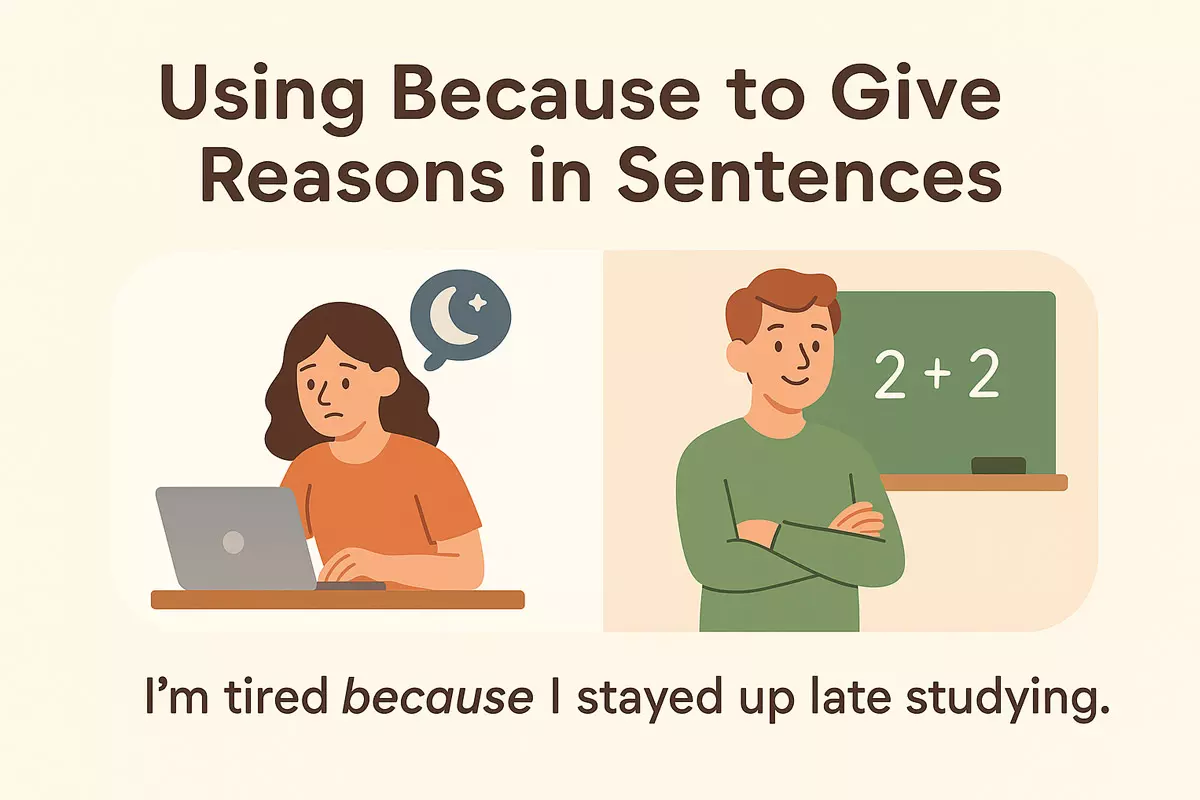 This article explains when to use because, its position in sentences, punctuation rules, and common mistakes such as confusing because with because of. It also provides real examples and practice sentences to help you use because correctly.
Have you ever wanted to explain why something happens in a way that others can easily understand? Providing clear explanations not only supports your statements but also helps people follow your reasoning. By connecting your ideas with logical reasons, you make your writing more persuasive and coherent. This article will guide you on how to effectively present explanations within your sentences, ensuring that your points are both clear and convincing to your audience.
When to Use Because
"Because" is a conjunction that helps explain reasons, causes, or motivations behind actions, feelings, or situations. It connects the result with its explanation, making sentences clearer and more informative. Typically, it's used to answer questions like "Why?" or to clarify statements by providing background information.
Situations for Using "Because"
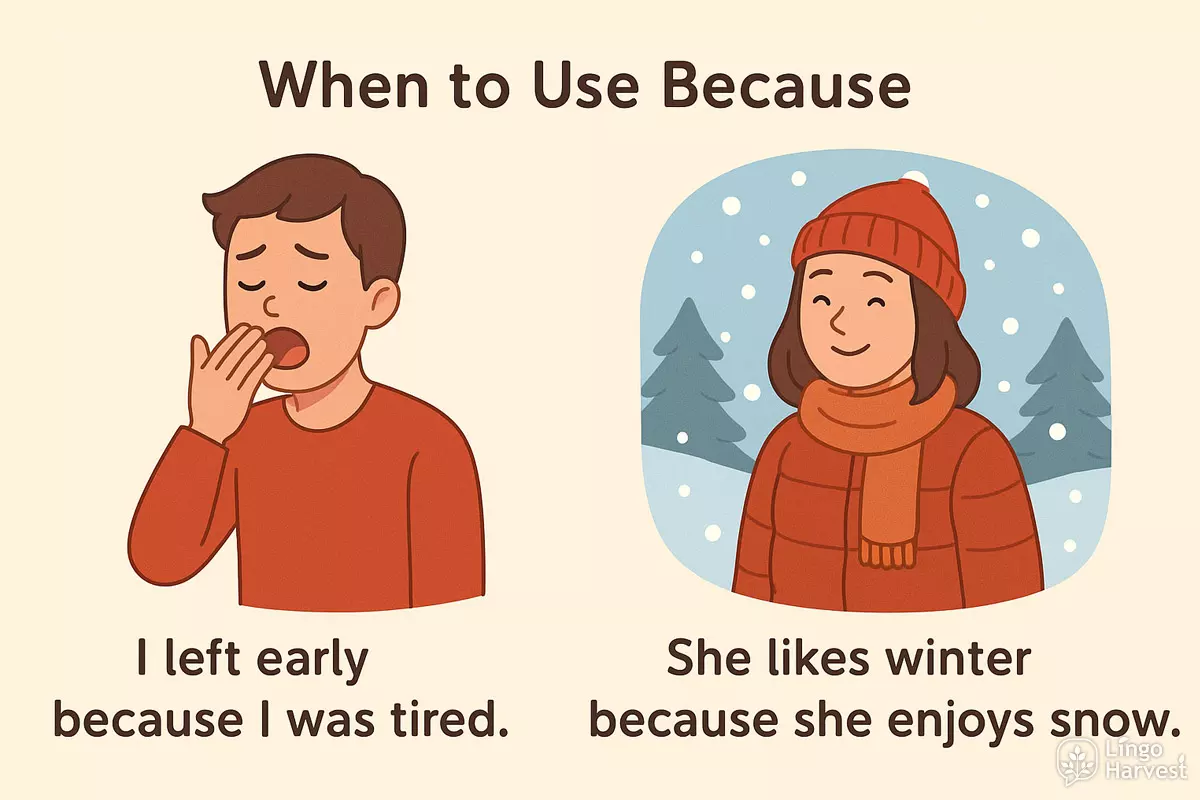
- Explaining your actions: I left early because I was tired.
- Giving reasons for opinions: She likes winter because she enjoys snow.
- Clarifying rules or instructions: Don't run because the floor is wet.
- Justifying decisions: We chose this route because it’s faster.
- Describing causes of emotions: He’s upset because he lost his keys.
- Stating scientific or factual reasons: Plants need sunlight because it helps them grow.
- Answering "why" questions: Why are you late? Because my bus was delayed.
- Connecting two clauses logically: The meeting was canceled because everyone was sick.
- Explaining consequences: The alarm rang because someone opened the door.
- Giving background information: The store is closed because today is a holiday.
Common Patterns with "Because"
To use "because" effectively, place it before the reason or cause. The structure usually follows one of these patterns:
- Main clause + because + reason: I am happy because I passed the test.
- Because + reason, + main clause: Because it was raining, we stayed inside.
Comparison: "Because" vs. Other Reason Words
| Word | Typical Use | Example |
|---|---|---|
| because | Gives a direct reason or cause | He stayed home because he was sick. |
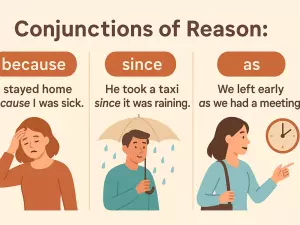
| since | Sometimes used for reasons, often in formal writing | Since it was late, we left the party. |
| as | Gives background reason, often at the start of a sentence | As it was raining, the event was canceled. |
| due to | Often follows a noun and is used in formal contexts | The game was postponed due to bad weather. |
Summary
Use "because" to link actions and their causes, make explanations clearer, and provide reasons in both spoken and written communication. It’s a versatile word that fits many everyday situations, from casual conversations to formal explanations.
Position in a Sentence
The word “because” most often introduces a reason or explanation, and its placement can affect both the structure and clarity of your sentence. Typically, you’ll find it connecting two clauses: one stating a result or action, and the other providing the cause or motive. Understanding where to insert “because” helps you form sentences that sound natural and clearly express why something happens.
Beginning or Middle?
“Because” can appear after the main clause or at the start of a sentence. When it comes in the middle, the main clause comes first, followed by the reason. If you lead with “because,” the cause is introduced first, and the result follows. Here are some common patterns:
- I stayed home because it was raining.
- Because it was raining, I stayed home.
Notice that when “because” starts the sentence, a comma is usually needed to separate the two clauses.
Examples of Clausal Order
Writers and speakers often choose the order based on emphasis. Placing the reason first can focus attention on the explanation, while putting it second highlights the result. Here are a variety of sentence patterns:
- She smiled because she was happy.
- Because she was happy, she smiled.
- We left early because we were tired.
- Because we were tired, we left early.
- He apologized because he made a mistake.
- Because he made a mistake, he apologized.
- The meeting was canceled because of the storm.
- Because of the storm, the meeting was canceled.
- They laughed because the joke was funny.
- Because the joke was funny, they laughed.
- She called because she needed help.
- Because she needed help, she called.
- He left early because he wasn’t feeling well.
- Because he wasn’t feeling well, he left early.
Direct and Indirect Reasons
“Because” can connect both clauses (with a verb) and phrases (with a noun or gerund). Compare:
- He succeeded because he worked hard. ✅
- He succeeded because of hard work. ✅
- He succeeded because hard work. ❌
Comparison of Structures
Below is a comparison of the two most common structures for using “because” to provide reasons:
| Main Clause First | Reason First |
|---|---|
| I left early because I was tired. | Because I was tired, I left early. |
| She didn’t come because she was sick. | Because she was sick, she didn’t come. |
| They shouted because they were excited. | Because they were excited, they shouted. |
| We stayed inside because it was cold. | Because it was cold, we stayed inside. |
Key Points to Remember
- “Because” can link two clauses or introduce a phrase explaining the reason.
- When starting a sentence with “because,” use a comma after the reason clause.
- Choose clause order to emphasize either the action/result or the reason/cause.
- Don’t use “because” alone with a noun; use “because of” for that structure.
By selecting the right position for “because,” you can highlight different aspects of your message and make your reasons clear to the reader or listener.
Punctuation Rules
When you use "because" to explain reasons in English sentences, the placement of commas can change depending on how the sentence is structured. Understanding these details helps your writing stay clear and natural.
Commas with "Because" in Sentences
Most of the time, you do not need a comma before "because" when it comes after the main clause. This is because the reason is closely connected to the main idea. For example:
- She went home because she felt sick. ✅
- I stayed up late because I was working on a project. ✅
Adding a comma before "because" in these sentences is unnecessary and can even confuse readers.
When a Comma Is Needed
A comma can be used before "because" if it helps to avoid ambiguity or if the reason is an afterthought, especially in longer sentences. However, this is rare:
- He didn't eat the cake, because he was allergic. (Emphasizes the reason as an aside)
In most cases, omitting the comma is correct.
Common Patterns and Examples
Here are some sentence structures that show how to use "because" effectively:
- We canceled the picnic because it started to rain.
- She smiled because she passed the exam.
- They left early because the movie was boring.
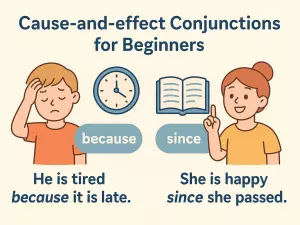
- He is tired because he didn't sleep well.
- The team lost because they didn't practice enough.
- I brought an umbrella because the forecast said it would rain.
- She was late because her alarm didn't go off.
- We celebrated because it was his birthday.
- The match was postponed because of bad weather.
- He feels better because he took his medicine.
- We missed the bus because we left the house late.
- She apologized because she made a mistake.
Comparing "Because" with Other Conjunctions
It can be useful to compare how punctuation works with "because" versus other words like "so" or "since." Notice how the punctuation changes:
| Conjunction | Example (with punctuation) |
|---|---|
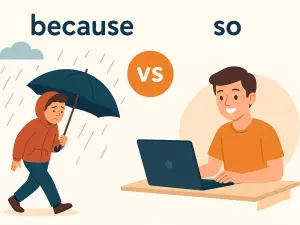
| because | I left early because I was tired. |
| so | I was tired, so I left early. |
| since | Since I was tired, I left early. |
| as | As I was tired, I left early. |
Quick Tips
- Omit the comma before "because" in most cases.
- Use a comma only if it clarifies the meaning or separates contrasting ideas.
- If you reverse the order ("Because I was tired, I left early."), add a comma after the clause.
- Check for ambiguity; punctuation should make your meaning obvious.
By following these guidelines, your sentences with "because" will be clear, accurate, and easy to read.
Common Mistakes (Because of vs Because)
Many learners get confused when choosing between "because" and "because of," but there’s a clear rule: "because" introduces a clause (subject + verb), while "because of" is followed by a noun or noun phrase. Mixing these up can lead to awkward or incorrect sentences.
When to Use Each Form
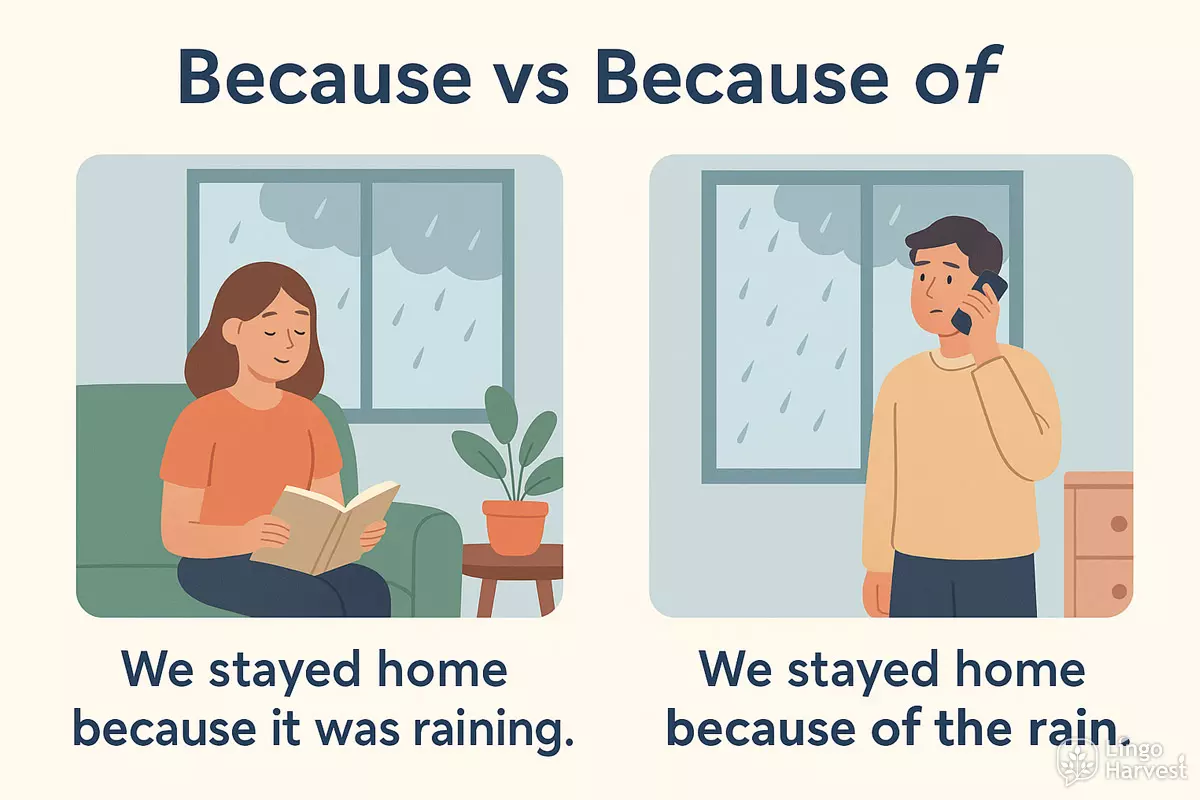
Use "because" to explain reasons with a full sentence:
- We stayed home because it was raining.
- She was late because she missed the bus.
Use "because of" before a noun or noun phrase:
- We stayed home because of the rain.
- She was late because of the traffic.
Typical Errors to Watch For
- ❌ We stayed home because of it was raining.
- ❌ She was late because missing the bus.
- ✅ We stayed home because it was raining.
- ✅ She was late because of missing the bus.
Quick Comparison
| Correct Usage | Incorrect Usage |
|---|---|
| He left early because he felt sick. | He left early because of he felt sick. |
| They canceled the picnic because of the storm. | They canceled the picnic because the storm. |
| We lost the game because our team was tired. | We lost the game because of our team was tired. |
| Flights were delayed because of fog. | Flights were delayed because fog. |
Extra Tips
- Remember: "because" = reason + clause; "because of" = reason + noun.
- If you see a verb after "because of," it’s likely wrong.
- Don’t mix the forms; stick to the pattern.
- Practice with both to build confidence.
Examples in Real Contexts
Understanding how to use "because" to explain reasons is much easier when you see it in authentic situations. Here, you'll find a variety of sample sentences and contexts that show how "because" connects ideas, clarifies motives, and adds detail to communication. These examples are drawn from daily life, academic settings, and professional environments, highlighting the versatility of this word.
Common Sentence Patterns
- She brought an umbrella because it looked like rain.
- I stayed late at the office because I had a deadline.
- They canceled the picnic because the weather was bad.
- He apologized because he realized his mistake.
- We chose this restaurant because the reviews were excellent.
- The children are excited because school is out for summer.
- She didn’t go to the party because she was feeling ill.
- I’m learning Spanish because I want to travel to Mexico.
- They left early because the meeting was over.
- He’s wearing a sweater because it’s cold outside.
- We can’t visit now because we’re too busy.
- She smiled because she was happy with the results.
- I brought snacks because I knew we’d get hungry.
- The class was canceled because the teacher was sick.
- He bought a new phone because his old one broke.
- They moved because they needed more space.
- We’re celebrating because it’s your birthday.
- She’s tired because she didn’t sleep well.
- I called you because I needed help.
- He’s quiet because he’s thinking.
Comparing “Because” with Other Reason Words
It’s useful to compare “because” with similar connectors, such as “since” and “as.” While all three can introduce reasons, their usage and tone can differ. Here’s a quick comparison:
| Connector | Example | Typical Use |
|---|---|---|
| because | She left early because she felt sick. | Direct, most common in speech and writing |
| since | Since it was raining, we stayed inside. | Often used for less direct or more formal reasons |
| as | As I was busy, I couldn’t attend. | Often appears in formal or written contexts |
| for | He was silent, for he was thinking. | Literary or formal writing |
Real-Life Dialogue Snippets
- “Why are you late?”
→ “I missed the bus because I overslept.” - “Do you want tea or coffee?”
→ “Tea, because I can’t drink coffee at night.” - “Why did you choose this course?”
→ “Because I’m interested in computer science.” - “Are you joining us for lunch?”
→ “I can’t, because I have a meeting.”
By seeing how "because" fits into interactions and explanations, it becomes much clearer how to use it confidently in your own sentences.
Practice: Write Sentences with Because
Understanding how to use "because" helps you explain reasons clearly in English. Below you’ll find several activities to guide your practice with this connector. These exercises will help you build sentences that show cause and effect, clarify your ideas, and make your communication more precise.
Task 1: Complete the Sentences
Read each phrase and finish the sentence so that it gives a logical reason. Try to use your own ideas.
- I stayed home yesterday because...
- She brought an umbrella because...
- They are happy because...
- We missed the bus because...
- He is tired because...
Show answers
- I stayed home yesterday because I was feeling sick.
- She brought an umbrella because it looked like it was going to rain.
- They are happy because they won the game.
- We missed the bus because we left the house late.
- He is tired because he didn't sleep well last night.
Task 2: Make Your Own Sentences
Use the prompts below to write complete sentences showing a reason. Each prompt includes a subject and an action; add a reason using "because".
- The teacher smiled...
- My friend called me...
- The cat ran away...
- We canceled our picnic...
- I finished my homework early...
Show answers
- The teacher smiled because the students did well on the test.
- My friend called me because she wanted to share some good news.
- The cat ran away because it heard a loud noise.
- We canceled our picnic because it started to rain.
- I finished my homework early because I wanted to watch a movie.
Common Patterns with "Because"
Here is a list of sentence structures you might use when giving reasons. These examples show how "because" connects a result with its cause.
- I am late because the train was delayed.
- She is smiling because she received a gift.
- They left early because they had another appointment.
- We are celebrating because we won the competition.
- He is worried because he lost his keys.
- The dog is barking because it sees a stranger.
- I brought my laptop because I have to work.
- She wore a jacket because it was cold outside.
- They are laughing because the joke was funny.
- We are cooking at home because the restaurants are closed.
Task 3: Spot the Reason
Read these sentences and identify the reason in each. Write the reason phrase on your own.
- He went to bed early because he was very tired.
- They took a taxi because the bus didn't come.
- She called her mother because she needed advice.
- I didn’t eat dessert because I was full.
Show answers
- he was very tired
- the bus didn't come
- she needed advice
- I was full