Prepositions for Cause–Effect Linking: as a result of, due to

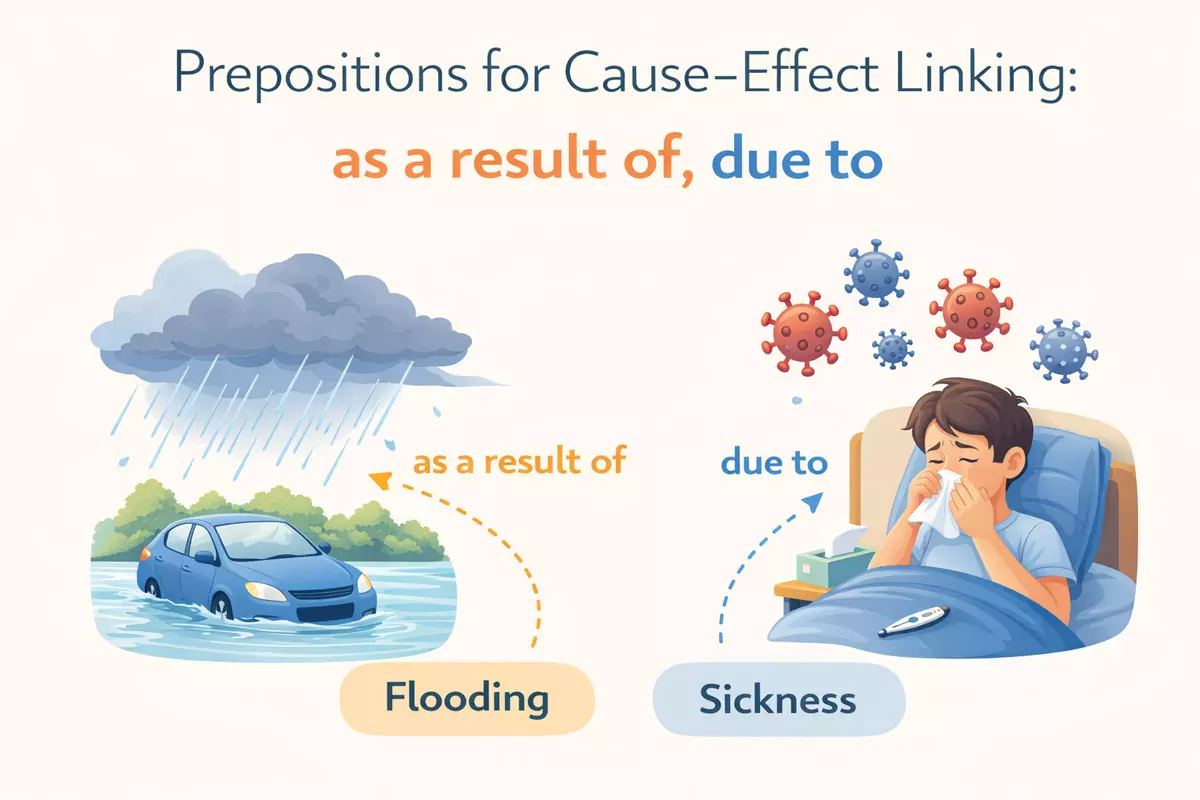 Here we how to distinguish between cause-focused and result-focused prepositions, the formal distinction between due to and because of, alternatives like owing to and thanks to, converting clauses to prepositional phrases, tracking multi-step causality,…
- The Logic of Causality: Differentiating between 'cause-focused' and 'result-focused' prepositions
- Grammar strictness: The 'due to' vs. 'because of' rule in formal prescriptive grammar
- Secondary markers: Using 'owing to', 'on account of', and 'thanks to' (positive vs negative bias)
- Structural transformation: Converting 'because' clauses into concise prepositional phrases
- Sequential effects: Tracking multi-step causality with 'subsequent to' and 'following'
- Scientific precision: Linking variables with 'as a function of' and 'stemming from'
- Register and impact: Choosing the right phrase for formal reports vs. news analysis
- Common pitfalls: Identifying redundant causal structures (e.g., 'the reason is due to')
- Practice: Real-world data analysis and rewriting causal links for maximum clarity
When expressing reasons and outcomes in English, selecting the appropriate connecting words is essential for clarity and precision. Using causal prepositions such as because of, due to, or owing to allows you to link actions with their consequences in a way that is both smooth and effective. Mastering these connectors not only improves the flow of your writing but also ensures that your ideas are logically organized, making it easier for readers to understand the relationships between events or statements.
The Logic of Causality: Differentiating between 'cause-focused' and 'result-focused' prepositions
Understanding how prepositions convey causality helps clarify both meaning and emphasis in sentences. In English, some prepositions highlight the reason behind an event (the cause), while others draw attention to the outcome (the effect). Recognizing which is which can improve clarity and precision, especially in formal or academic writing.
Cause-Focused Prepositions
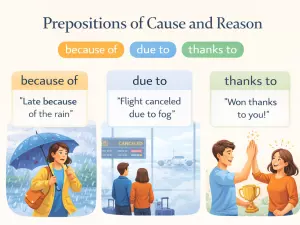
Prepositions such as due to, because of, and owing to put the spotlight on the origin or reason for something happening. They answer the question "Why did this occur?" and are typically followed by a noun phrase representing the cause.
- due to – The match was postponed due to heavy rain.
- because of – She was late because of traffic.
- owing to – The event was canceled owing to unforeseen circumstances.
- thanks to – We finished early thanks to your help.
- on account of – The flight was delayed on account of fog.
Result-Focused Prepositions
Other prepositions, including as a result of, consequent to, and following, shift the focus toward the outcome or consequence. These structures answer "What happened because of this?" and usually precede the result.
- as a result of – The streets flooded as a result of the storm.
- consequent to – New regulations were introduced consequent to recent discoveries.
- following – There were changes following the meeting.
- in consequence of – The policy changed in consequence of public protest.
- resulting from – Damage resulting from negligence will not be covered.
Comparison of Focus: Cause vs. Result
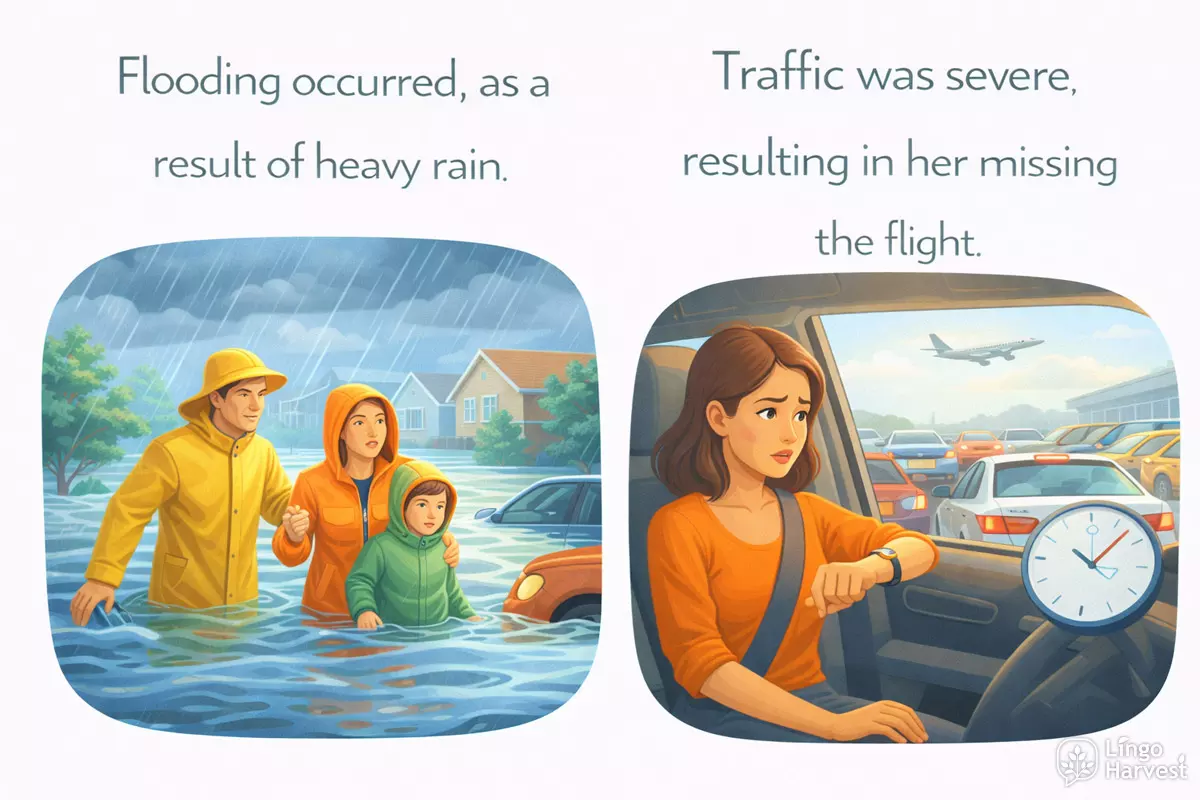
To see the distinction clearly, compare how these prepositions reframe the same situation:
| Cause-Focused Example | Result-Focused Example |
|---|---|
| The road was closed due to flooding. | Flooding occurred, as a result of heavy rain. |
| She missed the flight because of traffic. | Traffic was severe, resulting in her missing the flight. |
| The picnic was canceled owing to bad weather. | Bad weather led to the picnic being canceled as a result. |
| The team succeeded thanks to hard work. | Hard work paid off, resulting in the team's success. |
Choosing the Right Emphasis
Selecting between these types depends on what you want to highlight: the reason something happened, or the outcome itself. In academic and scientific writing, this distinction can subtly shift the reader’s attention and influence interpretation. For clear, logical writing, match your preposition to the intended focus—cause or effect.
Grammar strictness: The 'due to' vs. 'because of' rule in formal prescriptive grammar
Traditional grammar guides draw a sharp line between when to use "due to" and "because of," especially in formal writing. While casual speech often blurs this distinction, academic and professional contexts may expect precise usage, and some editors still enforce these rules.
Prescriptive Rule: What’s the Difference?
"Due to" is traditionally treated as an adjective phrase, meaning it should modify nouns. In contrast, "because of" acts as an adverbial phrase, modifying verbs. This distinction is rooted in older grammar traditions and is sometimes enforced in edited prose.
- Due to should follow a form of the verb "to be" and directly describe a noun. Example: The cancellation was due to rain.
- Because of should modify verbs, explaining why an action happened. Example: The game was canceled because of rain.
Formal Examples: Correct and Incorrect Usage
Writers aiming for strict correctness can follow these patterns:
- ✅ The train's delay was due to signal problems.
- ✅ The train was delayed because of signal problems.
- ❌ The train was delayed due to signal problems. (considered incorrect by strict traditionalists)
- ❌ The delay was because of signal problems. (awkward, but sometimes seen)
Comparison Table: Usage in Formal Grammar
| Expression | Traditional Function | Example Sentence |
|---|---|---|
| Due to | Adjective phrase (modifies noun) | The closure was due to maintenance. |
| Because of | Adverbial phrase (modifies verb) | The venue closed because of maintenance. |
| Due to (misused) | Used adverbially (discouraged in formal writing) | The venue closed due to maintenance. |
| Because of (awkward usage) | Used adjectivally (rare and awkward) | The closure was because of maintenance. |
Summary: Should You Follow This Rule?
In modern English, especially in speech and informal writing, most speakers use both phrases interchangeably. However, if you’re writing for a formal audience or submitting to a publication with traditional standards, it’s wise to follow the prescriptive rule. Editors may mark "due to" as incorrect if it does not directly follow a form of "to be" and modify a noun. For clarity and to avoid criticism, reserve "due to" for noun modification and "because of" for verb modification when in doubt.
Secondary markers: Using 'owing to', 'on account of', and 'thanks to' (positive vs negative bias)
When expressing cause and effect in English, alternatives like owing to, on account of, and thanks to offer subtle shades of meaning. These secondary connectors are not interchangeable with due to or as a result of in every context, as they can introduce either positive or negative connotations.
Understanding nuance and tone
Owing to and on account of are generally neutral or slightly formal, often used in writing and speech to explain reasons. Thanks to, by contrast, usually adds a positive slant, suggesting a beneficial cause, though it can sometimes be used ironically.
- Owing to – Used for neutral or factual reasons; common in formal contexts.
- On account of – Slightly informal; can be used for both positive and negative causes but often seen in spoken English.
- Thanks to – Implies a positive or fortunate outcome; occasionally used sarcastically for negative results.
Examples of usage and bias
The choice of preposition impacts the perceived mood of the sentence. Compare the following:
- Owing to the heavy traffic, we arrived late. (neutral/factual)
- She was promoted on account of her hard work. (positive/neutral)
- Thanks to the new software, our work is much easier. (positive)
- Thanks to his mistake, we lost the game. (ironic/negative)
Comparing secondary cause–effect markers
| Expression | Typical Bias / Context | Example |
|---|---|---|
| Owing to | Neutral, formal | Owing to the rain, the match was cancelled. |
| On account of | Neutral or slight emphasis; informal | School was closed on account of snow. |
| Thanks to | Positive, sometimes ironic | Thanks to your help, we finished early. |
| Thanks to (ironic) | Negative (sarcastic) | Thanks to the delay, we missed the flight. |
Quick reference: choosing the right marker
- Use owing to for formal, neutral explanations—especially in writing.
- Choose on account of for conversational or informal statements about cause.
- Pick thanks to when you want to highlight a positive effect or, less commonly, to be ironic about a negative result.
Being aware of the subtle differences helps you communicate your intended meaning more precisely, whether you're writing a report, giving a presentation, or chatting informally.
Structural transformation: Converting 'because' clauses into concise prepositional phrases
Switching from full clauses beginning with “because” to streamlined prepositional phrases is a common way to make sentences more formal and concise. This transformation is especially useful in academic, business, and technical writing. Instead of stating the cause in a full clause, you can reduce it to a phrase starting with expressions like as a result of, due to, because of, or owing to.
How the transformation works
Start by identifying the “because” clause, then rephrase it using an appropriate prepositional phrase. This often involves moving the new phrase to the beginning or middle of the sentence, depending on the desired emphasis and flow.
- Because it rained heavily, the match was canceled. → Due to heavy rain, the match was canceled.
- The flight was delayed because the weather was bad. → The flight was delayed because of bad weather.
- She succeeded because she worked hard. → She succeeded as a result of her hard work.
- We left early because the traffic was terrible. → We left early due to terrible traffic.
- The event was postponed because there were not enough participants. → The event was postponed owing to insufficient participation.
- They lost money because they made poor investments. → They lost money as a result of poor investments.
- Production stopped because a key part was missing. → Production stopped because of a missing key part.
- He was late because the train broke down. → He was late due to a train breakdown.
- The company grew because it innovated constantly. → The company grew as a result of constant innovation.
- Prices increased because demand rose. → Prices increased because of rising demand.
- The meeting ended early because everyone agreed. → The meeting ended early due to unanimous agreement.
- He failed the test because he didn't study. → He failed the test owing to lack of preparation.
- Roads flooded because it rained non-stop. → Roads flooded as a result of continuous rain.
Patterns and considerations
Choosing the right prepositional phrase depends on the context and formality. Due to and owing to are more formal, while because of fits most situations. As a result of often emphasizes the consequence. These phrases typically precede a noun or noun phrase, not a full clause.
| Original with 'because' | Revised with prepositional phrase |
|---|---|
| Because he was ill, he stayed home. | Due to illness, he stayed home. |
| The road was closed because there was an accident. | The road was closed because of an accident. |
| Because the project was late, costs increased. | As a result of the project's delay, costs increased. |
| She missed the bus because she overslept. | Owing to oversleeping, she missed the bus. |
| Because the software crashed, data was lost. | As a result of the software crash, data was lost. |
Summary tips
- Use prepositional phrases for brevity and formality.
- Match the phrase to the noun, not a full clause.
- Vary your phrasing to avoid repetition and monotony.
- Check that your sentence remains clear and natural after the transformation.
Sequential effects: Tracking multi-step causality with 'subsequent to' and 'following'
When discussing events that unfold in a clear order, English has precise ways to express that one thing happened after another and was influenced by the preceding event. Phrases like subsequent to and following help clarify not just the timeline, but also the chain of cause and effect, especially in complex or multi-step scenarios.
Understanding 'subsequent to' and 'following'
Both expressions indicate that one event happened after another, but they often carry subtle differences in tone and usage:
- Subsequent to is more formal and often used in academic, legal, or technical contexts to highlight a direct sequence or result.
- Following is versatile and appears in both formal and informal writing, indicating sequence and sometimes suggesting causality.
Multi-step causality in action
Complex situations often require tracking several related events. Instead of repeating "because of" or "as a result of," these prepositional phrases neatly show how each step leads to the next. Consider these patterns:
- Subsequent to the data breach, security protocols were updated.
- Following the announcement, the stock price dropped sharply.
- Subsequent to his promotion, team morale improved.
- Following the completion of repairs, the building reopened.
- Subsequent to the new law, compliance rates increased.
- Following her appointment, several policy changes occurred.
- Subsequent to the merger, restructuring began immediately.
- Following the survey, the company adjusted its strategy.
- Subsequent to the investigation, charges were filed.
- Following the training session, employee performance improved.
- Subsequent to the review, the report was revised.
- Following the public consultation, plans were amended.
- Subsequent to the incident, safety measures were introduced.
- Following the pilot program, full implementation was approved.
- Subsequent to the vote, a new committee was formed.
Comparing 'subsequent to' and 'following'
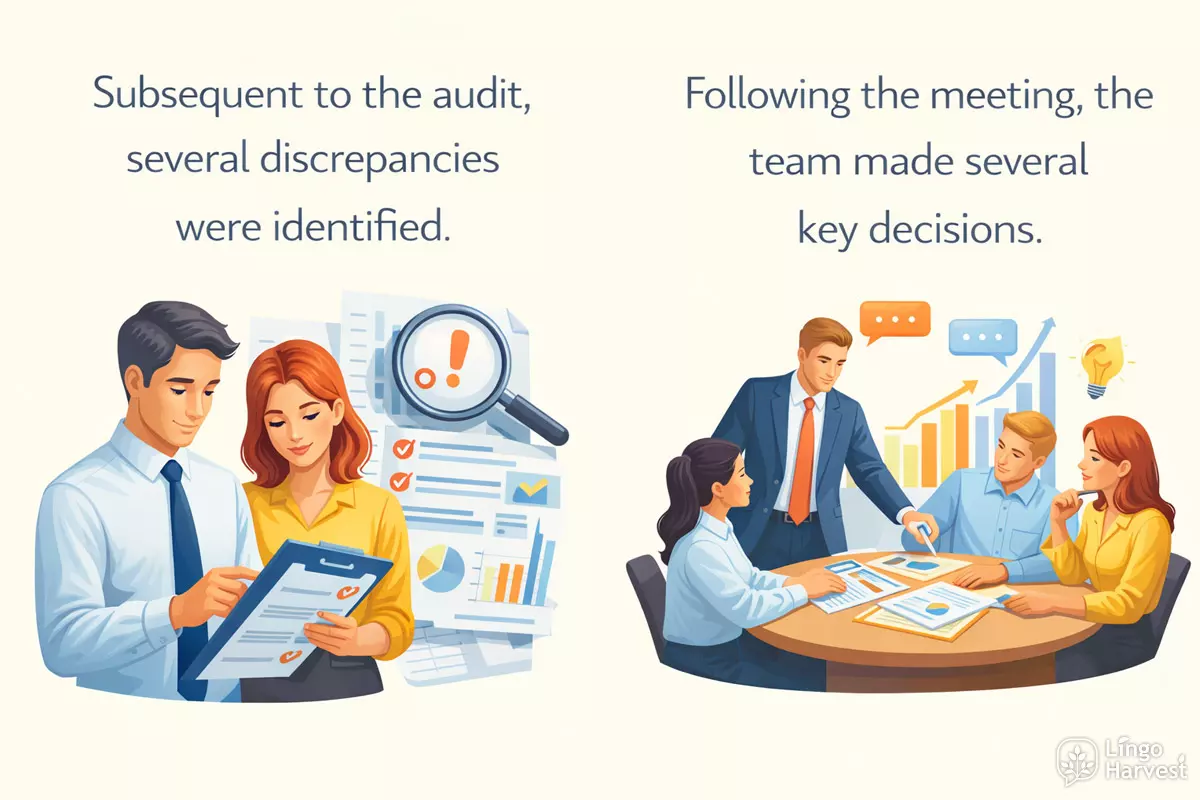
These two phrases can sometimes be used interchangeably, but the nuance and formality may differ depending on the context. Below is a summary of how they compare in typical usage:
| Expression | Common Context & Example |
|---|---|
| Subsequent to | Formal writing, technical reports Subsequent to the audit, several discrepancies were identified. |
| Following | General use, both formal and informal Following the meeting, the team made several key decisions. |
| Subsequent to | Legal or official documents Subsequent to the agreement, new terms were enacted. |
| Following | News, narratives, everyday contexts Following the announcement, customers responded enthusiastically. |
In summary, these phrases are practical tools for tracing the ripple effects of one event leading to another. They help writers avoid repetition and clarify the flow of actions or decisions in a sequence, especially in settings where precision and clarity are valued.
Scientific precision: Linking variables with 'as a function of' and 'stemming from'
Clarity in academic and technical writing often depends on how cause-and-effect relationships are expressed. When you need to show that one variable depends on or results from another in scientific contexts, expressions like as a function of and stemming from offer more precision than general-purpose phrases such as due to or as a result of. These terms help avoid ambiguity and make the logical connection between variables explicit.
Using as a function of in scientific statements
As a function of is especially common in mathematics, physics, and data analysis. It highlights that one quantity varies according to changes in another. This phrase is ideal when describing quantitative relationships or dependencies.
- The resistance increases as a function of temperature.
- Output voltage is measured as a function of input current.
- Growth rate changes as a function of nutrient availability.
- Speed was plotted as a function of time.
- Absorption varies as a function of wavelength.
- Concentration was determined as a function of depth.
- Efficiency decreases as a function of load.
- Signal strength changes as a function of distance.
- Pressure is recorded as a function of altitude.
- Score distribution was analyzed as a function of age.
Applying stemming from for causal explanation
Stemming from is more qualitative and is used to attribute an effect, phenomenon, or observation to a particular source or cause. It’s useful when the relationship is not strictly mathematical, but a clear link exists.
- The error stemming from inaccurate measurements was significant.
- Delays stemming from equipment failure affected results.
- Symptoms stemming from vitamin deficiency were observed.
- Confusion stemming from ambiguous instructions was common.
- Complications stemming from the initial procedure were rare.
- Financial losses stemming from market volatility increased.
- Noise stemming from external interference was filtered out.
- Errors stemming from data entry were corrected.
- Problems stemming from outdated protocols persisted.
- Findings stemming from preliminary studies informed the design.
Comparing precision: When to use which phrase?
Choosing between these linking phrases depends on the type of relationship and the field of study. For structured comparisons, see the table below:
| Phrase | Best Use Case |
|---|---|
| as a function of | Quantitative dependencies, variable plotting, mathematical relationships (e.g., physics, statistics) |
| stemming from | Describing origins of effects, qualitative causality, attributing sources in discussion or analysis |
| due to / as a result of | General explanations or less formal contexts; suitable when precise variable linkage is not needed |
| resulting from | Highlighting consequences, often interchangeable with "stemming from" in scientific narratives |
Understanding these distinctions helps writers avoid vagueness and improve the rigor of their scientific communication. By selecting the most fitting phrase, authors can convey relationships between variables with greater accuracy and clarity.
Register and impact: Choosing the right phrase for formal reports vs. news analysis
Selecting the most appropriate phrase to express cause and effect depends heavily on the context and the intended audience. In formal reports—such as academic papers, scientific research, or business documents—precision and objectivity are essential. In contrast, news analysis and journalistic writing often aim for clarity and reader engagement, sometimes favoring brevity or a less formal register.
Formal reports: Prioritizing precision and neutrality
Writers of official documents and research papers typically choose prepositional phrases that reflect formality and accuracy. Common choices include:
- As a result of → As a result of the policy change, costs decreased.
- Due to → The delay occurred due to technical issues.
- Owing to → Owing to limited resources, the project was postponed.
- Because of → Because of heavy traffic, he arrived late.
- Consequent to → Consequent to the audit, several procedures were revised.
- Following (when indicating sequence) → Following the meeting, a revised schedule was circulated.
- In the wake of → In the wake of the incident, new safety measures were introduced.
- Subsequent to → Subsequent to approval, the contract will be finalized.
- On account of → On account of poor visibility, the flight was delayed.
- By virtue of → By virtue of her experience, she was selected to lead the team.
These phrases help maintain a neutral tone and signal clear logical links between events or facts.
News analysis: Emphasizing readability and flow
Journalistic writing often balances accuracy with accessibility. While some formal options are still used, reporters may select more conversational or succinct alternatives:
- Because of → Because of budget constraints, the program was revised.
- After → After the review process, the proposal was approved.
- Since (when context allows) → Since recent data was incomplete, the analysis was delayed.
- Thanks to (sometimes for positive causes) → Thanks to improved coordination, productivity increased.
- Over (e.g., "over concerns about") → The project was paused over concerns about safety.
- From (e.g., "from rising costs") → Pressure increased from rising costs.
- Following → Following the announcement, several changes were implemented.
- As a result (standalone) → The system failed several tests. As a result, it was redesigned.
- Resulting from → Delays resulting from supply shortages affected delivery.
- Stemming from → The issue stems from a lack of clear guidelines.
Writers may also use shorter cause–effect structures to keep sentences concise and dynamic.
Comparing phrase choices by context
Below is a comparison of typical cause–effect phrases in formal reports and news analysis, with example usage to illustrate the difference in tone and register.
| Phrase | Example & Register |
|---|---|
| As a result of | Formal: "As a result of increased rainfall, the river overflowed." ✅ Preferred in reports. |
| Due to | Formal & News: "The event was canceled due to unforeseen circumstances." ✅ Neutral, widely accepted. |
| Because of | News: "Flights were delayed because of fog." ✅ More conversational. |
| Thanks to | News: "Thanks to quick action, injuries were avoided." ✅ Informal, positive connotation. |
| Owing to | Formal: "Owing to technical difficulties, the launch was postponed." ✅ Formal, less common in news. |
| Following | Both: "Following the announcement, shares fell." → Flexible usage. |
| In the wake of | Formal & News: "In the wake of the scandal, new policies were introduced." → Often for serious events. |
| Resulting from | Formal: "The changes resulting from the merger were significant." ✅ Technical, used in analysis. |
Summary: Matching phrase to audience
When deciding between options like as a result of or due to, consider the expectations of your readers and the conventions of your genre. Formal documents prioritize accuracy and distance, while news writing values clarity and engagement. Adapting your cause–effect language to fit the context not only improves readability but also enhances credibility in your chosen field.
Common pitfalls: Identifying redundant causal structures (e.g., 'the reason is due to')
When linking causes and effects in English, writers often slip into wordy or repetitive constructions. One frequent issue is redundancy—using more words than necessary to express a simple relationship. For instance, phrases like "the reason is due to" combine two causal structures, making the sentence unnecessarily long and sometimes awkward.
Recognizing Redundant Phrases
Many common expressions are actually combinations of two cause–effect markers, which leads to over-explaining the causal link. Instead of clarifying meaning, these structures can confuse readers or sound unnatural. It’s more effective to use a single, clear connector.
- the reason is because → the reason is that → The reason is that funding was reduced.
- the reason is due to → the reason is that / this is due to → The delay is due to technical issues.
- the cause is because of → the cause is / this is because of → The cause is poor planning.
- the reason why is because → the reason why is that / the reason is that → The reason is that demand increased.
- owing to the fact that → owing to / because → Owing to budget cuts, the program was canceled.
- as a consequence of the fact that → as a consequence of / because → As a consequence of delays, costs increased.
- resulting as a result of → resulting from / as a result of → Delays resulting from supply issues affected delivery.
- for the reason that → because / since → The meeting was postponed because key staff were absent.
- on account of the fact that → on account of / because → On account of safety concerns, the event was canceled.
- the effect is due to → the effect is caused by → The effect is caused by insufficient regulation.
- is caused as a result of → is caused by → The failure is caused by human error.
- since because → since / because → Since resources are limited, priorities must be set.
- because of the reason that → because / because of → The project failed because of poor coordination.
- as a result of the fact that → as a result of / because → As a result of new regulations, procedures changed.
- due to the reason that → due to / because → The delay was due to weather conditions.
- as a result because → as a result / because → The system failed. As a result, it was redesigned.
- by reason of the fact that → by reason of / because → By reason of staff shortages, services were reduced.
- the reason for this is because → the reason for this is that → The reason for this is that funding was withdrawn.
Why Avoid These Structures?
Redundant forms can:
- Make sentences harder to read ❌
- Sound less professional or academic ❌
- Obscure the true cause–effect relationship ❌
- Lead to grammatical errors or awkward phrasing ❌
Clearer Alternatives
Instead of combining multiple cause–effect connectors, choose one that fits your sentence. Here are some improved forms:
- because of → The match was canceled because of heavy rain.
- due to → The delay was due to a technical problem.
- as a result of → As a result of the new policy, costs decreased.
- since → Since the data was incomplete, the analysis was postponed.
- because → The project failed because communication broke down.
- owing to → Owing to limited funding, the program was scaled back.
Quick Reference: Redundant vs. Correct Forms
| Redundant Structure | Concise Alternative |
|---|---|
| The reason is due to bad weather. | This happened due to bad weather. |
| The reason why he left is because he was tired. | He left because he was tired. |
| Owing to the fact that she was late, the meeting started late. | Because she was late, the meeting started late. |
| As a result of the fact that sales dropped, profits fell. | As a result of sales dropping, profits fell. |
| Because of the reason that he was sick, he stayed home. | Because he was sick, he stayed home. |
| Due to the reason that it rained, the game was canceled. | Due to rain, the game was canceled. |
| The effect is due to poor planning. | This happened due to poor planning. |
| As a result because he was late, we missed the bus. | Because he was late, we missed the bus. |
Tips for Avoiding Redundancy
- Use only one causal connector per sentence.
- Edit for clarity: if a phrase feels long or repetitive, try simplifying it.
- When in doubt, read your sentence aloud—does it sound natural?
- Replace phrases like "the reason is due to" with a single preposition or conjunction.
Careful attention to these details makes your writing clearer, more professional, and easier to understand.
Practice: Real-world data analysis and rewriting causal links for maximum clarity
Understanding how to use "as a result of" and "due to" in context is essential for making cause–effect relationships explicit and easy to follow. Below, you'll work with real-world sentences and learn how to clarify causal links in writing. This practice will help you distinguish between subtle differences in meaning, and improve the precision and readability of your explanations.
Spotting and Revising Ambiguous Cause–Effect Links
Read each sentence and consider how the causal connection could be made clearer. Rewrite the sentence, choosing between "as a result of" and "due to" for maximum clarity. Try to focus on making the cause and effect relationship explicit, while also keeping the sentence concise.
- The meeting was canceled. Heavy snow.
- Sales increased. The new advertising campaign.
- She felt tired. Staying up late the night before.
- The system crashed. Too many users logged in simultaneously.
- He missed the flight. Traffic congestion on the highway.
- The project was delayed. A shortage of qualified staff.
- Prices rose sharply. Increased production costs.
- The event was postponed. Unexpected safety concerns.
- The experiment failed. Errors in the initial setup.
- Attendance dropped. Poor weather conditions.
Show answers
- The meeting was canceled due to heavy snow.
- Sales increased as a result of the new advertising campaign.
- She felt tired due to staying up late the night before.
- The system crashed as a result of too many users logging in simultaneously.
- He missed the flight due to traffic congestion on the highway.
- The project was delayed due to a shortage of qualified staff.
- Prices rose sharply as a result of increased production costs.
- The event was postponed due to unexpected safety concerns.
- The experiment failed as a result of errors in the initial setup.
- Attendance dropped due to poor weather conditions.
Comparing Real-World Usage: "as a result of" vs. "due to"
Writers often choose between these two expressions based on the structure and emphasis of their sentences. The table below presents authentic examples and highlights the differences in form and context:
| Expression | Example in Context |
|---|---|
| as a result of | The city experienced flooding as a result of prolonged rainfall. |
| due to | The train was delayed due to technical problems. |
| as a result of | Profits fell sharply as a result of reduced consumer demand. |
| due to | The match was postponed due to heavy winds. |
| as a result of | Pollution levels rose as a result of increased factory output. |
| due to | Flights were canceled due to severe weather conditions. |
Practice: Rewriting for Clarity
Below is a list of sentences with vague or awkward cause–effect links. Rewrite each sentence to clarify the causal connection using either "as a result of" or "due to."
- Many people worked from home. The pandemic.
- The river overflowed. Heavy rain last week.
- He got a promotion. His excellent performance.
- There was a power outage. Maintenance work.
- The store closed early. A staff shortage.
- She won the award. Her innovative project.
- The website was inaccessible. Server upgrades.
- Attendance dropped. The new schedule.
- They canceled the picnic. Thunderstorms.
- Prices fell. Competition among suppliers.
Show answers
- Many people worked from home due to the pandemic.
- The river overflowed as a result of heavy rain last week.
- He got a promotion as a result of his excellent performance.
- There was a power outage due to maintenance work.
- The store closed early due to a staff shortage.
- She won the award as a result of her innovative project.
- The website was inaccessible due to server upgrades.
- Attendance dropped as a result of the new schedule.
- They canceled the picnic due to thunderstorms.
- Prices fell as a result of competition among suppliers.
Summary Tips for Maximum Clarity
- Use due to for direct, noun-based causes, especially after a form of "be."
- Use as a result of when emphasizing the outcome of an action or event.
- Keep sentences concise by placing the cause immediately after the effect.
- Avoid vague linking words; choose prepositions that specify the relationship.
- Check that your revised sentence flows naturally and leaves no ambiguity.