either...or / neither...nor: Simple Patterns with Examples

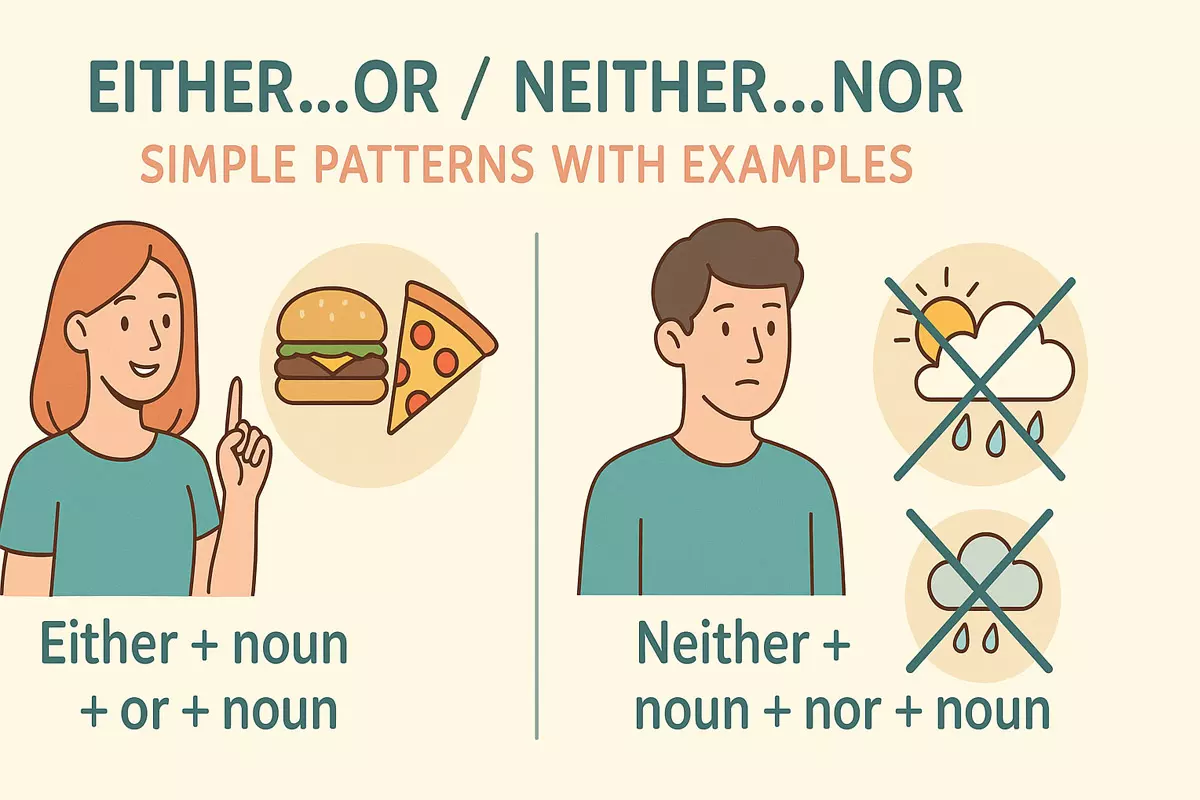 This article explains how to use either...or and neither...nor for choice or absence, covers sentence structures, verb agreement, formal and informal tones, offers real dialogues, highlights common mistakes, and includes practice exercises.
Making decisions or expressing a lack of options in English often involves using certain paired structures, which can sometimes challenge learners. This article explains these patterns in a straightforward way, offering practical examples so you can understand and apply them with confidence. By recognizing these structures and practicing with real-life examples, you will become more comfortable making choices or indicating when no choice exists, ultimately improving your fluency and communication skills.
Meaning: Choice vs No Choice
The phrases either...or and neither...nor help express two different kinds of situations in English. One structure is about making a selection between options, while the other describes the absence of all options. Understanding this difference is key to using them correctly in conversation and writing.
When to Use "Either...Or"
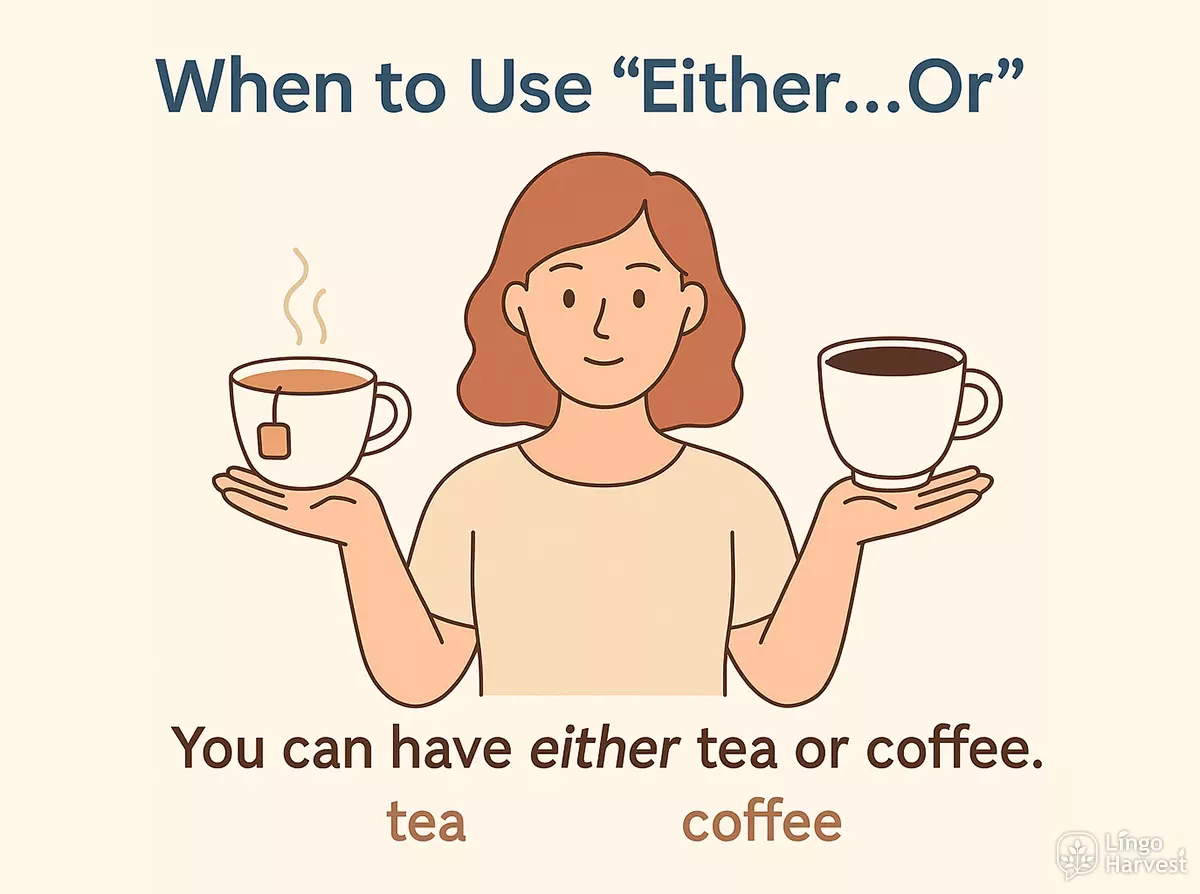
Use either...or when you want to indicate that there is a possibility of choosing between two alternatives. This pattern clearly shows that at least one of the options is available, but not both at the same time. It’s about presenting alternatives and allowing for a decision.
- You can have either tea or coffee.
- We will meet either today or tomorrow.
- Either John or Mary will help you.
- I want either the red shirt or the blue one.
- You may either call me or send a message.
- The answer is either yes or no.
- Choose either option A or option B.
- We can either walk or take the bus.
- Either my brother or my sister will pick you up.
- You must either accept or decline the invitation.
When to Use "Neither...Nor"
The pattern neither...nor is used when you want to say that none of the given options are true, available, or possible. It denies both alternatives, making it clear that there is no selection to be made—both are excluded.
- I want neither tea nor coffee.
- Neither John nor Mary came to the meeting.
- She speaks neither Spanish nor French.
- They will neither call nor write.
- The answer is neither yes nor no.
- We have neither the time nor the resources.
- Neither of the options is suitable.
- The restaurant serves neither pizza nor pasta.
- He is neither happy nor sad.
- Neither my brother nor my sister knows the answer.
Quick Comparison Table
| Pattern | What it Expresses |
|---|---|
| Either...or | Choice between two options (one or the other, not both) |
| Neither...nor | Denial of both options (not one, not the other) |
In summary, either...or is about options and decisions, while neither...nor is about rejecting all given possibilities. Being able to distinguish between these two forms helps you be clearer and more precise in your communication.
Sentence Structures and Word Order
Understanding how to use “either...or” and “neither...nor” in English sentences is all about knowing where to place each part. These paired conjunctions help us connect two ideas, choices, or alternatives. The specific arrangement depends on what is being linked—subjects, verbs, objects, or full clauses. Let’s look at the most common patterns and how word order changes in different situations.
Basic Patterns for “either...or” and “neither...nor”
When these pairs join two subjects, verbs, or objects, the structure remains parallel. This means that what comes after “either” and “or” (or after “neither” and “nor”) should be the same kind of word or phrase for clarity and correctness.
- Connecting subjects: Either my brother or my sister will pick you up.
- Connecting verbs: She will either call or text you.
- Connecting objects: You can have either tea or coffee.
- Negative parallel: Neither the manager nor the assistant was available.
- Negative verbs: He neither called nor emailed.
- Negative objects: I want neither fame nor fortune.
Word Order with Verb Agreement
When “either...or” or “neither...nor” join two subjects, the verb usually agrees with the subject closest to it (the one after “or” or “nor”). This is important for grammatical accuracy.
| Example | Explanation |
|---|---|
| Either the teachers or the student is present. | Verb “is” matches singular “student.” |
| Neither the cat nor the dogs are hungry. | Verb “are” matches plural “dogs.” |
| Either my friends or my father knows the answer. | Verb “knows” matches singular “father.” |
| Neither the players nor the coach was late. | Verb “was” matches singular “coach.” |
Additional Usage Tips
- When combining full clauses, use a comma before “or” or “nor”: “Either we can go now, or we can wait.”
- “Neither...nor” makes the whole sentence negative; don’t add extra negatives (avoid: “I don’t want neither…”).
- Keep elements balanced: don’t mix verbs and nouns within the same pair.
- For emphasis, “Either” and “neither” can begin a sentence: “Either you apologize, or you leave.”
- With long phrases, repeat “either” or “neither” before both choices for clarity: “Either on Monday or on Tuesday, we will meet.”
By following these structures and word order rules, your sentences with “either...or” and “neither...nor” will be clear, correct, and easy to understand.
Verb Agreement Rules (singular/plural)
Understanding how to match verbs with subjects in sentences using either...or and neither...nor is essential for clear English. The verb form depends on the subject that is closest to the verb. This pattern is called the “proximity rule.” It helps avoid confusion when the two subjects differ in number (singular or plural).
How Proximity Affects Verb Choice
When you link two subjects with either...or or neither...nor, the verb agrees with the noun or pronoun that comes right before it. This means you should pay attention to which subject is nearest the verb, and use the correct singular or plural form.
- Either the cat or the dogs are outside. (dogs is plural and closest to the verb, so use are)
- Either the dogs or the cat is outside. (cat is singular and closest to the verb, so use is)
- Neither the teacher nor the students have finished. (students is plural and closest to the verb, so use have)
- Neither the students nor the teacher has finished. (teacher is singular and closest to the verb, so use has)
More Patterns and Examples
This rule applies to all combinations, not just people. Here are more situations to help you see the pattern:
- Either my friend or my parents are coming.
- Neither the manager nor the employees were late.
- Either the keys or the wallet is missing.
- Neither the books nor the pen was found.
- Either the apples or the banana is ripe.
- Neither the child nor the adults have left.
- Either the doctor or the nurses are on duty.
- Neither the shoes nor the shirt fits me.
- Either the players or the coach is responsible.
- Neither the lamp nor the chairs were broken.
Quick Reference: Proximity Rule in Action
| Subjects (Order) | Correct Verb Form |
|---|---|
| Either the teacher or the students | are |
| Neither my friends nor my brother | is |
| Either the books or the magazine | is |
| Neither the dog nor the cats | are |
| Either the children or the teacher | is |
Remember, the verb always matches the part of the subject that is nearest to it when using these paired conjunctions. This approach helps ensure sentences sound natural and follow standard English grammar.
Formal vs Everyday Tone Differences
The way we use either...or and neither...nor can change depending on whether we’re speaking or writing in a formal setting or just chatting casually. In formal English, these paired structures are often used to clarify choices or exclusions, while informal conversation may simplify or even drop one part of the pattern. Paying attention to these differences helps you sound natural in any context.
Common Variations in Formal and Informal Contexts
- Formal: Both parts are usually fully expressed. Example: Neither the manager nor the employees were present.
- Casual: Shorter forms or only one part may be spoken. Example: Neither John nor Mary came. might become John or Mary didn’t come.
- Formal: Sentences often avoid contractions. Example: Either you attend the meeting, or you submit a report.
- Casual: Contractions and simpler wording are common. Example: You can either come or send it in.
- Informal speech might use or alone instead of either...or.
- In everyday conversation, double negatives sometimes appear, even though they are not considered standard: I don’t want neither cake nor pie. (Nonstandard, but common in speech.)
- Formal writing sticks to strict parallel structure: Either she will call or she will email.
- In casual talk, the second verb is often dropped: She’ll either call or email.
- With neither...nor, formal contexts require verb agreement with the subject closest to the verb: Neither the teachers nor the principal is attending.
- Informally, agreement is sometimes ignored: Neither the teachers nor the principal are coming.
Comparison Table: Formal vs Informal Usage
| Formal Example | Informal Example |
|---|---|
| Neither the manager nor the staff was available. | The manager or staff weren’t around. |
| Either you must agree, or you must leave. | You can agree or leave. |
| Neither my brother nor my friends are interested. | My brother or my friends don’t care. |
| I will bring either tea or coffee to the meeting. | I’ll bring tea or coffee. |
| Neither the report nor the data was complete. | The report or data wasn’t finished. |
Tips for Switching Between Styles
- Use full either...or or neither...nor patterns for clarity in essays, reports, or presentations.
- In casual speech, it’s fine to drop “either” or “neither” if the meaning is clear.
- For exams or formal writing, avoid double negatives and keep to standard forms.
- Listen to native speakers to pick up common informal shortcuts.
Understanding these nuances helps you adapt your language for any audience, whether you’re writing a formal letter or having a friendly chat.
Short Dialogues for Real Speech
Learning how to use either...or and neither...nor in conversations helps you speak more naturally. Here are sample exchanges that show these patterns in action, reflecting common situations you might face with friends, colleagues, or family members.
Everyday Conversation Examples
- A: Do you want tea or coffee?
B: Either is fine. I like both! - A: Are you going to the party or staying home?
B: I’ll either go to the party or visit my cousin. - A: Did you talk to Mark or Lucy about the project?
B: I haven’t spoken to either Mark or Lucy yet. - A: Do you want pizza or burgers for dinner?
B: Neither pizza nor burgers sound good to me tonight. - A: Are you traveling by train or by bus?
B: I’ll take either the train or the bus, whichever is faster. - A: Did you see Sarah or Tom at the meeting?
B: Neither Sarah nor Tom was there. - A: Will you call or text me?
B: I’ll either call or text, depending on how busy I am. - A: Do you want to watch a movie or read a book?
B: Neither. I’m too tired for both. - A: Are you free on Friday or Saturday?
B: I’m available on either day. - A: Do you prefer apples or oranges?
B: I like neither apples nor oranges. - A: Is the answer A or B?
B: It’s neither A nor B. It’s C. - A: Will you drive or should I?
B: Either way works for me. - A: Did you find your keys or your wallet?
B: Neither. I’m still looking for both.
Quick Reference Table: Dialogue Patterns
| Pattern | Sample Line |
|---|---|
| either...or for choices | We can either eat out or cook at home. |
| neither...nor for negative options | Neither John nor Mary knows the answer. |
| either...or in questions | Is your appointment on Monday or Tuesday? |
| neither...nor as a reply | Neither option works for me. |
| either...or with actions | I’ll either call you or send a message. |
| neither...nor with preferences | I like neither tea nor coffee. |
These sample exchanges and patterns show how either...or and neither...nor are woven into everyday English. Practice using them in your own conversations to sound more fluent and comfortable.
Common Mistakes and How to Fix Them
Many English learners mix up “either…or” and “neither…nor” because both structures connect two options, but their meanings and forms are quite different. Misplacing these patterns can lead to confusion or even the opposite meaning of what you intend. Below are frequent pitfalls and strategies to avoid them.
Mixing Up Positive and Negative Structures
One of the most frequent errors is using “neither…or” or “either…nor,” which are not standard in English. Remember:
- Either…or is used for positive choices or possibilities.
- Neither…nor is used to deny both options.
Subject-Verb Agreement Challenges
When connecting subjects, verb agreement can be tricky. The verb should match the noun closest to it (the one after “or” or “nor”). For example:
- Either my friends or my brother is going.
- Neither the teacher nor the students are ready.
Double Negatives
Another common problem is accidentally creating a double negative. Using “neither…nor” with another negative word (like “not”) is incorrect:
- ❌ I don’t want neither tea nor coffee.
- ✅ I want neither tea nor coffee.
Incorrect Pairing
Some mistakenly pair “either” with “nor” or “neither” with “or.” The correct pairs are:
- either…or
- neither…nor
Mixing them can confuse your listener or reader.
Word Order and Parallel Structure
For clarity, keep the structure after “either” and “neither” parallel (the same form). Compare these patterns:
- Either she will call or she will email.
- Neither the manager nor the employees were present.
Expanded Examples: Typical Errors and Fixes
- ❌ Either John nor Mary was invited. → Either John or Mary was invited.
- ❌ I want neither or tea nor coffee. → I want neither tea nor coffee.
- ❌ She doesn’t like either apples nor oranges. → She doesn’t like either apples or oranges.
- ❌ Neither my parents or my sister are coming. → Neither my parents nor my sister are coming.
- ❌ I don’t want neither of them. → I want neither of them.
- ❌ Either the cat nor the dog is allowed. → Either the cat or the dog is allowed.
- ❌ Neither he or she knows the answer. → Neither he nor she knows the answer.
- ❌ You can either stay nor leave. → You can either stay or leave.
- ❌ I will not neither confirm nor deny. → I will neither confirm nor deny.
- ❌ Either pizza nor pasta is available. → Either pizza or pasta is available.
Quick Reference: Correct Usage Patterns
| Incorrect Example | Corrected Sentence |
|---|---|
| She doesn’t want either tea nor coffee. | She doesn’t want either tea or coffee. |
| I didn’t see neither Tom nor Jerry. | I saw neither Tom nor Jerry. |
| Either the boys nor the girls are responsible. | Either the boys or the girls are responsible. |
| Neither my friend or my brother is coming. | Neither my friend nor my brother is coming. |
| I want neither or both options. | I want neither option. |
By keeping these points in mind and checking your sentences for correct pairings, verb agreement, and negative forms, you can avoid common pitfalls and use these structures with confidence.
Practice: Complete and Create Sentences
To build confidence using "either...or" and "neither...nor," try these tasks. Fill in the blanks, choose the correct connector, or create your own statements. Focus on expressing alternatives or exclusions clearly.
Complete the Sentences
Fill each blank with either...or or neither...nor to complete the sentence logically.
- ________ the manager ________ the assistant was available to help me.
- We can ________ watch a movie ________ go for a walk tonight.
- ________ my brother ________ my sister likes spicy food.
- Would you prefer ________ tea ________ coffee?
- ________ the blue shirt ________ the red one fits me well.
- She is ________ tired ________ hungry after the long journey.
- Can ________ you ________ your friend solve this puzzle?
- He wants to ________ travel to Spain ________ Italy this summer.
- ________ John ________ Paul attended the meeting.
- We could ________ take a taxi ________ walk to the hotel.
Show answers
- Neither the manager nor the assistant was available to help me.
- We can either watch a movie or go for a walk tonight.
- Neither my brother nor my sister likes spicy food.
- Would you prefer either tea or coffee?
- Neither the blue shirt nor the red one fits me well.
- She is neither tired nor hungry after the long journey.
- Can either you or your friend solve this puzzle?
- He wants to either travel to Spain or Italy this summer.
- Neither John nor Paul attended the meeting.
- We could either take a taxi or walk to the hotel.
Create Your Own Sentences
Now, write your own examples using both connectors. Try to use different subjects, verbs, and situations. Here are some ideas:
- Decide what two options you want to offer, then use "either...or."
- Think of two things that are not true or not present, and use "neither...nor."
Examples:
- Either my mom or my dad will pick me up from school.
- Neither the train nor the bus was on time today.
- We can either cook dinner at home or order takeout.
- Neither the cat nor the dog likes water.
- You can either call me later or send a message.
- Neither this answer nor that one seems correct.
- Either bring your umbrella or wear a raincoat.
- Neither my friends nor I have visited that museum.
- We could either start early or leave after lunch.
- Neither his explanation nor his apology satisfied her.
Quick Reference: Patterns and Usage
| Connector | Example Pattern |
|---|---|
| either...or | Either + noun/pronoun + or + noun/pronoun Either you or I am wrong. |
| neither...nor | Neither + noun/pronoun + nor + noun/pronoun Neither the students nor the teacher was late. |
| either...or | Either + verb + or + verb You can either stay or leave. |
| neither...nor | Neither + adjective + nor + adjective The book is neither interesting nor useful. |