Build Clear Sentences Fast: 12 Conjunctions You'll Use Every Day

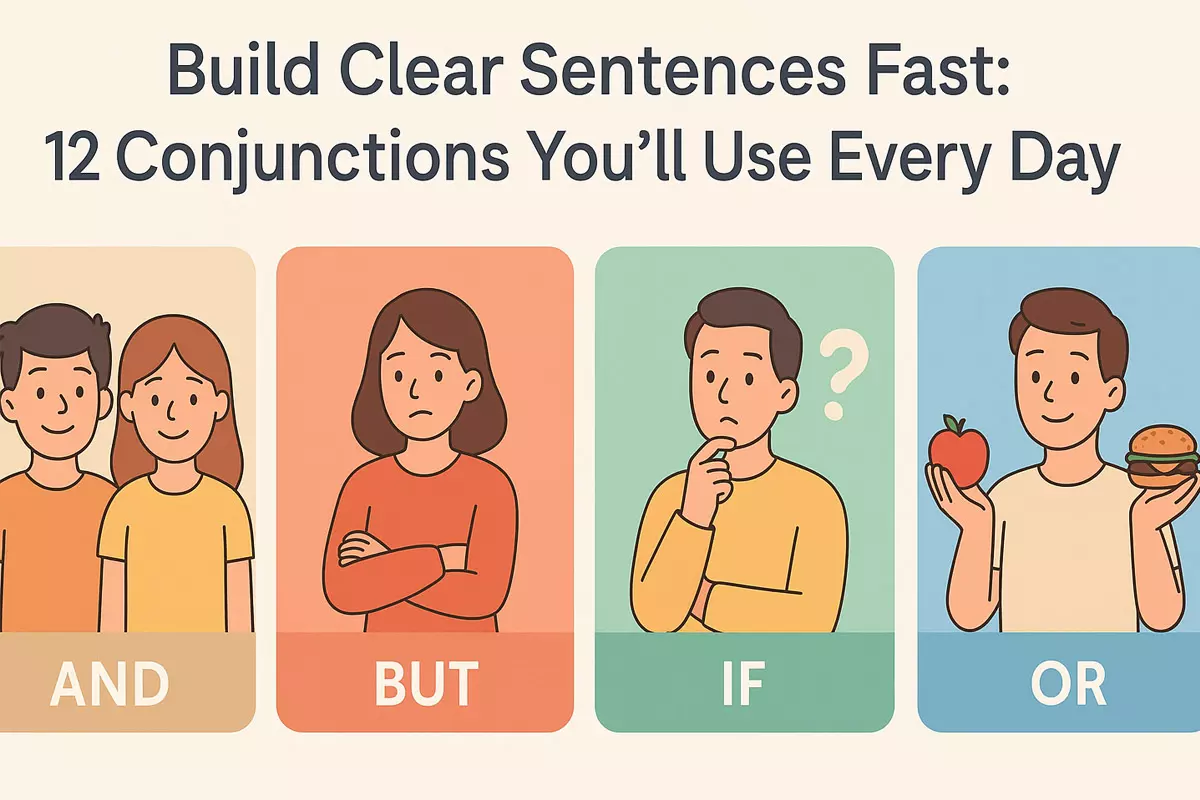 This article explains 12 common conjunctions, offers quick meanings, sentence frames, and speaking practice. It covers tone control, a mini quiz, and exercises to help you reply briefly and expand sentences confidently in conversation.
Are you tired of awkward, choppy writing that makes your ideas hard to follow? Learning how to connect your thoughts smoothly can greatly improve both clarity and reader engagement. By mastering essential connectors—such as however, therefore, moreover, and for example—you can make your writing flow naturally and convey your message more effectively. These tools are simple to use and can quickly transform your communication, helping you express complex ideas with confidence and precision in any context.
Why These 12 Are High-Frequency
The conjunctions featured in this guide appear constantly in everyday conversation and writing because they perform essential linking functions. These words help us connect ideas, clarify relationships, and build sentences that flow logically. Without them, communication would be choppy and unclear.
Essential for Everyday Communication
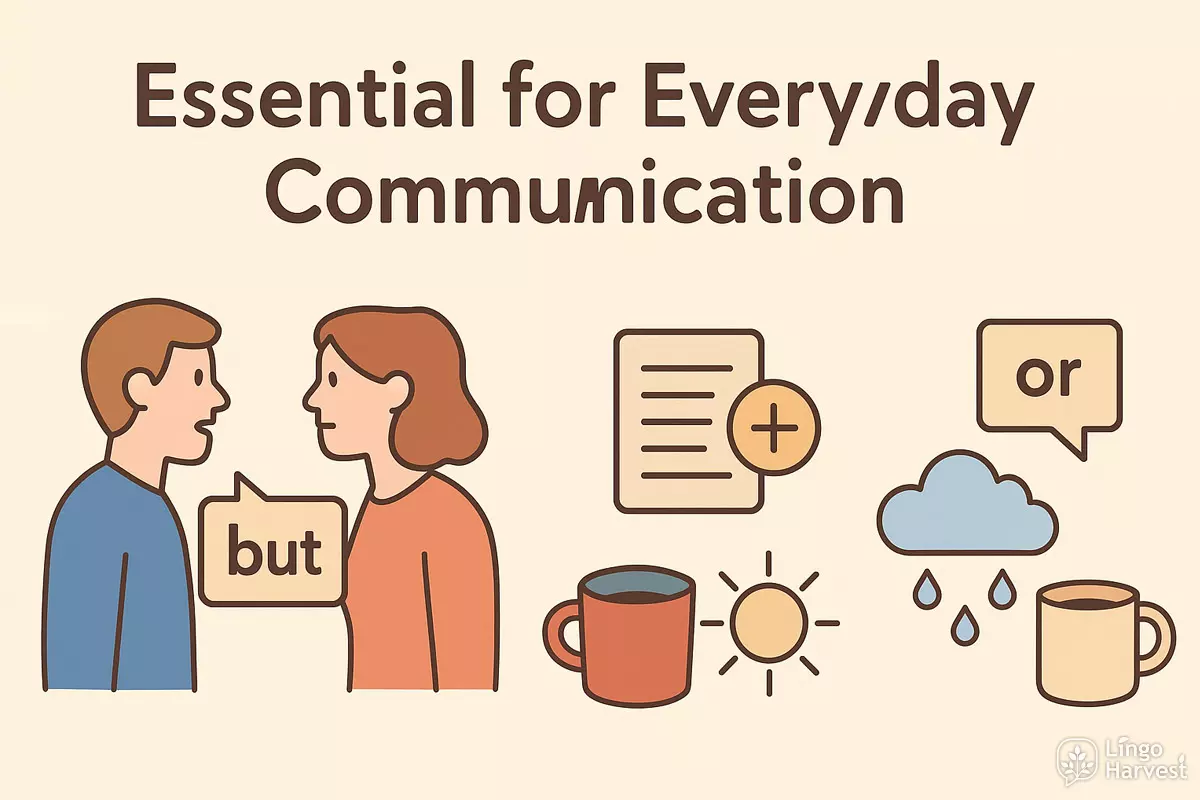
People rely on these connectors to express contrast, add information, show cause and effect, or present alternatives. Their simplicity and versatility make them the backbone of both casual dialogue and formal writing. For example, joining two thoughts (“I was tired, but I finished my work”) is much clearer with a conjunction.
Why They're Used So Often
- They help avoid repetition by linking related ideas.
- They clarify the relationship between statements (cause, contrast, condition, etc.).
- They make complex ideas easier to understand in a single sentence.
- They’re short, easy to remember, and fit naturally into speech.
- They allow speakers to add, compare, or contrast points without starting a new sentence.
| Conjunction | Common Use |
|---|---|
| And | Adding similar ideas or items (e.g., "She likes tea and coffee.") |
| But | Showing contrast or exception (e.g., "He is tall, but not athletic.") |
| Or | Offering alternatives (e.g., "Would you like juice or water?") |
| Because | Giving reasons (e.g., "She left early because she felt sick.") |
| So | Showing result or consequence (e.g., "It rained, so we stayed inside.") |
| If | Expressing condition (e.g., "If it snows, school will close.") |
| When | Indicating time (e.g., "When I arrive, I'll call you.") |
| While | Showing simultaneous actions or contrast (e.g., "She read while he cooked.") |
| Although | Introducing contrast (e.g., "Although it was cold, we went out.") |
| Because | Stating reasons (e.g., "He smiled because he won.") |
| After | Showing sequence in time (e.g., "After dinner, we walked.") |
| Before | Indicating prior events (e.g., "Before you leave, call me.") |
Patterns You’ll See Everywhere
- Combining two short sentences into one smooth statement
- Explaining reasons and results in a single phrase
- Making comparisons or showing exceptions
- Setting up conditions for actions
- Sequencing events clearly
Because these connectors cover so many essential functions, they naturally show up in nearly every conversation, email, or text you write. Mastering them means you can express yourself more clearly, whatever the situation.
Quick Meanings and Sentence Frames
Understanding how conjunctions work can help you connect ideas smoothly and express yourself more clearly. Below you'll find straightforward meanings for 12 essential connecting words, along with practical sentence patterns to help you use each one accurately. These building blocks let you piece together statements for everyday conversation, writing, and more.
Everyday Conjunctions: What They Mean
- And – adds information; joins similar ideas.
Example: "She likes tea and coffee." - But – shows contrast or exception.
Example: "He wanted to go, but he was busy." - Or – offers a choice or alternative.
Example: "Would you like juice or water?" - So – expresses result or consequence.
Example: "It rained, so we stayed inside." - Because – gives a reason.
Example: "She left early because she was tired." - Although – introduces a contrast, often unexpected.
Example: "Although it was cold, he went swimming." - While – shows two actions happening at the same time or a contrast.
Example: "While I cooked, she cleaned." - If – presents a condition.
Example: "If you call, I'll answer." - When – refers to time.
Example: "When you arrive, call me." - Since – indicates time or reason.
Example: "Since Monday, I've been tired." or "She smiled since she won." - Unless – means 'except if.'
Example: "I won't go unless it stops raining." - Because of – gives a reason, followed by a noun.
Example: "They canceled the trip because of the storm."
Useful Sentence Frames
Try these patterns to quickly build your own sentences with different connectors:
- [Subject] + [verb] + and + [subject] + [verb]
→ "Tom reads and Anna writes." - [Subject] + [verb] + but + [subject] + [verb]
→ "I called but nobody answered." - [Choice 1] or [choice 2]
→ "Tea or coffee?" - [Result], so [result]
→ "It was late, so we left." - [Subject] + [verb] because [reason]
→ "She smiled because she won." - Although + [clause], [main clause]
→ "Although it rained, we played." - If + [condition], [result]
→ "If you need help, ask." - When + [time], [action]
→ "When it gets dark, turn on the light." - Since + [time], [result]
→ "Since Monday, I've worked hard." - [Action] unless [condition]
→ "I'll go unless it rains."
Comparison of Conjunction Use
| Conjunction | Typical Sentence Frame |
|---|---|
| And | [A] and [B]: "She danced and sang." |
| But | [A] but [B]: "He tried but failed." |
| Because | [A] because [reason]: "They left because it was late." |
| If | If [condition], [result]: "If it rains, we’ll stay home." |
| Or | [A] or [B]: "You can eat now or later." |
| Although | Although [contrast], [main idea]: "Although tired, he kept working." |
| While | While [action], [other action]: "While I waited, she read." |
| Unless | [Action] unless [condition]: "I’ll call unless I’m busy." |
Experiment with these structures to practice connecting your ideas. Swapping in different conjunctions will help you express contrasts, reasons, conditions, and more, making your communication smoother and more precise.
Speaking Practice with Short Replies
Quick, clear responses are essential for real-world conversations. Practicing short answers using common conjunctions will help you connect ideas naturally and make your speech flow. Here are practical ways to use everyday conjunctions in brief exchanges, focusing on clarity and speed.
Short Reply Patterns with Conjunctions
Try answering questions or commenting on situations using these simple patterns. Notice how conjunctions join ideas efficiently:
- And: "Yes, and I finished my homework."
- But: "I wanted to go, but it was raining."
- Or: "Tea or coffee?" — "Tea, please."
- Because: "Why are you late?" — "Because my bus was delayed."
- So: "It’s cold, so I wore a jacket."
- Although: "Although I was tired, I finished the project."
- While: "She cooked while I cleaned."
- Since: "Since it’s late, let’s go home."
- If: "If you need help, ask me."
- Unless: "I’ll go unless it rains."
- When: "Call me when you arrive."
- Before: "Finish this before you leave."
Quick Reply Practice: Choose and Connect
Respond to the following prompts using a conjunction for a natural, connected answer:
- Your friend asks: “Are you coming to the party?”
- Someone says: “It’s getting late.”
- You didn’t bring an umbrella. Why?
- Your classmate offers help. How do you respond?
- You're choosing between two movies. What do you say?
Show answers
- Yes, but I’ll be a little late.
- Let’s go home since it’s late.
- Because I thought it wouldn’t rain.
- Thanks, and I appreciate it.
- We can watch either one, or we could watch both.
Mini Table: Conjunctions in Short Answers
Here’s a quick comparison of how conjunctions change the meaning or flow in brief replies:
| Prompt | Possible Short Reply (with Conjunction) |
|---|---|
| “Are you hungry?” | “Yes, but I can wait.” |
| “Do you want tea?” | “Tea or coffee—either is fine.” |
| “Why did you call?” | “Because I needed your help.” |
| “Let’s meet now.” | “If you’re free, let’s meet.” |
| “It’s raining.” | “So we should stay inside.” |
Tips for Fast, Clear Replies
- Listen for the main idea, then add your thought with a conjunction.
- Keep your answer short, but make sure it’s complete.
- Practice combining two ideas in one sentence for smooth replies.
- Repeat these patterns aloud to build confidence and speed.
With regular practice, you’ll find it easier to use conjunctions to give clear, connected short replies in any conversation.
Tone Control for Polite Conversation
Choosing the right conjunctions can soften your statements and make interactions friendlier. When you want to express disagreement or suggest alternatives, certain words help you sound respectful rather than abrupt. The way you connect ideas often shapes the mood of your message, especially in spoken exchanges.
Polite Conjunctions in Everyday Speech
Some conjunctions naturally lend themselves to tactful conversation. They help balance honesty with consideration for others’ feelings. Here are a few commonly used for this purpose:
- Although – acknowledges a point before offering a contrast (“Although I see your point, I have a different opinion.”)
- However – transitions gently to another idea (“I appreciate your input; however, I’d like to add something.”)
- Because – explains reasoning, making your stance easier to accept (“I can’t join you, because I have another appointment.”)
- While – shows simultaneous ideas, often softening disagreement (“While I agree with the plan, I think we should revise the timeline.”)
- Though – offers a mild contrast, less formal than “although” (“That’s a good idea, though it might be expensive.”)
- But – signals contrast, best softened with a positive phrase first (“It’s a great suggestion, but we have a tight budget.”)
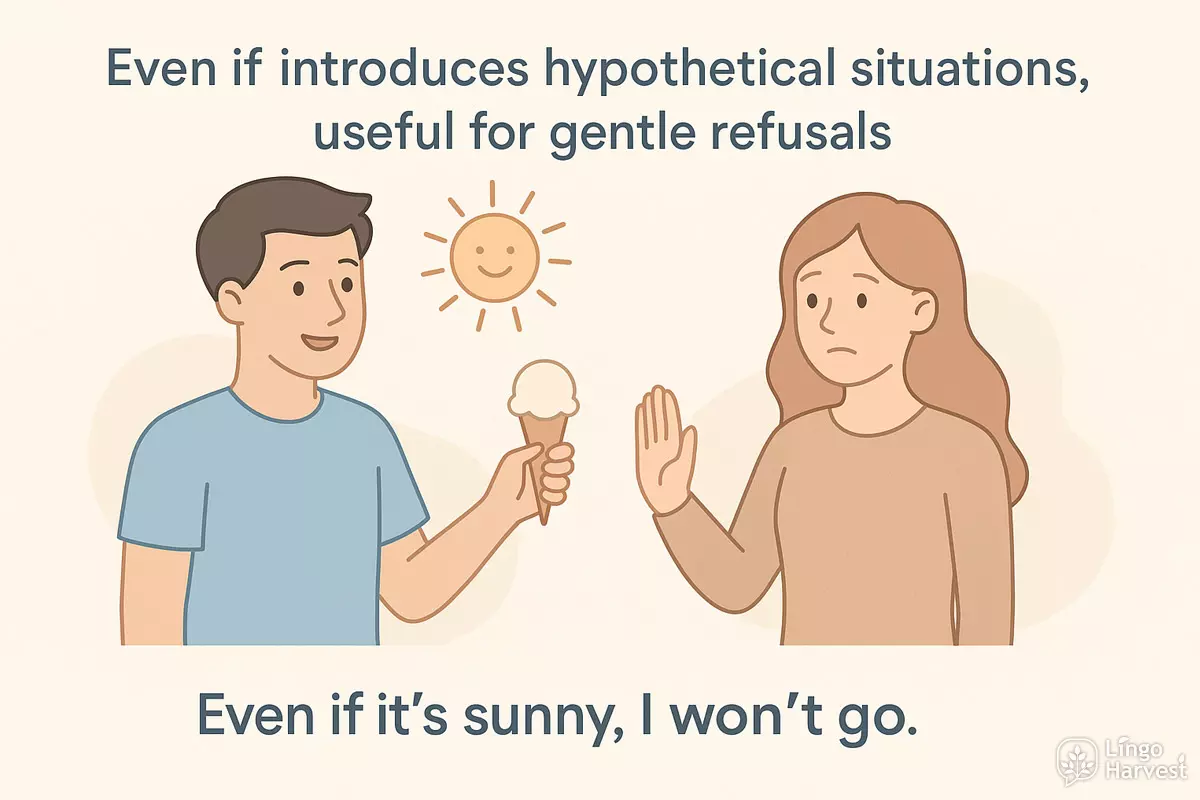
- Even if – introduces hypothetical situations, useful for gentle refusals (“Even if I wanted to help, I’m not available tomorrow.”)
- So – explains outcomes, often used to suggest next steps (“The meeting ran late, so let’s reschedule lunch.”)
- Yet – frames exceptions without sounding negative (“The report is thorough, yet a few details need clarification.”)
- And – adds information, making your tone inclusive (“You did well, and your effort is appreciated.”)
Comparing Direct and Polite Connections
Using conjunctions with care can mean the difference between sounding blunt and being considerate. Here’s a comparison of direct versus more diplomatic phrasing:
| Direct Connection | Polite Alternative |
|---|---|
| I disagree, but that’s your opinion. | While I see your point, I have a different perspective. |
| That won’t work. | Although it’s an interesting idea, it might be challenging to implement. |
| I can’t help. | I’d love to assist, however I have another commitment. |
| Your answer is wrong. | Your response is thoughtful, yet the correct answer is different. |
Tips for Softer Sentences
- Start with appreciation or agreement before using a contrasting conjunction.
- Pair conjunctions with polite phrases (“I understand,” “I appreciate,” “Thank you for…”).
- Choose less forceful connectors like “though,” “while,” or “although” to reduce directness.
- Use “because” to give reasons, not just refusals.
- Keep sentences balanced; avoid stacking negatives.
With intentional use of these connectors, your sentences will feel more considerate and help maintain positive communication in both casual and professional settings.
Mini Quiz: Choose the Best Conjunction
Strengthening your grasp of everyday conjunctions is easier when you see them in action. Below you'll find a set of sentences with missing connectors. Your task: select the conjunction that best completes each sentence from the options provided. This not only reinforces recognition, but also builds confidence in using them naturally.
Fill in the Blank: Select the Right Connector
- She wanted to go hiking, ____ it started raining.
- and
- but
- so
- I can make pasta ____ rice for dinner.
- or
- because
- although
- He was tired, ____ he finished the project.
- since
- yet
- for
- We will leave early ____ we don’t miss the train.
- so
- although
- and
- She doesn’t like coffee, ____ she drinks tea every morning.
- but
- because
- or
Common Conjunctions in Context
Get familiar with how these connectors function by reviewing a few everyday examples:
- and – connects similar ideas: "I bought apples and oranges."
- but – shows contrast: "He is tall but slow."
- or – offers a choice: "Would you like tea or coffee?"
- so – indicates a result: "It was late, so we went home."
- because – gives a reason: "She stayed home because she was sick."
- although – expresses unexpected contrast: "Although it rained, we played outside."
- if – introduces a condition: "If you hurry, you’ll catch the bus."
- when – relates to time: "Call me when you arrive."
- since – gives a cause: "Since it’s warm, let’s swim."
- yet – signals contrast: "He is young, yet wise."
- while – shows two things happen at the same time: "She cooked while he cleaned."
- unless – states an exception: "You can’t go unless you finish."
Test Your Knowledge
Try these quick practice sentences. Choose the most suitable linking word:
- He didn’t study, ____ he failed the test.
- Call me ____ you get home.
- Take a jacket ____ it gets cold.
- We can eat pizza ____ burgers for lunch.
Show answers
- 1. but
- 2. or
- 3. yet
- 4. so
- 5. but
- He didn’t study, so he failed the test.
- Call me when you get home.
- Take a jacket in case it gets cold.
- We can eat pizza or burgers for lunch.
Practice: Expand Short Sentences
Combining brief statements into longer, more informative ones is a practical way to strengthen your writing. Using conjunctions like “and,” “but,” “because,” or “although,” you can link ideas, show contrasts, or explain reasons. This exercise helps you learn to connect short ideas smoothly for clearer, richer communication.
How to Connect Short Ideas
- And adds information: “She likes tea. She likes coffee.” → “She likes tea and coffee.”
- But shows contrast: “He is tired. He will go running.” → “He is tired, but he will go running.”
- Because explains reasons: “She stayed home. She was sick.” → “She stayed home because she was sick.”
- Or offers choices: “We can eat now. We can eat later.” → “We can eat now or later.”
- So shows results: “It was raining. They took an umbrella.” → “It was raining, so they took an umbrella.”
- Although introduces contrast: “He studied hard. He didn’t pass.” → “Although he studied hard, he didn’t pass.”
Expand These Sentences
Try joining each pair of sentences below using a suitable conjunction. Pay attention to the meaning you want to express.
- She opened the window. She wanted fresh air.
- It was cold. They went swimming.
- I finished my homework. I watched a movie.
- He forgot his keys. He couldn’t enter the house.
- You can have tea. You can have coffee.
- She was tired. She kept working.
- We missed the bus. We walked to school.
- The sun was shining. It was still chilly.
- He didn’t call. He was busy.
- The food was spicy. I enjoyed it.
Show answers
- She opened the window because she wanted fresh air.
- It was cold, but they went swimming.
- I finished my homework and watched a movie.
- He forgot his keys, so he couldn’t enter the house.
- You can have tea or coffee.
- She was tired, but she kept working.
- We missed the bus, so we walked to school.
- The sun was shining, although it was still chilly.
- He didn’t call because he was busy.
- The food was spicy, but I enjoyed it.
Common Conjunctions for Sentence Expansion
Here are several conjunctions you’ll see frequently when combining clauses. Notice how each one helps shape the meaning:
- and → addition
- but → contrast
- or → choice/alternative
- so → result
- because → reason
- although → concession
- while → contrast/time
- since → reason/time
- if → condition
- unless → negative condition
- when → time
- after → time
Quick Transformation Exercise
Combine the following using any appropriate conjunction:
- He studied for hours. He passed the exam.
- We can go out. We can stay home.
- I like apples. I don’t like bananas.
- She called me. I was sleeping.
Show answers
- He studied for hours, so he passed the exam.
- We can go out or stay home.
- I like apples, but I don’t like bananas.
- She called me while I was sleeping.
By practicing these patterns, you’ll become faster and more confident at building clear, connected sentences in everyday writing and speech.