Precision with Determiners: this vs that in argument structure

 Here we why determiner choice matters in arguments, compares the meanings of this and that, explains their use in academic claims, identifies common essay mistakes, and provides practice choosing the correct determiner in argumentative writing.
- Why Determiner Choice Matters in Arguments
- Meaning Differences Between This and That
- Using This for Immediate or Strongly Linked Ideas
- Using That for Distance, Contrast, or Critique
- Determiners in Academic Claims and Reasoning
- Common Mistakes with This/That in Essays
- Practice: Choose the Correct Determiner in Arguments
Choosing between words that indicate near or distant reference can subtly influence how we construct and interpret arguments, as these choices affect the clarity and nuance of our communication. By examining the distinctions between such terms, we become more aware of how precise language contributes to effective expression and understanding. These seemingly minor decisions can have a significant impact on how ideas are conveyed, ensuring that our messages are both accurate and appropriately contextualized for our audience.
Why Determiner Choice Matters in Arguments
Choosing between determiners like this and that can change the entire direction of an argument. The words we use to point to ideas, objects, or statements—known as deixis—signal our stance and shape how listeners interpret what follows. When debating, negotiating, or clarifying a position, the right determiner does more than just point; it frames the context, suggests closeness or distance (both literal and figurative), and even subtly guides agreement or disagreement.
Nuances of Reference and Distance
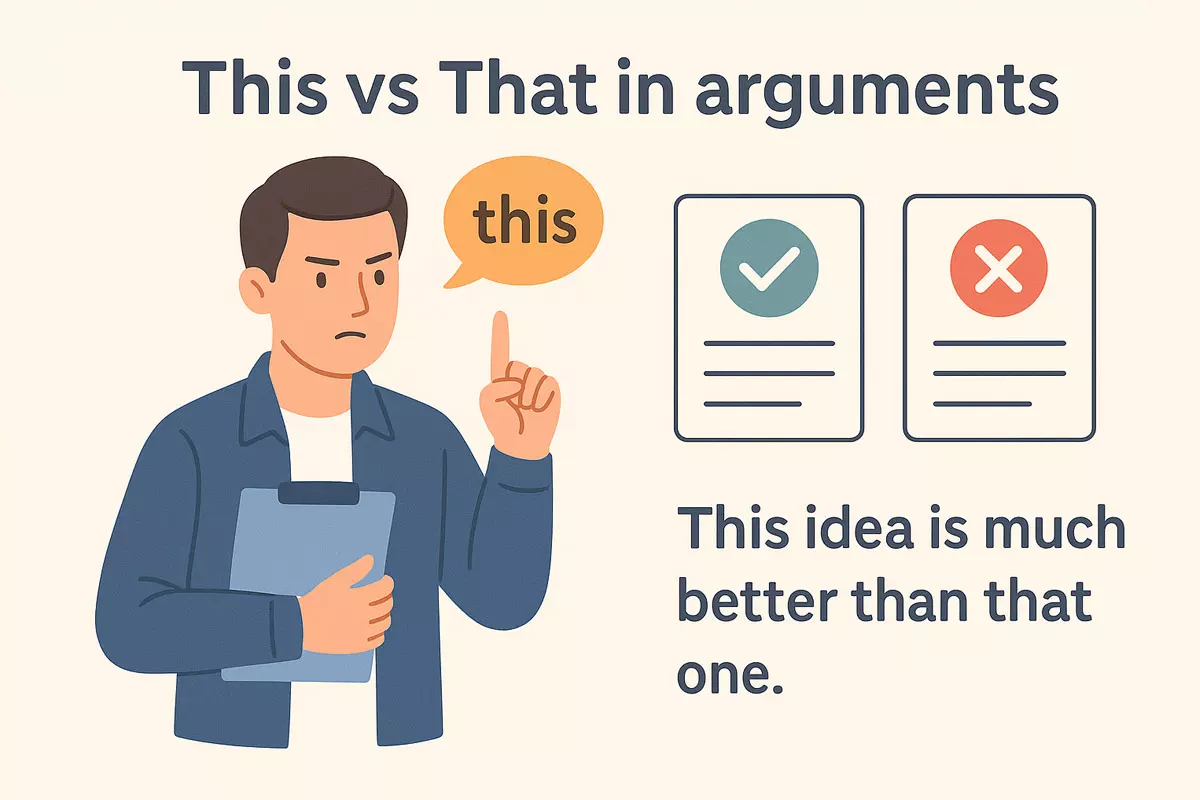
Using this often brings a concept closer, either in space, time, or relevance, while that can signal detachment or contrast. These choices can underline support for an idea or create distance from a counterpoint. For example, saying "this solution" versus "that solution" immediately reveals an attitude about which option is preferred or under discussion.
Impact on Persuasion and Clarity
Precision with determiners helps avoid ambiguity and misinterpretation. In structured arguments, especially written ones, being clear about which claim, evidence, or proposal is being referenced is crucial. A misplaced or vague determiner can lead to confusion or weaken the persuasive force of a statement.
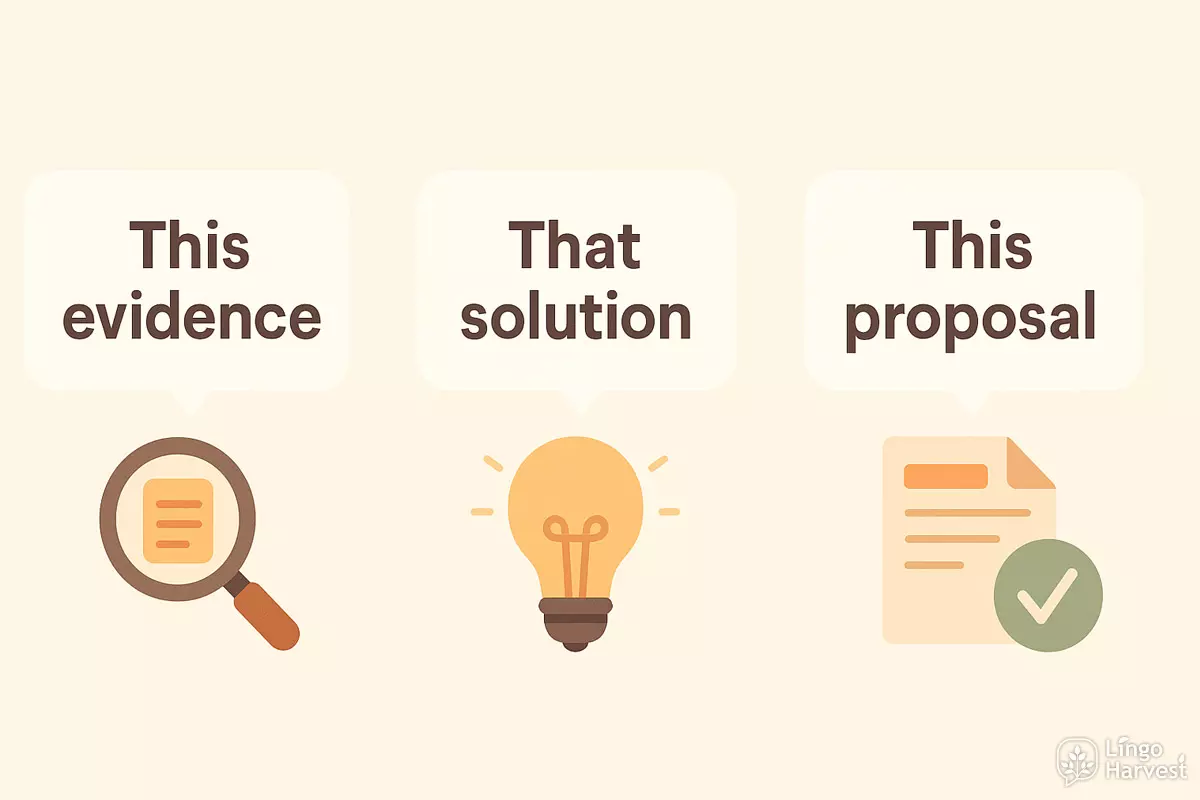
- “This argument” implies alignment or endorsement.
- “That argument” may suggest distance or criticism.
- “This evidence” brings focus to what’s immediately relevant.
- “That solution” can highlight a previous or less favored option.
- “This proposal” draws attention to the current idea under consideration.
- “That claim” can single out a competing view.
- “This point” can be used to reinforce what was just made.
- “That issue” might distance the speaker from a problematic topic.
- “This perspective” often signals a position being advocated.
- “That perspective” can indicate a different or opposing stance.
- “This example” for immediate illustrations.
- “That example” for comparisons or contrasts.
Comparison of “This” and “That” in Argument Structure
| Form | Typical Function in Argument | Effect on Listener/Reader |
|---|---|---|
| this | Signals immediacy, alignment, or focus on a current point | Builds connection, draws agreement, clarifies relevance |
| that | Indicates distance, contrast, or reference to previous point | Highlights difference, sets boundaries, may challenge |
| these | Groups supporting items or arguments close to the speaker’s stance | Unifies examples or evidence, reinforces position |
| those | Groups items or arguments as separate or less relevant | Creates separation, may discourage acceptance |
In sum, careful selection of determiners is not just a matter of grammar but a strategic choice that can influence how arguments are perceived and received. By mastering these subtle cues, speakers and writers can guide discussions more effectively and ensure their intended meaning is understood.
Meaning Differences Between This and That
When choosing between “this” and “that” in argument structure, the distinction often centers on proximity—both physical and psychological. “This” typically refers to something close to the speaker, either in space, time, or relevance, while “that” points to something more distant. These differences shape how listeners interpret arguments and the clarity of reference in communication.
Proximity and Relevance
The core difference lies in the sense of nearness. “This” is used for entities or ideas that are immediate or just mentioned, signaling importance or direct involvement. “That,” on the other hand, often introduces elements that are further away, less immediate, or previously discussed. This nuance affects how arguments are constructed and received: “this” draws attention, “that” can distance or background information.
Comparing Typical Usage
Below is a structured look at how “this” and “that” function differently in common contexts:
| Usage Context | This | That |
|---|---|---|
| Physical Distance | Near the speaker (e.g., “this book” on the desk) | Farther from the speaker (e.g., “that chair” across the room) |
| Time Reference | Present or very recent (e.g., “this morning”) | More remote in time (e.g., “that day” in the past) |
| Discourse Reference | New or upcoming ideas (“Let me explain this: …”) | Ideas already mentioned (“Remember that point earlier?”) |
| Emotional Involvement | Personal or emotionally close (“I love this!”) | Detached or less involved (“That doesn’t concern me”) |
Practical Examples
Here are some concise illustrations of how each determiner shifts meaning or focus:
- “This solution works best.” → Implies direct relevance or immediacy.
- “That idea needs more thought.” → Suggests distance, either mental or chronological.
- “Consider this: efficiency matters.” → Introducing a point for immediate attention.
- “I remember that time we traveled.” → Refers to a moment further in the past.
- “This argument is compelling.” → Highlights the present, active discussion.
- “That argument was dismissed.” → Refers to something previously debated.
- “Is this your pen?” → Object is likely nearby.
- “Was that your call?” → May refer to a phone call that happened earlier.
- “This is what I mean.” → Clarifies or emphasizes a current point.
- “That’s not what I intended.” → Deflects or distances from a misunderstanding.
Subtle Effects on Argument Structure
Selecting between “this” and “that” can subtly guide how listeners perceive the weight or immediacy of a claim. “This” can make a point feel urgent or central, while “that” may relegate information to the background or signal a shift in focus. These distinctions are crucial for precise, persuasive communication.
Using This for Immediate or Strongly Linked Ideas
When constructing arguments or explanations, the word "this" acts as a pointer to something close in context—either in the flow of discourse or in physical or conceptual proximity. "This" brings focus to information just mentioned, a concept currently in discussion, or an idea about to be unpacked. Its use helps readers or listeners track your reasoning, ensuring clarity and cohesion.
When to Choose "This"
Writers and speakers often use "this" to connect to:
- A previously stated idea or argument in the same sentence or paragraph
- Examples or evidence just introduced
- Immediate consequences or implications of a point
- Summing up a sequence of thoughts before transitioning
- Highlighting a key term or concept being defined or discussed
- Drawing attention to a visual aid or data set presented at that moment
- Reacting to a statement or question in conversation
- Referring to a new concept being introduced for the first time
- Clarifying a process or step just completed
- Signaling an important distinction or contrast immediately relevant
Examples of "This" in Context
The following phrases illustrate how "this" functions as a determiner in argument structure:
- This result suggests a new direction for research.
- Consider this scenario: the data changes unexpectedly.
- This raises an important question about methodology.
- This approach differs from previous models.
- This evidence supports our hypothesis.
- This is why the conclusion matters.
- This problem affects all subsequent findings.
- This step is crucial for accuracy.
- This solution addresses the immediate challenge.
- This example illustrates the main point.
- This change impacts the overall outcome.
- This argument relies on recent data.
- This method yields faster results.
- This observation leads to further questions.
- This interpretation aligns with earlier studies.
- This point requires clarification.
Key Functions of "This" in Argument Structure
Using "this" effectively allows for:
- Maintaining logical flow between sentences
- Emphasizing immediacy or relevance
- Reducing ambiguity by tightly linking ideas
- Facilitating transitions within arguments
Using That for Distance, Contrast, or Critique
Writers and speakers often select “that” instead of “this” to signal more than just physical distance; it can express emotional detachment, skepticism, or even a subtle critique. The choice between these determiners is not arbitrary—each one frames the noun it modifies in a particular light. “That” tends to place the referent further away, either literally or metaphorically, and can be a tool for highlighting contrast or signaling disapproval.
Functions of “That” in Argument Structure
Using “that” in discourse can serve several nuanced purposes:
- Emotional distance: Refers to something the speaker wishes to keep at arm’s length, emotionally or intellectually.
- Contrast: Differentiates one idea or object from another, often paired with “this” for clarity.
- Critique or dismissal: Signals skepticism or a negative evaluation of a concept or proposal.
- Past reference: Points to something previously mentioned or experienced, creating a sense of removal in time.
- Generalization: Sometimes used to refer to a category or type rather than a specific instance.
- Indirectness: Softens statements or avoids direct confrontation.
Examples of “That” for Distance and Contrast
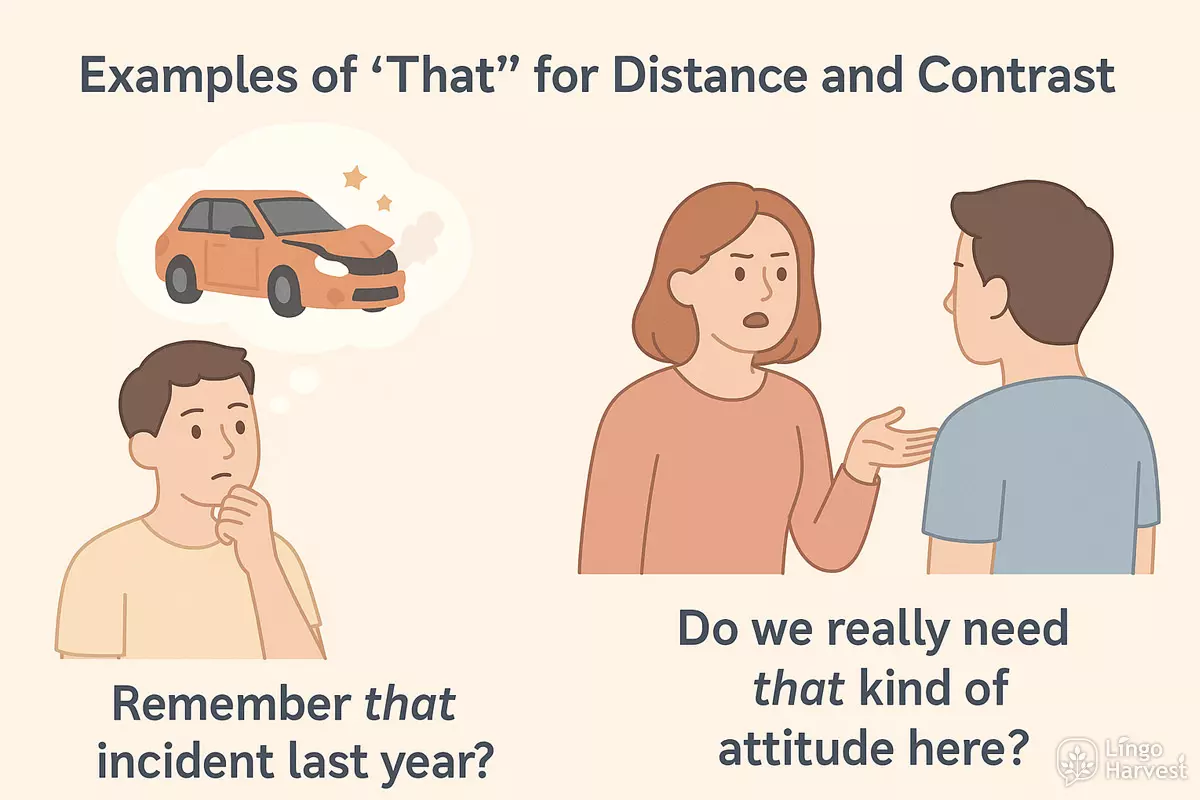
Writers use “that” in various argumentative and conversational contexts. Here are common patterns:
- “That idea doesn’t really solve the problem.”
- “I’m not sure I agree with that approach.”
- “This solution is practical; that one is theoretical.”
- “Remember that incident last year?”
- “Do we really need that kind of attitude here?”
- “This is what I meant; that was just a suggestion.”
- “I can’t believe that happened.”
- “That’s exactly the problem I was referring to.”
- “She has that look again.”
- “We should avoid that mistake in the future.”
- “That’s not what I intended.”
- “This is my preference; that is yours.”
- “I have to question that assumption.”
- “That claim requires more evidence.”
- “I wish you’d reconsider that decision.”
- “That’s an interesting perspective, but…”
- “That kind of thinking leads nowhere.”
- “Is that really necessary?”
Comparison: “This” vs. “That” in Argumentation
When contrasting ideas or responses, “this” and “that” often appear together. Their interplay can clarify relationships between concepts or stances. The table below highlights key distinctions:
| Function | Example |
|---|---|
| Presenting your own point | This is the main reason for our decision. |
| Referring to an opposing view | That argument overlooks several key facts. |
| Highlighting contrast | This solution is feasible; that one is risky. |
| Expressing critique or doubt | I have concerns about that proposal. |
| Creating emotional distance | That kind of behavior is unacceptable. |
Choosing “that” carefully in your writing or speech can subtly shift how an argument is perceived—whether by establishing distance, drawing a clear contrast, or implying critique. Understanding these nuances enriches both expressive precision and interpretive skill.
Determiners in Academic Claims and Reasoning
Precision in language is essential for effective scholarly communication, and the selection of determiners like "this" and "that" can subtly shape the reader’s understanding of argument structure. When presenting claims, writers often use these words to guide the audience’s attention—either drawing it closer to a specific point or distancing it to introduce alternative perspectives.
How "This" and "That" Function in Arguments
Using "this" typically signals a close connection to the immediately preceding idea, emphasizing relevance or direct consequence. In contrast, "that" can create a sense of distance, referring back to something previously mentioned or suggesting a more general or contrasting stance.
- This result demonstrates the immediate effect of the intervention.
- That interpretation, however, overlooks key variables.
- This supports our central hypothesis.
- That conclusion is not supported by the data.
- This claim aligns with current research trends.
- That argument appears less convincing upon review.
- This evidence highlights the need for further study.
- That perspective has been widely debated.
- This method yields consistent results.
- That approach was previously unsuccessful.
- This analysis reveals a critical pattern.
- That assumption requires re-examination.
- This position is supported by recent data.
- That claim remains unsubstantiated.
Comparing Effects of "This" vs "That"
Writers can subtly influence the reader’s perception of certainty, alignment, or skepticism by switching between these determiners. "This" often lends immediacy and endorsement, while "that" can introduce skepticism or distance from the claim.
| Usage Context | Effect on Argument |
|---|---|
| "This" before a claim | Signals endorsement or emphasis on a specific, closely related point |
| "That" when referencing prior content | Creates distance, signals contrast or critique, or refers to earlier sections |
| Switching from "this" to "that" | Highlights a shift in stance or introduces an alternative viewpoint |
| Repetition of "this" in successive sentences | Builds cohesion and reinforces a chain of reasoning |
Strategic Use in Reasoning
Academic writers benefit from consciously choosing between "this" and "that" to clarify relationships between ideas. Overuse of either can lead to ambiguity or unintended emphasis, so variation and precision are key. By aligning determiner choice with argumentative intent, scholars can enhance clarity, coherence, and persuasive impact in their writing.
Common Mistakes with This/That in Essays
Clarity often suffers in essays when writers misuse “this” and “that.” These determiners may seem interchangeable, but their distinctions matter in academic argumentation. Confusing the two can lead to vague references, logical gaps, or unintended shifts in emphasis. Understanding their precise use is key to maintaining coherence and guiding your reader through complex ideas.
Ambiguous References
A frequent pitfall is using “this” or “that” without a clear antecedent. When the referent is buried in previous sentences or not explicitly stated, readers are left guessing. To avoid this, always ensure the noun or idea each determiner points to is unmistakable.
- Using “this” to refer to an entire argument instead of a specific claim.
- Placing “this” at the start of a sentence without clarifying what “this” means.
- Relying on “that” to reference something not directly mentioned.
- Switching from “this” to “that” mid-paragraph without a logical reason.
Overgeneralization and Vagueness
Another issue arises when writers use these determiners in a generic way, making their arguments less precise. For example, “this shows” or “that proves” can be too broad if the subject isn’t clear. Every “this” or “that” should point to a specific idea, fact, or statement.
Incorrect Shifts in Focus
Switching between “this” and “that” can subtly change the focus or tone. “This” signals immediacy or closeness, while “that” creates distance. Using the wrong one may mislead readers about the importance or relevance of the referenced information.
| Problematic Use | Why It’s an Issue |
|---|---|
| “This suggests…” (without clear antecedent) | Leaves reader unsure what “this” refers to ❌ |
| “That supports the claim…” (refers to a distant idea) | Creates unnecessary distance; may confuse the timeline of arguments |
| Switching between “this” and “that” randomly | Disrupts logical flow; weakens argument structure |
| Using “this” or “that” without specifying a noun (“This is important.”) | Vague reference; lacks precision and academic rigor |
Checklist: Avoiding Determiner Errors
Writers can improve clarity by following these guidelines:
- Always double-check that “this” or “that” has a clear, nearby noun.
- Pair determiners with a specific noun (“this result,” “that argument”).
- Use “this” for something just mentioned; use “that” for something more distant or previously discussed.
- Don’t overuse “this” or “that” to begin sentences; vary sentence structure.
- Be wary of stacking determiners (“this this” or “that that”), even accidentally.
- Clarify whether you are referring to a single point or a broader idea.
- Revise sentences where the reference could be interpreted in more than one way.
- Use synonyms or repeat the key noun if confusion is possible.
- Maintain consistency in how you refer to central arguments or evidence.
- Read your essay aloud to check for unclear references.
Precision with “this” and “that” strengthens arguments, helping readers follow your reasoning without confusion. Recognizing and correcting these common errors can make your writing more effective and persuasive.
Practice: Choose the Correct Determiner in Arguments
Understanding when to use "this" or "that" in argumentative writing can sharpen the clarity and impact of your points. Below, you'll find exercises and guidance designed to help you distinguish between these determiners in various contexts. Focus on how proximity (mental or physical), emphasis, and logical flow influence your choices.
Quick Review: When to Use "This" or "That"
- This refers to something close—either in the text, in time, or conceptually. It often introduces a point you're about to explain or just mentioned.
- That points to something more distant—perhaps mentioned earlier, or to contrast with a previous idea.
- In arguments, "this" typically signals the main claim or a new supporting idea, while "that" can reference a previously stated argument or opposing viewpoint.
Choose the Right Determiner: Practice Sentences
Read each sentence and decide whether "this" or "that" fits best. Consider the context and what the determiner is referencing.
- ______ argument clearly addresses the problem at hand, making it more persuasive.
- On the other hand, ______ claim seems less relevant to our discussion.
- Many believe that stricter laws will solve the issue. However, ______ is an oversimplification.
- We have seen several proposals, but only ______ solution considers all stakeholders.
- ______ evidence supports the conclusion we drew in the previous section.
- The research from last year was inconclusive. ______ is why further studies are needed.
- Critics often mention the cost. ______ concern cannot be ignored.
- Earlier, we rejected a similar idea. ______ decision was based on extensive data.
- Some argue for immediate action, but ______ approach may overlook long-term effects.
- After reviewing the data, the committee adopted ______ recommendation without hesitation.
Show answers
- This
- that
- this
- this
- This
- This
- This
- That
- that
- this
Common Pitfalls: Avoiding Ambiguity
Writers sometimes use "this" or "that" without a clear reference, leading to confusion. Practice rewriting the following sentences to clarify the reference. Add a noun after the determiner for precision where needed.
- This is unclear. (What does "this" refer to?)
- That was unexpected. (Specify what was unexpected.)
- This matters. (Explain what matters.)
- That makes sense. (Clarify what "that" refers to.)
Show answers
- This argument is unclear.
- That outcome was unexpected.
- This evidence matters.
- That explanation makes sense.
Expanded Examples: Determiner Choice in Context
Below is a table illustrating how "this" and "that" function in structured argumentation. Note how the choice of determiner shapes meaning and coherence.
| Context | Example with "this"/"that" |
|---|---|
| Introducing a new argument | This proposal addresses the root cause of the problem. |
| Referring back to a previous point | That suggestion, made earlier, still holds value. |
| Contrasting viewpoints | This approach is practical, while that method is theoretical. |
| Summarizing a complex idea | This analysis demonstrates the need for further research. |
| Rejecting or critiquing a prior argument | That reasoning fails to consider recent evidence. |
When making arguments, always check that your use of "this" or "that" clearly signals the intended reference, ensuring your writing remains precise and persuasive.