Distributive Determiners: each, every, either, neither

 This article explains distributive determiners in simple terms, showing how to use each, every, either, and neither correctly. It covers word order, common mistakes, and includes practice choosing the right determiner in context.
- Meaning of distributive determiners in simple language
- Using each to talk about individual members of a group
- Using every for general statements and routines
- Either and neither with two options or people
- Word order with distributive determiners in noun phrases
- Common errors with each vs every and either vs neither
- Practice: choose the correct distributive determiner
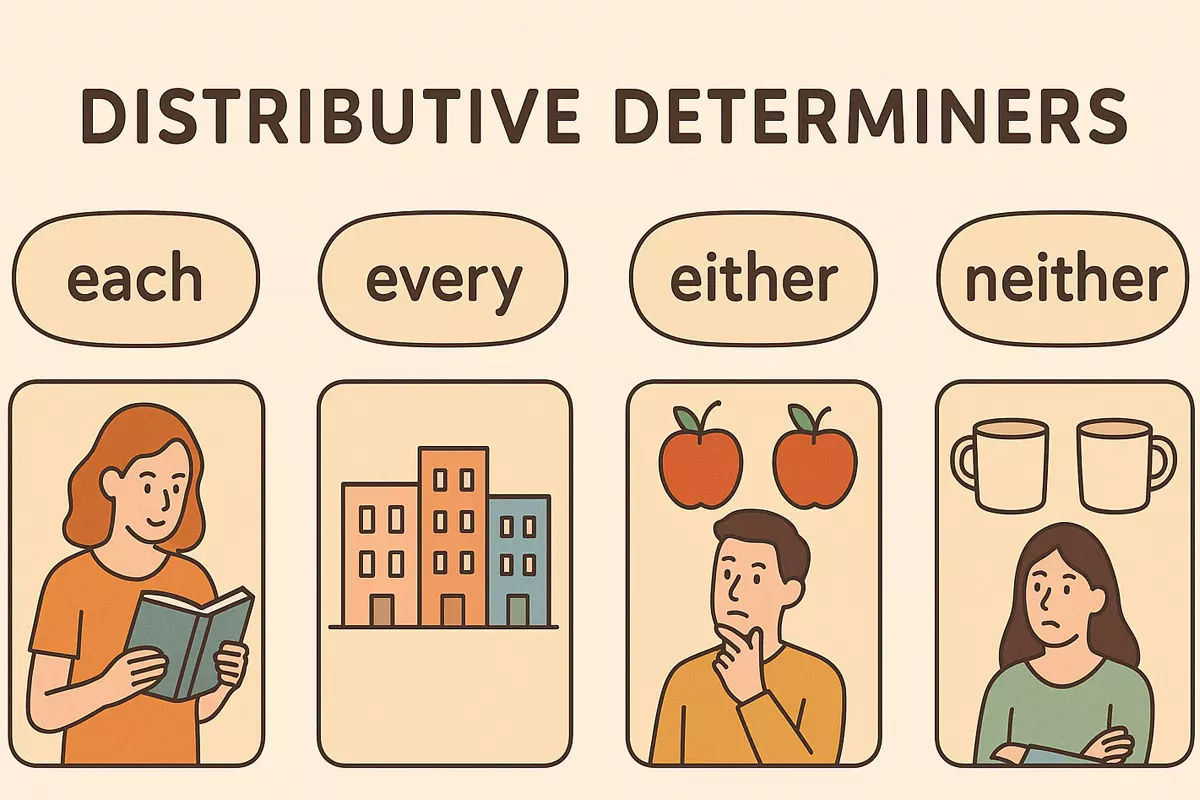
Mastering the subtleties of English grammar can be challenging, particularly when dealing with words that distinguish individuals within a group or present choices. Knowing how to correctly use terms such as each, every, either, and neither is essential for clear and accurate communication. These words often seem similar but serve different functions; for example, each refers to individual members of a group, every emphasizes the group as a whole, either offers a choice between two options, and neither indicates that none of the options apply.
Meaning of distributive determiners in simple language
Distributive determiners are words that help us talk about members of a group, one at a time or separately. They let us show if we mean all, just one, or none from a set. In English, the most common distributive determiners are each, every, either, and neither.
What do these words do?
These determiners point out how things or people are considered within a group:
- Each: Refers to every single member of a group, one by one. Example: “Each student received a book.”
- Every: Means all the members of a group, seen as a whole set. Example: “Every child loves to play.”
- Either: Refers to one out of two options. Example: “You can take either road.”
- Neither: Means not one and not the other of two options. Example: “Neither answer is correct.”
How are distributive determiners used?
They come before a noun to show how we are thinking about the items or people in a group. Here are some simple guidelines:
- Use each when you want to focus on individuals in a group, one at a time.
- Use every to talk about all the members of a group as a whole, not separately.
- Use either for a choice between two.
- Use neither to say that none of two choices is selected or true.
Quick comparison of meanings
| Word | What it means | Example |
|---|---|---|
| Each | Every one, separately | Each apple is red. |
| Every | All, as a group | Every apple is red. |
| Either | One of two choices | You can choose either dress. |
| Neither | Not one and not the other | Neither shirt fits me. |
More examples for practice
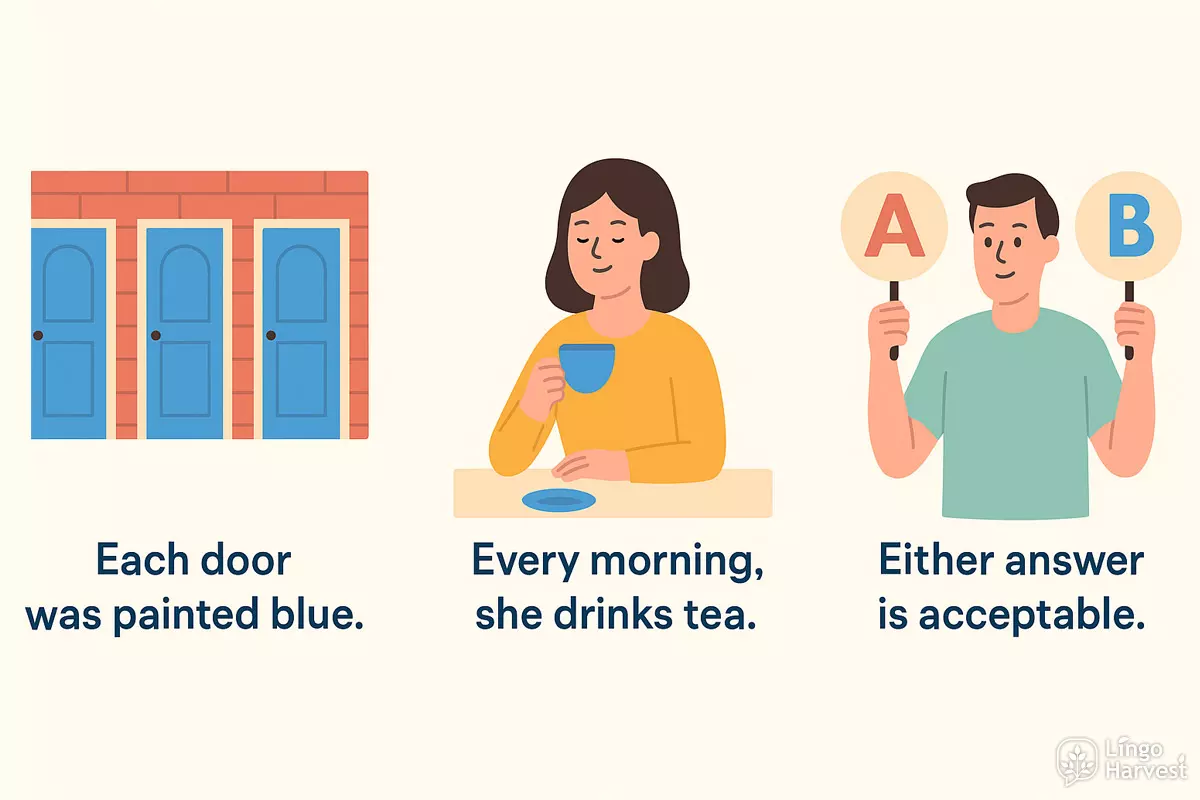
- Each door was painted blue.
- Every morning, she drinks tea.
- Either answer is acceptable.
- Neither cat likes water.
- Each player shook hands.
- Every ticket has a number.
- Either solution works.
- Neither suggestion was helpful.
- Each child got a balloon.
- Every seat was taken.
- Either path leads to the park.
- Neither road is open.
Understanding these words helps us be clear about how many people or things we mean, and whether we are talking about them as a group or as individuals.
Using each to talk about individual members of a group
The word each highlights individuals within a group, focusing on one member at a time, even though the group may be treated collectively. This is useful when you want to emphasize that something applies separately to every single person or thing, not just to the group as a whole.
How "each" functions in sentences
"Each" can be used with singular countable nouns and is typically followed by a singular verb. You can place it before the noun, after the verb, or after the object, depending on the sentence structure. Here are some patterns:
- Each student received a certificate.
- The players each wore a different color.
- We gave a ticket to each visitor.
Key points to remember
- Each focuses on individuals, not the group as a whole.
- Use a singular noun and verb after "each."
- It can refer to people or objects.
- It’s often used for small groups, but can be used for larger numbers when you want to stress individuality.
Common sentence patterns with "each"
- Each + singular noun + singular verb: Each child has a backpack.
- Plural noun + each (after the verb): The children each have a backpack.
- Object + each: We handed out books to each participant.
- With prepositions: There is a prize for each winner.
Examples of "each" in context
- Each apple was carefully inspected. ✅
- Each of the answers is correct. ✅
- She gave each guest a gift. ✅
- Each has its own advantages.
- Each team member must sign the form.
- The twins each got a present.
- You can ask each person individually.
- There are seats for each of you.
- Each of these books is new.
- We visited each country on our list.
- Each solution is possible in a different way.
- Each participant introduced themselves.
- The students each completed their own project.
- Each attempt brought us closer to the answer.
- Each of my friends has a different hobby.
- Each question must be answered in full.
- We sent an invitation to each family.
Summary table: "each" usage patterns
| Pattern | Example |
|---|---|
| Each + singular noun + singular verb | Each student has a locker. |
| Plural noun + each (after verb) | The players each received a medal. |
| Each of + plural noun + singular verb | Each of the books is interesting. |
| Object + each | We gave a ticket to each visitor. |
By using "each," you draw attention to the individual nature of actions or characteristics within a group, which is especially helpful for clarity and specificity in communication.
Using every for general statements and routines
The determiner every is commonly used to talk about things that are true in general or happen on a regular basis. It emphasizes that something applies to all members of a group without exception, particularly when discussing schedules, habits, or repeated actions. Unlike each, which often draws attention to individuals within the group, every tends to refer to the group as a whole, highlighting the routine or general nature of the statement.
Typical contexts for "every"
- Describing regular events or scheduled activities (e.g., "The bus leaves every hour.")
- Expressing general truths or rules (e.g., "Every child needs love.")
- Talking about frequency (e.g., "She goes to the gym every morning.")
- Making statements that apply to all members of a category (e.g., "Every student must submit the form.")
- Setting expectations or requirements (e.g., "Every applicant must provide identification.")
Common patterns with "every"
Several sentence structures feature this word, often with time expressions or plural nouns. Notice that it is always followed by a singular countable noun, even when the meaning refers to all members.
- Every + singular noun (e.g., "every book," "every teacher")
- Every + time period (e.g., "every week," "every Monday")
- Every + number + time unit (e.g., "every three days")
Examples of "every" in routines and generalizations
- Every morning, I drink a glass of water.
- The store opens at 9 a.m. every day.
- Every passenger must have a valid ticket.
- We meet every Friday for lunch.
- Every answer in the test must be written in ink.
- He calls his parents every weekend.
- Every dog needs exercise.
- Doctors recommend brushing your teeth every night.
- Every question was answered correctly.
- She checks her email every hour.
- Every student received a certificate.
- Every two weeks, we get paid.
- Every city has its own traditions.
- Every rule has an exception.
- I buy groceries every Monday.
- Every member of the team contributed.
- Every meal should include vegetables.
- He visits his grandparents every summer.
- Every problem has a solution.
Comparing "every" and "each" in general statements
| Form | Typical Use | Example Sentence |
|---|---|---|
| every + singular noun | Emphasizes the group as a whole; routines or general truths | Every employee must wear a badge. |
| each + singular noun | Focuses on individuals, often for emphasis or when considering separately | Each employee has a unique ID number. |
| every + time period | Used for schedules and repeated events | The meeting is held every month. |
| each + of + plural noun | Used when talking about individual members of a group | Each of the students received a prize. |
To sum up, every is ideal for expressing habits, schedules, and generalizations that apply to all members of a group as a collective, especially when focusing on repeated actions or universal truths.
Either and neither with two options or people

When you are faced with a choice between two items or individuals, the words either and neither are useful for expressing your preferences or indicating possibilities. Either refers to one or the other of two, while neither means not one nor the other. Both can be used as determiners before nouns, as pronouns, or in combination with prepositions.
How to Use "Either"
Use either to show that any one of two options is acceptable or possible. It suggests a positive or open choice between two alternatives. Here are some common patterns:
- Either answer is correct. (Both are acceptable, choose one.)
- You can sit on either side of the table.
- Either John or Alex will help you.
- I don’t mind; either movie is fine.
- Take either route to reach the park.
How to Use "Neither"
Neither is used to indicate that none of the two options or people is chosen or is true. It creates a negative statement involving both items or people. Here are typical uses:
- Neither shirt fits me. (Both are unsuitable.)
- Neither of the students knew the answer.
- Neither Tom nor Jerry was at the meeting.
- I like neither option.
- Neither road is safe during winter.
Comparison: Either vs. Neither
The main difference is that either is affirmative (one or the other), while neither is negative (not one, not the other). This contrast is especially clear when making choices or giving information about two people or things.
| Usage | Example Sentence |
|---|---|
| Either (affirmative, one or the other) | Either candidate can win the election. |
| Neither (negative, not one or the other) | Neither candidate impressed the audience. |
| Either of + noun/pronoun | Either of you may take the lead. |
| Neither of + noun/pronoun | Neither of the answers is correct. |
Common Mistakes and Tips
- Don’t use either or neither with more than two options; use any or none instead.
- With either/neither of, the verb is usually singular in formal English: "Neither of them is ready." In informal speech, plural is sometimes heard.
- When joining two subjects, use either...or and neither...nor: "Either Mark or Lisa will call." / "Neither Mark nor Lisa called."
- For polite offers or agreements, use either: "Would you like tea or coffee?" "Either is fine."
- If you want to reject both options, use neither: "Do you want pizza or pasta?" "Neither, thanks."
Understanding the distinction between either and neither helps you communicate choices and exclusions clearly when discussing two alternatives, whether you’re talking about people, items, or actions.
Word order with distributive determiners in noun phrases
Understanding where to place distributive determiners such as each, every, either, and neither is crucial for clear and natural English. These words usually appear at the beginning of a noun phrase, immediately before adjectives or the noun they describe. For example, "each student" or "every interesting idea" are both correct, with the determiner coming first.
Position in the noun phrase
Distributive determiners precede any descriptive words and the noun itself. You won’t find them after the noun or separated from it by adjectives. Here are the most typical patterns:
- each/every/either/neither + adjective + noun
e.g., each small child, every important detail, either available seat, neither possible answer - each/every/either/neither + noun
e.g., each time, every month, either option, neither side
Modifiers such as adjectives or quantifiers (other than the distributive determiner itself) always follow the determiner, never precede it. For instance, "each three books" is incorrect, but "each of the three books" works.
Examples of correct and incorrect placement
To clarify how these determiners fit into noun phrases, consider these examples:
- ✅ each talented musician
- ✅ every new idea
- ✅ either empty glass
- ✅ neither possible solution
- ❌ talented each musician
- ❌ new every idea
- ❌ glass either empty
- ❌ solution neither possible
Using distributive determiners with "of"
When a phrase includes "of," the structure changes slightly: the determiner comes first, followed by "of the/my/these," and then the noun. For example:
- each of the children
- every one of my friends
- either of those answers
- neither of his proposals
Note that every is rarely used with "of," except in the phrase "every one of...".
Summary: Placement Patterns
| Pattern | Example |
|---|---|
| Determiner + Adjective + Noun | each red apple, every difficult question |
| Determiner + Noun | either door, neither proposal |
| Determiner + of + Determiner + Noun | each of the students, either of my hands |
| every one of + Determiner + Noun | every one of those books |
Key points to remember
- Distributive determiners are placed at the very start of the noun phrase.
- They come before any adjectives or descriptive words.
- With "of," use the structure: determiner + of + article/pronoun + noun.
- Every is not used with plural nouns or "of" (except in "every one of").
- Never place these determiners after the noun or in the middle of the phrase.
Common errors with each vs every and either vs neither
Mixing up “each” and “every,” or “either” and “neither,” is a frequent challenge for English learners. These determiners look similar, but their usage differs in subtle ways. Understanding the typical pitfalls can help you avoid awkward or incorrect sentences.
Mix-ups between “each” and “every”
Learners often confuse these words because both refer to all members of a group, but not always in the same way. “Each” focuses on individual members separately, while “every” refers to all members as a group.
- Incorrect: Every of the students must submit their homework. ❌
- Correct: Each of the students must submit their homework. ✅
- Incorrect: Each student in the class has a different uniform. ❌ (if you mean all students share the same uniform)
- Correct: Every student in the class has the same uniform. ✅
- Using “each” with plural nouns: Each students ❌ → Each student ✅
- For scheduled events: “every Monday” (recurring) vs. “each Monday” (more attention to individual Mondays)
Issues with “either” and “neither”
Problems arise with “either” and “neither” because of their negative or positive meanings and the number of choices involved. “Either” means one or the other (out of two), while “neither” means not one and not the other.
| ❌ Common Error | ✅ Correct Usage |
|---|---|
| Neither of the three answers is correct. | Neither of the two answers is correct. None of the three answers is correct. |
| Either of the students can help you. (when >2 students) | Any of the students can help you. Either of the two students can help you. |
| Neither student want to leave. | Neither student wants to leave. |
| Either of them are available. | Either of them is available. |
Other common mistakes
- Using “every” with “of”: Every of my friends ❌ → Each of my friends ✅
- “Each” with plural verbs: Each student are ❌ → Each student is ✅
- “Either” with more than two: Either of the three ❌ → Any of the three ✅
- Double negatives: Neither didn’t call ❌ → Neither called ✅
- Confusing “neither” and “none”: “Neither of the five” ❌ → “None of the five” ✅
By being aware of these frequent errors and understanding why they happen, you can confidently choose the right distributive determiner in your sentences.
Practice: choose the correct distributive determiner
Understanding when to use "each," "every," "either," and "neither" can be challenging in English. The following activities will help you distinguish between these distributive determiners in real sentences and contexts. Pay attention to the number (singular/plural), context (choice, distribution, or exclusion), and the tone of the sentence.
Fill in the blank
Read each sentence carefully and decide which distributive determiner fits best: "each," "every," "either," or "neither."
- ________ student in the class must submit their homework by Friday.
- There are two routes to the station. You can take ________ route.
- ________ of the answers is correct, so try again.
- ________ of my parents likes spicy food.
- She gave a gift to ________ of her friends at the party.
- ________ morning, I go for a walk before breakfast.
- ________ of the two phones works properly; both are broken.
- He visited ________ museum in the city during his vacation.
- You can choose ________ of the two desserts on the menu.
- ________ player received a medal at the end of the match.
Show answers
- Every
- either
- Neither
- Neither
- each
- Every
- Neither
- every
- either
- Each
Common patterns and differences
Look at these common uses of distributive determiners. Notice how the meaning changes depending on the word used.
- Each: refers to individual items in a group (often used for small numbers).
- Every: refers to all items in a group, considered collectively (used for larger groups or generalizations).
- Either: means "one or the other" of two items.
- Neither: means "not one nor the other" of two items.
Choose the best option
Select the most appropriate distributive word for each sentence:
- ________ (Each/Every) of the candidates answered the question differently.
- You may sit on ________ (either/neither) side of the table.
- ________ (Either/Neither) of the solutions works for this problem.
- ________ (Each/Every) Monday, we have a team meeting.
- ________ (Each/Every) student must submit the form by Friday.
- ________ (Either/Neither) option is acceptable, depending on your preference.
- ________ (Neither/Either) of the two explanations makes sense to me.
- ________ (Each/Every) of the books on the shelf belongs to Sarah.
- We can choose ________ (either/neither) movie for tonight.
- ________ (Neither/Either) of them wants to take responsibility.
Show answers
- Each
- either
- Neither
- Every
- Every
- Either
- Neither
- Each
- either
- Neither
Quick reference: usage comparison
| Determiner | Typical Use/Example |
|---|---|
| Each | Individual focus in a small group Each child received a balloon. |
| Every | Generalization, whole group Every child likes stories. |
| Either | One or the other (of two) You can have either tea or coffee. |
| Neither | Not one nor the other (of two) Neither answer is correct. |
Practice makes perfect. Review these examples and try to create your own sentences to reinforce your understanding of distributive determiners.