each vs every: Easy Rules with Examples

 The article compares each and every, focusing on their similarities, differences, and singular verb agreement. It also covers time expressions, use with of and determiners, set phrases, exceptions, common mistakes, and provides practice exercises.
Selecting the correct word in English, such as choosing between "each" and "every," can be challenging, even for those with a strong command of the language. Recognizing the subtle differences between these terms is important for clear and accurate communication, both in speaking and in writing. By learning when to use one over the other, you can express your ideas more precisely, avoid misunderstandings, and sound more natural in everyday interactions or formal situations.
Similarities and Key Differences
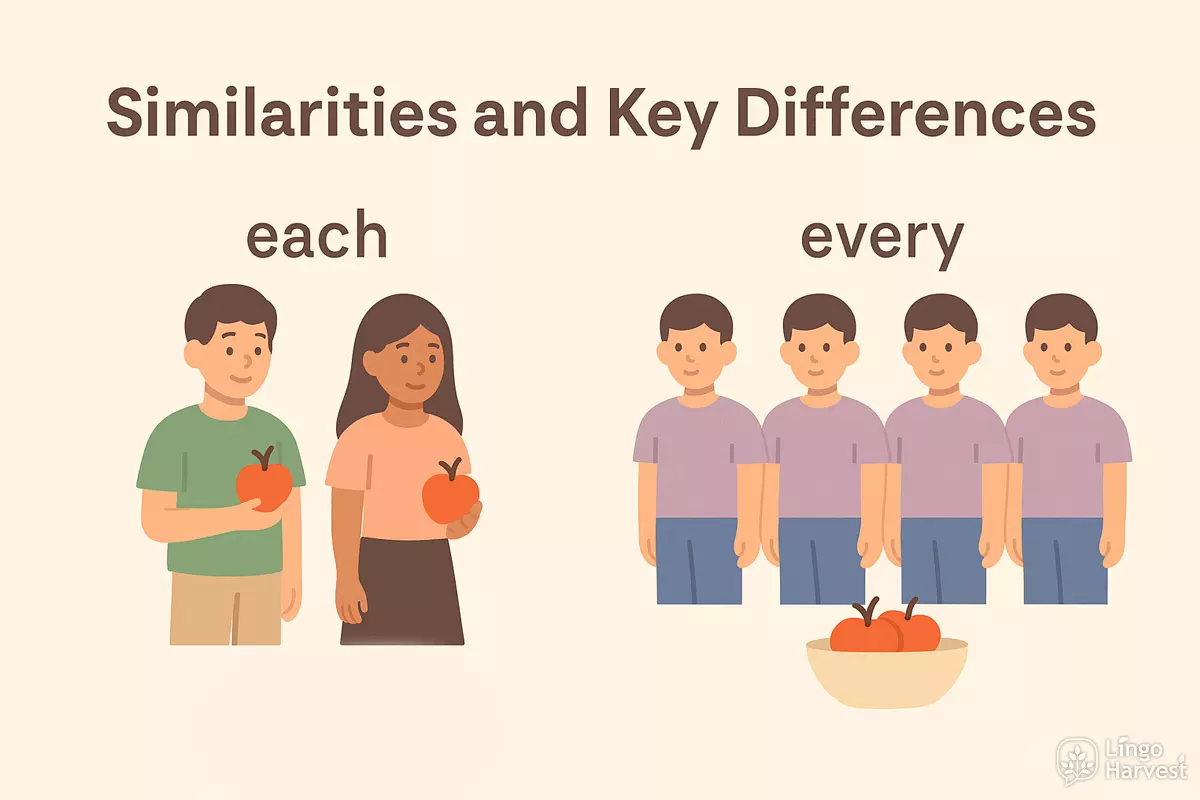
Understanding how "each" and "every" work can help make your English sound more natural and precise. Both words are used to talk about all the members of a group, but the way they focus on individuals versus the group as a whole is a major distinction.
What They Have in Common
Both "each" and "every" refer to all items in a group:
- Used with singular nouns to indicate all members are included.
- Can describe habits, routines, or repeated events.
- Appear before a singular countable noun (e.g., each student, every day).
- Often used in statements that generalize or describe patterns.
How They Differ
While "each" and "every" share some uses, their differences affect meaning and sentence structure:
- "Each" emphasizes individual members, one by one.
- "Every" focuses on the group as a whole, treating all members as a collective.
- "Each" can be used with small groups (sometimes just two); "every" is only used for groups of three or more.
- "Each" can stand alone (as a pronoun): "Each was given a prize." "Every" cannot.
- "Each of" is followed by plural nouns ("each of the players"); "every of" is not correct.
- Sometimes "every" suggests regularity or repetition ("every Monday"), while "each" does not always carry this sense.
Quick Comparison Table
| Usage | "Each" | "Every" |
|---|---|---|
| Focus | Individual members | The group as a whole |
| Minimum number | Two or more | Three or more |
| Can be a pronoun? | Yes ("Each was...") | No |
| Use with "of" + plural? | Yes ("each of the...") | No |
| Used for repeated events? | Sometimes | Often ("every day") |
Sample Sentences
- Each student received a certificate. ✅
- Every student received a certificate. ✅
- Each of the apples is ripe. ✅
- Every of the apples is ripe. ❌
- Each was given a task. ✅
- Every was given a task. ❌
- I go jogging every morning. ✅
- Each morning was different. ✅
- Each team has a different color. ✅
- Every team has a different color. ✅
- Each and every detail matters. ✅ (for emphasis)
Singular Verb Agreement
When using "each" or "every" as subjects, it’s important to remember they always take a singular verb form—even if the noun they refer to is plural. This is because these words emphasize individual items within a group, not the group as a whole. For instance, you would say, "Each student receives a certificate," not "Each student receive a certificate." The same applies to "every": "Every car needs maintenance," not "Every car need maintenance."
Common Patterns with "Each" and "Every"
You’ll often see these words followed by a singular countable noun and then a singular verb. Here are some typical uses:
- Each child gets a gift.
- Every answer matters.
- Each dog has its own collar.
- Every country follows its own laws.
- Each person is responsible for their ticket.
- Every room in the hotel is clean.
- Each apple was washed.
- Every student is welcome.
- Each player tries hard.
- Every idea counts.
- Each book belongs on a shelf.
- Every train arrives on time.
- Each question was answered.
- Every opportunity is important.
- Each key opens a door.
Why the Verb Must Be Singular
Both "each" and "every" focus on individuals one by one, not as a collective. That's why a verb in the singular form matches best: it treats each member as a separate entity within the set. This rule holds true regardless of how many people or things are involved.
Quick Reference: Correct and Incorrect Forms
| ✅ Correct Usage | ❌ Incorrect Usage |
|---|---|
| Each student is present. | Each student are present. |
| Every book belongs to the library. | Every book belong to the library. |
| Each answer matters. | Each answer matter. |
| Every child needs attention. | Every child need attention. |
Pay attention to this rule in both writing and speaking. Even advanced learners sometimes slip up and use plural verbs with "each" or "every," especially when the noun is plural. Keeping the verb singular will make your English sound more natural and accurate.
Time Expressions (every day, each day)
When talking about routines or habits, English speakers often use "every day" and "each day" to show how often something happens. Both phrases refer to something happening daily, but there are subtle differences in their use and tone.
When to Use "Every Day"
"Every day" is the most common way to talk about daily activities. It emphasizes the regularity and the idea that something happens on all days within a period. For example, "I go for a walk every day" means the action happens on all days, without exception.
When to Use "Each Day"
"Each day" can be used similarly, but it often focuses more on individual days, sometimes highlighting them as separate or distinct. For instance, "Each day brings a new challenge" suggests that every single day is unique in some way.
Common Patterns and Examples
Here are some typical ways to use these expressions in sentences:
- I drink coffee every day.
- She takes her medicine each day at 8 a.m.
- They exercise every day after work.
- Each day, the sun rises a little earlier.
- We check our mailbox every day.
- He learns something new each day.
- I write in my journal every day.
- Each day, she calls her grandmother.
- Our dog gets a treat every day.
- Each day brings new opportunities.
- Every day, the train arrives on time.
- Each day is a fresh start.
Comparing "Every Day" and "Each Day"
While both phrases can often be used interchangeably, "every day" is more neutral and common in most contexts. "Each day" can sound a bit more formal or poetic, especially when emphasizing individual days.
| Phrase | Typical Use |
|---|---|
| Every day | General routines, habits, schedules (e.g. "She jogs every day.") |
| Each day | Highlighting separate days, uniqueness, or formal style (e.g. "Each day offers something new.") |
Quick Tips
- Use "every day" for most daily actions and routines.
- Choose "each day" to stress the individuality or importance of the days.
- Both forms are grammatically correct, but "every day" is preferred in casual speech.
With Of + Pronouns/Determiners
When using "each" and "every," there’s a clear difference in how they combine with "of" plus pronouns or determiners (such as my, these, them, us, etc.). This is an area where English learners often make mistakes, so let’s clarify how these structures work.
Using "Each of" Correctly
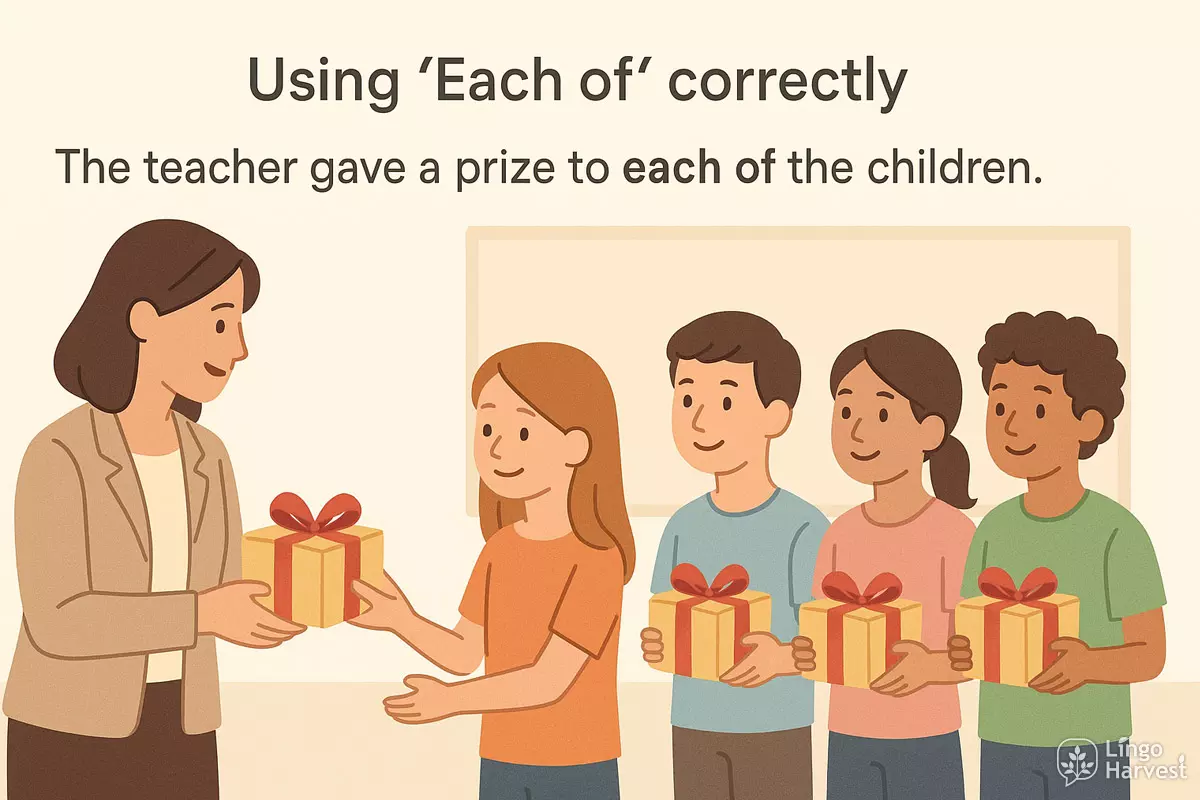
"Each" can be followed by "of" and then a pronoun or determiner. This structure helps to single out individual items or people from a specific group. For example, you can say "each of them," "each of the students," or "each of my friends." This is very common and always correct.
- Each of us needs to bring our own lunch.
- I spoke to each of the participants separately.
- Each of these apples looks delicious.
- The teacher gave a prize to each of the children.
- She checked each of her emails carefully.
- Each of those books is interesting.
- Each of their answers was different.
- Each of my colleagues received an invitation.
- They handed out forms to each of you.
- Each of the winners will receive a certificate.
Why "Every of" Is Incorrect
Unlike "each," "every" does not work with "of" plus pronouns or determiners. You cannot say "every of them" or "every of my friends." This is always incorrect in standard English. Instead, use "every" directly before a singular noun: "every student," "every apple," "every answer." If you want to use a phrase like "every one of…", that’s a different structure, and "one" becomes the subject.
| Correct Form | Incorrect Form |
|---|---|
| Each of us | Every of us ❌ |
| Each of the students | Every of the students ❌ |
| Each of my friends | Every of my friends ❌ |
| Every student | Each student of ❌ (incorrect word order) |
| Every apple | Every of these apples ❌ |
Quick Tips
- Use "each of" with plural pronouns or determiners (them, us, my, these, those, etc.).
- Never use "every of" directly; it’s always wrong.
- For general groups, use "every" before a singular noun ("every child").
- To emphasize individuals within a group, use "each of" plus the group ("each of the children").
Understanding these patterns will help you avoid common mistakes and make your English sound more natural.
Set Phrases and Exceptions
Some uses of "each" and "every" don’t follow the typical rules. In fixed expressions, idioms, or certain grammatical structures, only one word is correct—even if the other might seem possible. Knowing these exceptions helps you sound more natural and avoid common mistakes.
Common Set Expressions
English includes many standard phrases where only "each" or "every" is accepted. Here are some of the most frequent patterns:
- every now and then (not each now and then)
- every other day (meaning "every second day")
- every single time
- each and every (used together for emphasis)
- each one (refers to individual items from a group)
- to each his own (idiom: everyone has their preferences)
- every so often
- each time (not every time in some contexts, e.g., "Each time I called, he answered.")
- every day (not each day in routine contexts: "I go to work every day.")
- each of them (used before plural pronouns: "each of us")
- everybody / everyone (these are set forms; not eachbody or eachone)
- everywhere (not eachwhere)
- every so often (for occasional repetition)
- each way (especially in British English betting: "I placed an each way bet.")
- every which way (idiom: in all directions)
- every once in a while
- each to their own (similar to "to each his own")
Special Grammatical Cases
Sometimes, the choice depends on grammar rather than meaning. For example, "each" can be used with "of" and plural nouns or pronouns ("each of the students"), but "every" cannot ("every of the students" ❌ is incorrect). Also, "every" is typically used before singular countable nouns, while "each" may be used for emphasis or to highlight individuality.
Summary Table: Typical Patterns
| Phrase or Structure | Correct Form |
|---|---|
| Referring to two people/things | "each" is preferred (Each student received a certificate.) |
| Emphasizing the group as a whole | "every" is used (Every child in the class passed.) |
| Before plural pronouns/nouns with "of" | Only "each of" is correct (each of them) |
| Set idiomatic phrases | Memorize as fixed expressions (see list above) |
Understanding these fixed phrases and exceptions will help you avoid awkward mistakes and choose the most natural-sounding option in everyday English.
Learner Pitfalls and Fixes
Understanding the difference between “each” and “every” can trip up even advanced English learners. Most mistakes happen because these words seem similar, but their use in sentences isn’t always interchangeable. Below, you’ll find the most common stumbling blocks and practical ways to avoid them.
Common Confusions and How to Avoid Them
- Mixing up singular and plural verbs: Both “each” and “every” require singular verbs. For example, say “Each student is ready,” not “Each student are ready.”
- Using with plural nouns: “Each” and “every” should be followed by a singular noun: “every book,” not “every books.”
- Forgetting about exceptions: “Each” can sometimes be used with plural nouns when followed by “of.” Example: “Each of the students was present.”
- Interchanging meanings: “Each” often emphasizes individuals in a group, while “every” refers to the group as a whole. Don’t use “every” when you want to highlight individual attention.
- Incorrect with 'of the': Use “each of the” but not “every of the.” For example, “Each of the apples is ripe,” ❌ “Every of the apples is ripe.”
- Misusing with time expressions: “Every” is standard with repeated events (“every day,” “every Monday”), while “each” sounds odd: ❌ “Each day I go to work” is less common than “Every day I go to work.”
- Confusing with “all”: “All” is used for the whole group (often with plural nouns), while “each” and “every” focus on individuals or frequency.
- Forgetting about “each one” and “every one”: “Each one” refers to individual items; “every one” can sometimes mean all people/things in a group, but usage is less frequent.
- Double negatives: Don’t use “not each” or “not every” when “none” or “no” makes more sense.
- Using numbers: “Each” can be used with numbers (“each of the three”), but “every” can’t: ❌ “every of the three.”
Quick Reference: Usage Patterns
| Mistake | Correction & Explanation |
|---|---|
| Each students are ready. ❌ | Each student is ready. Use singular noun + singular verb. |
| Every of the books is new. ❌ | Each of the books is new. “Every of the” is incorrect; use “each of the.” |
| Every three days, I exercise. ✅ | This is correct. “Every + number + plural noun” expresses frequency. |
| Each of the three cats are sleeping. ❌ | Each of the three cats is sleeping. Still takes singular verb. |
| All student is present. ❌ | All students are present. “All” uses plural noun and verb. |
| Every child and adult was invited. ✅ | This is correct. “Every” used with two singular nouns joined by “and.” |
| Each Monday, we meet. ✅ | This is correct. “Each” can be used with time expressions, but “every Monday” is more common. |
| Every of them finished the race. ❌ | Each of them finished the race. Use “each of” with pronouns, not “every of.” |
| Every people in the room stood up. ❌ | Every person in the room stood up. Use singular noun after “every.” |
| Each one is important. ✅ | This is correct. “Each one” emphasizes individuality. |
Tips for Mastery
- When in doubt, check if the noun after “each” or “every” should be singular.
- Remember: “each of the…” is valid, but “every of the…” isn’t.
- For frequency or regularity, “every” is usually best (“every week,” “every five minutes”).
- Use “each” when you want to highlight the individual members of a group.
- Review example sentences aloud to get a feel for natural usage.
With regular practice and attention to these patterns, learners can sidestep the most frequent errors and use both forms with confidence.
Practice: Replace and Explain Choice
Understanding when to use "each" or "every" is easier with practical exercises. Below, you'll find example sentences where you need to choose the correct word and explain your reasoning. This helps reinforce the difference between the two and builds confidence in real communication.
Choose the Correct Word
For each sentence, decide if "each" or "every" fits best. Then, briefly explain your choice.
- _______ student in the class must submit their assignment by Friday.
- She gave a gift to _______ of her friends at the party.
- We have meetings _______ Monday morning.
- The coach spoke to _______ player individually after the game.
- _______ time I call, you are busy!
- There are two doors. Please check _______ one before you leave.
- He reads _______ book on the list before the end of the year.
- The instructions are the same for _______ participant.
- _______ of the twins has a different hobby.
- She waters the plants _______ day.
Show answers
- Every student in the class must submit their assignment by Friday.
Explanation: "Every" is used because we refer to all students as a group. - Each of her friends at the party.
Explanation: "Each" emphasizes individual friends separately. - Every Monday morning.
Explanation: "Every" fits with repeated regular events. - Each player individually.
Explanation: "Each" highlights separate attention to individuals. - Every time I call, you are busy!
Explanation: "Every" is used for repeated events or occasions. - Each one before you leave.
Explanation: "Each" is appropriate for a small, countable number (two doors). - Every book on the list.
Explanation: "Every" is used for all items in a group, especially with longer lists. - Every participant.
Explanation: "Every" indicates the statement applies to all participants as a group. - Each of the twins.
Explanation: "Each" works with two people/things. - Every day.
Explanation: "Every" is used with regular time expressions.
Quick Reference: When to Use "Each" or "Every"
- "Each" — focuses on individuals, often with two or more items, sometimes used for smaller groups.
- "Every" — refers to all members of a group collectively, especially with larger numbers or repeated time expressions.
Common Examples: "Each" vs "Every" in Sentences
- Each child received a balloon.
- Every child loves ice cream.
- Each ticket is valid for one entry.
- Every ticket was sold out.
- Each hand has five fingers.
- Every week, we go shopping.
- Each answer was checked carefully.
- Every answer was correct.
- Each of the cookies is homemade.
- Every cookie disappeared quickly.
- Each side of the square is equal.
- Every side of the argument was discussed.
Try making your own sentences using both words to strengthen your understanding. If you’re unsure, remember: use "each" for individual focus, and "every" for group or repeated events.